‘Adapt or die’- SEC approves Nasdaq plan to trade tokenized securities

ambcrypto2026-03-19 tarihinde yayınlandı2026-03-19 tarihinde güncellendi

Özet

The SEC has approved Nasdaq's pilot program to trade tokenized securities, allowing the exchange to test blockchain-based versions of stocks and ETFs on a unified platform. The program will initially include high-volume assets like those in the Russell 1000 Index and major ETFs. Unlike many existing tokenized products, Nasdaq’s tokens will grant holders the same legal rights as traditional shareholders, including the same CUSIP numbers and trading symbols. This move is seen as a major disruptive force in asset management, with experts comparing its potential impact to that of ETFs on mutual funds. The approval accelerates Nasdaq’s partnership with Kraken and aims to enable 24/7 trading and attract offshore investors. The tokenized securities market has already surpassed $1 billion, with significant growth in early 2026.

New York-based Nasdaq Exchange has gotten the green light to proceed with its pilot program for trading tokenized securities.

The SEC approval would allow the traditional exchange to test trading of the blockchain-based version of stocks under its Depository Trust Company (DTC) pilot program.

Both traditional stocks and these tokenized variants will trade on the same unified platform. The program will initially target high-volume ETFs and stocks.

This would include the constituents of the Russell 1000 Index (Apple, Microsoft, Nvidia, Amazon, etc.). Additionally, ETFs such as the S&P 500 and the Nasdaq-100 will fall within the early asset scope.

Community reactions

For ETF analyst Nate Geraci, the SEC approval would set the stage for a massive disruption by the tokenization boom.

For him, the writing is on the wall: the top regulator, the SEC, major exchanges (Nasdaq, NYSE), and the world’s largest asset managers (BlackRock and Fidelity) are all in on tokenization.

He added,

Tokenization will be as disruptive to asset management as ETFs were to mutual funds...Will basically be adapt or die a slow death.

Nasdaq initially sought SEC approval for tokenized stocks in September 2025. But its proposal was wholly different from the current tokenized securities on the market, such as xStocks offered by Kraken and Backed Finance.

Unlike most current offerings, including leveraged derivatives that grant holders no legal rights, Nasdaq pushed for its tokenized securities to have rights similar to those of investors holding traditional shares. And the SEC acknowledged this.

A tokenized share of a DTC Eligible Security must be fungible with, share the same CUSIP number and trading symbol with, and afford its shareholders the same rights and privileges as a share of an equivalent class of the traditional security for it to trade on Nasdaq.

Nasdaq’s tokenization plans

That said, the SEC’s green light will accelerate Nasdaq’s recent partnership with Kraken to distribute tokenized securities by xStocks.

This integration may likely be tied to the DTC pilot and eventually accord xStock holders similar legal rights as traditional shareholders.

The end goal? Ensure 24/7 trading and target large offshore users to gain access to the U.S. equity market.

And the appetite for these products is incredible. So far, the tokenized segment has crossed $1B, and over $300 million of the market cap was added in Q1 2026 alone.
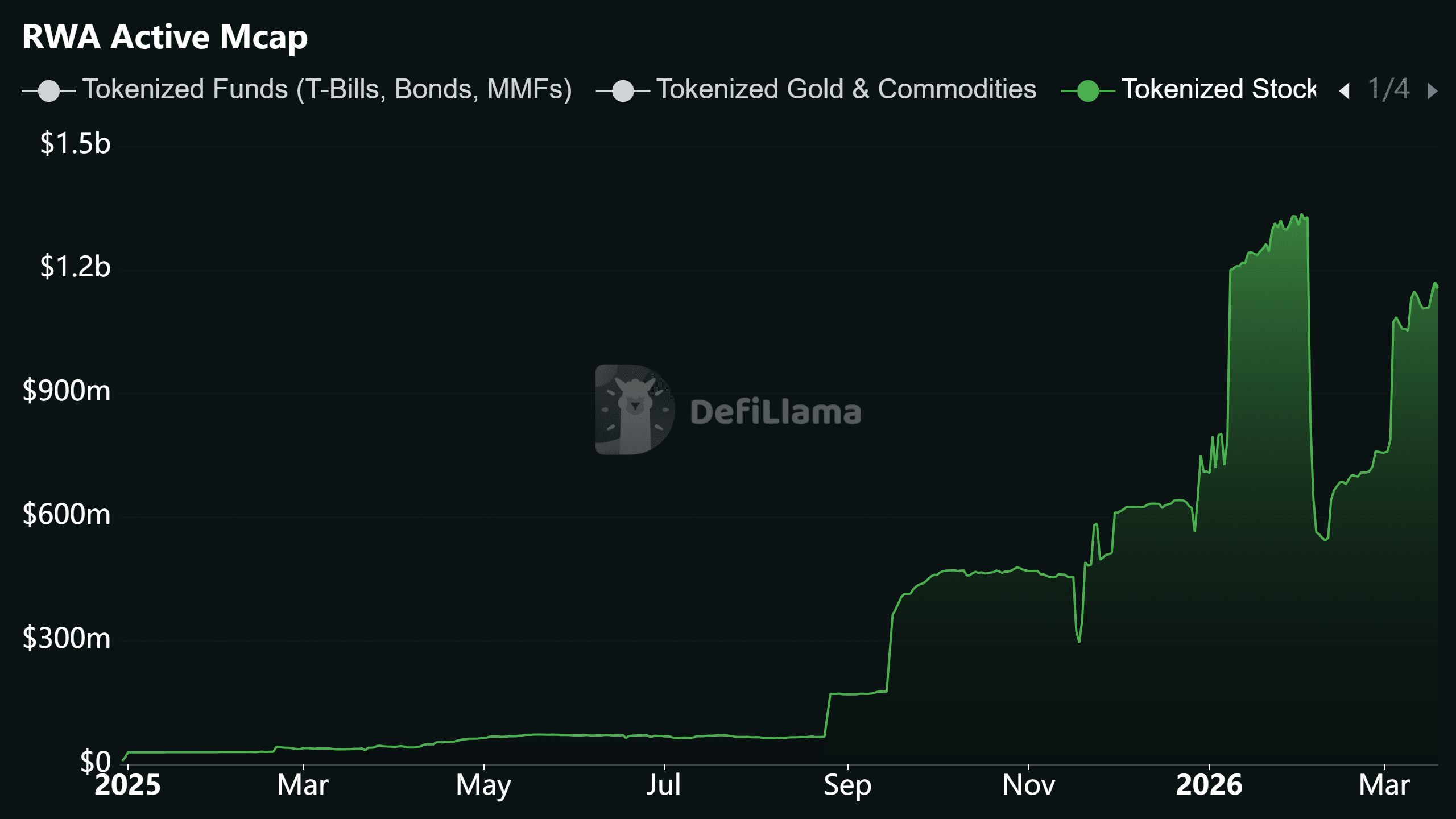
Source: DeFiLlama

Final Summary

  • The approval of Nasdaq’s tokenized securities trading is a major unfolding disruption that would force other traditional players to pivot, per an ETF expert.
  • SEC clarified that Nasdaq’s tokenized stocks and ETFs will offer similar rights as traditional securities.


İlgili Sorular

QWhat is the significance of the SEC's approval for Nasdaq's pilot program?

AThe SEC's approval allows Nasdaq to proceed with its pilot program for trading tokenized securities, which are blockchain-based versions of stocks. This program will enable both traditional stocks and their tokenized variants to trade on the same unified platform, initially targeting high-volume ETFs and stocks like those in the Russell 1000 Index and major ETFs such as the S&P 500 and Nasdaq-100.

QAccording to ETF analyst Nate Geraci, how disruptive will tokenization be to asset management?

ANate Geraci believes tokenization will be as disruptive to asset management as ETFs were to mutual funds. He stated that it will force traditional players to 'adapt or die a slow death,' indicating a significant transformation in the industry.

QHow do Nasdaq's tokenized securities differ from current offerings like xStocks from Kraken and Backed Finance?

AUnlike current offerings such as leveraged derivatives that grant holders no legal rights, Nasdaq's tokenized securities are designed to have rights similar to those of investors holding traditional shares. The SEC requires that tokenized shares must be fungible, share the same CUSIP number and trading symbol, and afford shareholders the same rights and privileges as traditional securities.

QWhat is the end goal of Nasdaq's tokenization plans, as mentioned in the article?

AThe end goal of Nasdaq's tokenization plans is to ensure 24/7 trading and target large offshore users to gain access to the U.S. equity market. This initiative aims to expand market accessibility and provide continuous trading opportunities.

QWhat is the current market size of the tokenized segment, and how much growth was seen in Q1 2026?

AThe tokenized segment has crossed $1 billion in market size. In Q1 2026 alone, over $300 million in market capitalization was added, indicating significant growth and appetite for these products.

İlgili Okumalar

Within Strategy's Framework, STRC's Dividend Yield Remains at 12% as Share Price Stays Below Par Value

Michael Saylor, Executive Chairman of Strategy (MSTR), confirmed that the dividend rate for its STRC perpetual preferred shares will remain at 12.00% through August 2026. The rate has increased from 9% at its July 2025 launch to the current high via a "ratchet" mechanism, which permanently raises the rate by 0.5% whenever the share price falls below $95. This mechanism is intended to push the price back toward its $100 par value and support Strategy's "at-the-market" (ATM) program for issuing new shares to fund Bitcoin purchases. However, the mechanism has not worked as intended. STRC shares closed at $89.46 on July 31, remaining about 10-11% below par value despite the record-high dividend. Competition from rival Strive's higher-yielding SATA securities has pressured demand. The persistent discount has forced Strategy to suspend new STRC issuances via its ATM program, limiting this funding channel for Bitcoin acquisitions. STRC's struggles reflect Bitcoin's own volatility, as the preferred shares historically move in tandem. Analysts have warned the ratchet structure carries long-term, one-way risk. A law firm is investigating Strategy's ability to maintain dividend payments if Bitcoin's price stays low. Retail investors own roughly 83% of outstanding STRC shares, a group seen as prone to panic selling during downturns. In response, Strategy has established financial reserves, including a liquidity cushion covering about 26 months of dividend/interest obligations, and a $2 billion share buyback program alongside a Bitcoin monetization framework, though the company emphasized it is not obligated to sell any Bitcoin.

cryptonews.ru3 dk önce

Within Strategy's Framework, STRC's Dividend Yield Remains at 12% as Share Price Stays Below Par Value

cryptonews.ru3 dk önce

Analyst: Bitcoin's Price Will Drop to $60k in August, Then Rebound to $70k

Financial analyst Andrey Poroshin has provided a new forecast for Bitcoin's price dynamics in August. Poroshin, an analyst at the Bitbanker exchange, expects the cryptocurrency market to experience a downturn this month, with prices retesting the $60,000 level due to a lack of supportive macroeconomic catalysts. He noted that the recent US Federal Reserve decision to hold interest rates did not significantly impact the market, while inflation remains above the 2% target. Poroshin stated that Bitcoin is ending July under pressure from moderate volatility and a lack of new macroeconomic stimuli, leading to continued market caution. According to his base scenario, Bitcoin will drop to a range of $60,000 to $62,000 before recovering to $70,000. He pointed out that even $70,000 remains below the cost of mining in the US, which has prompted some miners to shift towards AI data center operations. Poroshin cited the winding down of BitMEX's operations as a potential catalyst for a price rebound, suggesting the exit of weaker players often coincides with market reversals and reduced short-term selling pressure. He believes Bitcoin is currently less susceptible to geopolitical shocks, such as the Iran-US conflict, and does not expect significant market changes in August related to the pending CLARITY Act. Looking ahead, Poroshin forecasts that September will bring more active price fluctuations driven by potential Fed rate decisions and possible discussions or approval of the CLARITY Act.

cryptonews.ru3 dk önce

Analyst: Bitcoin's Price Will Drop to $60k in August, Then Rebound to $70k

cryptonews.ru3 dk önce

In Jinjiang, Fujian, a Storage Super Unicorn Lies Quiet

In Fujian's Jinjiang, a city known for sportswear, lies a quiet semiconductor giant: Fujian Jinhua Integrated Circuit Co. (JHICC). Once a promising domestic DRAM manufacturer alongside Yangtze Memory and ChangXin Memory Technologies (CXMT), its journey was derailed in 2018 when the U.S. placed it on an Entity List and filed criminal charges for alleged trade secret theft. This halted production for years. A turning point came in February 2024 when a U.S. federal court found JHICC not guilty. However, it had lost crucial time. While CXMT soared to become a top-valued A-share company in 2024, JHICC, with an estimated valuation of 80 billion RMB, was just restarting. Its current output is primarily customized DDR4 chips, not the advanced DDR5/HBM demanded for AI, but it still benefits from the broader memory chip upcycle. JHICC's story is tied to Chen Zhengkun, a veteran engineer who left Micron to lead the venture. Founded in 2016 with state-backed funding, JHICC partnered with Taiwan's UMC to develop DRAM technology. Rapid progress was cut short by the U.S. actions, which Micron initiated, partly due to its heavy reliance on the Chinese market. Post-sanctions, Chen's team worked to rebuild the production line with reduced reliance on U.S. technology. According to its records, JHICC achieved small-scale production and revenue growth under immense pressure. It now focuses on the stable "niche" DRAM market (e.g., TVs, routers) with a monthly capacity of ~40,000 wafers, aiming for 60,000 by 2026. It holds over 1,000 patents but remains on the Entity List. For Jinjiang, investing in JHICC was a bold industrial leap. The local government provided unwavering financial and logistical support during the crisis, helping the company survive. JHICC has become the anchor for a growing local semiconductor cluster. Though its scale lags behind domestic peers, JHICC's persistence symbolizes a hard-won foothold in a global market long dominated by Samsung, SK Hynix, and Micron. Having missed one boom, it seeks a place in the new AI-driven memory supercycle.

marsbit2 saat önce

In Jinjiang, Fujian, a Storage Super Unicorn Lies Quiet

marsbit2 saat önce

İşlemler

Spot
活动图片




