Adam Back slams Bitcoiner VC for ‘uninformed noise’ about quantum risk

cointelegraph2025-12-20 tarihinde yayınlandı2025-12-20 tarihinde güncellendi

Özet

Blockstream CEO Adam Back criticized Castle Island Ventures' Nic Carter for amplifying concerns about quantum computing threats to Bitcoin, calling it "uninformed noise." Carter defended his firm's investment in quantum-resistant startup Project Eleven, stating he was "quantum pilled" and believes Bitcoin is vulnerable. He argues governments are preparing for quantum risks and Bitcoin is a "bug bounty" for quantum attacks. While some, like Capriole Investments' Charles Edwards, warn the threat could emerge in 2-9 years, Back contends quantum technology is still decades away from being a real threat. Others, like Kevin O’Leary, doubt attacking Bitcoin would be a practical use of quantum computing.

Blockstream CEO Adam Back has criticized Castle Island Ventures founding partner Nic Carter for amplifying concerns about quantum computing threats to Bitcoin.

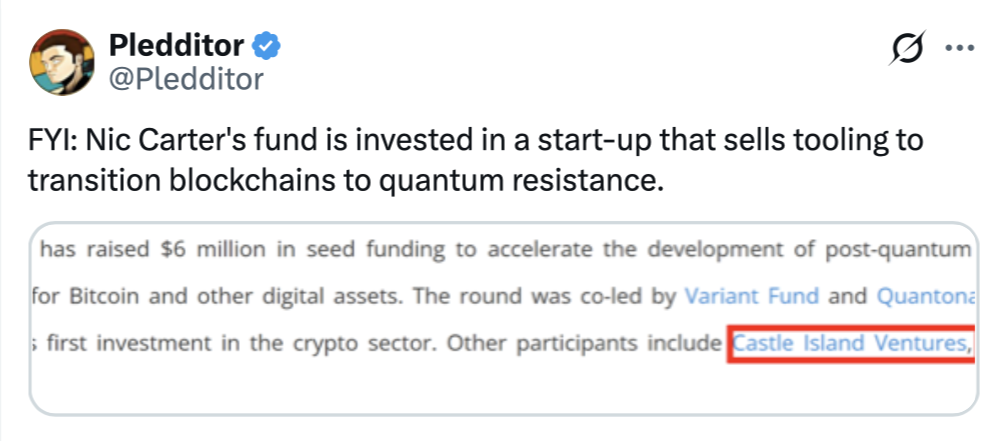
“You make uninformed noise and try to move the market or something. You’re not helping,” Back said in an X post on Friday, after Carter explained in an X post why Castle Island Ventures invested in Project Eleven, a startup focused on protecting Bitcoin and other crypto assets from the threat of quantum computing.

Back said the Bitcoin community is not in denial about the need to research and develop protections against potential quantum computing threats, but is instead doing that work “quietly.” However, Carter refuted Back’s comment, arguing that many Bitcoin developers are still in “total denial” about the risk of quantum computing to Bitcoin.
Source: Pledditor

While Castle Island Ventures’ investment only recently resurfaced on social media within the Bitcoin community, Carter first disclosed it in a Substack post on Oct. 20. “I disclosed this in the first sentence of my main article on quantum. Can’t get more transparent than that,” Carter said.

Carter says he was “quantum pilled”

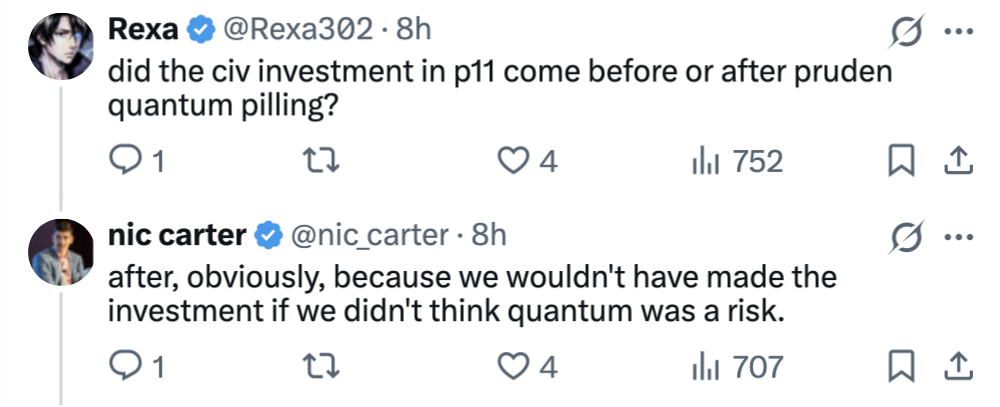
Carter said that he invested in the project because Project Eleven CEO Alex Pruden “quantum pilled” him. “I became extremely concerned about quantum threats to blockchains. I put capital behind my convictions, always have,” he said.
Source: Nic Carter

“I knew the bad faith criticisms would come, so I made absolutely sure to be crystal clear about my financial exposure here,” Carter added.

Carter raised several points why quantum computing poses a risk to Bitcoin, including governments planning for a post-quantum world, Bitcoin itself being “a bug bounty” for quantum supremacy, and the increasing amount of investment in quantum firms.

Carter isn’t the only prominent Bitcoin figure to have recently stepped up public warnings about the potential quantum computing threat to Bitcoin.

Some warn the threat could emerge in as little as two years

Capriole Investments founder Charles Edwards warned in a post on X on Thursday that quantum computing could pose a genuine threat to Bitcoin within the next two to nine years unless the network upgrades to quantum-resistant cryptography.

However, others are less concerned.

Related: Anxiety of quantum risk to Bitcoin is weighing on its price: Execs

Multimillionaire entrepreneur Kevin O’Leary recently told Cointelegraph Magazine that using quantum computing to break Bitcoin’s security wouldn’t be the most effective use of the technology, arguing it would be far more valuable in areas like AI-driven medical research.

Meanwhile, Back recently said it is good for Bitcoin to be “quantum ready,” but it won’t be a threat for the next few decades, as the technology is still “ridiculously early,” and has research and development issues.

Magazine: Big questions: Would Bitcoin survive a 10-year power outage?

İlgili Sorular

QWhat is Adam Back's criticism of Nic Carter regarding quantum computing threats to Bitcoin?

AAdam Back criticized Nic Carter for making 'uninformed noise' and trying to move the market, arguing that the Bitcoin community is already working 'quietly' on quantum protections rather than being in denial.

QWhy did Nic Carter invest in Project Eleven?

ANic Carter invested in Project Eleven because its CEO Alex Pruden 'quantum pilled' him, making him extremely concerned about quantum threats to blockchains, and he wanted to put capital behind his convictions.

QWhat are some reasons Carter believes quantum computing poses a risk to Bitcoin?

ACarter cited governments planning for a post-quantum world, Bitcoin being 'a bug bounty' for quantum supremacy, and increasing investments in quantum firms as reasons for the risk.

QHow soon does Charles Edwards believe quantum computing could threaten Bitcoin?

ACharles Edwards warned that quantum computing could pose a genuine threat to Bitcoin within the next two to nine years unless the network upgrades to quantum-resistant cryptography.

QWhat is Adam Back's timeline for when quantum computing might become a threat to Bitcoin?

AAdam Back stated that quantum computing won't be a threat to Bitcoin for the next few decades, as the technology is still 'ridiculously early' and has research and development issues.

İlgili Okumalar

Kicked Out of PayPal, Musk Aims for a Comeback in the Crypto Market

Elon Musk's X (formerly Twitter) has launched its "Smart Cashtags" feature, generating approximately $1 billion in trading volume within days of its April 2026 pilot launch. The feature allows users to click on stock or crypto tickers (or even full Solana token contract addresses) in posts to view real-time price charts and discussions without leaving the app. Initially available to iPhone users in the US and Canada, with a partnership in Canada enabling direct trading via the Wealthsimple app. This move is part of Musk's broader "Everything App" vision, spearheaded by the upcoming X Money platform. Analysts, such as Mizuho's Dan Dolev, see this as a potential disruptor to the US payments market, even prompting a downgrade of PayPal's stock. X Money's beta offers services like 6% APY on deposits, cashback, and P2P transfers, with speculation it may later incorporate crypto trading and stablecoin settlements for faster transactions. However, the ambitious plan faces significant regulatory scrutiny. Senator Elizabeth Warren has questioned the sustainability of the high 6% yield and raised concerns over X's banking partner, Cross River Bank, which has a history of regulatory violations. Additional risks involve the "GENIUS Act," which may create loopholes for stablecoin issuance without full FDIC insurance coverage, potentially leaving users unprotected. The integration of social trading on a platform with over 500 million users could inject new liquidity and retail interest into the crypto market. Yet, it also amplifies risks like herd mentality and the blurring of lines between entertainment and financial speculation. Musk's return to finance, after his ouster from PayPal, hinges on balancing innovation with regulatory compliance.

marsbit39 dk önce

Kicked Out of PayPal, Musk Aims for a Comeback in the Crypto Market

marsbit39 dk önce

İşlemler

Spot
Futures
活动图片