a16z, The Biggest Donor Behind the US Midterm Elections

marsbit2026-05-14 tarihinde yayınlandı2026-05-14 tarihinde güncellendi

Özet

Theodore Schleifer reports for The York Times that the venture capital firm Andreessen Horowitz (a16z), along with its founders Marc Andreessen and Ben Horowitz, has become the single largest donor in the current U.S. midterm election cycle, contributing over $115 million in political funds. This massive expenditure, far exceeding the $63 million from the 2024 cycle, marks a significant shift in political funding from individual billionaires to corporate entities. A16z’s strategy involves long-term political engagement. Immediately after the 2024 election, it injected over $23 million into key crypto-focused Super PACs. Its funding is now channeled through a bipartisan network supporting its core business interests: $47.5 million to the crypto Super PAC Fairshake and $50 million to Leading the Future, a new Super PAC promoting pro-artificial intelligence candidates. The firm and its founders have also donated $12 million to a pro-Trump Super PAC. This political push is closely tied to a16z's commercial stakes in crypto and AI and reflects founders’ evolving political views, particularly Andreessen’s shift toward conservative circles. His access has grown, including an advisory role during Trump’s transition and a seat on a White House tech council. The firm’s activism has sparked internal dissent and external backlash. Critics, including progressive Democrats and some Republicans, argue it represents an attempt to buy political influence. In response, a rival "Public First...

By:Theodore Schleifer, The New York Times

Compiled by:Luffy, Forsight News

The biggest donor in this round of US midterm elections is not Elon Musk, George Soros, nor any other billionaire with the deepest pockets in politics.

The actual top donor is a venture capital firm: Andreessen Horowitz (a16z).
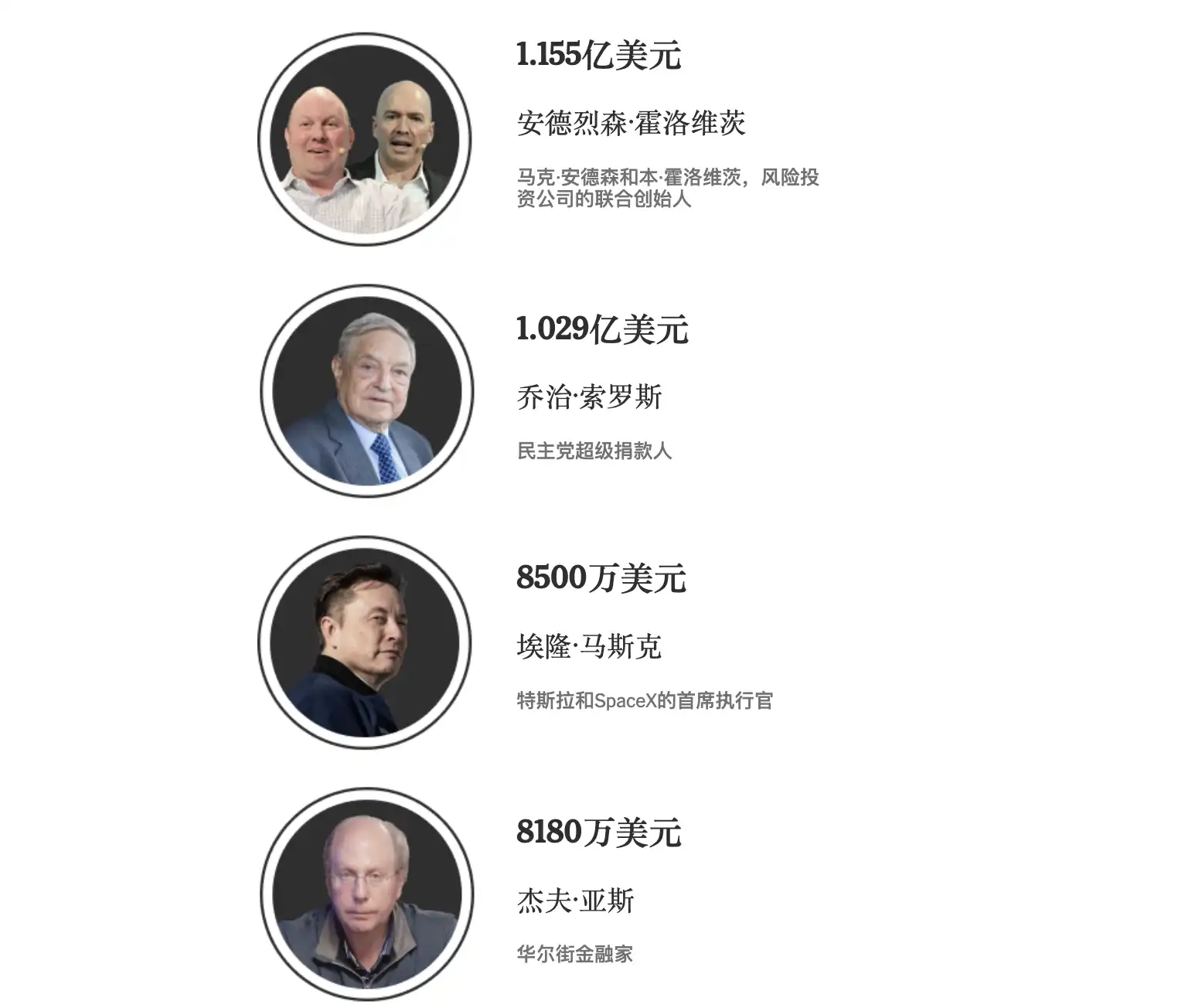
Top donors in the current midterm election cycle, data source: Federal Election Commission, The New York Times

Analysis by The New York Times shows that this Silicon Valley venture capital firm, together with its founding partners Marc Andreessen and Ben Horowitz, has already donated over $115 million in political contributions for midterm election-related activities, making it the single largest known donor in this election cycle.

a16z's involvement in politics is not new; the two founders themselves are seasoned political donors worth tens of billions. However, the scale of donations this cycle far exceeds the approximately $63 million spent during the 2024 election cycle. This top-tier investment firm is now investing in politics with unprecedented intensity, attempting to leverage policy directions to align with its commercial interests.

Following the last presidential election, a16z established a posture of long-term political engagement. Conventionally, the day after a major election ends (with two years left until the next significant election) is not the time for massive donations. But on November 6, 2024, a16z injected over $23 million in a single day into two key crypto industry Super PACs (Political Action Committees), sending a clear signal: its political strategy is a long-term plan, not a fleeting trend.

a16z declined to comment on media interview requests and did not arrange for interviews with the two founders.

A few days later, Andreessen stated bluntly in an election recap podcast, "My conclusion is that we have to treat political participation as a permanent mission." "Sometimes circumstances allow us to go with the flow, other times we must fight with all our might. But regardless of whether it's smooth sailing or an uphill battle, we need to be deeply involved throughout the entire process."

The massive political contributions from venture capital firms also reflect a significant shift in the US political landscape. In this midterm election, the top donor force has shifted from individual billionaires to corporate entities like a16z. Critics argue that large-scale institutional money entering the fray could hijack the electoral process, solely for their own commercial gain.

Since the 2024 presidential election, a16z has contributed $47.5 million to the crypto industry Super PAC network Fairshake. Its strategy has also extended beyond the crypto sector: following the Fairshake model, it took the lead in establishing the Super PAC Leading the Future, focused on supporting pro-artificial intelligence (AI) candidates, and invested $50 million. Both Fairshake and Leading the Future adopt a bipartisan strategy, funding both Republican and Democratic candidates.

Additionally, a16z and its two founders collectively donated $12 million to the Trump-aligned Super PAC MAGA Inc., including a single $6 million donation in March. In the same month, a trust fund linked to Andreessen also donated nearly $900,000 to the Republican National Committee.

This series of political investments has also helped Marc Andreessen build close connections with the Trump administration.

A chart showing the dramatic surge in public political contributions from Andreessen and Horowitz this cycle: a16z and its founders' political donations skyrocketed from $2 million in 2022 to $115.5 million in 2026; funds primarily flowed to AI-related issues, the Republican camp, and the crypto industry.
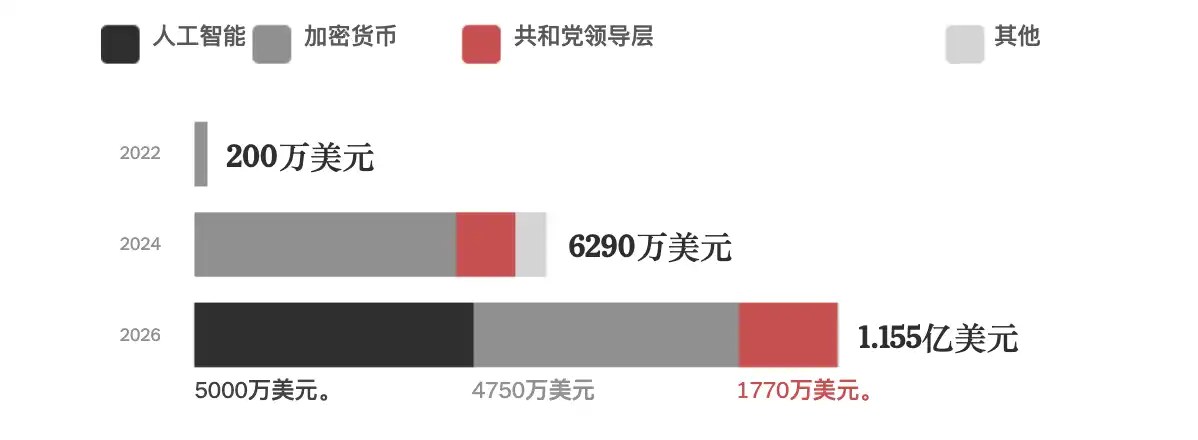
Source: Federal Election Commission, The New York Times

Before Trump began his second term last year, Andreessen revealed that he spent half his time at Mar-a-Lago, assisting the Trump team with the transition. The venture capital titan also served as an informal advisor to the government efficiency department led by Musk. Two former a16z partners have taken up senior government positions, with one handling AI regulatory matters.

In March of this year, 54-year-old Andreessen was appointed to a top White House science and technology advisory committee; recently, he was also invited to attend the state dinner for King Charles III's visit to the US and a private club dinner hosted by Trump in the White House Rose Garden.

Regulatory filings show that the large donations from Andreessen and Horowitz mostly come from the wholly-owned a16z entity. The $115.5 million for this election cycle does not yet include the tens of millions of dollars the firm recently invested in the emerging AI non-profit advocacy organization American Innovators Network, which is not required to disclose donation details.

Founded in 2009, a16z is one of the most prestigious investment firms in Silicon Valley. It incubates startups by borrowing from the Hollywood talent agency model, recruiting aggressively and excelling at self-promotion. Early bets on crypto exchange Coinbase and social platform Instagram cemented its industry reputation.

The political stances of the two founders are quite storied. In the 1990s, Andreessen gained early fame and fortune with the pioneering web browser Mosaic, was a core member of former Vice President Al Gore's tech brain trust, and a major Democratic fundraiser.

Years later, his political leanings gradually shifted rightward. He himself revealed that after Trump's victory in 2016, he deliberately withdrew from political fundraising activities, embarking on a journey of political "self-reflection," re-examining various ideological extremes.

According to people familiar with his private social circles, Andreessen is now active in various private communities, often discussing current events with conservative activists.

Ben Horowitz, 59, is the son of the prominent conservative agitator David Horowitz. However, insiders say Horowitz himself is less vocal in public about politics and has relatively limited involvement in the firm's Super PAC affairs. a16z publicly endorsed Trump in the summer of 2024; in October of the same year, Horowitz also provided financial support to Democratic presidential candidate Harris due to personal connections.

Andreessen and Horowitz describe themselves as "single-issue voters": their voting and donations are based solely on what benefits tech startups. Insiders say the two became determined to engage deeply in politics after repeated clashes with the media and the Biden administration over tech policy in earlier years.

Andreessen once told a friend an anecdote. About a decade ago, at the headquarters of Condé Nast, parent company of The New Yorker, he had a heated argument with the magazine's editor, David Remnick. Remnick's team accused tech elites of being out of touch with the masses, but after Andreessen toured their luxurious offices and bathrooms, he concluded that it was the media elites who were truly out of touch with reality.

Before the 2024 election, Chris Lehane, a seasoned Silicon Valley political operative and Coinbase board member, spearheaded the formation of Fairshake. Andreessen and Horowitz believed the Biden administration was too harsh on the crypto industry, where a16z had heavily invested. Coupled with the fraud conviction of crypto political figure SBF, the industry urgently needed a new political path.

Thus, a16z joined forces with crypto giants like Coinbase and Ripple to become core funders of Fairshake, with the firm donating $47 million to the organization during the 2024 election cycle. Although most pro-crypto policies in Washington now originate from Trump (Fairshake did not endorse Trump), this political move is still seen within the industry as a successful experiment.

In the spring of 2025, Lehane, who had joined OpenAI, again took the lead. Together with a16z, tech donors, and political operatives, they planned to replicate the crypto industry's political fundraising strategy for the AI field, starting early and investing more heavily.

a16z, which has heavily invested in numerous AI projects, fully committed. In August 2025, it donated $25 million to the AI-focused PAC Leading the Future, and added another $25 million in February 2026. Insiders reveal the firm has not yet decided whether to make further contributions.

Compared to a16z's trillion-dollar assets under management, a $115.5 million political investment is not particularly high. However, other top Silicon Valley venture capital firms, such as Sequoia Capital and Founders Fund, have not undertaken similar large-scale political initiatives.

According to The New York Times' tally, since the 2024 election, the next largest publicly disclosed federal donors after a16z are Soros-linked entities (approximately $103 million) and Musk ($85 million).

The large-scale political involvement has also drawn a16z into controversy and backlash from multiple sides.

Internally, early partner John O'Farrell resigned from his part-time advisory role in May last year due to political differences. He publicly criticized the two PACs, Fairshake and Leading the Future, as well as what he called "tech figures actively cozying up to this administration, including many former venture capital peers and partners." He declined to comment further.

Externally, the progressive camp strongly criticizes a16z. Last year, several Democratic lawmakers publicly criticized Arizona Democratic Senator Ruben Gallego for co-hosting a fundraiser with Andreessen.

a16z's support for the AI PAC Leading the Future has even prompted industry countermeasures. The opposing Super PAC Public First, espousing AI safety principles, emerged with the express purpose of counterbalancing the political financial influence of a16z and its allies. Insiders even jokingly named the organization "z16a," deliberately inverting a16z's common abbreviation.

New York State Democratic Assemblyman Alex Bores, who is running for Congress with Public First's endorsement, stated bluntly that he is not afraid of attacks from Leading the Future: "The venture capital logic is about rapid scaling, but that logic shouldn't be applied to buying democracy."

Some Republicans are also unimpressed with a16z's political bets. They privately complain that Fairshake and Leading the Future's insistence on a bipartisan, neutral strategy is misguided, arguing that AI and crypto policies are inherently more Republican-friendly, and the related PACs should fully align with the Republican Party.

Andreessen and Horowitz have told allies that their decision-making power within the two PACs is limited and they rarely directly interact with the PAC leadership.

a16z's political strategy and Washington lobbying efforts are coordinated by former congressional aide and Republican Collin McCune. He keeps track of the two PACs' movements and updates Andreessen on the latest policies and political developments.

But this doesn't mean Andreessen is unaware of political rules. In 2000, at just 29 years old, he asserted, "If you think the scale of political donations is big now, you haven't seen anything yet."

İlgili Sorular

QAccording to the article, which organization has become the largest financial contributor to the 2026 US midterm election cycle, and how much did they donate?

AAccording to the article, the venture capital firm Andreessen Horowitz (a16z), along with its founding partners Marc Andreessen and Ben Horowitz, has donated over $115.5 million to activities related to the 2026 midterm election, making it the largest known donor in this cycle.

QWhat are the names of the two main Super PACs that a16z has heavily funded, and which industries do they focus on?

AThe two main Super PACs that a16z has heavily funded are Fairshake, which focuses on the cryptocurrency industry, and Leading the Future, which focuses on supporting pro-artificial intelligence candidates.

QHow does a16z's political donation strategy for the 2026 election cycle differ from its approach in the 2024 election cycle?

Aa16z's political donation strategy has significantly escalated. In the 2024 election cycle, they donated about $63 million. For the 2026 cycle, their donations have surged to over $115.5 million, indicating a much deeper and more strategic long-term commitment to political engagement.

QWhat criticism has a16z faced due to its increased political spending, according to the article?

Aa16z has faced criticism both internally and externally. Internally, early partner John O'Farrell resigned over political disagreements. Externally, progressives have criticized its influence, and a rival Super PAC called Public First (jokingly called 'z16a') was formed to counter its AI-focused spending. Some Republicans are also displeased with its bipartisan funding strategy for issues they feel are more aligned with their party.

QWhat personal political evolution is described for Marc Andreessen in the article?

AThe article describes Marc Andreessen's political evolution from being a core member of former Vice President Al Gore's technology brain trust and a major Democratic fundraiser in the 1990s, to gradually shifting his stance to the right. After Trump's 2016 victory, he undertook a period of political 'introspection' and is now active in private circles discussing current affairs with conservative activists.

İlgili Okumalar

55TB to 28TB? The Rumor and Panic Behind Rubin's Memory Being Halved

Title: 55TB to 28TB? The Rumor and Panic Behind the Potential Halving of Rubin's Memory. On June 4th, a report from SemiAnalysis suggested NVIDIA's next-gen Vera Rubin NVL72 AI rack may ship with roughly 28TB of SOCAMM DRAM per rack instead of the anticipated 55TB, primarily using 96GB modules. This sparked a market panic, causing Micron's stock to drop over 10% on fears of halved memory demand. However, the article argues this panic is misguided for several key reasons. First, SOCAMM modules are socketed and upgradeable, not soldered. Lower initial configuration doesn't mean permanent demand loss. Second, the primary driver is a severe 2026 LPDDR5X supply shortage, not diminished need. NVIDIA is likely prioritizing rack shipments with available components. Third, with fixed total LPDDR5X supply, using less per rack could allow NVIDIA to ship *more* racks, not necessarily reducing overall memory orders. Micron's sharp drop was also attributed to a broader semiconductor sell-off triggered by Broadcom's earnings, with the SemiAnalysis report providing a convenient narrative for profit-taking after Micron's massive rally. In summary: the report on lower default configurations is likely accurate, but interpreting it as a demand collapse is wrong. The real risk for Micron lies in its reportedly minimal HBM4 share for Rubin, not in potentially flexible SOCAMM demand. The sell-off appears more like a correction amplified by coinciding negative catalysts.

marsbit16 dk önce

55TB to 28TB? The Rumor and Panic Behind Rubin's Memory Being Halved

marsbit16 dk önce

Exclusive from Yingke | Tang Wenbin's 'Yuanli Lingji' Merges with Logistics Robotics Company, and Secures Investment from Zhipu, SenseTime, Jieyue, and Others

Exclusive report: Embodied AI company "Yuanli Lingji" recently completed a new round of financing from major AI model firms including Zhipu AI, Stepfun, and SenseTime, alongside continued investments from industrial backers like Huaqin and SAIC Hengxu. Founded in March 2025 by Tang Wenbin, former co-founder and CTO of Megvii, Yuanli Lingji is a general-purpose embodied AI model company. In a notable move, the company has merged with logistics robotics firm "Atomix" (formerly known as Yuanli Juhe) through a share acquisition. Atomix, which originated from Megvii's logistics robotics business led by Tang in 2016 and was spun off in July 2024, has grown to become the world's second-largest supplier of pallet shuttle robots, with annual revenue nearing 1 billion RMB and over 500 projects globally for clients like Uniqlo and CATL. This merger aims to break the industry's "data deadlock" by combining Atomix's extensive real-world operational data from more than 20 countries with Yuanli Lingji's model training capabilities. The company's embodied AI model "DM0" utilizes a cross-domain training approach, integrating internet semantics, autonomous driving rules, and robotics data to achieve hardware-agnostic, precise manipulation even with a compact 2.4B parameter size. The collective investment from key AI players and the strategic merger signal a shift in the competitive landscape, as major model companies pivot from language tokens to physical actions ("from Token to Action"). The industry is entering a consolidation phase where hardware, AI models, data, and application scenarios converge to scale embodied intelligence, a trend mirrored by recent moves from giants like ByteDance and Skild AI.

marsbit23 dk önce

Exclusive from Yingke | Tang Wenbin's 'Yuanli Lingji' Merges with Logistics Robotics Company, and Secures Investment from Zhipu, SenseTime, Jieyue, and Others

marsbit23 dk önce

U.S. Stock Market Trends: Dow Hits New High, Nasdaq Falls, Whom Did Broadcom's Slap Wake Up?

U.S. Stocks Split: Dow Hits Record High as Nasdaq Slips; Broadcom's Plunge Sparks Rotation On June 4, the U.S. stock market saw a sharp divergence. The Dow Jones surged 875 points (+1.73%) to a record high of 51,561.93, while the Nasdaq Composite edged down 0.09%. The S&P 500 rose 0.41%. The primary catalyst was a sharp sell-off in AI-related chip stocks, led by Broadcom (AVGO). Despite reporting a 143% year-over-year jump in AI semiconductor revenue to $10.8 billion, the company's shares plunged about 14%. This was triggered by its maintained long-term AI revenue target, which failed to meet heightened expectations for a stock that had gained 55% this quarter and traded at a high P/E ratio. The slide dragged down the broader semiconductor sector and the technology板块. Conversely, money rotated into sectors like Healthcare (+3.14%), Financials (+2.67%), and Real Estate (+1.87%). UnitedHealth and Goldman Sachs were major contributors to the Dow's gains. The rotation was attributed to a search for value outside overheated tech names and a slight dip in Treasury yields. In other major news, SpaceX confirmed its IPO for June 12, targeting a record $75 billion raise at a ~$1.75 trillion valuation. Additionally, initial jobless claims rose to a four-month high, adding nuance to the labor market narrative ahead of the key May non-farm payrolls report. The day's action signaled that while the AI growth story remains intact, excessive valuations are prompting a market reassessment. Funds are moving, at least temporarily, from high-flying tech to more defensive and value-oriented sectors. The sustainability of this rotation hinges on upcoming economic data, particularly the jobs report, and the market's absorption of the massive SpaceX IPO.

marsbit26 dk önce

U.S. Stock Market Trends: Dow Hits New High, Nasdaq Falls, Whom Did Broadcom's Slap Wake Up?

marsbit26 dk önce

From 'Old Dogs' to 'New Darlings': How AI is Revaluing Old Infrastructure, from Dell to Nokia

"Old Dogs" Become AI's New Darlings: Revaluing Legacy Infrastructure The AI investment narrative is shifting. Beyond the spotlight on core chipmakers like Nvidia, a new wave of interest is rising for legacy tech companies—Dell, HPE, Nokia, Cisco, Corning, Western Digital—once labeled as slow-growth, outdated stories. This resurgence stems from AI's evolution from model development to real-world deployment, creating massive demand for physical infrastructure. As AI moves into data center construction and enterprise adoption, the focus turns to who can actually build and deliver complex systems. These established players hold decades of experience in supply chains, integration, networking, and enterprise delivery—assets now critical for scaling AI. The revaluation can be grouped into three key infrastructure areas: 1. **Servers & Integration (e.g., Dell, HPE):** They are becoming essential system integrators, transforming GPUs into full-scale AI servers with networking, power, and cooling, then delivering them to clients. Strong recent earnings and AI-specific revenue/order growth for Dell and HPE underscore this shift. 2. **Networking & Connectivity (e.g., Corning, Nokia, Cisco):** As AI clusters grow, high-speed data transfer becomes paramount. Corning benefits from fiber demand for data center links, Nokia is exploring AI-integrated wireless networks (AI-RAN), and Cisco sees surging orders for data center switches—all critical for efficient AI operations. 3. **Storage (e.g., Western Digital, Seagate):** The AI data explosion requires vast capacity. Beyond high-speed memory (HBM), there's growing need for high-capacity HDDs to store training data, logs, video, and cold/archival data cost-effectively. This revaluation, however, is not a blanket endorsement. True reassessment requires concrete proof: AI-driven orders and revenue growth, upward revisions to company guidance, and sustainable improvements in profit quality, not just top-line sales. In essence, AI is not turning all old tech firms into high-growth stocks; it is selectively re-pricing the "old assets" of companies that are mission-critical for building the new AI infrastructure, transforming their legacy capabilities into renewed growth engines.

marsbit35 dk önce

From 'Old Dogs' to 'New Darlings': How AI is Revaluing Old Infrastructure, from Dell to Nokia

marsbit35 dk önce

İşlemler

Spot
Futures
活动图片