a16z Releases Top 100 AI Apps List: ChatGPT's Dominance Shakes, Global Market Divides into Three

marsbit2026-03-10 tarihinde yayınlandı2026-03-10 tarihinde güncellendi

Özet

a16z's sixth annual Generative AI Consumer Apps Top 100 reveals a shifting landscape. While it remains the dominant leader with 900M weekly active users, ChatGPT's supremacy is being challenged. Competitors like Gemini and Claude are growing paid subscriptions faster, signaling a battle for the "default AI assistant." The report expands its scope to include established products where AI is now core to the experience, such as Canva, Notion, and CapCut. Key findings include: the market is splitting into three distinct geographic ecosystems (Western, Chinese, and Russian); creative tools are undergoing a major reshuffle as video, music, and voice generation rise while image tools get bundled into larger platforms; agentic AI, capable of taking actions, is emerging with tools like OpenClaw; and AI is increasingly moving beyond browsers and apps into desktops, browsers themselves, and deep integrations into existing software. The competition is evolving from a simple feature war to a strategic battle over building entire ecosystems and operating systems.

Author: ethn, a16z

Compiled by: Deep Tide TechFlow

Deep Tide Guide: a16z has released the sixth edition of its generative AI consumer applications list. ChatGPT has 900 million weekly active users, but Gemini and Claude are growing their paid subscriptions faster. The battle for the "default AI assistant" has officially begun.

The biggest change in this edition is the inclusion of established products like CapCut, Canva, and Notion, where "AI features have become core," alongside the first-time coverage of Agents, AI browsers, and desktop tools.

Author Olivia Moore is a partner on a16z's consumer team. This report is one of the most systematic public datasets currently tracking the landscape of AI consumer applications.

Full text below:

Three years ago, we released the first edition of this list with a simple goal: to figure out which generative AI products were actually being used by mainstream consumers. Back then, the line between "AI-native" companies and others was clear. ChatGPT, Midjourney, and Character.AI were products built from the ground up around foundational models, while the rest of the software world was still figuring out how to use the technology.
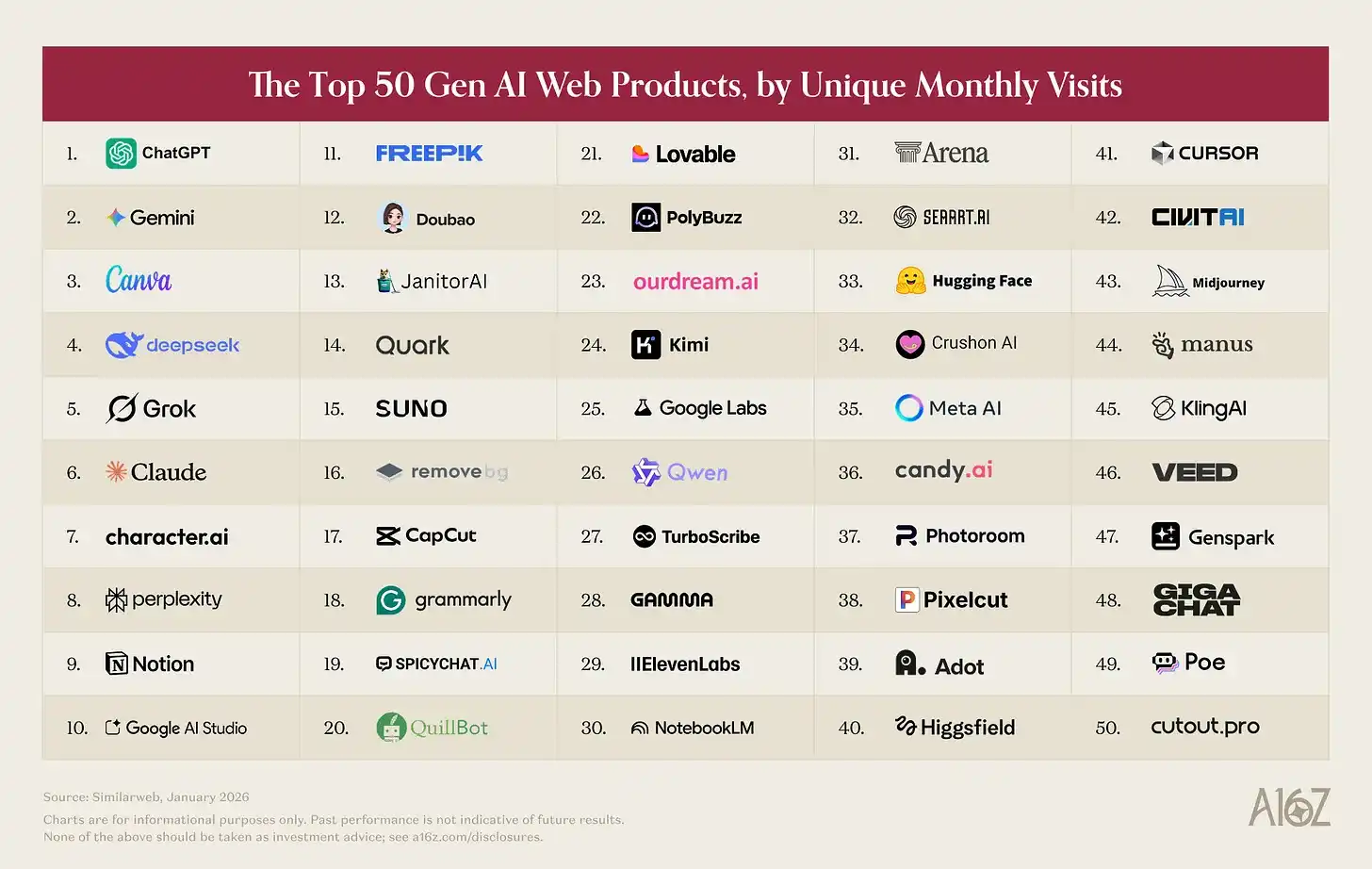
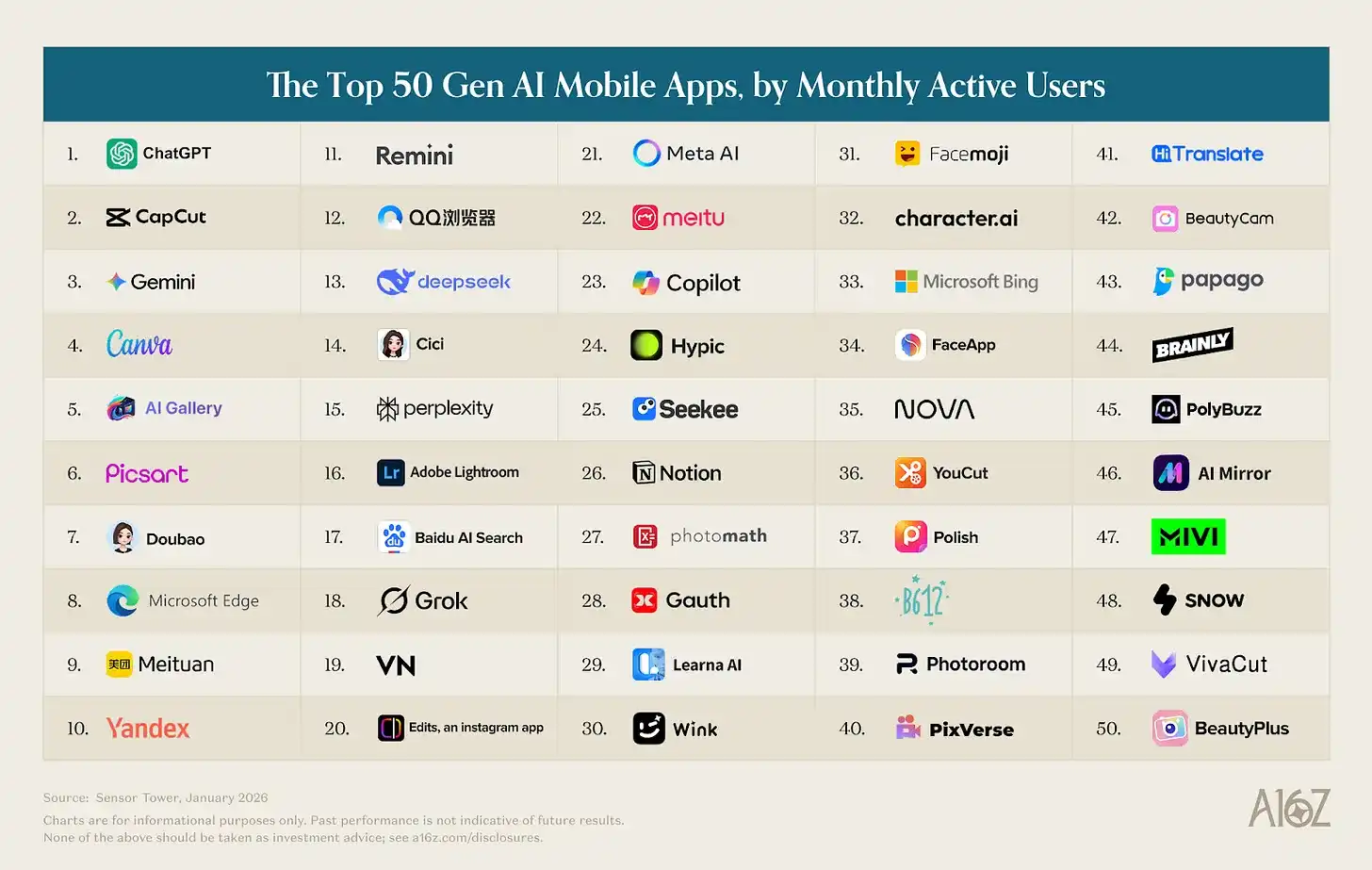
That line no longer holds. CapCut, a video editor with 736 million monthly active mobile users, has its most popular features entirely powered by AI—background removal, AI effects, auto-captions, and text-to-video. Canva's growth engine is completely built on its Magic Suite AI tools. Notion's paid attachment rate for AI soared from 20% to over 50% in a year, with AI features now contributing to about half of the company's ARR.

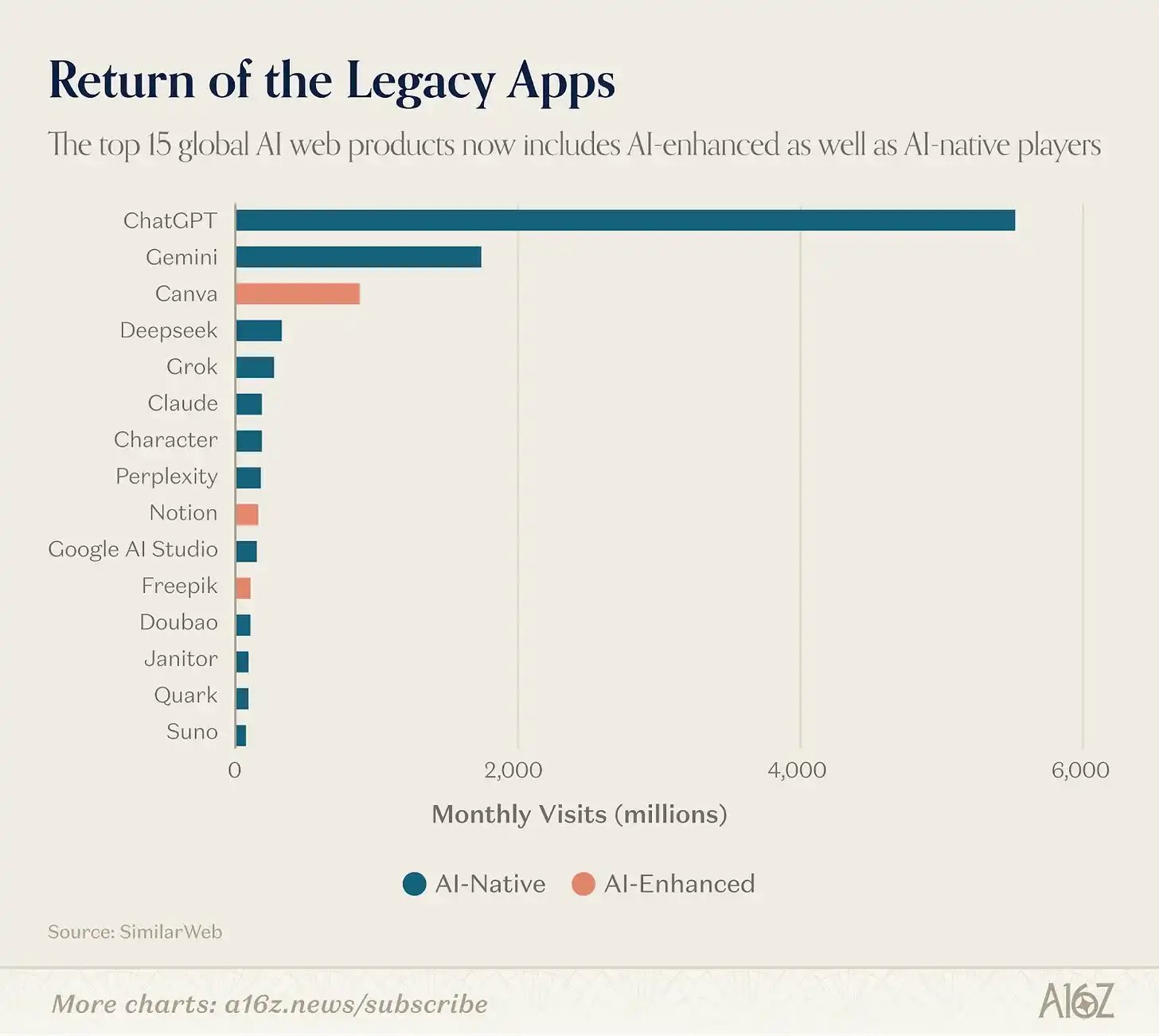
Starting with this edition, we've expanded our scope to include all consumer products where generative AI has become a core part of the experience, including CapCut, Canva, Notion, Picsart, Freepik, and Grammarly. We believe this gives a more accurate picture of how people actually use AI, though the top-ranked products are still mostly AI-native.
Caption: Full Top 100 Generative AI Consumer Applications List, March 2026 Edition

As before, web rankings are based on monthly unique visitors (data source: SimilarWeb, as of January 2026), and mobile rankings are based on monthly active users (data source: Sensor Tower, as of January 2026). Here are our key findings:

1. ChatGPT Leads, But the Battle for the "Default AI" Has Begun

ChatGPT remains the largest consumer AI product by a significant margin. Its web traffic is 2.7 times that of the second-place Gemini, and its mobile MAU is 2.5 times Gemini's. ChatGPT's weekly active users grew by 500 million in the past year, now reaching 900 million. This is staggering given the difficulty of growth at scale—over 10% of the global population uses ChatGPT weekly.
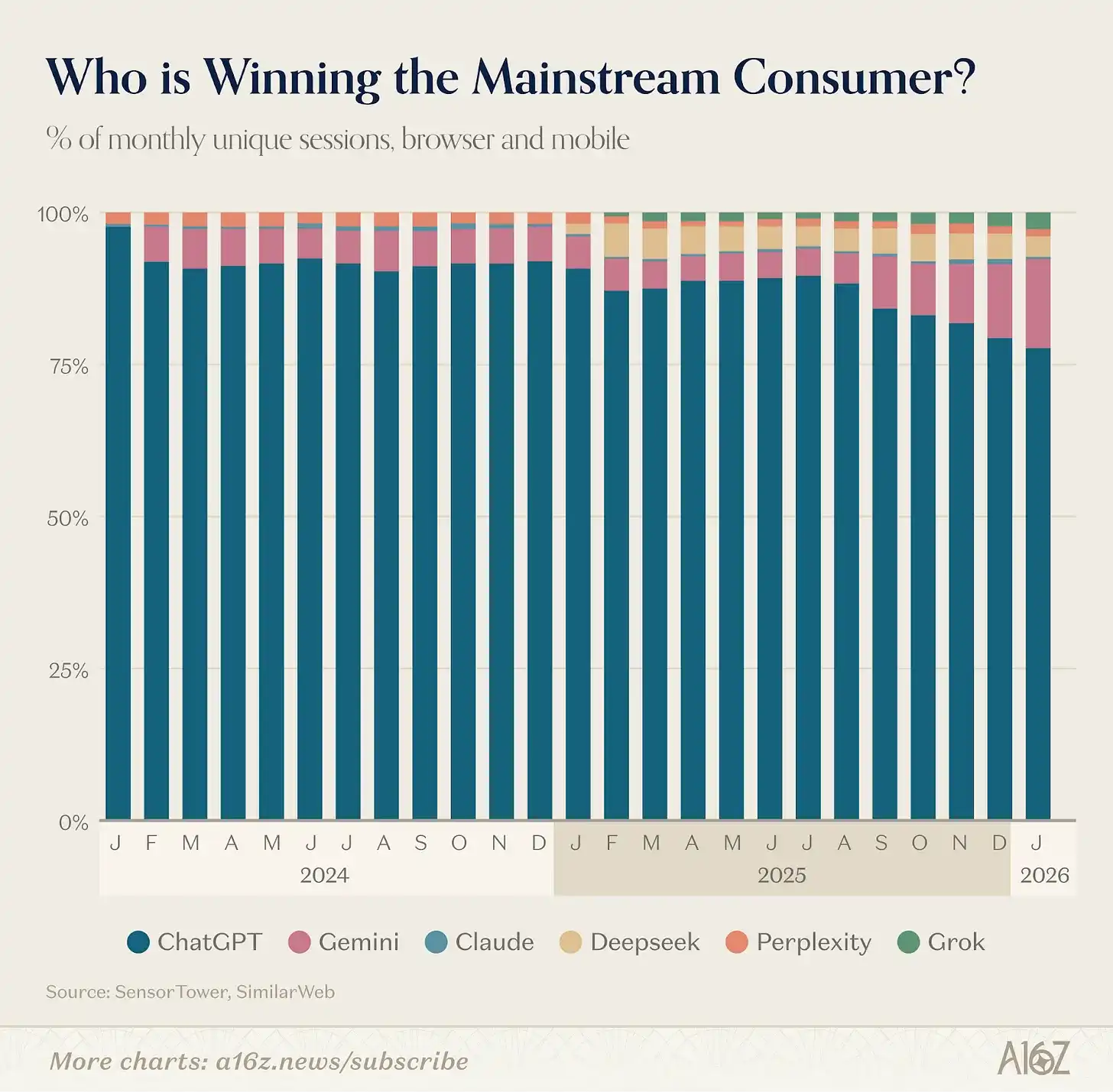
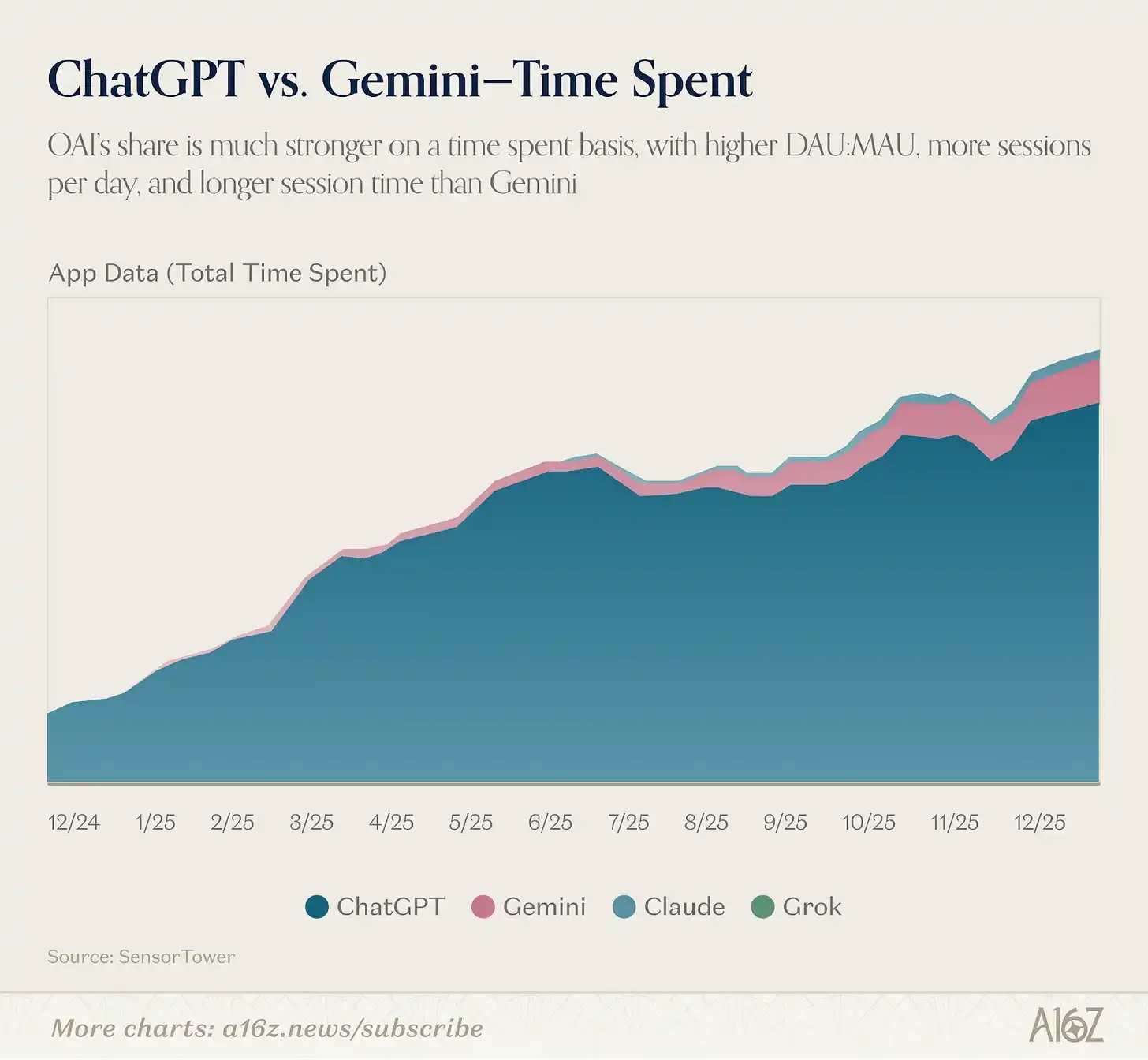
But we're starting to see the field widen, with other general-purpose platforms focusing on specific scenarios. Gemini and Claude's paid subscription growth in the US accelerated over the past year (though they are still far behind ChatGPT in absolute terms—ChatGPT has 8x the paid users of Claude and 4x those of Gemini). According to Yipit Data, as of January 2026, Claude's paid users grew over 200% year-over-year, while Gemini's grew 258%. We also see increasing "multi-platform" behavior—about 20% of ChatGPT's weekly web users also used Gemini in the same week.
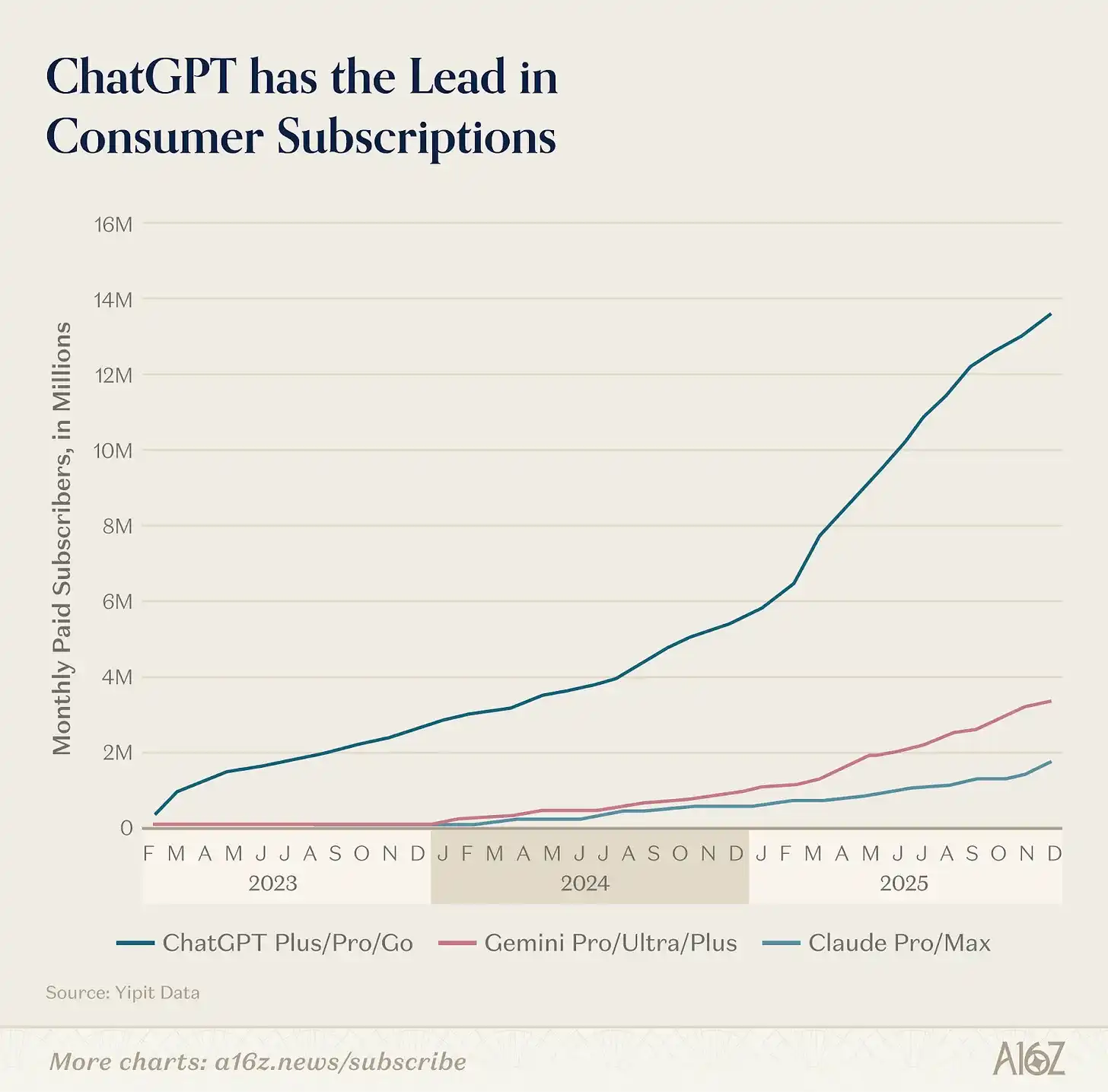
What's happening? Competitors are pushing hard. Google scored a big win with creative models—Nano Banana generated 200 million images in its first week, bringing 10 million new users to Gemini; Veo 3 is widely recognized as a breakthrough moment for AI video. Anthropic is targeting professional users, launching Cowork, Claude in Chrome, Excel and PowerPoint plugins, and most crucially, Claude Code.

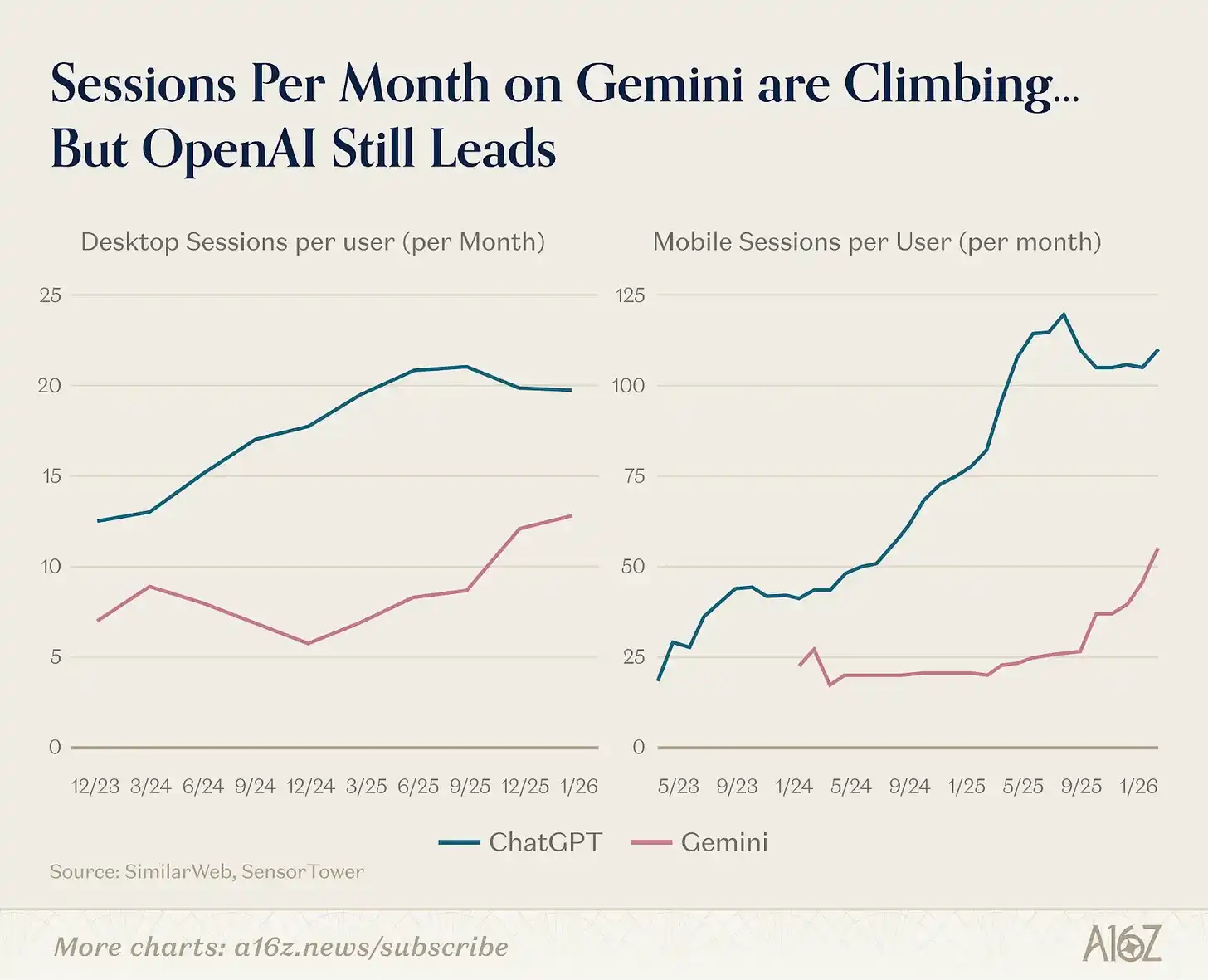
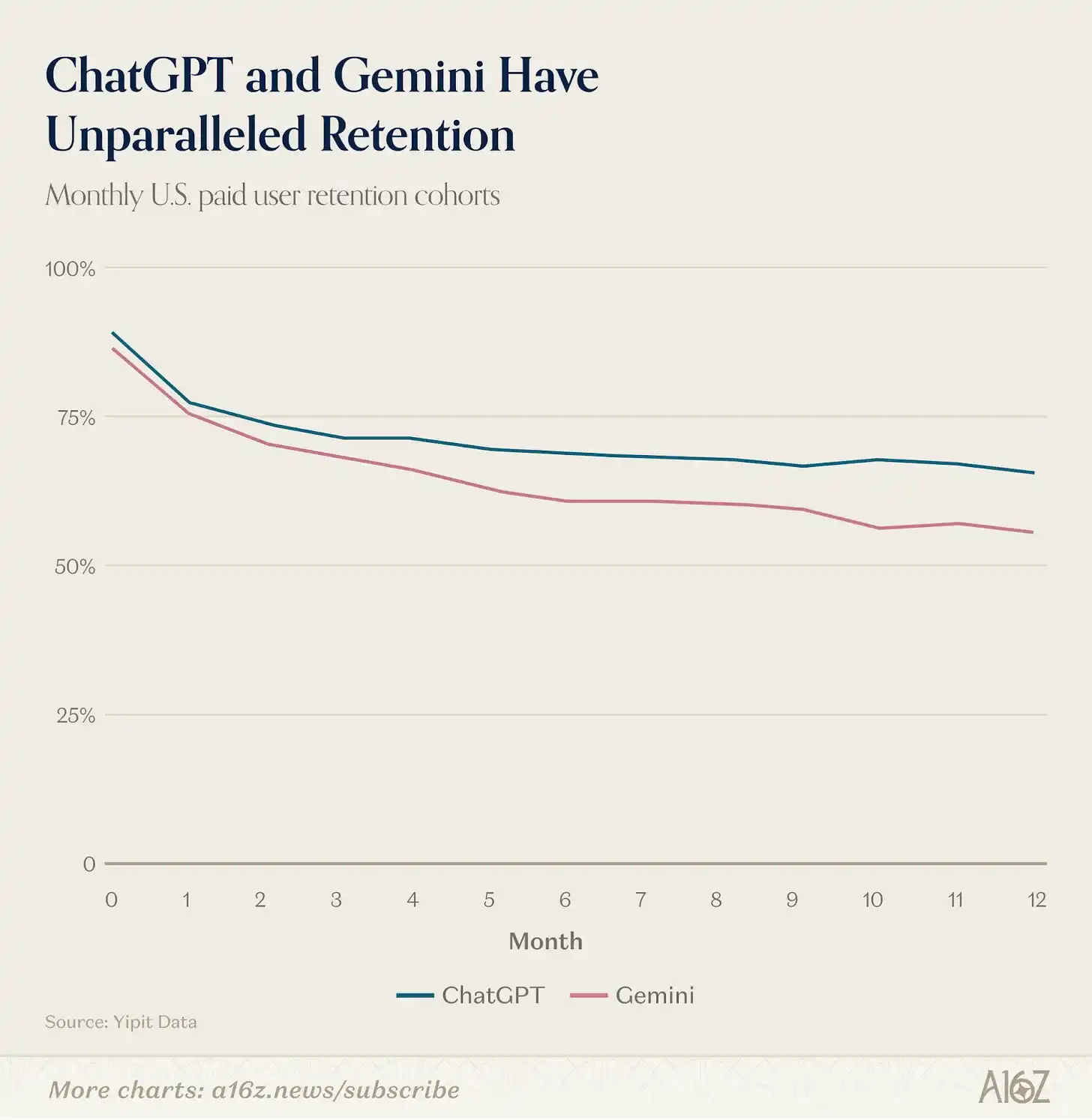
This competition isn't just about who leads today, but who can build structural moats. Context accumulates: the more an LLM knows about you, the better its results, and the more locked-in you become. Early data shows Gemini's average monthly sessions per user on the web are rising, though ChatGPT still leads by 1.3x. On mobile, ChatGPT's advantage is greater, with 2.2x the average monthly sessions per user compared to Gemini. According to Yipit Data, both have top-tier consumer paid user retention rates in the US.
The next layer of lock-in comes from app stores. Both ChatGPT and Claude have launched connector ecosystems—ChatGPT has GPTs and Apps, Claude has MCP integrations and Connectors, allowing users to build workflows on top of the assistants. Once users configure their AI to connect to their calendar, email, and CRM, switching costs rise dramatically. Developers are likely to focus their efforts on the platform with the most users, creating a flywheel effect similar to early platform wars.

We can already see the platforms diverging. Sam Altman previously stated that OpenAI wants to "bring AI to the billions who can't afford a subscription," which is why they started showing ads. He also indicated OpenAI would launch a "Sign in with ChatGPT" identity layer, positioning the AI assistant as the default interface between consumers and the internet. The ambition is to make ChatGPT the starting point for everything: shopping, booking hotels, browsing the web, health management, daily life.

The app directories reflect this divergence. As of late February, ChatGPT's app store covers 13 categories with 220 apps. Claude has about 160 curated connectors plus about 50 community MCP servers. But only 41 apps overlap between the two—roughly 11% of their combined directories—and these 41 are almost all universal productivity tools everyone needs: Slack, Notion, Figma, Gmail, Google Calendar, HubSpot, Stripe.

Beyond core tools, the two platforms are heading in almost completely different directions. ChatGPT has over 85 exclusive apps in categories like travel, shopping, food, health, lifestyle, and entertainment, where Claude has almost none. These are consumer transaction scenarios: booking flights on Expedia, grocery shopping via Instacart, browsing homes on Zillow, tracking nutrition on MyFitnessPal. This is the most aggressive super-app play among all AI companies. Claude's exclusive integrations lean professional: financial data terminals (PitchBook, FactSet, Moody's, MSCI), developer infrastructure (Sentry, Supabase, Snowflake, Databricks), science and medical tools (PubMed, Clinical Trials, Benchling), and an open-source MCP community which has no equivalent on ChatGPT.
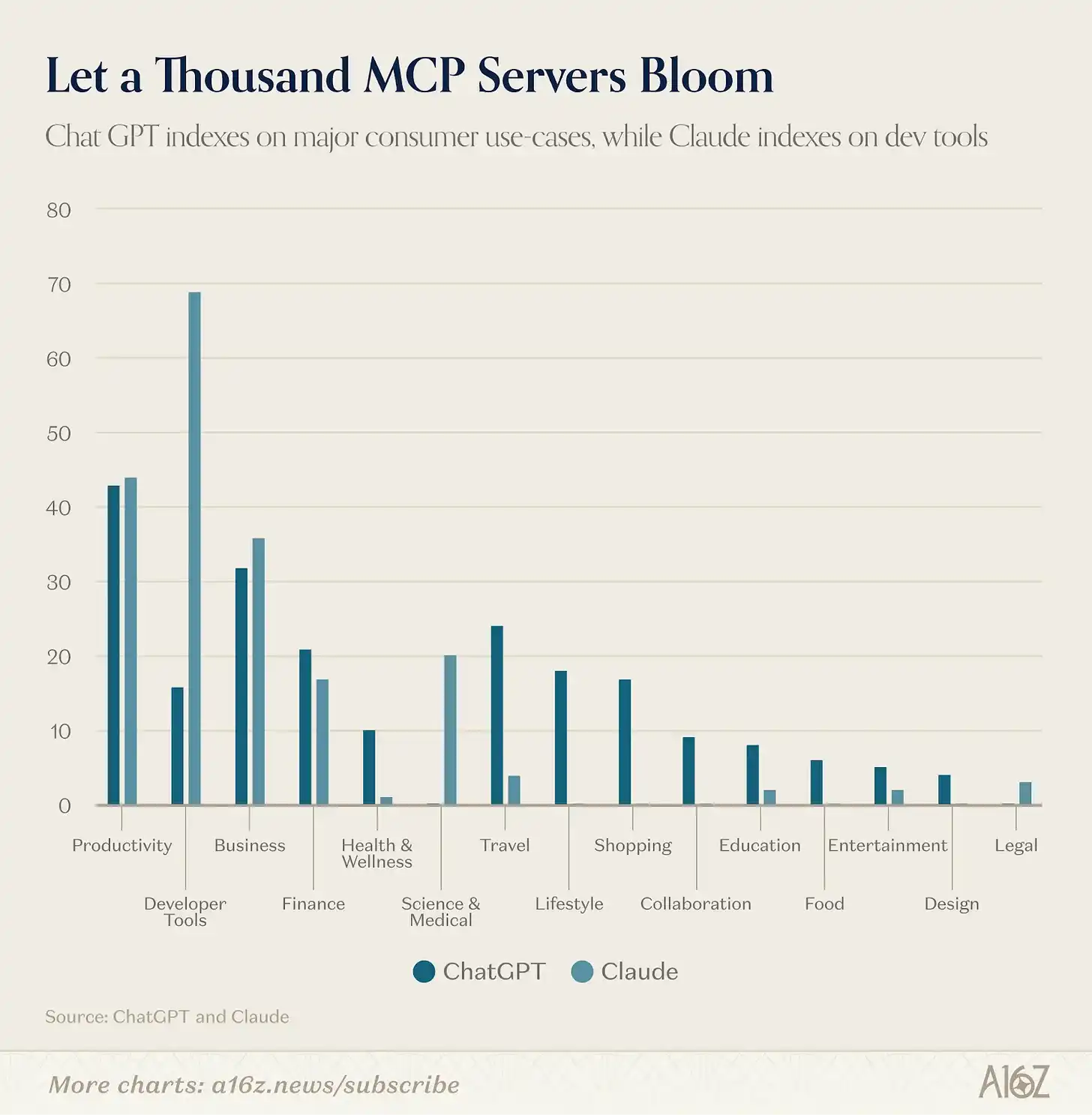
Anthropic seems focused on power AI users (developers, knowledge workers, etc.). These users are more willing and able to pay for expensive direct subscriptions. While ChatGPT also has products for similar audiences (e.g., Codex, Frontier), they are simultaneously aiming to be a platform for truly mass-market users—which could open more monetization paths as the user base grows. They are already testing ads, and transaction fees are a logical extension.

If AI assistants are not just chat windows but OS-level environments, this competition might ultimately resemble the mobile OS wars more than the search wars—two platforms with starkly different philosophies, each building trillion-dollar ecosystems.

2. Global Usage is Splitting Along Product Lines

Geographically, the AI market is splitting into three distinct ecosystems, with the gaps between them widening.
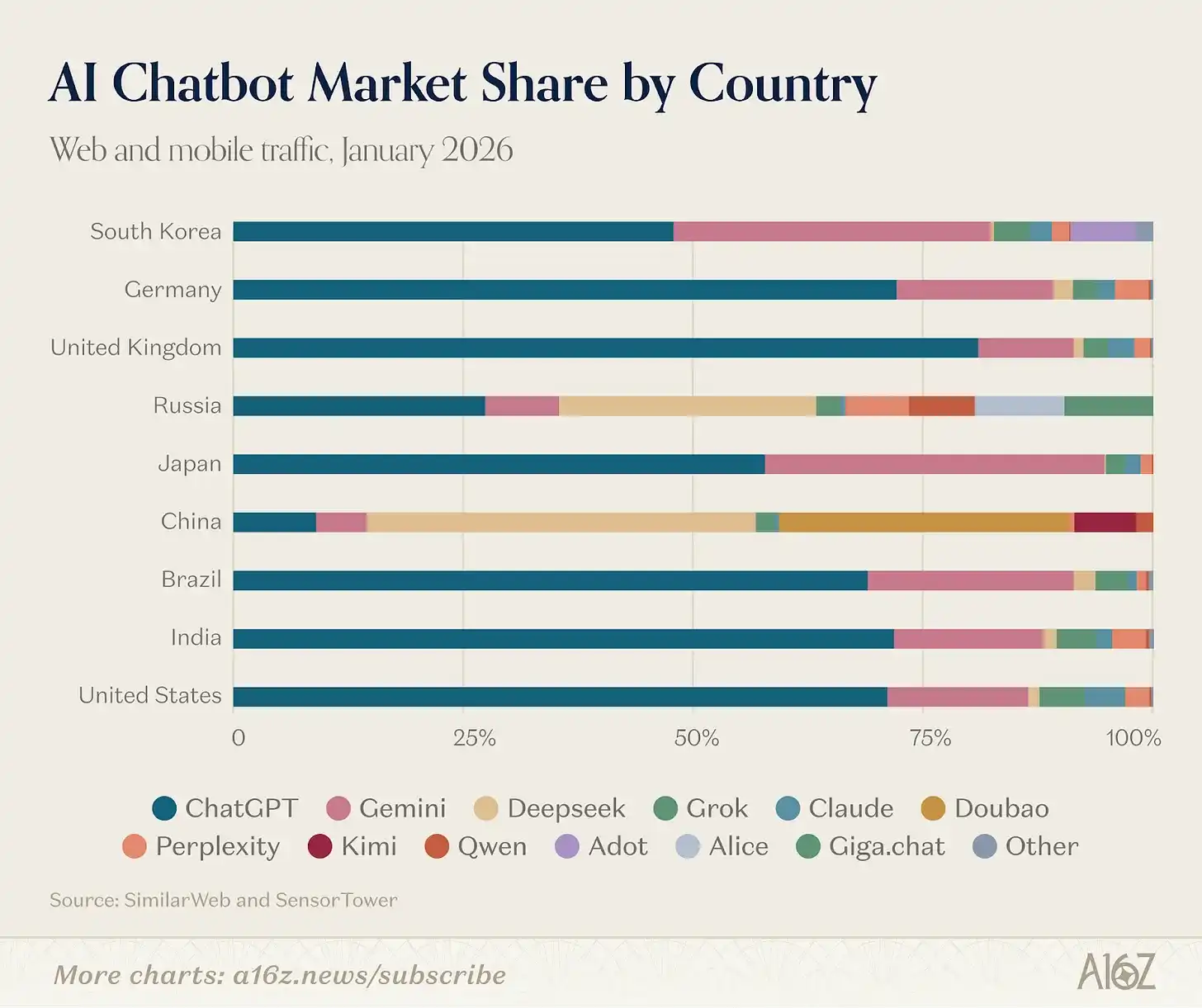
Western AI tools share highly similar user bases. The core markets for ChatGPT, Claude, Gemini, and Perplexity all come from the same pool: the US, India, Brazil, the UK, and Indonesia, just in different orders. None have significant usage in China or Russia. The reason is policy: since 2022, Western tech sanctions have restricted Russian access to US AI tools; China requires AI providers to register, store data locally, and comply with censorship rules.

DeepSeek is the only product that spans multiple camps. Its web traffic is distributed across China (33.5%), Russia (7.1%), and the US (6.6%), with a similar pattern on mobile. Chinese users also heavily use ByteDance's Doubao and local product Kimi.

Russia, which barely registered as a separate market in our early editions, has now become a third pole, with DeepSeek ranking second in penetration. The Yandex browser, integrated with the Alice AI assistant, has 71 million MAU, placing it in the global top 10 mobile AI products. Sber's GigaChat also appears on our web list for the first time. This pattern mirrors China's, just compressed: sanctions created a vacuum, and local products filled it within two years.

To measure AI adoption on a per capita basis, we built a simple index combining web visits per capita and mobile MAU per capita, scored from 0 to 100. The results redefine the geographic landscape. Singapore ranks first, followed by the UAE, Hong Kong, and South Korea. The US—the origin of most AI products—ranks 20th.
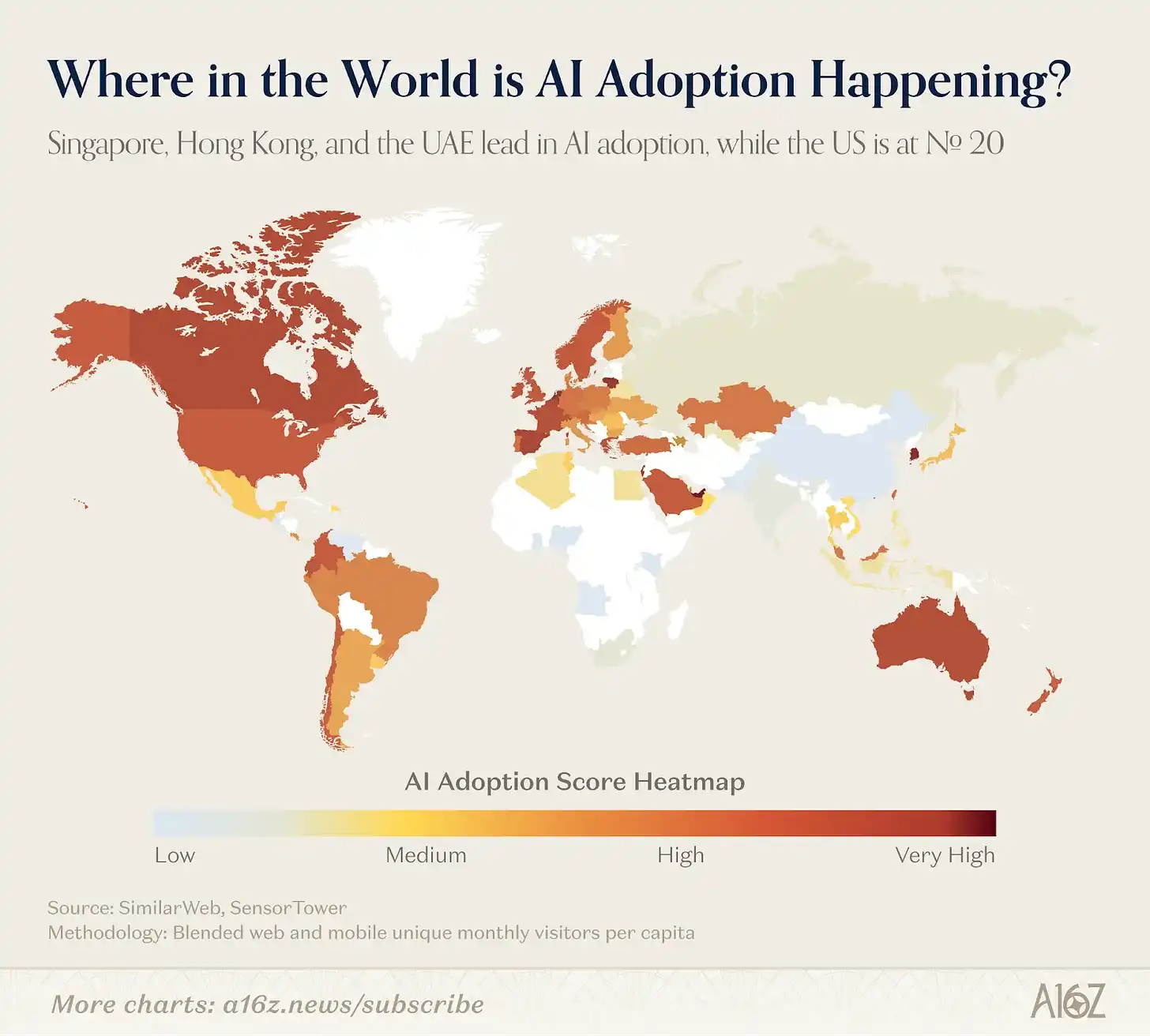
Caption: Generative AI Per Capita Adoption Index (0-100), Singapore leads, US ranks 20th

3. Creative Tools See Major Reshuffle

Midjourney, DALL-E, and Stable Diffusion were the products that brought most early users into the world of generative AI—all three launched before ChatGPT. Image generators not only dominated the creative category (video and audio generation came later) but also held steady positions in the upper tiers of our first three lists. This category has since changed dramatically.

In the first list from September 2023, 7 out of 9 creative tools on the web were image generators. Three years later, only 3 image generators remain on the list, but there are still 7 creative tools. The difference lies in what filled the vacancies: video, music, and voice products have claimed the spots vacated by image generation.
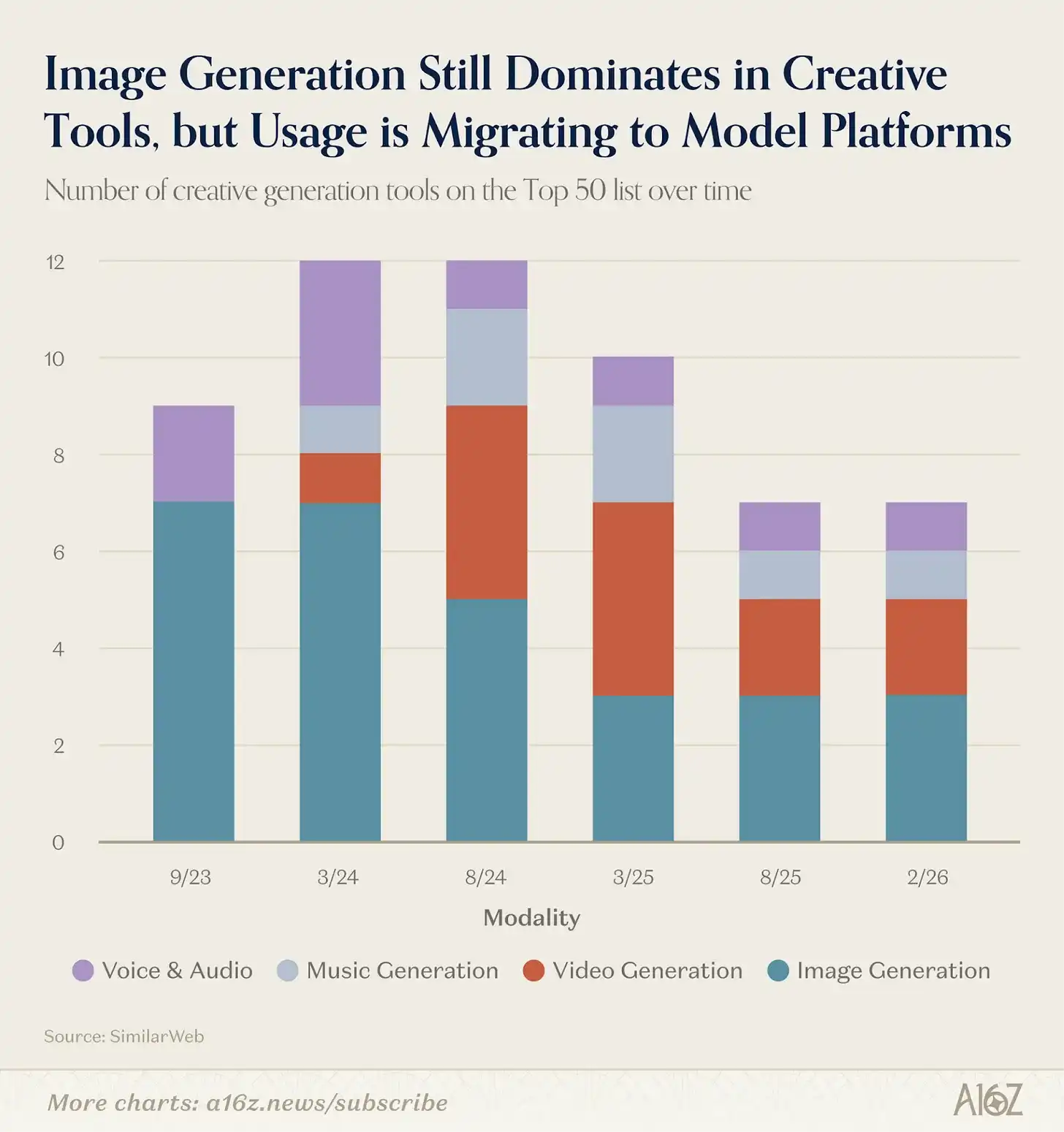
The story of image generation is one of being consumed by bundling. As the quality of built-in image models in ChatGPT (GPT Image 1.5) and Gemini (Nano Banana) improved, the bar for standalone image products rose sharply. Midjourney, which ranked in the top 10 in our first list, has now fallen to 46th place. The products that remain—Leonardo, Ideogram, CivitAI—tend to serve specific creative communities, differentiating with opinionated features rather than competing head-on with general-purpose generators.

Video generation is the area with the most change in this edition. Kling AI, Hailuo, and Pixverse have all built substantial user bases, with Chinese-developed models continuing to lead in output quality. It wouldn't surprise us to see apps based on Seedance 2.0 appear in the next list. Veo 3 was the first US model to close the gap, driving traffic to Google Labs (which rose from rank 36 to 25).

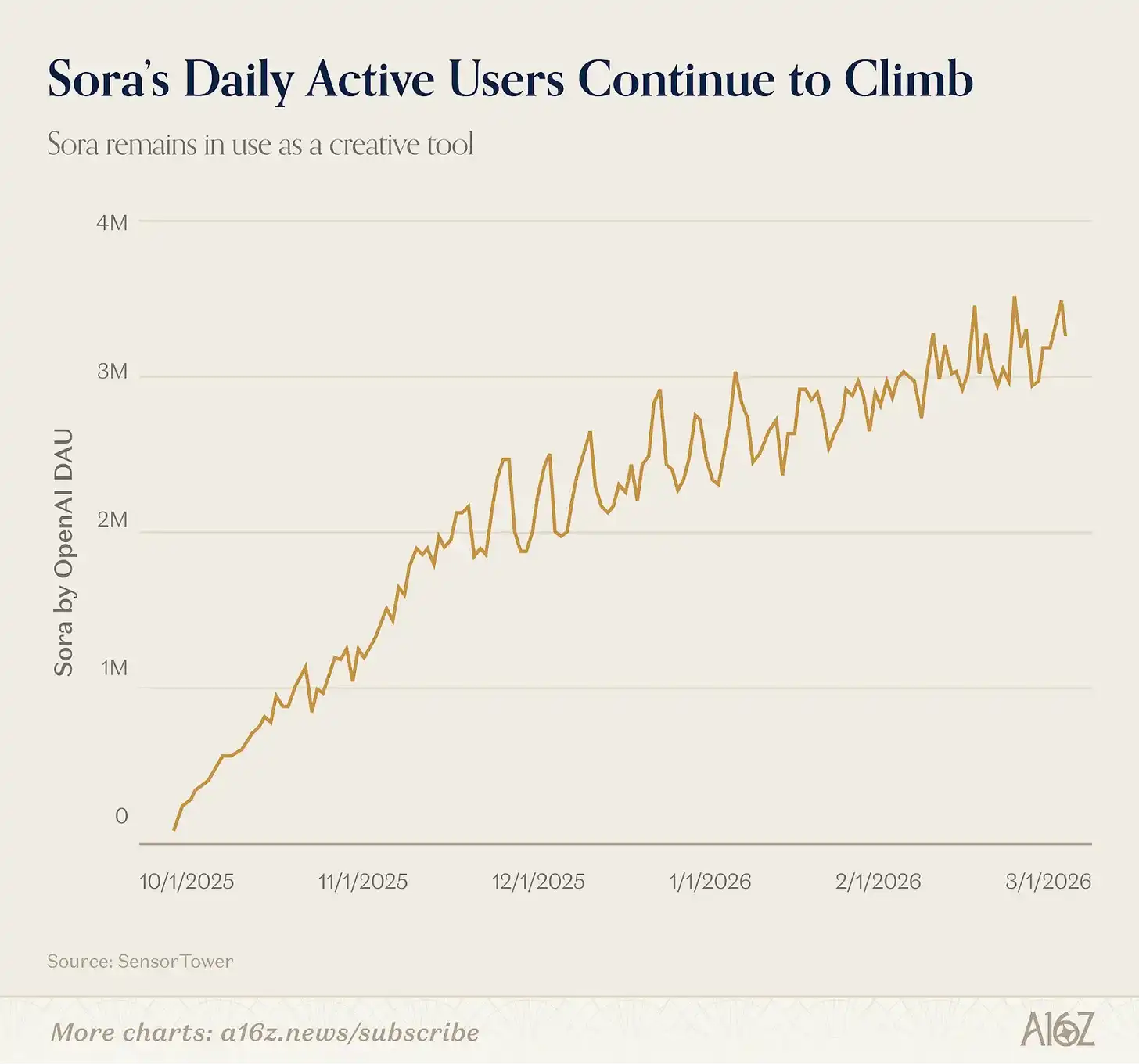
Who's missing? Sora. OpenAI launched Sora 2.0 as a standalone app in September 2025, allowing users to upload their own digital avatars as Cameos to generate videos featuring real people. Sora topped the US App Store charts for 20 consecutive days, reaching 1 million downloads faster than ChatGPT. Downloads subsequently fell back, because Sora failed to sustain viral growth as a social app (no one has cracked the AI × social formula yet), so it didn't make the mobile list this time. But SensorTower data shows Sora still has over 3 million mobile DAU, and AI video creators continue to use the model, even if they publish their work on other platforms.
Music and voice have been more defensible. Suno maintained its ranking from the previous edition (15th). ElevenLabs has been on every list since September 2023; its core capabilities—voice cloning, dubbing, audio production—are specialized enough that they haven't yet been turned into a checkbox feature in a giant's product.

The pattern to summarize: in creative directions where model giants and big players like Google and OpenAI focus (images, and increasingly video), traffic for independent products gets compressed—though there's still room for products targeting niches beyond the mainstream, potentially with higher price points. In directions the giants haven't focused on (music, voice), independent products have more room.

4. Agents Have Arrived

The shift towards agentic AI didn't start with this edition—it began last time, in the form of vibe coding. When Lovable, Cursor, and Bolt appeared on our March 2025 list, they represented something new: AI products that don't just answer questions or generate media, but build things for the user. This is agent behavior, just confined to a vertical.

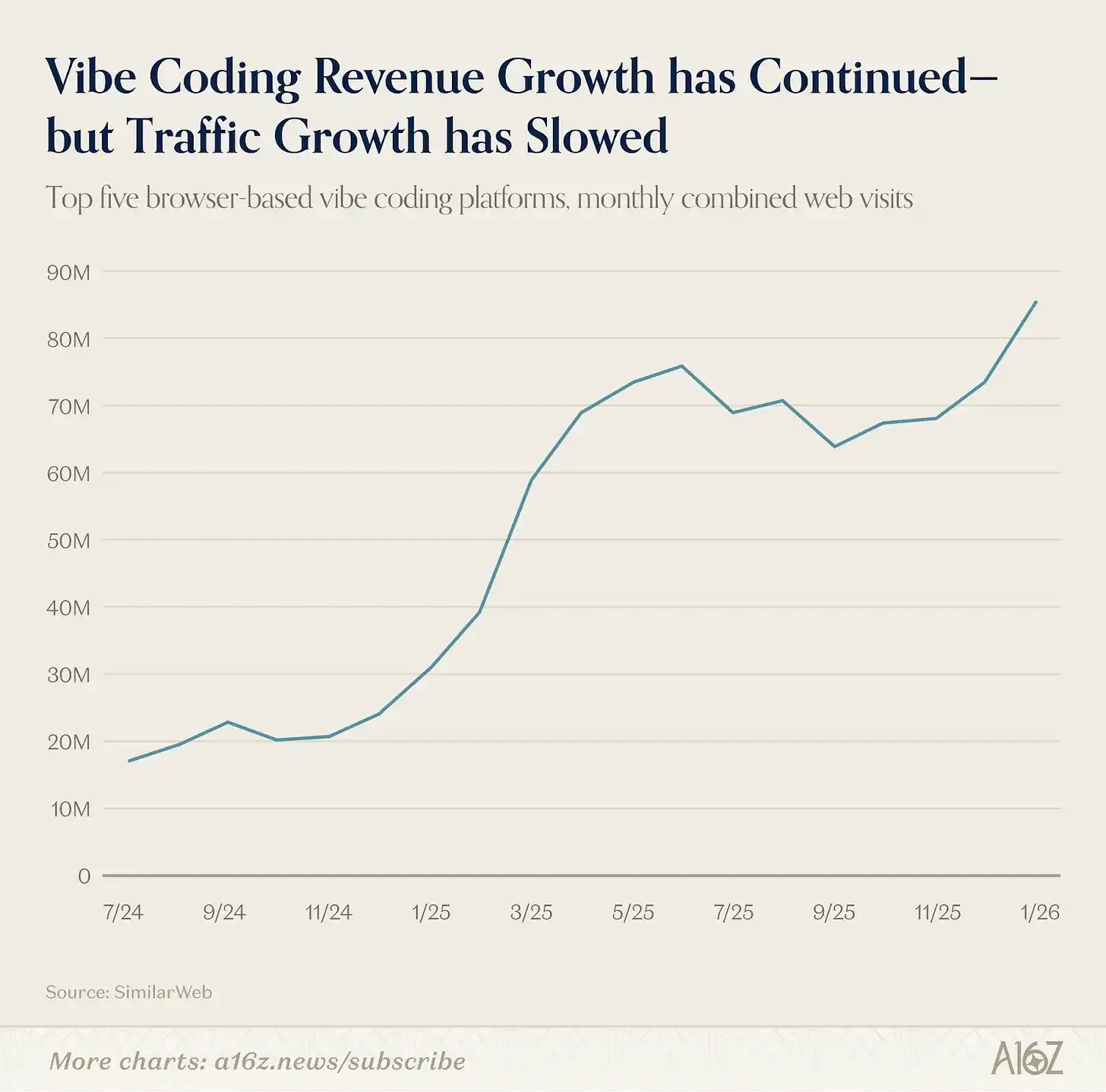
Vibe coding proved its retention capability among technical (and semi-technical) users. Both Replit and Lovable are on this list, as is Claude Code (via Claude). There's more room for growth, as this trend hasn't truly hit the mass market. Traffic for the top five vibe coding platforms is still growing, albeit slower than the initial explosion, but revenue for many products is rising as developers and teams deepen their usage.
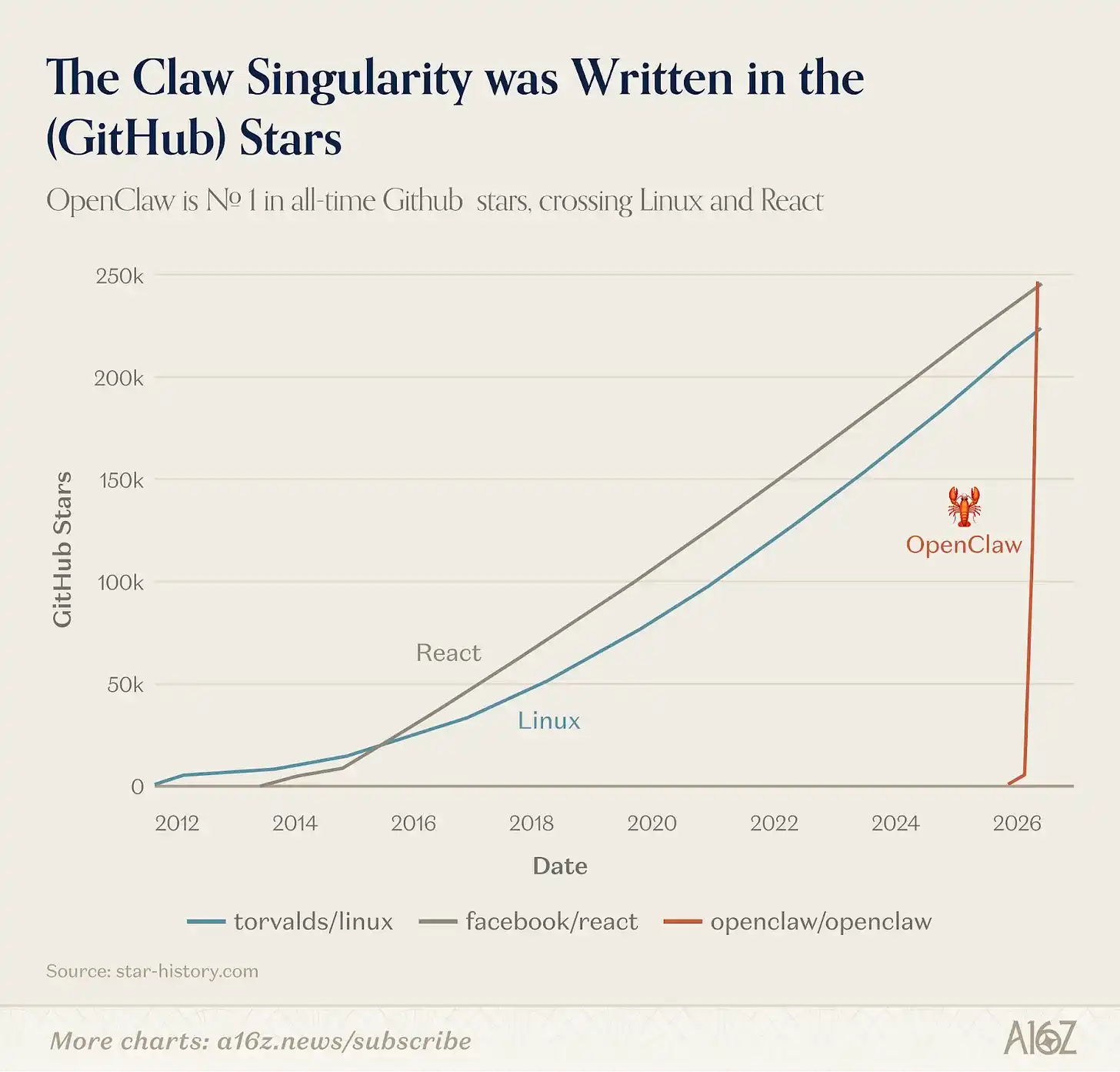
More recently, general-purpose agents have begun to emerge. In January 2026, an open-source project called OpenClaw went from a side project by an independent developer to 68,000 GitHub stars and mainstream media coverage in just weeks. Created by Austrian developer Peter Steinberger, OpenClaw is an AI agent that runs locally, connects to your messaging apps, and performs multi-step tasks on your behalf.

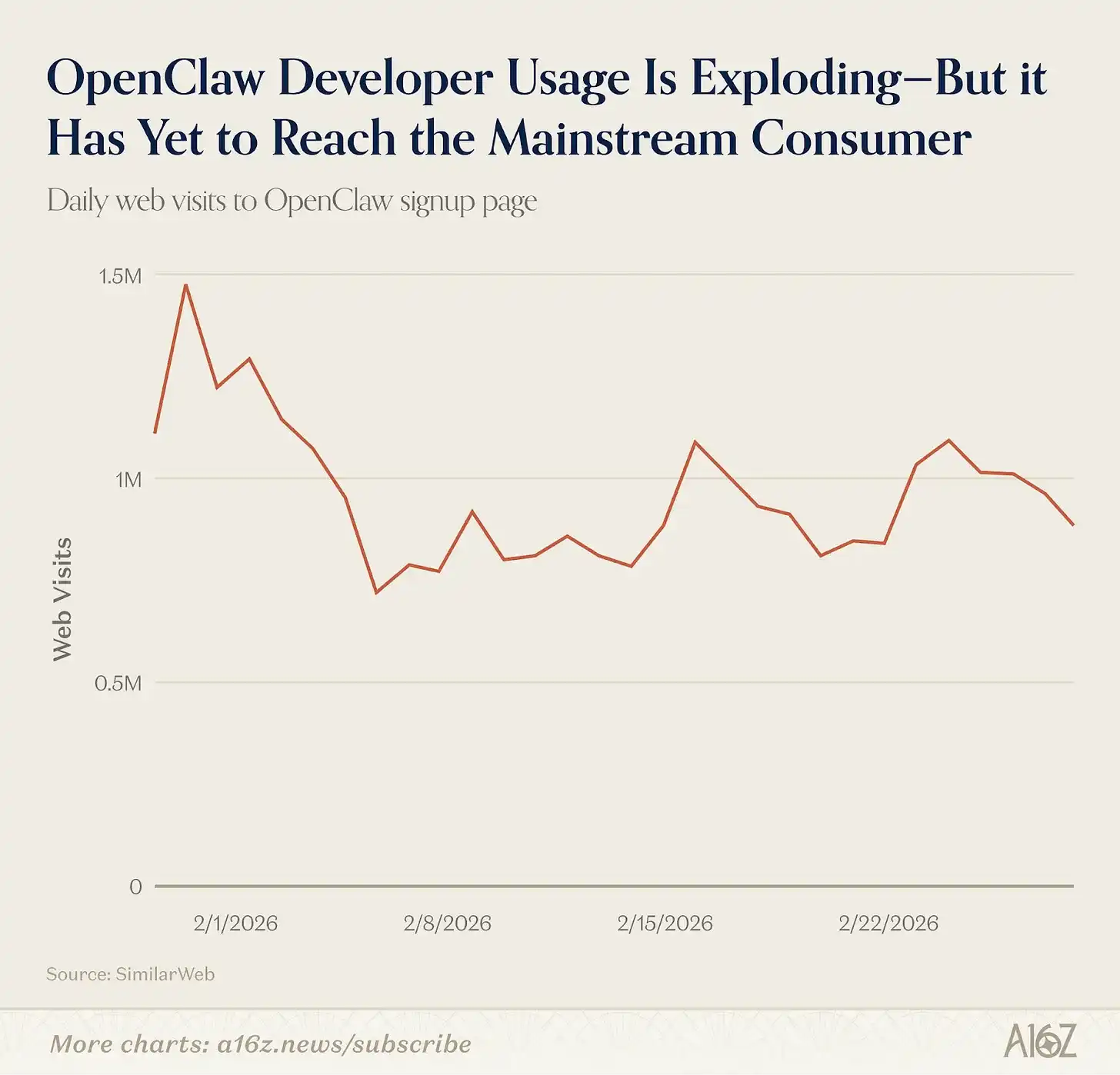
If ChatGPT was the moment consumers discovered AI could converse, OpenClaw might be the moment they discover AI can act. The product exploded in the developer community—if we extended our analysis window to February instead of January, OpenClaw would rank in the web top 30.

But OpenClaw isn't yet a consumer product—installation and maintenance require terminal skills. OpenClaw continues to gain momentum among technical users, becoming the most starred project on GitHub in early March, surpassing React and Linux. But the product hasn't "graduated" to truly mainstream users yet—at least judging by the new visitor data for the OpenClaw installation page, growth has been fairly flat. The project was acquired by OpenAI in February 2026, which might signal a more user-friendly version of OpenClaw is coming.
OpenClaw isn't the only general-purpose agent on the list. Manus and Genspark also made it—both platforms allow consumers to hand off open-ended tasks (research, spreadsheet analysis, slide deck creation) to AI, which completes the entire workflow end-to-end. Manus is on the list for the second time; after its last appearance, it was acquired by Meta for approximately $2 billion in December 2025. Genspark is new to this edition—the company closed a $300 million Series B earlier this year and announced it reached $100 million in annualized revenue.

On mobile, consumers often interact with agents via text, not through a mobile app. Upon installation, users connect OpenClaw to platforms like WhatsApp, Telegram, and Signal, sending it instructions as if messaging a friend, and it executes tasks in the background. Other products like Poke offer similar agent experiences via SMS.

These products will compete directly with the agent capabilities of the general-purpose LLM assistants consumers use every day—ChatGPT, Claude, and Gemini. As these giants build out their own connector and app ecosystems, will consumers choose one as their primary agent? The next six months will give us the answer.

5. AI Moves Beyond the Browser and App

Every previous edition of this list ranked AI products using two metrics: web visits and mobile MAU. But a new class of AI products is emerging that neither metric captures. Some of the most important consumer AI growth over the past year has occurred in products that are completely invisible in these two dimensions.

The most obvious change is that the browser itself is becoming an AI product. Over the past nine months, OpenAI released Atlas (a browser with ChatGPT built into every page), Perplexity launched Comet, and Browser Company (later acquired by Atlassian) launched Dia. Yipit data shows Perplexity's Comet has had the biggest impact in the market (measured by download page visits), but no AI browser has yet seen accelerating growth.

Other AI giants have chosen the path of adding AI to existing browsers rather than launching a separate AI browser. Google integrated Gemini into Chrome and released a beta of Disco, which can dynamically generate web apps based on a user's browser tabs. Anthropic released Claude in Chrome, which can connect to a user's Claude or Claude Code session to drive actions on the web.
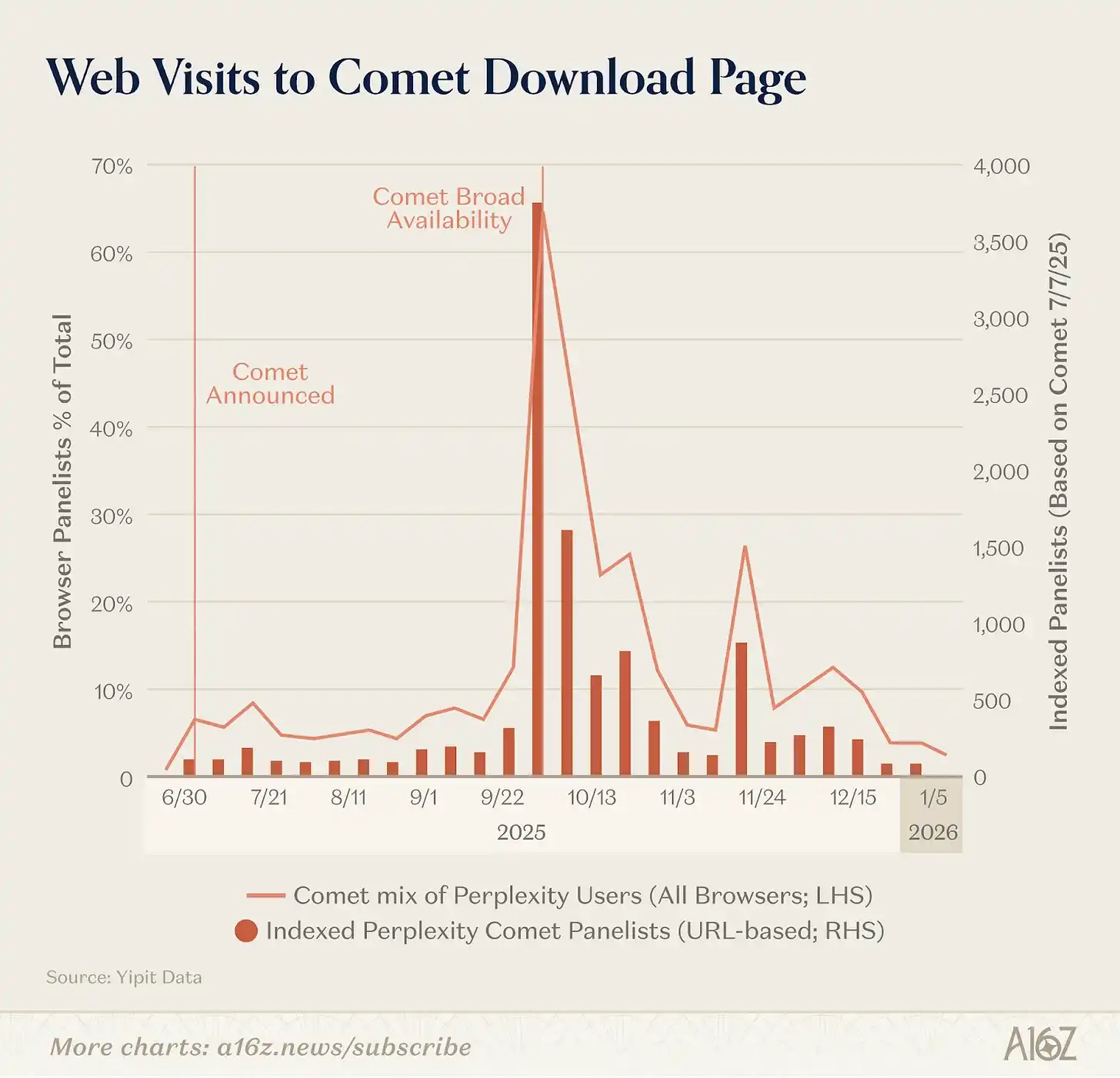
Growth in native desktop AI tools is even more explosive, especially developer tools. Claude Code—a command-line developer agent—reached $1 billion in annualized revenue in just six months. OpenAI launched a standalone Mac app for Codex, and the company stated Codex had 2 million weekly active users by early March, growing 25% week-over-week. Cursor held its position in the web top 50.

For pure consumers, the most common standalone desktop AI applications are voice-related. Note-taking tools like Fireflies, Fathom, Otter, TL;DV, and Granola reach users through PLG models, gradually penetrating enterprises—the top five players combined have over 20 million visitors. Workspace apps like Notion (on the list for the first time) are also increasingly integrating AI through notetakers, research agents, and even task automation.

Finally, AI is embedding itself more deeply into the tools people already use. Anthropic launched Claude in Excel and Claude in PowerPoint. OpenAI launched ChatGPT for Excel. Google deepened Gemini's integration across the entire Workspace suite—Docs, Sheets, Gmail, and Meet all have native AI features. In January 2026, Google also launched Personal Intelligence, connecting Gemini to Gmail, Google Photos, YouTube, and Search, allowing the assistant to reference your hotel bookings, purchase history, photo library, and watch history without you having to tell it.

The implication for this list: our rankings increasingly underestimate the AI products people use the most. A developer who spends eight hours a day in Claude Code, or a knowledge worker who dictates every email through Wispr, are heavy AI users, but are almost invisible in web traffic data. As AI shifts from a destination to a feature, our methodology needs to evolve too.


İlgili Sorular

QWhat are the main findings of a16z's sixth edition of the Top 100 Generative AI Consumer Applications list?

AThe main findings include: 1) ChatGPT remains the dominant AI product but faces growing competition from Gemini and Claude, especially in paid subscriptions; 2) The global AI market is splitting into three distinct ecosystems (Western, Chinese, and Russian); 3) Creative tools are undergoing a major reshuffle, with video, music, and voice generation gaining ground over image generation; 4) AI agents are emerging as a new category, with tools like OpenClaw and Manus gaining traction; 5) AI is increasingly moving beyond browsers and apps into desktop tools, browsers themselves, and embedded integrations.

QHow has the competitive landscape for general AI assistants like ChatGPT, Gemini, and Claude evolved?

AWhile ChatGPT still leads with 900 million weekly active users (2.7x more web traffic than Gemini and 2.5x more mobile MAUs), Gemini and Claude are growing faster paid subscription rates in the U.S. (258% and 200% YoY growth, respectively). About 20% of ChatGPT's weekly web users also use Gemini in the same week. The competition is intensifying around building structural moats through context accumulation, app stores, and differentiated strategies—OpenAI aims for a super-app approach targeting mass consumers, while Anthropic focuses on high-end professional users.

QWhat geographic trends does the report highlight in AI adoption?

AThe global AI market is splitting into three ecosystems: 1) Western tools (ChatGPT, Gemini, Claude, Perplexity) dominate in the U.S., India, Brazil, the U.K., and Indonesia but have negligible usage in China or Russia due to policies; 2) China has its own ecosystem with products like DeepSeek, Doubao, and Kimi; 3) Russia has rapidly developed a local AI market with DeepSeek, Yandex Browser (with Alice AI), and GigaChat. Singapore leads in per capita AI adoption, while the U.S. ranks 20th.

QHow has the creative AI tools category changed since the first edition of the list?

AIn the first list (2023), 7 out of 9 creative tools were image generators. Now, only 3 image generators remain in the top 100, but creative tools still hold 7 spots—with video, music, and voice generation replacing image generation. Image tools like Midjourney declined as giants like ChatGPT and Gemini integrated high-quality image models. Video generation (e.g., Kling AI, Veo 3) saw significant momentum, while music (Suno) and voice (ElevenLabs) tools remain resilient due to their specialized, less-bundled nature.

QWhat are AI agents, and which examples are mentioned in the report?

AAI agents are products that go beyond generating content to taking actions or completing multi-step tasks for users. Examples include: 1) Vibe coding tools like Lovable, Cursor, and Claude Code for developers; 2) General-purpose agents like OpenClaw (an open-source agent for messaging apps), Manus (acquired by Meta), and Genspark (for research and presentations); 3) Mobile agents operating via text (e.g., Poke). These agents compete with the expanding capabilities of major LLM assistants like ChatGPT, Claude, and Gemini.

İlgili Okumalar

Google and Amazon Simultaneously Invest Heavily in a Competitor: The Most Absurd Business Logic of the AI Era Is Becoming Reality

In a span of four days, Amazon announced an additional $25 billion investment, and Google pledged up to $40 billion—both direct competitors pouring over $65 billion into the same AI startup, Anthropic. Rather than a typical venture capital move, this signals the latest escalation in the cloud wars. The core of the deal is not equity but compute pre-orders: Anthropic must spend the majority of these funds on AWS and Google Cloud services and chips, effectively locking in massive future compute consumption. This reflects a shift in cloud market dynamics—enterprises now choose cloud providers based on which hosts the best AI models, not just price or stability. With OpenAI deeply tied to Microsoft, Anthropic’s Claude has become the only viable strategic asset for Google and Amazon to remain competitive. Anthropic’s annualized revenue has surged to $30 billion, and it is expanding into verticals like biotech, positioning itself as a cross-industry AI infrastructure layer. However, this funding comes with constraints: Anthropic’s independence is challenged as it balances two rival investors, its safety-first narrative faces pressure from regulatory scrutiny, and its path to IPO introduces new financial pressures. Globally, this accelerates a "tri-polar" closed-loop structure in AI infrastructure, with Microsoft-OpenAI, Google-Anthropic, and Amazon-Anthropic forming exclusive model-cloud alliances. In contrast, China’s landscape differs—investments like Alibaba and Tencent backing open-source model firm DeepSeek reflect a more decoupled approach, though closed-source models from major cloud providers still dominate. The $65 billion bet is ultimately about securing a seat at the table in an AI-defined future—where missing the model layer means losing the cloud war.

marsbit3 saat önce

Google and Amazon Simultaneously Invest Heavily in a Competitor: The Most Absurd Business Logic of the AI Era Is Becoming Reality

marsbit3 saat önce

Computing Power Constrained, Why Did DeepSeek-V4 Open Source?

DeepSeek-V4 has been released as a preview open-source model, featuring 1 million tokens of context length as a baseline capability—previously a premium feature locked behind enterprise paywalls by major overseas AI firms. The official announcement, however, openly acknowledges computational constraints, particularly limited service throughput for the high-end DeepSeek-V4-Pro version due to restricted high-end computing power. Rather than competing on pure scale, DeepSeek adopts a pragmatic approach that balances algorithmic innovation with hardware realities in China’s AI ecosystem. The V4-Pro model uses a highly sparse architecture with 1.6T total parameters but only activates 49B during inference. It performs strongly in agentic coding, knowledge-intensive tasks, and STEM reasoning, competing closely with top-tier closed models like Gemini Pro 3.1 and Claude Opus 4.6 in certain scenarios. A key strategic product is the Flash edition, with 284B total parameters but only 13B activated—making it cost-effective and accessible for mid- and low-tier hardware, including domestic AI chips from Huawei (Ascend), Cambricon, and Hygon. This design supports broader adoption across developers and SMEs while stimulating China's domestic semiconductor ecosystem. Despite facing talent outflow and intense competition in user traffic—with rivals like Doubao and Qianwen leading in monthly active users—DeepSeek has maintained technical momentum. The release also comes amid reports of a new funding round targeting a valuation exceeding $10 billion, potentially setting a new record in China’s LLM sector. Ultimately, DeepSeek-V4 represents a shift toward open yet realistic infrastructure development in the constrained compute landscape of Chinese AI, emphasizing engineering efficiency and domestic hardware compatibility over pure model scale.

marsbit3 saat önce

Computing Power Constrained, Why Did DeepSeek-V4 Open Source?

marsbit3 saat önce

İşlemler

Spot
Futures

Popüler Makaleler

$S$ Nedir

SPERO'yu Anlamak: Kapsamlı Bir Genel Bakış SPERO'ya Giriş İnovasyonun manzarası gelişmeye devam ederken, web3 teknolojilerinin ve kripto para projelerinin ortaya çıkışı dijital geleceği şekillendirmede önemli bir rol oynamaktadır. Bu dinamik alanda dikkat çeken projelerden biri SPERO, $$s$$ olarak adlandırılmaktadır. Bu makale, SPERO hakkında ayrıntılı bilgi toplamak ve sunmak amacıyla, meraklılar ve yatırımcıların web3 ve kripto alanlarındaki temellerini, hedeflerini ve yeniliklerini anlamalarına yardımcı olmayı amaçlamaktadır. SPERO,$$s$$ Nedir? SPERO,$$s$$, kripto alanında merkeziyetsizlik ve blok zinciri teknolojisi ilkelerini kullanarak etkileşimi, faydayı ve finansal kapsayıcılığı teşvik eden bir ekosistem yaratmayı amaçlayan benzersiz bir projedir. Proje, kullanıcıların yenilikçi finansal çözümler ve hizmetler sunarak eşler arası etkileşimleri yeni yollarla kolaylaştırmayı hedeflemektedir. SPERO,$$s$$'nin temel amacı, bireyleri güçlendirmek ve kripto para alanındaki kullanıcı deneyimini artıran araçlar ve platformlar sağlamaktır. Bu, daha esnek işlem yöntemlerini mümkün kılmayı, topluluk odaklı girişimleri teşvik etmeyi ve merkeziyetsiz uygulamalar (dApp'ler) aracılığıyla finansal fırsatlar yaratmayı içermektedir. SPERO,$$s$$'nin temel vizyonu kapsayıcılık etrafında dönmekte olup, geleneksel finansal sistemlerdeki boşlukları kapatmayı ve blok zinciri teknolojisinin faydalarından yararlanmayı hedeflemektedir. SPERO,$$s$$'nin Yaratıcısı Kimdir? SPERO,$$s$$'nin yaratıcısının kimliği bir miktar belirsizdir, çünkü kurucusu(ları) hakkında ayrıntılı arka plan bilgisi sağlayan sınırlı kamuya açık kaynaklar bulunmaktadır. Bu şeffaflık eksikliği, projenin merkeziyetsizlik taahhüdünden kaynaklanabilir—birçok web3 projesinin paylaştığı bir etik anlayışı, bireysel tanınmanın yerine kolektif katkıları önceliklendirmektedir. Topluluk ve onun kolektif hedefleri etrafında tartışmaları merkezileştirerek, SPERO,$$s$$, belirli bireyleri öne çıkarmadan güçlendirme özünü taşımaktadır. Bu nedenle, SPERO'nun etik anlayışını ve misyonunu anlamak, tek bir yaratıcının kimliğini belirlemekten daha önemlidir. SPERO,$$s$$'nin Yatırımcıları Kimlerdir? SPERO,$$s$$, kripto sektöründe yeniliği teşvik etmeye adanmış girişim sermayedarlarından melek yatırımcılara kadar çeşitli yatırımcılar tarafından desteklenmektedir. Bu yatırımcıların odak noktası genellikle SPERO'nun misyonuyla uyumlu olup, toplumsal teknolojik ilerlemeyi, finansal kapsayıcılığı ve merkeziyetsiz yönetimi vaat eden projeleri önceliklendirmektedir. Bu yatırımcı temelleri, yalnızca yenilikçi ürünler sunan projelere değil, aynı zamanda blok zinciri topluluğuna ve ekosistemlerine olumlu katkılarda bulunan projelere de ilgi duymaktadır. Bu yatırımcıların desteği, SPERO,$$s$$'yi hızla gelişen kripto projeleri alanında dikkate değer bir rakip haline getirmektedir. SPERO,$$s$$ Nasıl Çalışır? SPERO,$$s$$, onu geleneksel kripto para projelerinden ayıran çok yönlü bir çerçeve kullanmaktadır. İşte benzersizliğini ve yeniliğini vurgulayan bazı temel özellikler: Merkeziyetsiz Yönetim: SPERO,$$s$$, kullanıcıların projenin geleceğiyle ilgili karar alma süreçlerine aktif olarak katılmalarını sağlayan merkeziyetsiz yönetim modellerini entegre etmektedir. Bu yaklaşım, topluluk üyeleri arasında sahiplik ve hesap verebilirlik duygusunu teşvik etmektedir. Token Kullanımı: SPERO,$$s$$, ekosistem içinde çeşitli işlevler sunmak üzere tasarlanmış kendi kripto para token'ını kullanmaktadır. Bu token'lar, işlemleri, ödülleri ve platformda sunulan hizmetlerin kolaylaştırılmasını sağlayarak genel etkileşimi ve faydayı artırmaktadır. Katmanlı Mimari: SPERO,$$s$$'nin teknik mimarisi, modülerlik ve ölçeklenebilirliği destekleyerek projenin evrimi sırasında ek özelliklerin ve uygulamaların sorunsuz bir şekilde entegrasyonuna olanak tanımaktadır. Bu uyum sağlama yeteneği, sürekli değişen kripto manzarasında geçerliliği sürdürmek için hayati öneme sahiptir. Topluluk Katılımı: Proje, işbirliği ve geri bildirim teşvik eden mekanizmalar kullanarak topluluk odaklı girişimlere vurgu yapmaktadır. Güçlü bir topluluk oluşturarak, SPERO,$$s$$, kullanıcı ihtiyaçlarını daha iyi karşılayabilir ve piyasa trendlerine uyum sağlayabilir. Kapsayıcılığa Odaklanma: Düşük işlem ücretleri ve kullanıcı dostu arayüzler sunarak, SPERO,$$s$$, daha önce kripto alanında yer almamış bireyler de dahil olmak üzere çeşitli bir kullanıcı tabanını çekmeyi hedeflemektedir. Bu kapsayıcılık taahhüdü, erişilebilirlik yoluyla güçlendirme misyonuyla uyumludur. SPERO,$$s$$ Zaman Çizelgesi Bir projenin tarihini anlamak, gelişim yolculuğu ve kilometre taşları hakkında kritik bilgiler sağlar. Aşağıda, SPERO,$$s$$'nin evriminde önemli olayları haritalayan önerilen bir zaman çizelgesi bulunmaktadır: Kavram Geliştirme ve Fikir Aşaması: SPERO,$$s$$'nin temelini oluşturan ilk fikirler, blok zinciri endüstrisindeki merkeziyetsizlik ve topluluk odaklılık ilkeleriyle yakından uyumlu olarak geliştirildi. Proje Beyaz Kağıdının Yayınlanması: Kavramsal aşamayı takiben, SPERO,$$s$$'nin vizyonunu, hedeflerini ve teknolojik altyapısını ayrıntılı bir şekilde açıklayan kapsamlı bir beyaz kağıt yayımlandı ve topluluk ilgisini ve geri bildirimini toplamak amacıyla sunuldu. Topluluk Oluşturma ve Erken Katılımlar: Projenin hedefleri etrafında tartışmalar yürüterek destek toplamak ve erken benimseyenler ile potansiyel yatırımcılar için bir topluluk oluşturmak amacıyla aktif iletişim çabaları gerçekleştirildi. Token Üretim Etkinliği: SPERO,$$s$$, yerel token'larını erken destekçilere dağıtmak ve ekosistem içinde başlangıç likiditesini sağlamak amacıyla bir token üretim etkinliği (TGE) gerçekleştirdi. İlk dApp'in Yayınlanması: SPERO,$$s$$ ile ilişkili ilk merkeziyetsiz uygulama (dApp) faaliyete geçti ve kullanıcıların platformun temel işlevleriyle etkileşimde bulunmalarını sağladı. Sürekli Gelişim ve Ortaklıklar: Projenin tekliflerine sürekli güncellemeler ve iyileştirmeler yapılmakta olup, blok zinciri alanındaki diğer oyuncularla stratejik ortaklıklar, SPERO,$$s$$'yi rekabetçi ve gelişen bir oyuncu haline getirmiştir. Sonuç SPERO,$$s$$, web3 ve kripto paranın finansal sistemleri devrim niteliğinde dönüştürme ve bireyleri güçlendirme potansiyelinin bir kanıtıdır. Merkeziyetsiz yönetime, topluluk katılımına ve yenilikçi tasarlanmış işlevselliğe olan bağlılığıyla, daha kapsayıcı bir finansal manzaraya doğru bir yol açmaktadır. Hızla gelişen kripto alanındaki herhangi bir yatırımda olduğu gibi, potansiyel yatırımcılar ve kullanıcılar, SPERO,$$s$$ içindeki devam eden gelişmelerle ilgili olarak kapsamlı bir araştırma yapmaları ve düşünceli bir şekilde katılmaları teşvik edilmektedir. Proje, kripto endüstrisinin yenilikçi ruhunu sergileyerek, sayısız olasılığını keşfetmeye davet etmektedir. SPERO,$$s$$'nin yolculuğu hala devam ederken, temel ilkeleri, teknoloji, finans ve birbirimizle etkileşim biçimimizi etkileyebilir.

89 Toplam GörüntülenmeYayınlanma 2024.12.17Güncellenme 2024.12.17

$S$ Nedir

AGENT S Nedir

Agent S: Web3'te Otonom Etkileşimin Geleceği Giriş Web3 ve kripto para dünyasında sürekli gelişen manzarada, yenilikler bireylerin dijital platformlarla etkileşim biçimlerini sürekli olarak yeniden tanımlıyor. Bu tür öncü projelerden biri olan Agent S, açık ajans çerçevesi aracılığıyla insan-bilgisayar etkileşimini devrim niteliğinde değiştirmeyi vaat ediyor. Otonom etkileşimlerin yolunu açarak, Agent S karmaşık görevleri basitleştirmeyi ve yapay zeka (AI) alanında dönüştürücü uygulamalar sunmayı hedefliyor. Bu detaylı inceleme, projenin karmaşıklıklarına, benzersiz özelliklerine ve kripto para alanındaki etkilerine dalacaktır. Agent S Nedir? Agent S, bilgisayar görevlerinin otomasyonunda üç temel zorluğu ele almak üzere özel olarak tasarlanmış çığır açıcı bir açık ajans çerçevesidir: Alan Spesifik Bilgi Edinimi: Çerçeve, çeşitli dış bilgi kaynaklarından ve iç deneyimlerden akıllıca öğrenir. Bu çift yönlü yaklaşım, alan spesifik bilgi açısından zengin bir veri havuzu oluşturmasını sağlar ve görev yürütmedeki performansını artırır. Uzun Görev Ufukları Üzerinde Planlama: Agent S, karmaşık görevlerin verimli bir şekilde parçalanmasını ve yürütülmesini kolaylaştıran deneyim artırımlı hiyerarşik planlama kullanır. Bu özellik, çoklu alt görevleri etkili ve verimli bir şekilde yönetme yeteneğini önemli ölçüde artırır. Dinamik, Homojen Olmayan Arayüzlerle Başlama: Proje, ajanlar ve kullanıcılar arasındaki etkileşimi geliştiren yenilikçi bir çözüm olan Ajan-Bilgisayar Arayüzü'ni (ACI) tanıtmaktadır. Çok Modlu Büyük Dil Modellerini (MLLM'ler) kullanarak, Agent S çeşitli grafik kullanıcı arayüzlerini sorunsuz bir şekilde gezinebilir ve manipüle edebilir. Bu öncü özellikler aracılığıyla, Agent S, makinelerle insan etkileşimini otomatikleştirmede karşılaşılan karmaşıklıkları ele alan sağlam bir çerçeve sunarak, AI ve ötesinde birçok uygulama için zemin hazırlıyor. Agent S'nin Yaratıcısı Kimdir? Agent S'nin kavramı temelde yenilikçi olsa da, yaratıcısı hakkında spesifik bilgiler belirsizliğini koruyor. Yaratıcı şu anda bilinmiyor, bu da projenin yeni aşamasını veya kurucu üyeleri gizli tutma stratejik tercihini vurguluyor. Anonimlikten bağımsız olarak, odak çerçevenin yetenekleri ve potansiyeli üzerinde kalıyor. Agent S'nin Yatırımcıları Kimlerdir? Agent S, kriptografik ekosistemde oldukça yeni olduğundan, yatırımcıları ve finansal destekçileri hakkında ayrıntılı bilgiler açıkça belgelenmemiştir. Projeyi destekleyen yatırım temelleri veya organizasyonları hakkında kamuya açık bilgilerdeki eksiklik, finansman yapısı ve gelişim yol haritası hakkında sorular doğuruyor. Destekleyicilerin anlaşılması, projenin sürdürülebilirliğini ve potansiyel pazar etkisini değerlendirmek için kritik öneme sahiptir. Agent S Nasıl Çalışır? Agent S'nin temelinde, çeşitli ortamlarda etkili bir şekilde çalışmasını sağlayan son teknoloji bir sistem yatmaktadır. İşleyiş modeli birkaç ana özellik etrafında inşa edilmiştir: İnsan Benzeri Bilgisayar Etkileşimi: Çerçeve, bilgisayarlarla etkileşimleri daha sezgisel hale getirmeyi amaçlayan gelişmiş AI planlaması sunar. Görev yürütmedeki insan davranışını taklit ederek, kullanıcı deneyimlerini yükseltmeyi vaat eder. Anlatı Belleği: Yüksek düzeyde deneyimlerden yararlanmak için kullanılan Agent S, görev geçmişlerini takip etmek amacıyla anlatı belleğini kullanarak karar verme süreçlerini geliştirir. Episodik Bellek: Bu özellik, kullanıcılara adım adım rehberlik sağlayarak, çerçevenin görevler gelişirken bağlamsal destek sunmasına olanak tanır. OpenACI Desteği: Yerel olarak çalışabilme yeteneği ile Agent S, kullanıcıların etkileşimleri ve iş akışları üzerinde kontrol sağlamasına olanak tanır ve Web3'ün merkeziyetsiz felsefesiyle uyumlu hale gelir. Dış API'lerle Kolay Entegrasyon: Çeşitli AI platformlarıyla uyumluluğu ve çok yönlülüğü, Agent S'nin mevcut teknolojik ekosistemlere sorunsuz bir şekilde entegre olmasını sağlar ve geliştiriciler ile organizasyonlar için cazip bir seçenek haline getirir. Bu işlevsellikler, Agent S'nin kripto alanındaki benzersiz konumuna katkıda bulunarak, karmaşık, çok aşamalı görevleri minimum insan müdahalesi ile otomatikleştirir. Proje geliştikçe, Web3'teki potansiyel uygulamaları dijital etkileşimlerin nasıl gelişeceğini yeniden tanımlayabilir. Agent S'nin Zaman Çizelgesi Agent S'nin gelişimi ve kilometre taşları, önemli olaylarını vurgulayan bir zaman çizelgesinde özetlenebilir: 27 Eylül 2024: Agent S'nin kavramı, “Bilgisayarları İnsan Gibi Kullanan Açık Bir Ajans Çerçevesi” başlıklı kapsamlı bir araştırma makalesi ile tanıtıldı ve projenin temelini sergiledi. 10 Ekim 2024: Araştırma makalesi arXiv'de kamuya açık olarak yayınlandı ve çerçevenin derinlemesine bir incelemesini ve OSWorld benchmark'ına dayalı performans değerlendirmesini sundu. 12 Ekim 2024: Agent S'nin yetenekleri ve özellikleri hakkında görsel bir içgörü sağlayan bir video sunumu yayımlandı ve potansiyel kullanıcılar ve yatırımcılarla daha fazla etkileşim sağlandı. Bu zaman çizelgesindeki işaretler, sadece Agent S'nin ilerlemesini değil, aynı zamanda şeffaflık ve topluluk katılımına olan bağlılığını da göstermektedir. Agent S Hakkında Ana Noktalar Agent S çerçevesi gelişmeye devam ederken, birkaç ana özellik öne çıkmakta ve yenilikçi doğasını ve potansiyelini vurgulamaktadır: Yenilikçi Çerçeve: İnsan etkileşimine benzer bir bilgisayar kullanımı sağlamak üzere tasarlanan Agent S, görev otomasyonuna yeni bir yaklaşım getiriyor. Otonom Etkileşim: GUI aracılığıyla bilgisayarlarla otonom olarak etkileşim kurabilme yeteneği, daha akıllı ve verimli hesaplama çözümlerine doğru bir sıçrama anlamına geliyor. Karmaşık Görev Otomasyonu: Sağlam metodolojisi ile karmaşık, çok aşamalı görevleri otomatikleştirerek süreçleri daha hızlı ve daha az hata payı ile gerçekleştirebilir. Sürekli İyileştirme: Öğrenme mekanizmaları, Agent S'nin geçmiş deneyimlerden öğrenmesini sağlar ve sürekli olarak performansını ve etkinliğini artırır. Çok Yönlülük: OSWorld ve WindowsAgentArena gibi farklı işletim ortamlarında uyumlu olması, geniş bir uygulama yelpazesine hizmet edebilmesini sağlar. Agent S, Web3 ve kripto alanında kendini konumlandırırken, etkileşim yeteneklerini artırma ve süreçleri otomatikleştirme potansiyeli, AI teknolojilerinde önemli bir ilerlemeyi temsil etmektedir. Yenilikçi çerçevesi aracılığıyla, Agent S dijital etkileşimlerin geleceğini örneklemekte ve çeşitli sektörlerde kullanıcılar için daha sorunsuz ve verimli bir deneyim vaat etmektedir. Sonuç Agent S, AI ve Web3'ün birleşiminde cesur bir sıçramayı temsil ediyor ve teknoloji ile etkileşim biçimimizi yeniden tanımlama kapasitesine sahip. Henüz erken aşamalarında olmasına rağmen, uygulama olanakları geniş ve çekici. Kritik zorlukları ele alan kapsamlı çerçevesi ile Agent S, otonom etkileşimleri dijital deneyimin ön plana çıkmasına taşımayı hedefliyor. Kripto para ve merkeziyetsizlik alanlarına daha derinlemesine girdikçe, Agent S gibi projelerin teknoloji ve insan-bilgisayar işbirliğinin geleceğini şekillendirmede önemli bir rol oynayacağı kesin.

440 Toplam GörüntülenmeYayınlanma 2025.01.14Güncellenme 2025.01.14

AGENT S Nedir

S Nasıl Satın Alınır

HTX.com’a hoş geldiniz! Sonic (S) satın alma işlemlerini basit ve kullanışlı bir hâle getirdik. Adım adım açıkladığımız rehberimizi takip ederek kripto yolculuğunuza başlayın. 1. Adım: HTX Hesabınızı OluşturunHTX'te ücretsiz bir hesap açmak için e-posta adresinizi veya telefon numaranızı kullanın. Sorunsuzca kaydolun ve tüm özelliklerin kilidini açın. Hesabımı Aç2. Adım: Kripto Satın Al Bölümüne Gidin ve Ödeme Yönteminizi SeçinKredi/Banka Kartı: Visa veya Mastercard'ınızı kullanarak anında Sonic (S) satın alın.Bakiye: Sorunsuz bir şekilde işlem yapmak için HTX hesap bakiyenizdeki fonları kullanın.Üçüncü Taraflar: Kullanımı kolaylaştırmak için Google Pay ve Apple Pay gibi popüler ödeme yöntemlerini ekledik.P2P: HTX'teki diğer kullanıcılarla doğrudan işlem yapın.Borsa Dışı (OTC): Yatırımcılar için kişiye özel hizmetler ve rekabetçi döviz kurları sunuyoruz.3. Adım: Sonic (S) Varlıklarınızı SaklayınSonic (S) satın aldıktan sonra HTX hesabınızda saklayın. Alternatif olarak, blok zinciri transferi yoluyla başka bir yere gönderebilir veya diğer kripto para birimlerini takas etmek için kullanabilirsiniz.4. Adım: Sonic (S) Varlıklarınızla İşlem YapınHTX'in spot piyasasında Sonic (S) ile kolayca işlemler yapın.Hesabınıza erişin, işlem çiftinizi seçin, işlemlerinizi gerçekleştirin ve gerçek zamanlı olarak izleyin. Hem yeni başlayanlar hem de deneyimli yatırımcılar için kullanıcı dostu bir deneyim sunuyoruz.

1.3k Toplam GörüntülenmeYayınlanma 2025.01.15Güncellenme 2025.03.21

S Nasıl Satın Alınır

Tartışmalar

HTX Topluluğuna hoş geldiniz. Burada, en son platform gelişmeleri hakkında bilgi sahibi olabilir ve profesyonel piyasa görüşlerine erişebilirsiniz. Kullanıcıların S (S) fiyatı hakkındaki görüşleri aşağıda sunulmaktadır.

活动图片