a16z Invests Heavily with $356 Million in HYPE, Surpassing Paradigm to Become the Largest External Holder

链捕手2026-05-21 tarihinde yayınlandı2026-05-21 tarihinde güncellendi

Özet

On May 21st, HYPE surged past $59, reaching a new high since September 2025, with a market cap nearing $150 billion. Analysts attribute the rally to a short squeeze and significant ETF inflows. The launch of two U.S. spot ETFs for Hyperliquid has driven substantial capital, with their inflows at times surpassing those of Bitcoin and Ethereum ETFs. Major institutions are actively accumulating HYPE. Venture firm a16z has become the largest external holder with a $356 million position, surpassing Paradigm. Other firms like Goldman Sachs, Grayscale, and Galaxy Digital have also made large purchases, with Goldman reportedly selling portions of its XRP, ETH, and BTC holdings to buy HYPE. Bitwise CIO Matt Hougan calls HYPE one of the most "mispriced" assets, arguing its valuation should reflect Hyperliquid's broader platform beyond just a perpetual DEX token. The protocol generates substantial real revenue, using 97% of fees to buy back and burn HYPE. Its expansion into RWA commodities and prediction markets has driven user growth and transaction volume, now commanding about 70% of the on-chain perpetual DEX market. However, this rapid growth faces challenges. Traditional exchanges CME and ICE are pressuring the CFTC to regulate Hyperliquid, citing concerns over its impact on global commodity benchmarks. Concurrently, some major market makers have withdrawn significant liquidity from the platform. With HYPE up over 125% year-to-date, operational risks are rising. Large holders a...

Author: Zhou, ChainCatcher

On May 21, HYPE broke through $59, hitting a new high since September 2025, with a 24-hour gain exceeding 20%. Its market cap approached $15 billion, ranking 11th globally.
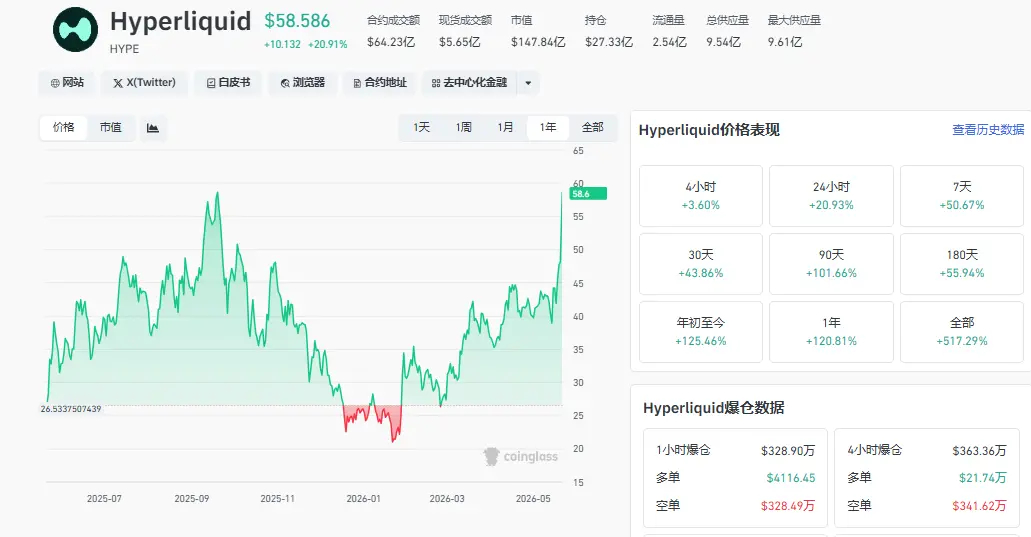
According to Santiment analysis, short squeezes and ETF fund inflows are the direct triggers for this rally.

Over the past few days, a large number of traders bet against HYPE, leading to a significant spike in negative funding rates across various trading platforms. As prices continued to rise, bearish traders were forced to buy back their positions, further driving up the price. Currently, HYPE's open interest remains high at over $1.92 billion, with new traders continuously entering the market, keeping the position scale stable.

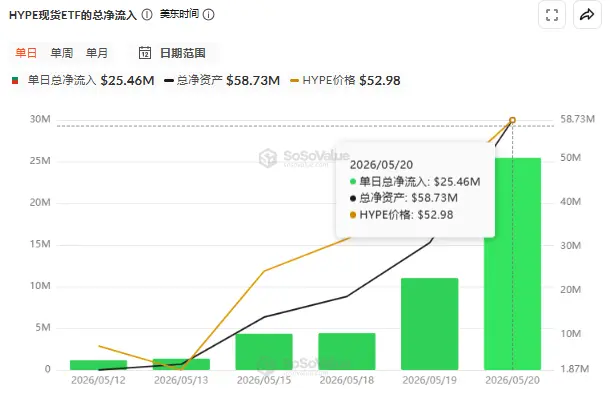
Simultaneously, ETF channels amplified the capital inflows. According to SoSoValue data, two US spot ETFs tracking Hyperliquid (21Shares' THYP and Bitwise's BHYP) recorded a combined net inflow of approximately $22.3 million in their first week of trading, with a single-day net inflow exceeding $25.46 million yesterday.

Analysts noted that in the first 6 trading days, the two Hyperliquid ETFs had 3 days where their market-cap-adjusted net inflows outperformed Bitcoin ETFs, and 5 days outperforming Ethereum ETFs. Among them, Bitwise announced that 10% of BHYP's management fees would be used to continuously buy and stake HYPE on the company's balance sheet.
Notably, over the past three days, a16z, Goldman Sachs, Grayscale, and Galaxy Digital have almost simultaneously made moves, and the largest external holder of HYPE has quietly changed hands.

According to on-chain analyst Ai Yi's monitoring, a16z began a large-scale accumulation mode in August 2025 and has accelerated the pace this year. Currently, it has accumulated 9.18 million HYPE tokens, worth approximately $356 million, at an average price of $38.77. The holdings are stored across dozens of addresses, mostly in a staked state, making it the largest external holder of HYPE by size, surpassing Paradigm, which previously held this position.

In the past 24 hours, a16z withdrew another 2.597 million tokens from major exchanges at an average price of $51.17, with an unrealized profit exceeding $79 million, and continues to add to its position.

Other institutions have also been active. Goldman Sachs recently sold over $152 million worth of XRP, $500 million worth of ETH, and $450 million worth of BTC, switching to buying HYPE. Grayscale-associated addresses bought and staked approximately $24.95 million worth of HYPE in the past week, adding another ~$12.1 million in the last 17 hours. Grayscale filed an S-1 registration for a HYPE spot ETF in January this year.

Additionally, Galaxy Digital-associated wallets bought about $8.8 million worth of HYPE in the past 2 hours; the insider whale agent Garrett Jin, also deposited 10 million USDC into Hyperliquid to directly buy HYPE.

Recently, Bitwise CIO Matt Hougan described HYPE as one of the "most mispriced" assets in the current crypto market. He believes the market still prices HYPE within the framework of a perpetual contract DEX token, while Hyperliquid's true scale far exceeds this framework. Nearly half of the platform's trading volume is now related to non-crypto assets, covering commodities, stock indices, RWAs, and even prediction markets.

Supporting this judgment is the real revenue generated by the Hyperliquid protocol itself. The platform directs 97% of fee revenue into the Assistance Fund, which continuously buys back and burns HYPE in the open market. Since 2025, it has repurchased over $2.49 billion, accounting for 46% of the industry's total buybacks.

On-chain data shows that Hyperliquid recently accounted for over 42% of total blockchain fee revenue across all networks.

Revenue sources are also expanding. Following Coinbase's collaboration with Circle as the USDC Treasury capital deployer, the AQAv2 upgrade was activated, expected to add approximately $440,000 in daily repurchase potential to the protocol from USDC reserve yield.

In terms of RWA, following the launch of HIP-3, trading volume for commodity perpetual contracts like oil, gold, and silver has continued to explode. During the Iran conflict, the daily peak trading volume for crude oil perpetual contracts once exceeded $2.2 billion.

Currently, the open interest for RWA perpetuals on the Hyperliquid platform has reached a new all-time high of $2.6 billion, doubling compared to two months ago. Total users have reached 1.2 million, with a total trading volume of $4.33 trillion, capturing about 70% of the on-chain perpetual DEX market share.

Regarding the HIP-4 prediction market, Hyperliquid officially launched its prediction market function in May this year. The daily trading volume of its first binary contract for BTC price direction was about three times the combined volume of similar markets on Polymarket and Kalshi. ChainCatcher provided detailed analysis in "Can Hyperliquid Win in the Prediction Market?".

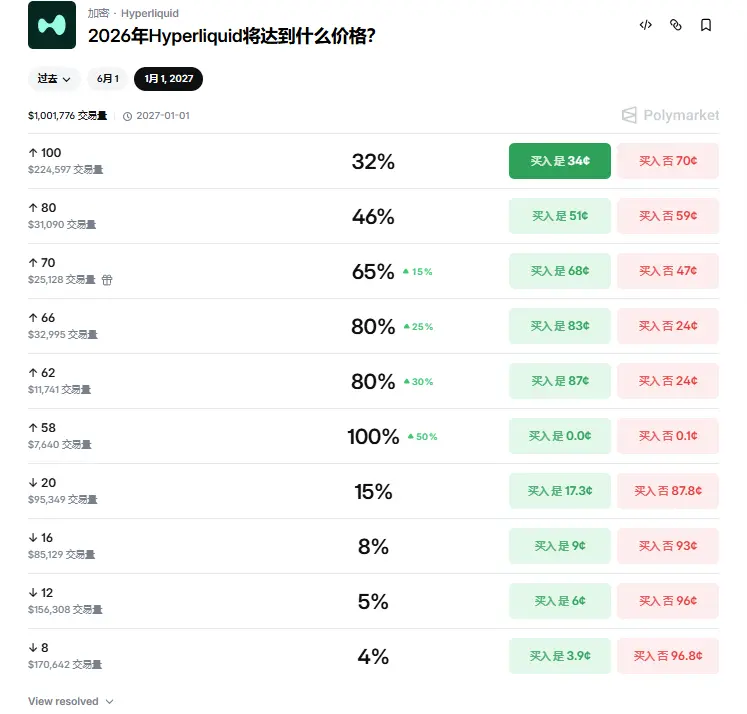
Latest data from Polymarket shows the market is betting an 80% probability that HYPE will reach $66 by the end of 2026, a 46% probability of reaching $80, and a 32% probability of reaching $100.
Previously, BitMEX co-founder Arthur Hayes publicly touted HYPE, suggesting it could reach $150 by August. Today, he posted again on social media, stating that HYPE is getting closer to setting a new all-time high.

Hayes's Maelstrom fund has been selling holdings like ENA, PENDLE, and ETHFI, switching to increase its HYPE position. According to HyperInsight monitoring, Arthur Hayes currently holds 247,334 HYPE, worth $14.5 million, with an unrealized profit exceeding $6.5 million.

However, Hyperliquid's rapid expansion has also brought trouble. Especially after the launch of HIP-3, the trading volume of on-chain commodity contracts quickly eroded the weekend and after-hours trading periods of traditional exchanges, directly stepping on Wall Street's interests.

Recently, CME and ICE have jointly pressured the US CFTC, demanding that Hyperliquid register and accept regulation, arguing that its anonymous, 24/7 trading environment could distort global oil price benchmarks.

Meanwhile, according to Hyperinsight on-chain monitoring, two addresses on Hyperliquid, marked as mainstream market makers, withdrew nearly 90% of BTC and ETH liquidity during the same period, with an estimated total withdrawal of nearly $100 million. ChainCatcher provided detailed analysis of this background in "Hyperliquid Disrupts Wall Street's Game: Regulation Uncertain, Market Makers Flee First?".

As the token price continues to climb, HYPE has achieved a gain of over 125% since the beginning of this year, and its FDV once surpassed SOL, indicating that operational risks can no longer be ignored. According to on-chain monitoring, some large holders have already established hundreds of millions of dollars worth of short positions for hedging while holding substantial HYPE spot positions.

Regulatory uncertainty persists, and the CFTC's stance towards Hyperliquid remains a variable hanging overhead. Beyond the battle between bulls and bears, this game concerning the boundaries of on-chain finance is also far from over.


İlgili Sorular

QAccording to the article, what are the two main catalysts for HYPE's recent price surge to a new high?

AThe two main catalysts are a short squeeze and ETF inflows.

QWhich investment firm has become the largest external holder of HYPE, surpassing Paradigm, and what is the total value of its holdings?

Aa16z has become the largest external holder of HYPE, with total holdings worth approximately $356 million.

QWhat key challenge or risk does Hyperliquid face from traditional financial institutions according to the article?

AHyperliquid faces pressure from traditional institutions like CME and ICE, who are pushing the CFTC to require Hyperliquid to register and be regulated, arguing its 24/7 anonymous trading could distort global oil price benchmarks.

QWhat does Bitwise CIO Matt Hougan describe HYPE as in the current crypto market, and what metric does he use to support his view of Hyperliquid's growth?

AMatt Hougan describes HYPE as one of the 'most mispriced' assets. He supports this by stating that nearly half of Hyperliquid's trading volume is now related to non-crypto assets like commodities, stock indices, and RWAs, moving beyond its original framework as a perps DEX token.

QWhat is the market's probability, according to Polymarket data mentioned in the article, of HYPE reaching $66 by the end of 2026?

AAccording to Polymarket data, the probability of HYPE reaching $66 by the end of 2026 is 80%.

İlgili Okumalar

The Shutdown of Claude Mythos Revealed the True Cost of Renting AI to Me

The sudden shutdown of Claude Mythos this week starkly highlights a critical, often overlooked risk for founders: when your core capability relies entirely on someone else's platform, your fate is not in your own hands. The key question becomes: who truly owns the intelligence your product depends on? For years, the debate around open-source models focused on cost. Now, the evidence is clear: fine-tuned open-source models can achieve frontier-level quality for specific, mission-critical tasks at a fraction of the cost. However, the deeper issue is control. Relying on a third-party API is like renting; it works until the landlord changes the rules, raises the rent, or asks you to leave—as Mythos experienced. The lesson is not to stop using frontier models—they are incredible infrastructure. The goal is ownership. Ownership means starting with a powerful open-source model and shaping it around what makes your company unique: your data, workflows, domain expertise, and definition of "good." Over time, the model becomes less generic and more reflective of your business, creating durable value. The optimistic conclusion is that AI's future doesn't hinge on one superior model. There is no single frontier. The frontier includes proprietary models, models fine-tuned on company-specific knowledge, specialized models for narrow problems, and intelligent routers orchestrating model ensembles. The most interesting development is not models getting smarter, but intelligence becoming increasingly customizable. The winning companies will be those that transform intelligence into a unique, owned asset. Looking ahead, the vision is not one model dominating all, but many teams owning the part of the frontier that matters most to them.

marsbit4 dk önce

The Shutdown of Claude Mythos Revealed the True Cost of Renting AI to Me

marsbit4 dk önce

Tiger Research: U.S. Strategic Bitcoin Reserve - Should the Market Be Happy or Disappointed?

Tiger Research analyzes the evolution of U.S. legislative efforts regarding a strategic Bitcoin reserve, concluding the market impact is limited in the short term but potentially positive long-term. The core event was a March 2025 executive order by former President Trump, which designated confiscated Bitcoin as a strategic reserve and promised not to sell existing holdings (approx. 190k BTC). As it contained no mandate to purchase new Bitcoin, the market reacted negatively, with prices dropping 5.7%. Legislative history shows a significant retreat from initial ambitions. The 2024 "BITCOIN Act" proposed mandatory purchases of 1 million BTC over five years. Reintroduced in 2025, it stalled due to high fiscal costs, concerns over dollar hegemony, and opposition from the Treasury Secretary. The current frontrunner, the 2026 "American Retirement and Monetary Advancement (ARMA) Act," is a compromise. It lacks any purchase requirement, instead focusing on consolidating existing government-held Bitcoin and legally prohibiting its sale for at least 20 years. While ARMA has higher passage odds due to bipartisan support and no purchase mandate, its immediate market effect is neutral. It eliminates potential government selling pressure but creates no new demand. The long-term significance is that formally establishing Bitcoin as a national reserve asset in law could later reignite debates on mandatory purchases. Therefore, the path to a government buyer is longer than initially priced by the market, but the directional narrative remains intact.

marsbit6 dk önce

Tiger Research: U.S. Strategic Bitcoin Reserve - Should the Market Be Happy or Disappointed?

marsbit6 dk önce

US Stock Market Trend (June 16): SpaceX Rises 42% in Two Days, New Fed Chairman Takes Office Today

**U.S. Stocks Trend (June 16): SpaceX Soars 42% in Two Days, New Fed Chair Takes Office Today** Markets surged on Monday following former President Trump's social media announcement of a completed U.S.-Iran deal to reopen the Strait of Hormuz, pending a June 19 signing. The news triggered a broad risk-on rally: oil prices crashed, tech stocks soared, bond yields fell, and defensive sectors lagged. **Market Performance:** The Nasdaq jumped 3.07%, led by semiconductor stocks like Micron (+9.2%). The S&P 500 gained 1.65%, and the Dow rose 0.92% to a record high. However, the Russell 2000 small-cap index underperformed (+0.72%). SpaceX continued its hot streak, rising another 5% pre-market after disclosures of large buys by an Australian billionaire and Cathie Wood's ARK. Boeing also rallied on the transportation optimism. Conversely, energy stocks like Chevron fell over 3% on the oil price plunge, with other defensive sectors also selling off. The day's action showed a clear rotation of funds from energy/defensive plays into AI and tech narratives. **Macro & Outlook:** The VIX fear index fell 8.37%. Treasury yields declined, and WTI crude dropped over 5%. Attention now shifts to a packed schedule: the Bank of Japan is widely expected to hike rates to 1.0% on Tuesday. The Fed's June meeting concludes Wednesday, marking new Chair Wash's debut. While rates are expected to hold, his tone on stubborn inflation and the "dot plot" will be crucial for gauging the 2024 rate path. The formal Iran deal signing is set for Friday. **Trend Perspective:** While the peace deal is a genuine positive, Monday's explosive rally may have gotten ahead of itself, pricing in a swift resolution to inflation concerns. The shortened trading week faces a triple test: BoJ tightening, the Fed's policy stance, and deal implementation details. Tech and semiconductors, which led the surge, remain vulnerable to any disappointment from these key events. The real price discovery begins with the central banks' communications this week.

marsbit27 dk önce

US Stock Market Trend (June 16): SpaceX Rises 42% in Two Days, New Fed Chairman Takes Office Today

marsbit27 dk önce

Xiaohongshu's Second Great Voyage, This Time Sailing Towards AI

Xiaohongshu's Second Voyage: Navigating Towards AI Since ChatGPT's emergence, Xiaohongshu's founder Mao Wenchao has been acutely aware of AI's potential threat, recognizing that the life advice people seek from chatbots overlaps directly with his platform's core business. Founded in 2013 as a PDF shopping guide for Chinese tourists, Xiaohongshu evolved into a massive community where millions share authentic, personal experiences—from product reviews to travel tips. This vast repository of "I've tried this" human judgment became its most valuable asset. However, the rise of AI, which delivers instant answers, challenges the very need for users to sift through numerous personal notes. Fearing its treasure trove of lived experience could become mere training data for others, Xiaohongshu is proactively adapting. In 2026, it established a dedicated AI division (Dots), launched RED Skill to turn user experiences into usable AI tools, and acquired the AI search product "Diandian." Its investments now extend to AI firms like MiniMax and hardware startups, moving upstream to address needs before they even become search queries. The platform's commercialization strategy is also evolving. With a newly acquired payment license and tools like the AIPS model to track consumer decision journeys, Xiaohongshu aims to seamlessly integrate recommendations with transactions, embedding commerce within AI-generated answers. Yet, a critical tension remains. While building smarter machines to organize and leverage its human experiences, Xiaohongshu must prevent AI from drowning out the authentic, flawed, and trustworthy "I've tried this" voices that built its community. Its core challenge is to harness AI's power without letting the map—the machine's perfect, synthesized answer—replace the territory of genuine human experience. This balance between technological advancement and preserving human trust defines its current journey and its future.

marsbit1 saat önce

Xiaohongshu's Second Great Voyage, This Time Sailing Towards AI

marsbit1 saat önce

İşlemler

Spot
Futures

Popüler Makaleler

HYPE Nasıl Satın Alınır

HTX.com’a hoş geldiniz! Hyperliquid (HYPE) satın alma işlemlerini basit ve kullanışlı bir hâle getirdik. Adım adım açıkladığımız rehberimizi takip ederek kripto yolculuğunuza başlayın. 1. Adım: HTX Hesabınızı OluşturunHTX'te ücretsiz bir hesap açmak için e-posta adresinizi veya telefon numaranızı kullanın. Sorunsuzca kaydolun ve tüm özelliklerin kilidini açın. Hesabımı Aç2. Adım: Kripto Satın Al Bölümüne Gidin ve Ödeme Yönteminizi SeçinKredi/Banka Kartı: Visa veya Mastercard'ınızı kullanarak anında Hyperliquid (HYPE) satın alın.Bakiye: Sorunsuz bir şekilde işlem yapmak için HTX hesap bakiyenizdeki fonları kullanın.Üçüncü Taraflar: Kullanımı kolaylaştırmak için Google Pay ve Apple Pay gibi popüler ödeme yöntemlerini ekledik.P2P: HTX'teki diğer kullanıcılarla doğrudan işlem yapın.Borsa Dışı (OTC): Yatırımcılar için kişiye özel hizmetler ve rekabetçi döviz kurları sunuyoruz.3. Adım: Hyperliquid (HYPE) Varlıklarınızı SaklayınHyperliquid (HYPE) satın aldıktan sonra HTX hesabınızda saklayın. Alternatif olarak, blok zinciri transferi yoluyla başka bir yere gönderebilir veya diğer kripto para birimlerini takas etmek için kullanabilirsiniz.4. Adım: Hyperliquid (HYPE) Varlıklarınızla İşlem YapınHTX'in spot piyasasında Hyperliquid (HYPE) ile kolayca işlemler yapın.Hesabınıza erişin, işlem çiftinizi seçin, işlemlerinizi gerçekleştirin ve gerçek zamanlı olarak izleyin. Hem yeni başlayanlar hem de deneyimli yatırımcılar için kullanıcı dostu bir deneyim sunuyoruz.

289 Toplam GörüntülenmeYayınlanma 2024.12.11Güncellenme 2026.06.02

HYPE Nasıl Satın Alınır

Tartışmalar

HTX Topluluğuna hoş geldiniz. Burada, en son platform gelişmeleri hakkında bilgi sahibi olabilir ve profesyonel piyasa görüşlerine erişebilirsiniz. Kullanıcıların HYPE (HYPE) fiyatı hakkındaki görüşleri aşağıda sunulmaktadır.

活动图片