a16z: How Tokenization is Transforming the Nature of Assets in 7 Charts

Odaily星球日报2026-05-24 tarihinde yayınlandı2026-05-24 tarihinde güncellendi

Özet

"Tokenized Assets: How Tokenization Changes the Nature of Assets" by a16z Crypto The market for tokenized assets, excluding stablecoins, has grown from under $3 billion two years ago to over $340 billion today. US Treasury bonds are the primary growth driver, allowing investors to hold yield-bearing assets digitally and enabling more efficient settlement. Other key sectors include private credit (growing fastest), commodities (dominated by gold), and niche financial assets. However, the market remains concentrated in tokenized US Treasuries and gold. A critical insight is that most tokenized assets currently lack "composability." While the total market is large, only a small fraction is actively used within DeFi protocols. For instance, only about 5% of tokenized bonds and a low percentage of tokenized gold are utilized on-chain. In contrast, assets like reinsurance and private credit tokens show much higher on-chain usage rates (84% and 33%, respectively). This highlights a divide: many tokenized assets are merely digital records on a blockchain without enabling new, programmable financial applications. The Pantera Capital Token Native Index indicates over 70% of tokenized assets have minimal on-chain native functionality. Ethereum remains the dominant blockchain for tokenized assets (over $150B), but the ecosystem is diversifying across chains like BNB Chain, Solana, and Stellar, based on factors like cost and compliance. Major institutions forecast massive future growt...

Original: a16z crypto

Compiled | Odaily Planet Daily (@OdailyChina); Translator | Moni

Tokenized Assets, often referred to as "Real World Assets (RWA)", are changing the form of assets, how they flow, and how financial systems are constructed.

Just last month, the market size of tokenized assets surpassed $30 billion and is currently stabilizing around $34 billion (excluding stablecoins). This scale is roughly equivalent to that of a regional bank or a top university endowment fund. While still minuscule compared to the global financial system, it is substantial enough to create real-world impact.

Two years ago, the market size of tokenized assets was less than $3 billion. Since then, the market has undergone a dramatic transformation: the US GENIUS Act brought clearer regulatory frameworks for stablecoins, institutional-grade on-chain infrastructure matured, and a wave of financial institutions began deploying blockchain technology around the same time. It was driven by these factors that the tokenized asset market grew tenfold in less than two years. (Note: Although stablecoins are not included in the above statistics, they have substantially fueled the growth of the entire market by greatly simplifying on-chain payments and settlements.)

This article analyzes the reasons behind the rise of tokenized assets and their future trajectory through 7 charts.

Tokenized Assets Take Off: U.S. Treasuries Become the Biggest Growth Engine

U.S. Treasuries are the primary driver behind the recent growth of the tokenized asset market.

The advantages of tokenized U.S. Treasuries are clear and intuitive: investors can hold robust interest-bearing assets in a digital form, enabling more efficient and flexible trading and transfer. Financial institutions, on the other hand, can achieve efficiency gains in settlement and collateral asset allocation, seamlessly connecting with digital financial markets.
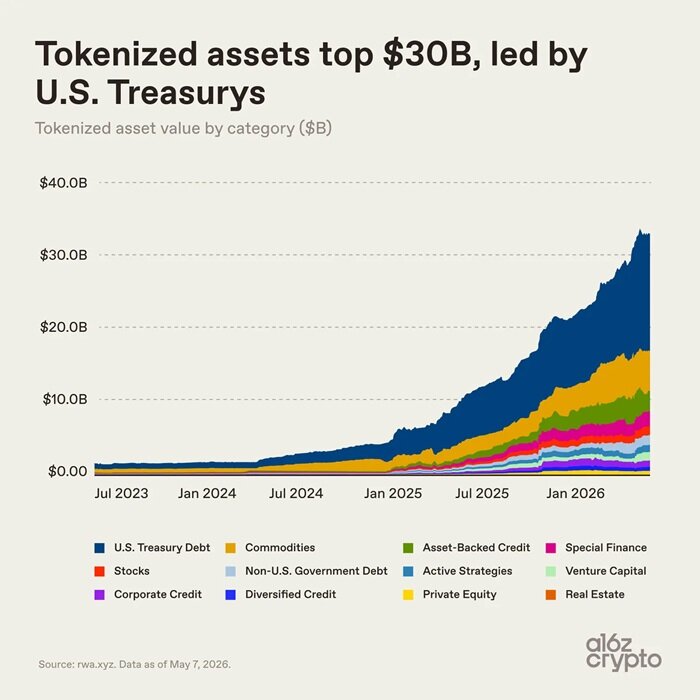
Crypto investors can also leverage tokenized Treasuries to put idle stablecoins to work, earning traditional money market yields. Asset managers like BlackRock and Franklin Templeton have accordingly entered the space, fostering a market with hundreds of billions in potential.
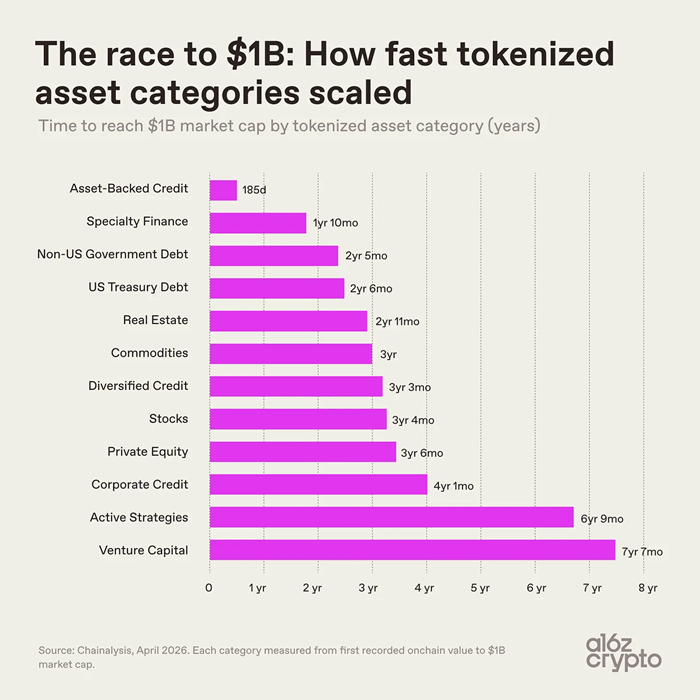
It's important to note that the growth rates of various tokenized asset types vary widely. This stems from differences in the technical and regulatory difficulty of tokenizing different assets, as well as market acceptance post-launch.

  • Asset-backed credit leads the growth by a wide margin. This category mainly includes tokens for Home Equity Lines of Credit (HELOCs) and lending vaults. Niche financial assets like reinsurance contracts and Bitcoin mining notes follow, reaching a $1 billion market cap within two years.
  • Venture capital-related assets took over seven years to break the $10 billion market cap mark. Active strategy-related assets followed a similar timeline. These asset structures are more complex, have longer investment cycles, and face higher operational and regulatory barriers.
  • Treasuries and commodities have a moderate pace of on-chain adoption, reaching a market cap of over $10 billion in 2 to 3 years, and are now mainstream categories.

At the beginning of 2024, Treasuries and commodities accounted for almost the entire tokenized asset market share. Since 2024, the share of credit, niche finance, equities, and other categories has steadily increased, but market concentration remains high. Currently, U.S. tokenized Treasuries and commodities together occupy about two-thirds of the market share.
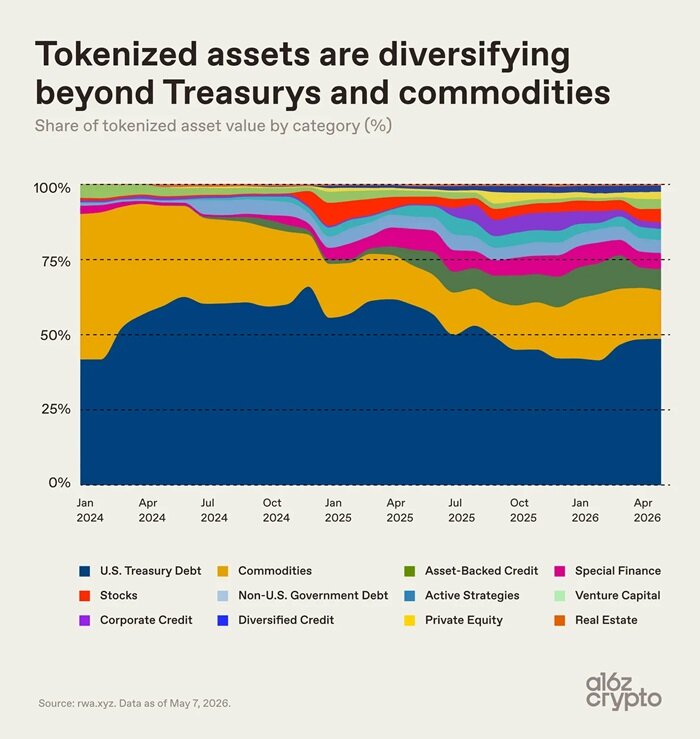
Segmented Landscape of the Tokenized Asset Market

The tokenized commodities sector is highly concentrated internally, with gold tokens dominating the vast majority of the share. The total size is about $5.1 billion, with gold tokens alone amounting to $5 billion. Silver and other commodity tokens are only $57.6 million, accounting for less than 0.01%.

Gold is naturally suited for the tokenized asset model. Currently, the tokenized commodity market is essentially dominated by gold. This is because gold has a globally unified standard, is convenient to store, is not easily perishable, and has long been traded based on entitlements/claims.

Moreover, crypto market investors have historically favored gold assets, with Bitcoin being called digital gold in its early days. Products like Tether Gold (XAUT) and Paxos Gold (PAXG) map ownership of physical gold in vaults onto the blockchain, transforming gold entitlements into digital tokens that can be held in on-chain wallets.
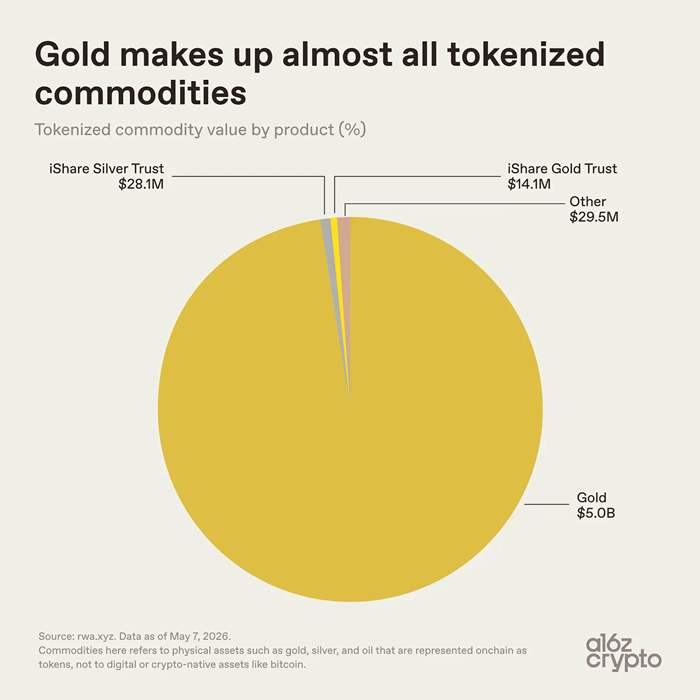
Tokenized assets for crude oil, agricultural products, and emerging categories like energy and computing power have an extremely low market share, and the industry is still in its infancy.

Looking at the distribution across underlying public blockchains, the tokenized asset ecosystem is more diverse. Ethereum, leveraging its DeFi first-mover advantage and institutional adoption foundation, remains the leader, hosting assets worth $15.7 billion, accounting for over half of the market.

The rest of the tokenized asset market is dispersed across multiple public chains: BNB Chain has a tokenized asset market size of about $4 billion, Solana about $2.2 billion, Stellar about $1.7 billion, the Bitcoin sidechain Liquid Network about $1.5 billion, while XRP Ledger, ZKsync Era, and Arbitrum each have tokenized asset sizes close to $1 billion.
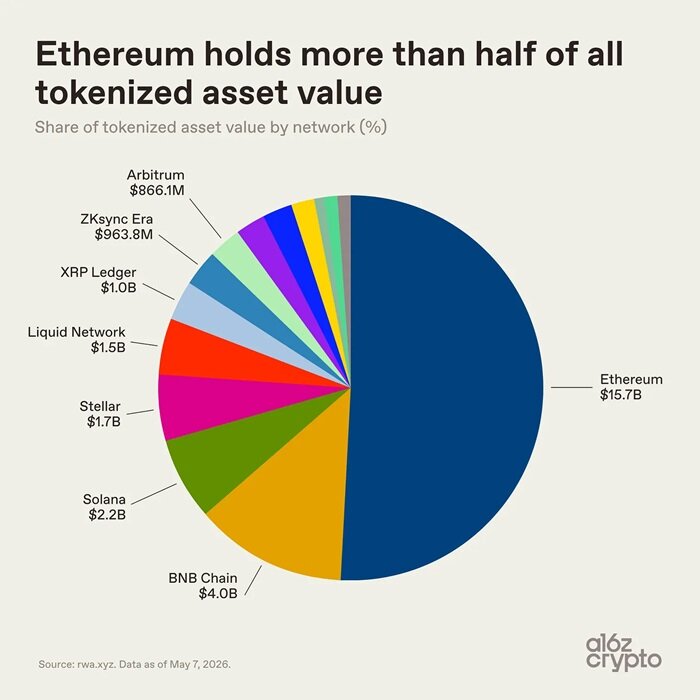
The tokenized asset industry is not consolidated on a single public chain. Assets are distributed across major blockchain ecosystems based on transaction costs, liquidity, regulatory requirements, and business partnerships. However, the most telling data point is not the market size of tokenized assets... but how these assets are used.

Let's delve deeper—

Most Tokenized Assets Are Not Yet "Composable"

Market size is not the only key metric; the actual utility value of assets is more indicative.

Bonds are the largest category of tokenized assets by market cap, valued at $15.2 billion, but only 5% of the circulating supply is used in DeFi protocols, approximately $800 million. The utilization rate of tokenized precious metals is similarly low. Most tokenized assets are used merely for on-chain storage and have not yet become freely combinable, interconnected, reusable financial building blocks.

Smaller tokenized asset categories show a starkly different picture: tokenized reinsurance contracts, with a market cap of $362 million, have an on-chain protocol usage rate as high as 84%; private credit tokens have a usage rate of 33%. These two categories were designed from the outset to fit composable on-chain application scenarios. In contrast, top categories like Treasuries and gold are primarily positioned to simplify holding and transferring assets on-chain without altering their fundamental operational logic. This situation also highlights a core divergence within the tokenized asset industry: the degree of on-chain nativity varies greatly among different tokenized assets.
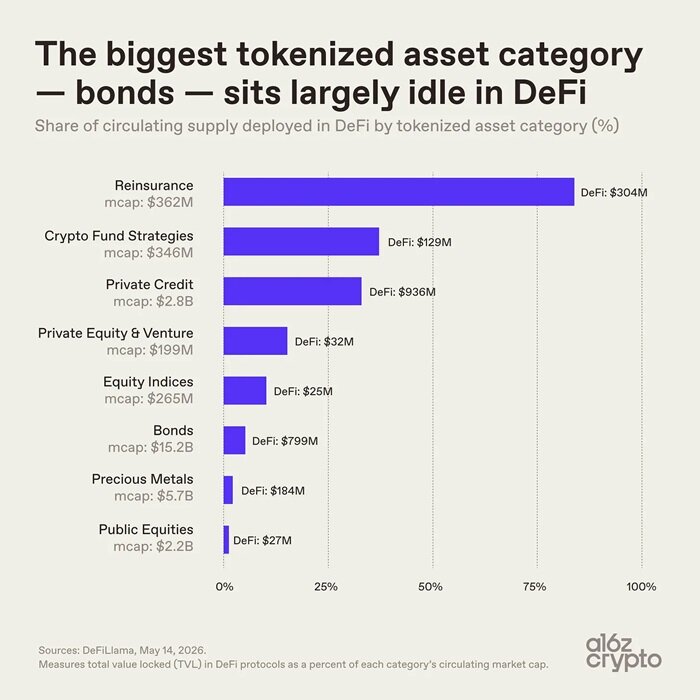
Some assets can be freely transferred and used across chains, while others merely use blockchain as an accounting tool, with limited asset transfer and composability functions. Currently, most tokenized assets are essentially just digitized assets, merely moving ledgers on-chain without unlocking composability potential. Composability is the core value of on-chain finance and a key to upgrading the financial system.

The Pantera Capital Token Native Index shows that over 70% of tokenized assets have the lowest level of on-chain nativity. A large number of tokens are merely digital certificates for offline physical assets, with actual asset control still relying on offline ledgers and intermediaries.

Currently, the tokenized asset industry is still in its early stages of development: one type is digitally recorded assets that are only formally on-chain, and the other is native on-chain assets that deeply integrate with blockchain properties.

The technical infrastructure for on-chain composition is already in place, and asset categories are gradually enriching, but deep integration and application are just beginning.

Future Trends for Tokenized Assets

Industry predictions for the long-term size of the tokenized asset market vary, but the overall consensus is that the market will continue to expand.

  • McKinsey predicts the tokenized asset market will reach $2-4 trillion by 2030.
  • Ark Invest estimates the tokenized asset market could be $1.1 trillion.
  • Boston Consulting Group (BCG) in partnership with Ripple calculates the tokenized asset market will reach $0.94 trillion by 2030 and climb to $1.89 trillion by 2033.
  • Standard Chartered forecasts the tokenized asset market could exceed $3 trillion by 2034.

Based on the above estimates, compared to the current market size of $34 billion, the tokenized asset market has potential for hundred-fold growth in the long term. Of course, the numerical differences don't stem from disagreements about adoption speed, but from different scopes of what is being measured. Each institution's statistical scope differs, covering varying asset classes, whether stablecoins and deposits are included, and the definitional boundaries of tokenization. For example: McKinsey focuses on bonds, credit, funds, and equities; Standard Chartered adds commodities and trade finance; BCG and Ripple additionally include deposits and stablecoins. Although statistical methods differ, the industry unanimously agrees that the scale of tokenized assets will see leapfrog growth.

Looking at the global financial landscape, the current size of tokenized assets remains minuscule.

  • Global bond market size exceeds $140 trillion; tokenized bonds are only $15.2 billion, accounting for 0.01%.
  • Global physical gold market cap reaches several trillion dollars; tokenized gold is $5 billion, accounting for less than 0.02%.
  • Global equity market cap exceeds $100 trillion; tokenized stocks are $1.5 billion, accounting for only 0.001%.
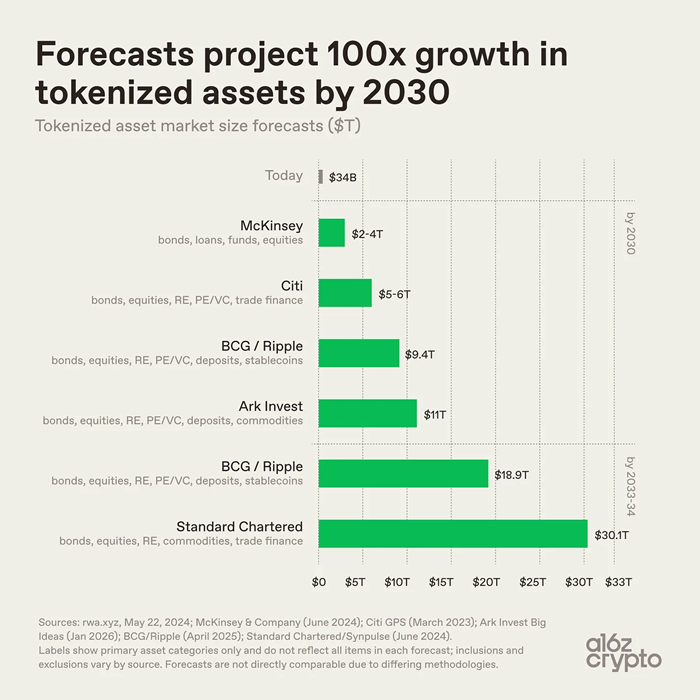
Today, emerging sectors have steadily taken shape. Assets with clear pricing, stable demand, and simple ownership like U.S. Treasuries, gold, and private credit have been the first to go on-chain. Currently, tokenization has not yet disrupted the underlying nature of assets; it mainly optimizes settlement and transfer methods. The deep integration of assets with digital financial systems is still being explored.

Currently, tokenized assets remain more at the digitization level, where assets struggle to achieve programmable, composable applications. The industry's next phase faces hard challenges: bringing more complex parts of the financial system on-chain and integrating tokenized assets more deeply into composable, internet-native financial infrastructure.


İlgili Sorular

QAccording to the article, what is the current approximate market size of tokenized assets (excluding stablecoins), and what is the primary driver behind its recent explosive growth?

AThe current market size of tokenized assets is approximately $34 billion. The primary driver of its recent explosive growth (a 10x increase in less than two years) is the tokenization of US Treasuries.

QWhat are the two main categories of tokenized assets that dominated the market share at the beginning of 2024, and which category currently holds the largest share within the tokenized commodities sector?

AAt the beginning of 2024, US Treasuries and commodities dominated the market share. Within the tokenized commodities sector, gold tokens currently hold the vast majority share, accounting for around $5 billion of the roughly $5.1 billion total.

QThe article states that most tokenized assets currently lack a key property. What is this property, and why is its absence significant for the evolution of the financial system?

AThe key property most tokenized assets currently lack is composability. Its absence is significant because composability is the core value of on-chain finance and a key to upgrading the financial system. While many assets are simply 'digitized' on-chain, they are not yet programmable financial 'Lego blocks' that can be freely combined and reused in DeFi protocols.

QWhat does the Pantera Capital Token Native Index reveal about the majority of tokenized assets regarding their level of 'on-chain nativity'?

AThe Pantera Capital Token Native Index reveals that over 70% of tokenized assets are at the lowest level of on-chain nativity. This means the majority are merely digital representations of off-chain assets, with the actual control and settlement still reliant on traditional off-chain ledgers and intermediaries.

QWhat is the fundamental difference between how tokenized US Treasuries/gold are currently used and how niche assets like reinsurance tokens are used, according to the article?

ATokenized US Treasuries and gold are primarily used for simplified on-chain holding and transfer, essentially just moving accounting ledgers to the blockchain. In contrast, niche assets like reinsurance tokens and private credit tokens are designed from the start for on-chain composable applications, resulting in a very high rate of use within DeFi protocols (e.g., 84% for reinsurance tokens).

İlgili Okumalar

Buyback and Burn: Just Empty Promises? The Unbridgeable Rights Gap Between Tokens and Equity

"Token Repurchase and Burn: An Empty Promise? The Unbridgeable Rights Gap Between Tokens and Equity" Holding company stock grants shareholders residual claim rights - a legally enforceable entitlement to remaining assets after all other obligations are paid. This comes with rights like voting, dividends, and a share in sale proceeds. Crypto protocols have long promised token holders similar benefits: governance participation and a share of future growth. However, this narrative is fundamentally flawed and built on voluntary promises, not enforceable legal rights. The core difference is that token holders lack any legally enforceable claim to a protocol's underlying value or revenues. Common mechanisms like using protocol revenue to buy back and burn tokens are purely discretionary; the team can alter or stop the policy at any time. Token holders have no legal recourse. This rights gap becomes critically apparent when protocols introduce traditional equity alongside tokens, as seen with Venice AI's $65M funding round. Equity investors hold legal contracts with rights to company assets and profits, while token holders' benefits depend entirely on the continued goodwill of the protocol's management. The acquisition of Houdini Swap, where equity holders were paid while token holders received nothing, starkly illustrates this disparity. Upcoming legislation like the CLARITY Act threatens to eliminate the regulatory gray area that has allowed this ambiguous "pseudo-equity" narrative. The Act would classify tokens as either digital commodities (regulated by CFTC) or investment contract assets/securities (regulated by SEC). Protocols aiming for the "digital commodity" classification would be explicitly prohibited from granting token holders any legal claim to corporate revenue, profits, or assets. Promising that tokens will appreciate from protocol profits would likely classify them as securities. Projects like Aave are attempting technical solutions, such as its automated, on-chain "Aavenomics 3.0" buyback mechanism. However, this remains code that the governance body could still vote to change, not an immutable legal contract. The industry faces a clear fork: either acknowledge tokens as digital commodities and stop promising economic rights tied to corporate profits, or formally register tokens as securities and bear the associated compliance burden. The decade-long narrative equating tokens with ownership is built on unenforceable promises. The entry of traditional equity investors with real legal rights exposes this foundational weakness, which may unravel with the next major funding deal.

Foresight News42 dk önce

Buyback and Burn: Just Empty Promises? The Unbridgeable Rights Gap Between Tokens and Equity

Foresight News42 dk önce

Navigating the World of Event Trading: Top 5 Prediction Markets for Every Type of User

The prediction market industry has grown significantly, with trading volumes exceeding $20 billion monthly by mid-2026, driven by sports, politics, and macroeconomics. Success now depends heavily on platform choice and execution logistics. This guide compares five leading networks: **Polymarket**: A high-volume, decentralized platform on Polygon, using USDC for international and crypto-native users. It offers diverse markets but lacks built-in risk tools. **Kalshi**: A CFTC-regulated U.S. exchange for institutional traders, using direct fiat. It leads in regulated volume, especially for major sports and economic events, but has limited contract listings. **Outpoll**: A CeDeFi platform for advanced traders, focusing on professional tools. It uniquely features built-in stop-loss/take-profit orders, 0.1% fees, and full API support, with settlement in USDC. **OG Predictive**: A CFTC-regulated, sports-focused platform from Crypto.com. It offers granular player props and a flat fee structure, appealing to long-term position traders. **Manifold Markets**: A play-money, no-KYC platform for casual users and developers. It allows user-generated markets on any topic with zero fees, serving as a sandbox for strategy testing. Key differentiators include regulatory models (regulated vs. decentralized), funding (fiat vs. crypto), order types, risk management features, API access, and mobile support. The conclusion emphasizes that in today's event trading, profitability hinges not just on accurate predictions but on optimizing execution through platform infrastructure, liquidity, fees, and risk tools.

TheNewsCrypto1 saat önce

Navigating the World of Event Trading: Top 5 Prediction Markets for Every Type of User

TheNewsCrypto1 saat önce

Why Are Large-Scale Crypto Conferences No Longer Glamorous?

Why Are Major Crypto Conferences Losing Their Allure? A growing sense of fatigue surrounds large in-person crypto conferences, with many founders and investors now avoiding events they would never have missed just two years ago. While complaints cite declining ROI and information quality, the root causes are more structural. Crypto, global from inception, once relied on these mega-conferences as neutral hubs for essential face-to-face connections. However, their core value has been fragmented. High-quality participants—developers, investors—have largely migrated to smaller, private side-events, leaving main stages for repetitive content already shared online. The main conference often just becomes the excuse for being in the same city, with attendees scrambling between exclusive dinners and micro-events. While these intimate gatherings offer signal-rich conversations, they lose the "serendipitous encounters" of large conferences and can create insular echo chambers, especially as talent concentrates in hubs like New York. Meanwhile, invite-only, high-caliber summits are rising, offering quality and scale but at the cost of accessibility and crypto's early egalitarian ethos. This shift isn't unique to crypto; AI events in San Francisco show a similar trend. The perception of higher-value interactions drives core groups towards smaller, private settings, potentially creating a vicious cycle that drains larger events of their vitality. Yet, a more optimistic view exists. The apparent decline of crypto-centric events may signal industry maturation. Leading projects are now focused outward—on stablecoins for traditional finance, consumer-facing digital banks, or real-world assets. Crypto topics are increasingly integrated into mainstream finance and tech conferences. Just as dedicated "internet conferences" faded, dedicated crypto summits may become redundant as the technology embeds into every sector. The future likely holds far fewer large, inward-looking crypto conferences. The industry has moved past needing frequent self-congratulatory gatherings. True growth lies in engaging with the broader economy. This evolution towards private networking and mainstream integration, for better or worse, is a mark of the industry coming of age.

marsbit1 saat önce

Why Are Large-Scale Crypto Conferences No Longer Glamorous?

marsbit1 saat önce

Coin & Stock Compass: Global Listed Companies Net Sold $85.45 Million in BTC Last Week, Strategy's Dollar Reserves Scale Up to $3 Billion (July 14)

Global Public Companies Net Sell $85.45 Million in BTC; Strategy's Dollar Reserves Hit $3 Billion (July 14) Last week saw a significant net sell-off of Bitcoin by global public companies, excluding miners, totaling $85.45 million—a 908.42% decrease from the prior week. Major buyers like Strategy (formerly MicroStrategy) and Japan's Metaplanet were notably absent from the market. However, two companies, Brazil's OrangeBTC and asset manager Strive, made purchases, adding 8 and 18 BTC, respectively. The aggregate BTC holdings of tracked public companies now stand at 1,139,635 BTC, valued at approximately $71.38 billion and representing 5.7% of Bitcoin's circulating market cap. In corporate updates, Strategy announced its dollar reserves have grown by $450 million to reach $3 billion, while its BTC holdings remain at 843,775 coins. Hyperscale Data increased its BTC reserves past 1,000 coins. Strategy will report its Q2 2026 financial results on July 30. Mining firm Cleanspark added 454 BTC, bringing its total to 13,924 BTC. Conversely, BitFuFu sold 184 BTC, Bitdeer maintained zero net BTC holdings after selling its weekly production, and Empery Digital sold 1,400 BTC to fund an AI data center project and repay debt. Overall, public companies purchased 110,000 BTC in Q2 2026, 1.8 times the volume of the previous two quarters combined. In other cryptocurrency-related corporate news, Ethereum treasury company Bitmine increased its ETH holdings by 27,801 coins, with total staked ETH exceeding 4.9 million. Solana-focused company DFDV transferred daily operations of its meme coin DONT to an independent team. BNB treasury company BNB Plus was delisted from Nasdaq for failing to meet the $1 minimum bid price and moved to trade on the OTCQB market under the symbol BNBX. The broader equity markets showed mixed signals. Bank of America warned that bullish investor positioning indicated a potential pullback risk for stocks. In contrast, Morgan Stanley predicted the ongoing earnings season could broaden market gains beyond tech giants. Specific regional highlights included continued foreign investor outflows from South Korean stocks, pressure on US equities, and the upcoming IPO of Chinese memory chip maker ChangXin Memory. Most crypto-linked stocks remained in a downtrend.

marsbit1 saat önce

Coin & Stock Compass: Global Listed Companies Net Sold $85.45 Million in BTC Last Week, Strategy's Dollar Reserves Scale Up to $3 Billion (July 14)

marsbit1 saat önce

İşlemler

Spot
活动图片