a16z Crypto Partner: Cash Flow is the Moat

链捕手2026-06-12 tarihinde yayınlandı2026-06-12 tarihinde güncellendi

Özet

Title: a16z Crypto Partner: Cash Flow Is the Moat Summary: Historically, many of the best businesses were built by positioning themselves within the "flow of funds"—facilitating the creation and transfer of value within a network and taking a cut. The more value flows through, the larger the business grows. Cryptocurrency is the first modern technology natively built for this purpose. If a startup hasn't architected its product and business to benefit from these principles, it's missing a major opportunity. Thanks to stablecoins, capital and value now move at internet speed—globally settled, 24/7, with end-to-end programmability. Blockchains are inherently network businesses. Each transaction settles on a shared ledger, and every new participant strengthens the same underlying network. Network tokens amplify this effect. A well-designed token aligns all participants—users, developers, suppliers, validators, the protocol—around a single goal: growing the network. Participants are paid proportionally to their contributions, creating a transparent feedback loop between value flowing in the system and value accumulating to those building it. This model isn't new; crypto simply makes it more accessible and scalable for startups. The pattern is consistent: find where value flows and position yourself in the middle. Examples range from railroads (earning from freight) and Standard Oil to Google, Meta, and AWS (earning from attention, commerce, and compute flows, respectively). Fi...

Author: Jason Rosenthal, a16z Operating Partner

Compiled by: Hu Tao, ChainCatcher Highlights

Many of history's greatest businesses were built by positioning themselves in the "flow of funds" – facilitating the creation and transfer of value within a network and taking a cut. The more value that flows through the network, the larger the business typically grows.

Cryptocurrency is the first modern technology natively built for this purpose. If your startup hasn't yet architected its product and business to benefit from these principles, you're missing an opportunity. Thanks to stablecoins, funds and value now flow at internet speed – 24/7, with global settlement, and end-to-end programmability. Payment rails are frictionless, unit economics are transparent, and every dollar flowing globally is addressable.

The Specific Model

Blockchains are network businesses by design. Every transaction settles on a shared ledger. Every new participant strengthens the same underlying network that the next builder can use. As more people use and build on it, the network becomes more valuable for all users.

Most companies spend years manufacturing network effects on top of traditional infrastructure. Crypto founders inherit them as starting conditions.

Network tokens amplify this. A well-designed token aligns users, developers, suppliers, validators, and the protocol around a single outcome—growing the network—and pays each proportionally to their contribution. But the protocol's revenue belongs to the people who use it. No partner rebates, no side deals. Just a feedback loop between value flowing in the system and value accumulating in the hands of the people building and growing it.

This isn't a new model. Cryptocurrency just makes it accessible and scalable for startups for the first time.

Railroads didn't make money on locomotives. They made money on every ton of grain, coal, and steel that crossed their tracks. Standard Oil, U.S. Steel, and AT&T were companies in the flow of funds. Google and Meta replaced print and TV not because their ads were better, but because they sat at the choke point where attention turned into commerce, enabling them to take a cut of trillions in commercial intent. AWS is in the flow of compute.

The pattern is consistent: find where value moves and put yourself in the middle.
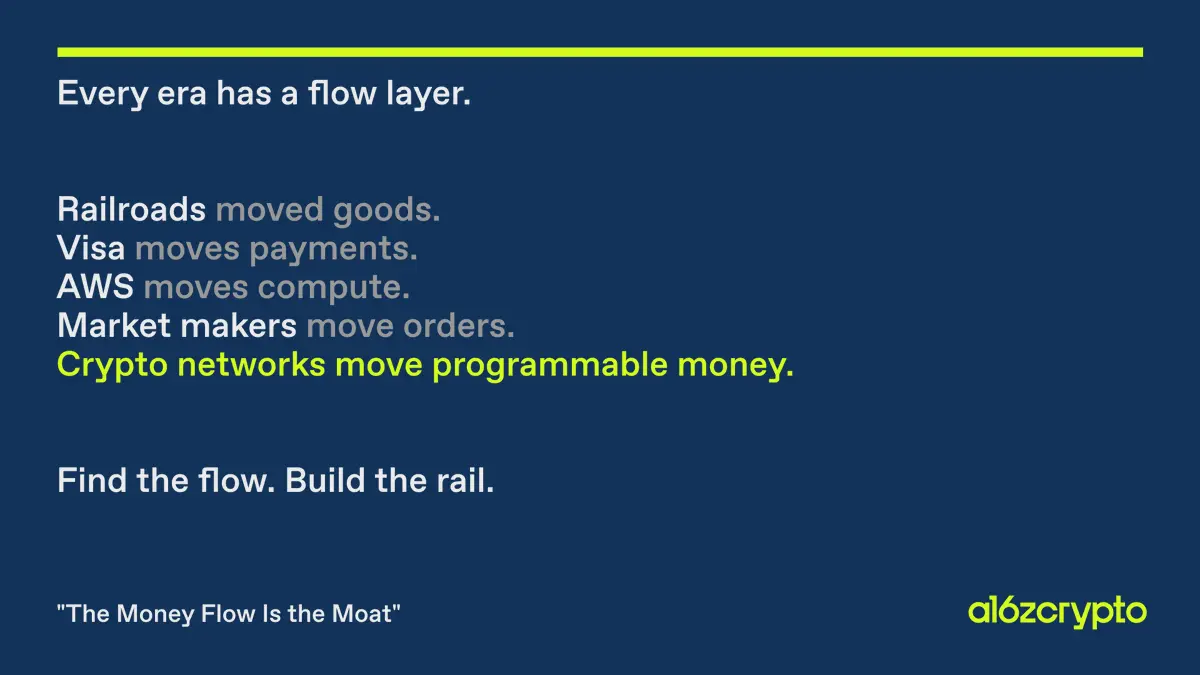
Financial markets make this model even clearer. Visa processed $15.7 trillion in payment volume in FY 2024 and reported $35.9 billion in net income. Jane Street posted $20.5 billion in net trading income last year – more than Citigroup or Bank of America. The top five US market makers handled 87% of order flow payment: they don't predict markets; they sit in the flow of every order and earn more as volume grows.

These businesses share another trait: network effects. Visa is more useful to more merchants because there are more cards; more useful to more cardholders because more merchants accept it. Same with order flow – each additional broker tightens spreads, attracting more brokers, which attracts more flow.

Flow of funds plus network effects is one of the most durable business structures ever.

Your Margin Is My Opportunity

Bezos called it “your margin is my opportunity.” He was talking about retail, but it applies even more to traditional financial services – the world's largest pool of profit extraction. Payments, custody, lending, FX, securitization, settlement, market making, without exception. Visa and Mastercard charge 2–3% transaction fees on networks designed in the 1960s. Remittance corridors take 6–9%. Prime brokers and custodians take a piece of every securities trade. Even after the US moved to T+1 settlement in 2024, funds still sit idle overnight as a structural tax on everyone involved.

Each of these margins is a target. Compress the cost, increase the speed, and potentially expand the whole market. Stripe and Square proved this was possible in payments.

Crypto founders have the opportunity to build the next version – programmable, instant, global, and natively in the flow of funds.

And the frontier extends far beyond financial services. Compute and GPU markets. Memory chips. AI training data. Energy. Robotics. Space. Rare earth metals. Each is a category where global value can begin to move at volumes the existing rails were never designed to carry.

Each is greenfield for building a flow-of-funds business on programmable infrastructure from the ground up. These markets have no existing rails, no entrenched intermediaries, and nothing to defend.

As a founder, ask yourself:

1. Are you in the flow of funds today?

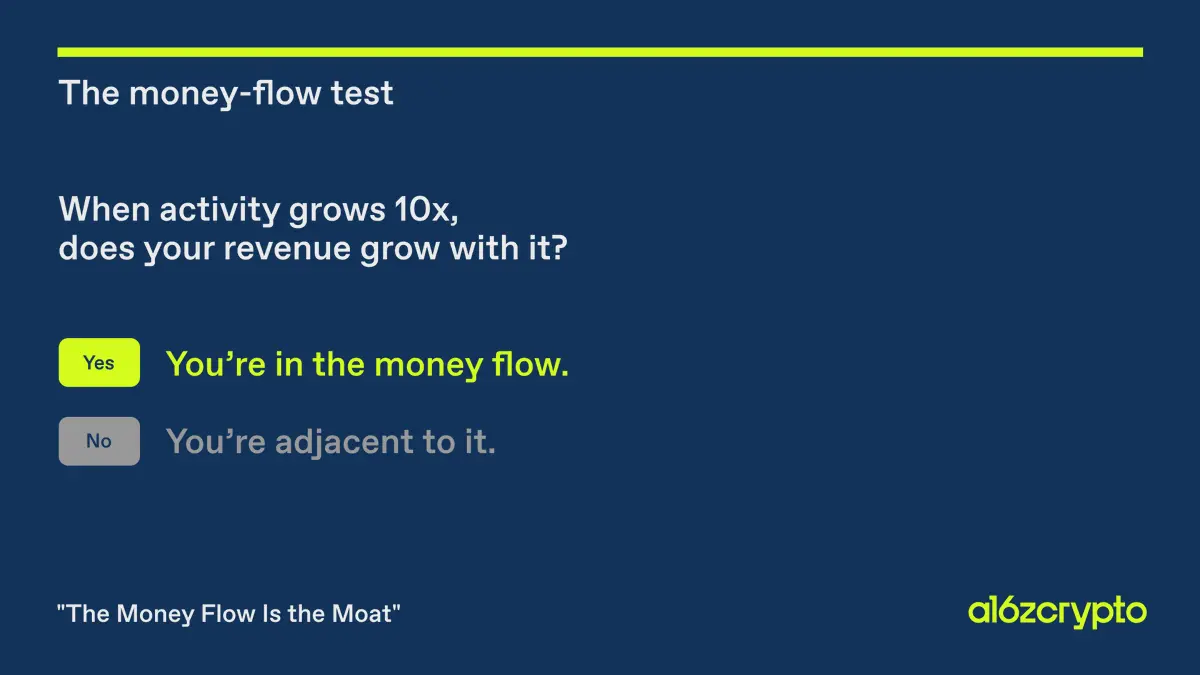
2. When the value of activity on your product grows 10x, does your revenue grow with it?

3. If you're building a new product, where in your target market is the profit extraction highest relative to the value being created?
The opportunity is there. Take it, get into the new flow, and let the network compound from there.

İlgili Sorular

QAccording to the article, what is the core principle shared by historically great businesses like railroads, Google, Meta, and AWS?

AThe core principle is that historically great businesses position themselves within the 'flow of funds.' They facilitate the creation and transfer of value within a network and capture a portion of it. The more value that flows through the network, the larger the business typically becomes.

QHow does the article describe the unique advantage that cryptocurrency provides for startups regarding business models?

ACryptocurrency is the first modern technology natively built for the 'flow of funds' model. It enables value to move at internet speed—24/7, settled globally, with end-to-end programmability. This gives startups the advantage of inheriting network effects from the start and building on programmable infrastructure where payment rails are frictionless.

QWhat two powerful business concepts, when combined, does the article claim create one of the most durable business structures ever?

AThe combination of being in the 'flow of funds' and having 'network effects' creates one of the most durable business structures ever. The flow of funds generates revenue, while network effects make the service more valuable as more participants join, creating a powerful, self-reinforcing cycle.

QWhat does the article suggest is the primary target for crypto founders looking to disrupt traditional industries?

AThe primary target is the high-profit margins extracted by entrenched intermediaries in traditional industries, especially in financial services (payments, custody, lending, FX, etc.). The article quotes Jeff Bezos: 'Your margin is my opportunity.' Crypto founders can build cheaper, faster, and more programmable alternatives.

QWhat are the three key questions the article advises founders to ask themselves about their business?

A1. Are you in the flow of funds today? 2. When the value of activity on your product grows 10x, does your revenue scale with it? 3. If you're building a new product, where in your target market is profit extraction highest relative to the value being created?

İlgili Okumalar

M&A Deals in the Crypto Market Are Unusually Active

Title: M&A Activity in Crypto Market Becomes Unusually Active A rare signal is emerging in the crypto primary market: mergers and acquisitions (M&A) are nearing half of all financing deals. According to RootData, this month, M&A cases in the crypto industry reached 10, while financing rounds numbered only 14, meaning M&A accounts for approximately 42% of primary market transactions—the highest level in history. This does not signal a sudden industry boom. Instead, the rapid rise in M&A share primarily reflects the continued downturn in the financing market. Since November 2024, monthly crypto M&A deals have remained between 10-20, while financing deals have plummeted from around 100 to about 50, possibly hitting a new low this month. For project teams, this means the traditional path of relying on narratives, token expectations, and ecosystem subsidies to maintain valuations is narrowing. For leading companies, it presents a rare window to acquire teams, licenses, technology, liquidity, and market access at lower prices, with less competition and stronger bargaining power. Key active buyers include Coinbase, Kraken, Ripple, MoonPay, Polymarket, Kaiko, Sol Strategies, GSR, Keyrock, Jupiter, Paxos, and Ondo Finance. Their M&A logic is consistent: acquiring key capabilities at lower costs during the industry downturn. This is driven by more attractive valuations, reduced time and trial-and-error costs, the acquisition of licenses and compliance resources, and the integration of industry upstream and downstream segments. Current M&A focuses are concentrated in four areas: trading infrastructure (e.g., Coinbase acquiring Deribit, Kraken acquiring NinjaTrader), payments and stablecoins (e.g., MoonPay, Ripple expanding payment networks), compliance licenses, and asset issuance/distribution (e.g., acquisitions related to RWA and token issuance platforms like Coinbase's purchases of Liquifi and Echo). The rise in M&A is altering the primary market's exit logic. It provides an alternative path to the token-dependent model, encouraging teams to build tangible products, revenue, and strategic value that can be integrated. This could inject confidence into the market, showing that asset buyers and exit possibilities still exist, albeit with a stricter focus on real utility. However, this trend also indicates the crypto industry is becoming more centralized. As asset issuance, trading, market-making, custody, payments, and data gradually consolidate in the hands of a few major players, the industry's initial emphasis on openness and anti-monopoly is being reshaped by commercial realities. Coupled with rising compliance barriers, this signals the end of the low-barrier era for crypto entrepreneurship.

链捕手25 dk önce

M&A Deals in the Crypto Market Are Unusually Active

链捕手25 dk önce

M&A Deals Are Exceptionally Active in the Crypto Market

Mergers and acquisitions (M&A) activity in the cryptocurrency primary market has reached a historic high, accounting for approximately 42% of total deals in the current month, nearly matching the number of financing rounds. This shift does not signal a new boom cycle but rather reflects a severe contraction in the venture capital funding environment. As financing dwindles, established industry giants—including major exchanges, payment firms, and infrastructure providers—are seizing the opportunity to acquire strategic assets at lower valuations. Key drivers behind the surge in M&A include depressed project valuations, the need to quickly acquire talent and technology to capture short market windows, the pursuit of crucial regulatory licenses, and the strategic expansion into adjacent business verticals such as derivatives, payments, stablecoins, and real-world asset (RWA) issuance. Major acquisitions, like Coinbase's purchase of Deribit and Kraken's acquisition of NinjaTrader, exemplify the push to expand into high-margin areas like derivatives and multi-asset trading. This trend is reshaping the industry's exit landscape, offering an alternative to token-based exits and incentivizing startups to build tangible products and revenue streams with inherent strategic value for acquisition. However, it also points toward increasing centralization, as critical functions—trading, custody, payments, compliance—become concentrated within a few large, well-capitalized platforms, potentially raising barriers to entry for new ventures.

marsbit26 dk önce

M&A Deals Are Exceptionally Active in the Crypto Market

marsbit26 dk önce

Solana Privacy Ecosystem Panorama: A Complete Privacy Stack from Compute to AI

**Title: The Solana Privacy Ecosystem: A Full-Stack View from Compute to AI** **Summary:** This article provides a comprehensive overview of the emerging privacy landscape on the Solana blockchain, characterizing it as still in early development. It identifies two primary verticals—Neobanks and Private DeFi—as key drivers, while noting gaps in tooling and user experience. The discussion centers on two main approaches to private computation: Arcium, which utilizes Multi-Party Computation (MPC) networks (Multi-Party eXecution Environments) to process encrypted data with final settlement on Solana; and Magic Block, which leverages Trusted Execution Environments (TEEs) via its Private Ephemeral Rollup (PER). Both enable confidential applications like dark pools and private DeFi with minimal code changes. Building on this infrastructure, projects are creating privacy-focused applications. Umbra, built on Arcium, offers Encrypted Token Accounts (ETAs) for private balances, transfers, and selective disclosure for compliance. Other wallets like Privacy Cash and Hush provide mixer-like functionality for SOL. For private trading, encifherio uses TEEs to encrypt swap details routed through Jupiter, while VanishTrade and Darklake focus on shielding transaction intent and liquidity routing, with Darklake introducing a "blind slippage pool" to prevent front-running. Further applications include private prediction markets (e.g., Melee Markets using Arcium's encrypted order books) and private AI. Loyal exemplifies the latter, using both Magic Block and Arcium to enable decentralized AI agents that store user data, conversations, and transactions confidentially on-chain. The article concludes by framing privacy not as a single technology but as an evolving "ultimate privacy stack," with experts like Helius's Mert envisioning a future combination of Fully Homomorphic Encryption (FHE) and Zero-Knowledge proofs (ZK). Helius Privacy itself is developing a ZK-based UTXO privacy layer for Solana.

Foresight News31 dk önce

Solana Privacy Ecosystem Panorama: A Complete Privacy Stack from Compute to AI

Foresight News31 dk önce

İşlemler

Spot
Futures

Popüler Makaleler

FLOW Nasıl Satın Alınır

HTX.com’a hoş geldiniz! Flow (FLOW) satın alma işlemlerini basit ve kullanışlı bir hâle getirdik. Adım adım açıkladığımız rehberimizi takip ederek kripto yolculuğunuza başlayın. 1. Adım: HTX Hesabınızı OluşturunHTX'te ücretsiz bir hesap açmak için e-posta adresinizi veya telefon numaranızı kullanın. Sorunsuzca kaydolun ve tüm özelliklerin kilidini açın. Hesabımı Aç2. Adım: Kripto Satın Al Bölümüne Gidin ve Ödeme Yönteminizi SeçinKredi/Banka Kartı: Visa veya Mastercard'ınızı kullanarak anında Flow (FLOW) satın alın.Bakiye: Sorunsuz bir şekilde işlem yapmak için HTX hesap bakiyenizdeki fonları kullanın.Üçüncü Taraflar: Kullanımı kolaylaştırmak için Google Pay ve Apple Pay gibi popüler ödeme yöntemlerini ekledik.P2P: HTX'teki diğer kullanıcılarla doğrudan işlem yapın.Borsa Dışı (OTC): Yatırımcılar için kişiye özel hizmetler ve rekabetçi döviz kurları sunuyoruz.3. Adım: Flow (FLOW) Varlıklarınızı SaklayınFlow (FLOW) satın aldıktan sonra HTX hesabınızda saklayın. Alternatif olarak, blok zinciri transferi yoluyla başka bir yere gönderebilir veya diğer kripto para birimlerini takas etmek için kullanabilirsiniz.4. Adım: Flow (FLOW) Varlıklarınızla İşlem YapınHTX'in spot piyasasında Flow (FLOW) ile kolayca işlemler yapın.Hesabınıza erişin, işlem çiftinizi seçin, işlemlerinizi gerçekleştirin ve gerçek zamanlı olarak izleyin. Hem yeni başlayanlar hem de deneyimli yatırımcılar için kullanıcı dostu bir deneyim sunuyoruz.

275 Toplam GörüntülenmeYayınlanma 2024.12.10Güncellenme 2026.06.02

FLOW Nasıl Satın Alınır

Tartışmalar

HTX Topluluğuna hoş geldiniz. Burada, en son platform gelişmeleri hakkında bilgi sahibi olabilir ve profesyonel piyasa görüşlerine erişebilirsiniz. Kullanıcıların FLOW (FLOW) fiyatı hakkındaki görüşleri aşağıda sunulmaktadır.

活动图片