a16z Crypto Partner: Cash Flow is the Moat

marsbit2026-06-12 tarihinde yayınlandı2026-06-12 tarihinde güncellendi

Özet

Cash Flow as the Moat: A Playbook for Crypto Founders Historically, the most enduring businesses have been built by positioning themselves within the "flow of funds"—facilitating the creation and transfer of value in a network and extracting a portion of it. Cryptocurrency is the first modern technology natively built for this purpose. For startups, failing to architect products and businesses to leverage these principles means missing a major opportunity. Blockchains are inherently network businesses. Each transaction settles on a shared ledger, and every new participant strengthens the underlying network for all. Well-designed network tokens amplify this by aligning users, developers, and validators around growing the network, with value flowing back to contributors in a transparent feedback loop. This model is not new; companies from railroads and Standard Oil to Google, Meta, and AWS have thrived by inserting themselves into critical flows of value (goods, attention, compute). Financial markets make it even clearer: firms like Visa and major market makers generate immense revenue not by predicting markets but by being in the path of transactions. The combination of fund flow and network effects creates one of the most durable business structures. The high margins in traditional finance (payments, custody, lending, FX) represent prime targets. Crypto founders have the opportunity to build the next version—programmable, instant, global, and natively in the flow of funds...

Author: Jason Rosenthal, a16z Operating Partner

Translation: Hu Tao, ChainCatcher Selection

Many of history's greatest businesses were built by positioning themselves in the "flow of funds"—facilitating the creation and transfer of value within a network and taking a cut of it. The more value that flows through the network, the larger the business typically becomes.

Cryptocurrency is the first modern technology natively built for this purpose. If your startup hasn't yet architected its product and business to benefit from these principles, you're missing an opportunity. Thanks to stablecoins, capital and value now flow at internet speed—settling globally, 24/7, with end-to-end programmability. Payment channels are unobstructed, unit economics are transparent, and every dollar flowing anywhere in the world is reachable.

The Model

Blockchains are network businesses by design. Every transaction settles on a shared ledger. Each new participant reinforces the same underlying network that the next builder can use. As more people use and build on it, the network becomes more valuable to all users.

Most companies spend years manufacturing network effects on top of traditional infrastructure. Crypto founders inherit them as a starting condition.

Network tokens amplify this. Well-designed tokens can align users, developers, suppliers, validators, and protocols around a single outcome—growing the network—and pay proportionally to each participant's contribution. But the protocol's revenue belongs to the people who use it. No partner rebates, no side deals. Just a feedback loop between value flowing through the system and value accruing to the hands of those building and growing it.

This isn't a new model. Cryptocurrency just makes it accessible and scalable for startups for the first time.

Railroads didn't make money from locomotives. They made money from every ton of grain, coal, and steel that crossed their tracks. Standard Oil, U.S. Steel, and AT&T were all companies in the flow of funds. Google and Meta displaced print and TV not because their ads were better, but because they sat at the chokepoint where attention converts to commerce, enabling them to take a cut of trillions in commercial intent. AWS is in the flow of computation.

The model is consistent: find where value flows, and position yourself in the middle of it.
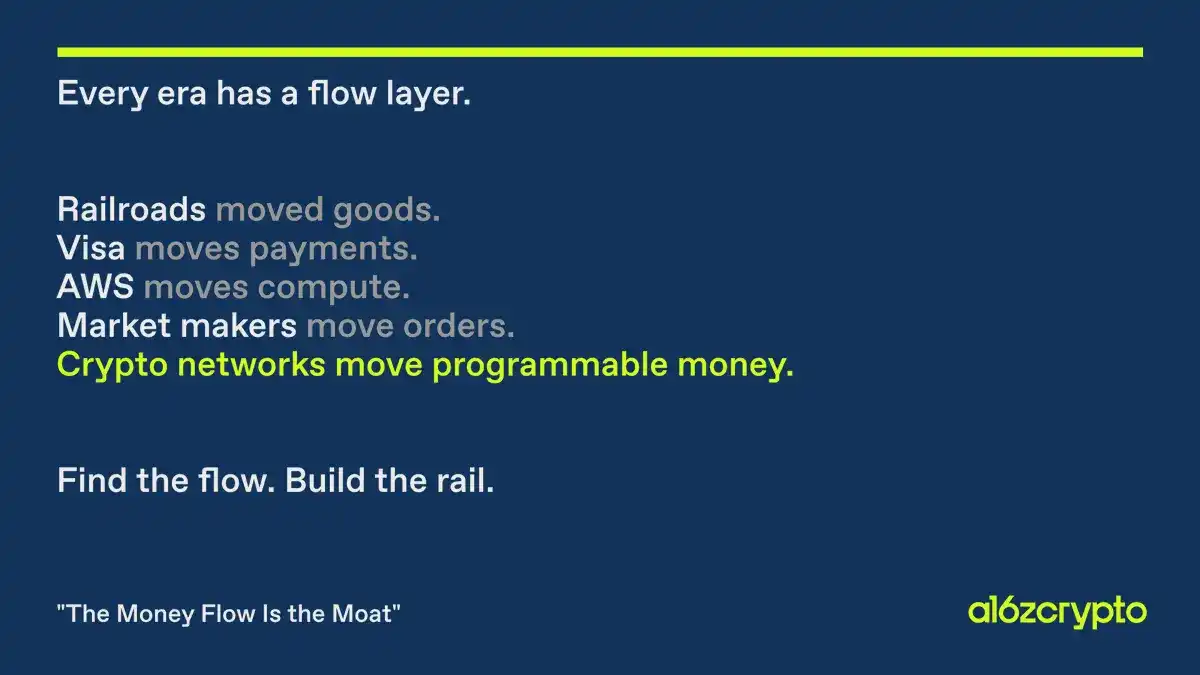
Financial markets make this model even clearer. Visa processed $15.7 trillion in payment volume in FY2024, reporting $35.9 billion in net revenue. Jane Street posted $20.5 billion in net trading revenue last year—more than Citigroup or Bank of America. The top five U.S. market makers handled 87% of order flow payment: they don't predict the market; they sit in the flow of every order and earn more as trading volume grows.

These businesses share another commonality: network effects. Visa is more useful to more merchants because there are more cards; more useful to more cardholders because more merchants accept it. It's the same with order flow—each additional broker narrows spreads, attracting more brokers, which attracts more flow.

The flow of funds plus network effects is one of the most durable business structures ever.

Your Margin is My Opportunity

Bezos called it "your margin is my opportunity." He was talking about retail, but it applies even more to traditional financial services—the world's largest pool of margin extraction. Payments, custody, lending, FX, securitization, settlement, market making—all of it. Visa and Mastercard charge 2-3% transaction fees on networks designed in the 1960s. Remittance corridors charge 6-9%. Prime brokers and custodians take a piece of every securities trade. Even after the U.S. shifted to T+1 settlement in 2024, money still sits idle overnight as a structural tax on every participant.

Each of these margins is a target. Compress cost, increase speed, and potentially expand the entire market. Stripe and Square proved this is possible in payments.

Crypto founders have the opportunity to build the next version—programmable, instant, global, and natively in the flow of funds.

And the frontier extends far beyond financial services. Compute and GPU markets. Memory chips. AI training data. Energy. Robotics. Space. Rare earth metals. Each category is an area where global value can begin to flow at volumes the existing rails were never designed to handle.

Each is an open field for building flow-of-funds businesses from the ground up on programmable infrastructure. These markets have no existing rails, no entrenched intermediaries, and nothing to defend.

As a founder, ask yourself:

1. Are you in the flow of funds today?

2. When the value of activity on your product grows 10x, does your revenue grow with it?

3. If you're building a new product, where in your target market is the margin extraction highest relative to the value being created?
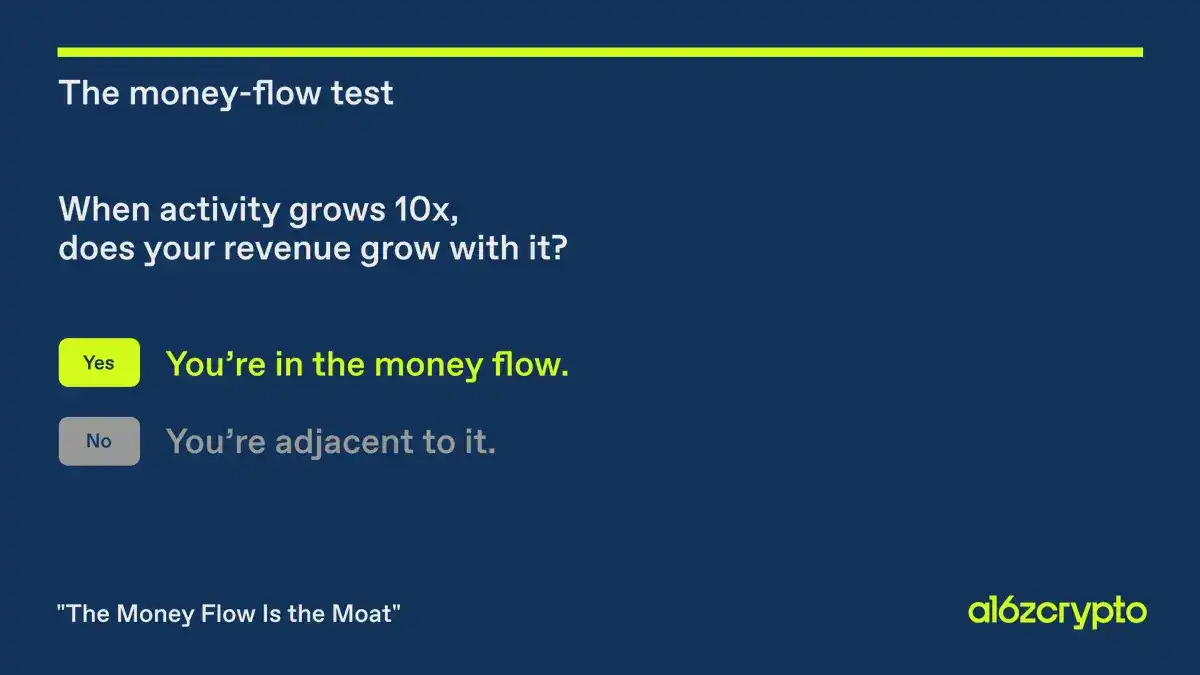
The opportunity is there. Seize it, ride the new flow, and let the network compound from there.


Trend Kriptolar

İlgili Sorular

QAccording to the article, what are the core characteristics of successful business models historically?

AHistorically, many of the best businesses positioned themselves within 'cash flows'—facilitating the creation and transfer of value within a network and taking a cut of that flow. The more value that flows through the network, the larger the business typically becomes.

QHow does the article describe the fundamental advantage that cryptocurrency offers for startups?

ACryptocurrency is the first modern technology natively built for cash flow. It enables value to move at internet speed—24/7, global settlement, with end-to-end programmability—providing startups with accessible and scalable network effects and open unit economics from the start.

QWhat is the relationship between network tokens and business growth as explained in the text?

AWell-designed network tokens align users, developers, suppliers, validators, and the protocol around a single outcome: growing the network. Participants are paid proportionally to their contributions. This creates a feedback loop between the value flowing through the system and the value accumulating to those building it, without private deals or rebates.

QWhat does the phrase 'your margin is my opportunity' refer to in the context of the article?

AIt refers to the opportunity for new, often crypto-native, businesses to compete by targeting high-margin areas in traditional industries (especially financial services). By reducing costs, increasing speed, and building on programmable infrastructure, they can capture market share from established players with inefficient profit structures.

QWhat are the three key questions founders should ask themselves, according to the article's conclusion?

A1. Are you in the cash flow today? 2. When the value of activity on your product grows 10x, does your revenue grow with it? 3. If you're building a new product, where in your target market is the profit-taking highest relative to the value being created?

İlgili Okumalar

Playnance’s $GCOIN Lists on KoinBX Amid Rapid Growth in India

Playnance's native token, $GCOIN, has been listed on the cryptocurrency exchange KoinBX as of June 18. This move aims to enhance accessibility for its rapidly growing community, particularly in India, where the blockchain-powered Web3 iGaming ecosystem has gained significant traction. Over 130 partners in Playnance's "Be the Boss" program have built communities engaging thousands of active players in the region. The "Be the Boss" model allows participants to create and manage their own gaming communities, earning rewards tied to community activity. CEO Pini Peter noted India's high engagement, with community leaders successfully building player networks. One partner, Dr. Nicolas, reported earning over $57,000 through the program in recent months, highlighting both the financial rewards and the opportunity to grow an engaged community. $GCOIN serves as the ecosystem's core utility token, incentivizing participation and aligning the interests of players and community leaders ("Bosses"). The listing on KoinBX is part of Playnance's strategy to expand globally, increasing the token's utility and accessibility by combining community ownership, gamified engagement, and blockchain-based incentives. Founded in 2020, Playnance is a Web3 iGaming infrastructure company focused on creating live, non-custodial, on-chain products to onboard mainstream users. It currently processes approximately one million transactions daily, aiming to simplify the user experience while maintaining full on-chain transparency.

TheNewsCrypto12 dk önce

Playnance’s $GCOIN Lists on KoinBX Amid Rapid Growth in India

TheNewsCrypto12 dk önce

STRC Hits Historic Low, Saylor's Perpetual Motion Machine Grinds to a Halt

STRC, the perpetual preferred stock issued by MicroStrategy to fund its Bitcoin purchases, hit a historic low of $85.32, a 17% discount to its $100 par value. Designed as a "digital credit engine" to trade stably near par and enable continuous share issuance for buying Bitcoin, its plunge signals a breakdown in this model. Three key factors drove the decline: 1. Bitcoin's price fell over 50% from its peak, trading around $63,000 amid hawkish Fed signals. 2. MicroStrategy's cash reserves were depleted after a $1.5 billion convertible note repayment, slashing the dividend coverage for STRC's 11.5% yield to ~7 months. The company then sold 32 BTC to cover dividends—Michael Saylor's first Bitcoin sale since 2022—damaging the "never sell" narrative. 3. A competing Bitcoin-backed preferred stock, Strive's SATA, offers a higher yield (~13%) and daily dividends, drawing investors away from STRC. The drop triggers a negative cycle: STRC below par halts ATM share issuances, cutting off a key funding source for Bitcoin buys and potentially forcing more BTC sales for dividends, further eroding confidence. While Saylor argues the model is mathematically sound—needing only 2.3% annual Bitcoin growth to sustain itself—the market is testing the resilience of the leveraged Bitcoin treasury strategy in a bear market. The STRC price now reflects rising skepticism about this financial machinery's durability during downturns.

marsbit32 dk önce

STRC Hits Historic Low, Saylor's Perpetual Motion Machine Grinds to a Halt

marsbit32 dk önce

A Guide to Grayscale’s ‘Bottom Fishing’: Using Cash Flow to Assess Cryptocurrency Value

**Title:** Grayscale's Guide to Bottom-Fishing: Valuing Cryptoassets Using Cash Flows **Summary:** This report by Grayscale Research presents a fundamental valuation framework for cryptocurrency assets, moving beyond pure speculation to analyze those with underlying cash flows. It distinguishes between "commodity-like" assets (e.g., Bitcoin) and "cash-flow" assets, primarily within DeFi. Using the leading decentralized lending protocol Aave as a case study, the analysis applies traditional financial methodologies like Discounted Cash Flow (DCF) and Price-to-Earnings (P/E) multiples. Key findings indicate that AAVE tokens are currently undervalued. Despite recent challenges, the protocol's strong revenue growth, ~50% net profit margin, and diversified treasury support a fundamental valuation range of $80-$100 per token (compared to a ~$75 market price at the time of writing). In a base-case scenario driven by stablecoin adoption and regulatory clarity, the fair value could rise to around $175 within a year. The report emphasizes that protocol success does not automatically translate to token value. It critically examines the "value capture" mechanisms—such as buybacks, burns, and staking rewards—that channel protocol profits to token holders. Furthermore, it addresses the legal and governance complexities of Decentralized Autonomous Organizations (DAOs), noting their difference from traditional corporate equity but highlighting how robust, transparent governance can align protocol economics with holder interests. The conclusion is that the crypto market is maturing, with capital increasingly flowing towards projects with demonstrable fundamentals, real adoption, and disciplined capital allocation, creating opportunities for value-based investors.

marsbit1 saat önce

A Guide to Grayscale’s ‘Bottom Fishing’: Using Cash Flow to Assess Cryptocurrency Value

marsbit1 saat önce

After semiconductors lead the gains, are funds buying into AI orders or a macroeconomic rebound?

After US-Iran talks led to a temporary ceasefire and framework for reopening the strategic Strait of Hormuz, U.S. stocks rose on June 18, with the Nasdaq gaining 1.9%. The semiconductor and AI hardware sectors outperformed. This rally stemmed primarily from reduced geopolitical risk, which lowered oil prices and inflation expectations, easing discount rate pressure on high-valuation growth stocks like tech. The key question is not whether tech rebounded, but the nature of the rebound. The market appears to be selectively repricing AI infrastructure plays rather than broadly chasing AI narratives. Gains were concentrated in chips, optical interconnects, memory, and domestic manufacturing—segments tied to tangible data center build-outs and capital expenditure. Intel's ~10% surge, fueled by a Trump statement about potential Apple collaboration, exemplifies this mixed dynamic. It reflects policy catalysts and domestic manufacturing sentiment more than confirmed fundamentals. Meanwhile, strong earnings from companies like Astera Labs (revenue up 93% YoY) provided concrete evidence of AI-driven demand in hardware. In essence, the rally represents a risk-premium recalibration. Lower Middle East tensions opened a valuation repair window, and capital flowed first into AI infrastructure segments with visible near-term revenue streams. The sustainability of this move hinges on upcoming Q2 earnings, specifically continued strength in cloud provider capex, AI server orders, and hardware company guidance. Policy hopes alone are insufficient; the cycle needs validation from orders and financials.

marsbit1 saat önce

After semiconductors lead the gains, are funds buying into AI orders or a macroeconomic rebound?

marsbit1 saat önce

İşlemler

Spot
Futures

Popüler Makaleler

FLOW Nasıl Satın Alınır

HTX.com’a hoş geldiniz! Flow (FLOW) satın alma işlemlerini basit ve kullanışlı bir hâle getirdik. Adım adım açıkladığımız rehberimizi takip ederek kripto yolculuğunuza başlayın. 1. Adım: HTX Hesabınızı OluşturunHTX'te ücretsiz bir hesap açmak için e-posta adresinizi veya telefon numaranızı kullanın. Sorunsuzca kaydolun ve tüm özelliklerin kilidini açın. Hesabımı Aç2. Adım: Kripto Satın Al Bölümüne Gidin ve Ödeme Yönteminizi SeçinKredi/Banka Kartı: Visa veya Mastercard'ınızı kullanarak anında Flow (FLOW) satın alın.Bakiye: Sorunsuz bir şekilde işlem yapmak için HTX hesap bakiyenizdeki fonları kullanın.Üçüncü Taraflar: Kullanımı kolaylaştırmak için Google Pay ve Apple Pay gibi popüler ödeme yöntemlerini ekledik.P2P: HTX'teki diğer kullanıcılarla doğrudan işlem yapın.Borsa Dışı (OTC): Yatırımcılar için kişiye özel hizmetler ve rekabetçi döviz kurları sunuyoruz.3. Adım: Flow (FLOW) Varlıklarınızı SaklayınFlow (FLOW) satın aldıktan sonra HTX hesabınızda saklayın. Alternatif olarak, blok zinciri transferi yoluyla başka bir yere gönderebilir veya diğer kripto para birimlerini takas etmek için kullanabilirsiniz.4. Adım: Flow (FLOW) Varlıklarınızla İşlem YapınHTX'in spot piyasasında Flow (FLOW) ile kolayca işlemler yapın.Hesabınıza erişin, işlem çiftinizi seçin, işlemlerinizi gerçekleştirin ve gerçek zamanlı olarak izleyin. Hem yeni başlayanlar hem de deneyimli yatırımcılar için kullanıcı dostu bir deneyim sunuyoruz.

276 Toplam GörüntülenmeYayınlanma 2024.12.10Güncellenme 2026.06.02

FLOW Nasıl Satın Alınır

Tartışmalar

HTX Topluluğuna hoş geldiniz. Burada, en son platform gelişmeleri hakkında bilgi sahibi olabilir ve profesyonel piyasa görüşlerine erişebilirsiniz. Kullanıcıların FLOW (FLOW) fiyatı hakkındaki görüşleri aşağıda sunulmaktadır.

活动图片