a16z Crypto Partner: Cash Flow is the Moat

marsbit2026-06-12 tarihinde yayınlandı2026-06-12 tarihinde güncellendi

Özet

Cash Flow as the Moat: A Playbook for Crypto Founders Historically, the most enduring businesses have been built by positioning themselves within the "flow of funds"—facilitating the creation and transfer of value in a network and extracting a portion of it. Cryptocurrency is the first modern technology natively built for this purpose. For startups, failing to architect products and businesses to leverage these principles means missing a major opportunity. Blockchains are inherently network businesses. Each transaction settles on a shared ledger, and every new participant strengthens the underlying network for all. Well-designed network tokens amplify this by aligning users, developers, and validators around growing the network, with value flowing back to contributors in a transparent feedback loop. This model is not new; companies from railroads and Standard Oil to Google, Meta, and AWS have thrived by inserting themselves into critical flows of value (goods, attention, compute). Financial markets make it even clearer: firms like Visa and major market makers generate immense revenue not by predicting markets but by being in the path of transactions. The combination of fund flow and network effects creates one of the most durable business structures. The high margins in traditional finance (payments, custody, lending, FX) represent prime targets. Crypto founders have the opportunity to build the next version—programmable, instant, global, and natively in the flow of funds...

Author: Jason Rosenthal, a16z Operating Partner

Translation: Hu Tao, ChainCatcher Selection

Many of history's greatest businesses were built by positioning themselves in the "flow of funds"—facilitating the creation and transfer of value within a network and taking a cut of it. The more value that flows through the network, the larger the business typically becomes.

Cryptocurrency is the first modern technology natively built for this purpose. If your startup hasn't yet architected its product and business to benefit from these principles, you're missing an opportunity. Thanks to stablecoins, capital and value now flow at internet speed—settling globally, 24/7, with end-to-end programmability. Payment channels are unobstructed, unit economics are transparent, and every dollar flowing anywhere in the world is reachable.

The Model

Blockchains are network businesses by design. Every transaction settles on a shared ledger. Each new participant reinforces the same underlying network that the next builder can use. As more people use and build on it, the network becomes more valuable to all users.

Most companies spend years manufacturing network effects on top of traditional infrastructure. Crypto founders inherit them as a starting condition.

Network tokens amplify this. Well-designed tokens can align users, developers, suppliers, validators, and protocols around a single outcome—growing the network—and pay proportionally to each participant's contribution. But the protocol's revenue belongs to the people who use it. No partner rebates, no side deals. Just a feedback loop between value flowing through the system and value accruing to the hands of those building and growing it.

This isn't a new model. Cryptocurrency just makes it accessible and scalable for startups for the first time.

Railroads didn't make money from locomotives. They made money from every ton of grain, coal, and steel that crossed their tracks. Standard Oil, U.S. Steel, and AT&T were all companies in the flow of funds. Google and Meta displaced print and TV not because their ads were better, but because they sat at the chokepoint where attention converts to commerce, enabling them to take a cut of trillions in commercial intent. AWS is in the flow of computation.

The model is consistent: find where value flows, and position yourself in the middle of it.
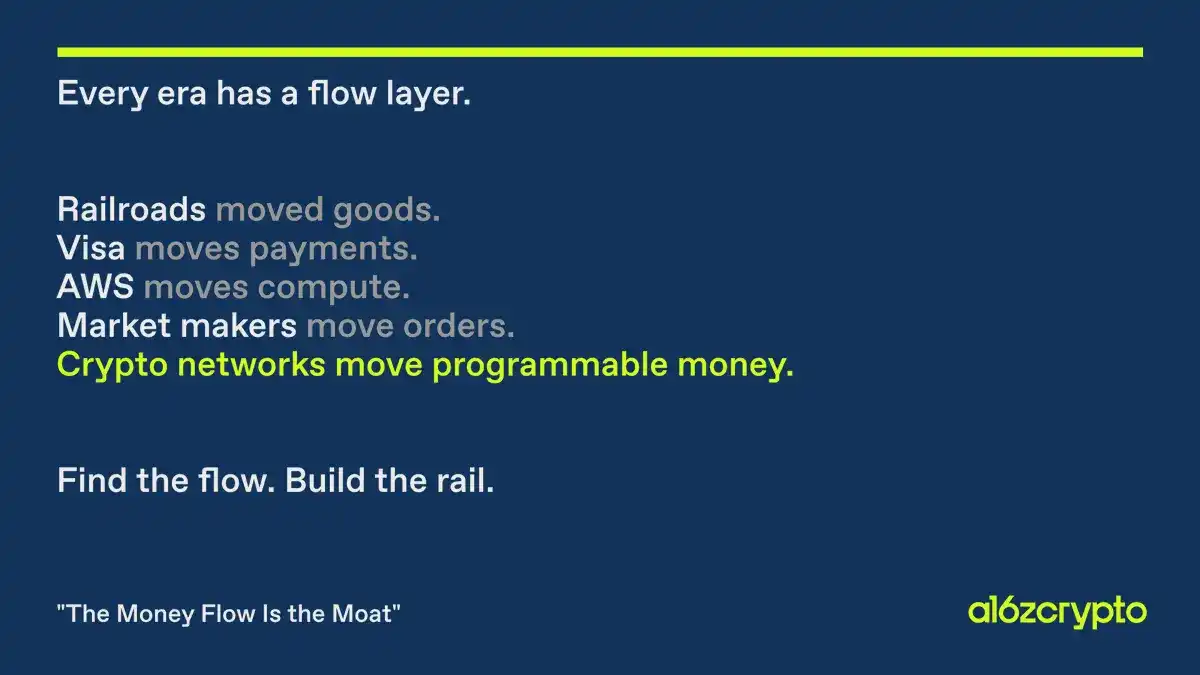
Financial markets make this model even clearer. Visa processed $15.7 trillion in payment volume in FY2024, reporting $35.9 billion in net revenue. Jane Street posted $20.5 billion in net trading revenue last year—more than Citigroup or Bank of America. The top five U.S. market makers handled 87% of order flow payment: they don't predict the market; they sit in the flow of every order and earn more as trading volume grows.

These businesses share another commonality: network effects. Visa is more useful to more merchants because there are more cards; more useful to more cardholders because more merchants accept it. It's the same with order flow—each additional broker narrows spreads, attracting more brokers, which attracts more flow.

The flow of funds plus network effects is one of the most durable business structures ever.

Your Margin is My Opportunity

Bezos called it "your margin is my opportunity." He was talking about retail, but it applies even more to traditional financial services—the world's largest pool of margin extraction. Payments, custody, lending, FX, securitization, settlement, market making—all of it. Visa and Mastercard charge 2-3% transaction fees on networks designed in the 1960s. Remittance corridors charge 6-9%. Prime brokers and custodians take a piece of every securities trade. Even after the U.S. shifted to T+1 settlement in 2024, money still sits idle overnight as a structural tax on every participant.

Each of these margins is a target. Compress cost, increase speed, and potentially expand the entire market. Stripe and Square proved this is possible in payments.

Crypto founders have the opportunity to build the next version—programmable, instant, global, and natively in the flow of funds.

And the frontier extends far beyond financial services. Compute and GPU markets. Memory chips. AI training data. Energy. Robotics. Space. Rare earth metals. Each category is an area where global value can begin to flow at volumes the existing rails were never designed to handle.

Each is an open field for building flow-of-funds businesses from the ground up on programmable infrastructure. These markets have no existing rails, no entrenched intermediaries, and nothing to defend.

As a founder, ask yourself:

1. Are you in the flow of funds today?

2. When the value of activity on your product grows 10x, does your revenue grow with it?

3. If you're building a new product, where in your target market is the margin extraction highest relative to the value being created?
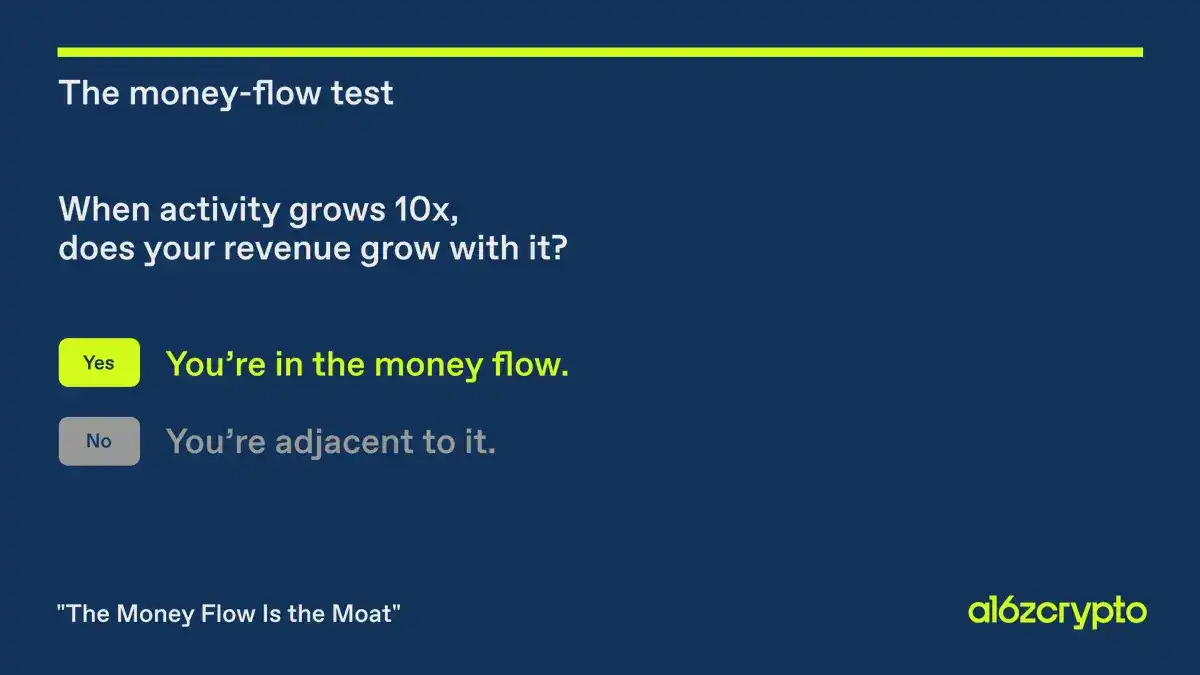
The opportunity is there. Seize it, ride the new flow, and let the network compound from there.


İlgili Sorular

QAccording to the article, what are the core characteristics of successful business models historically?

AHistorically, many of the best businesses positioned themselves within 'cash flows'—facilitating the creation and transfer of value within a network and taking a cut of that flow. The more value that flows through the network, the larger the business typically becomes.

QHow does the article describe the fundamental advantage that cryptocurrency offers for startups?

ACryptocurrency is the first modern technology natively built for cash flow. It enables value to move at internet speed—24/7, global settlement, with end-to-end programmability—providing startups with accessible and scalable network effects and open unit economics from the start.

QWhat is the relationship between network tokens and business growth as explained in the text?

AWell-designed network tokens align users, developers, suppliers, validators, and the protocol around a single outcome: growing the network. Participants are paid proportionally to their contributions. This creates a feedback loop between the value flowing through the system and the value accumulating to those building it, without private deals or rebates.

QWhat does the phrase 'your margin is my opportunity' refer to in the context of the article?

AIt refers to the opportunity for new, often crypto-native, businesses to compete by targeting high-margin areas in traditional industries (especially financial services). By reducing costs, increasing speed, and building on programmable infrastructure, they can capture market share from established players with inefficient profit structures.

QWhat are the three key questions founders should ask themselves, according to the article's conclusion?

A1. Are you in the cash flow today? 2. When the value of activity on your product grows 10x, does your revenue grow with it? 3. If you're building a new product, where in your target market is the profit-taking highest relative to the value being created?

İlgili Okumalar

Sequoia Dialogue with Jensen Huang: Computing Model Undergoes a 60-Year Transformation; You Won't Be Replaced by AI, But You Will Be Dimensionality-Reduced by 'Those Who Master AI'

NVIDIA founder and CEO Jensen Huang, in a conversation with Sequoia Capital's Konstantine Buhler, argues that we are witnessing the most significant computing shift in 60 years—from retrieval-based to generative computing. Instead of just storing and retrieving data, future systems will generate highly personalized content (text, images, video) on demand, powered by massive "AI factories." Huang envisions a global "intelligence network" that will envelop the planet, following the historical patterns of energy and communication grids. He outlines a five-layer investment framework: 1) Energy, 2) Chips/Computers, 3) Infrastructure (data centers), 4) AI Models, and 5) Applications. He predicts this ecosystem will reach a scale of $20 trillion annually. Crucially, Huang pushes back against fears of AI-driven job loss. He distinguishes between specific "tasks" (e.g., typing, analyzing images) and overall "jobs" (e.g., CEO, radiologist). While AI automates tasks, it increases efficiency and demand for the higher-value problem-solving aspects of professions, thus creating more jobs and "up-leveling" careers. The real risk, he asserts, is not being replaced by AI, but being outperformed by someone who effectively leverages it. He urges everyone to embrace AI as a tool for augmented capability and innovation.

marsbit43 dk önce

Sequoia Dialogue with Jensen Huang: Computing Model Undergoes a 60-Year Transformation; You Won't Be Replaced by AI, But You Will Be Dimensionality-Reduced by 'Those Who Master AI'

marsbit43 dk önce

"I Don't Need a Better Model Anymore": A Panorama of AI Users Under a Reddit Hot Post

Titled "I Don't Need a Better Model Anymore": AI User Reactions on Reddit Anthropic recently released Claude Fable 5, its first publicly available 'Mythos'-tier model, achieving 80.3% on the SWE-Bench Pro benchmark and significantly outperforming its predecessor and competitors. However, a viral Reddit post titled "Claude Fable made me realize I don't need better models anymore" highlighted a growing user sentiment of "good enough." Top comments expressed "model fatigue," with users stating that earlier models like Opus 4.5/4.8 already sufficed for their workflows. High cost was a key concern, as Fable 5's API is nearly twice the price of Opus 4.8, with users questioning the return on investment and suggesting the field has hit a plateau. The most frequent complaint targeted Fable 5's stringent safety filters. Designed to intercept high-risk requests (e.g., cybersecurity), the system was perceived as overly conservative. Users reported frequent rejections for routine security-related tasks, leading to automatic fallbacks to the older Opus model. Paying users were particularly frustrated, feeling they paid a premium for a less usable product. Dissenting voices came from users with heavy, complex tasks. For workloads like high-energy physics simulations with thousands of code lines, Fable 5's improved long-context understanding and error detection represented a significant, worthwhile leap—described as moving from a "college player to an NBA starter." The debate underscores a divergence between benchmark performance and practical utility. For most users, current models meet their needs, making further advances relevant only for extreme use-cases. The discussion also raised concerns about a potential "Public AI Freeze," where the most powerful models (like the restricted Mythos 5) remain exclusive to enterprises and governments, while public offerings stagnate. The launch presents two report cards: one of technical excellence and another of user skepticism. Fable 5's ultimate reception may depend on Anthropic's ability to refine its safety filters and justify its cost for specialized, high-demand users.

marsbit50 dk önce

"I Don't Need a Better Model Anymore": A Panorama of AI Users Under a Reddit Hot Post

marsbit50 dk önce

When AI Traffic Surpasses Humans, How Do You Prove You're Human?

With AI-generated web traffic surpassing human activity, websites face a crisis as AI agents bypass ads, avoid clicks, and scrape data without generating revenue. This disrupts the ad-based internet economy, diverting traffic and reducing site visits. In response, sites are blocking AI crawlers and deploying traps like Cloudflare's "honeypot" pages. Traditional CAPTCHAs are now ineffective against advanced AI. The focus has shifted to behavioral biometrics—analyzing unique human patterns such as cursor movement, typing rhythm, and keystroke dynamics. Companies like IBM and BioCatch use this data to distinguish humans from bots, even detecting fraud through behavioral inconsistencies. Two competing approaches aim to verify human identity centrally. Sam Altman’s World (formerly Worldcoin) uses iris scanning to create unique credentials, though it faces privacy concerns and regulatory bans. Alternatively, cryptographic zero-knowledge proofs offer anonymous verification without revealing personal data, championed by Vitalik Buterin to avoid centralized surveillance. However, both systems have flaws. Centralized solutions risk biometric data misuse, while decentralized models may be exploited through identity rental markets in economically unequal regions. Despite challenges, the author favors cryptographic methods for preserving privacy over pervasive behavioral monitoring that permanently captures and controls personal biometric data.

marsbit59 dk önce

When AI Traffic Surpasses Humans, How Do You Prove You're Human?

marsbit59 dk önce

2026 Landscape of Decentralized AI: Why is Blockchain the Inevitable "Antidote" for AI?

**The 2026 Landscape of Decentralized AI: Why Blockchain is the "Cure" AI Cannot Ignore** Decentralized AI addresses fundamental bottlenecks of centralized AI: scarce and expensive computational resources, excessive control concentration, unverifiable model outputs, and increasing difficulty in acquiring training data due to privacy and regulation. Blockchain offers a path to make intelligence open, verifiable, and economically accessible. The technical stack comprises three layers: 1. **Applications & Services**: The main crypto use cases are "Agentic Finance" (converting natural language into on-chain actions) and "Agentic Payments" for machine-to-machine commerce. Projects like Giza, Infinity Labs, Coinvest AI, and x402 (handling 173M+ transactions) are key players. 2. **Middleware**: This coordination layer enables agents to discover, identify, and transact. Notable projects include Gokite AI (specialized L1), Virtuals (an OS for the agent economy), and especially Bittensor—a network of specialized subnets forming competitive AI micro-economies. 3. **Infrastructure**: The capital-intensive layer providing raw resources. It includes decentralized compute (Akash, Render, Aethir), verifiable inference (Venice AI, OpenGradient), distributed training (Prime Intellect, Templar AI), decentralized storage (Filecoin, Walrus), and privacy/verification layers (Nillion, Arcium, Phala Network) using technologies like ZKPs, MPC, and TEEs. The outlook for 2026-2027 indicates AI demand outpacing infrastructure, with AI agents as a primary growth engine. Computation is becoming an asset class, with on-chain markets as its financial layer. Tokenomics is emerging as a structural advantage for coordinating capital, compute, and data in decentralized AI networks. While still early—with adoption uneven and revenue often trailing token incentives—projects like Bittensor, NEAR, and Virtuals demonstrate a shift from speculative narrative to a new model for coordinating intelligence.

marsbit1 saat önce

2026 Landscape of Decentralized AI: Why is Blockchain the Inevitable "Antidote" for AI?

marsbit1 saat önce

İşlemler

Spot
Futures

Popüler Makaleler

FLOW Nasıl Satın Alınır

HTX.com’a hoş geldiniz! Flow (FLOW) satın alma işlemlerini basit ve kullanışlı bir hâle getirdik. Adım adım açıkladığımız rehberimizi takip ederek kripto yolculuğunuza başlayın. 1. Adım: HTX Hesabınızı OluşturunHTX'te ücretsiz bir hesap açmak için e-posta adresinizi veya telefon numaranızı kullanın. Sorunsuzca kaydolun ve tüm özelliklerin kilidini açın. Hesabımı Aç2. Adım: Kripto Satın Al Bölümüne Gidin ve Ödeme Yönteminizi SeçinKredi/Banka Kartı: Visa veya Mastercard'ınızı kullanarak anında Flow (FLOW) satın alın.Bakiye: Sorunsuz bir şekilde işlem yapmak için HTX hesap bakiyenizdeki fonları kullanın.Üçüncü Taraflar: Kullanımı kolaylaştırmak için Google Pay ve Apple Pay gibi popüler ödeme yöntemlerini ekledik.P2P: HTX'teki diğer kullanıcılarla doğrudan işlem yapın.Borsa Dışı (OTC): Yatırımcılar için kişiye özel hizmetler ve rekabetçi döviz kurları sunuyoruz.3. Adım: Flow (FLOW) Varlıklarınızı SaklayınFlow (FLOW) satın aldıktan sonra HTX hesabınızda saklayın. Alternatif olarak, blok zinciri transferi yoluyla başka bir yere gönderebilir veya diğer kripto para birimlerini takas etmek için kullanabilirsiniz.4. Adım: Flow (FLOW) Varlıklarınızla İşlem YapınHTX'in spot piyasasında Flow (FLOW) ile kolayca işlemler yapın.Hesabınıza erişin, işlem çiftinizi seçin, işlemlerinizi gerçekleştirin ve gerçek zamanlı olarak izleyin. Hem yeni başlayanlar hem de deneyimli yatırımcılar için kullanıcı dostu bir deneyim sunuyoruz.

269 Toplam GörüntülenmeYayınlanma 2024.12.10Güncellenme 2026.06.02

FLOW Nasıl Satın Alınır

Tartışmalar

HTX Topluluğuna hoş geldiniz. Burada, en son platform gelişmeleri hakkında bilgi sahibi olabilir ve profesyonel piyasa görüşlerine erişebilirsiniz. Kullanıcıların FLOW (FLOW) fiyatı hakkındaki görüşleri aşağıda sunulmaktadır.

活动图片