a16z: AI's 'Amnesia', Can Continuous Learning Cure It?

marsbit2026-04-25 tarihinde yayınlandı2026-04-25 tarihinde güncellendi

Özet

The article "a16z: AI's 'Amnesia' – Can Continual Learning Cure It?" explores the limitations of current large language models (LLMs), which, like the protagonist in the film *Memento*, are trapped in a perpetual present—unable to form new memories after training. While methods like in-context learning (ICL), retrieval-augmented generation (RAG), and external scaffolding (e.g., chat history, prompts) provide temporary solutions, they fail to enable true internalization of new knowledge. The authors argue that compression—the core of learning during training—is halted at deployment, preventing models from generalizing, discovering novel solutions (e.g., mathematical proofs), or handling adversarial scenarios. The piece introduces *continual learning* as a critical research direction to address this, categorizing approaches into three paths: 1. **Context**: Scaling external memory via longer context windows, multi-agent systems, and smarter retrieval. 2. **Modules**: Using pluggable adapters or external memory layers for specialization without full retraining. 3. **Weights**: Enabling parameter updates through sparse training, test-time training, meta-learning, distillation, and reinforcement learning from feedback. Challenges include catastrophic forgetting, safety risks, and auditability, but overcoming these could unlock models that learn iteratively from experience. The conclusion emphasizes that while context-based methods are effective, true breakthroughs requ...

Original Author: Malika Aubakirova, Matt Bornstein, a16z crypto

Original Compilation: Deep Tide TechFlow

In Christopher Nolan's "Memento," the main character Leonard Shelby lives in a fragmented present. Brain damage has left him with anterograde amnesia, unable to form new memories. Every few minutes, his world resets, trapping him in an eternal "now," unable to remember what just happened or what will happen next. To survive, he tattoos words on his body and takes Polaroids, relying on these external props to replace the memory functions his brain can no longer perform.

Large language models live in a similar eternal present. After training ends, vast amounts of knowledge are frozen in their parameters; the model cannot form new memories or update its parameters based on new experiences. To compensate for this defect, we build a bunch of scaffolding for it: chat history acts as short-term sticky notes, retrieval systems serve as external notebooks, and system prompts are like tattoos on the body. But the model itself never truly internalizes this new information.

More and more researchers believe this is not enough. In-context learning (ICL) can solve problems, provided the answer (or fragments of the answer) already exists somewhere in the world. But for problems that require true discovery (like novel mathematical proofs), adversarial scenarios (like security attacks and defenses), or knowledge that is too implicit to be expressed in language, there is a strong argument that models need a way to directly write new knowledge and experience into their parameters after deployment.

In-context learning is temporary. True learning requires compression. Until we allow models to continuously compress, we might be stuck in the eternal present of "Memento." Conversely, if we can train models to learn their own memory architecture, rather than relying on external custom tools, we might unlock a whole new dimension of scaling.

This field of research is called continual learning. This concept is not new (see McCloskey and Cohen's 1989 paper), but we believe it is one of the most important research directions in AI today. The explosive growth of model capabilities over the past two to three years has made the gap between what models "know" and what they "can know" increasingly apparent. The purpose of this article is to share what we have learned from top researchers in this field, help clarify the different paths of continual learning, and promote the development of this topic within the startup ecosystem.

Note: This article was shaped by in-depth discussions with a group of excellent researchers, PhD students, and entrepreneurs who generously shared their work and insights in the field of continual learning. From theoretical foundations to the engineering realities of post-deployment learning, their insights have made this article much more solid than anything we could have written alone. Thank you for your time and ideas!

First, Let's Talk About Context

Before defending parameter-level learning (i.e., learning that updates model weights), it's necessary to acknowledge a fact: in-context learning does work. And there is a strong argument that it will continue to win.

The essence of a Transformer is a sequence-based next-token predictor conditioned on the input. Give it the right sequence, and you can get surprisingly rich behavior without ever touching the weights. This is why methods like context management, prompt engineering, instruction fine-tuning, and few-shot examples are so powerful. Intelligence is encapsulated in static parameters, and the manifested capabilities change dramatically based on what you feed into the context.

A recent in-depth article by Cursor on the scaling of autonomous programming agents is a good example: the model weights are fixed; what really makes the system run is the careful orchestration of context—what to put in, when to summarize, how to maintain a coherent state over hours of autonomous operation.

OpenClaw is another good example. It went viral not because of special model access (the underlying model is available to everyone), but because it extremely efficiently converted context and tools into a working state: tracking what you're doing, structuring intermediate outputs, deciding when to re-inject prompts, maintaining persistent memory of previous work. OpenClaw elevated the "shell design" of agents to the level of an independent discipline.

When prompt engineering first emerged, many researchers were skeptical that "just prompts" could become a serious interface. It seemed like a hack. But it is a native product of the Transformer architecture, requires no retraining, and automatically upgrades as models improve. As models get stronger, prompts get stronger. "Crude but native" interfaces often win because they are coupled directly to the underlying system, not fighting against it. So far, the trajectory of LLM development has followed this pattern.

State Space Models: Context on Steroids

As mainstream workflows shift from raw LLM calls to agent loops, in-context learning models are under increasing pressure. In the past, it was relatively rare for the context window to be completely filled. This usually happened when an LLM was asked to perform a long series of discrete tasks, and the application layer could trim and compress chat history in a straightforward way.

But for agents, a single task can consume a large portion of the total available context. Each step of an agent loop relies on the context passed from previous iterations. And they often fail after 20 to 100 steps because they "lose the thread": the context gets filled, coherence degrades, and they fail to converge.

Therefore, major AI labs are now investing significant resources (i.e., large-scale training runs) to develop models with ultra-long context windows. This is a natural path because it builds on what already works (in-context learning) and aligns with the industry's broader shift towards inference-time computation. The most common architecture involves interleaving fixed memory layers between standard attention heads, namely State Space Models (SSMs) and linear attention variants (collectively referred to as SSMs below). SSMs offer fundamentally better scaling curves in long-context scenarios.
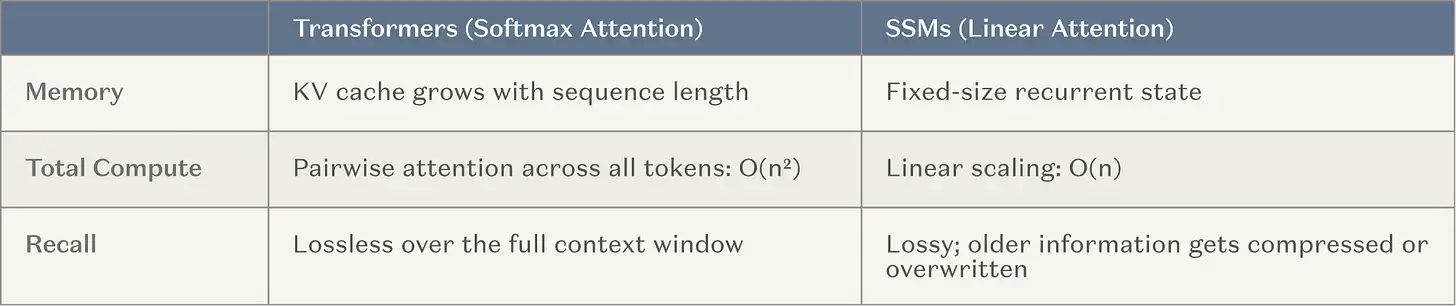
Figure Caption: Scaling comparison of SSM vs. traditional attention mechanism

The goal is to help agents increase the number of coherent run steps by several orders of magnitude, from about 20 steps to about 20,000 steps, without losing the broad skills and knowledge provided by traditional Transformers. If successful, this would be a major breakthrough for long-running agents.

You could even view this approach as a form of continual learning: although the model weights aren't updated, an external memory layer that rarely needs resetting is introduced.

So, these non-parametric methods are real and powerful. Any evaluation of continual learning must start here. The question isn't whether today's context systems work—they do. The question is: have we already seen the ceiling, and can new methods take us further?

What Context Omits: The "Filing Cabinet Fallacy"

"What happened with AGI and pre-training is that, in a sense, they overshot... Humans are not AGI. Yes, humans do have a skill base, but humans lack a vast amount of knowledge. We rely on continual learning.

If I create a super-smart 15-year-old, he knows nothing. A good student, very eager to learn. You could say, go be a programmer, go be a doctor. Deployment itself would involve a process of learning, trial and error. It's a process, not throwing the finished product out there. — Ilya Sutskever"

Imagine a system with infinite storage space. The world's largest filing cabinet, every fact perfectly indexed, instantly retrievable. It can look up anything. Has it learned?

No. It was never forced to compress.

This is the core of our argument, referencing a point previously made by Ilya Sutskever: LLMs are essentially compression algorithms. During training, they compress the internet into parameters. Compression is lossy, and it is this lossiness that makes it powerful. Compression forces the model to find structure, generalize, and build representations that transfer across contexts. A model that memorizes all training samples is inferior to one that extracts underlying patterns. Lossy compression is learning itself.

Ironically, the mechanism that makes LLMs so powerful during training (compressing raw data into compact, transferable representations) is precisely what we stop them from doing after deployment. We halt compression at the moment of release, substituting it with external memory.

Of course, most agent shells compress context in some custom way. But doesn't the bitter lesson tell us that the model itself should learn this compression, directly and at scale?

Yu Sun shared an example to illustrate this debate: mathematics. Consider Fermat's Last Theorem. For over 350 years, no mathematician could prove it, not because they lacked the right literature, but because the solution was highly novel. The conceptual distance between existing mathematical knowledge and the final answer was too great.

When Andrew Wiles finally cracked it in the 1990s, he spent seven years working in near isolation, having to invent entirely new techniques to reach the answer. His proof relied on successfully bridging two different branches: elliptic curves and modular forms. Although Ken Ribet had previously shown that establishing this connection would automatically solve Fermat's Last Theorem, no one before Wiles possessed the theoretical tools to actually build that bridge. A similar argument can be made for Grigori Perelman's proof of the Poincaré conjecture.

The core question is: Do these examples prove that LLMs are missing something, some ability to update priors and engage in truly creative thinking? Or does this story恰恰证明恰恰相反——all human knowledge is just data available for training and recombination, and Wiles and Perelman merely demonstrate what LLMs could also do at a larger scale?

This question is empirical, and the answer is still uncertain. But we do know that there are many categories of problems where in-context learning fails today, and parameter-level learning could be useful. For example:
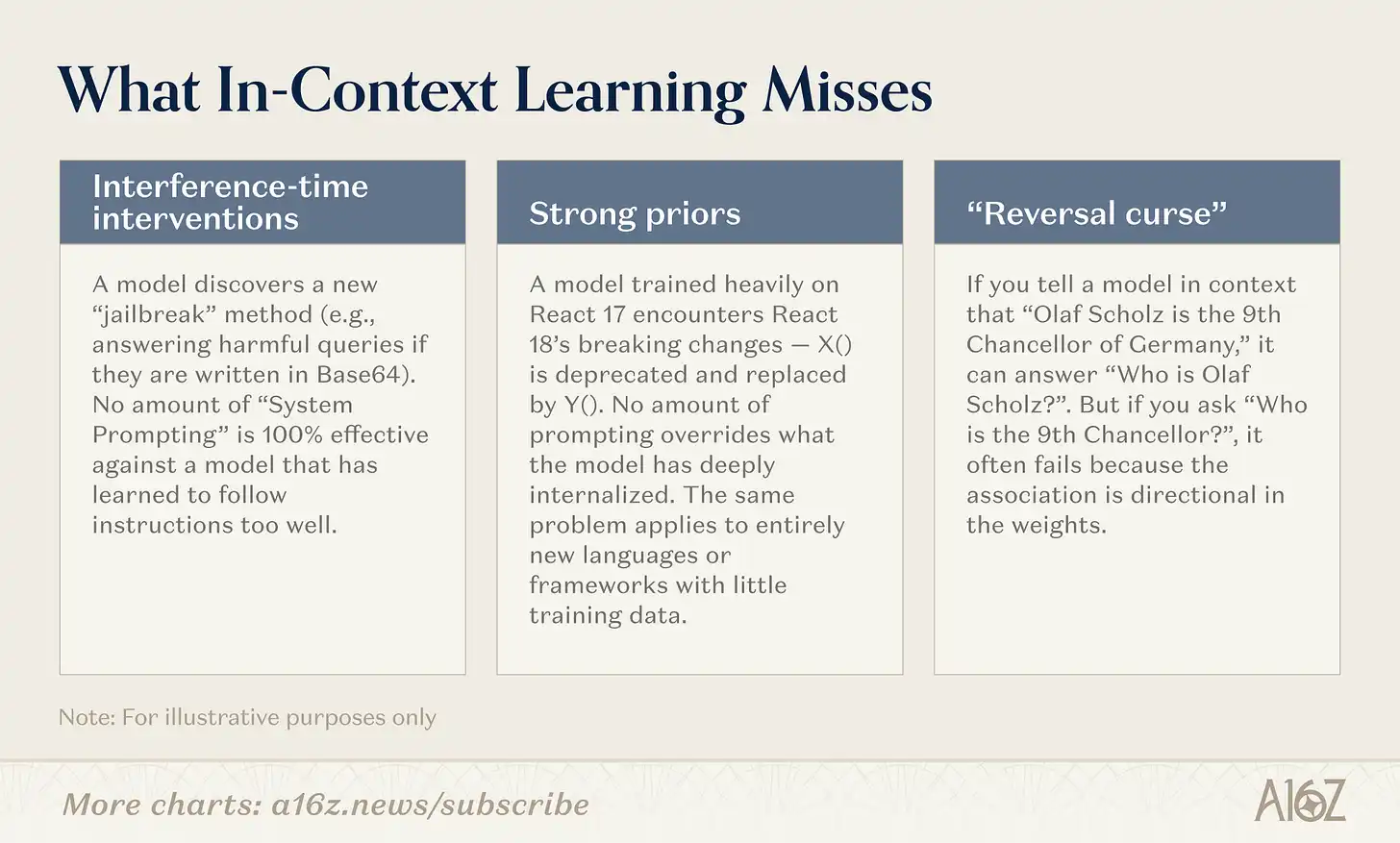
Figure Caption: Problem categories where in-context learning fails and parameter learning might succeed

More importantly, in-context learning can only handle things that can be expressed in language, while weights can encode concepts that prompts cannot convey in words. Some patterns are too high-dimensional, too implicit, too deeply structured to fit into context. For instance, the visual texture that distinguishes a benign artifact from a tumor in a medical scan, or the subtle audio fluctuations that define a speaker's unique rhythm—these patterns are not easily broken down into precise vocabulary.

Language can only approximate them. No prompt, no matter how long, can transmit these things; this kind of knowledge can only live in the weights. They reside in the latent space of learned representations, not in words. No matter how large the context window grows, there will always be knowledge that text cannot describe, knowledge that can only be carried by parameters.

This might explain why explicit "the robot remembers you" features (like ChatGPT's memory) often make users feel discomfort rather than delight. What users really want is not "recall," but "capability." A model that has internalized your behavioral patterns can generalize to new scenarios; a model that merely recalls your history cannot. The gap between "Here's what you wrote last time you replied to this email" (verbatim repetition) and "I understand your way of thinking well enough to anticipate what you need" is the gap between retrieval and learning.

Continual Learning Primer

There are multiple paths to continual learning. The dividing line is not "whether there is memory function," but: Where does compression happen? These paths exist on a spectrum, from no compression (pure retrieval, frozen weights), to full internal compression (weight-level learning, the model gets smarter), with an important middle ground (modules).
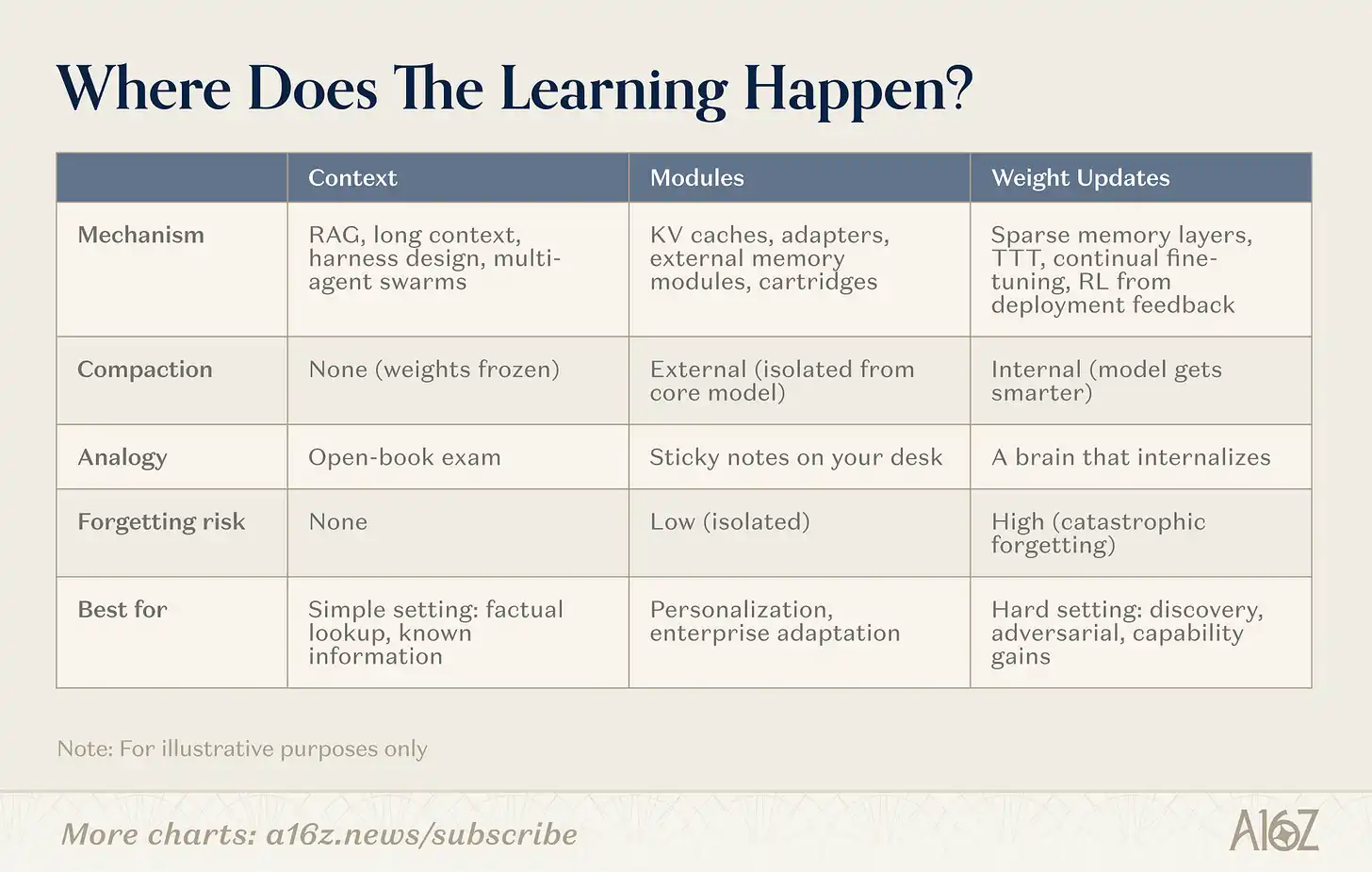
Figure Caption: Three paths of continual learning—Context, Modules, Weights

Context

On the context end, teams build smarter retrieval pipelines, agent shells, and prompt orchestration. This is the most mature category: infrastructure is proven, deployment paths are clear. The limitation is depth: context length.

A notable new direction: multi-agent architectures as a scaling strategy for context itself. If a single model is limited to a 128K token window, a coordinated group of agents—each holding its own context, focusing on a slice of the problem, communicating results—can approximate infinite working memory as a whole. Each agent does in-context learning within its own window; the system does aggregation. Karpathy's recent autoresearch project and Cursor's example of building a web browser are early cases. This is a purely non-parametric approach (no weight changes), but it significantly raises the ceiling of what context systems can do.

Modules

In the module space, teams build pluggable knowledge modules (compressed KV caches, adapter layers, external memory stores) that allow general models to specialize without retraining. An 8B model with the right module can match the performance of a 109B model on a target task, with a fraction of the memory footprint. The appeal is its compatibility with existing Transformer infrastructure.

Weights

On the weight update end, researchers are pursuing true parameter-level learning: sparse memory layers that update only relevant parameter segments, reinforcement learning loops that optimize the model from feedback, test-time training that compresses context into weights during inference. These are the deepest methods, and the hardest to deploy, but they truly allow the model to fully internalize new information or skills.

There are various specific mechanisms for parameter updates. Listing a few research directions:
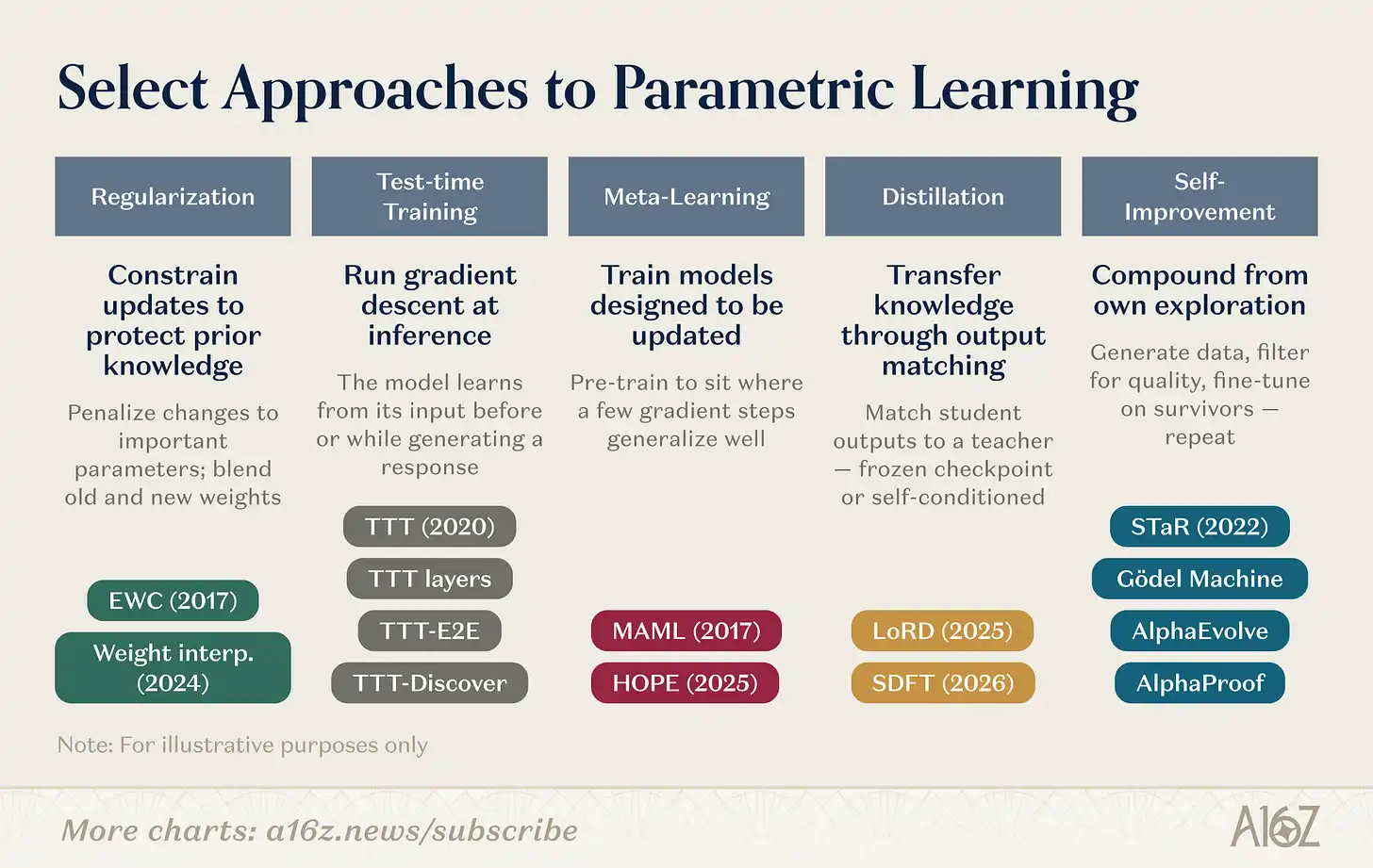
Figure Caption: Overview of research directions in weight-level learning

Weight-level research covers multiple parallel tracks. Regularization and weight space methods have the longest history: EWC (Kirkpatrick et al., 2017) penalizes parameter changes based on their importance to previous tasks; weight interpolation (Kozal et al., 2024) mixes old and new weight configurations in parameter space, but both are relatively fragile at scale.

Test-time training, pioneered by Sun et al. (2020) and later developed into architectural primitives (TTT layers, TTT-E2E, TTT-Discover), takes a截然不同的 approach: perform gradient descent on test data, compressing new information into parameters at the moment it's needed.

Meta-learning asks: Can we train models that know "how to learn"? From MAML's few-shot-friendly parameter initialization (Finn et al., 2017) to Behrouz et al.'s Nested Learning (2025), which structures the model as a hierarchical optimization problem with modules operating on different time scales for fast adaptation and slow updates, inspired by biological memory consolidation.

Distillation retains knowledge of previous tasks by having a student model match frozen teacher checkpoints. LoRD (Liu et al., 2025) makes distillation efficient enough for continuous operation by simultaneously pruning the model and the replay buffer. Self-distillation (SDFT, Shenfeld et al., 2026) flips the source, using the model's own outputs under expert conditions as the training signal, bypassing the catastrophic forgetting of sequential fine-tuning.

Recursive self-improvement operates on similar lines: STaR (Zelikman et al., 2022) bootstraps reasoning能力 from self-generated reasoning chains; AlphaEvolve (DeepMind, 2025) discovered algorithmic optimizations that had gone unimproved for decades; Silver and Sutton's "Age of Experience" (2025) defines agent learning as a never-ending stream of continuous experience.

These research directions are converging. TTT-Discover has already融合 test-time training and RL-driven exploration. HOPE nests fast and slow learning loops within a single architecture. SDFT turns distillation into a fundamental operation for self-improvement. The boundaries between columns are blurring. The next generation of continual learning systems will likely combine multiple strategies: regularization for stability, meta-learning for speed, self-improvement for compound growth. A growing number of startups are betting on different layers of this tech stack.

Continual Learning Startup Landscape

The non-parametric end of the spectrum is the most well-known. Shell companies (Letta, mem0, Subconscious) build orchestration layers and scaffolding, managing what goes into the context window. External storage and RAG infrastructure (e.g., Pinecone, xmemory) provide the retrieval backbone. The data exists; the challenge is getting the right slice in front of the model at the right time. As context windows expand, the design space for these companies grows, especially on the shell side, where a new wave of startups is emerging to manage increasingly complex context strategies.

The parametric end is earlier and more diverse. Companies here are experimenting with some version of "post-deployment compression," allowing models to internalize new information in their weights. The paths roughly correspond to different bets on *how* models should learn after release.

Partial Compression: Learning Without Retraining. Some teams are building pluggable knowledge modules (compressed KV caches, adapter layers, external memory stores) that allow general models to specialize without touching the core weights. The common argument is: you get meaningful compression (not just retrieval), while keeping the stability-plasticity trade-off manageable because learning is isolated, not spread throughout the parameter space. An 8B model with the right module can match the performance of much larger models on target task. The advantage is composability: modules can be plugged and played with existing Transformer architectures, can be swapped or updated independently, with much lower experimentation cost than retraining.

RL and Feedback Loops: Learning from Signals. Other teams bet that the richest signal for post-deployment learning already exists in the deployment loop itself—user corrections, task success/failure, reward signals from real-world outcomes. The core idea is that the model should treat every interaction as a potential training signal, not just an inference request. This is highly analogous to how humans improve at their jobs: do work, get feedback, internalize what works. The engineering challenge is converting sparse, noisy, sometimes adversarial feedback into stable weight updates without catastrophic forgetting. But a model that can truly learn from deployment compounds value in ways context systems cannot.

Data-Centric: Learning from the Right Signals. A related but distinct bet is that the bottleneck is not the learning algorithm, but the training data and surrounding systems. These teams focus on curating, generating, or synthesizing the *right* data to drive continuous updates: the premise is that a model with high-quality, well-structured learning signals needs far fewer gradient steps to improve meaningfully. This dovetails naturally with feedback loop companies but emphasizes the upstream question: it's one thing if the model *can* learn, another what it *should* learn from and to what extent.

New Architectures: Designing Learning Capability from the Ground Up. The most radical bet argues that the Transformer architecture itself is the bottleneck, and continual learning requires fundamentally different computational primitives: architectures with continuous-time dynamics and built-in memory mechanisms. The argument here is structural: if you want a continually learning system, you should embed the learning mechanism into the underlying foundation.
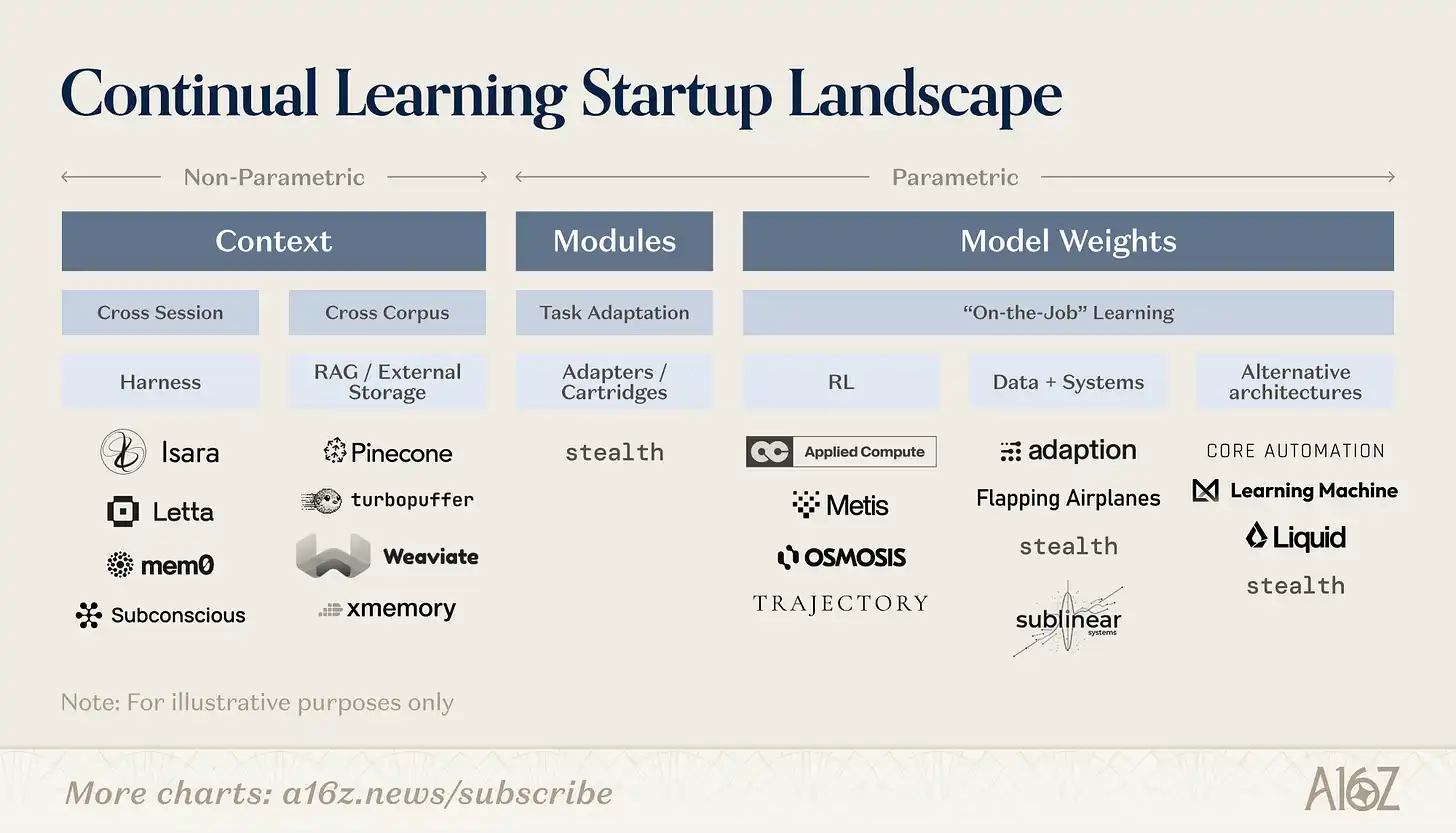
Figure Caption: Continual Learning Startup Landscape

All major labs are also actively working within these categories. Some are exploring better context management and chain-of-thought reasoning, others are experimenting with external memory modules or sleep-time compute pipelines, and several stealth companies are pursuing new architectures. The field is early enough that no single approach has won yet, and given the breadth of use cases, there shouldn't be just one winner.

Why Naive Weight Updates Fail

Updating model parameters in a production environment triggers a cascade of failure modes that are not yet resolved at scale.
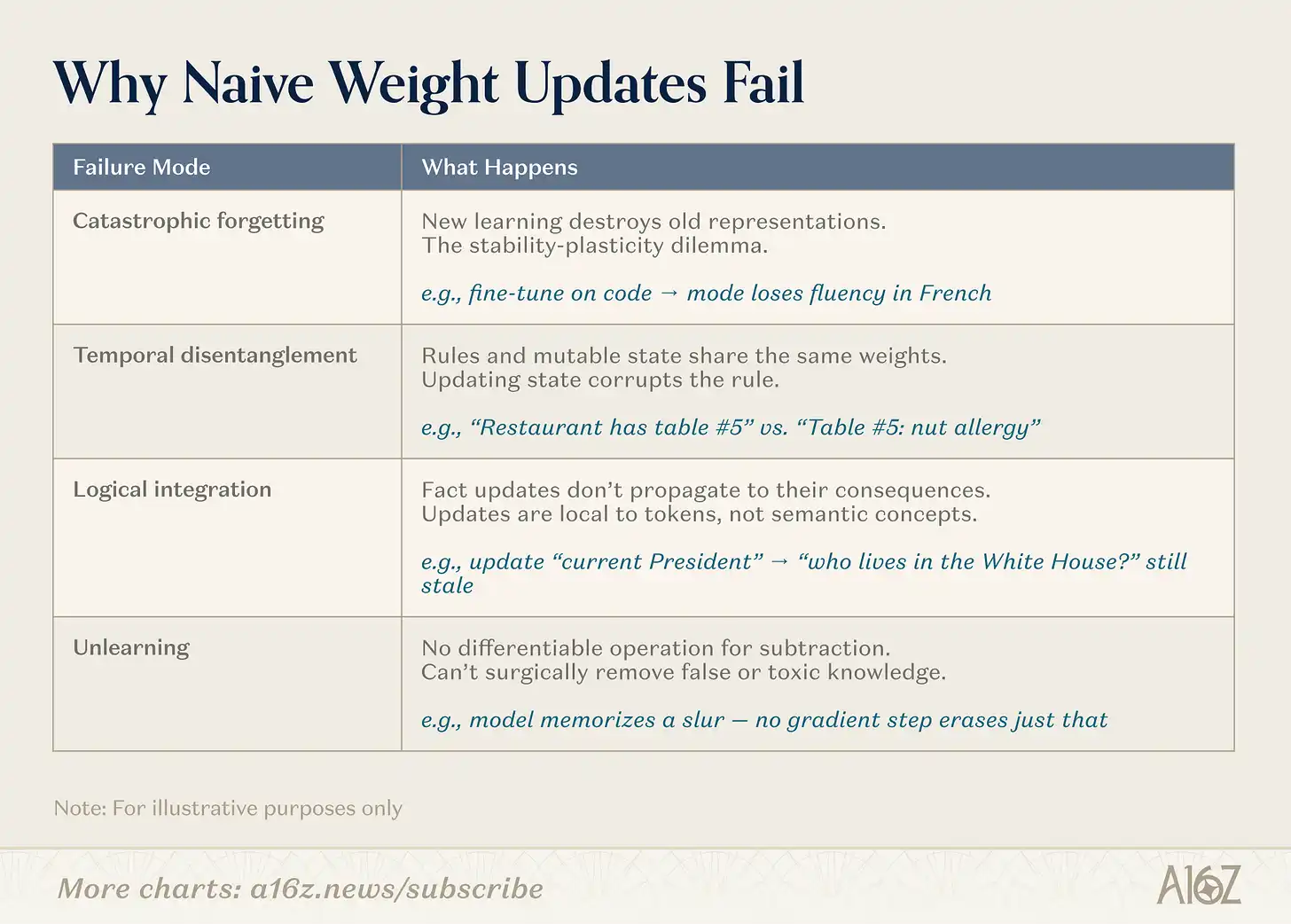
Figure Caption: Failure modes of naive weight updates

The engineering problems are well-documented. Catastrophic forgetting means a model sensitive enough to learn from new data will destroy existing representations—the stability-plasticity dilemma. Temporal decoupling refers to the fact that invariant rules and mutable state are compressed into the same set of weights; updating one corrupts the other. Logical integration fails because fact updates don't propagate to their corollaries: changes are confined to the token sequence level, not the semantic concept level. Unlearning is still impossible: there is no differentiable subtraction operation, so there is no precise surgical removal method for false or toxic knowledge.

There is a second class of problems that receives less attention. The current separation between training and deployment is not just an engineering convenience; it is a boundary for safety, auditability, and governance. Opening this boundary causes multiple things to go wrong simultaneously. Safety alignment can degrade unpredictably: even narrow fine-tuning on benign data can produce widespread misaligned behavior.

Continuous updates create an attack surface for data poisoning—a slow, persistent version of prompt injection, but it lives in the weights. Auditability collapses because a continuously updated model is a moving target, making version control, regression testing, or one-time certification impossible. Privacy risks intensify when user interactions are compressed into parameters, baking sensitive information into representations that are harder to filter than information in a retrieved context.

These are open problems, not fundamental impossibilities. Solving them is part of the continual learning research agenda, just like solving the core architectural challenges.

From "Memento" to True Memory

Leonard's tragedy in "Memento" is not that he can't function—in any given scene, he is resourceful, even brilliant. His tragedy is that he can never compound. Every experience remains external—a Polaroid, a tattoo, a note in someone else's handwriting. He can retrieve, but he cannot compress new knowledge.

As Leonard navigates this self-constructed maze, the line between truth and belief begins to blur. His condition doesn't just deprive him of memory; it forces him to constantly reconstruct meaning, making him both the detective and the unreliable narrator of his own story.

Today's AI operates under the same constraints. We have built very powerful retrieval systems: longer context windows, smarter shells, coordinated multi-agent swarms, and they work. But retrieval is not learning. A system that can look up any fact is not forced to find structure. It is not forced to generalize. The lossy compression that made training so powerful—the mechanism that turns raw data into transferable representations—is precisely what we turn off the moment we deploy.

The path forward is likely not a single breakthrough, but a layered system. In-context learning will remain the first line of adaptive defense: it is native, proven, and improving. Module mechanisms can handle the middle ground of personalization and domain specialization.

But for those truly difficult problems—discovery, adversarial adaptation, implicit knowledge that cannot be put into words—we may need to let models continue to compress experience into parameters after training. This means advances in sparse architectures, meta-learning objectives, and self-improvement loops. It might also require us to redefine what a "model" is: not a fixed set of weights, but an evolving system comprising its memory, its update algorithm, and its ability to abstract from its own experience.

The filing cabinet is getting bigger. But a bigger filing cabinet is still a filing cabinet. The breakthrough is to let the model do after deployment what made it powerful during training: compress, abstract, learn. We stand at the turning point from amnesiac models to models with a glimmer of experience. Otherwise, we'll be stuck in our own "Memento."


İlgili Sorular

QWhat is the core problem with current large language models (LLMs) regarding memory and learning after deployment, as discussed in the a16z article?

AThe core problem is that LLMs suffer from a form of 'amnesia' or an inability to form new memories after their initial training is complete. Their parameters are frozen, and they cannot internally update their knowledge based on new experiences. They rely on external scaffolds' like chat history (short-term sticky notes), retrieval systems (external notebooks), and system prompts (tattoos) to function, but the model itself never truly internalizes this new information.

QAccording to the article, what is 'continual Learning' and why is it considered a critical research direction in AI?

AContinual learning is the research field focused on enabling AI models to learn continuously and update their parameters (weights) after deployment, thereby internalizing new knowledge and experiences. It is considered critical because the gap between what a model 'knows' at release and what it 'could know' is becoming increasingly apparent. This ability is seen as essential for tackling problems requiring true discovery, adversarial scenarios, and internalizing knowledge that is too implicit to be expressed in language.

QWhat is the 'filing cabinet fallacy' argument presented in the article against relying solely on context learning (ICL)?

AThe 'filing cabinet fallacy' argues that a system with infinite storage and perfect retrieval (like a massive filing cabinet) does not constitute learning because it is never forced to perform compression. Compression, which is lossy, is what forces a model to find structure, generalize, and build transferable representations. Relying solely on context learning and external memory avoids this crucial compression step, preventing the model from truly learning and generalizing from new information after deployment.

QWhat are the three main paths or spectra of continual learning discussed in the article?

AThe three main paths on the continual learning spectrum are: 1. **Context:** Building smarter retrieval pipelines, agent shells, and prompt orchestration without updating model weights. 2. **Modules:** Using pluggable knowledge modules (compressed KV caches, adapter layers, external memory stores) to specialize a general model without full retraining. 3. **Weights:** Pursuing true parameter-level learning through methods like sparse memory layers, reinforcement learning loops from feedback, and test-time training to compress context into weights internally.

QWhat are some of the key challenges and failure modes associated with naively updating a model's weights in a production environment?

AKey challenges and failure modes include: - **Catastrophic Forgetting:** Updating on new data can destroy existing representations (the stability-plasticity dilemma). - **Temporal Decoupling:** Invariant rules and mutable state are compressed into the same weights; updating one can corrupt the other. - **Failure of Logical Integration:** Fact updates don't propagate to their logical corollaries. - **Safety & Security Risks:** Safety alignment can degrade unpredictably, creating a new attack surface for data poisoning. - **Auditability & Governance Collapse:** A continuously updated model is a moving target, making version control, regression testing, and certification difficult. - **Privacy Risks:** User interactions compressed into parameters can bake in sensitive information.

İlgili Okumalar

The Midlife Crisis of Crypto GPs: No PMF, No Next Check from LPs

The article "The Midlife Crisis of Crypto GPs: No PMF, No Next LP Check" analyzes the shifting crypto fundraising landscape. It argues the era of selling grand visions to LPs is over; GPs must now offer products with clear Product-Market Fit (PMF). The author categorizes crypto fundraising products into three types: Primary (VC funds), Liquid (trading strategies), and CeFi/DeFi Native Yield. This summary focuses on the Primary market. Key points include: * **Market Shift:** LPs are impatient, demand immediate returns, and are skeptical of future promises. The "easy money" narrative has faded. * **GP Value Erosion:** LP learning curves have shortened (aided by AI), reducing the value of a GP's basic "crypto knowledge." Superior judgment is now rare. * **Weakened LP Motivations:** Traditional reasons for LPs to invest in crypto VC funds (capturing industry beta, gaining access, leveraging GP judgment) have weakened due to new products like ETFs and increased LP sophistication. * **Surviving in Primary:** The primary market will likely persist for: 1) large funds in endowment mandates treating it as a lottery ticket, 2) family offices/HNWIs using proprietary capital, 3) a few funds with proven recent outperformance, and 4) funds with strong ecosystem "deal-making" capabilities. * **Conclusion:** For most GPs, rebuilding trust requires starting over in a niche, demonstrating alpha-generating ability, or providing concrete value/services to LPs.

marsbit43 dk önce

The Midlife Crisis of Crypto GPs: No PMF, No Next Check from LPs

marsbit43 dk önce

Crypto GPs' Midlife Crisis: No PMF, No LP's Next Check

The article "The Midlife Crisis of Crypto GPs: No PMF, No LP's Next Check" analyzes the shifting crypto fundraising landscape. It argues that the era of LPs funding vague "vision" is over; GPs must now offer products with clear Product-Market Fit (PMF) to secure capital. The market has matured. LPs, disillusioned by the last cycle's failures and wary of long lock-up periods, now demand tangible, near-term returns rather than speculative narratives. The proliferation of accessible crypto ETFs and other liquid products has reduced the need for VC blind pools as an entry point. The author categorizes crypto fundraising products into three types: Primary (VC funds, with blind pools or clear pipelines), Liquid (alpha/beta, directional/market-neutral strategies), and CeFi/DeFi Native Yield (crypto-specific mechanisms like staking, farming). Focusing on the Primary market, the piece details why traditional LP rationales for investing in crypto VCs have weakened: easier beta access via ETFs, diminished "access" and "judgement" premiums as LPs build internal teams, and a widespread lack of proven superior returns from GPs. Ultimately, only specific players are likely to remain at the primary VC table: large funds with access to patient endowment capital, family offices/HNWIs investing proprietary capital, the few funds with demonstrable excess returns from the last cycle, and those with clear "deal-making" or ecosystem resource advantages. For others, the path forward is to rebuild trust by proving alpha-generation capability in a niche or providing concrete, valuable services.

链捕手1 saat önce

Crypto GPs' Midlife Crisis: No PMF, No LP's Next Check

链捕手1 saat önce

The Age of Decoupling Has Arrived: Bitcoin is No Longer the Sole Compass of Crypto

The era of the cryptocurrency market moving in lockstep with Bitcoin is ending, as the industry splits into two distinct asset categories: endogenous and exogenous. Endogenous assets, like Bitcoin, derive value purely from the crypto market's cycles. Their narratives swing between being "interstellar money" in bull markets and "digital collectibles" in bear markets. Exogenous assets, however, are nominally crypto but operate with independent value drivers. Examples include: * **Venice:** An AI inference service using tokens for payments; its consumer-AI business model is decoupled from crypto price swings. * **Figure:** A fintech lender using blockchain to speed up loan approvals; its core value is in credit, not crypto. * **Stablecoin firms like BVNK:** Acquired by traditional finance giants (Mastercard, Stripe), their growth is tied to payment infrastructure, not market cycles. Hybrid projects like **Hyperliquid** (a decentralized exchange) show a shift, with a growing share of non-crypto trading (e.g., prediction markets). This divergence is fundamental. Endogenous assets remain highly correlated to Bitcoin, similar to gold miners to gold. Exogenous assets are evolving to have their own fundamentals, like the weak correlation between gold and the S&P 500. This changes investment analysis. Evaluating exogenous assets requires traditional fundamental research—assessing user bases, unit economics, and moats—more akin to fintech investing than charting Bitcoin. Promising exogenous sectors include: on-chain exchanges/brokers, AI-crypto fusion, privacy-focused digital banks, lending (institutional/private credit), stablecoins/real-world asset tokenization, payment rails, and non-financial crypto-consumer products. Currently, investing via equity is often safer than via tokens, as token value accrual mechanisms need further regulatory and industry development (e.g., the CLARITY Act). Nonetheless, the core trend is clear: crypto market drivers are diversifying from a single factor (Bitcoin) to multiple fundamentals, ending the era of uniform market moves.

marsbit2 saat önce

The Age of Decoupling Has Arrived: Bitcoin is No Longer the Sole Compass of Crypto

marsbit2 saat önce

Five Cryptos That Could Outperform Bitcoin Over the Next Cycle Due To Higher Growth Velocity

Bitcoin's growth often sets market trends, but analysts believe the next cycle's highest percentage gains may come from assets with greater growth velocity. While Bitcoin provides stability, several cryptocurrencies are positioned for stronger relative upside. This article highlights five such assets, with a particular focus on Ozak AI as the potential high-growth standout of the cycle. Ethereum (ETH) is noted for its ongoing evolution and institutional adoption. Solana (SOL) is recognized for its high throughput and history of sharp rallies. Chainlink (LINK) is highlighted as essential infrastructure for DeFi and AI applications. Avalanche (AVAX) is mentioned for its subnet architecture and enterprise potential. Ozak AI ($OZ) is presented as a distinct early-stage opportunity, currently in presale at $0.014 with a target listing price of $1.00. The project is building a full AI-native blockchain ecosystem, including prediction agents, a data stream network, and structured data vaults. Analysts suggest its early valuation stage and focus on AI infrastructure could allow for exponential growth velocity compared to more mature assets like Bitcoin, which requires massive capital inflows for significant price movement. The final takeaway positions Ozak AI as a high-asymmetry bet for investors seeking exponential upside alongside more stable assets.

TheNewsCrypto2 saat önce

Five Cryptos That Could Outperform Bitcoin Over the Next Cycle Due To Higher Growth Velocity

TheNewsCrypto2 saat önce

İşlemler

Spot
Futures

Popüler Makaleler

$S$ Nedir

SPERO'yu Anlamak: Kapsamlı Bir Genel Bakış SPERO'ya Giriş İnovasyonun manzarası gelişmeye devam ederken, web3 teknolojilerinin ve kripto para projelerinin ortaya çıkışı dijital geleceği şekillendirmede önemli bir rol oynamaktadır. Bu dinamik alanda dikkat çeken projelerden biri SPERO, $$s$$ olarak adlandırılmaktadır. Bu makale, SPERO hakkında ayrıntılı bilgi toplamak ve sunmak amacıyla, meraklılar ve yatırımcıların web3 ve kripto alanlarındaki temellerini, hedeflerini ve yeniliklerini anlamalarına yardımcı olmayı amaçlamaktadır. SPERO,$$s$$ Nedir? SPERO,$$s$$, kripto alanında merkeziyetsizlik ve blok zinciri teknolojisi ilkelerini kullanarak etkileşimi, faydayı ve finansal kapsayıcılığı teşvik eden bir ekosistem yaratmayı amaçlayan benzersiz bir projedir. Proje, kullanıcıların yenilikçi finansal çözümler ve hizmetler sunarak eşler arası etkileşimleri yeni yollarla kolaylaştırmayı hedeflemektedir. SPERO,$$s$$'nin temel amacı, bireyleri güçlendirmek ve kripto para alanındaki kullanıcı deneyimini artıran araçlar ve platformlar sağlamaktır. Bu, daha esnek işlem yöntemlerini mümkün kılmayı, topluluk odaklı girişimleri teşvik etmeyi ve merkeziyetsiz uygulamalar (dApp'ler) aracılığıyla finansal fırsatlar yaratmayı içermektedir. SPERO,$$s$$'nin temel vizyonu kapsayıcılık etrafında dönmekte olup, geleneksel finansal sistemlerdeki boşlukları kapatmayı ve blok zinciri teknolojisinin faydalarından yararlanmayı hedeflemektedir. SPERO,$$s$$'nin Yaratıcısı Kimdir? SPERO,$$s$$'nin yaratıcısının kimliği bir miktar belirsizdir, çünkü kurucusu(ları) hakkında ayrıntılı arka plan bilgisi sağlayan sınırlı kamuya açık kaynaklar bulunmaktadır. Bu şeffaflık eksikliği, projenin merkeziyetsizlik taahhüdünden kaynaklanabilir—birçok web3 projesinin paylaştığı bir etik anlayışı, bireysel tanınmanın yerine kolektif katkıları önceliklendirmektedir. Topluluk ve onun kolektif hedefleri etrafında tartışmaları merkezileştirerek, SPERO,$$s$$, belirli bireyleri öne çıkarmadan güçlendirme özünü taşımaktadır. Bu nedenle, SPERO'nun etik anlayışını ve misyonunu anlamak, tek bir yaratıcının kimliğini belirlemekten daha önemlidir. SPERO,$$s$$'nin Yatırımcıları Kimlerdir? SPERO,$$s$$, kripto sektöründe yeniliği teşvik etmeye adanmış girişim sermayedarlarından melek yatırımcılara kadar çeşitli yatırımcılar tarafından desteklenmektedir. Bu yatırımcıların odak noktası genellikle SPERO'nun misyonuyla uyumlu olup, toplumsal teknolojik ilerlemeyi, finansal kapsayıcılığı ve merkeziyetsiz yönetimi vaat eden projeleri önceliklendirmektedir. Bu yatırımcı temelleri, yalnızca yenilikçi ürünler sunan projelere değil, aynı zamanda blok zinciri topluluğuna ve ekosistemlerine olumlu katkılarda bulunan projelere de ilgi duymaktadır. Bu yatırımcıların desteği, SPERO,$$s$$'yi hızla gelişen kripto projeleri alanında dikkate değer bir rakip haline getirmektedir. SPERO,$$s$$ Nasıl Çalışır? SPERO,$$s$$, onu geleneksel kripto para projelerinden ayıran çok yönlü bir çerçeve kullanmaktadır. İşte benzersizliğini ve yeniliğini vurgulayan bazı temel özellikler: Merkeziyetsiz Yönetim: SPERO,$$s$$, kullanıcıların projenin geleceğiyle ilgili karar alma süreçlerine aktif olarak katılmalarını sağlayan merkeziyetsiz yönetim modellerini entegre etmektedir. Bu yaklaşım, topluluk üyeleri arasında sahiplik ve hesap verebilirlik duygusunu teşvik etmektedir. Token Kullanımı: SPERO,$$s$$, ekosistem içinde çeşitli işlevler sunmak üzere tasarlanmış kendi kripto para token'ını kullanmaktadır. Bu token'lar, işlemleri, ödülleri ve platformda sunulan hizmetlerin kolaylaştırılmasını sağlayarak genel etkileşimi ve faydayı artırmaktadır. Katmanlı Mimari: SPERO,$$s$$'nin teknik mimarisi, modülerlik ve ölçeklenebilirliği destekleyerek projenin evrimi sırasında ek özelliklerin ve uygulamaların sorunsuz bir şekilde entegrasyonuna olanak tanımaktadır. Bu uyum sağlama yeteneği, sürekli değişen kripto manzarasında geçerliliği sürdürmek için hayati öneme sahiptir. Topluluk Katılımı: Proje, işbirliği ve geri bildirim teşvik eden mekanizmalar kullanarak topluluk odaklı girişimlere vurgu yapmaktadır. Güçlü bir topluluk oluşturarak, SPERO,$$s$$, kullanıcı ihtiyaçlarını daha iyi karşılayabilir ve piyasa trendlerine uyum sağlayabilir. Kapsayıcılığa Odaklanma: Düşük işlem ücretleri ve kullanıcı dostu arayüzler sunarak, SPERO,$$s$$, daha önce kripto alanında yer almamış bireyler de dahil olmak üzere çeşitli bir kullanıcı tabanını çekmeyi hedeflemektedir. Bu kapsayıcılık taahhüdü, erişilebilirlik yoluyla güçlendirme misyonuyla uyumludur. SPERO,$$s$$ Zaman Çizelgesi Bir projenin tarihini anlamak, gelişim yolculuğu ve kilometre taşları hakkında kritik bilgiler sağlar. Aşağıda, SPERO,$$s$$'nin evriminde önemli olayları haritalayan önerilen bir zaman çizelgesi bulunmaktadır: Kavram Geliştirme ve Fikir Aşaması: SPERO,$$s$$'nin temelini oluşturan ilk fikirler, blok zinciri endüstrisindeki merkeziyetsizlik ve topluluk odaklılık ilkeleriyle yakından uyumlu olarak geliştirildi. Proje Beyaz Kağıdının Yayınlanması: Kavramsal aşamayı takiben, SPERO,$$s$$'nin vizyonunu, hedeflerini ve teknolojik altyapısını ayrıntılı bir şekilde açıklayan kapsamlı bir beyaz kağıt yayımlandı ve topluluk ilgisini ve geri bildirimini toplamak amacıyla sunuldu. Topluluk Oluşturma ve Erken Katılımlar: Projenin hedefleri etrafında tartışmalar yürüterek destek toplamak ve erken benimseyenler ile potansiyel yatırımcılar için bir topluluk oluşturmak amacıyla aktif iletişim çabaları gerçekleştirildi. Token Üretim Etkinliği: SPERO,$$s$$, yerel token'larını erken destekçilere dağıtmak ve ekosistem içinde başlangıç likiditesini sağlamak amacıyla bir token üretim etkinliği (TGE) gerçekleştirdi. İlk dApp'in Yayınlanması: SPERO,$$s$$ ile ilişkili ilk merkeziyetsiz uygulama (dApp) faaliyete geçti ve kullanıcıların platformun temel işlevleriyle etkileşimde bulunmalarını sağladı. Sürekli Gelişim ve Ortaklıklar: Projenin tekliflerine sürekli güncellemeler ve iyileştirmeler yapılmakta olup, blok zinciri alanındaki diğer oyuncularla stratejik ortaklıklar, SPERO,$$s$$'yi rekabetçi ve gelişen bir oyuncu haline getirmiştir. Sonuç SPERO,$$s$$, web3 ve kripto paranın finansal sistemleri devrim niteliğinde dönüştürme ve bireyleri güçlendirme potansiyelinin bir kanıtıdır. Merkeziyetsiz yönetime, topluluk katılımına ve yenilikçi tasarlanmış işlevselliğe olan bağlılığıyla, daha kapsayıcı bir finansal manzaraya doğru bir yol açmaktadır. Hızla gelişen kripto alanındaki herhangi bir yatırımda olduğu gibi, potansiyel yatırımcılar ve kullanıcılar, SPERO,$$s$$ içindeki devam eden gelişmelerle ilgili olarak kapsamlı bir araştırma yapmaları ve düşünceli bir şekilde katılmaları teşvik edilmektedir. Proje, kripto endüstrisinin yenilikçi ruhunu sergileyerek, sayısız olasılığını keşfetmeye davet etmektedir. SPERO,$$s$$'nin yolculuğu hala devam ederken, temel ilkeleri, teknoloji, finans ve birbirimizle etkileşim biçimimizi etkileyebilir.

89 Toplam GörüntülenmeYayınlanma 2024.12.17Güncellenme 2024.12.17

$S$ Nedir

AGENT S Nedir

Agent S: Web3'te Otonom Etkileşimin Geleceği Giriş Web3 ve kripto para dünyasında sürekli gelişen manzarada, yenilikler bireylerin dijital platformlarla etkileşim biçimlerini sürekli olarak yeniden tanımlıyor. Bu tür öncü projelerden biri olan Agent S, açık ajans çerçevesi aracılığıyla insan-bilgisayar etkileşimini devrim niteliğinde değiştirmeyi vaat ediyor. Otonom etkileşimlerin yolunu açarak, Agent S karmaşık görevleri basitleştirmeyi ve yapay zeka (AI) alanında dönüştürücü uygulamalar sunmayı hedefliyor. Bu detaylı inceleme, projenin karmaşıklıklarına, benzersiz özelliklerine ve kripto para alanındaki etkilerine dalacaktır. Agent S Nedir? Agent S, bilgisayar görevlerinin otomasyonunda üç temel zorluğu ele almak üzere özel olarak tasarlanmış çığır açıcı bir açık ajans çerçevesidir: Alan Spesifik Bilgi Edinimi: Çerçeve, çeşitli dış bilgi kaynaklarından ve iç deneyimlerden akıllıca öğrenir. Bu çift yönlü yaklaşım, alan spesifik bilgi açısından zengin bir veri havuzu oluşturmasını sağlar ve görev yürütmedeki performansını artırır. Uzun Görev Ufukları Üzerinde Planlama: Agent S, karmaşık görevlerin verimli bir şekilde parçalanmasını ve yürütülmesini kolaylaştıran deneyim artırımlı hiyerarşik planlama kullanır. Bu özellik, çoklu alt görevleri etkili ve verimli bir şekilde yönetme yeteneğini önemli ölçüde artırır. Dinamik, Homojen Olmayan Arayüzlerle Başlama: Proje, ajanlar ve kullanıcılar arasındaki etkileşimi geliştiren yenilikçi bir çözüm olan Ajan-Bilgisayar Arayüzü'ni (ACI) tanıtmaktadır. Çok Modlu Büyük Dil Modellerini (MLLM'ler) kullanarak, Agent S çeşitli grafik kullanıcı arayüzlerini sorunsuz bir şekilde gezinebilir ve manipüle edebilir. Bu öncü özellikler aracılığıyla, Agent S, makinelerle insan etkileşimini otomatikleştirmede karşılaşılan karmaşıklıkları ele alan sağlam bir çerçeve sunarak, AI ve ötesinde birçok uygulama için zemin hazırlıyor. Agent S'nin Yaratıcısı Kimdir? Agent S'nin kavramı temelde yenilikçi olsa da, yaratıcısı hakkında spesifik bilgiler belirsizliğini koruyor. Yaratıcı şu anda bilinmiyor, bu da projenin yeni aşamasını veya kurucu üyeleri gizli tutma stratejik tercihini vurguluyor. Anonimlikten bağımsız olarak, odak çerçevenin yetenekleri ve potansiyeli üzerinde kalıyor. Agent S'nin Yatırımcıları Kimlerdir? Agent S, kriptografik ekosistemde oldukça yeni olduğundan, yatırımcıları ve finansal destekçileri hakkında ayrıntılı bilgiler açıkça belgelenmemiştir. Projeyi destekleyen yatırım temelleri veya organizasyonları hakkında kamuya açık bilgilerdeki eksiklik, finansman yapısı ve gelişim yol haritası hakkında sorular doğuruyor. Destekleyicilerin anlaşılması, projenin sürdürülebilirliğini ve potansiyel pazar etkisini değerlendirmek için kritik öneme sahiptir. Agent S Nasıl Çalışır? Agent S'nin temelinde, çeşitli ortamlarda etkili bir şekilde çalışmasını sağlayan son teknoloji bir sistem yatmaktadır. İşleyiş modeli birkaç ana özellik etrafında inşa edilmiştir: İnsan Benzeri Bilgisayar Etkileşimi: Çerçeve, bilgisayarlarla etkileşimleri daha sezgisel hale getirmeyi amaçlayan gelişmiş AI planlaması sunar. Görev yürütmedeki insan davranışını taklit ederek, kullanıcı deneyimlerini yükseltmeyi vaat eder. Anlatı Belleği: Yüksek düzeyde deneyimlerden yararlanmak için kullanılan Agent S, görev geçmişlerini takip etmek amacıyla anlatı belleğini kullanarak karar verme süreçlerini geliştirir. Episodik Bellek: Bu özellik, kullanıcılara adım adım rehberlik sağlayarak, çerçevenin görevler gelişirken bağlamsal destek sunmasına olanak tanır. OpenACI Desteği: Yerel olarak çalışabilme yeteneği ile Agent S, kullanıcıların etkileşimleri ve iş akışları üzerinde kontrol sağlamasına olanak tanır ve Web3'ün merkeziyetsiz felsefesiyle uyumlu hale gelir. Dış API'lerle Kolay Entegrasyon: Çeşitli AI platformlarıyla uyumluluğu ve çok yönlülüğü, Agent S'nin mevcut teknolojik ekosistemlere sorunsuz bir şekilde entegre olmasını sağlar ve geliştiriciler ile organizasyonlar için cazip bir seçenek haline getirir. Bu işlevsellikler, Agent S'nin kripto alanındaki benzersiz konumuna katkıda bulunarak, karmaşık, çok aşamalı görevleri minimum insan müdahalesi ile otomatikleştirir. Proje geliştikçe, Web3'teki potansiyel uygulamaları dijital etkileşimlerin nasıl gelişeceğini yeniden tanımlayabilir. Agent S'nin Zaman Çizelgesi Agent S'nin gelişimi ve kilometre taşları, önemli olaylarını vurgulayan bir zaman çizelgesinde özetlenebilir: 27 Eylül 2024: Agent S'nin kavramı, “Bilgisayarları İnsan Gibi Kullanan Açık Bir Ajans Çerçevesi” başlıklı kapsamlı bir araştırma makalesi ile tanıtıldı ve projenin temelini sergiledi. 10 Ekim 2024: Araştırma makalesi arXiv'de kamuya açık olarak yayınlandı ve çerçevenin derinlemesine bir incelemesini ve OSWorld benchmark'ına dayalı performans değerlendirmesini sundu. 12 Ekim 2024: Agent S'nin yetenekleri ve özellikleri hakkında görsel bir içgörü sağlayan bir video sunumu yayımlandı ve potansiyel kullanıcılar ve yatırımcılarla daha fazla etkileşim sağlandı. Bu zaman çizelgesindeki işaretler, sadece Agent S'nin ilerlemesini değil, aynı zamanda şeffaflık ve topluluk katılımına olan bağlılığını da göstermektedir. Agent S Hakkında Ana Noktalar Agent S çerçevesi gelişmeye devam ederken, birkaç ana özellik öne çıkmakta ve yenilikçi doğasını ve potansiyelini vurgulamaktadır: Yenilikçi Çerçeve: İnsan etkileşimine benzer bir bilgisayar kullanımı sağlamak üzere tasarlanan Agent S, görev otomasyonuna yeni bir yaklaşım getiriyor. Otonom Etkileşim: GUI aracılığıyla bilgisayarlarla otonom olarak etkileşim kurabilme yeteneği, daha akıllı ve verimli hesaplama çözümlerine doğru bir sıçrama anlamına geliyor. Karmaşık Görev Otomasyonu: Sağlam metodolojisi ile karmaşık, çok aşamalı görevleri otomatikleştirerek süreçleri daha hızlı ve daha az hata payı ile gerçekleştirebilir. Sürekli İyileştirme: Öğrenme mekanizmaları, Agent S'nin geçmiş deneyimlerden öğrenmesini sağlar ve sürekli olarak performansını ve etkinliğini artırır. Çok Yönlülük: OSWorld ve WindowsAgentArena gibi farklı işletim ortamlarında uyumlu olması, geniş bir uygulama yelpazesine hizmet edebilmesini sağlar. Agent S, Web3 ve kripto alanında kendini konumlandırırken, etkileşim yeteneklerini artırma ve süreçleri otomatikleştirme potansiyeli, AI teknolojilerinde önemli bir ilerlemeyi temsil etmektedir. Yenilikçi çerçevesi aracılığıyla, Agent S dijital etkileşimlerin geleceğini örneklemekte ve çeşitli sektörlerde kullanıcılar için daha sorunsuz ve verimli bir deneyim vaat etmektedir. Sonuç Agent S, AI ve Web3'ün birleşiminde cesur bir sıçramayı temsil ediyor ve teknoloji ile etkileşim biçimimizi yeniden tanımlama kapasitesine sahip. Henüz erken aşamalarında olmasına rağmen, uygulama olanakları geniş ve çekici. Kritik zorlukları ele alan kapsamlı çerçevesi ile Agent S, otonom etkileşimleri dijital deneyimin ön plana çıkmasına taşımayı hedefliyor. Kripto para ve merkeziyetsizlik alanlarına daha derinlemesine girdikçe, Agent S gibi projelerin teknoloji ve insan-bilgisayar işbirliğinin geleceğini şekillendirmede önemli bir rol oynayacağı kesin.

521 Toplam GörüntülenmeYayınlanma 2025.01.14Güncellenme 2025.01.14

AGENT S Nedir

S Nasıl Satın Alınır

HTX.com’a hoş geldiniz! Sonic (S) satın alma işlemlerini basit ve kullanışlı bir hâle getirdik. Adım adım açıkladığımız rehberimizi takip ederek kripto yolculuğunuza başlayın. 1. Adım: HTX Hesabınızı OluşturunHTX'te ücretsiz bir hesap açmak için e-posta adresinizi veya telefon numaranızı kullanın. Sorunsuzca kaydolun ve tüm özelliklerin kilidini açın. Hesabımı Aç2. Adım: Kripto Satın Al Bölümüne Gidin ve Ödeme Yönteminizi SeçinKredi/Banka Kartı: Visa veya Mastercard'ınızı kullanarak anında Sonic (S) satın alın.Bakiye: Sorunsuz bir şekilde işlem yapmak için HTX hesap bakiyenizdeki fonları kullanın.Üçüncü Taraflar: Kullanımı kolaylaştırmak için Google Pay ve Apple Pay gibi popüler ödeme yöntemlerini ekledik.P2P: HTX'teki diğer kullanıcılarla doğrudan işlem yapın.Borsa Dışı (OTC): Yatırımcılar için kişiye özel hizmetler ve rekabetçi döviz kurları sunuyoruz.3. Adım: Sonic (S) Varlıklarınızı SaklayınSonic (S) satın aldıktan sonra HTX hesabınızda saklayın. Alternatif olarak, blok zinciri transferi yoluyla başka bir yere gönderebilir veya diğer kripto para birimlerini takas etmek için kullanabilirsiniz.4. Adım: Sonic (S) Varlıklarınızla İşlem YapınHTX'in spot piyasasında Sonic (S) ile kolayca işlemler yapın.Hesabınıza erişin, işlem çiftinizi seçin, işlemlerinizi gerçekleştirin ve gerçek zamanlı olarak izleyin. Hem yeni başlayanlar hem de deneyimli yatırımcılar için kullanıcı dostu bir deneyim sunuyoruz.

1.5k Toplam GörüntülenmeYayınlanma 2025.01.15Güncellenme 2026.06.01

S Nasıl Satın Alınır

Tartışmalar

HTX Topluluğuna hoş geldiniz. Burada, en son platform gelişmeleri hakkında bilgi sahibi olabilir ve profesyonel piyasa görüşlerine erişebilirsiniz. Kullanıcıların S (S) fiyatı hakkındaki görüşleri aşağıda sunulmaktadır.

活动图片