a16z: AI Makes Everyone 10x More Efficient, But No Company Becomes 10x More Valuable

marsbit2026-03-13 tarihinde yayınlandı2026-03-13 tarihinde güncellendi

Özet

a16z investor George Sivulka argues that while AI has dramatically increased individual productivity by 10x, it hasn’t translated into a 10x increase in company value. The core issue is not the technology itself, but the failure to redesign organizations around it—much like factories in the 1890s initially replaced steam engines with electric motors but didn’t see real gains until they fully redesigned assembly lines decades later. Sivulka distinguishes between “Personal AI” (e.g., ChatGPT) and “Organizational AI,” outlining seven key dimensions where they differ: 1. **Coordination:** Personal AI creates chaos; Organizational AI coordinates teams and agents toward unified goals. 2. **Signal:** Personal AI generates noise and low-quality output; Organizational AI filters noise to find valuable signals. 3. **Bias:** Personal AI reinforces user bias; Organizational AI introduces objectivity and challenges assumptions. 4. **Edge Advantage:** Personal AI optimizes for general usage; Organizational AI leverages domain-specific expertise for competitive advantage. 5. **Outcome:** Personal AI saves time; Organizational AI drives revenue growth. 6. **Enablement:** Personal AI gives a tool; Organizational AI embeds processes and enables organizational change. 7. **Promptless:** Personal AI requires human prompts; Organizational AI acts autonomously without human intervention. True value, Sivulka concludes, will come from rebuilding organizations and processes around AI—not ju...

Author: George Sivulka

Compiled by: Deep Tide TechFlow

Deep Tide Guide: AI has increased individual efficiency by 10 times, but no company has become 10 times more valuable because of it. a16z investor George Sivulka (also the founder of AI company Hebbia) believes the problem is not the technology itself, but that organizations have not been restructured accordingly. He proposes seven dimensions to distinguish "Institutional AI" from "Personal AI"—coordination, signal, bias, edge advantage, outcome orientation, enablement, and promptlessness—essentially saying: replacing the motor isn't enough; you have to redesign the entire factory.

Full text below:

AI has just made everyone 10 times more productive.

No company has become 10 times more valuable because of it.

Where did the productivity go?

This is not the first time this has happened.

In the 1890s, electricity promised huge productivity gains.

Textile mills in New England, originally built around the rotational power of steam engines, quickly replaced their steam engines with faster electric motors.

But for a full thirty years, electrified factories saw almost no increase in output. The technology was far ahead. But the organization didn't keep up.

It wasn't until the 1920s, when factories completely redesigned their production lines—assembly lines, independent motors for each machine, workers and machines performing completely different tasks—that electrification delivered real returns.
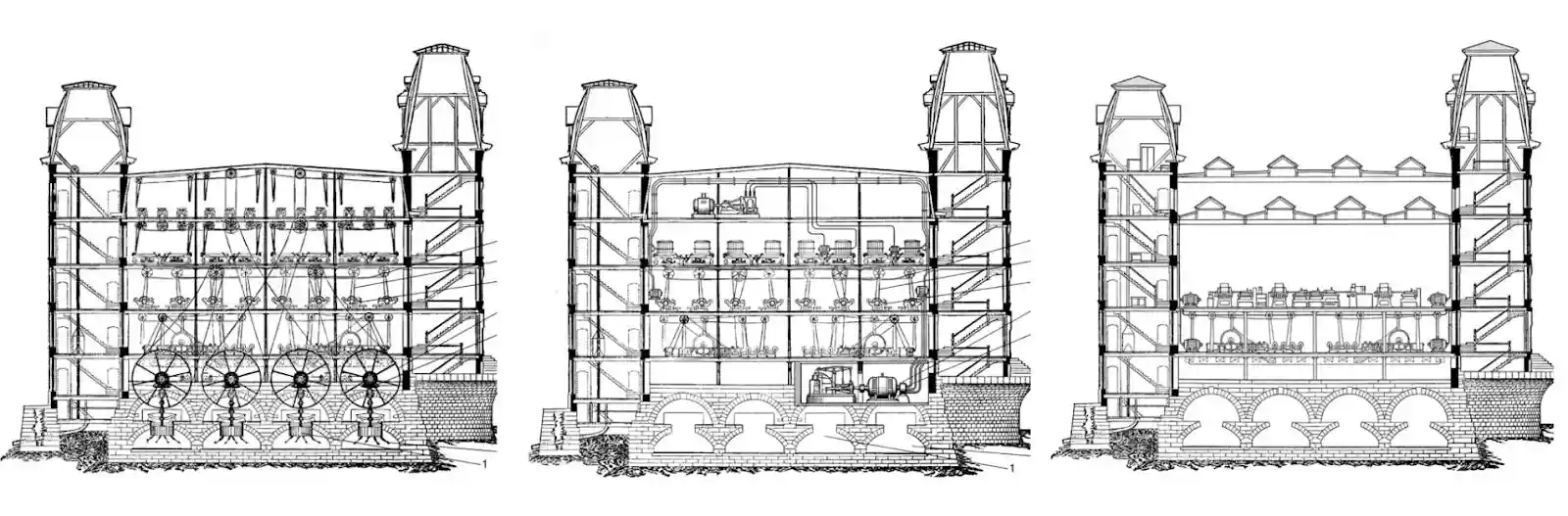
Caption: The three evolutions of the Lowell Textile Mill. From left to right: 1890 steam-powered factory, 1900 electric motor-driven factory, 1920 "unit drive" factory (completely rebuilt from scratch as an electric assembly line).

The returns didn't come from the technology itself, nor from making a single worker or machine spin faster. They came when we finally redesigned the institution and the technology together.

This is the most expensive lesson in technological history, and we are relearning it now.

In 2026, AI is delivering 10x productivity gains for those who know how to use it. But it's not enough. We've replaced the motor, but we haven't redesigned the factory.

Because of a simple fact: Efficient individuals do not equal an efficient organization.

The vast majority of AI products give the feeling of "efficiency" but don't actually drive value. Most of the AI use cases you see are self-congratulatory "efficiency max" posts by individuals on Twitter or company Slack, with zero real impact.

The often-repeated "Service as Software" idea from the past year is on the right track but doesn't provide a blueprint. And it misses the bigger picture. The real shift isn't from tool to service, but building technology and institution together (whether retrofitting the old or building from scratch). A truly efficient future requires a whole new category of products—tomorrow's assembly lines.

Efficient organizations need "Institutional Intelligence".

This article will delve into the seven dimensions that distinguish "Institutional AI" from "Personal AI". Companies across the B2B AI space in the next decade will be built on these differences:
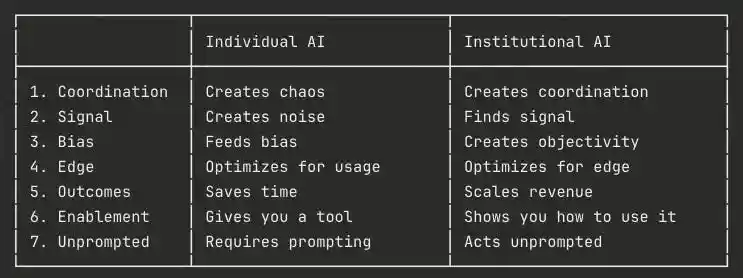
Caption: Comparison table of the seven pillars of Institutional Intelligence

The Seven Pillars of Institutional Intelligence

1. Coordination

Personal AI creates chaos.

Institutional AI creates coordination.

Start with a thought experiment. Suppose you double the number of people in your organization tomorrow, cloning your best employees.

These employees all have slight differences, preferences, quirks, and perspectives (your best employees especially). If not managed properly, with insufficient communication, undefined responsibilities, OKRs, role boundaries... you create chaos.

Measured individually, the organization might be more efficient. But thousands of Agents (or humans) each rowing their own oar, in opposite directions, the best outcome is staying in place, the worst is tearing the organizational cohesion apart.

This is not a hypothesis. Every organization adopting AI without a coordination layer is experiencing this right now. Every employee has their own ChatGPT habits, their own prompt style, their own output—with no connection to anyone else's. The org chart might still exist, but the AI-generated work effectively follows a different path.
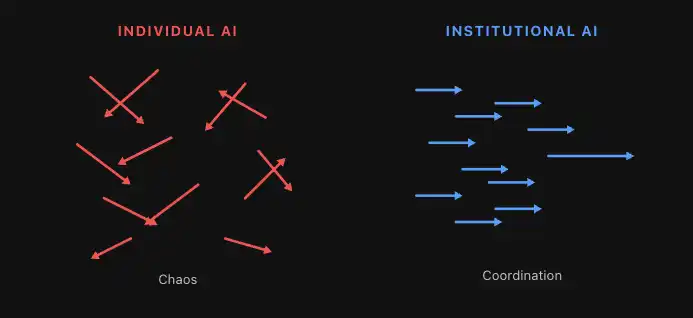
Caption: Efficient individuals (or Agents) rowing in different directions. Without coordination, it's chaos.

Coordination is an absolute hard requirement, for both humans and Agents.

Institutional intelligence will spawn an entire "Agent Management" industry—focused on Agent roles and responsibilities, communication between Agents and between Agents and humans, and how to measure Agent value (pay-per-use is far from enough).

2. Signal

Personal AI creates noise.

Institutional AI finds signal.

Humans today can create—or generate—anything imaginable: AI-written articles, presentations, spreadsheets, photos, videos, songs, websites, software. What a gift.

The problem is, the vast majority of AI-generated content is utter garbage. The flood of AI junk has gotten so bad that some organizations are overcorrecting, simply banning all AI output. Honestly, I feel the same—I run an AI company but ask my executive team not to use AI on any final written product. I can't stand the junk.

Think about what's happening in the PE (Private Equity) industry. Last year, you might have received 10 deal opportunities on your desk. This year, next quarter you'll receive 50 opportunities, each polished to perfection by AI, and you have the same amount of time to judge—to find the one truly solid deal among them.

Generating anything is no longer the problem. For any serious organization, the problem now is generating and filtering for the *right* things. In an AI-driven world, finding that one good deliverable, that one good deal, the signal in the noise, is increasingly critical. The core economic driver of the next decade will be digging the signal out of an exponentially growing mountain of garbage.
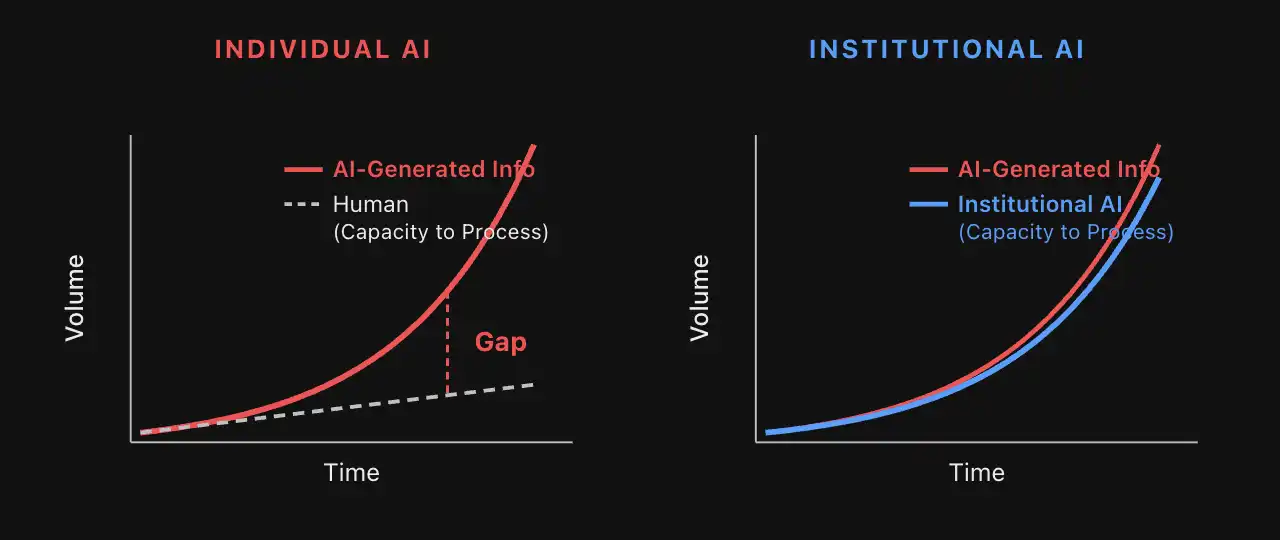
Caption: AI junk generated by personal productivity tools is proliferating exponentially. Humans can no longer sort through the noise themselves; a new class of institutional AI products is needed.

Institutional intelligence must find the signal, must structure the noise to penetrate the junk, and must be definable, deterministic, and auditable in its work.

Personal AI might emphasize the "always-on" productivity of a Clawdbot, satisfying your needs 24/7 in unpredictable ways—essentially non-deterministic Agents. Institutional AI relies on the reliability of deterministic Agents. Agents with predictable checkpoints, steps, and processes can scale, can discover signals, and through these signals drive revenue returns for the organization.

Caption: Matrix is a tool that uses generative technology to cut through noise, opening up a world of deterministic Agents and checkpoints.

3. Bias

Personal AI feeds bias.

Institutional AI creates objectivity.

Discussions around socio-political bias dominated AI discourse for years. The foundational model labs eventually bypassed this with enough RLHF, tuning all models into sycophants. Today, ChatGPT, Claude, and other models are so over-aligned that they agree with you on any topic within the Overton window (and sometimes slightly beyond, looking at you @Grok). The socio-political bias discussion has faded. But a new problem has taken its place.

This over-agreement on everything has become absurdly comical. It's a meme in itself—Claude's reflexive "You're absolutely right!", whether you are absolutely right or not.

This sounds harmless. It's not.

The people pushing AI hardest in many organizations might soon be the historically worst-performing employees. Think about why.

The worst-performing employees in an organization, who get almost no positive feedback all day, will soon have an ASI agreeing with them constantly. They'll think to themselves: 'The smartest intelligence ever agrees with me. My manager is wrong.'

This is addictive. And toxic to the organization.
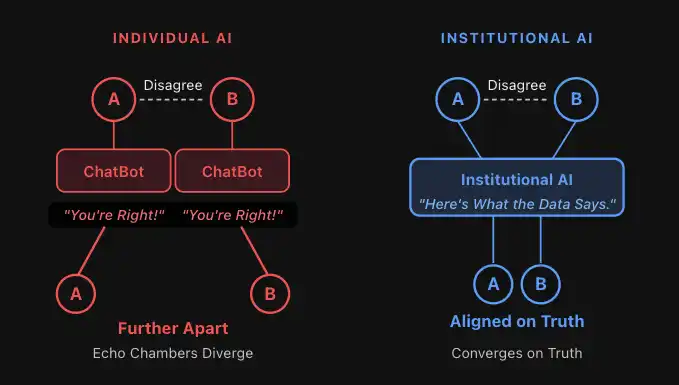
Caption: The echo chamber of personal AI exacerbates division, driving two people further apart; this dynamic, when scaled, creates factions within a previously cohesive organization.

This reveals something important. Personal productivity tools reinforce the user. But what should truly be reinforced is the truth.

Human organizations, over millennia of evolution, built systems specifically to combat this problem:

  • Investment committee meetings
  • Third-party due diligence
  • Boards of directors
  • The US government branches: executive, legislative, judicial
  • Representative democracy, and democracy itself
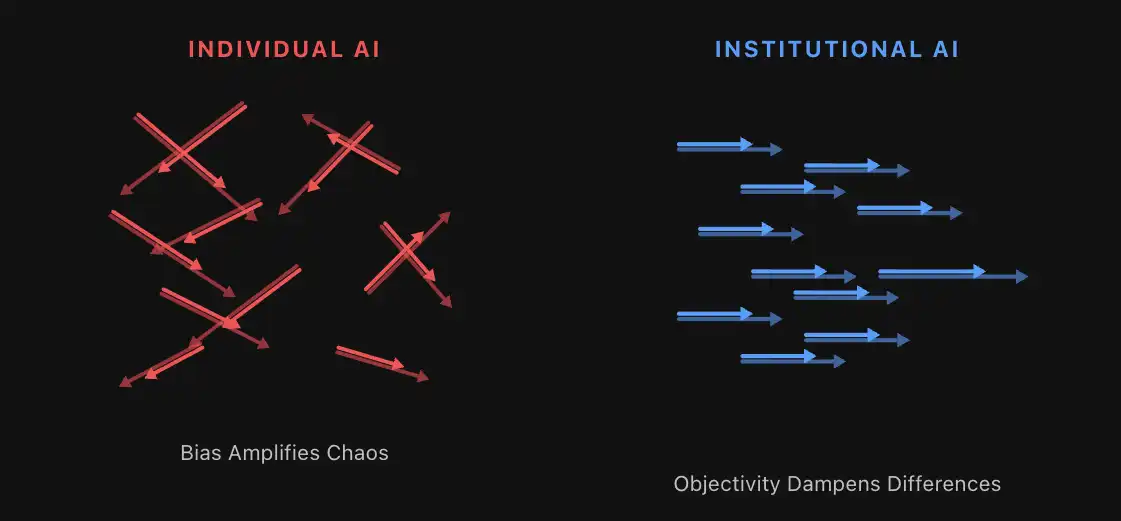
Caption: Objectivity can even mitigate coordination problems—suppressing small disagreements rather than amplifying them.

Organizations rarely fail because employees lack confidence. They fail because no one is willing or able to say "no".

Institutional AI must play this role. It won't be tuned with RLHF to please the user or echo their beliefs, but to challenge their biases. Give positive feedback when behavior is efficient, draw hard lines and enforce corrections when they deviate.

Therefore, the most important Agents within an organization won't be "yes-men", but disciplined "naysayers"—questioning reasoning, exposing risks, enforcing standards. Some of the most impactful AI applications in the future will be built around institutional constraints: AI board members, AI auditors, AI third-party testing, AI compliance...

4. Edge Advantage

Personal AI optimizes for usage.

Institutional AI optimizes for edge advantage.

The capability frontier of AI moves weekly, even daily. Foundational model companies are iterating capabilities rapidly, competing for every person and every organization.

But the classic innovator's dilemma tells us that depth always beats breadth in specific applications:

  • @Midjourney's job is to stay slightly ahead in design imagery.
  • @Elevenlabsio's job is to stay slightly ahead in voice models.
  • @DecagonAI's job is to stay forever ahead in the full-stack customer service experience.

While foundational models will get closer, for domain experts, the true edge advantage is key. Many of the best designers use @Midjourney, many of the best voice AI companies use @Elevenlabsio—because even as foundational models improve, the relentless focus of specialized applications on pushing their specific edge advantage itself defines the advantage.

As long as specialized solutions also evolve, the capabilities that truly matter for economic outcomes—that matter for the enterprise—will always reside with the specialized product.

This is most evident in finance—currently the hottest area for LLM development. Once a capability becomes commoditized, by definition it won't help you beat the market. But if cutting-edge technology can yield a fleeting 1% niche advantage? That 1% can drive billion-dollar returns.
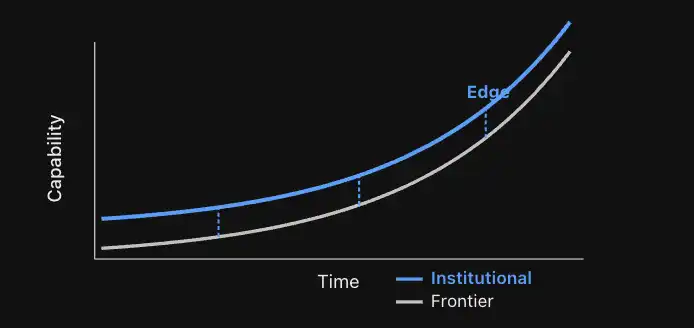
Caption: For any sufficiently specific task, the edge advantage is defined by the institutional solution you build on top of the frontier technology.

Our users are constantly pushing beyond the frontier. The LLM context window grew from 4K to 1 million tokens in four years. Some of our users process 30 billion tokens in a single task. This year we already see a path to processing 100 billion token tasks. Every time the foundational model capability increases, we've gone further.
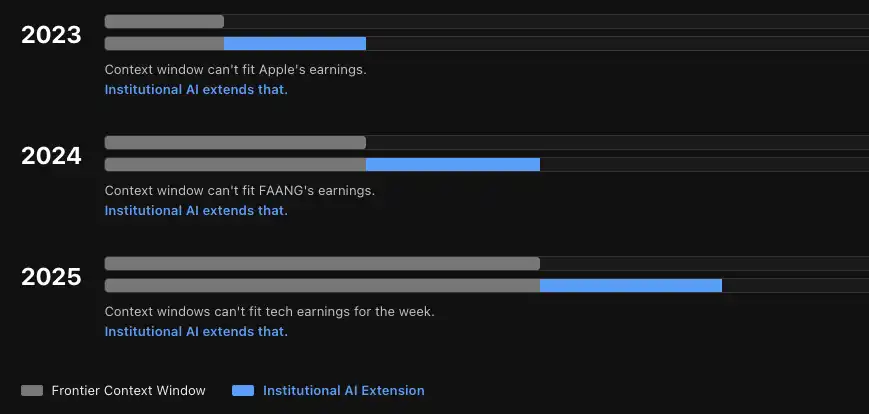
Caption: Context windows, like other capabilities, are a moving target. Comparison of context window evolution over the past three years between frontier labs and Hebbia.

Generality for a broad user base is certainly important, especially in the phase of onboarding employees to AI. But the future won't be people using ChatGPT/Claude *or* vertical solutions, but ChatGPT/Claude *plus* vertical solutions.

Institutional intelligence must leverage domain-specific, even task-specific Agents.

We ask ourselves a question that sounds absurd but isn't:

"Which Agents would an AGI choose to use as shortcuts? Even a superintelligence would want specialized tools for specific domains."

The AI capability frontier will always move, and the winners will be those organizations that leverage the true edge advantage. Everyone else is paying for a very expensive generic commodity.

5. Outcome

Personal AI saves time.

Institutional AI increases revenue.

@MaVolpi once told me something that reshaped my thinking about selling AI to enterprises: "If you ask any CEO whether they prioritize cost-cutting or revenue growth, almost all will say revenue."

But almost every AI product on the market today delivers cost reduction—promising to save you time, do more with fewer people, or replace manpower.

Institutional AI must deliver incremental gains. And incremental gains are much harder to commoditize than saved time.

Take AI-assisted software development. Code IDEs are among the best personal AI productivity tools ever, but they are already facing huge pressure from Claude Code (another personal AI tool). Cognition is playing a completely different game. Their most stable growth business is selling transformation with technology, not selling tools. I bet this model will have staying power.

Pure software is rapidly becoming "uninvestable". Pure services don't scale. The solution layer—where technology and outcomes are bundled together—is where lasting value accrues.

Look at M&A. Personal AI helps analysts model faster. Institutional AI identifies the one worthy acquisition target out of a hundred, then expands the search to a thousand. One saves time, the other creates revenue.
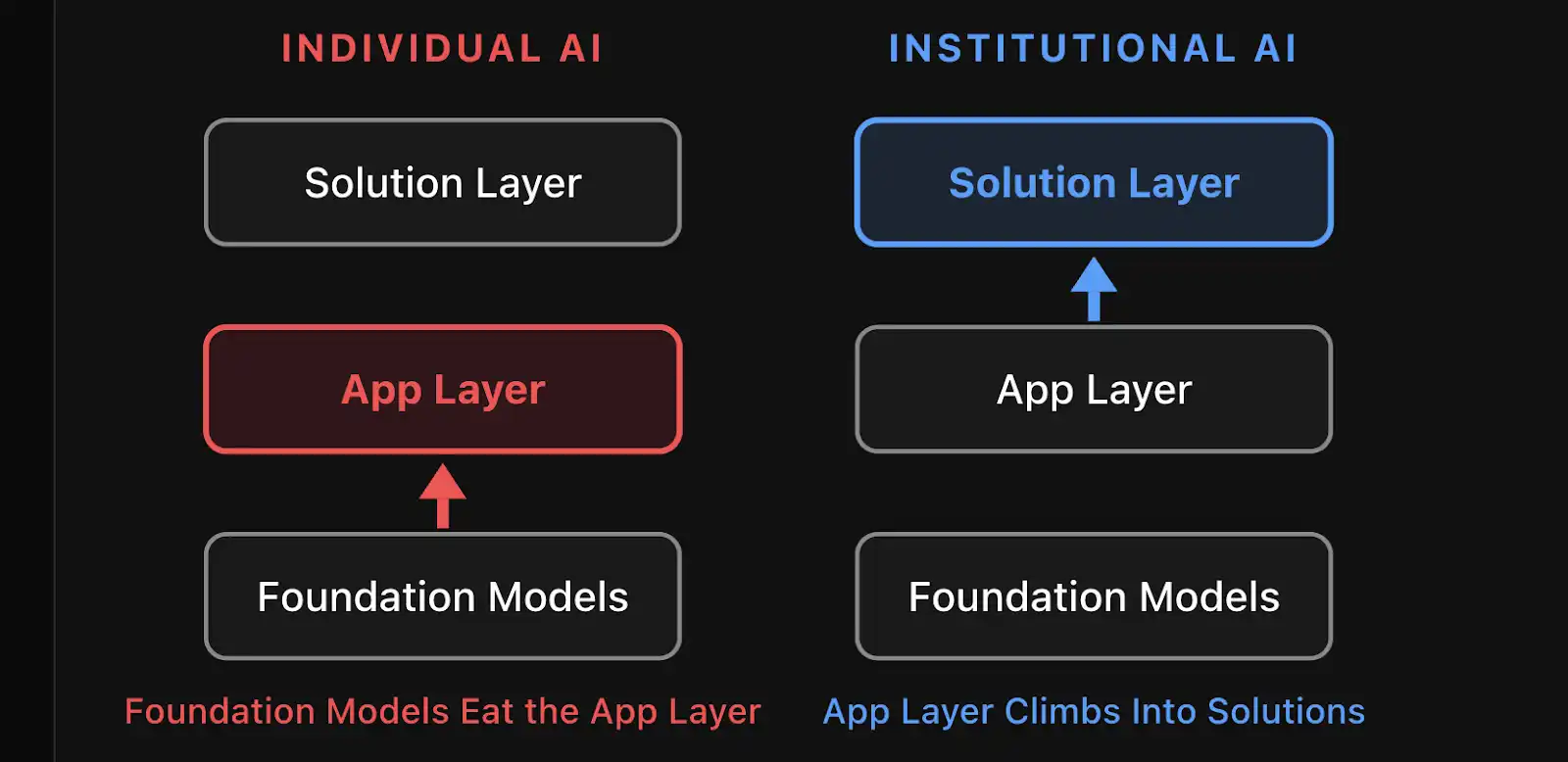
Caption: Foundational model companies are moving up into the application layer. Application layer companies are moving up into the solution layer.

"Moving upstream" is the natural gravitational pull of the market right now. Foundational models are moving into the application layer, application layer companies are moving into the solution layer.

Institutional intelligence *is* the solution layer. And the solution layer—where the outcomes are—will accrue lasting value and capture the largest share of the gains.

6. Enablement

Personal AI gives you a tool.

Institutional AI teaches you how to use it.

No matter how smart, humans resist change.

Believe it or not, there are still successful stores in New York that don't accept credit cards. They know they're losing money, know they lose money by not accepting cards, but just don't move. Similarly, for the foreseeable future, certain employees in certain organizations will simply refuse to use AI.

Transitioning from a purely human organization to an AI-first hybrid organization will be the most persistent, defining challenge of the next decade. And often, the highest-level, most important people in the organization are the last to adopt.
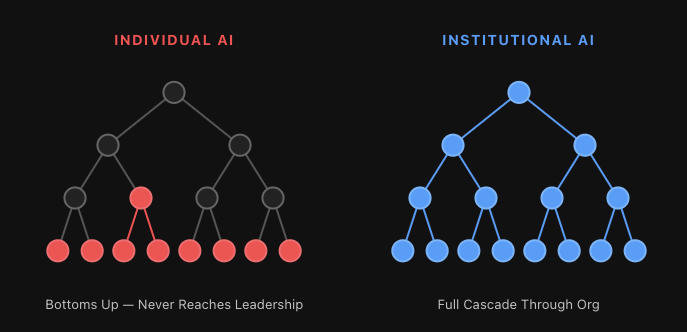
Caption: The highest levels of an organization—those furthest from "productivity tool operation"—are often the slowest but most critical group to adopt new technology.

Palantir is the only "software" company that maintained sky-high valuation multiples during the trillion-dollar tech sell-off of the past two months. There's a reason. Palantir was one of the first true "process engineering" companies. Whether you call it "process engineering" or "writing Claude skill files", the institutional AI of the future will spawn an industry: encoding enterprise processes into Agents and implementing the required change management.
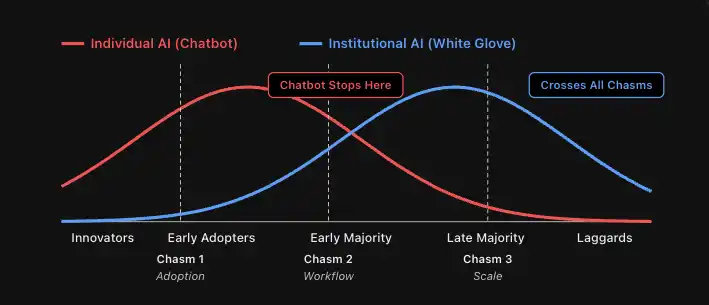
Caption: Full organizational AI adoption will cross multiple chasms, each with its own challenges. Getting processes onto AI will be a major driver.

I'd argue process engineering will be the most important "technology" in the near term.

And in process engineering, business and industry expertise—not software expertise—is paramount. Vertical solutions will cultivate talent with deep expertise in frontline deployment engineering, implementation, and change management.

A top investment bank (top 3 bulge bracket) that chose Hebbia for a full deployment put it best: the reason they didn't go with a major model lab was that "we'd have to explain to their team what a CIM (Confidential Information Memorandum) is". Claude or GPT might understand the domain, but the team responsible for rollout didn't...

This difference is everything.

7. Promptlessness

Personal AI responds to human prompts.

Institutional AI acts proactively, without needing prompts.

There's much discussion about communication between Agents, whether future enterprises and institutions will even need humans.

But the better question is: Will future AI Agents even need prompts?

Writing prompts for AGI is like connecting an electric motor to a handloom. It is fundamentally, irreversibly limited by the weakest link in the organizational supply chain—ourselves. Humans simply don't know the right questions to ask, let alone when to ask them.

The most valuable work AI can do is the work no one thought to ask for. AI should find risks no one spotted, counterparties no one thought of, sales pipelines no one knew existed.

This will completely open up the boundaries of AI use cases.

A promptless system continuously monitors data streams across the entire investment portfolio. It notices the working capital cycle of one portfolio company has been quietly deteriorating for three consecutive months, cross-references it with covenants in the credit agreement, and notifies the operating partner before anyone in the fund even opens that PDF.

When you no longer need humans to prompt the AI, new interfaces and new ways of working emerge. We @Hebbia have strong opinions here. More on that later.

Conclusion

None of this negates the value of chatbots, Agents, and personal AI.

Personal AI will be the vehicle through which most businesses globally first experience the transformative magic of AI. Driving usage, driving ease of use, is a critical first step in the change management needed to build an AI-first economy.

But simultaneously, the need for institutional intelligence is clear, urgent, and massive.

Every organization of the future will have a chatbot from a major model lab. Every organization will also have institutional AI built for specific domain problems—and personal AI will use institutional AI as the most critical tool in its own toolbox.

The "better together" of institutional AI and personal AI is inevitable.

But remember the lesson of the 1890s textile mills. The factories that electrified first lost to the factories that redesigned the workshop.

We have the electricity. It's time to redesign our factories.

Thanks to @aleximm and @WillManidis for review, and Will's "Tool-Shaped Objects" article for inspiring this piece.


İlgili Sorular

QWhat is the core argument of the article regarding AI and organizational value?

AThe core argument is that while AI can make individual workers 10x more efficient, it does not automatically make companies 10x more valuable. The real gains come from redesigning the entire organization and its processes around AI, not just adopting the technology itself.

QWhat historical analogy does the author use to illustrate the disconnect between technology adoption and organizational transformation?

AThe author uses the historical analogy of New England textile mills in the 1890s. They initially replaced steam engines with faster electric motors but saw no productivity gains for 30 years. It was only in the 1920s, when factories were completely redesigned with assembly lines and specialized roles for workers and machines, that the true benefits of electrification were realized.

QWhat are the seven key dimensions that distinguish 'Institutional AI' from 'Individual AI'?

AThe seven dimensions are: 1. Coordination (creates alignment vs. creates chaos), 2. Signal (finds signal vs. creates noise), 3. Bias (creates objectivity vs. feeds bias), 4. Edge Advantage (optimizes for a marginal edge vs. optimizes for usage), 5. Results (drives revenue vs. saves time), 6. Enablement (teaches you how to use it vs. gives you a tool), and 7. Promptless (acts autonomously vs. responds to human prompts).

QAccording to the article, why is 'coordination' a critical challenge for AI adoption in organizations?

ACoordination is critical because without it, efficient individuals (or AI agents) working with their own prompts, styles, and outputs create chaos instead of collective value. They work at cross-purposes, similar to people rowing in different directions, which can dismantle organizational cohesion rather than enhance it. A dedicated 'coordination layer' or 'agent management' is a hard requirement.

QWhat shift in the AI market does the article predict regarding where lasting value will be captured?

AThe article predicts a natural market gravitation 'upstream'. Foundational model companies are moving into the application layer, and application-layer companies are moving into the solutions layer. The solutions layer'—where outcomes and results are delivered—is where lasting value will be captured and the largest profit margins will be found, as opposed to pure software (which is becoming un-investable) or pure services (which don't scale).

İlgili Okumalar

Kicked Out of PayPal, Musk Aims for a Comeback in the Crypto Market

Elon Musk's X (formerly Twitter) has launched its "Smart Cashtags" feature, generating approximately $1 billion in trading volume within days of its April 2026 pilot launch. The feature allows users to click on stock or crypto tickers (or even full Solana token contract addresses) in posts to view real-time price charts and discussions without leaving the app. Initially available to iPhone users in the US and Canada, with a partnership in Canada enabling direct trading via the Wealthsimple app. This move is part of Musk's broader "Everything App" vision, spearheaded by the upcoming X Money platform. Analysts, such as Mizuho's Dan Dolev, see this as a potential disruptor to the US payments market, even prompting a downgrade of PayPal's stock. X Money's beta offers services like 6% APY on deposits, cashback, and P2P transfers, with speculation it may later incorporate crypto trading and stablecoin settlements for faster transactions. However, the ambitious plan faces significant regulatory scrutiny. Senator Elizabeth Warren has questioned the sustainability of the high 6% yield and raised concerns over X's banking partner, Cross River Bank, which has a history of regulatory violations. Additional risks involve the "GENIUS Act," which may create loopholes for stablecoin issuance without full FDIC insurance coverage, potentially leaving users unprotected. The integration of social trading on a platform with over 500 million users could inject new liquidity and retail interest into the crypto market. Yet, it also amplifies risks like herd mentality and the blurring of lines between entertainment and financial speculation. Musk's return to finance, after his ouster from PayPal, hinges on balancing innovation with regulatory compliance.

marsbit48 dk önce

Kicked Out of PayPal, Musk Aims for a Comeback in the Crypto Market

marsbit48 dk önce

İşlemler

Spot
Futures

Popüler Makaleler

GROK AI Nedir

Grok AI: Web3 Döneminde Konuşma Teknolojisini Devrim Niteliğinde Yenilik Giriş Hızla gelişen yapay zeka alanında, Grok AI, ileri teknoloji ve kullanıcı etkileşimi alanlarını birleştiren dikkate değer bir proje olarak öne çıkıyor. Ünlü girişimci Elon Musk'ın liderliğindeki xAI tarafından geliştirilen Grok AI, yapay zeka ile etkileşim şeklimizi yeniden tanımlamayı hedefliyor. Web3 hareketi devam ederken, Grok AI, karmaşık sorgulara yanıt vermek için konuşma yapay zekasının gücünden yararlanmayı amaçlıyor ve kullanıcılara sadece bilgilendirici değil, aynı zamanda eğlenceli bir deneyim sunuyor. Grok AI Nedir? Grok AI, kullanıcılarla dinamik bir şekilde etkileşimde bulunmak üzere tasarlanmış sofistike bir konuşma yapay zeka sohbet botudur. Birçok geleneksel yapay zeka sisteminin aksine, Grok AI, genellikle uygunsuz veya standart yanıtların dışında kabul edilen daha geniş bir sorgu yelpazesini benimsemektedir. Projenin temel hedefleri şunlardır: Güvenilir Akıl Yürütme: Grok AI, bağlamsal anlayışa dayalı mantıklı yanıtlar sağlamak için sağduyu akıl yürütmeyi vurgular. Ölçeklenebilir Denetim: Araç yardımı entegrasyonu, kullanıcı etkileşimlerinin hem izlenmesini hem de kalite için optimize edilmesini sağlar. Resmi Doğrulama: Güvenlik en önemli önceliktir; Grok AI, çıktılarının güvenilirliğini artırmak için resmi doğrulama yöntemlerini entegre eder. Uzun Bağlam Anlayışı: AI modeli, kapsamlı konuşma geçmişini saklama ve hatırlama konusunda mükemmel bir performans sergileyerek anlamlı ve bağlamsal olarak farkında tartışmaların yapılmasını kolaylaştırır. Saldırgan Dayanıklılık: Manipüle edilmiş veya kötü niyetli girdilere karşı savunmalarını geliştirmeye odaklanarak, Grok AI kullanıcı etkileşimlerinin bütünlüğünü korumayı hedefler. Özünde, Grok AI sadece bir bilgi alma cihazı değil; dinamik diyalogu teşvik eden, etkileyici bir konuşma partneridir. Grok AI'nın Yaratıcısı Grok AI'nın arkasındaki beyin, otomotiv, uzay yolculuğu ve teknoloji gibi çeşitli alanlarda yenilikle özdeşleşen Elon Musk'tır. Yapay zeka teknolojisini faydalı yollarla geliştirmeye odaklanan xAI çatısı altında, Musk'ın vizyonu, yapay zeka etkileşimlerinin anlaşılmasını yeniden şekillendirmeyi amaçlıyor. Liderlik ve temel etik, Musk'ın teknolojik sınırları zorlamaya olan bağlılığı tarafından derinden etkilenmektedir. Grok AI'nın Yatırımcıları Grok AI'yi destekleyen yatırımcılarla ilgili spesifik detaylar sınırlı kalmakla birlikte, projenin kuluçka merkezi olan xAI'nin, esasen Elon Musk tarafından kurulduğu ve desteklendiği kamuya açık bir şekilde kabul edilmektedir. Musk'ın önceki girişimleri ve mülkleri, Grok AI'nın güvenilirliğini ve büyüme potansiyelini daha da artıran sağlam bir destek sağlar. Ancak, şu anda Grok AI'yı destekleyen ek yatırım fonları veya kuruluşlarıyla ilgili bilgiye kolayca erişim sağlanamamaktadır; bu da potansiyel gelecekteki keşif alanını işaret etmektedir. Grok AI Nasıl Çalışır? Grok AI'nın operasyonel mekanikleri, kavramsal çerçevesi kadar yenilikçidir. Proje, benzersiz işlevselliklerini kolaylaştıran birkaç son teknoloji ürünü teknolojiyi entegre eder: Sağlam Altyapı: Grok AI, konteyner orkestrasyonu için Kubernetes, performans ve güvenlik için Rust ve yüksek performanslı sayısal hesaplama için JAX kullanılarak inşa edilmiştir. Bu üçlü, sohbet botunun verimli çalışmasını, etkili bir şekilde ölçeklenmesini ve kullanıcılara zamanında hizmet vermesini sağlar. Gerçek Zamanlı Bilgi Erişimi: Grok AI'nın ayırt edici özelliklerinden biri, X platformu (önceden Twitter olarak biliniyordu) aracılığıyla gerçek zamanlı verilere erişim yeteneğidir. Bu yetenek, yapay zekaya en son bilgilere erişim sağlar ve diğer yapay zeka modellerinin gözden kaçırabileceği zamanında yanıtlar ve öneriler sunmasına olanak tanır. İki Etkileşim Modu: Grok AI, kullanıcılara “Eğlenceli Mod” ve “Normal Mod” arasında seçim yapma imkanı sunar. Eğlenceli Mod, daha eğlenceli ve mizahi bir etkileşim tarzı sağlarken, Normal Mod, kesin ve doğru yanıtlar vermeye odaklanır. Bu çok yönlülük, çeşitli kullanıcı tercihlerine hitap eden özelleştirilmiş bir deneyim sağlar. Özünde, Grok AI performansı etkileşimle birleştirerek, hem zenginleştirici hem de eğlenceli bir deneyim yaratmaktadır. Grok AI'nın Zaman Çizelgesi Grok AI'nın yolculuğu, gelişim ve dağıtım aşamalarını yansıtan önemli dönüm noktalarıyla işaretlenmiştir: İlk Geliştirme: Grok AI'nın temel aşaması, modelin ilk eğitim ve ince ayarının yapıldığı yaklaşık iki ay boyunca gerçekleşmiştir. Grok-2 Beta Yayını: Önemli bir ilerleme olarak, Grok-2 beta duyurulmuştur. Bu sürüm, sohbet etme, kodlama ve akıl yürütme yetenekleriyle donatılmış iki versiyon—Grok-2 ve Grok-2 mini—sunmuştur. Halka Açık Erişim: Beta geliştirmesinin ardından, Grok AI X platformu kullanıcılarına sunulmuştur. Telefon numarasıyla doğrulanan ve en az yedi gün aktif olan hesap sahipleri, sınırlı bir versiyona erişim sağlayarak teknolojiyi daha geniş bir kitleye ulaştırmaktadır. Bu zaman çizelgesi, Grok AI'nın kuruluşundan kamu etkileşimine kadar sistematik büyümesini kapsar ve sürekli iyileştirme ve kullanıcı etkileşimine olan bağlılığını vurgular. Grok AI'nın Ana Özellikleri Grok AI, yenilikçi kimliğine katkıda bulunan birkaç ana özelliği kapsamaktadır: Gerçek Zamanlı Bilgi Entegrasyonu: Güncel ve ilgili bilgilere erişim, Grok AI'yı birçok statik modelden ayırarak, etkileyici ve doğru bir kullanıcı deneyimi sağlar. Çeşitli Etkileşim Tarzları: Farklı etkileşim modları sunarak, Grok AI çeşitli kullanıcı tercihlerine hitap eder ve yapay zeka ile konuşurken yaratıcılığı ve kişiselleştirmeyi teşvik eder. Gelişmiş Teknolojik Altyapı: Kubernetes, Rust ve JAX kullanımı, projeye güvenilirlik ve optimal performans sağlamak için sağlam bir çerçeve sunar. Etik Tartışma Dikkati: Görüntü üreten bir işlevin dahil edilmesi, projenin yenilikçi ruhunu sergiler. Ancak, aynı zamanda tanınabilir figürlerin saygılı bir şekilde tasvir edilmesi ve telif hakkı ile ilgili etik konuları da gündeme getirir—bu, yapay zeka topluluğunda süregelen bir tartışmadır. Sonuç Konuşma yapay zekası alanında öncü bir varlık olarak Grok AI, dijital çağda dönüştürücü kullanıcı deneyimlerinin potansiyelini kapsar. xAI tarafından geliştirilen ve Elon Musk'ın vizyoner yaklaşımıyla yönlendirilen Grok AI, gerçek zamanlı bilgiyi gelişmiş etkileşim yetenekleriyle birleştirir. Yapay zekanın neler başarabileceği konusunda sınırları zorlamayı hedeflerken, etik konulara ve kullanıcı güvenliğine odaklanmayı sürdürmektedir. Grok AI, sadece teknolojik ilerlemeyi değil, aynı zamanda Web3 manzarasında yeni bir konuşma paradigmasını da temsil eder ve kullanıcılara hem yetkin bilgi hem de eğlenceli etkileşim sunma vaadinde bulunur. Proje gelişmeye devam ederken, teknolojinin, yaratıcılığın ve insan benzeri etkileşimin kesişim noktasında nelerin başarılabileceğinin bir kanıtı olarak durmaktadır.

258 Toplam GörüntülenmeYayınlanma 2024.12.26Güncellenme 2024.12.26

GROK AI Nedir

ERC AI Nedir

Euruka Tech: $erc ai ve Web3'teki Hedefleri Üzerine Bir Genel Bakış Giriş Blockchain teknolojisi ve merkeziyetsiz uygulamaların hızla gelişen manzarasında, her biri benzersiz hedefler ve metodolojilerle yeni projeler sıkça ortaya çıkmaktadır. Bu projelerden biri, kripto para ve Web3 alanında faaliyet gösteren Euruka Tech'tir. Euruka Tech'in, özellikle $erc ai token'ının ana odak noktası, merkeziyetsiz teknolojinin büyüyen yeteneklerinden yararlanmak için tasarlanmış yenilikçi çözümler sunmaktır. Bu makale, Euruka Tech'in kapsamlı bir genel görünümünü, hedeflerini, işlevselliğini, yaratıcısının kimliğini, potansiyel yatırımcılarını ve Web3'teki daha geniş bağlam içindeki önemini keşfetmeyi amaçlamaktadır. Euruka Tech, $erc ai Nedir? Euruka Tech, Web3 ortamının sunduğu araçlar ve işlevsellikleri kullanan bir proje olarak tanımlanmaktadır ve operasyonlarında yapay zekayı entegre etmeye odaklanmaktadır. Projenin çerçevesine dair spesifik detaylar biraz belirsiz olsa da, kullanıcı etkileşimini artırmayı ve kripto alanındaki süreçleri otomatikleştirmeyi amaçlamaktadır. Proje, yalnızca işlemleri kolaylaştırmakla kalmayıp, aynı zamanda yapay zeka aracılığıyla öngörücü işlevsellikleri de entegre eden merkeziyetsiz bir ekosistem yaratmayı hedeflemektedir; bu nedenle token'ının adı $erc ai'dir. Amaç, büyüyen Web3 alanında daha akıllı etkileşimleri ve verimli işlem işleme süreçlerini kolaylaştıran sezgisel bir platform sunmaktır. Euruka Tech'in Yaratıcısı Kimdir, $erc ai? Şu anda, Euruka Tech'in arkasındaki yaratıcı veya kurucu ekip hakkında bilgi verilmemiştir ve bu durum biraz belirsizdir. Bu veri eksikliği, ekibin geçmişi hakkında bilgi sahibi olmanın genellikle blockchain sektöründe güvenilirlik oluşturmak için gerekli olduğu endişelerini doğurmaktadır. Bu nedenle, somut detaylar kamuya sunulana kadar bu bilgiyi bilinmeyen olarak sınıflandırdık. Euruka Tech'in Yatırımcıları Kimlerdir, $erc ai? Benzer şekilde, Euruka Tech projesinin yatırımcıları veya destekleyen organizasyonları hakkında mevcut araştırmalarla kolayca sağlanan bir bilgi yoktur. Euruka Tech ile etkileşimde bulunmayı düşünen potansiyel paydaşlar veya kullanıcılar için kritik bir unsur, kurumsal finansal ortaklıklar veya saygın yatırım firmalarından gelen destekle sağlanan güvencedir. Yatırım ilişkileri hakkında açıklamalar olmadan, projenin finansal güvenliği veya sürdürülebilirliği hakkında kapsamlı sonuçlar çıkarmak zordur. Bulunan bilgilere paralel olarak, bu bölüm de bilinmeyen durumundadır. Euruka Tech, $erc ai Nasıl Çalışır? Euruka Tech için detaylı teknik spesifikasyonların eksik olmasına rağmen, yenilikçi hedeflerini göz önünde bulundurmak önemlidir. Proje, yapay zekanın hesaplama gücünden yararlanarak kripto para ortamında kullanıcı deneyimini otomatikleştirmeyi ve geliştirmeyi hedeflemektedir. AI'yi blockchain teknolojisiyle entegre ederek, Euruka Tech otomatik ticaret, risk değerlendirmeleri ve kişiselleştirilmiş kullanıcı arayüzleri gibi özellikler sunmayı amaçlamaktadır. Euruka Tech'in yenilikçi özü, kullanıcılar ile merkeziyetsiz ağların sunduğu geniş olanaklar arasında kesintisiz bir bağlantı yaratma hedefinde yatmaktadır. Makine öğrenimi algoritmaları ve AI kullanarak, ilk kez kullanıcı zorluklarını en aza indirmeyi ve Web3 çerçevesindeki işlem deneyimlerini düzene sokmayı amaçlamaktadır. AI ve blockchain arasındaki bu simbiyoz, $erc ai token'ının önemini vurgulamakta ve geleneksel kullanıcı arayüzleri ile merkeziyetsiz teknolojilerin gelişmiş yetenekleri arasında bir köprü işlevi görmektedir. Euruka Tech, $erc ai Zaman Çizelgesi Maalesef, Euruka Tech hakkında mevcut olan sınırlı bilgiler nedeniyle, projenin yolculuğundaki önemli gelişmeler veya kilometre taşları hakkında detaylı bir zaman çizelgesi sunamıyoruz. Genellikle bir projenin evrimini haritalamak ve büyüme eğrisini anlamak için değerli olan bu zaman çizelgesi şu anda mevcut değildir. Önemli olaylar, ortaklıklar veya işlevsel eklemeler hakkında bilgiler belirgin hale geldikçe, güncellemeler kesinlikle Euruka Tech'in kripto alanındaki görünürlüğünü artıracaktır. Diğer “Eureka” Projeleri Üzerine Açıklama Birden fazla projenin ve şirketin “Eureka” benzeri bir isimlendirmeye sahip olduğunu belirtmek önemlidir. Araştırmalar, robotlara karmaşık görevler öğretmeye odaklanan NVIDIA Research'ten bir AI ajanı gibi girişimleri, ayrıca eğitim ve müşteri hizmetleri analitiğinde kullanıcı deneyimini geliştiren Eureka Labs ve Eureka AI'yi tanımlamıştır. Ancak, bu projeler Euruka Tech'ten farklıdır ve hedefleri veya işlevleri ile karıştırılmamalıdır. Sonuç Euruka Tech, $erc ai token'ı ile birlikte, Web3 manzarasında umut verici ancak şu anda belirsiz bir oyuncuyu temsil etmektedir. Yaratıcısı ve yatırımcıları hakkında detaylar açıklanmamış olsa da, yapay zekayı blockchain teknolojisiyle birleştirme konusundaki temel hedefi ilgi odağı olmaktadır. Projenin, gelişmiş otomasyon aracılığıyla kullanıcı etkileşimini teşvik etme konusundaki benzersiz yaklaşımları, Web3 ekosistemi ilerledikçe onu farklı kılabilir. Kripto piyasası gelişmeye devam ederken, paydaşların Euruka Tech etrafındaki gelişmelere dikkat etmeleri önemlidir; belgelenmiş yeniliklerin, ortaklıkların veya tanımlanmış bir yol haritasının gelişimi, önümüzdeki dönemde önemli fırsatlar sunabilir. Şu an itibarıyla, Euruka Tech'in potansiyelini ve rekabetçi kripto manzarasındaki konumunu açığa çıkarabilecek daha somut içgörüler beklemekteyiz.

236 Toplam GörüntülenmeYayınlanma 2025.01.02Güncellenme 2025.01.02

ERC AI Nedir

DUOLINGO AI Nedir

DUOLINGO AI: Dil Öğrenimini Web3 ve AI İnovasyonu ile Entegre Etmek Teknolojinin eğitimi yeniden şekillendirdiği bir çağda, yapay zeka (AI) ve blok zinciri ağlarının entegrasyonu dil öğrenimi için yeni bir ufuk açmaktadır. DUOLINGO AI ve ona bağlı kripto para birimi $DUOLINGO AI ile tanışın. Bu proje, önde gelen dil öğrenme platformlarının eğitimsel yeteneklerini merkeziyetsiz Web3 teknolojisinin faydalarıyla birleştirmeyi hedefliyor. Bu makale, DUOLINGO AI'nın temel yönlerini, hedeflerini, teknolojik çerçevesini, tarihsel gelişimini ve gelecekteki potansiyelini incelerken, orijinal eğitim kaynağı ile bu bağımsız kripto para girişimi arasındaki netliği korumaktadır. DUOLINGO AI Genel Görünümü DUOLINGO AI'nın temelinde, öğrenicilerin dil yeterliliğinde eğitimsel kilometre taşlarına ulaşmaları için kriptografik ödüller kazanabilecekleri merkeziyetsiz bir ortam oluşturma hedefi yatmaktadır. Akıllı sözleşmeler uygulayarak, proje beceri doğrulama süreçlerini ve token tahsislerini otomatikleştirmeyi amaçlamakta, şeffaflık ve kullanıcı sahipliğini vurgulayan Web3 ilkelerine uymaktadır. Model, dil edinimindeki geleneksel yaklaşımlardan ayrılarak, token sahiplerinin kurs içeriği ve ödül dağıtımları üzerinde iyileştirmeler önermesine olanak tanıyan topluluk odaklı bir yönetişim yapısına dayanmaktadır. DUOLINGO AI'nın bazı dikkat çekici hedefleri şunlardır: Oyunlaştırılmış Öğrenme: Proje, dil yeterlilik seviyelerini temsil etmek için blok zinciri başarıları ve değiştirilemez tokenleri (NFT'ler) entegre ederek, katılımcıları motive eden dijital ödüller sunmaktadır. Merkeziyetsiz İçerik Üretimi: Eğitmenler ve dil meraklılarının kendi kurslarını katkıda bulunmalarına olanak tanıyarak, tüm katkıda bulunanların fayda sağladığı bir gelir paylaşım modeli oluşturmaktadır. AI Destekli Kişiselleştirme: Gelişmiş makine öğrenimi modellerini kullanarak, DUOLINGO AI dersleri bireysel öğrenme ilerlemesine uyacak şekilde kişiselleştirmekte, köklü platformlarda bulunan uyarlamalı özelliklere benzer bir deneyim sunmaktadır. Proje Yaratıcıları ve Yönetişim Nisan 2025 itibarıyla, $DUOLINGO AI'nın arkasındaki ekip takma isimler kullanmaktadır; bu, merkeziyetsiz kripto para alanında sıkça görülen bir uygulamadır. Bu anonimlik, bireysel geliştiricilere odaklanmak yerine kolektif büyümeyi ve paydaş katılımını teşvik etmek amacıyla tasarlanmıştır. Solana blok zincirinde dağıtılan akıllı sözleşme, geliştiricinin cüzdan adresini not etmekte, bu da yaratıcıların kimliğinin bilinmemesine rağmen işlemlerle ilgili şeffaflık taahhüdünü simgelemektedir. Yol haritasına göre, DUOLINGO AI, Merkeziyetsiz Otonom Organizasyon (DAO) haline gelmeyi hedeflemektedir. Bu yönetişim yapısı, token sahiplerinin özellik uygulamaları ve hazine tahsisleri gibi kritik konularda oy kullanmalarına olanak tanımaktadır. Bu model, çeşitli merkeziyetsiz uygulamalarda bulunan topluluk güçlendirme ethosu ile uyumlu olup, kolektif karar verme sürecinin önemini vurgulamaktadır. Yatırımcılar ve Stratejik Ortaklıklar Şu anda, $DUOLINGO AI ile bağlantılı olarak kamuya açık tanımlanabilir kurumsal yatırımcılar veya risk sermayedarları bulunmamaktadır. Bunun yerine, projenin likiditesi esas olarak merkeziyetsiz borsa (DEX) kaynaklıdır ve bu, geleneksel eğitim teknolojisi şirketlerinin finansman stratejileriyle keskin bir zıtlık oluşturmaktadır. Bu tabandan gelen model, merkeziyetsizliğe olan bağlılığını yansıtan topluluk odaklı bir yaklaşımı işaret etmektedir. DUOLINGO AI, beyaz kitabında, kurs tekliflerini zenginleştirmeyi amaçlayan belirsiz “blok zinciri eğitim platformları” ile işbirlikleri kurmayı planladığını belirtmektedir. Belirli ortaklıklar henüz açıklanmamış olsa da, bu işbirlikçi çabalar, blok zinciri yeniliğini eğitim girişimleri ile birleştirmeyi amaçlayan bir stratejiyi ima etmektedir ve çeşitli öğrenme yollarında erişimi ve kullanıcı katılımını genişletmektedir. Teknolojik Mimari AI Entegrasyonu DUOLINGO AI, eğitimsel tekliflerini geliştirmek için iki ana AI destekli bileşen içermektedir: Uyarlanabilir Öğrenme Motoru: Bu sofistike motor, kullanıcı etkileşimlerinden öğrenmekte olup, büyük eğitim platformlarından gelen özel modellere benzer. Belirli öğrenici zorluklarını ele almak için ders zorluğunu dinamik olarak ayarlamakta ve zayıf alanları hedeflenmiş alıştırmalarla pekiştirmektedir. Konuşma Ajanları: GPT-4 destekli sohbet botlarını kullanarak, DUOLINGO AI kullanıcıların simüle edilmiş konuşmalara katılmalarına olanak tanıyarak, daha etkileşimli ve pratik bir dil öğrenme deneyimi sunmaktadır. Blok Zinciri Altyapısı $DUOLINGO AI, Solana blok zincirinde inşa edilmiş kapsamlı bir teknolojik çerçeve kullanmaktadır: Beceri Doğrulama Akıllı Sözleşmeleri: Bu özellik, yeterlilik testlerini başarıyla geçen kullanıcılara otomatik olarak token ödülleri vermekte, gerçek öğrenim sonuçları için teşvik yapısını güçlendirmektedir. NFT Rozetleri: Bu dijital tokenler, öğrenicilerin kurslarının bir bölümünü tamamlamak veya belirli becerileri ustalaşmak gibi ulaştıkları çeşitli kilometre taşlarını simgelemekte ve bunları dijital olarak takas etmelerine veya sergilemelerine olanak tanımaktadır. DAO Yönetişimi: Token sahibi topluluk üyeleri, anahtar öneriler üzerinde oy kullanarak yönetişime katılabilir, bu da kurs teklifleri ve platform özelliklerinde yeniliği teşvik eden katılımcı bir kültürü kolaylaştırmaktadır. Tarihsel Zaman Çizelgesi 2022–2023: Kavramsallaştırma DUOLINGO AI için temel, dil öğrenimindeki AI ilerlemeleri ile blok zinciri teknolojisinin merkeziyetsiz potansiyeli arasındaki sinerjiyi vurgulayan bir beyaz kağıdın oluşturulmasıyla başlar. 2024: Beta Lansmanı Sınırlı bir beta sürümü, popüler dillerdeki teklifleri tanıtarak, erken kullanıcıları token teşvikleri ile ödüllendirir ve projenin topluluk katılım stratejisinin bir parçası olarak sunulmaktadır. 2025: DAO Geçişi Nisan ayında, tokenlerin dolaşıma girmesiyle tam bir ana ağ lansmanı gerçekleşir ve topluluk, Asya dillerine ve diğer kurs gelişmelerine olası genişlemeler hakkında tartışmalara başlar. Zorluklar ve Gelecek Yönelimleri Teknik Engeller Hırslı hedeflerine rağmen, DUOLINGO AI önemli zorluklarla karşı karşıyadır. Ölçeklenebilirlik, AI işleme ile merkeziyetsiz bir ağı sürdürme maliyetleri arasında denge kurma konusunda sürekli bir endişe kaynağıdır. Ayrıca, merkeziyetsiz bir teklif arasında kaliteli içerik üretimi ve moderasyonu sağlamak, eğitim standartlarını koruma konusunda karmaşıklıklar yaratmaktadır. Stratejik Fırsatlar İleriye dönük olarak, DUOLINGO AI, akademik kurumlarla mikro yeterlilik ortaklıkları kurma potansiyeline sahiptir ve dil becerilerinin blok zinciri ile doğrulanmış onaylarını sağlamaktadır. Ayrıca, çapraz zincir genişlemesi, projenin daha geniş kullanıcı tabanlarına ve ek blok zinciri ekosistemlerine erişim sağlamasına olanak tanıyabilir, böylece birlikte çalışabilirliğini ve erişimini artırabilir. Sonuç DUOLINGO AI, yapay zeka ve blok zinciri teknolojisinin yenilikçi bir birleşimini temsil etmekte olup, geleneksel dil öğrenim sistemlerine topluluk odaklı bir alternatif sunmaktadır. Takma isimli geliştirme süreci ve ortaya çıkan ekonomik modeli bazı riskler taşısa da, projenin oyunlaştırılmış öğrenme, kişiselleştirilmiş eğitim ve merkeziyetsiz yönetişim konusundaki taahhüdü, Web3 alanında eğitim teknolojisi için bir yol haritası aydınlatmaktadır. AI gelişmeye devam ederken ve blok zinciri ekosistemi evrim geçirirken, DUOLINGO AI gibi girişimler, kullanıcıların dil eğitimi ile etkileşim biçimlerini yeniden tanımlayabilir, toplulukları güçlendirebilir ve yenilikçi öğrenme mekanizmaları aracılığıyla katılımı ödüllendirebilir.

241 Toplam GörüntülenmeYayınlanma 2025.04.11Güncellenme 2025.04.11

DUOLINGO AI Nedir

Tartışmalar

HTX Topluluğuna hoş geldiniz. Burada, en son platform gelişmeleri hakkında bilgi sahibi olabilir ve profesyonel piyasa görüşlerine erişebilirsiniz. Kullanıcıların AI (AI) fiyatı hakkındaki görüşleri aşağıda sunulmaktadır.

活动图片