A Wave of Resistance Against AI Data Centers Sweeps the U.S., and the Most Vocal Are Not in Wealthy Areas

marsbit2026-06-08 tarihinde yayınlandı2026-06-08 tarihinde güncellendi

Özet

A nationwide movement against AI data center construction is gaining momentum across the US, from Vermont to California. New York's legislature recently passed a one-year moratorium, and Illinois has paused tax incentives for such projects. A new report, featuring exclusive data analysis from researcher Geoff Holtzman, challenges the narrative that opposition is led by wealthy "NIMBYs." Key findings reveal: 1) Resistance is highest in the poorest communities (19% protest rate) and lowest in the wealthiest (3.8%). 2) Proposed data centers facing community protests are over five times more likely to be canceled or paused (28.2% vs. 5.2%). 3) The higher cancellation rate in low-income areas is directly explained by their higher protest rates. A separate Heatmap poll shows 55% of Americans strongly oppose local data centers, with opposition strongest among Democrats, rural residents, and young adults (80% of 18-35 year olds). The analysis concludes that the anti-data center movement is largely driven by working-class communities and is proving effective at halting projects.

Author: Brian Merchant

Compiled and Edited by: BitpushNews

The data center protest movement has swept across the United States. From Vermont to Oklahoma, from Indiana to California, communities are organizing to halt the tech industry's rapid expansion of data centers on their doorsteps. This week, the New York state legislature passed a one-year moratorium on data center construction, which is now on the governor's desk awaiting signature. The governor of Chicago, Illinois, has also suspended tax incentives for data centers. Few issues have generated such political intensity or unity; the rare bipartisan consensus emerging in the U.S. for 2026 is contempt for data centers and hostility towards artificial intelligence (AI).

This article brings an exclusive report from a data scientist who, through deep data analysis, precisely examines who is blocking data center construction and how successful these protests actually are.

If you think I'm exaggerating, consider a recent survey released by Heatmap. It polled over 4,000 Americans on their attitudes towards data centers and whether they support building such projects near their homes.

The results show public negativity towards data centers has become utterly irreversible. The poll reveals that 55% of Americans "strongly" oppose building a data center in their area. This is a "record low, revealing a stunning shift in public opinion towards the facilities underpinning the AI boom."
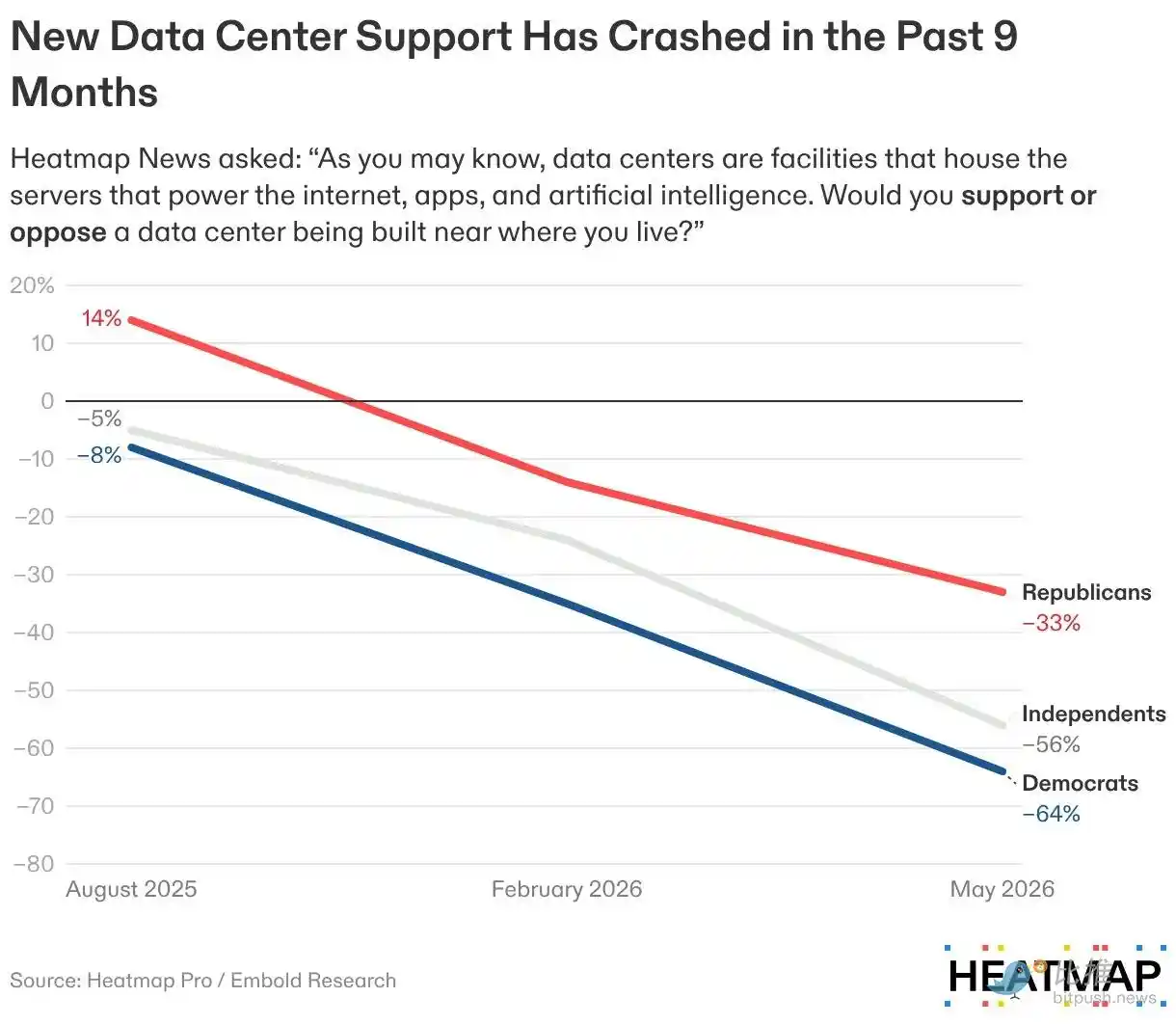
Demographics of Opposition

Democrats, rural residents, and young people express particularly strong opposition: among respondents aged 18 to 35, a striking 80% oppose data centers. (This aligns perfectly with current overall trends; other polls and countless anecdotes have long confirmed that Generation Z holds deep-seated animosity towards AI. Just listen to the chorus of boos that erupted during pro-AI commencement speeches this summer.)

However, as readers well know, there has been debate and skepticism about the driving forces and nature of this growing resistance movement.

Some have argued with conviction that opposition to data centers is simply conservative "NIMBYism" (Not In My Backyard), led by affluent environmentalists in Patagonia vests. While the sheer number of data center opponents shown in the Heatmap survey suggests otherwise, that poll didn't specifically test for these class factors.

If you want to counter this narrative—as I, along with Astra Taylor and Saul Levin, have argued, positing that the data center opposition is actually rooted in working-class politics—then having solid data is crucial. That's where data scientists come in. After I published a report on the "Data Center Rebellion" (which relied on my firsthand interviews and a review of national news), researcher Geoff Holtzman contacted me to share his quantitative analysis of the movement, specifically focusing on who is actually protesting.

Holtzman describes himself as "a philosopher and data scientist who writes about quantitative rhetoric and scientism," often publishing in his Science & Power newsletter. His peer-reviewed work has appeared in journals like the Proceedings of the National Academy of Sciences (PNAS) and the American Journal of Bioethics. He too had heard the widespread claim that data center protests are led by wealthy NIMBYs, so he decided to investigate. He cross-referenced a dataset of current and proposed data center projects with U.S. Census data (see Note 1) and agreed to share his findings exclusively here. He arrived at at least three stark conclusions.
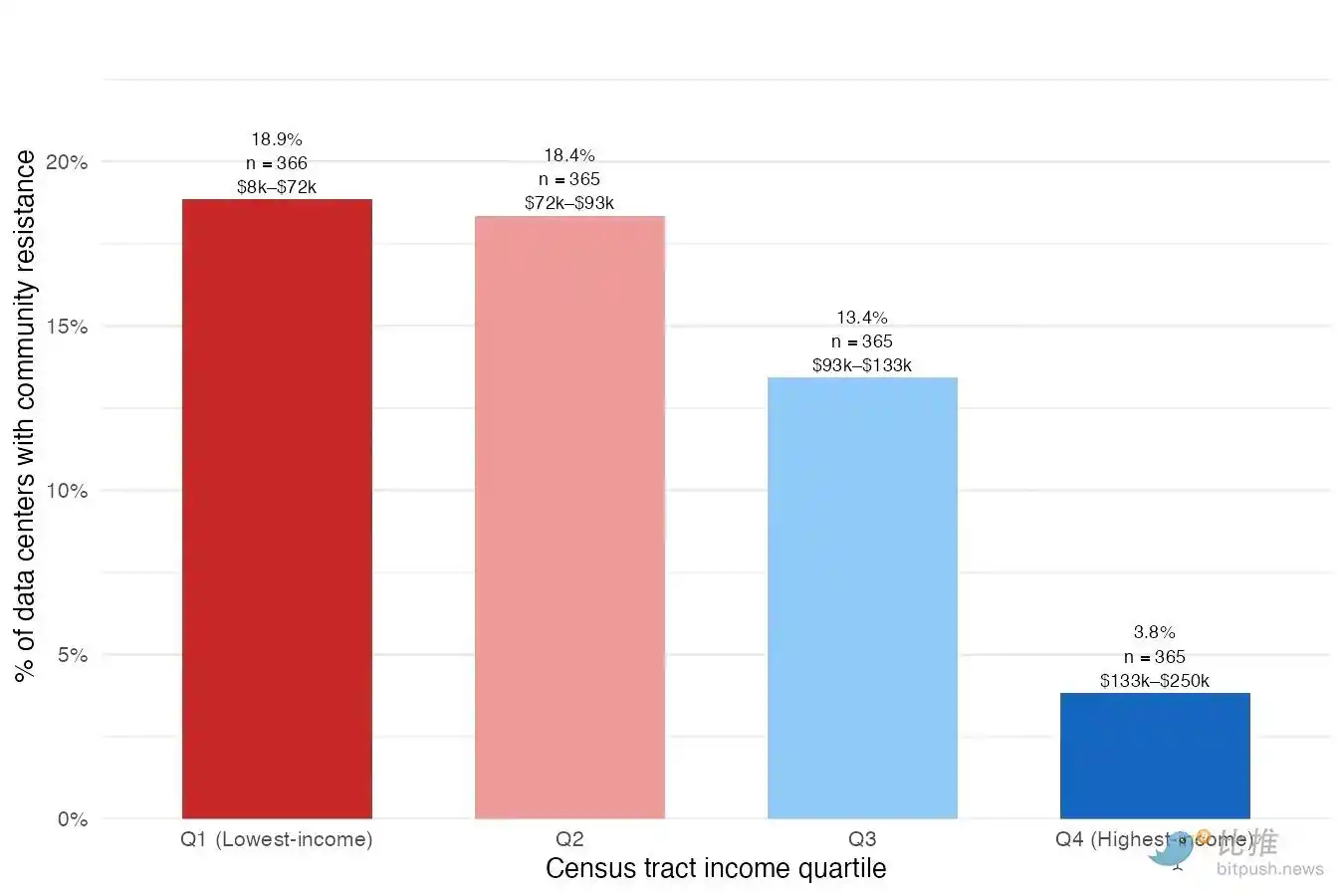
1. The poorest communities protest data centers at almost five times the rate of the highest-asset communities (19.0% vs. 3.8%).

(Chart note: These quartiles are calculated only for census tracts in the data center dataset, not nationwide quartiles.)

"The most frequent protests come from communities with median household incomes between $8,000 and $72,000," Holtzman notes. "Meanwhile, the communities with the lowest protest rates have average household incomes between $133,000 and $250,000."

This directly punctures the political myth that data center opposition is led by comfortable, Patagonia-clad upper-middle-class activists; protests occur far more frequently in poor or blue-collar communities than in affluent ones.

As Holtzman puts it: "Putting aside all moral or justice questions, from a purely pragmatic standpoint, tech companies would find it much easier to build compute centers in higher-income areas."
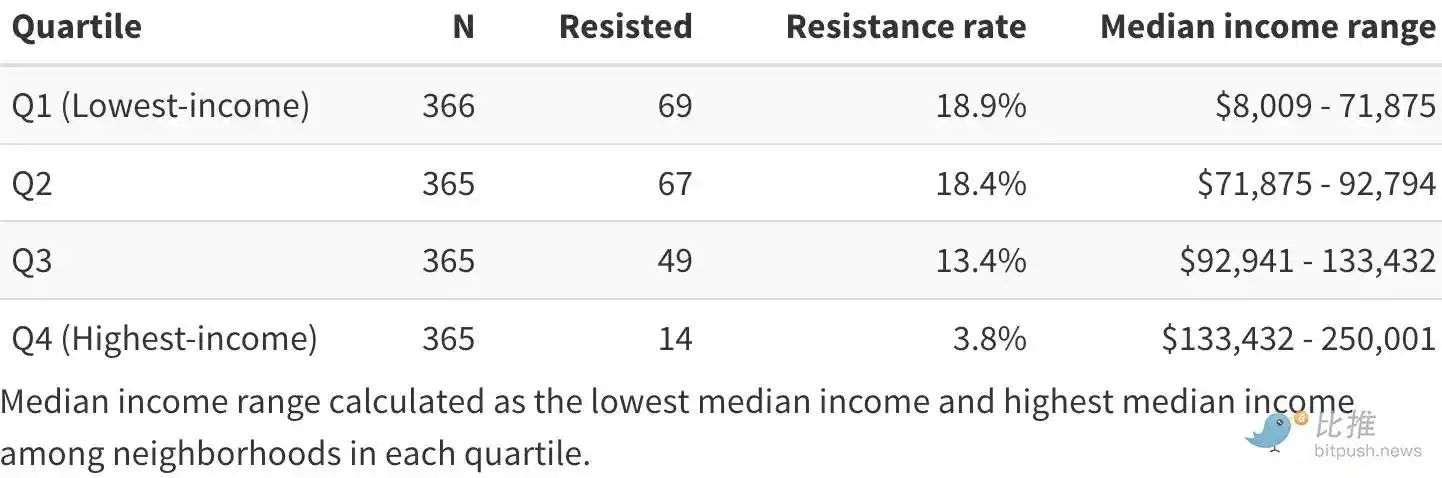
He adds: "Among low-income, low-education communities facing project proposals, it's the communities with the lowest income and least education that fight back the hardest." Meanwhile:

High-education, high-income communities show remarkably little protest. As for the possible role of homeownership rates, we're not talking about old money resisting affordable housing—we're talking precisely about the people who might be living in that affordable housing.

Furthermore, Holtzman's data confirms that the data center rebellion is working. We've seen numerous headlines about developments being canceled or scaled back—just this week, under immense public pressure, Ken O'Leary's massive Utah project was halved by the state's governor. Other projects have been canceled outright.

According to Holtzman's analysis:

2. Recently proposed data centers that faced protest were over five times more likely to be canceled or paused than those that didn't (28.2% vs. 5.2%).

This is a startling figure. When a newly proposed data center project faces community resistance, nearly one-third end up being canceled, paused, or shut down. This is a remarkably high success rate, offering further inspiration for data center opposition organizers weighing whether to launch new campaigns.
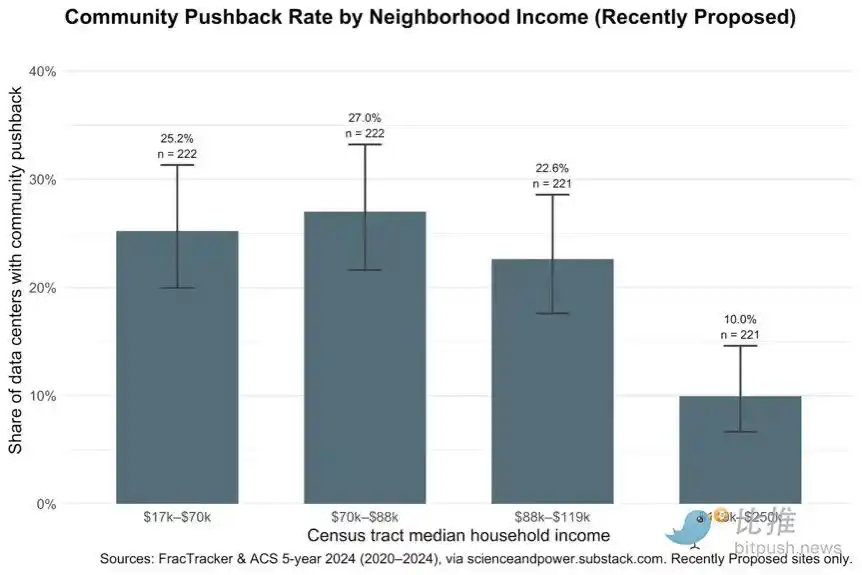
Finally, combining insights from the first two points, Holtzman found:

3. The higher cancellation rates in low-income areas can be entirely explained by their higher protest rates.

"In communities that rise up, projects are six times more likely to be canceled than in communities that acquiesce," Holtzman points out. He adds: "The increase in cancellation rates in low-income areas is entirely due to the high protest rates in these communities. Therefore, continuing to push project proposals in these areas may incite more public anger, trigger stronger resistance, and further increase cancellation rates."
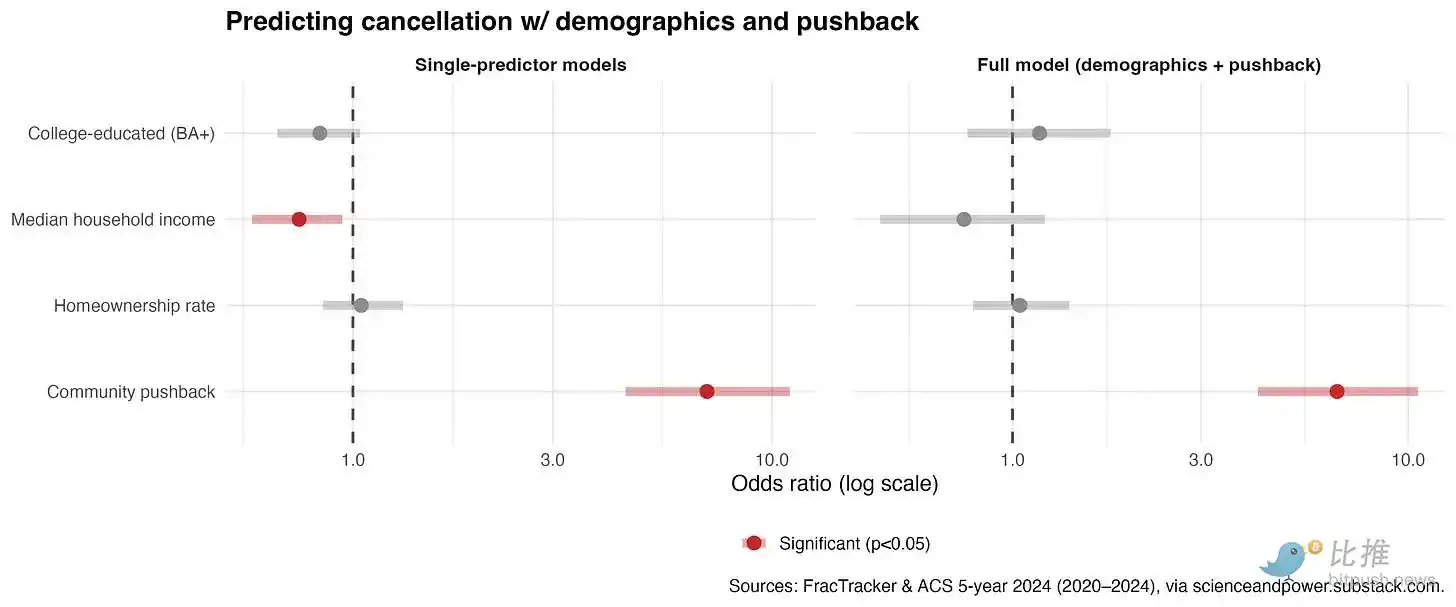
I hope this data helps shatter the condescending prejudice that the data center resistance movement is led by affluent NIMBYs. In reality, the vast majority of those standing up are working-class residents and communities. I also hope these findings serve as a powerful tool for cities, residents, and organizers grappling with data center development.

My sincere thanks again to Geoff Holtzman for allowing me to publish these research findings on the blog. For those interested in studying or further testing his data, he has hosted the entire code repository on GitHub.

The U.S. Becomes the Most Resistant Nation to New Data Centers Overall
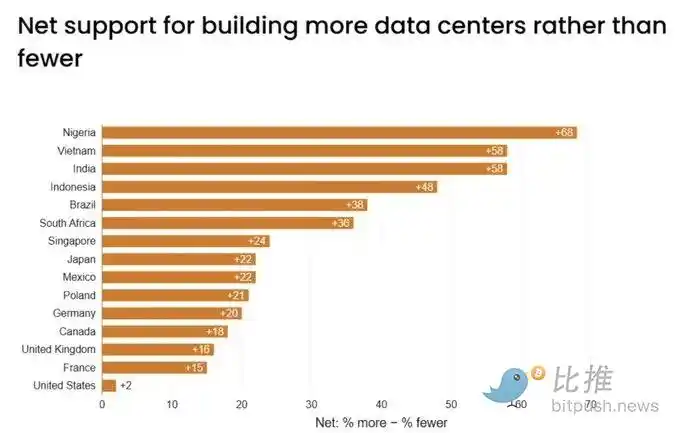
Data from research firm Public First (shared by WIRED reporter Molly Taft): How did the U.S., the epicenter of the AI boom, become its own stumbling block? Our survey offers several explanations.

–Informed Opposition

The public now understands better than before what AI is, what it does, and what data centers are and do. When we conducted AI surveys 5 years ago, it was at best a niche interest. Now we see a clear growth in public awareness and understanding, and more sophisticated use of the tools, especially among the 25-44 age group. Our analysis of who understands AI needs to shift from "who has opened a large language model" to "who uses large language models in complex, integrated ways."

Our survey shows the U.S. is middling in terms of self-reported understanding of data centers, higher than other "developed" markets. This is unsurprising given the prevalence of data center construction in the U.S.

And this "informed opposition" makes it more averse to data centers than any other country surveyed. Interesting!

Note 1:

According to Holtzman: I used 5-year American Community Survey data from 2020-2024, so income figures are generally a bit lower than you might expect. I needed to do this to get data at the census tract level; therefore, for national medians, I stuck with the same dataset.


İlgili Sorular

QAccording to the data scientist's analysis, which income-level communities are most active in opposing AI data center construction in the US, and how does their protest rate compare to the wealthiest communities?

AAccording to the data analysis, the lowest income-level communities (with median household incomes ranging from $8,000 to $72,000) are most active in opposing AI data centers. Their protest rate is almost five times higher than that of the wealthiest communities (19.0% compared to 3.8%).

QWhat is the reported likelihood of a proposed data center project being canceled or paused if it faces community opposition, based on the analysis in the article?

AThe analysis shows that proposed data center projects facing community opposition are more than five times as likely to be canceled or paused compared to those without opposition, with a rate of 28.2% versus 5.2%.

QWhat does the Heatmap poll mentioned in the article reveal about overall US public opinion regarding the construction of data centers in their local area?

AThe Heatmap poll reveals that a majority, specifically 55% of Americans, "strongly" oppose the construction of data centers in their area, indicating a record low in public support.

QWhich demographic groups does the article identify as having particularly strong opposition to data centers, based on the Heatmap survey?

ABased on the Heatmap survey, Democrats, rural residents, and young people aged 18 to 35 show particularly strong opposition. Notably, 80% of the 18-35 age group opposes data centers.

QHow does the article describe the reason for the high project cancellation rate in low-income areas, based on the data scientist's findings?

AThe article explains that the high project cancellation rate in low-income areas is entirely explained by their higher rate of community protest and opposition.

İlgili Okumalar

7 Months After the Collapse of Huiwang, Southeast Asia's Escrow Platforms Undergo a Major Reshuffle

Following the collapse of Huione Pay—dubbed the "Alipay of Southeast Asia"—seven months ago, the region's underground financial guarantee platform sector is undergoing a significant reshuffle. This power vacuum has been swiftly filled by emerging platforms such as XinBi, Tiger/Navigator, JinBei (renamed JinBo), Dali/Tiancheng, and FullyLight. These platforms, operating largely via Telegram and offering services like escrow for illicit transactions, have absorbed the vast user base and markets left behind by Huione. While positioning themselves as "trust intermediaries," their primary clientele consists of networks involved in online scams, money laundering, illegal gambling, and even human trafficking. For instance, the Tiger/Navigator platform explicitly provides "escrow" services for kidnapping-for-ransom operations ("强押车交易"). Data underscores the immense scale: Huione alone processed over $103 billion in cryptocurrency payments and facilitated over $31 billion through its escrow market before its downfall, linking it to Cambodia's notorious Prince Group. Since its collapse, competitors have seen explosive growth. For example, the XinBi platform has accumulated over $1.6 billion in total USDT revenue, while platforms like NewPay, OkPay (under Dali), and FullyLight Wallet collectively processed over $4.8 billion in USDT in a single year. This ecosystem thrives in regions like Cambodia and Myanmar, where regulatory gaps allow these platforms to act as critical financial infrastructure for sprawling cybercrime industries, from scam compounds to online casinos. The article concludes that the moniker "Southeast Asian Alipay" is a misnomer, obscuring the platforms' fundamental role in enabling serious criminal enterprises rather than representing legitimate financial innovation.

Odaily星球日报59 dk önce

7 Months After the Collapse of Huiwang, Southeast Asia's Escrow Platforms Undergo a Major Reshuffle

Odaily星球日报59 dk önce

The Changing Landscape: What Are Crypto VCs Experiencing?

Title: The Shifting Landscape of Crypto Venture Capital The era of dedicated crypto venture capital funds is undergoing a significant transformation. Once essential for navigating the sector's complexity and high risk, these specialized funds are now facing an identity crisis as the market matures. This shift mirrors historical patterns in other specialized investment classes like cleantech and SPACs, where initial information advantages dissipate as technologies become mainstream and integrated into existing industry frameworks. The article argues that crypto is reaching a critical inflection point, transitioning from a "building phase" to an "integration phase." Major players like Stripe, BlackRock, and Visa now engage with crypto not for its novel mechanics but as a foundational financial infrastructure. Their needs—regulatory compliance, banking partnerships, distribution channels—align with traditional fintech, a domain easily understood by large, generalist funds like Sequoia and Founders Fund. This evolution creates a "barbell effect" within the VC landscape. On one end are massive, diversified platforms that can incorporate crypto as one vertical among many. On the other are small, nimble funds focused on niche, experimental projects. The middle ground—medium-sized dedicated crypto funds—is being squeezed out. Their typical fund size makes it impossible to generate sufficient returns solely from early-stage crypto bets, yet they cannot compete with giants for later-stage deals. Consequently, leading crypto-native firms like Paradigm and Framework Ventures are expanding into AI, robotics, and other sectors, driven partly by LP pressure for better returns amid a broader VC DPI crisis. Others, like Dragonfly and a16z, have narrowed their crypto focus predominantly to financial infrastructure like stablecoins, reframing the sector's core narrative. For crypto entrepreneurs, this consolidation presents challenges. While generalist funds offer larger checks and broader resources, crypto projects now compete fiercely with AI for attention and capital within these firms. Furthermore, the long-term, non-commercial foundational work that built the ecosystem—funded by dedicated crypto VCs—is less likely to attract generalist capital focused on direct returns. The conclusion is that "crypto investor" as a standalone category is becoming obsolete, akin to "internet investor." Crypto is becoming a baseline infrastructure layer. The future will see a barbell structure: large-scale growth financing handled by generalist funds, while pioneering, speculative projects are funded by small, specialized vehicles. The dedicated crypto funds of the 2017-2021 boom, which incubated core infrastructure, are giving way to this new, bifurcated reality.

Foresight News1 saat önce

The Changing Landscape: What Are Crypto VCs Experiencing?

Foresight News1 saat önce

As Consensus Accelerates, What Are Young Investors Betting On?

Title: As Consensus Forms Faster, What Are Young Investors Betting On? In the rapid evolution of tech investment, a new generation of young investors is navigating a landscape where AI, robotics, commercial aerospace, and quantum computing are advancing simultaneously. Traditional investment logic based on financial models is giving way to a need for deep technical understanding and the ability to act before industry consensus forms. An analysis of trends from the "WAIC FUTURE TECH" list of young investment leaders reveals key shifts in focus. The first major trend is the movement of AI from the digital screen into the physical world. Investment is shifting from large language models and chatbots towards embodied AI, robotics, AI hardware, and edge computing. While demonstrations generate excitement, the real challenge lies in achieving scalable, reliable, and cost-effective delivery in complex real-world environments like factories and logistics. Success depends not just on algorithms but on the integration of sensors, actuators, and control systems. Second, the competitive focus for large models is moving beyond raw capability toward building an "intelligence flywheel." The goal is to create self-reinforcing systems where user interaction generates data, improving the model, which in turn enhances the user experience and attracts more engagement. Companies that successfully embed AI into workflows to create these closed-loop systems can build lasting value that isn't easily erased by the next model upgrade. Third, facing a potential bottleneck in high-quality human-generated data, investors are looking at new underlying technologies. Reinforcement learning and self-play, as demonstrated by AlphaGo Zero, offer paths for AI to generate its own experience. Scientific foundation models, which aim to build general AI capabilities for fields like life sciences and materials discovery, represent a non-consensus direction that could unlock new frontiers of knowledge and data. Finally, in deep-tech areas like quantum computing, commercial aerospace, and space-based infrastructure, patient capital is essential. These fields have long, uncertain development and validation cycles involving complex engineering, supply chains, and regulations. Investment here requires a long-term view, focusing on foundational team capabilities and the eventual emergence of market demand, even if commercial returns are distant. Collectively, these trends illustrate how young investors are adapting to a new era. They are learning to make earlier, technically-informed judgments, balance hype with real-world viability, and provide the patient capital needed to build the deep-tech foundations of the future.

marsbit1 saat önce

As Consensus Accelerates, What Are Young Investors Betting On?

marsbit1 saat önce

İşlemler

Spot
活动图片




