A Threefold Performance Leap! NEAR Achieves 200ms Physical Block Time Limit with SPICE

Foresight News2026-06-23 tarihinde yayınlandı2026-06-23 tarihinde güncellendi

Özet

NEAR's core development team, Near One, has announced its next major protocol evolution: SPICE (Separation of Consensus and Execution). Currently in development, SPICE represents the most significant upgrade before the full implementation of Nightshade 3.0. Its core innovation is decoupling the consensus layer, responsible for ordering transactions, from the execution layer, which processes them. This allows the consensus layer to run at full speed without waiting for transaction execution to complete. Once deployed, SPICE is projected to triple NEAR's block production speed, achieving a 200ms block time, which is considered the physical limit due to the speed of light and network latency. This leap will dramatically reduce transaction latency and finality, with transactions confirming in roughly 0.4 seconds—faster than a typical card payment. The upgrade also enables more complex, long-running transactions and significantly improves user experience for applications like NEAR Intents and near.com. Beyond raw speed, SPICE enhances network scalability and security. It enables deeper parallelism, efficiently distributing workload across shards and improving resource utilization. The simpler block structure and lighter contracts also facilitate formal verification and security auditing. Furthermore, SPICE lays the critical groundwork for future Nightshade 3.0 features, most notably atomic cross-shard transactions, which would simplify complex contract logic and eliminate develo...


Authors: Anton Astafiev, Chief Technology Officer, Near One;

Mally Anderson, NEAR Columnist

Compiled by: Saoirse, Foresight News


The NEAR core development team Near One recently announced two major upgrades to the NEAR protocol, both set to go live later this month: one is dynamic resharding, used to enhance network scalability; the other is the launch of the first quantum signature scheme, providing post-quantum security for all NEAR accounts. This article details the next core plan in NEAR's technical roadmap—SPICE, which stands for "Separation of Protocol Into Consensus and Execution." SPICE is currently still in the research and development phase and is the most important upgrade before the implementation of Nightshade 3.0, the next iteration of NEAR's sharding technology.

(To understand the sharding technology evolution from 2019 to the present, you can read the previously published dynamic resharding feature article; for a complete understanding of NEAR protocol's overall evolution, please refer to Bowen Wang's keynote speech on Nightshade 3.0 at the 2026 NEARCON conference.)


After SPICE officially launches, NEAR's block production speed will increase to three times its original rate, achieving a 200-millisecond block time. As of May 2025, NEAR's current performance is 600ms block time and 1.2-second transaction finality. The core logic behind this performance leap is decoupling the consensus process from transaction execution: the consensus layer can run at full speed without waiting for transaction execution to complete before producing a block. It's worth mentioning that constrained by the speed of light and the basic time required for consensus nodes to send and receive messages, 200 milliseconds is the theoretical fastest block time achievable at the physical layer.


The layered operation of consensus and execution will bring three core improvements: faster block times, lower transaction latency, and support for longer-running, more complex logic transactions.


How SPICE Achieves Protocol Speedup


The separation of consensus and execution is a fundamental and far-reaching upgrade to the NEAR protocol. It is also the most extensive technical transformation since the introduction of the stateless validation mechanism in 2024, representing a massive engineering effort for the Near One team. The concept of SPICE was first proposed at the NEAR industry summit in late 2024; now that prerequisite upgrades like Gas Keys (already live in version 2.12), sharded smart contracts, and dynamic resharding have all been implemented, SPICE's development process has also accelerated.


Although implementing this layered architecture is extremely difficult, its underlying logic is clear and easy to understand: the core value of a blockchain is to provide an immutable, irrevocable guarantee of transaction ordering. Traditional schemes rely on Byzantine Fault Tolerant (BFT) consensus mechanisms, where each block synchronously packs ordered transactions and updates account balances, which directly slows down block production efficiency. SPICE, however, splits transaction ordering and state execution into two independent processes: all validator nodes only need to reach consensus on the transaction list and block hash, ensuring the transaction order cannot be tampered with. This process requires no complex computation while preserving blockchain determinism. Nodes can produce blocks by only verifying transaction signatures. Account state calculations can proceed asynchronously while block consensus is confirmed. The execution flow is no longer tied to block ordering and does not need to synchronously update the state root in every consensus block round.
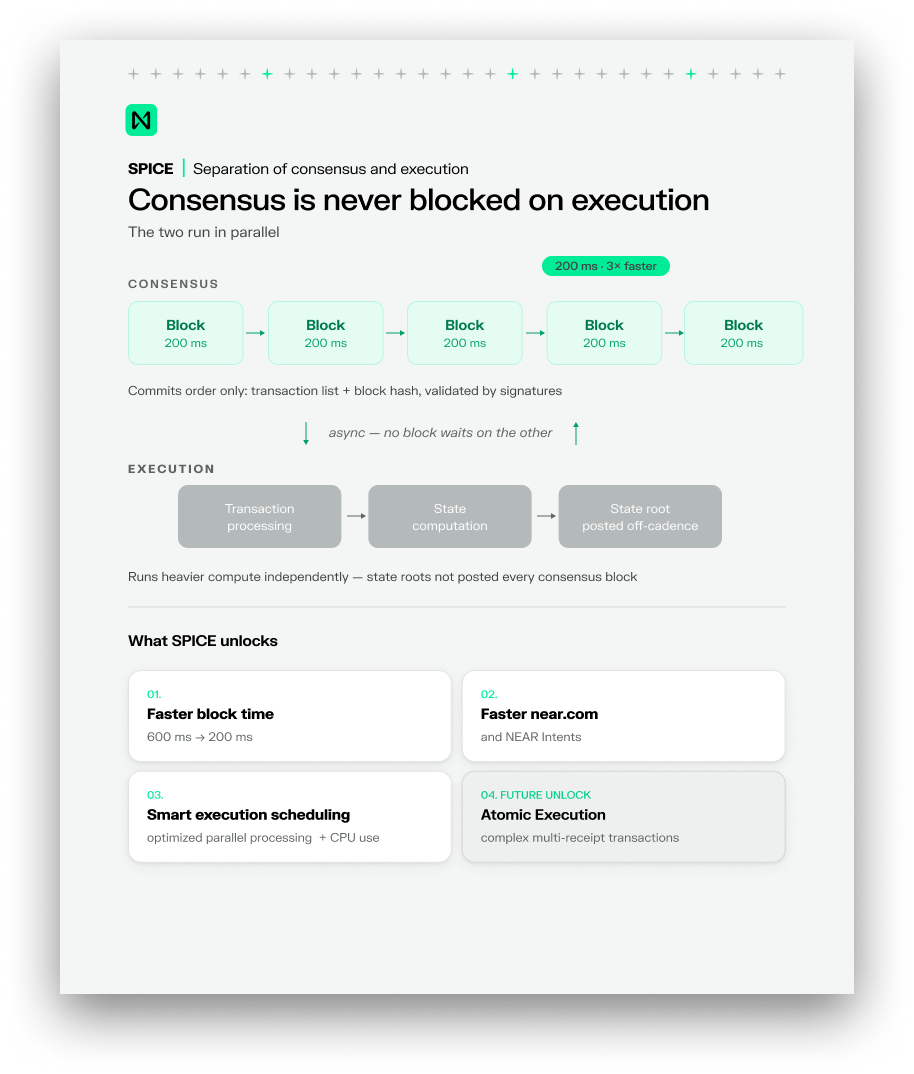

Diagram of the SPICE layered architecture


SPICE does not just compress block time from 600ms to 200ms, tripling the speed; it can also handle more interaction operations within the same timeframe, significantly accelerating complex transaction processing, and even support long-process transactions executed in steps across multiple blocks. NEAR itself already uses an optimistic block mechanism, and SPICE will greatly reduce the maximum wait time for users. Under the current mechanism, if a transaction requires supplementary external data, users must wait for a full block to be produced before initiating the next operation; with SPICE, users can complete three consecutive interaction operations within the waiting period of what was previously one block.


SPICE will also significantly optimize the user experience for near.com and NEAR Intents. Alex Shevchenko, CEO of Defuse Labs, commented on this: "The increased block speed on NEAR means faster transaction finality, making the user experience incredibly smooth, truly achieving 'instantaneous completion.' Whether it's ultra-fast sub-second transactions, transfers, or private payments, all can be realized. The transaction confirmation standard for traditional payment giant Visa is 3 seconds, while NEAR only needs 0.4 seconds, faster than you can input a payment password or tap your phone against a payment terminal."


This extreme speed is also a necessity for the agent economy: the interaction rate of automated agents far exceeds that of human users and traditional financial systems. Relying on this block production mechanism approaching the physical limit, NEAR can unleash the full operational potential of agents, enabling seamless flow between fiat and crypto assets; while also supporting multiple agents initiating complex, longer-duration transactions in parallel.


The Technical Path to Nightshade 3.0


The separation of consensus and execution is the first crucial step towards implementing Nightshade 3.0. Among all sharded public blockchains, NEAR is the first project to implement this architecture; while Monad has also achieved consensus-execution separation, it is based on a non-sharded EVM public chain. Besides speed improvement, SPICE further enhances network scalability through deep parallelization. Currently, NEAR executes transactions by shard according to account ID. Once a shard experiences a surge in load, all user transactions within that shard will experience delays. SPICE lays the groundwork for subsequent cross-shard synchronous transactions. Simultaneously, it utilizes "bubble filling" mechanisms to make full use of bandwidth resources: the execution queue doesn't need to wait for network communication, and block generation doesn't need to wait for transaction execution to complete. The two processes run in parallel without gaps, greatly improving network resource utilization.


Faster blocks paired with the already-launched sharded smart contracts can also simultaneously enhance network security. NEAR's sharded smart contracts are essentially lightweight independent accounts, partitioned individually by user and business scenario; combined with shorter, more concise blocks, the entire network's business load can be evenly distributed across various shards, enabling dynamic adaptive scaling for the network. This not only optimizes scaling performance but also yields significant security benefits. With AI tools significantly lowering the barrier for hacker attacks and vulnerability exploitation, structurally simple blocks and lightweight contracts are easier to secure; as NEAR gradually implements formal verification of contracts and zero-knowledge proofs, short blocks can significantly reduce verification computational power consumption and cost.
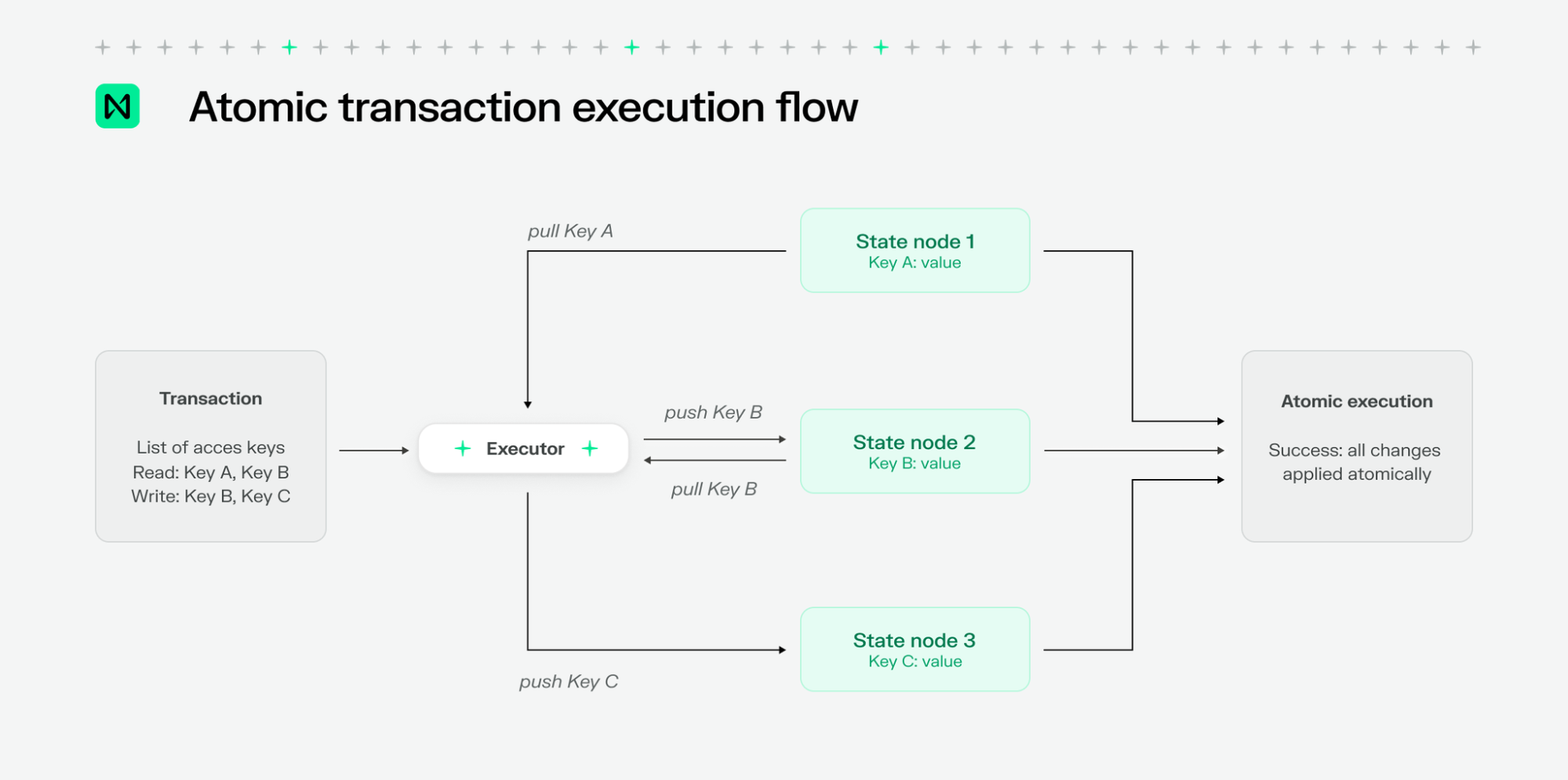

Cross-shard atomic transaction execution flow


SPICE also paves the way for subsequent major upgrades in Nightshade 3.0. In the future, building on SPICE with another iteration of updates will enable cross-shard atomic transactions—indivisible, irreversible complete execution across shards. This has long been a core goal in the field of sharding technology and a key demand for developers (especially NEAR Intents ecosystem developers). Atomic execution can simplify complex transaction logic, avoiding development difficulties brought by existing asynchronous cross-shard mechanisms. This type of asynchronous logic has long been a primary cause of smart contract vulnerabilities and functional delays, and the SPICE architecture can mitigate this issue from the ground up. The core implementation idea is: by leveraging the decoupling of consensus and execution, migrate transaction calculations to dedicated execution nodes that can read the state of all shards involved in the transaction. Combined with NEAR's mature stateless validation system, only a single execution node needs to generate an execution proof for all other nodes in the network to complete verification. This design does not raise the hardware requirements for ordinary validator nodes while continuously unleashing the performance ceiling of the execution layer.


The Near One team is fully advancing SPICE development, planning to implement and launch it within the coming months. (Everyone can continue to follow nearone.org for detailed technical updates, or check the latest protocol developments on the NEAR X official account.)

Trend Kriptolar

İlgili Sorular

QWhat is the SPICE upgrade in the NEAR Protocol and what does it aim to achieve?

ASPICE, short for 'Separating Consensus from Execution,' is a major underlying upgrade to the NEAR Protocol. Its primary goal is to decouple the consensus process from transaction execution, allowing the consensus layer to run at full speed without waiting for transaction execution to complete before producing a block. This separation aims to achieve a threefold performance improvement, reducing block production time from 600ms to a near-physical limit of 200ms, lowering transaction latency, and supporting more complex, longer-running transactions.

QAccording to the article, what is the theoretical physical limit for block production time that NEAR aims to achieve with SPICE, and why is this the limit?

AThe theoretical physical limit for block production time that NEAR aims to achieve with SPICE is 200 milliseconds. This limit is considered the fastest possible at a physical level due to constraints imposed by the speed of light and the fundamental time required for consensus nodes to send and receive messages.

QWhat are the three core improvements expected from implementing the consensus and execution separation architecture of SPICE?

AThe three core improvements expected from the SPICE architecture are: 1) Faster block production speed, 2) Lower transaction latency, and 3) The ability to support transactions with longer execution cycles and more complex logic.

QHow does the SPICE architecture lay the groundwork for future upgrades like Nightshade 3.0 and cross-shard atomic transactions?

ASPICE lays the groundwork for Nightshade 3.0 and cross-shard atomic transactions by establishing the foundational separation of consensus and execution. This decoupling allows for the future implementation of a dedicated execution node that can read the state of all shards involved in a transaction. Combined with NEAR's stateless validation system, this enables a single execution node to generate an execution proof that the rest of the network can verify, paving the way for atomic execution across shards without increasing hardware requirements for ordinary validators.

QWhat problem does the current NEAR sharding design have that SPICE helps to mitigate, according to the article?

AIn the current NEAR sharding design, transactions are executed in shards divided by account ID. If one shard experiences a sudden surge in load, transactions for all users within that shard can face delays. SPICE helps mitigate this by enabling deeper parallelization and preparing the network for synchronized transaction processing across shards in the future.

İlgili Okumalar

What's New in Ethereum's Roadmap: Privacy, Quantum Security, Native Rollup?

On August 10, 2024, Ethereum co-founder Vitalik Buterin revealed an updated technical roadmap, highlighting significant changes in priorities and new focus areas. Key new additions include: - **Strong Privacy Protection**: Elevated to a top-tier protocol concern. Proposals like EIP-8250 (keyed nonces for concurrency), EIP-8272 (recent roots for verification), and EIP-8182 (shared protocol-level privacy pools) aim to enable private transfers of ETH and ERC-20s, moving toward default private accounts. - **Quantum Resilience**: Priority increased. The plan addresses risks to ECDSA/BLS signatures, KZG commitments, and ZK systems, exploring solutions like leanSPHINCS signatures, STARK proofs (considered quantum-resistant), and streamlined verification processes. A full L1 upgrade is tentatively targeted for ~2029. - **Native Rollups**: A novel concept where rollups could reuse Ethereum's core validation infrastructure via a new EXECUTE precompile (EIP-8079 draft). This aims to reduce custom code and enhance security for certain L2s, while specialized chains will continue to exist. - **Protocol Simplification & Formal Verification**: Leveraging AI tools to make full-protocol formal verification feasible, aiming for more rigorous and machine-verifiable specifications. Other notable shifts: - State storage is evolving from Verkle trees to a Partitioned Binary Tree (PBT, EIP-8347 draft). - Some 2023 items like VDFs and certain EVM improvements were deprioritized. - Long-term discussions include blob/gas futures and non-EVM instruction sets (e.g., RISC-V). The "Strawmap" outlines potential upgrades through ~2029 but is a directional guide, not a firm timeline. Key milestones to watch include the Glamsterdam (Q4 2026) and Hegotá (2027) forks. Many proposals remain in draft or research phases.

marsbit13 dk önce

What's New in Ethereum's Roadmap: Privacy, Quantum Security, Native Rollup?

marsbit13 dk önce

Hyperliquid Trading Volume Soars, So Why Are Profits Falling?

Hyperliquid, a leading decentralized perpetuals trading platform, has seen its open interest surge to a record high above $11 billion, capturing roughly 9% of the global market share. Trading volume remains robust, nearing $178 billion over 30 days, driven largely by the explosive growth of third-party markets offering tokenized real-world assets (RWAs) like stocks and commodities. Despite this growth, the platform's protocol revenue has declined for four consecutive quarters, falling 43% from its Q3 2025 peak of $357 million to approximately $202 million in Q2 2026. This divergence is primarily attributed to the HIP-3 governance proposal, which allows external developers to launch their own markets and keep up to half of the generated fees. These third-party markets now account for nearly 50% of total volume. Consequently, the share of revenue redistributed to developers, market makers, and the treasury has tripled from 6% to 18% in a year. This directly reduces the funds allocated to the platform's buyback-and-burn mechanism for its native HYPE token, weakening a key price support. HYPE's price has fallen 28% from its all-time high. The platform's growth is also heavily concentrated, with a single entity, Trade.xyz, responsible for over 90% of HIP-3 open interest, introducing systemic risk. Additionally, the ecosystem lacks diversity beyond HYPE, faces ongoing token unlocks adding sell pressure, and is encountering increased regulatory scrutiny and new competition from platforms like Robinhood Chain. While still a major revenue generator in crypto, Hyperliquid's model of sharing fees to fuel expansion is currently compressing its own earnings and token economics.

marsbit13 dk önce

Hyperliquid Trading Volume Soars, So Why Are Profits Falling?

marsbit13 dk önce

Citi Research Report Analysis: U.S. Proposed Ban on Chinese Optical Modules Has No Substantial Progress, Short-term Enforcement Faces Supply Constraints

Citi Report Analysis: U.S. Proposed Ban on Chinese Optical Modules Lacks Substantive Progress, Faces Supply Bottlenecks in Short Term. Reuters reported on August 4th that the U.S. government and FCC are considering a ban on Chinese optical modules. Citi's August 9th report clarifies that optical modules are not listed on any effective FCC ban. The FCC's Order 26-50 established two restricted list mechanisms (based on manufacturer and production location), but optical modules were only mentioned once, as an example in a disclosure requirement, not as a restricted product. The reported ban remains at a proposal stage. Citi estimates Chinese suppliers provide 60-70% of high-speed optical modules for U.S. hyperscalers. Non-Chinese suppliers cannot fill this gap in the short term, making the immediate implementation of a genuine ban unlikely. Future regulatory paths could be manufacturer-based (least likely), location-based covering all offshore production (strictest), or location-based covering only China (more feasible but with unresolved definitions). A ban would pressure U.S. AI infrastructure, conflicting with stated policy goals. Citi sees low near-term implementation probability, with the issue potentially becoming a negotiation chip in bilateral talks. U.S. domestic capacity build-out is a key long-term variable. Among Chinese companies, XSENS and Dongshan Precision have the highest U.S. exposure, while Tianfu Communication, as a passive component supplier, is relatively insulated. Citi maintains Buy ratings on all three with respective price targets. The conclusion is that Chinese modules are currently irreplaceable in the U.S. AI supply chain, creating a longer timeline for potential restrictions than the market may expect.

marsbit1 saat önce

Citi Research Report Analysis: U.S. Proposed Ban on Chinese Optical Modules Has No Substantial Progress, Short-term Enforcement Faces Supply Constraints

marsbit1 saat önce

İşlemler

Spot

Popüler Makaleler

ONE Nasıl Satın Alınır

HTX.com’a hoş geldiniz! Harmony (ONE) satın alma işlemlerini basit ve kullanışlı bir hâle getirdik. Adım adım açıkladığımız rehberimizi takip ederek kripto yolculuğunuza başlayın. 1. Adım: HTX Hesabınızı OluşturunHTX'te ücretsiz bir hesap açmak için e-posta adresinizi veya telefon numaranızı kullanın. Sorunsuzca kaydolun ve tüm özelliklerin kilidini açın. Hesabımı Aç2. Adım: Kripto Satın Al Bölümüne Gidin ve Ödeme Yönteminizi SeçinKredi/Banka Kartı: Visa veya Mastercard'ınızı kullanarak anında Harmony (ONE) satın alın.Bakiye: Sorunsuz bir şekilde işlem yapmak için HTX hesap bakiyenizdeki fonları kullanın.Üçüncü Taraflar: Kullanımı kolaylaştırmak için Google Pay ve Apple Pay gibi popüler ödeme yöntemlerini ekledik.P2P: HTX'teki diğer kullanıcılarla doğrudan işlem yapın.Borsa Dışı (OTC): Yatırımcılar için kişiye özel hizmetler ve rekabetçi döviz kurları sunuyoruz.3. Adım: Harmony (ONE) Varlıklarınızı SaklayınHarmony (ONE) satın aldıktan sonra HTX hesabınızda saklayın. Alternatif olarak, blok zinciri transferi yoluyla başka bir yere gönderebilir veya diğer kripto para birimlerini takas etmek için kullanabilirsiniz.4. Adım: Harmony (ONE) Varlıklarınızla İşlem YapınHTX'in spot piyasasında Harmony (ONE) ile kolayca işlemler yapın.Hesabınıza erişin, işlem çiftinizi seçin, işlemlerinizi gerçekleştirin ve gerçek zamanlı olarak izleyin. Hem yeni başlayanlar hem de deneyimli yatırımcılar için kullanıcı dostu bir deneyim sunuyoruz.

671 Toplam GörüntülenmeYayınlanma 2024.12.12Güncellenme 2026.06.02

ONE Nasıl Satın Alınır

Tartışmalar

HTX Topluluğuna hoş geldiniz. Burada, en son platform gelişmeleri hakkında bilgi sahibi olabilir ve profesyonel piyasa görüşlerine erişebilirsiniz. Kullanıcıların ONE (ONE) fiyatı hakkındaki görüşleri aşağıda sunulmaktadır.

活动图片