A String Theory Problem Stuck for Half a Year, Claude Solved It Overnight, UTokyo Professor Shocked into Deleting Tweet

marsbit2026-07-14 tarihinde yayınlandı2026-07-14 tarihinde güncellendi

Özet

A theoretical physics problem that had stumped researchers for six months was reportedly solved overnight by the AI Claude Fable. Professor Yuji Tachikawa, a mathematical physicist at the University of Tokyo specializing in quantum field theory and string theory, shared that he input his stalled research notes into the AI on a whim. To his surprise, Claude not only provided a crucial insight that broke the impasse but also proactively used SymPy to write code and verify its own predictions. Professor Tachikawa noted the AI seemed to genuinely understand string theory and possess intuition, even remarking it might know more algebraic topology than he does. In a parallel development, Stanford geneticist and cardiologist Euan Ashley had Claude analyze his own genome. The AI completed the task in 30 minutes—a process that took his 31-person team nine months in 2010—correctly identifying an Alzheimer's disease risk allele and several gene variants affecting drug metabolism at a minimal cost. These incidents, involving both theoretical physics and clinical genomics, suggest AI is transitioning from a mere tool to a collaborative partner in scientific discovery, potentially heralding an unpredictable acceleration in research.

A string theory problem stuck for half a year, Claude solved it overnight!

Netizens exclaim: Humanity is entering a whole new era of science.
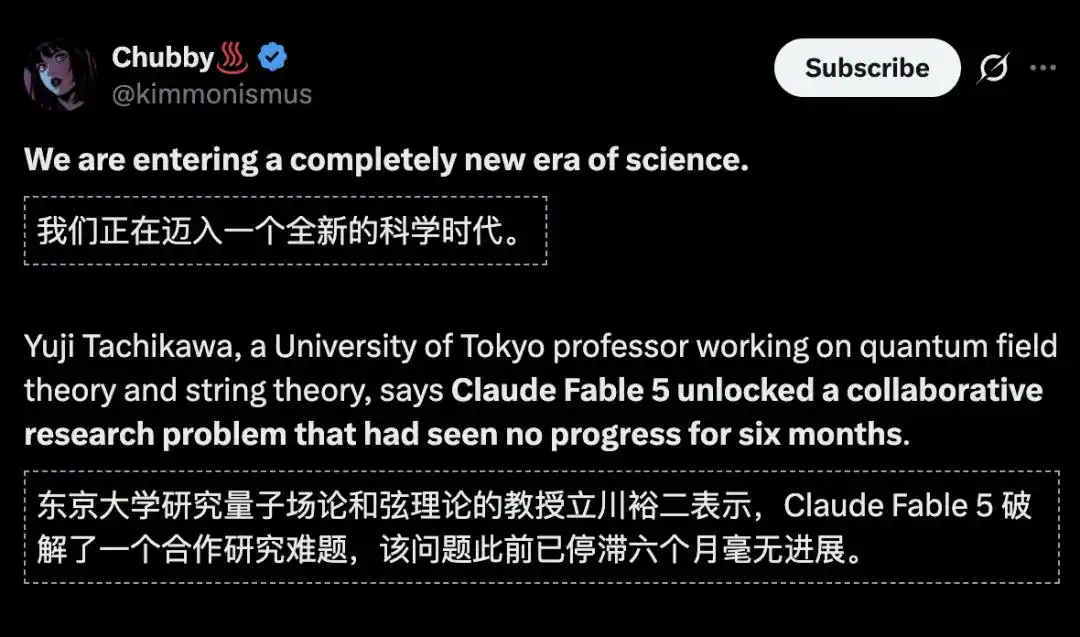
Fable 5 left a deep impression on Yuji Tachikawa, a professor at the University of Tokyo researching quantum field theory and string theory:

It seems Fable really does understand string theory, and also has intuition.

The tweet went viral overnight, author urgently deleted it and explained:

I deleted that tweet because it spread in unexpected ways too widely.

This is a heavy blow to AI skepticism: In the face of facts, who still thinks AI cannot or will not make scientific discoveries?

Who can imagine where AI will be in 5 years?

Physics Professor Stuck for Half a Year, Claude Solved 'String Theory' Problem Overnight

For half a year, research made no progress.

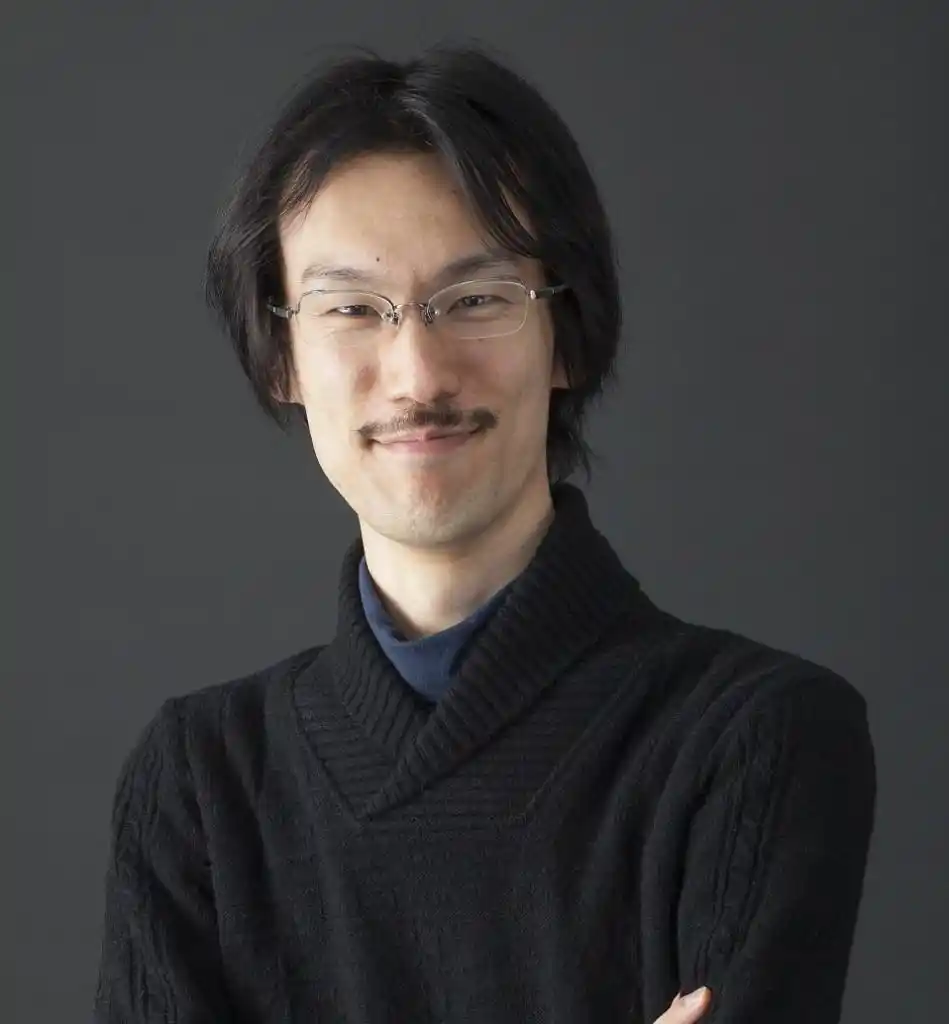
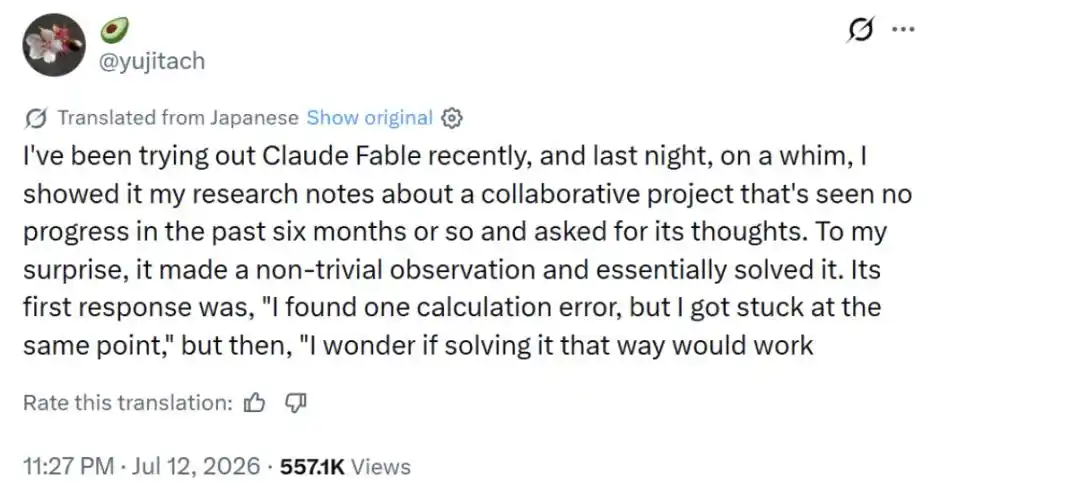
On the evening of July 12th, Yuji Tachikawa, a mathematical physicist at the University of Tokyo, suddenly had an impulse and threw this research note, stagnant for half a year, to an AI, without holding much hope.
But the AI proposed a very valuable insight, helping him solve this six-month-long problem.

What surprised him even more was that the AI then went on to call SymPy to write code and verify its own prediction results.

Yuji Tachikawa's assessment was: It seems to truly understand String Theory, and has intuition.
Previously, he asked Claude Fable to calculate the BN invariants under the map from TMF to KO.
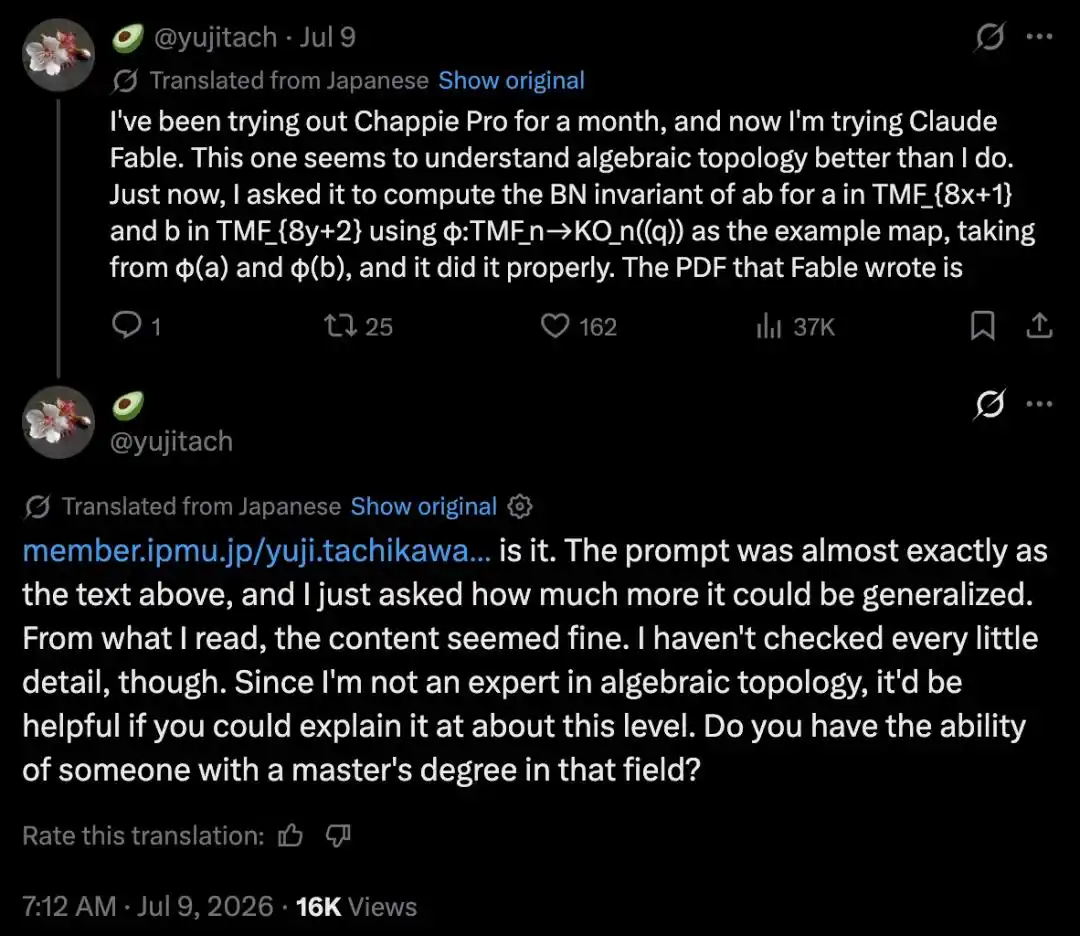
Fable correctly completed it and generated a PDF proof.
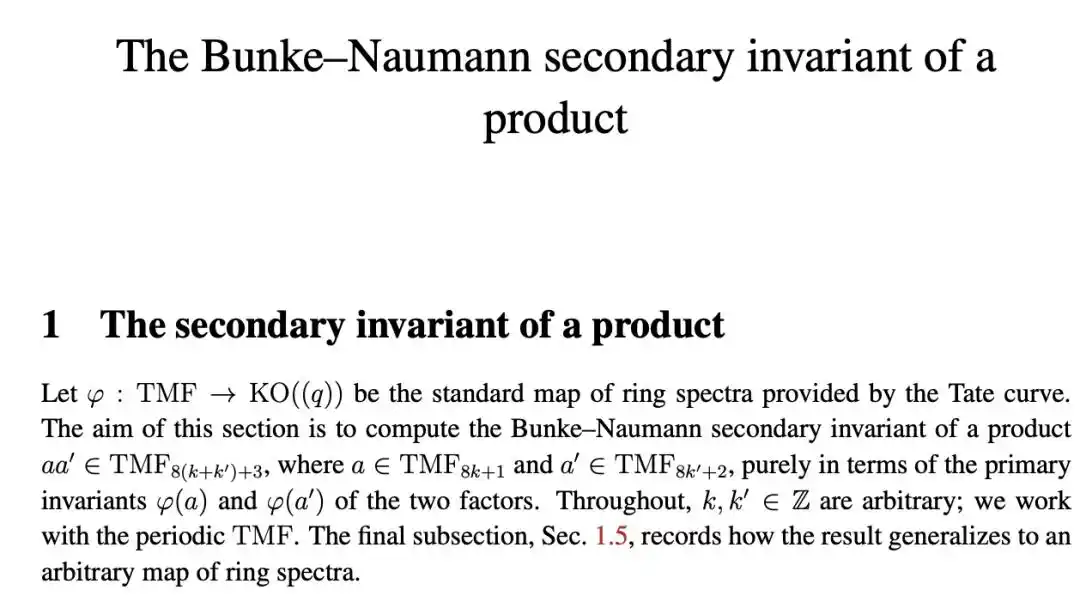
Portal: https://member.ipmu.jp/yuji.tachikawa/tmp/product-BN.pdf

He evaluated it as 'Fable 5 knows algebraic topology better than I do,' and asked, 'Has it reached the level of a master's student in the field?'

This is high praise, considering Yuji Tachikawa's recent interest is 'geometric and algebraic structures related to supersymmetric quantum field theory.'

Humanity Steps into a New Scientific Era

Recently, the AI science circle has been quite lively.

In June, Anthropic released the preview of Claude Science, specifically designed to accelerate scientific research.

While Yuji Tachikawa was using Fable 5 to help solve his string theory problem, Euan Ashley, a geneticist and cardiologist at Stanford University, asked Claude to interpret his own genome. The AI finished in 30 minutes.

Back in 2010, Ashley led a 31-person team to complete the world's first clinical interpretation of a human genome, which took 9 months.

This time, upon returning from vacation, while unpacking, he had Claude analyze his own genome using the same standards.
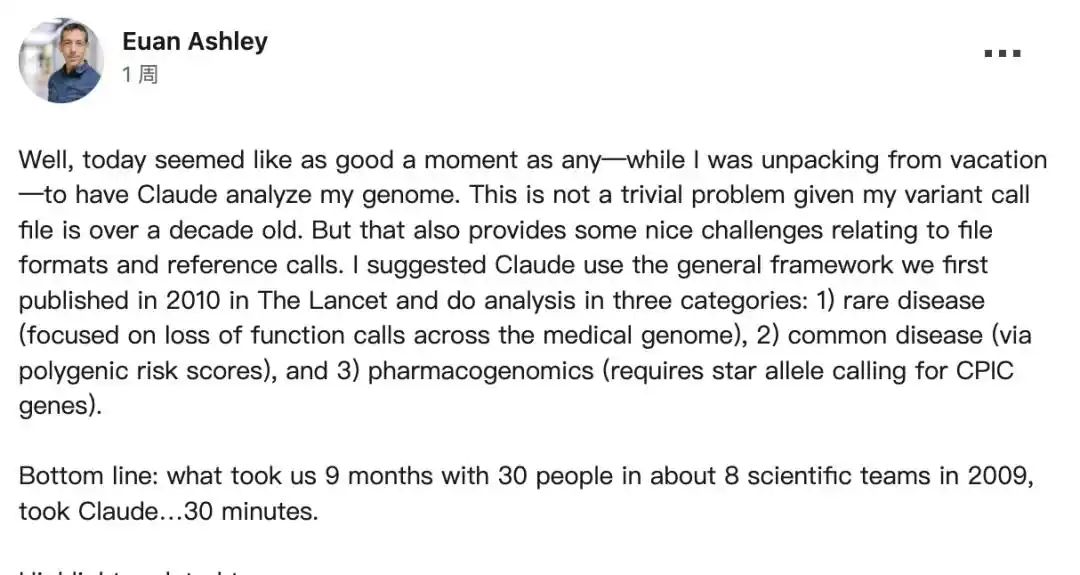
In 30 minutes, the AI correctly identified an Alzheimer's disease risk allele, as well as several gene variants affecting drug metabolism.
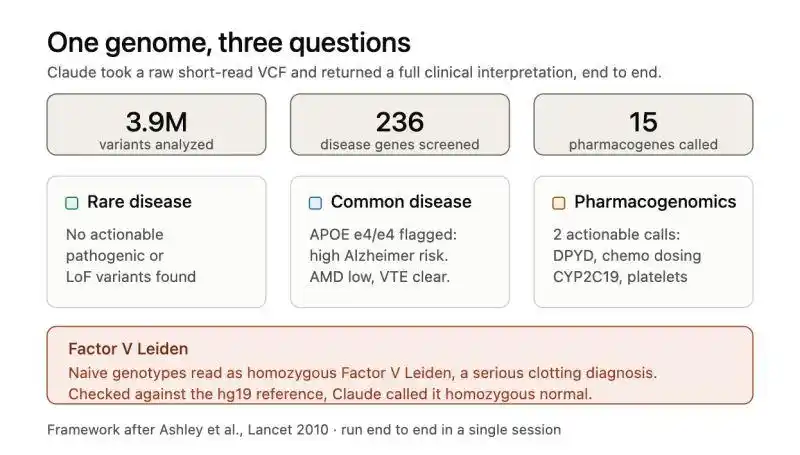
The entire process used only about 180 words of prompts, consumed roughly 400,000 tokens, costing about $5 (estimated by Claude).

And for most of the time, Claude was idle, paused via waiting for connection to the NCBI server.
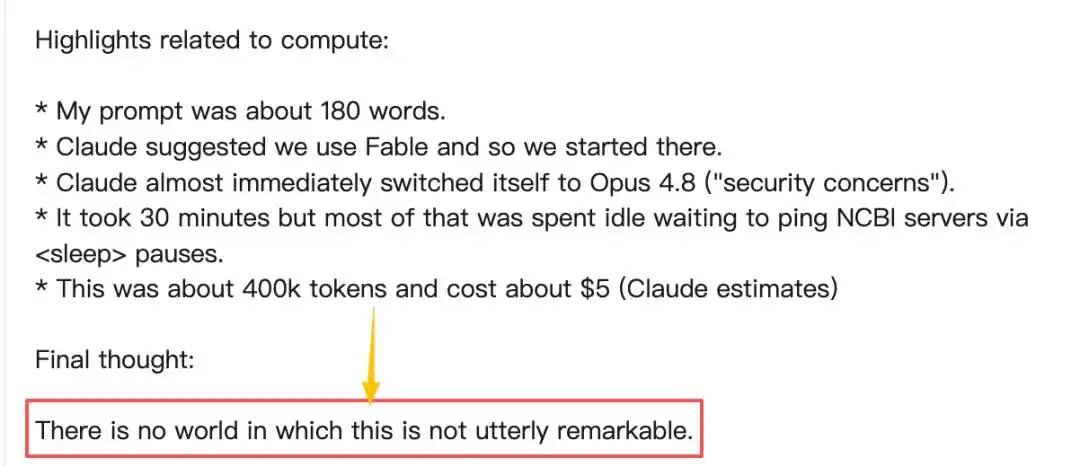
Finally, Ashley left with a thought: By any measure, this is absolutely astonishing.

One is in theoretical physics, the other in clinical genomics. AI has crossed the line between tool and colleague.

Under the tide of AI, science will erupt in unpredictable ways.

References:

https://www.nature.com/articles/d41586-026-02091-6

https://x.com/kimmonismus/status/2076658442282934351

https://www.reddit.com/r/singularity/comments/1uv399n/yuji_tachikawa_one_of_the_worlds_leading/

This article is from the WeChat public account "AI Era Insight", author: ASI启示录

İlgili Sorular

QWhat did Professor Yuji Tachikawa achieve with the help of Claude AI?

AProfessor Yuji Tachikawa, a mathematical physicist at the University of Tokyo, was stuck on a string theory problem for six months. He presented the research notes to Claude AI, which provided a valuable insight that helped solve the problem. Claude even independently wrote code using SymPy to verify its own predictions.

QHow did Professor Tachikawa evaluate Claude Fable's understanding of string theory?

AProfessor Tachikawa stated that Claude Fable seemed to genuinely understand string theory and exhibited intuition. He was so impressed that he commented, 'Fable 5 knows more algebraic topology than I do,' and questioned if its ability was at the master's level in the field.

QWhat other scientific achievement involving Claude AI is mentioned in the article?

AThe article mentions that geneticist and cardiologist Euan Ashley from Stanford University used Claude to interpret his own genome. While Ashley's 31-person team took 9 months for the world's first clinical interpretation in 2010, Claude completed a similar analysis in just 30 minutes, correctly identifying an Alzheimer's disease risk allele and several gene variants affecting drug metabolism.

QWhy did Professor Tachikawa delete his initial tweet about the AI's achievement?

AProfessor Tachikawa deleted his tweet because it spread far beyond his intended audience in an unexpected direction, leading him to remove it to control its widespread and potentially sensationalized dissemination.

QWhat does the article suggest about the future role of AI in science?

AThe article suggests that AI is crossing the line from being just a tool to becoming a collaborative partner in scientific research. It highlights rapid advancements, like those from Anthropic's Claude Science, and posits that science will explode in unpredictable ways under the influence of AI, marking the dawn of a new scientific era.

İlgili Okumalar

In Jinjiang, Fujian, a Storage Super Unicorn Lies Quiet

In Fujian's Jinjiang, a city known for sportswear, lies a quiet semiconductor giant: Fujian Jinhua Integrated Circuit Co. (JHICC). Once a promising domestic DRAM manufacturer alongside Yangtze Memory and ChangXin Memory Technologies (CXMT), its journey was derailed in 2018 when the U.S. placed it on an Entity List and filed criminal charges for alleged trade secret theft. This halted production for years. A turning point came in February 2024 when a U.S. federal court found JHICC not guilty. However, it had lost crucial time. While CXMT soared to become a top-valued A-share company in 2024, JHICC, with an estimated valuation of 80 billion RMB, was just restarting. Its current output is primarily customized DDR4 chips, not the advanced DDR5/HBM demanded for AI, but it still benefits from the broader memory chip upcycle. JHICC's story is tied to Chen Zhengkun, a veteran engineer who left Micron to lead the venture. Founded in 2016 with state-backed funding, JHICC partnered with Taiwan's UMC to develop DRAM technology. Rapid progress was cut short by the U.S. actions, which Micron initiated, partly due to its heavy reliance on the Chinese market. Post-sanctions, Chen's team worked to rebuild the production line with reduced reliance on U.S. technology. According to its records, JHICC achieved small-scale production and revenue growth under immense pressure. It now focuses on the stable "niche" DRAM market (e.g., TVs, routers) with a monthly capacity of ~40,000 wafers, aiming for 60,000 by 2026. It holds over 1,000 patents but remains on the Entity List. For Jinjiang, investing in JHICC was a bold industrial leap. The local government provided unwavering financial and logistical support during the crisis, helping the company survive. JHICC has become the anchor for a growing local semiconductor cluster. Though its scale lags behind domestic peers, JHICC's persistence symbolizes a hard-won foothold in a global market long dominated by Samsung, SK Hynix, and Micron. Having missed one boom, it seeks a place in the new AI-driven memory supercycle.

marsbit2 saat önce

In Jinjiang, Fujian, a Storage Super Unicorn Lies Quiet

marsbit2 saat önce

İşlemler

Spot
活动图片





