A New Crypto Predator Emerges: Google Exposes ‘Ghostblade’

bitcoinist2026-03-21 tarihinde yayınlandı2026-03-21 tarihinde güncellendi

Özet

A new iOS malware called "Ghostblade," part of the DarkSword tool suite, has been exposed by Google Threat Intelligence. Designed to steal sensitive data from Apple devices, it targets cryptocurrency private keys, messages from iMessage, WhatsApp, and Telegram, as well as SIM details, location data, and media files. Ghostblade operates once, extracts information, and then deletes crash logs to avoid detection, leaving no persistent trace. This makes it particularly effective and hard to identify. The emergence of Ghostblade reflects a broader shift in cyberattacks toward individual crypto users rather than institutions. Although overall crypto hack losses dropped to around $50 million in February—down from $385 million the previous month—this decline is due to attackers shifting from code exploits to social engineering, phishing, and wallet poisoning schemes. The report underscores that high-value individual holders are increasingly targeted through deceptive websites and malware designed to operate quickly and discreetly.

Private crypto holders took the heaviest losses from hacking, phishing, and digital theft attempts in February 2026, according to blockchain intelligence firm Nominis — and a newly identified strain of iOS malware may explain part of why individual users have become the preferred target.

Designed To Strike Fast And Disappear

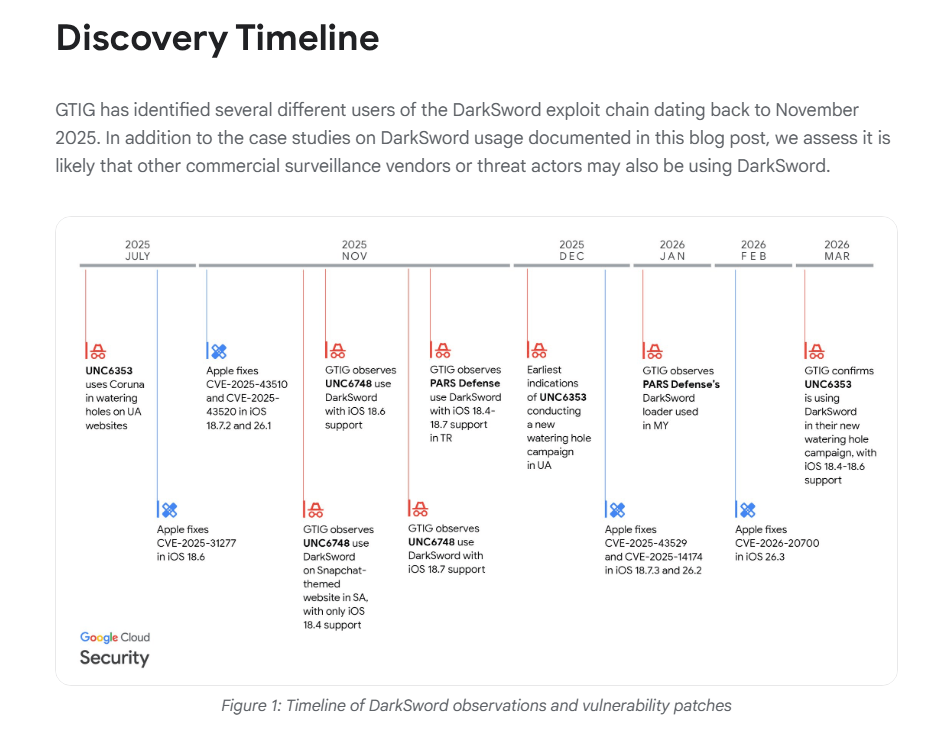
Google Threat Intelligence has identified a JavaScript-based malicious tool called Ghostblade, built specifically to hit Apple iOS devices, extract sensitive data, and go quiet before anyone notices.

The software is one of six tools bundled inside a broader package researchers are calling DarkSword. Together, the tools are engineered to steal cryptocurrency private keys, messaging data, and personal information from infected devices.

Ghostblade runs once, takes what it needs, and stops. No persistent background activity. No extra software required to make it work. That design makes it far harder to catch than malware that keeps running after an infection.
Source: Google

The tool also covers its tracks in a specific way. After it finishes, it wipes crash logs from the compromised device. Those logs are what Apple normally collects to identify software problems and flag suspicious activity. Without them, Apple receives no signal that anything went wrong.

What Ghostblade Can Actually Access

The scope of what Ghostblade can pull from a device is wide. Based on Google’s report, the malware is capable of reaching messages from iMessage, WhatsApp, and Telegram.

It can also collect SIM card details, location data, multimedia files, and system-level settings. For crypto users, the most direct threat is private key exposure — the kind of access that gives an attacker full control over a digital wallet with no way to reverse transactions once funds are moved.

Bitcoin is currently trading at $70,572. Chart: TradingView

The DarkSword suite represents a new chapter in browser-based attacks aimed at the crypto space, with Ghostblade serving as one of its most technically refined components.

Hackers Shift Focus From Code To People

Total losses from crypto-related hacks dropped sharply in February, falling to close to $50 million from $385 million the month before, Nominis data shows. But that decline does not signal a safer environment.

Reports indicate the drop reflects a change in method, not ambition. Attackers moved away from exploiting code vulnerabilities and toward phishing schemes, wallet poisoning, and other approaches that rely on tricking users rather than breaking systems.

Fake websites built to mirror legitimate platforms are a common vehicle. Users who land on them and interact with any element can have credentials and keys lifted without realizing it.

The Ghostblade alert from Google arrives against that backdrop — a reminder that high-value individual users, not just exchanges or protocols, are firmly in the crosshairs.

Featured image from Unsplash, chart from TradingView

İlgili Sorular

QWhat is the name of the newly identified iOS malware described in the article, and what is its primary function?

AThe malware is called Ghostblade. Its primary function is to extract sensitive data, such as cryptocurrency private keys, messaging data, and personal information, from infected Apple iOS devices and then go quiet to avoid detection.

QAccording to the article, what broader package is Ghostblade a part of, and what is the collective goal of its tools?

AGhostblade is one of six tools bundled inside a broader package called DarkSword. The collective goal of these tools is to steal cryptocurrency private keys, messaging data, and personal information from infected devices.

QHow does the Ghostblade malware avoid detection after it completes its task on a compromised device?

AGhostblade avoids detection by running only once, taking the data it needs, and then stopping with no persistent background activity. It also covers its tracks by wiping crash logs from the device, which prevents Apple from receiving signals that would normally flag suspicious activity.

QWhat specific types of data can the Ghostblade malware access on an infected device?

AGhostblade can access messages from iMessage, WhatsApp, and Telegram. It can also collect SIM card details, location data, multimedia files, system-level settings, and most critically for crypto users, private keys that control digital wallets.

QWhat trend in cyber attacks does the article highlight, as shown by the change in total crypto losses from January to February 2026?

AThe article highlights a trend where attackers are shifting their focus from exploiting code vulnerabilities to using methods that trick users, such as phishing schemes and wallet poisoning. This is evidenced by a sharp drop in total losses from $385 million in January to about $50 million in February, which reflects this change in method rather than a decrease in attacker ambition.

İlgili Okumalar

Circle CEO's Seoul Visit: No Korean Won Stablecoin Issuance, But Met All Major Korean Banks

Circle CEO Jeremy Allaire's recent activities in Seoul indicate a strategic shift for the company, moving away from issuing a Korean won-backed stablecoin and instead focusing on embedding itself as a key infrastructure provider within Korea’s financial and crypto ecosystem. Despite Korea accounting for nearly 30% of global crypto trading volume—with a market characterized by high retail participation and altcoin dominance—Circle has chosen not to compete for the role of stablecoin issuer. Instead, Allaire met with major Korean banks (including Shinhan, KB, and Woori), financial groups, leading exchanges (Upbit, Bithumb, Coinone), and tech firms like Kakao. This approach reflects a broader industry transition: the core of stablecoin competition is shifting from issuance rights to systemic positioning. With Korean regulators still debating whether banks or tech companies should issue stablecoins, Circle is avoiding regulatory uncertainty by strengthening its role as a service and technology partner. The company is deepening integration with trading platforms, building connections, and promoting stablecoin infrastructure. This positions Circle to benefit regardless of which entity eventually issues a won stablecoin. Allaire also noted the potential for a Chinese yuan stablecoin in the next 3–5 years, underscoring a regional trend of stablecoins becoming more regulated and integrated with traditional finance. Ultimately, Circle’s strategy highlights that future influence in the stablecoin market will belong not necessarily to the issuers, but to the foundational infrastructure layers that enable cross-system transactions.

marsbit5 dk önce

Circle CEO's Seoul Visit: No Korean Won Stablecoin Issuance, But Met All Major Korean Banks

marsbit5 dk önce

SpaceX Ties Up with Cursor: A High-Stakes AI Gambit of 'Lock First, Acquire Later'

SpaceX has secured an option to acquire AI programming company Cursor for $60 billion, with an alternative clause requiring a $10 billion collaboration fee if the acquisition does not proceed. This structure is not merely a potential acquisition but a strategic move to control core access points in the AI era. The deal is designed as a flexible, dual-path arrangement, allowing SpaceX to either fully acquire Cursor or maintain a binding partnership through high-cost collaboration. This "option-style" approach minimizes immediate regulatory and integration risks while ensuring long-term alignment between the two companies. At its core, the transaction exchanges critical AI-era resources: SpaceX provides its Colossus supercomputing cluster—one of the world’s most powerful AI training infrastructures—while Cursor contributes its AI-native developer environment and strong product adoption. This synergy connects compute power, models, and application layers, forming a closed-loop AI capability stack. Cursor, founded in 2022, has achieved rapid growth with over $1 billion in annual revenue and widespread enterprise adoption. Its value lies in transforming software development through AI agents capable of coding, debugging, and system design—positioning it as a gateway to future software production. For SpaceX, this move is part of a broader strategy to evolve from a aerospace company into an AI infrastructure empire, integrating xAI, supercomputing, and chip manufacturing. Controlling Cursor fills a gap in its developer tooling layer, strengthening its AI narrative ahead of a potential IPO. The deal reflects a shift in AI competition from model superiority to ecosystem and entry-point control. With programming tools as a key battleground, securing developer loyalty becomes crucial for dominating the software production landscape. Risks include questions around Cursor’s valuation, technical integration challenges, and potential regulatory scrutiny. Nevertheless, the deal underscores a strategic bet: controlling both compute and software development access may redefine power dynamics in the AI-driven future.

marsbit45 dk önce

SpaceX Ties Up with Cursor: A High-Stakes AI Gambit of 'Lock First, Acquire Later'

marsbit45 dk önce

İşlemler

Spot
Futures
活动图片