A New Crypto Predator Emerges: Google Exposes ‘Ghostblade’

bitcoinist2026-03-21 tarihinde yayınlandı2026-03-21 tarihinde güncellendi

Özet

A new iOS malware called "Ghostblade," part of the DarkSword tool suite, has been exposed by Google Threat Intelligence. Designed to steal sensitive data from Apple devices, it targets cryptocurrency private keys, messages from iMessage, WhatsApp, and Telegram, as well as SIM details, location data, and media files. Ghostblade operates once, extracts information, and then deletes crash logs to avoid detection, leaving no persistent trace. This makes it particularly effective and hard to identify. The emergence of Ghostblade reflects a broader shift in cyberattacks toward individual crypto users rather than institutions. Although overall crypto hack losses dropped to around $50 million in February—down from $385 million the previous month—this decline is due to attackers shifting from code exploits to social engineering, phishing, and wallet poisoning schemes. The report underscores that high-value individual holders are increasingly targeted through deceptive websites and malware designed to operate quickly and discreetly.

Private crypto holders took the heaviest losses from hacking, phishing, and digital theft attempts in February 2026, according to blockchain intelligence firm Nominis — and a newly identified strain of iOS malware may explain part of why individual users have become the preferred target.

Designed To Strike Fast And Disappear

Google Threat Intelligence has identified a JavaScript-based malicious tool called Ghostblade, built specifically to hit Apple iOS devices, extract sensitive data, and go quiet before anyone notices.

The software is one of six tools bundled inside a broader package researchers are calling DarkSword. Together, the tools are engineered to steal cryptocurrency private keys, messaging data, and personal information from infected devices.

Ghostblade runs once, takes what it needs, and stops. No persistent background activity. No extra software required to make it work. That design makes it far harder to catch than malware that keeps running after an infection.
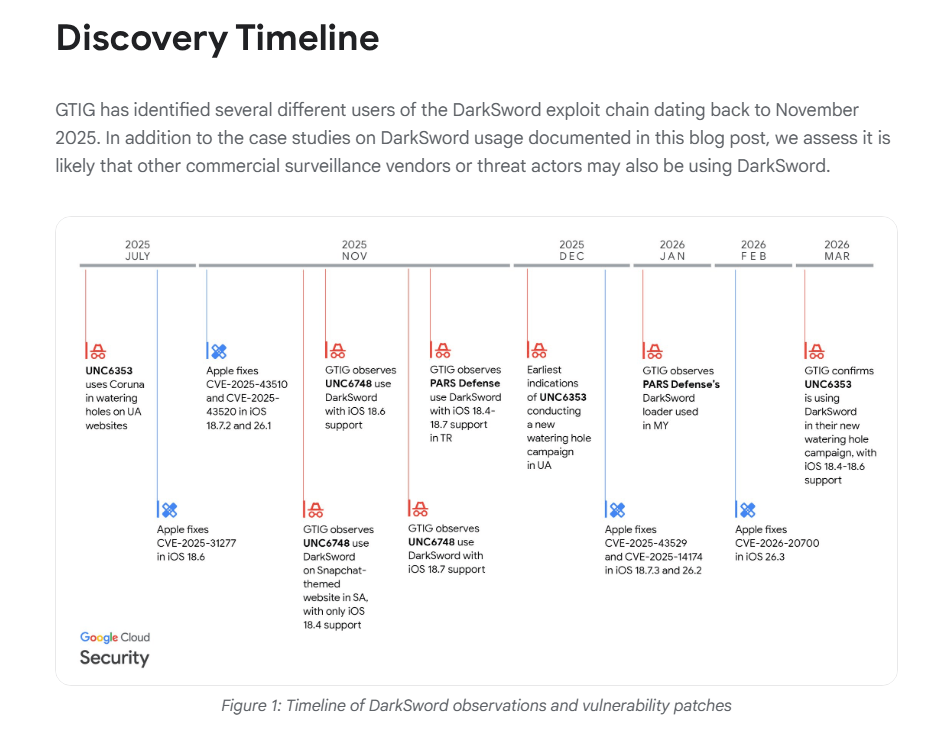
Source: Google

The tool also covers its tracks in a specific way. After it finishes, it wipes crash logs from the compromised device. Those logs are what Apple normally collects to identify software problems and flag suspicious activity. Without them, Apple receives no signal that anything went wrong.

What Ghostblade Can Actually Access

The scope of what Ghostblade can pull from a device is wide. Based on Google’s report, the malware is capable of reaching messages from iMessage, WhatsApp, and Telegram.

It can also collect SIM card details, location data, multimedia files, and system-level settings. For crypto users, the most direct threat is private key exposure — the kind of access that gives an attacker full control over a digital wallet with no way to reverse transactions once funds are moved.

Bitcoin is currently trading at $70,572. Chart: TradingView

The DarkSword suite represents a new chapter in browser-based attacks aimed at the crypto space, with Ghostblade serving as one of its most technically refined components.

Hackers Shift Focus From Code To People

Total losses from crypto-related hacks dropped sharply in February, falling to close to $50 million from $385 million the month before, Nominis data shows. But that decline does not signal a safer environment.

Reports indicate the drop reflects a change in method, not ambition. Attackers moved away from exploiting code vulnerabilities and toward phishing schemes, wallet poisoning, and other approaches that rely on tricking users rather than breaking systems.

Fake websites built to mirror legitimate platforms are a common vehicle. Users who land on them and interact with any element can have credentials and keys lifted without realizing it.

The Ghostblade alert from Google arrives against that backdrop — a reminder that high-value individual users, not just exchanges or protocols, are firmly in the crosshairs.

Featured image from Unsplash, chart from TradingView

İlgili Sorular

QWhat is the name of the newly identified iOS malware described in the article, and what is its primary function?

AThe malware is called Ghostblade. Its primary function is to extract sensitive data, such as cryptocurrency private keys, messaging data, and personal information, from infected Apple iOS devices and then go quiet to avoid detection.

QAccording to the article, what broader package is Ghostblade a part of, and what is the collective goal of its tools?

AGhostblade is one of six tools bundled inside a broader package called DarkSword. The collective goal of these tools is to steal cryptocurrency private keys, messaging data, and personal information from infected devices.

QHow does the Ghostblade malware avoid detection after it completes its task on a compromised device?

AGhostblade avoids detection by running only once, taking the data it needs, and then stopping with no persistent background activity. It also covers its tracks by wiping crash logs from the device, which prevents Apple from receiving signals that would normally flag suspicious activity.

QWhat specific types of data can the Ghostblade malware access on an infected device?

AGhostblade can access messages from iMessage, WhatsApp, and Telegram. It can also collect SIM card details, location data, multimedia files, system-level settings, and most critically for crypto users, private keys that control digital wallets.

QWhat trend in cyber attacks does the article highlight, as shown by the change in total crypto losses from January to February 2026?

AThe article highlights a trend where attackers are shifting their focus from exploiting code vulnerabilities to using methods that trick users, such as phishing schemes and wallet poisoning. This is evidenced by a sharp drop in total losses from $385 million in January to about $50 million in February, which reflects this change in method rather than a decrease in attacker ambition.

İlgili Okumalar

US and Japan's Unprecedented Joint Action in 30 Years Marks End of Yen Carry Trade Era

Japan and the U.S. conducted a rare coordinated intervention in the foreign exchange market around August 3rd to stem the yen's sharp depreciation. U.S. Treasury Secretary Scott Bessette's notepad, photographed by Reuters, revealed plans for a $5-10 billion yen-buying operation. Following official confirmation, the USD/JPY pair plunged from near 164 to around 155-156. The intervention marks a significant shift as the U.S. moved from verbal support to practical coordination. While the core carry trade logic—exploiting the higher U.S. interest rates—remains intact, the risk structure has changed. Traders must now account for potential repeated bilateral actions, altering the risk-reward calculation for yen shorts. The intervention's immediate effect is forcing leveraged positions to unwind, amplifying the yen's rebound. However, analysts note this does not signal the end of the yen carry trade. The fundamental driver—the wide interest rate differential between the U.S. (3.50%-3.75%) and Japan (1%)—persists. The action is seen more as buying time for the Bank of Japan's gradual policy normalization while mitigating imported inflation pressures. To avoid destabilizing the U.S. Treasury market during intervention, authorities utilized the Fed's FIMA repo facility, allowing Japan to obtain dollar liquidity using its Treasury holdings as collateral instead of selling them. The move aims to contain spillover risks. While creating short-term volatility and compressing leverage for yen bears, the long-term trend for the yen will ultimately depend on the convergence of U.S. and Japanese monetary policies, not unilateral market operations. The current action is narrower in scope than historical agreements like the Plaza Accord, focused on curbing excessive yen weakness rather than engineering a broad-based dollar decline.

marsbit19 dk önce

US and Japan's Unprecedented Joint Action in 30 Years Marks End of Yen Carry Trade Era

marsbit19 dk önce

Why Hasn't Bitcoin Made the Expected Surge? There Are Both Positive and Negative Data

Analytical firm Glassnode reports Bitcoin retreated to around $62,600 after failing to sustain above $66,000. Weak spot market demand and defensive positions in derivatives are applying downward pressure. However, structural support remains from resilient long-term holders, surging on-chain activity, and renewed inflows into Bitcoin ETFs. The price action reflects weakened spot momentum, with low trading volume and persistent seller pressure keeping Bitcoin in a consolidation phase with limited breakout potential. While open interest in derivatives has fallen, funding rates have risen again, and options investors maintain a cautious stance. Demand for downside protection has increased. Positively, Bitcoin ETFs have seen renewed net inflows and trading volume, indicating institutional repositioning. On-chain metrics show a significant spike in active addresses and adjusted transaction volume, pointing to increased network usage. The historically low ratio of short-term to long-term holders suggests long-term conviction remains firm. However, overall market profitability continues to decline as the proportion of Bitcoin in profit nears cycle lows, indicating a trend of loss realization and de-risking by investors. Glassnode concludes the Bitcoin market is in a transitional phase. Structural support is present, but valuation pressure, insufficient spot demand, and defensive derivatives positioning continue to limit overall risk appetite.

cryptonews.ru50 dk önce

Why Hasn't Bitcoin Made the Expected Surge? There Are Both Positive and Negative Data

cryptonews.ru50 dk önce

İşlemler

Spot
活动图片