A New Crypto Predator Emerges: Google Exposes ‘Ghostblade’

bitcoinist2026-03-21 tarihinde yayınlandı2026-03-21 tarihinde güncellendi

Özet

A new iOS malware called "Ghostblade," part of the DarkSword tool suite, has been exposed by Google Threat Intelligence. Designed to steal sensitive data from Apple devices, it targets cryptocurrency private keys, messages from iMessage, WhatsApp, and Telegram, as well as SIM details, location data, and media files. Ghostblade operates once, extracts information, and then deletes crash logs to avoid detection, leaving no persistent trace. This makes it particularly effective and hard to identify. The emergence of Ghostblade reflects a broader shift in cyberattacks toward individual crypto users rather than institutions. Although overall crypto hack losses dropped to around $50 million in February—down from $385 million the previous month—this decline is due to attackers shifting from code exploits to social engineering, phishing, and wallet poisoning schemes. The report underscores that high-value individual holders are increasingly targeted through deceptive websites and malware designed to operate quickly and discreetly.

Private crypto holders took the heaviest losses from hacking, phishing, and digital theft attempts in February 2026, according to blockchain intelligence firm Nominis — and a newly identified strain of iOS malware may explain part of why individual users have become the preferred target.

Designed To Strike Fast And Disappear

Google Threat Intelligence has identified a JavaScript-based malicious tool called Ghostblade, built specifically to hit Apple iOS devices, extract sensitive data, and go quiet before anyone notices.

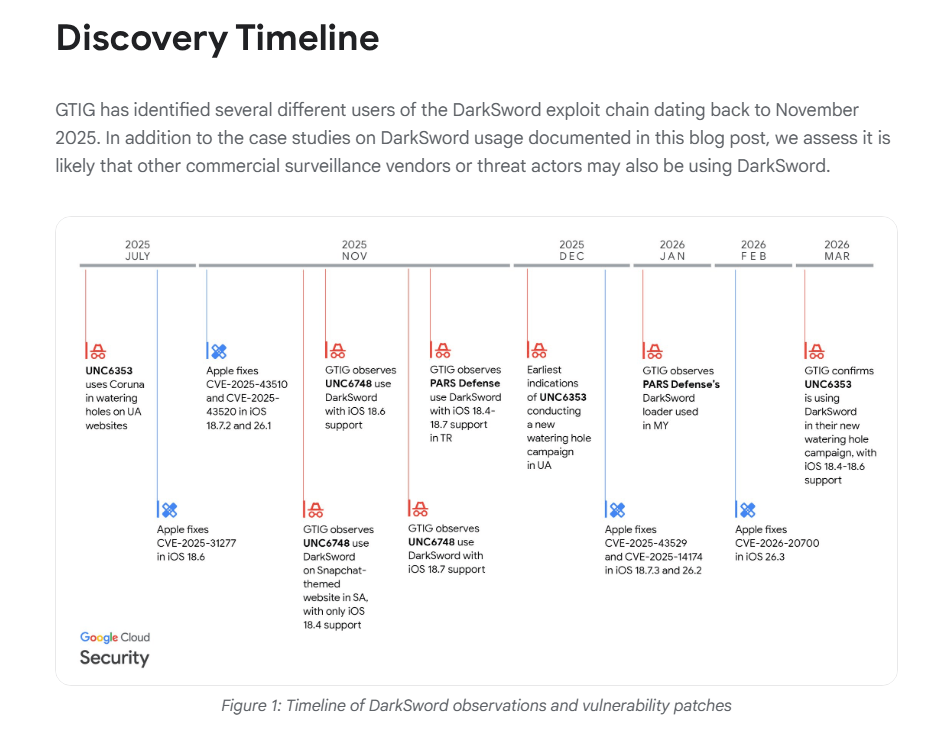
The software is one of six tools bundled inside a broader package researchers are calling DarkSword. Together, the tools are engineered to steal cryptocurrency private keys, messaging data, and personal information from infected devices.

Ghostblade runs once, takes what it needs, and stops. No persistent background activity. No extra software required to make it work. That design makes it far harder to catch than malware that keeps running after an infection.
Source: Google

The tool also covers its tracks in a specific way. After it finishes, it wipes crash logs from the compromised device. Those logs are what Apple normally collects to identify software problems and flag suspicious activity. Without them, Apple receives no signal that anything went wrong.

What Ghostblade Can Actually Access

The scope of what Ghostblade can pull from a device is wide. Based on Google’s report, the malware is capable of reaching messages from iMessage, WhatsApp, and Telegram.

It can also collect SIM card details, location data, multimedia files, and system-level settings. For crypto users, the most direct threat is private key exposure — the kind of access that gives an attacker full control over a digital wallet with no way to reverse transactions once funds are moved.

Bitcoin is currently trading at $70,572. Chart: TradingView

The DarkSword suite represents a new chapter in browser-based attacks aimed at the crypto space, with Ghostblade serving as one of its most technically refined components.

Hackers Shift Focus From Code To People

Total losses from crypto-related hacks dropped sharply in February, falling to close to $50 million from $385 million the month before, Nominis data shows. But that decline does not signal a safer environment.

Reports indicate the drop reflects a change in method, not ambition. Attackers moved away from exploiting code vulnerabilities and toward phishing schemes, wallet poisoning, and other approaches that rely on tricking users rather than breaking systems.

Fake websites built to mirror legitimate platforms are a common vehicle. Users who land on them and interact with any element can have credentials and keys lifted without realizing it.

The Ghostblade alert from Google arrives against that backdrop — a reminder that high-value individual users, not just exchanges or protocols, are firmly in the crosshairs.

Featured image from Unsplash, chart from TradingView

İlgili Sorular

QWhat is the name of the newly identified iOS malware described in the article, and what is its primary function?

AThe malware is called Ghostblade. Its primary function is to extract sensitive data, such as cryptocurrency private keys, messaging data, and personal information, from infected Apple iOS devices and then go quiet to avoid detection.

QAccording to the article, what broader package is Ghostblade a part of, and what is the collective goal of its tools?

AGhostblade is one of six tools bundled inside a broader package called DarkSword. The collective goal of these tools is to steal cryptocurrency private keys, messaging data, and personal information from infected devices.

QHow does the Ghostblade malware avoid detection after it completes its task on a compromised device?

AGhostblade avoids detection by running only once, taking the data it needs, and then stopping with no persistent background activity. It also covers its tracks by wiping crash logs from the device, which prevents Apple from receiving signals that would normally flag suspicious activity.

QWhat specific types of data can the Ghostblade malware access on an infected device?

AGhostblade can access messages from iMessage, WhatsApp, and Telegram. It can also collect SIM card details, location data, multimedia files, system-level settings, and most critically for crypto users, private keys that control digital wallets.

QWhat trend in cyber attacks does the article highlight, as shown by the change in total crypto losses from January to February 2026?

AThe article highlights a trend where attackers are shifting their focus from exploiting code vulnerabilities to using methods that trick users, such as phishing schemes and wallet poisoning. This is evidenced by a sharp drop in total losses from $385 million in January to about $50 million in February, which reflects this change in method rather than a decrease in attacker ambition.

İlgili Okumalar

Why Bitcoin Holds Above $64,000 After Fed's Hard Pause

**Bitcoin Stabilizes Near $64,000 Following Hawkish Fed Pause** The cryptocurrency market, led by Bitcoin, remained stable around $64,000 despite a volatile reaction to the latest U.S. Federal Reserve meeting. The Fed paused interest rates but signaled a hawkish stance, with three committee members voting for an increase—the highest dissent since 2016. This limits risk appetite but hasn't triggered panic selling. Key market highlights include Bitcoin ETFs seeing a net inflow of $32.1 million, breaking a streak of outflows, while Ethereum ETFs experienced outflows of $18.65 million. Liquidations affected about 90,000 traders. Technically, Bitcoin finds support around $63,000-$63,500, with major resistance near $66,000. While its price is about 49% below its all-time high, institutional demand via ETFs and the absence of mass capitulation support a potential recovery scenario in the second half of the year. Major altcoins showed mixed movements, with Solana attracting capital while Ethereum faced selling pressure despite strong on-chain metrics like a growing staking queue. Regulatory news took a pause as the U.S. Senate delayed the CLARITY Act vote until at least autumn. For the final trading day of July, U.S. inflation and consumer spending data will be crucial. Bitcoin's key levels to watch are $63,000 support and $66,000 resistance. Sustained ETF inflows and Bitcoin holding above $63,000 are seen as positive signs for a potential market recovery later in the year.

cryptonews.ru56 dk önce

Why Bitcoin Holds Above $64,000 After Fed's Hard Pause

cryptonews.ru56 dk önce

Participants in XRP Fraud Scheme That Stole $9 Million from 71 Investors Arrested

South Korean police have arrested three individuals accused of operating a fraudulent investment platform that stole approximately 3.4 million XRP (worth about $9 million) from 71 investors between October 16 and 23. The suspects promoted the site Fxrpntwork.com through blogs, online articles, and YouTube videos, promising guaranteed principal and monthly returns of 1.5% to 1.8%. Investors were instructed to transfer XRP from Korean exchanges to overseas platforms and then to wallets controlled by the group before the site was shut down. The scammers copied the branding of legitimate projects Flare Network and FXRP to appear credible. Authorities warn that such impersonation frauds, which use familiar branding and urgent promises of guaranteed profits, are a common red flag. Legitimate companies do not solicit cryptocurrency transfers through unsolicited promotions. Seoul police have issued an Interpol Red Notice for a fourth suspect abroad and are investigating others involved in creating and promoting the fraudulent website. While investigators froze 17.3 billion won in assets, approximately 10 billion won was moved during the probe, with wallet analysis revealing transfers totaling 27.3 billion won, suggesting there may be additional unidentified victims and accomplices. The case underscores the organized, cross-border nature of crypto investment fraud.

cryptonews.ru58 dk önce

Participants in XRP Fraud Scheme That Stole $9 Million from 71 Investors Arrested

cryptonews.ru58 dk önce

İşlemler

Spot
活动图片





