A New Crypto Era: SEC-CFTC To Host Joint Regulatory Harmonization Event Next Week

bitcoinist2026-01-24 tarihinde yayınlandı2026-01-24 tarihinde güncellendi

Özet

The U.S. Securities and Exchange Commission (SEC) and the Commodity Futures Trading Commission (CFTC) will host a joint public event on January 27 to discuss harmonizing crypto regulations. The event, part of the Trump administration's push to make the U.S. the global crypto leader, aims to clarify jurisdictional boundaries and foster innovation under American law. This follows ongoing efforts between the agencies to improve regulatory coordination, as emphasized in a September roundtable where SEC Chair Atkins declared an end to "regulatory fragmentation." Meanwhile, congressional efforts to pass crypto legislation have stalled, with the Senate Banking Committee delaying its bill after industry criticism, and Coinbase withdrawing support for what it called a "bad bill." The Senate Agriculture Committee has advanced its version of the Clarity Act, focusing on the CFTC's role.

The Securities and Exchange Commission (SEC) and the Commodity Futures Trading Commission (CFTC) have announced a joint event on the future of crypto oversight amid the Trump administration’s push to welcome the sector.

SEC-CFTC Push Joint Crypto Oversight

On Thursday, SEC Chairman Paul Atking and CFTC Chairman Michael Selig announced they will hold an event next week to discuss regulatory harmonization between the two sister agencies.

According to the announcement, the pro-industry chairmen will outline the efforts to work together and cooperate to “deliver on President Trump’s promise to make the United States the crypto capital of the world.”

The event will be hosted on January 27 at the CFTC headquarters and moderated by crypto journalist Eleanor Terret. Additionally, it will be open to the public and livestreamed on both agencies’ websites.

“For too long, market participants have been forced to navigate regulatory boundaries that are unclear in application and misaligned in design, based solely on legacy jurisdictional silos,” said SEC Chair Atkins and CFTC Chair Selig in a joint statement.

“This event will build on our broader harmonization efforts to ensure that innovation takes root on American soil, under American law, and in service of American investors, consumers, and economic leadership,” they added.

Last year, the SEC and CFTC began discussing their options for effectively collaborating on crypto regulations, as a clear framework for digital assets became a top priority for the agencies

As reported by Bitcoinist, the agencies explored reinstating the CFTC-SEC joint advisory committee to develop recommendations on ongoing issues, including efforts in regulatory coordination.

During a September joint roundtable between the two agencies, Atking declared that the era of regulatory fragmentation was ending and the age of harmonized, innovation-friendly crypto oversight was here:

We are at a crossroads. If we follow the path of our predecessors, America risks ceding leadership in the next chapter of financial history. (...) This ends now (...) our two agencies must work in lockstep to transform dual regulation from a source of confusion into a source of strength. Together, we can offer the best of both worlds: the investor protections that have defined U.S. markets, combined with the innovation-friendly approach that will keep us at the frontier of financial technology throughout the 21st century.

The SEC’s Director of the Division of Trading and Markets, Jamie Selway, highlighted the SEC’s efforts to “further harmonize its rules with our sister regulator, the CFTC. In a January 22 speech, He affirmed that the Division will work shoulder-to-shoulder with the CFTC staff to ensure the US’s continued leadership in financial markets, following Atkins’ September directions.

Congress Regulatory Efforts Stall

The SEC and CFTC’s efforts to regulate the crypto market come as the US Congress struggles to establish a framework to oversee the sector. The Senate Banking Committee’s version of the market structure bill, which focuses on the SEC’s oversight, was delayed after multiple market participants criticized the bill’s draft.

Coinbase CEO Brian Armstrong shared his disappointment with the crypto legislation, withdrawing the company’s support last week. “This version would be materially worse than the current status quo. We’d rather have no bill than a bad bill,” he affirmed.

The Senate Agriculture Committee published its version of the CLARITY Act on Thursday, which mainly addresses the CFTC’s role and regulations, scheduling its markup session for January 27.

Eleanor Terret shared that the industry’s reaction has been mostly positive, “with stakeholders noting the bill’s close similarities to the House Agriculture Committee’s version of the Clarity Act.”

However, recent reports have warned that the Banking Committee’s crypto talks may not resume until later February or early March, as focus shifts to advancing affordable housing plans linked to President Trump’s priorities.
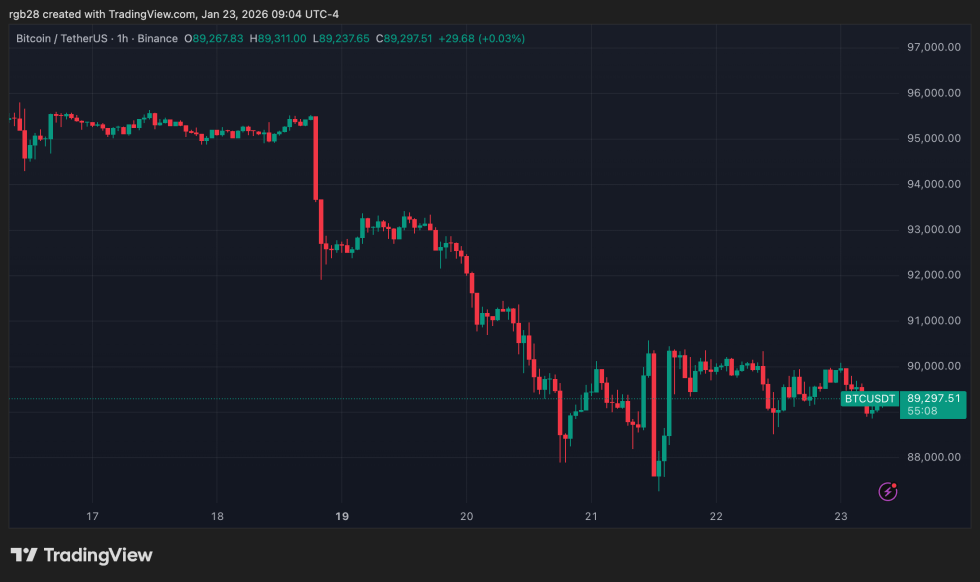
Bitcoin (BTC) trades at $89,297 in the one-week chart. Source: BTCUSDT on TradingView


İlgili Sorular

QWhat is the purpose of the joint event being hosted by the SEC and CFTC next week?

AThe purpose of the joint event is to discuss regulatory harmonization between the SEC and CFTC, outline efforts to cooperate, and deliver on President Trump's promise to make the United States the crypto capital of the world.

QWhere and when will the SEC-CFTC joint event take place, and how can the public access it?

AThe event will be hosted on January 27 at the CFTC headquarters. It will be open to the public and livestreamed on both agencies' websites.

QAccording to the agency chairmen, what problem has forced market participants to navigate unclear regulatory boundaries?

AThe chairmen stated that market participants have been forced to navigate regulatory boundaries that are unclear in application and misaligned in design, based solely on legacy jurisdictional silos.

QWhy did Coinbase CEO Brian Armstrong withdraw support for the Senate Banking Committee's market structure bill?

ABrian Armstrong withdrew support because he believed that version of the bill would be materially worse than the current status quo, stating, 'We'd rather have no bill than a bad bill.'

QWhat recent legislative action did the Senate Agriculture Committee take regarding crypto, and when is its markup session?

AThe Senate Agriculture Committee published its version of the CLARITY Act, which mainly addresses the CFTC's role and regulations, and scheduled its markup session for January 27.

İlgili Okumalar

Has Hook Summer Really Arrived? sato, Lo0p, FLOOD Ignite the New Narrative of Uniswap v4

"Hook Summer" Arrives? Sato, Lo0p, FLOOD Ignite Uniswap v4 Narrative Amidst a slight market recovery, attention within the Ethereum ecosystem has shifted to Meme coins built on Uniswap v4's Hook protocol. Following ASTEROID, tokens like sato, sat1, Lo0p, and FLOOD have become market focal points, with market caps ranging from millions to tens of millions, bringing concentrated liquidity to a narrative-dry market. Uniswap v4 Hooks are "plugin smart contracts" that allow developers to inject custom logic at key points in a liquidity pool's lifecycle (initialization, adding/removing liquidity, swaps, etc.), making the AMM programmable. Recent representative projects include: * **sato**: Market cap peaked over $38M; uses a v4 curve mechanism for minting/burning, locking ETH as reserve. * **sat1**: Market cap briefly exceeded $10M, positioning as an "optimized sato," but later declined significantly. * **Lo0p**: Market cap neared $6.6M; a "lending AMM protocol" allowing users to borrow ETH against deposited LO0P tokens without immediate selling pressure. * **FLOOD**: Market cap approached $6M; channels trading reserves into Aave v3 to generate yield, which is retained in the pool. The emergence of these Hook-based tokens could drive long-term growth for the Uniswap ecosystem by attracting users and liquidity to v4 pools. Combined with Uniswap's activated fee switch (partially used to burn UNI), the long-term outlook for UNI appears positive. However, short-term UNI price appreciation is not directly guaranteed. Factors include the sustainability and lifecycle of these new tokens, their price volatility, overall market conditions, and regulatory pressures. Currently, Uniswap v4's TVL ($595M) lags behind v3 and v2, indicating Hook adoption still requires time to mature. In summary, the Hook ecosystem serves as "long-term nourishment" for UNI, but acts more as a "catalyst" than a direct "booster" in the short term. Note: These are early-stage experimental tokens and may carry unknown risks.

marsbit21 dk önce

Has Hook Summer Really Arrived? sato, Lo0p, FLOOD Ignite the New Narrative of Uniswap v4

marsbit21 dk önce

Has Hook Summer Truly Arrived? sato, Lo0p, FLOOD Ignite the New Uniswap v4 Narrative

With the broader market showing signs of recovery, a new wave of interest has emerged around Ethereum-based meme coins. Following ASTEROID, tokens like sato, sat1, Lo0p, and FLOOD, built upon the Uniswap v4 Hook protocol, are capturing market attention. Their market capitalizations range from millions to tens of millions of dollars, injecting much-needed focused liquidity into a market lacking narratives. This article explores whether this trend signifies an incoming "Hook Summer" and its potential impact on UNI's price. Hooks are essentially plug-in smart contracts for Uniswap v4 liquidity pools, allowing developers to inject custom logic at key points in a pool's lifecycle (like initialization, adding/removing liquidity, swaps). This transforms the AMM into programmable building blocks. Key highlighted projects include: * **sato**: Peaked over $38M market cap. It utilizes a v4 curve for minting/burning; buying locks ETH as reserve to mint new tokens, while selling redeems ETH from the reserve and burns tokens. * **sat1**: Market cap briefly exceeded $10M, promoted as an "optimized sato," but later declined significantly. * **Lo0p**: Reached nearly $6.6M. It's a lending AMM protocol where buying LO0P tokens locks them as collateral, allowing users to borrow ETH from the pool reserve at 40% LTV, aiming to improve capital efficiency for idle ETH in LPs. * **FLOOD**: Peaked near $6M. Its mechanism directs asset reserves from buys into Aave v3 to generate yield, with fees and interest retained in the pool to potentially influence the token's price long-term. In the long term, the development of the Hook ecosystem can attract users and liquidity to Uniswap v4, benefiting UNI's fundamentals—especially combined with the recent activation of the protocol fee switch, where a portion of fees is used to burn UNI. However, in the short term, these Hook-based tokens are unlikely to directly drive significant UNI price appreciation. Their impact is moderated by factors like token sustainability, price volatility, and broader market and regulatory conditions. Currently, Uniswap v4's TVL ($595M) still trails behind v2 and v3, indicating adoption and growth will take time. The article concludes that while the Hook ecosystem provides long-term "nourishment" for UNI, its short-term role is more of a "catalyst" than a "booster." Readers are cautioned that these are early-stage experimental tokens and may carry unknown risks.

Odaily星球日报33 dk önce

Has Hook Summer Truly Arrived? sato, Lo0p, FLOOD Ignite the New Uniswap v4 Narrative

Odaily星球日报33 dk önce

Interview with Michael Saylor: I Did Say I Would Sell Bitcoin, But Never a Net Sale

Interview with Michael Saylor: I Said We'd Sell Bitcoin, But Never Be a Net Seller In a recent podcast, MicroStrategy Executive Chairman Michael Saylor clarified the company's stance on potentially selling Bitcoin. Following MicroStrategy's earnings call statement about being prepared to sell BTC to fund dividends for its STRC (Strategic) credit product, Saylor emphasized the distinction between selling and being a "net seller." Saylor explained the core business model: MicroStrategy sells credit instruments like STRC and uses the proceeds to buy Bitcoin, which is viewed as "digital capital" expected to appreciate around 30-40% annually. A portion of these capital gains can then be used to pay the dividends on the credit products. He stressed that even if the company sells some Bitcoin for dividends, it simultaneously buys much more with new credit issuance. For example, after raising $3.2 billion from STRC sales in April, the dividend obligation was only $80-90 million, making the company a net buyer. The clarification aims to counter market narratives questioning the value of Bitcoin on MicroStrategy's balance sheet if it were never sold, and to dismiss claims of a "Ponzi scheme." Saylor reiterated his personal philosophy for investors: "Don't be a net seller of bitcoin" and ensure your Bitcoin holdings increase each year. Saylor also discussed Bitcoin's role as the foundation for "digital credit," noting that STRC has become the largest and most liquid preferred stock issue in the U.S., offering high risk-adjusted returns (Sharpe ratio). He highlighted Bitcoin's deep liquidity, stating that even large purchases by MicroStrategy do not move the market significantly, which is driven by macro factors, geopolitical tensions, and capital flows from ETFs and credit products. Finally, Saylor reflected on his early inspiration from sci-fi books, which motivated his path to MIT, and maintained his fundamental thesis on Bitcoin remains unchanged: it is superior digital capital enabling superior digital credit.

链捕手38 dk önce

Interview with Michael Saylor: I Did Say I Would Sell Bitcoin, But Never a Net Sale

链捕手38 dk önce

İşlemler

Spot
Futures

Popüler Makaleler

ERA Nasıl Satın Alınır

HTX.com’a hoş geldiniz! Caldera (ERA) satın alma işlemlerini basit ve kullanışlı bir hâle getirdik. Adım adım açıkladığımız rehberimizi takip ederek kripto yolculuğunuza başlayın. 1. Adım: HTX Hesabınızı OluşturunHTX'te ücretsiz bir hesap açmak için e-posta adresinizi veya telefon numaranızı kullanın. Sorunsuzca kaydolun ve tüm özelliklerin kilidini açın. Hesabımı Aç2. Adım: Kripto Satın Al Bölümüne Gidin ve Ödeme Yönteminizi SeçinKredi/Banka Kartı: Visa veya Mastercard'ınızı kullanarak anında Caldera (ERA) satın alın.Bakiye: Sorunsuz bir şekilde işlem yapmak için HTX hesap bakiyenizdeki fonları kullanın.Üçüncü Taraflar: Kullanımı kolaylaştırmak için Google Pay ve Apple Pay gibi popüler ödeme yöntemlerini ekledik.P2P: HTX'teki diğer kullanıcılarla doğrudan işlem yapın.Borsa Dışı (OTC): Yatırımcılar için kişiye özel hizmetler ve rekabetçi döviz kurları sunuyoruz.3. Adım: Caldera (ERA) Varlıklarınızı SaklayınCaldera (ERA) satın aldıktan sonra HTX hesabınızda saklayın. Alternatif olarak, blok zinciri transferi yoluyla başka bir yere gönderebilir veya diğer kripto para birimlerini takas etmek için kullanabilirsiniz.4. Adım: Caldera (ERA) Varlıklarınızla İşlem YapınHTX'in spot piyasasında Caldera (ERA) ile kolayca işlemler yapın.Hesabınıza erişin, işlem çiftinizi seçin, işlemlerinizi gerçekleştirin ve gerçek zamanlı olarak izleyin. Hem yeni başlayanlar hem de deneyimli yatırımcılar için kullanıcı dostu bir deneyim sunuyoruz.

412 Toplam GörüntülenmeYayınlanma 2025.07.17Güncellenme 2025.07.17

ERA Nasıl Satın Alınır

Tartışmalar

HTX Topluluğuna hoş geldiniz. Burada, en son platform gelişmeleri hakkında bilgi sahibi olabilir ve profesyonel piyasa görüşlerine erişebilirsiniz. Kullanıcıların ERA (ERA) fiyatı hakkındaki görüşleri aşağıda sunulmaktadır.

活动图片












