A Must-Read for Tax Residents: Do I Need to Pay Taxes on Crypto Asset Profits?

marsbit2026-01-22 tarihinde yayınlandı2026-01-22 tarihinde güncellendi

Özet

Chinese tax residents are required to declare and pay taxes on profits from cryptocurrency transactions, regardless of whether the transactions occur on anonymous wallets or decentralized exchanges (DEXs). According to Chinese tax laws, income from the sale of crypto assets is classified as "property transfer income" and is taxed at a flat rate of 20%. Key points include: - A Chinese tax resident is defined as someone with a domicile in China or who resides in the country for 183 days or more within a tax year. - Despite the perceived privacy of decentralized platforms, tax authorities can trace transactions through banking channels, international information exchange mechanisms like CRS, and enhanced surveillance systems such as "Golden Tax Phase IV." - Failure to declare such income may result in back taxes, late payment fees (0.05% per day), fines ranging from ¥2,000 to ¥10,000, or even criminal charges in severe cases. - Recommendations include maintaining detailed transaction records, using official channels to declare income, preserving proof of transactions, and consulting tax professionals for compliance and planning.

Original Authors: Xu Qian, Jin Weilin

Introduction

In recent years, more and more people have earned considerable income through crypto asset trading, but many are still wondering: Do I need to pay taxes on money earned in anonymous wallets or on decentralized exchanges?

To put it directly: If you are a Chinese tax resident, in principle, you should declare and pay taxes to the Chinese tax authorities according to the law on income from crypto assets obtained through any channel.
How is a "Chinese Tax Resident" Defined?

According to the "Personal Income Tax Law of the People's Republic of China", an individual who meets any of the following conditions is considered a Chinese tax resident:

1. Has a domicile in China

Domicile: Refers to an individual who habitually resides in China due to household registration, family, main economic interests, or other reasons.

If your household registration (hukou) or family's center of gravity is in China, or your main life, work, and economic ties are in China, you may still be recognized as a tax resident even if you are often overseas.

2. Has resided in China for an aggregate of 183 days or more within a tax year

This is a clear time-based criterion. Even if you are a foreign national, as long as you reside in China for an aggregate of 183 days or more within one year, you are considered a Chinese tax resident.

Mankun Reminder:

Whether you are recognized as a tax resident due to "domicile" or "length of residence", once you meet the criteria, you need to declare and pay taxes to China on your worldwide income (including domestic and foreign income) according to the law.

Why Do Crypto Asset Profits Also Require Tax Payment?

Many people believe that since crypto assets are restricted domestically, the related profits are also "tax-free". This is a common misconception. Taxation focuses on whether you have income, not whether that income comes from an encouraged industry.

1. What is the nature of crypto assets?

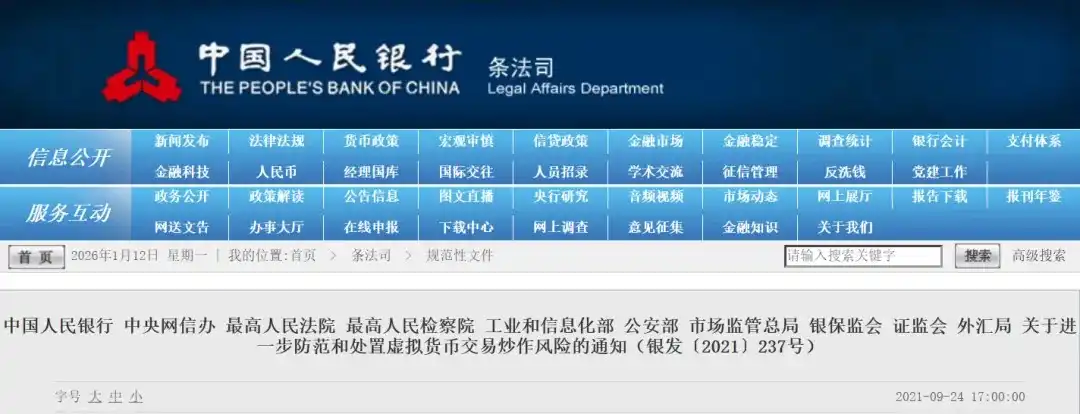
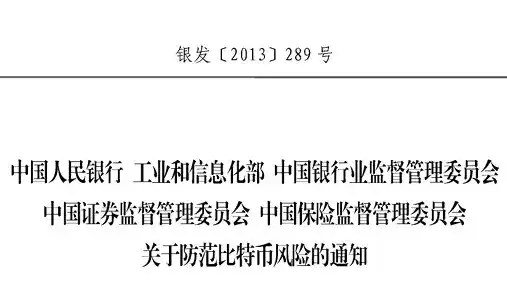
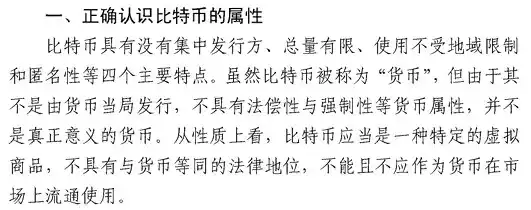
According to the "Notice on Preventing Bitcoin Risks" (Yin Fa [2013] No. 289) issued by the People's Bank of China and four other ministries, the "Announcement on Preventing Risks from Token Offering Financing" issued by the PBOC and six other ministries on September 4, 2017, and the "Notice on Further Preventing and Dealing with Virtual Currency Trading Speculation Risks" issued by the PBOC and nine other ministries on September 24, 2021, virtual currencies cannot be circulated as currency, but their property attributes as a "virtual commodity" are not denied. That is, the law recognizes them as tradable property.
2. What are the corresponding tax regulations?

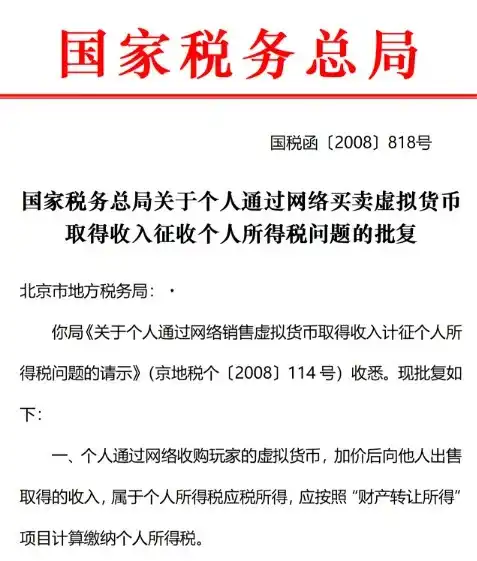
The "Reply of the State Administration of Taxation on the Levy of Personal Income Tax on Income Obtained by Individuals Buying and Selling Virtual Currency Online" (Guo Shui Han [2008] No. 818) clearly states: Income obtained by individuals from buying and selling virtual currency online belongs to "income from the transfer of property" and shall be subject to personal income tax according to the law.
3. Conclusion and Tax Rate

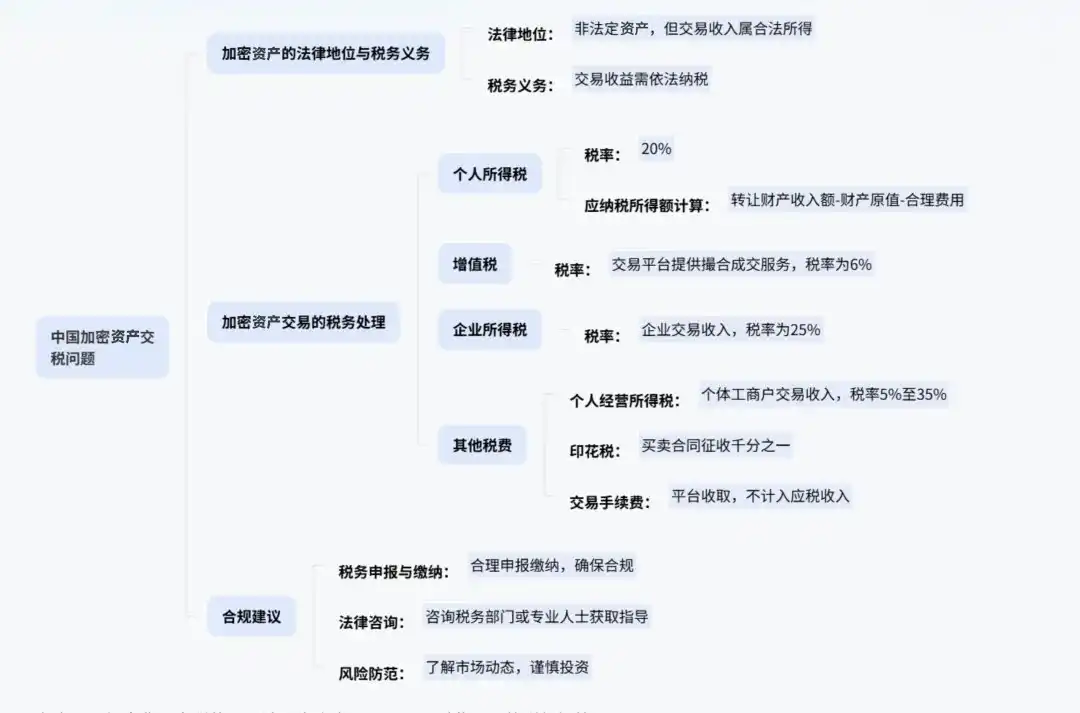
Therefore, regardless of which crypto asset you trade, as long as the transaction generates profit, this portion of the income is considered "income from the transfer of property" and should be subject to personal income tax at a rate of 20% according to the law.

In short: Taxation does not distinguish by industry; it only looks at income. Profits from crypto asset trading are considered income from property transfer and require declaration and payment of 20% personal income tax.

Do I Need to Declare Profits from Anonymous Wallets and DEX Trades?

Some investors believe that using decentralized wallets (like MetaMask) or trading on decentralized exchanges (like Uniswap) is anonymous and therefore untraceable by tax authorities. However, in the current regulatory and technological environment, this thinking carries significant risks.

1. The fund repatriation stage can still be traced

The vast majority of investors ultimately convert their crypto assets into fiat currency through OTC or compliant platforms and transfer it into domestic bank accounts.

Once funds enter the banking system, they fall under the purview of tax authorities. Transactions that are large in amount or high in frequency can easily trigger bank risk control systems, subsequently drawing attention from tax departments.

2. International tax information exchange mechanisms are now routine

China has joined the CRS (Common Reporting Standard) for the Automatic Exchange of Financial Account Information in Tax Matters, achieving automatic tax information exchange with over a hundred countries worldwide. If you have an account with an overseas exchange or bank, the relevant account information has likely already been exchanged back with the Chinese tax authorities.

3. "Golden Tax Project Phase IV" has strengthened data supervision capabilities

The "Golden Tax Phase IV" system utilizes big data, AI, and other technologies to achieve data linkage between tax, banking, customs, industry and commerce, and other departments. The system can automatically compare declared personal income with actual consumption and asset situations. Once a significant discrepancy is found, it triggers a tax warning.

Therefore, even if the trading activity occurs on-chain or overseas, as long as the final profits enter your name or are used for your living expenses in some form, there is a risk of being discovered by the tax authorities and being required to pay back taxes.

What Are the Consequences of Not Declaring Crypto Asset Income?

If the tax authorities discover that you have not declared income from overseas crypto assets, you may face the following legal consequences:

1. Back Taxes and Late Payment Surcharges

The tax authorities will order you to pay the taxes that should have been paid but were not, and, according to Article 32 of the "Law of the People's Republic of China on the Administration of Tax Collection", a late payment surcharge of 0.05% per day (approximately 18.25% annualized) will be added. The longer the time, the larger the accumulated amount.

2. Facing Tax Penalties

If deemed as "failure to file a tax return", a fine of up to RMB 2,000 may be imposed; if the circumstances are more severe, a fine between RMB 2,000 and RMB 10,000 may be imposed.

If deemed as "tax evasion" (refusing to declare or making false declarations after being notified), a fine of 50% to 5 times the amount of tax evaded or not paid will be imposed.

3. Possible Criminal Liability

If the amount of tax evaded is relatively large and accounts for more than 10% of the tax payable, and payment is still not made after the tax authorities have legally issued a recovery notice, it may constitute the crime of tax evasion, leading to criminal liability.

Mankun Reminder:

Not declaring crypto asset income may seem "hidden", but it actually carries multiple risks, from high late payment surcharges and substantial fines to potential criminal liability. We recommend proactive compliance and reporting to avoid subsequent legal and financial risks.

Mankun's Recommendations

If you have earned income from trading crypto assets, especially if funds have already been repatriated to domestic accounts, Mankun Law Firm recommends that you:

1. Proactively organize your transaction records

It is advisable to try to organize a clear transaction history, including the time, quantity, and price of purchases and sales, and focus on retaining proof that can demonstrate the "cost" of the assets, such as bank transfer records, exchange transaction details, on-chain transaction hashes, etc.

The more complete the cost documentation, the more accurate the calculation of taxable income, and the more reasonable the tax burden.

2. Consider proactive declaration or self-review

  • If you have not yet received notice from the tax authorities, you can declare through the "Personal Income Tax" APP or on the Natural Person Electronic Tax Bureau website.
  • According to regulations, the declaration should be submitted to the competent tax authority in the location of your employing unit; if you are not employed, you can file with the tax authority in your place of household registration, place of habitual residence, or place of main source of income.
  • If you have already received reminders from the tax authorities via text message, phone call, etc., please cooperate actively, truthfully explain the source of funds, and prepare relevant supporting materials such as transaction records.

3. Retain all transaction vouchers

Develop the habit of long-term retention of transaction screenshots, wallet addresses, transfer records, exchange statements, and other materials. These are not only the basis for calculating taxes but also key evidence for explaining and proving the authenticity of transactions during tax inspections.

4. Plan reasonably within compliance boundaries

If your trading is frequent and involves large amounts, you might consider tax planning within the legal boundaries, such as managing assets through compliant structures or legally applying tax treaties. It is recommended to consult professional tax lawyers or accountants during this process to ensure the plan is sound and feasible.

Conclusion

In today's world intertwined with the digital economy and globalization, tax compliance has become a required course for every investor. Although the world of crypto assets has a "decentralized" flavor, tax obligations do not disappear because of it.

Proactively understanding regulations, truthfully declaring income, and properly retaining vouchers are not only a respect for the law but also long-term protection for your asset and credit security.

If you have questions or need assistance regarding crypto asset taxation, you can seek professional support early to ensure steady progress on a compliant track.


İlgili Sorular

QWho is considered a tax resident in China according to the article?

AAccording to the Personal Income Tax Law of China, an individual is considered a tax resident if they either 1) have a domicile in China (due to household registration, family, or main economic interests), or 2) have resided in China for a cumulative total of 183 days or more within a single tax year.

QHow are profits from cryptocurrency assets classified for tax purposes in China?

AProfits from cryptocurrency transactions are classified as 'property transfer income' and are subject to a 20% personal income tax, as stipulated in the official tax document Guo Shui Han [2008] No. 818.

QWhat are the potential consequences of not declaring cryptocurrency investment income in China?

AConsequences include being required to pay back taxes plus a late payment fee of 0.05% per day, facing fines ranging from under ¥2,000 to up to five times the amount of tax evaded, and potentially facing criminal charges for tax evasion if the amount is large and constitutes over 10% of the total tax payable.

QWhy does the article state that trading on anonymous wallets or DEXs does not avoid tax obligations?

ABecause funds are typically converted to fiat currency and enter the domestic banking system, which is monitored. China's participation in the CRS allows for international information exchange, and the 'Golden Tax Project Phase IV' uses big data to cross-reference income declarations with spending and assets, creating a high risk of detection.

QWhat practical advice does the article give to someone who has made profits from crypto assets?

AThe advice is to: 1) Proactively organize clear transaction records (time, quantity, price, and proof of cost); 2) Consider making a voluntary declaration via the 'Personal Income Tax' app or tax bureau website; 3) Keep all transaction proof long-term; and 4) Seek professional tax or legal advice for complex situations to ensure compliance.

İlgili Okumalar

Has Hook Summer Really Arrived? sato, Lo0p, FLOOD Ignite the New Narrative of Uniswap v4

"Hook Summer" Arrives? Sato, Lo0p, FLOOD Ignite Uniswap v4 Narrative Amidst a slight market recovery, attention within the Ethereum ecosystem has shifted to Meme coins built on Uniswap v4's Hook protocol. Following ASTEROID, tokens like sato, sat1, Lo0p, and FLOOD have become market focal points, with market caps ranging from millions to tens of millions, bringing concentrated liquidity to a narrative-dry market. Uniswap v4 Hooks are "plugin smart contracts" that allow developers to inject custom logic at key points in a liquidity pool's lifecycle (initialization, adding/removing liquidity, swaps, etc.), making the AMM programmable. Recent representative projects include: * **sato**: Market cap peaked over $38M; uses a v4 curve mechanism for minting/burning, locking ETH as reserve. * **sat1**: Market cap briefly exceeded $10M, positioning as an "optimized sato," but later declined significantly. * **Lo0p**: Market cap neared $6.6M; a "lending AMM protocol" allowing users to borrow ETH against deposited LO0P tokens without immediate selling pressure. * **FLOOD**: Market cap approached $6M; channels trading reserves into Aave v3 to generate yield, which is retained in the pool. The emergence of these Hook-based tokens could drive long-term growth for the Uniswap ecosystem by attracting users and liquidity to v4 pools. Combined with Uniswap's activated fee switch (partially used to burn UNI), the long-term outlook for UNI appears positive. However, short-term UNI price appreciation is not directly guaranteed. Factors include the sustainability and lifecycle of these new tokens, their price volatility, overall market conditions, and regulatory pressures. Currently, Uniswap v4's TVL ($595M) lags behind v3 and v2, indicating Hook adoption still requires time to mature. In summary, the Hook ecosystem serves as "long-term nourishment" for UNI, but acts more as a "catalyst" than a direct "booster" in the short term. Note: These are early-stage experimental tokens and may carry unknown risks.

marsbit11 dk önce

Has Hook Summer Really Arrived? sato, Lo0p, FLOOD Ignite the New Narrative of Uniswap v4

marsbit11 dk önce

Has Hook Summer Truly Arrived? sato, Lo0p, FLOOD Ignite the New Uniswap v4 Narrative

With the broader market showing signs of recovery, a new wave of interest has emerged around Ethereum-based meme coins. Following ASTEROID, tokens like sato, sat1, Lo0p, and FLOOD, built upon the Uniswap v4 Hook protocol, are capturing market attention. Their market capitalizations range from millions to tens of millions of dollars, injecting much-needed focused liquidity into a market lacking narratives. This article explores whether this trend signifies an incoming "Hook Summer" and its potential impact on UNI's price. Hooks are essentially plug-in smart contracts for Uniswap v4 liquidity pools, allowing developers to inject custom logic at key points in a pool's lifecycle (like initialization, adding/removing liquidity, swaps). This transforms the AMM into programmable building blocks. Key highlighted projects include: * **sato**: Peaked over $38M market cap. It utilizes a v4 curve for minting/burning; buying locks ETH as reserve to mint new tokens, while selling redeems ETH from the reserve and burns tokens. * **sat1**: Market cap briefly exceeded $10M, promoted as an "optimized sato," but later declined significantly. * **Lo0p**: Reached nearly $6.6M. It's a lending AMM protocol where buying LO0P tokens locks them as collateral, allowing users to borrow ETH from the pool reserve at 40% LTV, aiming to improve capital efficiency for idle ETH in LPs. * **FLOOD**: Peaked near $6M. Its mechanism directs asset reserves from buys into Aave v3 to generate yield, with fees and interest retained in the pool to potentially influence the token's price long-term. In the long term, the development of the Hook ecosystem can attract users and liquidity to Uniswap v4, benefiting UNI's fundamentals—especially combined with the recent activation of the protocol fee switch, where a portion of fees is used to burn UNI. However, in the short term, these Hook-based tokens are unlikely to directly drive significant UNI price appreciation. Their impact is moderated by factors like token sustainability, price volatility, and broader market and regulatory conditions. Currently, Uniswap v4's TVL ($595M) still trails behind v2 and v3, indicating adoption and growth will take time. The article concludes that while the Hook ecosystem provides long-term "nourishment" for UNI, its short-term role is more of a "catalyst" than a "booster." Readers are cautioned that these are early-stage experimental tokens and may carry unknown risks.

Odaily星球日报23 dk önce

Has Hook Summer Truly Arrived? sato, Lo0p, FLOOD Ignite the New Uniswap v4 Narrative

Odaily星球日报23 dk önce

Interview with Michael Saylor: I Did Say I Would Sell Bitcoin, But Never a Net Sale

Interview with Michael Saylor: I Said We'd Sell Bitcoin, But Never Be a Net Seller In a recent podcast, MicroStrategy Executive Chairman Michael Saylor clarified the company's stance on potentially selling Bitcoin. Following MicroStrategy's earnings call statement about being prepared to sell BTC to fund dividends for its STRC (Strategic) credit product, Saylor emphasized the distinction between selling and being a "net seller." Saylor explained the core business model: MicroStrategy sells credit instruments like STRC and uses the proceeds to buy Bitcoin, which is viewed as "digital capital" expected to appreciate around 30-40% annually. A portion of these capital gains can then be used to pay the dividends on the credit products. He stressed that even if the company sells some Bitcoin for dividends, it simultaneously buys much more with new credit issuance. For example, after raising $3.2 billion from STRC sales in April, the dividend obligation was only $80-90 million, making the company a net buyer. The clarification aims to counter market narratives questioning the value of Bitcoin on MicroStrategy's balance sheet if it were never sold, and to dismiss claims of a "Ponzi scheme." Saylor reiterated his personal philosophy for investors: "Don't be a net seller of bitcoin" and ensure your Bitcoin holdings increase each year. Saylor also discussed Bitcoin's role as the foundation for "digital credit," noting that STRC has become the largest and most liquid preferred stock issue in the U.S., offering high risk-adjusted returns (Sharpe ratio). He highlighted Bitcoin's deep liquidity, stating that even large purchases by MicroStrategy do not move the market significantly, which is driven by macro factors, geopolitical tensions, and capital flows from ETFs and credit products. Finally, Saylor reflected on his early inspiration from sci-fi books, which motivated his path to MIT, and maintained his fundamental thesis on Bitcoin remains unchanged: it is superior digital capital enabling superior digital credit.

链捕手27 dk önce

Interview with Michael Saylor: I Did Say I Would Sell Bitcoin, But Never a Net Sale

链捕手27 dk önce

Beaten SK Hynix Employees in China: Year-end Bonus Less Than 5% of Korean Staff's

"SK Hynix Chinese Staff Hit Hard: Bonuses Less Than 5% of Korean Counterparts" Driven by the AI boom, South Korea's SK Hynix is experiencing record performance, with media reports predicting massive year-end bonuses for its employees, making them highly desirable in the matchmaking market. However, this prosperity starkly contrasts with the situation for the company's Chinese employees. According to reports, SK Hynix operates under a rule allocating 10% of operating profit for employee bonuses. While projections suggest Korean employees could receive bonuses reaching millions of RMB, a Chinese employee with over a decade of technical experience revealed the disparity: "If they get 3 million, Chinese staff get less than 5% of that." After adjustments based on KPI ratings, this employee's highest bonus was slightly over 100,000 RMB. Bonuses are paid annually in Korea but semi-annually in China. During the industry downturn in 2023-2024, Chinese employees received no bonus at all. The gap extends beyond bonuses. Recruitment posts for SK Hynix's Chinese factories (in Wuxi, Dalian, Chongqing) show engineer monthly salaries ranging from 10,000 to 35,000 RMB, with a 13th-month salary promised. Chinese employees also receive standard benefits like annual leave but lack stock incentives, which are reportedly unavailable to them. Furthermore, management positions in China are predominantly held by Korean personnel, though industry observers note a gradual increase in local middle managers over time. SK Hynix has confirmed the 10% bonus rule but cautioned that specific future bonus amounts remain unpredictable. The company forecasts strong demand for HBM and other high-value enterprise products for the next 2-3 years, driven by AI infrastructure investment. This focus on business-to-business markets may continue to constrain supply for consumer products, potentially prolonging price increases for components like memory.

链捕手41 dk önce

Beaten SK Hynix Employees in China: Year-end Bonus Less Than 5% of Korean Staff's

链捕手41 dk önce

İşlemler

Spot
Futures
活动图片