A Leading Wall Street Market Maker Increases Bitcoin ETF Holdings to Over $1 Billion!

cryptonews.ru2026-08-18 tarihinde yayınlandı2026-08-18 tarihinde güncellendi

Özet

Wall Street market maker Jane Street significantly increased its Bitcoin ETF holdings in the second quarter of 2026, according to an SEC 13F filing. The firm purchased approximately $630 million worth of Bitcoin ETF shares during the quarter, bringing its total assets in such ETFs to $1.06 billion. This marks a strategic shift from the first quarter when Jane Street had reduced its Bitcoin ETF positions by roughly 71%. Market experts view this substantial investment as a significant signal, suggesting renewed institutional interest in Bitcoin despite recent price volatility. The move bolsters expectations that long-term outlook for the cryptocurrency remains positive. Analysts note that U.S. spot Bitcoin ETFs have become a crucial gateway for institutional investors, and Jane Street's purchases indicate institutional demand persists. The ongoing adoption of Bitcoin through ETFs by major financial players is seen as a key indicator for the market's medium to long-term prospects.

Jane Street, a leading market maker on Wall Street, made significant investments in Bitcoin Exchange-Traded Funds (ETFs) in the second quarter of 2026.

According to a Form 13F filing submitted to the U.S. Securities and Exchange Commission (SEC), the company purchased approximately $630 million worth of Bitcoin ETF shares during this period. This brings Jane Street's total assets in Bitcoin ETFs to $1.06 billion.

The published data indicates a change from the strategy the company followed in the first quarter of the year. Jane Street reduced its positions in Bitcoin ETFs by approximately 71 percent during the first three months of 2026 and adopted a cautious stance towards the cryptocurrency market. However, active purchases in the second quarter have strengthened expectations that institutional investor interest in Bitcoin may be resurging.

Market experts say Jane Street's move is significant not only in terms of the investment size but also its timing. Despite Bitcoin's price volatility in recent months, the company's increased holdings are seen as a signal that long-term expectations remain positive.

Spot Bitcoin ETF trading in the U.S. has become an important tool for institutional investors to access the cryptocurrency market. In particular, products offered by major financial institutions like BlackRock and Fidelity are facilitating the flow of traditional capital into Bitcoin.

Analysts say Jane Street's second-quarter purchases indicate that institutional demand has not completely disappeared. However, investors will closely monitor upcoming Form 13F reports to see if other large funds and financial institutions make similar adjustments to their Bitcoin ETF positions.

The continued shift of institutional investors towards Bitcoin via ETFs is considered a key indicator for the market's medium- and long-term outlook.

*This is not investment advice.

end-content

İlgili Sorular

QAccording to the 13F filing, what was the total value of Jane Street's holdings in Bitcoin ETFs after their Q2 purchases?

AAfter purchasing approximately $630 million worth of Bitcoin ETF shares in Q2, Jane Street's total assets in Bitcoin ETFs reached $1.06 billion.

QHow did Jane Street's investment strategy towards Bitcoin ETFs change between Q1 and Q2 of 2026?

AIn Q1, Jane Street significantly reduced its Bitcoin ETF positions by roughly 71% and adopted a cautious stance. In Q2, it reversed this strategy by actively purchasing approximately $630 million worth of Bitcoin ETF shares.

QWhy do market experts consider Jane Street's recent investment significant, beyond just the amount?

AExperts highlight the timing of the investment as significant. Despite recent Bitcoin price volatility, Jane Street's increased positions are seen as a signal that long-term expectations for Bitcoin remain positive.

QWhat role do US spot Bitcoin ETFs play for institutional investors, according to the article?

AUS spot Bitcoin ETFs serve as a crucial tool for institutional investors to gain exposure to the cryptocurrency market, facilitating the flow of traditional capital into Bitcoin, especially through products from major firms like BlackRock and Fidelity.

QWhat will investors monitor in upcoming 13F reports, as mentioned in the article?

AInvestors will closely watch upcoming 13F filings to see if other major funds and financial institutions make similar adjustments to their Bitcoin ETF positions, indicating broader institutional demand.

İlgili Okumalar

Century-Old Chain Director Regulations Revived, a16z Faces Antitrust Investigation

The US Department of Justice has launched an antitrust investigation into venture capital firm Andreessen Horowitz (a16z), according to people familiar with the matter. The probe centers on whether a16z partners improperly hold board seats at competing artificial intelligence companies, specifically Databricks Inc. and Fivetran Inc., which both provide data collection and analytics services. a16z co-founder Ben Horowitz sits on Databricks' board, while partner Martin Casado is on Fivetran's board. The previously unreported investigation, ongoing for nearly a year, began around the time regulators reviewed and ultimately approved Fivetran's acquisition of a rival, dbt labs, last October. The inquiry revives a Biden-era enforcement focus on "interlocking directorates" under a 1914 law, where individuals or entities serve on the boards of direct competitors. While typical resolutions involve directors resigning from one board, this case is notable because the concern involves multiple partners from the same firm serving on competing boards. The scrutiny is heightened by a16z's significant political connections and influence, including donations to groups supporting both Trump and Harris, and its advocacy for relaxed AI regulations. A16z, managing $90 billion in assets, is a major investor in AI startups. The DOJ has not decided on any action, and the investigation may conclude without charges.

marsbit3 dk önce

Century-Old Chain Director Regulations Revived, a16z Faces Antitrust Investigation

marsbit3 dk önce

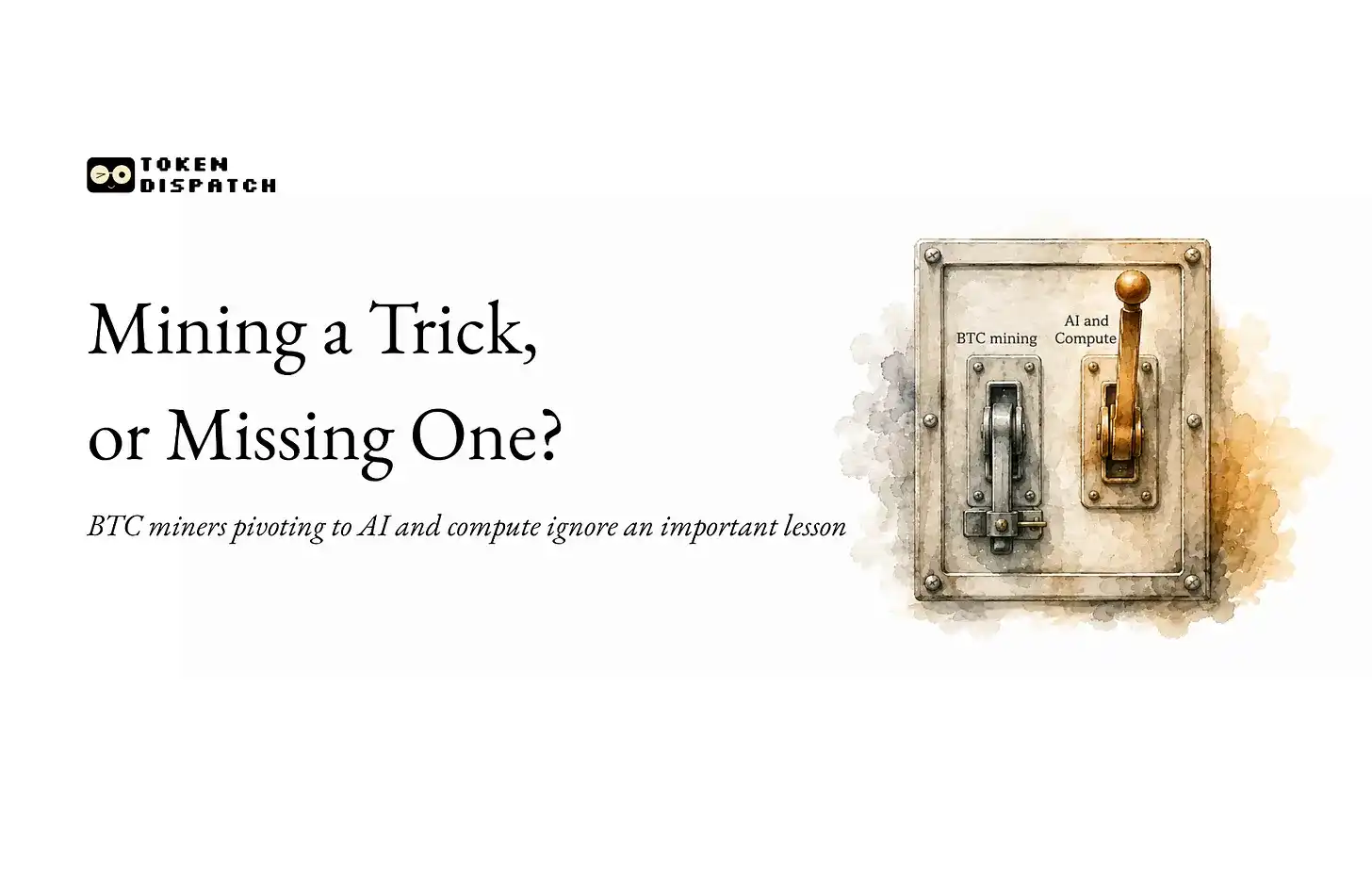
What Is the Cost of Bitcoin Mining Companies Going All-In on AI?

Bitcoin mining companies are undergoing a massive transformation, pivoting from cryptocurrency mining to AI infrastructure and high-performance computing (HPC) services. This shift is driven by the severe profitability crisis in Bitcoin mining following the 2024 halving and the October 2025 market crash, which pushed mining costs as high as $140,000 while Bitcoin's price fell to around $63,000. In response, major public miners like Core Scientific and TeraWulf are rebranding as "energy infrastructure platforms" or "AI cloud service providers." Their revenue structures have flipped, with AI/HPC hosting now constituting over 70-80% of quarterly revenue, dramatically surpassing declining Bitcoin mining income. They are securing massive, long-term contracts worth tens of billions of dollars with tech giants like AMD, CoreWeave, and Anthropic, locking in future cash flow. However, this all-in bet on AI carries significant risks. The AI compute market lacks Bitcoin's self-correcting mechanism, where unprofitable miners exit, reducing network difficulty and boosting profitability for those who remain. An AI compute supply glut could rapidly drive prices down, making today's lucrative long-term contracts burdensome. Furthermore, the transition is largely one-way; retrofitting facilities for AI and signing decade-plus contracts makes it nearly impossible to return to mining when its profitability eventually rebounds. Some companies, like Marathon Digital and Hut 8, are taking a more hedged approach. They are funding AI expansion through debt secured by Bitcoin holdings or by spinning off mining into separate subsidiaries, rather than completely divesting. This strategy maintains the optionality to shift power load back to Bitcoin mining if it becomes profitable again, positioning them as flexible power operators rather than being captive to a single, unproven market cycle. The article concludes that while the pivot to AI is a necessary survival move for many, abandoning Bitcoin mining entirely for long-term AI contracts is a risky gamble that could backfire.

marsbit7 dk önce

What Is the Cost of Bitcoin Mining Companies Going All-In on AI?

marsbit7 dk önce

Walsh May "Beat Around the Bush" at Global Central Bankers' Conference, but Internal Fed Division Is the Real Focus?

With the annual Jackson Hole symposium approaching, market expectations are rising for clues from Federal Reserve Chair Kevin Wash's upcoming speech on September monetary policy. However, analysts caution that expectations for clear guidance may be overstated, while underestimating the Fed's growing internal divisions. Since taking office in May, Wash has adopted a notably less communicative style than his predecessor, downplaying forward guidance and emphasizing policy independence from market pricing. His scheduled speech on "Financial Innovation in Payments" is thus more likely to focus on broad narratives than near-term policy signals. The more significant focus lies within the Fed itself. At Wash's first meeting in June, nearly half the committee's dot plot projections hinted at a 2026 rate hike need. The July meeting saw three regional Fed presidents dissent in favor of an immediate rate increase—an unusually high level of early-term dissent. This internal rift presents a clearer signal of policy uncertainty than any public speech. Market pricing currently shows high conviction for a September pause, with prediction markets assigning roughly a 74% probability to unchanged rates. Despite this consensus, traders remain wary of potential hawkish surprises amid mixed economic data. Analysts suggest that for investors, tracking the evolving voting patterns within the FOMC may offer more insight into future rate direction than parsing Wash's likely guarded Jackson Hole remarks.

marsbit8 dk önce

Walsh May "Beat Around the Bush" at Global Central Bankers' Conference, but Internal Fed Division Is the Real Focus?

marsbit8 dk önce

Automotive Chips Initiate a New Round of Game

After two years of deep inventory correction, the global automotive semiconductor industry is signaling a turning point in the second half of 2026, entering a structural upcycle. Unlike the broad-based shortages of 2022, this recovery is characterized by significant divergence across different chip segments, driven by 800V high-voltage platforms, high-level autonomous driving, and ongoing localization of supply chains in China. The industry-wide destocking cycle has concluded, with inventory levels at automakers and Tier 1 suppliers returning to healthy ranges. Key indicators, including rising OEM orders, lengthening component lead times, improving vendor revenues, and the initiation of price hikes by major suppliers like Infineon and Texas Instruments, confirm the start of a replenishment cycle. Segments are diverging into three tiers based on demand and supply dynamics. The first and strongest tier includes Silicon Carbide (SiC), high-voltage IGBTs, and automotive power management chips, fueled by the rapid adoption of 800V platforms. The second tier, experiencing a moderate recovery, comprises high-end 32-bit MCUs and automotive NOR Flash/DRAM, benefiting from advanced compute domains and AI-driven capacity constraints on mature nodes. The third tier, consisting of low-voltage MOSFETs and basic body electronics, remains stable with ample supply. The core growth logic has shifted from pure vehicle sales volume to increasing semiconductor content per vehicle. This is propelled by the transition to domain/centralized E/E architectures, software-defined vehicles, and new applications like commercial vehicle electrification and V2X communications. While the domestic Chinese supply chain is seizing this window for localization, risks remain, including potential softness in end-demand, future SiC oversupply, and possible easing of 8-inch wafer capacity constraints. In the near term, key segments are expected to see simultaneous volume and price increases, with the industry's cyclicality gradually giving way to more prominent long-term growth characteristics.

marsbit28 dk önce

Automotive Chips Initiate a New Round of Game

marsbit28 dk önce

İşlemler

Spot
活动图片