A History of Technological Evolution Powered by Electricity: Aluminum, Bitcoin, and AI

marsbit2026-05-26 tarihinde yayınlandı2026-05-26 tarihinde güncellendi

Özet

The journey from the Rockdale aluminum smelter in Texas to space-based data centers illustrates a core economic principle: whoever controls the cheapest electricity dictates the use of computing power. The evolution is clear. Old industrial sites with pre-existing, high-capacity power grids are being repurposed. In Rockdale, a former Alcoa plant now houses vast Bitcoin mining rigs, which are increasingly being replaced by AMD chips for AI training. The logic is purely financial: while smelting aluminum yields $0.17–0.27 per kWh and Bitcoin mining $0.05–0.11, AI inference on H100 GPUs generates $1.27–3.67 per kWh. Recent deals confirm the rush for power infrastructure. Riot Platforms leases space to AMD; TeraWulf bought an old Kentucky aluminum plant for its grid; NYDIG secured a New York site for its cheap hydropower to mine Bitcoin. As AI giants like Anthropic, Microsoft, Google, and Amazon aggressively expand, they now directly compete with crypto miners for the same industrial power resources, often outbidding them. This has led to a decline in Bitcoin's global hash rate and a wave of miner conversions to AI data centers. This "digital resource curse" extends globally. Gulf nations, long offering subsidized power to attract heavy industry like aluminum, are now pivoting to become AI and cloud computing hubs—exporting computational power instead of physical commodities. Similarly, Bhutan halted its sovereign Bitcoin mining to sell hydropower directly to India for a stead...

Written by: Thejaswini M A

Compiled by: Luffy, Foresight News

Drive about an hour northeast from Austin, Texas, past barbecue joints and barren scrubland, and you'll arrive in Rockdale, Texas. If you roll down the window before the town's outline comes into view, you'll hear a steady roar, like the rumble of a jet engine idling on the tarmac.

Rockdale, built around an old aluminum smelter, now hosts North America's largest concentration of Bitcoin mining operations, with industry leaders like Riot Platforms and Bitdeer having set up shop there. Investigations by The New York Times and Al Jazeera have long documented this soundscape: tens of thousands of mining rigs paired with industrial fans running at full throttle to prevent equipment from overheating and shutting down in the Texas heat.

Follow the roar into the former plant of Alcoa, a symbol of 20th-century heavy industry. No trace of aluminum production remains in the vast industrial yard. Inside a massive metal warehouse, countless thick copper cables and industrial server racks are arranged in grids. Computer equipment is fully submerged in churning synthetic coolant.

Originally used for Bitcoin mining, the equipment here is now being gradually replaced with AMD chips, transitioning to handle artificial intelligence model training workloads.

Forget debating whether AI is a bubble or Bitcoin is in terminal decline. This industrial succession is just a surface manifestation. The companies securing leases for these sites see it clearly: the true core asset is the electrical infrastructure. This is now an industry-wide consensus.

If you're still wondering why, the underlying logic stems from the disparity in revenue per kilowatt-hour of electricity (calculated at real-time London Metal Exchange prices):

  • Aluminum Smelting: Each kWh can generate $0.17–$0.27 in gross revenue.
  • Bitcoin Mining: At current rates, each kWh yields only $0.05–$0.11.
  • Running AI Inference Tasks on H100 GPUs: Each kWh yields a whopping $1.27–$3.67.
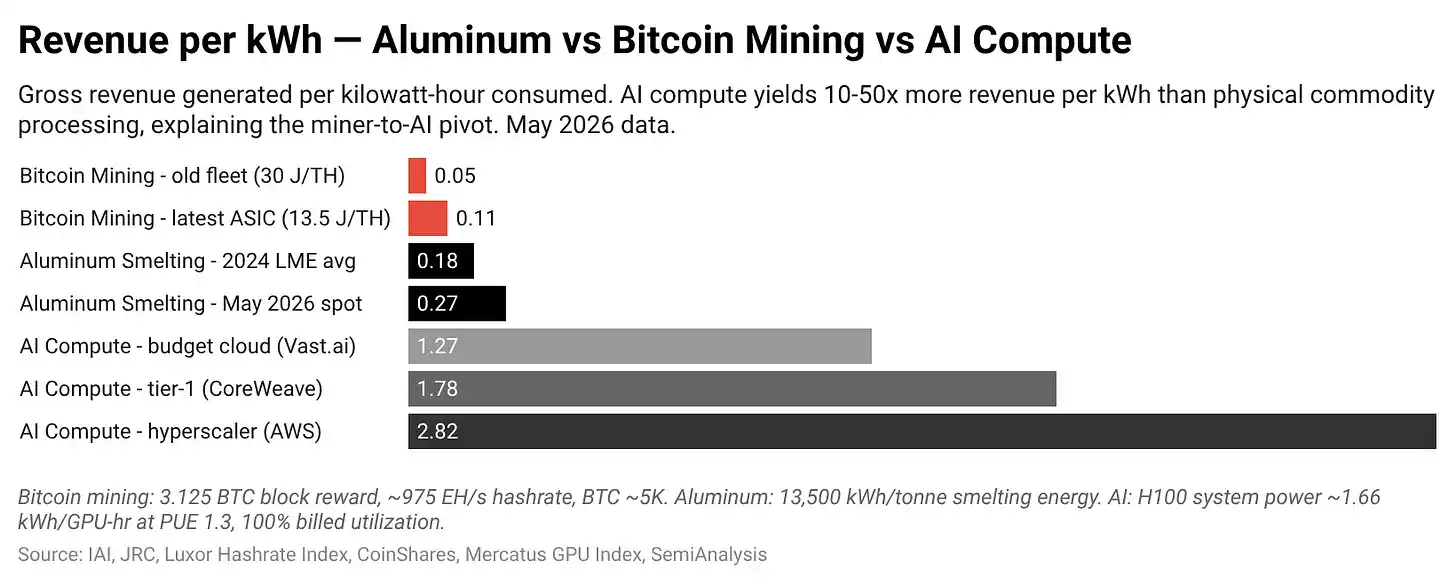
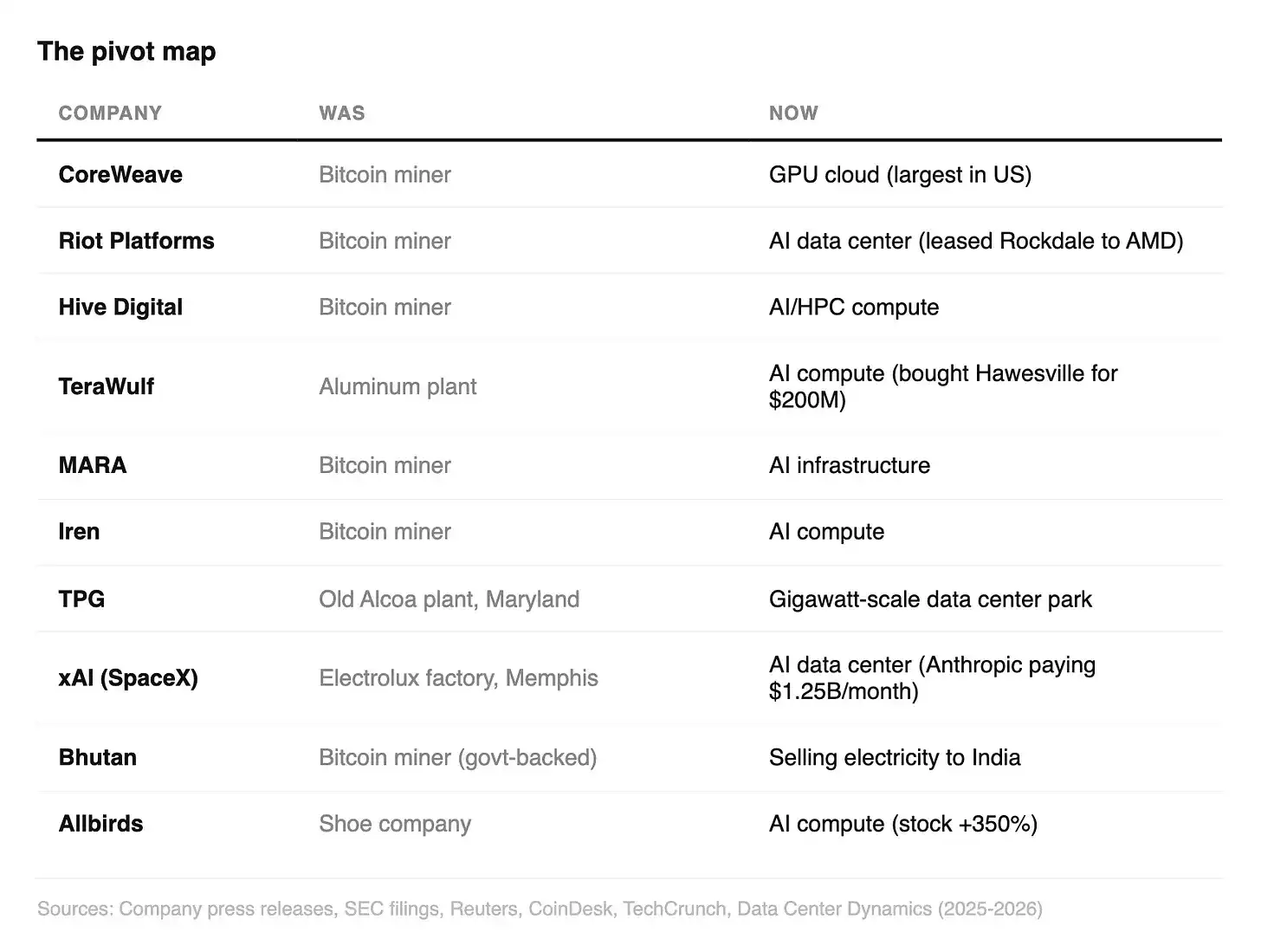
When electricity was cheap, producing aluminum made sense. As margins in the aluminum industry were squeezed, Bitcoin mining became the new use case for low-cost power. By 2026, with Bitcoin prices depressed, AI workloads have become the unequivocally better choice.

Three recent transactions vividly illustrate the industry-wide scramble for power resources, whether for cryptocurrency mining or AI compute.

Riot, with its large site in Rockdale, hasn't limited itself to Bitcoin mining. It has leased part of its space and power to chip giant AMD for building an AI data center. Simply by subleasing electricity and space, the company stands to earn hundreds of millions of dollars.

TeraWulf has embarked on a major expansion, spending $200 million to acquire the century-old Century Aluminum plant in Hawesville, Kentucky. The core reason for choosing this location is the plant's existing, robust high-capacity electrical infrastructure. The company plans to dismantle the old production equipment and build a large-scale data center campus leveraging the ready-made power grid.

NYDIG set its sights on the former Massena East industrial site in New York State. The site had been idle for years but offers direct access to 435 megawatts of cheap hydroelectric power from the St. Lawrence River. While peers pivot to AI, NYDIG secured this location solely to lock in low-cost hydropower to continue its Bitcoin mining operations. The industry has long since stopped building sites from scratch; it now competes for existing power hubs.

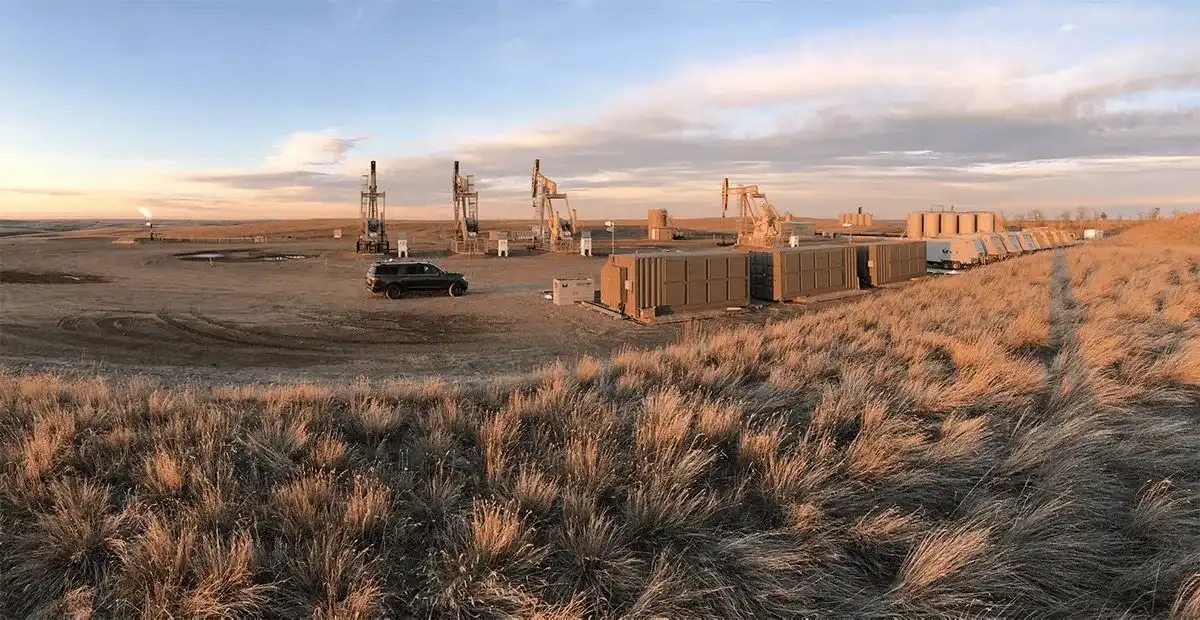
Over the past two decades, Bitcoin miners have roamed the globe in search of cheap power: at remote hydroelectric dams in Washington state, at flare gas sites in North Dakota's oil fields, in clusters of old industrial grids in upstate New York. The industry has honed a mature set of supporting capabilities: 24/7 high-load power management, industrial-grade cooling solutions, long-term, low-cost power contracts.

The rising AI firms happen to need these ready-made resources and have deeper pockets.
Anthropic is aggressively locking down power resources. Microsoft, Google, and Amazon are also on a data center construction spree, with power infrastructure buildout struggling to keep pace with new facility deployment. The three tech giants are now directly competing with Bitcoin miners for the same pool of industrial power resources. Where miners once competed against each other for power, they now find themselves at a disadvantage against the tech titans.

Data from early 2026 confirms the industry's predicament. Bitcoin's global network hash rate declined for the first time in six years. While the current cost to mine a single Bitcoin is around $88,000, for most of May this year, the price has hovered around $77,000. Miners operating at standard electricity rates are losing money on every coin they produce.

A collective pivot has followed. Companies like Hive, Hut 8, TeraWulf, and Iren are dismantling mining rigs and converting facilities into AI server rooms. CoreWeave has completely exited crypto mining, fully transitioning to AI cloud services. MARA acquired a French tech company to shift its business focus. Those positioned as "power operators," holding valuable electricity resources, are surviving. Miners solely focused on the crypto space are in crisis.
Energy analysts have dubbed this phenomenon the "digital resource curse": nations and companies are increasingly realizing that simply controlling cheap electricity yields higher returns than developing new technologies themselves.

The Gulf States grasped this logic early. For the past six decades, they have maintained ultra-low electricity tariffs: Kuwait has kept residential rates stable at $0.007 per kWh since 1966; in Abu Dhabi, the combined cost of production and delivery is about $0.087 per kWh, but it's sold to residents for just $0.014. Low-cost power was originally a tool for industrial policy, attracting energy-intensive industries like aluminum smelting, petrochemicals, and steel to the desert.
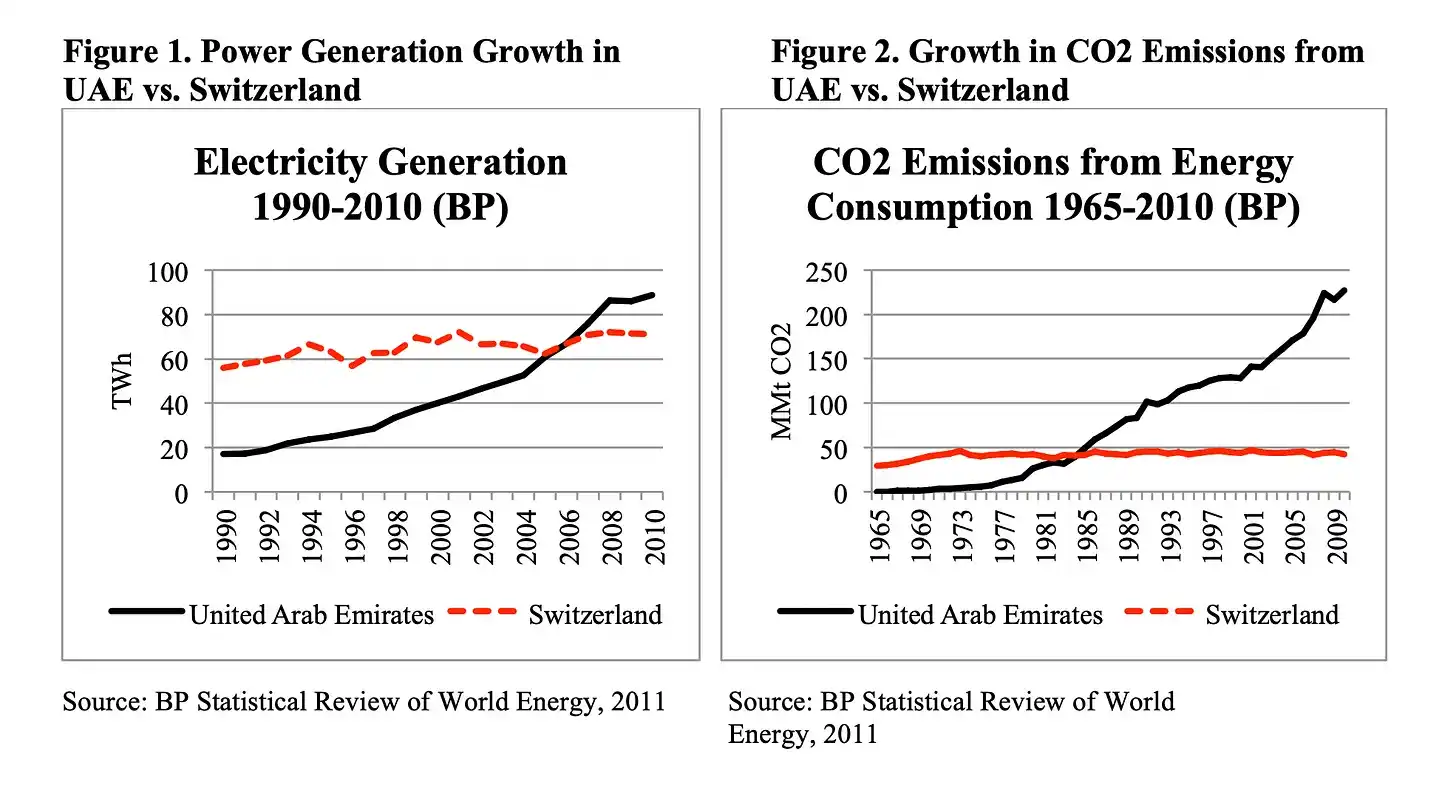
Today, that same cheap power that once supported heavy industry has found a new user: the data center. Saudi Arabia has established a sovereign AI investment agency, HUMAIN, investing tens of billions in tech infrastructure. The UAE is building a 5-gigawatt AI park, attracting companies like OpenAI, Oracle, and Nvidia. The grid that once powered aluminum smelters now powers AI compute. The planned NEOM Oxagon, originally conceived as a floating industrial city, has been repurposed into a $5 billion AI data center cluster powered by wind and solar.

The Carnegie Endowment for International Peace noted: Cloud computing has become the Gulf's "new aluminum." Instead of exporting physical commodities, the region is now converting fossil fuels and solar energy into compute power and exporting it via the internet.

It's not just the Middle East. Bhutan's case is equally telling.

Bhutan once possessed some of the world's cheapest hydropower. Its state-backed Bitcoin mining project was once hailed as a model of sovereign mining, holding a peak of 13,000 BTC. That has now dwindled to 3,100 BTC, and mining operations ceased over a year ago. The country's hydropower is now sold directly to the Indian grid.

The calculus mirrors that of the old American aluminum plant: Is Bitcoin mining still the best use of our electricity? When the answer was yes, Bhutan mined. When selling power to India offered a more stable return without the volatility risk of cryptocurrency, the power flowed to its neighbor.

Similarly, Starcloud raised $200 million to plan an orbital solar-powered data center. They recently trained the first AI model in space using H100 GPUs and are seeking approval to launch 88,000 satellites. While the project retains a Bitcoin mining operation, it is only a secondary component: the in-orbit solar panels generate continuous power, and when the AI compute queue is idle, the surplus electricity is used for crypto mining.

Low Earth orbit offers unique advantages for power generation: constant sunlight, no land use, and the cold of space negates the need for extensive cooling equipment. Over the past two decades, launch costs have fallen by 95%.

SpaceX is also deeply involved in the power-and-compute calculus. According to its latest IPO filing, the company's Colossus 1 data center in Memphis, Tennessee, has its entire compute capacity exclusively leased by Anthropic under a contract running until May 2029, valued at over $40 billion. This single deal alone brings SpaceX $1.25 billion in monthly revenue. This data center was also converted from an old appliance factory, mirroring the transformation model seen in Rockdale's aluminum plant.

Amidst all this industrial churn, perhaps the most unexpected pivot is that of Allbirds. The sustainable shoe brand, once valued at $4 billion, saw its stock price plummet 98% as the consumer brand bubble burst. With its core business struggling, the company, armed with cash and a public listing, decisively pivoted entirely to operating AI compute infrastructure. Its stock price subsequently surged 350%. The market voted: operating servers and trading in power/compute is far more profitable today than the traditional consumer sector.

Meanwhile, crypto projects like Bittensor, Render, and Akash are charting a different path: not building large, centralized facilities, but aggregating the world's distributed, idle compute.

Bittensor has built a compute marketplace where, underpinned by a fixed-supply token system, various AI models compete to provide answers; the project also halved its daily token issuance in December 2025. Render incentivizes users to share idle GPU resources for AI tasks. Akash rents out cloud compute, claiming prices up to 85% lower than Amazon Web Services.

This distributed compute model is gaining attention. At Nvidia's GTC conference in 2026, CEO Jensen Huang compared Bittensor to the classic internet project Folding@home. The latter was born from the idea of leveraging idle home computers worldwide, making dormant devices productive; Bittensor uses crypto tokens as an incentive to aggregate the compute of idle gaming PCs and old mining rigs.

Looking at the big picture, from the roar of industrial fans in Rockdale to sun-chasing satellites in orbit, a massive reconfiguration around physical assets is underway. For the companies involved, the only rule is to chase profit margins. I predict that a decade from now, these compute facilities may once again be emptied and repurposed for the next generation of emerging industries. The underground electrical transmission lines, however, will remain unchanged from beginning to end.

Whoever controls the cheapest electricity decides what the compute is used for. This logic has already played out in Texas, Bhutan, and Abu Dhabi. And 250 miles above the Earth's surface, it will hold true as well.

İlgili Sorular

QWhat is the core reason behind the industrial transformation from aluminum smelting to Bitcoin mining and then to AI data centers at sites like the one in Rockdale, Texas?

AThe core reason is the pursuit of maximizing revenue per kilowatt-hour of electricity consumed. The decision is driven by comparing the gross revenue each activity generates from the same unit of power: aluminum smelting ($0.17–0.27/kWh), Bitcoin mining ($0.05–0.11/kWh), and AI inference tasks using H100 GPUs ($1.27–3.67/kWh). As profitability shifts, businesses repurpose infrastructure to host the most lucrative power-consuming operation.

QHow are Bitcoin miners being outcompeted in the race for cheap electricity resources according to the article?

ABitcoin miners are being outcompeted by well-funded AI companies and tech giants like Microsoft, Google, and Amazon. These AI-focused firms have stronger capital and are aggressively securing the same industrial-scale, low-cost power resources and data center sites that miners previously relied on. This competition has contributed to a decline in Bitcoin's global hash rate as miners struggle with profitability against higher electricity bidders.

QWhat is the 'digital resource curse' mentioned in the article, and how is it exemplified by Gulf states?

AThe 'digital resource curse' refers to the phenomenon where countries or companies find that simply controlling cheap electricity resources yields higher returns than developing new technologies. Gulf states like Kuwait and Abu Dhabi exemplify this by using long-standing, heavily subsidized low electricity prices—initially to attract energy-intensive industries like aluminum and chemicals—to now pivot and attract massive AI data center investments, effectively exporting compute power instead of physical commodities.

QWhat alternative, decentralized model for providing AI compute is highlighted in the article, and which projects represent it?

AThe article highlights a decentralized model that aggregates globally distributed, idle computing power instead of building large centralized data centers. This model is represented by crypto projects like Bittensor (which creates a marketplace for AI models to compete), Render (which shares idle GPU resources for AI tasks), and Akash (which offers decentralized cloud computing at lower costs). Nvidia's CEO compared Bittensor to the classic distributed computing project Folding@home.

QWhat broader principle does the article conclude governs the evolution of power-intensive industries from aluminum to AI?

AThe article concludes that the fundamental principle is that whoever controls the cheapest electricity determines the use of compute power. Industries—whether aluminum smelting, Bitcoin mining, or AI training—will continuously migrate to and repurpose infrastructure based on where they can achieve the highest profit per unit of electricity. The physical power grid remains constant, while the operations it supports evolve to follow the highest monetary return.

İlgili Okumalar

Just Now, Chinese AI Enters Top 2 in Global Programming, Only Claude Remains Ahead

**China's AI Ranks Second Globally in Programming, Trailing Only Claude** Today, Alibaba's Qwen3.7-Max achieved a score of 1541 on the Code Arena benchmark, securing fourth place globally and surpassing top models like GPT-5.5 and Gemini 3.5 Flash. Among the top positions, it is now the only non-Claude model, placing second overall after Anthropic's Opus models. Before this official ranking, Qwen3.7-Max had already gained recognition overseas. In practical tests, it outperformed rivals on tasks like creating a self-training Tetris AI and generating complex 3D models, often at a significantly lower cost. Developers praised its ability, especially when integrated with tools like Hermes Agent and OpenCode, to effectively replace models such as GPT-5.5. In a hands-on challenge to create a 3D racing game from a detailed prompt, Qwen3.7-Max delivered a fully playable HTML file in the first attempt, requiring only minor bug fixes. It uniquely included a start menu and sound effects—details missed by other models. While competitors like Gemini 3.5 Flash and Claude Opus 4.6 produced less polished or functional versions, and GPT-5.5 had its own quirks, Qwen3.7-Max stood out for its initial completeness and playability. This performance stems from its design as an "Agent Base Model," built for long-duration, autonomous task execution. Internal tests show it can run continuously for 35 hours, making over 1158 tool calls without context degradation or instruction drift. Key technical advancements include "environment expansion" training, which improves adaptability across different frameworks, and "long-horizon autonomous execution" training, enabling sustained strategic decision-making. By entering the top tier of the programming arena, Qwen3.7-Max demonstrates that Chinese AI models are not just catching up but are becoming defining competitors, challenging the long-standing dominance of Silicon Valley in this field.

marsbit20 dk önce

Just Now, Chinese AI Enters Top 2 in Global Programming, Only Claude Remains Ahead

marsbit20 dk önce

From a Lunch Table to an Infinite Universe: Fei-Fei Li Bets on AI's Next Dimension

From a Lunch Table Conversation to an Infinite Universe: Fei-Fei Li Bets on AI's Next Frontier - Spatial Intelligence In an era dominated by large language models, AI pioneer Fei-Fei Li argues that true understanding requires spatial intelligence — the ability to perceive, reason, and interact within the physical 3D/4D world. She points to evolutionary history: spatial perception drove the Cambrian explosion 540 million years ago, while language is a far more recent, inherently "lossy" way to encode reality. Current models struggle with basic spatial tasks a child can do, like counting chairs in a video. Her company, World Labs, is pioneering this shift with "Marble," a model that generates navigable, consistent 3D worlds from text, images, or simple 3D inputs—distinct from video generators like Sora. Though smaller than models like GPT-5, due to scarce 3D data and early-stage scaling laws, Marble is already used in gaming, robot training (by NVIDIA), architectural design, and personalized therapy for conditions like OCD and acrophobia. Li envisions this technology enabling "infinite universes" for creativity, social interaction, and more. However, she cautions against utopian or dystopian extremes, advocating for a measured vision where AI enhances human dignity and prosperity, akin to how electricity transformed civilization. The journey is long — as evidenced by the 20-year path to viable autonomous vehicles — but the direction is clear: for AI to move from merely talking about the world to truly understanding and acting within it.

marsbit23 dk önce

From a Lunch Table to an Infinite Universe: Fei-Fei Li Bets on AI's Next Dimension

marsbit23 dk önce

X Stock Market Investment & Trading: A 'Noise-Free' List of 50 Key Accounts

Titled "A 'Noise-Reduction' List of 50 Top US Stock Market Influencers on X," this article curates a selection of accounts for investors seeking quality information beyond follower counts. The list prioritizes accounts that have consistently discussed US stocks, ETFs, earnings, macroeconomics, options, and tech/AI/semiconductor topics over the past 90 days. Selection criteria focused on genuine informational value, stable analytical frameworks over mere news aggregation, and a clear relevance to US equity markets, with tighter filtering for crypto-heavy accounts. The final 50 accounts are categorized into three groups: - **Core US Stocks/Trading (31 accounts)**: Covering market trends, individual stocks, earnings, valuation, options, macroeconomics, and trading strategies. - **Tech/AI/Semiconductors (18 accounts)**: Focused on tech stocks, AI supply chains, semiconductor cycles, data centers, and cloud capital expenditure. - **News Source (1 account)**: Useful as a news radar, not for standalone decision-making. Presented alphabetically by handle, the list includes analysts, traders, and researchers such as @amy6tina (options/CFA), @dylan522p (semiconductors/AI infrastructure), @gerberkawasaki (tech stocks), @jimcramer (market commentary), and @tengyanai (semiconductors/AI trends). The article suggests using the list to: 1) complete one's information sources on US markets and specific sectors, 2) observe narrative linkages between AI, semiconductors, earnings, macro liquidity, and stock prices, and 3) "de-noise" and enhance the quality of one's X feed. It clarifies this is not investment advice or an endorsement, but a snapshot of content relevance and informational value for US equity investors.

marsbit29 dk önce

X Stock Market Investment & Trading: A 'Noise-Free' List of 50 Key Accounts

marsbit29 dk önce

İşlemler

Spot
Futures

Popüler Makaleler

BITCOIN Nedir

HarryPotterObamaSonic10Inu (ERC-20)'yu ve Kripto Alanındaki Yerini Anlamak Son yıllarda, kripto para piyasası, hem ticaret yapanların hem de topluluk etkileşimi ve eğlence değeri arayanların ilgisini çeken meme coin'lerin popülaritesinde bir artış gördü. Bu benzersiz token'lar arasında, kripto para dokusuna kültürel referansları harmanlayan ilginç bir proje olan HarryPotterObamaSonic10Inu (ERC-20) bulunmaktadır. Bu makale, HarryPotterObamaSonic10Inu'nun temel yönlerini, mekanizmalarını, topluluk odaklı ethosunu ve daha geniş kripto manzarasıyla etkileşimini incelemektedir. HarryPotterObamaSonic10Inu (ERC-20) Nedir? Adından da anlaşılacağı gibi, HarryPotterObamaSonic10Inu, Ethereum blok zinciri üzerinde inşa edilen bir meme coin'dir ve ERC-20 standardı altında sınıflandırılmaktadır. Geleneksel kripto paraların pratik kullanılabilirlik veya yatırım potansiyeline odaklandığı durumların aksine, bu token eğlence değeri ve topluluğunun gücü üzerine kuruludur. Proje, bağlı kullanıcıların bir araya gelebileceği, fikirlerini paylaşabileceği ve çeşitli kültürel fenomenlerden ilham alan etkinliklere katılabileceği bir ortam yaratmayı hedeflemektedir. HarryPotterObamaSonic10Inu'nun dikkate değer özelliklerinden biri işlemlerde sıfır vergi olmasıdır. Bu çekici unsur, küçük ölçekli yatırımcıları caydırabilecek ek ücretlerden yoksun olarak ticareti ve topluluk katılımını teşvik etmeyi amaçlamaktadır. Coin'in toplam arzı bir milyar token olarak belirlenmiştir; bu, topluluk içinde önemli bir dolaşım sağlama niyetini göstermektedir. HarryPotterObamaSonic10Inu (ERC-20) Yaratıcısı HarryPotterObamaSonic10Inu'nun kökenleri bir miktar gizemlidir; yaratıcısı hakkında spesifik bilgilerin ne olduğu bilinmemektedir. Bu token'ın geliştirilmesi, belirli bir ekip veya açık bir plan eksikliği ile gerçekleşmiştir; bu durum, meme coin sektöründe oldukça yaygındır. Proje, topluluğunun heyecanı ve katılımına dayalı olarak organik bir şekilde ortaya çıkmıştır. HarryPotterObamaSonic10Inu (ERC-20) Yatırımcıları Dış yatırımlar ve destekler söz konusu olduğunda, HarryPotterObamaSonic10Inu da belirsiz kalmaktadır. Token, bilinen herhangi bir yatırım fonunu veya önemli bir kurumsal desteği listelememektedir. Bunun yerine, projenin can damarı, kolektif eylem ve kripto alanındaki katılım yoluyla büyüme ve sürdürülebilirlik sağlayan temel topluluğudur. HarryPotterObamaSonic10Inu (ERC-20) Nasıl Çalışır? Bir meme coin olarak, HarryPotterObamaSonic10Inu, genellikle varlık değerini yöneten geleneksel çerçevelerin dışında çalışmaktadır. Projenin nasıl çalıştığını tanımlayan birkaç özelliği vardır: Sıfır Vergi İşlemleri: İşlemlerde vergi ücreti olmadan, kullanıcılar gizli maliyet endişesi olmadan token'ı serbestçe alıp satabilirler. Topluluk Etkileşimi: Proje, topluluk etkileşimi üzerine kuruludur ve sosyal medya platformlarını kullanarak heyecan yaratarak katılımı kolaylaştırır. Tartışmalar, içerik paylaşımı ve katılım, projenin erişimini genişletmeye ve destekleyiciler arasında sadakat oluşturmaya yardımcı olan kritik unsurlardır. Pratik Kullanılabilirlik Yok: HarryPotterObamaSonic10Inu'nun mali ekosistem içinde somut bir kullanılabilirlik sunmadığı belirtilmelidir. Daha ziyade, eğlence ve topluluk etkinlikleri için bir token olarak sınıflandırılmaktadır. Kültürel Referans: Token, popüler kültürden unsurları zekice harmanlayarak ilgi çekmektedir ve hem meme meraklıları hem de kripto takipçileriyle bağlantı kurmaktadır. HarryPotterObamaSonic10Inu, meme coin'lerin, daha geleneksel kripto para projelerinden nasıl farklı çalıştığını örneklendirmektedir; bu projeler, utilitarist varlıklar yerine yenilikçi sosyal yapıların bir parçası olarak piyasaya girmektedir. HarryPotterObamaSonic10Inu (ERC-20) Zaman Çizelgesi HarryPotterObamaSonic10Inu'nun tarihi, birkaç dikkate değer kilometre taşı ile işaretlenmiştir: Oluşum: Token, birçok kripto meraklısının hayal gücünü yakalayan bir viral meme'den ortaya çıkmıştır. Spesifik yaratım tarihleri mevcut değildir ve bu onun organik yükselişini vurgulamaktadır. Borsa Listelemeleri: HarryPotterObamaSonic10Inu, topluluğun daha kolay erişim ve ticaret yapabilmesini sağlamak için çeşitli borsalarda yer bulmuştur. Topluluk Katılım İnisiyatifleri: Yarışmalar, sosyal medya kampanyaları ve hayranlar ile destekçilerden içerik üretimini içeren topluluk etkileşimini artırmayı amaçlayan devam eden etkinlikler. Gelecek Genişleme Planları: Projenin yol haritası, kültürel temalarına ilişkin bir NFT koleksiyonu, ticari ürünler ve bir e-ticaret sitesi başlatılmasını içermektedir; bu da topluluğun daha fazla katılımını sağlamayı ve ekosistemine daha fazla boyut kazandırmayı hedeflemektedir. HarryPotterObamaSonic10Inu (ERC-20) Hakkında Kilit Noktalar Topluluk Odaklı Doğası: Proje, kullanıcı katılımını geliştirme önceliği taşır ve böylece kullanıcıların sürecin en önünde yer almasını sağlar. Meme Coin Sınıflandırması: Eğlenceye dayalı kripto paranın doruk noktasıdır ve geleneksel yatırım araçlarından ayrılmaktadır. Bitcoin ile Doğrudan İlişki Yok: Ticker ismindeki benzeliğe rağmen, HarryPotterObamaSonic10Inu ayırt edicidir ve Bitcoin veya diğer yerleşik kripto paralarla herhangi bir ilişkisi yoktur. İşbirliğine Odaklanma: HarryPotterObamaSonic10Inu, sahipleri arasında işbirliği ve hikaye paylaşımı için bir alan oluşturmak üzere tasarlanmıştır ve bu da yaratıcılık ve topluluk bağlarını sağlamaktadır. Gelecek Beklentileri: Başlangıçta belirlendiği temalardan NFTs ve ticari ürünlere genişleme arzusu, projenin dijital kültürde daha ana akıma girebilmesi için bir yol haritası çizmektedir. Meme coin'ler, kripto para topluluğunun hayal gücünü çalmaya devam ederken, HarryPotterObamaSonic10Inu (ERC-20), kültürel bağları ve topluluk merkezli yaklaşımıyla öne çıkmaktadır. Geleneksel bir hizmet odaklı token modeliyle uyumlu olmasa da, özünde destekçileri arasında sağlanan neşe ve dostluğu vurgulayarak, giderek dijitalleşen bir çağda kripto paraların evrilen doğasını göstermektedir. Proje gelişmeye devam ettikçe, topluluk dinamiklerinin blockchain teknolojisi dünyasındaki seyrini nasıl etkilediğini izlemek önemli olacaktır.

1.7k Toplam GörüntülenmeYayınlanma 2024.04.01Güncellenme 2024.12.03

BITCOIN Nedir

BTC Nasıl Satın Alınır

HTX.com’a hoş geldiniz! Bitcoin (BTC) satın alma işlemlerini basit ve kullanışlı bir hâle getirdik. Adım adım açıkladığımız rehberimizi takip ederek kripto yolculuğunuza başlayın. 1. Adım: HTX Hesabınızı OluşturunHTX'te ücretsiz bir hesap açmak için e-posta adresinizi veya telefon numaranızı kullanın. Sorunsuzca kaydolun ve tüm özelliklerin kilidini açın. Hesabımı Aç2. Adım: Kripto Satın Al Bölümüne Gidin ve Ödeme Yönteminizi SeçinKredi/Banka Kartı: Visa veya Mastercard'ınızı kullanarak anında Bitcoin (BTC) satın alın.Bakiye: Sorunsuz bir şekilde işlem yapmak için HTX hesap bakiyenizdeki fonları kullanın.Üçüncü Taraflar: Kullanımı kolaylaştırmak için Google Pay ve Apple Pay gibi popüler ödeme yöntemlerini ekledik.P2P: HTX'teki diğer kullanıcılarla doğrudan işlem yapın.Borsa Dışı (OTC): Yatırımcılar için kişiye özel hizmetler ve rekabetçi döviz kurları sunuyoruz.3. Adım: Bitcoin (BTC) Varlıklarınızı SaklayınBitcoin (BTC) satın aldıktan sonra HTX hesabınızda saklayın. Alternatif olarak, blok zinciri transferi yoluyla başka bir yere gönderebilir veya diğer kripto para birimlerini takas etmek için kullanabilirsiniz.4. Adım: Bitcoin (BTC) Varlıklarınızla İşlem YapınHTX'in spot piyasasında Bitcoin (BTC) ile kolayca işlemler yapın.Hesabınıza erişin, işlem çiftinizi seçin, işlemlerinizi gerçekleştirin ve gerçek zamanlı olarak izleyin. Hem yeni başlayanlar hem de deneyimli yatırımcılar için kullanıcı dostu bir deneyim sunuyoruz.

7.6k Toplam GörüntülenmeYayınlanma 2024.12.12Güncellenme 2025.03.21

BTC Nasıl Satın Alınır

$BITCOIN Nedir

DİJİTAL ALTIN ($BITCOIN): Kapsamlı Bir Analiz DİJİTAL ALTIN ($BITCOIN) Tanıtımı DİJİTAL ALTIN ($BITCOIN), geleneksel değerli metallerin özelliklerini merkeziyetsiz teknolojilerin yeniliği ile birleştirmeyi amaçlayan Solana ağı üzerinde çalışan blockchain tabanlı bir projedir. Bitcoin ile aynı isme sahip olmasına rağmen, genellikle bir değer saklama aracı olarak algılandığı için “dijital altın” olarak anılmaktadır; DİJİTAL ALTIN, Web3 ortamında benzersiz bir ekosistem yaratmak için tasarlanmış ayrı bir tokendir. Hedefi, uygulanabilir bir alternatif dijital varlık olarak kendini konumlandırmaktır, ancak uygulamaları ve işlevleri ile ilgili ayrıntılar hala gelişmektedir. DİJİTAL ALTIN ($BITCOIN) Nedir? DİJİTAL ALTIN ($BITCOIN), Solana blockchain'inde kullanılmak üzere açıkça tasarlanmış bir kripto para tokenidir. Bitcoin'in yaygın olarak tanınan bir değer saklama rolü sağlamasının aksine, bu token daha geniş uygulamalara ve özelliklere odaklanıyor gibi görünmektedir. Dikkate değer yönler şunlardır: Blockchain Altyapısı: Token, yüksek hızlı ve düşük maliyetli işlemleri yönetme kapasitesi ile bilinen Solana blockchain'inde inşa edilmiştir. Arz Dinamikleri: DİJİTAL ALTIN'ın maksimum arzı 100 katrilyon token (100P $BITCOIN) ile sınırlıdır, ancak dolaşımdaki arzı ile ilgili ayrıntılar şu anda açıklanmamıştır. Kullanım Alanı: Kesin işlevler açıkça belirtilmemiş olsa da, token'ın merkeziyetsiz uygulamalar (dApps) veya varlık tokenizasyon stratejileri ile ilgili çeşitli uygulamalar için kullanılabileceğine dair işaretler bulunmaktadır. DİJİTAL ALTIN ($BITCOIN) Yaratıcısı Kimdir? Şu anda, DİJİTAL ALTIN ($BITCOIN) arkasındaki yaratıcıların ve geliştirme ekibinin kimliği bilinmemektedir. Bu durum, merkeziyetsiz finans ve meme coin fenomenleriyle uyumlu olan birçok yenilikçi proje arasında yaygındır. Böyle bir anonimlik, topluluk odaklı bir kültürü teşvik edebilirken, yönetişim ve hesap verebilirlik konusundaki endişeleri artırmaktadır. DİJİTAL ALTIN ($BITCOIN) Yatırımcıları Kimlerdir? Mevcut bilgiler, DİJİTAL ALTIN ($BITCOIN) için bilinen herhangi bir kurumsal destekçi veya önde gelen risk sermayesi yatırımı olmadığını göstermektedir. Proje, geleneksel finansman yolları yerine topluluk desteği ve benimsemeye odaklanan bir eşler arası modelde çalışıyor gibi görünmektedir. Faaliyetleri ve likiditesi esas olarak PumpSwap gibi merkeziyetsiz borsalarda (DEX'ler) yer almakta olup, bu da onun taban hareketine vurgu yapmaktadır. DİJİTAL ALTIN ($BITCOIN) Nasıl Çalışır DİJİTAL ALTIN ($BITCOIN) 'ın operasyonel mekanikleri, blockchain tasarımı ve ağ özellikleri temelinde açıklanabilir: Konsensüs Mekanizması: Solana'nın benzersiz tarih kanıtı (PoH) ile bir hisse kanıtı (PoS) modelini birleştirerek, proje ağın yüksek performansına katkıda bulunan verimli işlem doğrulamasını sağlar. Tokenomik: Belirli deflasyonist mekanizmalar kapsamlı bir şekilde detaylandırılmamış olsa da, geniş maksimum token arzı, henüz tanımlanmamış mikro işlemler veya niş kullanım durumlarına hitap edebileceğini ima etmektedir. Etkileşim: Solana'nın daha geniş ekosistemi ile entegrasyon potansiyeli bulunmaktadır; bu, çeşitli merkeziyetsiz finans (DeFi) platformlarını içermektedir. Ancak, belirli entegrasyonlarla ilgili ayrıntılar belirtilmemiştir. Önemli Olayların Zaman Çizelgesi DİJİTAL ALTIN ($BITCOIN) ile ilgili önemli kilometre taşlarını vurgulayan bir zaman çizelgesi: 2023: Token'ın Solana blockchain'inde ilk dağıtımı, sözleşme adresi ile işaretlenmiştir. 2024: DİJİTAL ALTIN, PumpSwap gibi merkeziyetsiz borsalarda işlem görmeye başladıkça görünürlük kazanır ve kullanıcıların bunu SOL karşısında ticaret yapmasına olanak tanır. 2025: Proje, topluluk odaklı etkileşimlere yönelik potansiyel ilgi ve ara sıra ticaret faaliyetleri görür, ancak şu ana kadar dikkate değer ortaklıklar veya teknik ilerlemeler belgelenmemiştir. Kritik Analiz Güçlü Yönler Ölçeklenebilirlik: Temel Solana altyapısı, yüksek işlem hacimlerini destekleyerek $BITCOIN'in çeşitli işlem senaryolarındaki faydasını artırabilir. Erişilebilirlik: Token başına potansiyel düşük ticaret fiyatı, perakende yatırımcıları çekebilir ve parçalı mülkiyet fırsatları sayesinde daha geniş katılımı kolaylaştırabilir. Riskler Şeffaflık Eksikliği: Kamuya açık olarak bilinen destekçilerin, geliştiricilerin veya bir denetim sürecinin olmaması, projenin sürdürülebilirliği ve güvenilirliği konusunda şüpheler doğurabilir. Piyasa Volatilitesi: Ticaret faaliyeti büyük ölçüde spekülatif davranışa dayanmakta olup, bu da yatırımcılar için önemli fiyat dalgalanmalarına ve belirsizliklere yol açabilir. Sonuç DİJİTAL ALTIN ($BITCOIN), hızla gelişen Solana ekosisteminde ilginç ama belirsiz bir proje olarak ortaya çıkmaktadır. “Dijital altın” anlatısını kullanmaya çalışırken, Bitcoin'in değer saklama rolünden ayrılması, amaçlanan faydasının ve yönetişim yapısının daha net bir şekilde tanımlanması gerekliliğini vurgulamaktadır. Gelecekteki kabul ve benimseme, mevcut belirsizliklerin giderilmesine ve operasyonel ile ekonomik stratejilerinin daha açık bir şekilde tanımlanmasına bağlı olacaktır. Not: Bu rapor, Ekim 2023 itibarıyla mevcut olan sentezlenmiş bilgileri kapsamaktadır ve araştırma döneminin ötesinde gelişmeler yaşanmış olabilir.

92 Toplam GörüntülenmeYayınlanma 2025.05.13Güncellenme 2025.05.13

$BITCOIN Nedir

Tartışmalar

HTX Topluluğuna hoş geldiniz. Burada, en son platform gelişmeleri hakkında bilgi sahibi olabilir ve profesyonel piyasa görüşlerine erişebilirsiniz. Kullanıcıların BTC (BTC) fiyatı hakkındaki görüşleri aşağıda sunulmaktadır.

活动图片