A Decade-Old Coin: Zcash Also Faces a Midlife Crisis

marsbit2026-01-09 tarihinde yayınlandı2026-01-09 tarihinde güncellendi

Özet

Zcash, a nearly decade-old privacy-focused cryptocurrency, faced a major crisis when its entire core development team, the Electric Coin Company (ECC), collectively resigned on January 7. The team, led by CEO Josh Swihart, left due to a governance dispute with the board of the non-profit Bootstrap organization, which oversees ECC. The conflict centered around Zashi, a privacy-first mobile wallet developed by ECC. The team wanted to privatize Zashi to attract external investment and operate as a nimble startup, but the board opposed, citing legal and compliance risks associated with converting a non-profit asset into a for-profit entity. This disagreement escalated into public accusations, with Swihart calling the board’s actions “malicious governance” and accusing them of making working conditions untenable. The board members, referred to as “ZCAM” (Zaki Manian, Christina, Alan, Michelle), were criticized—particularly Zaki, who had prior controversies in the crypto space. Following the resignation, the former ECC team announced a new venture, CashZ, and plans to launch a new wallet based on Zashi’s codebase, allowing seamless migration for existing users. The incident highlights recurring tensions in crypto between non-profit foundations and entrepreneurial development teams, especially as projects mature and face valuation pressures. Zcash’s token ZEC had surged nearly 800% in late 2025, making governance and control over key assets like Zashi increasingly contentious.

Written by: Kuli, Shenchao TechFow

On January 7th, the core development team of Zcash collectively resigned.

Not just one or two people throwing a tantrum, but the entire Electric Coin Company, about 25 people, led by the CEO, all left.

This company has an abbreviation, ECC, and is the main developer behind Zcash. You can understand it as: the people who write the code, quit.

Upon the news, ZEC plummeted by 20%.

A hot piece of knowledge: Zcash is almost ten years old.

Launched on October 28, 2016, it's older than many people's time in the crypto space. Its selling point back then was "private transactions"—sender, receiver, amount, all encrypted, nothing visible on the chain.

But the reality is, after nine years online, less than 1% of ZEC transactions actually used this feature.

The remaining 99% are still running naked.

Nine years. The product isn't used, but the team kept grinding. The price dropped from over $3,000 when it first launched in 2016 to $15 in July 2024.

Then, by the end of 2025, ZEC suddenly surged.

It was hovering around $40 at the start of the year, and by November 7th, it soared to $744, market cap breaking $10 billion, clawing its way back into the top twenty.

The long-dormant narrative of privacy coins suddenly became sexy again.

Okay, the price skyrocketed nearly 800%, and then, "the development team ran away."

This story sounds like a middle-aged man's script. Bought a Porsche, then got divorced. Year-end bonus came in, then it's splitsville.

When there's little money, everyone is comrades; when money increases, they start fighting over who calls the shots.

What are they fighting over? A wallet called Zashi.

Zashi is a mobile wallet released by ECC in early 2024, promoting "privacy features enabled by default." It's the most important user entry point in the Zcash ecosystem.
The ECC team wanted to privatize Zashi, bring in external investment, and turn it into a startup capable of raising funds and iterating quickly.

But ECC is not an independent company. In 2020, ECC was placed into a non-profit organization called Bootstrap, structured as a US 501(c)(3).

Simply put, this structure is specifically for charities and public welfare organizations. The benefit is no taxes, the downside is that money made cannot be distributed to insiders, and how assets are handled must be approved by the board of directors.

Back then, this was done for compliance, to avoid regulatory pressure from the SEC. In a bear market, no one cared about these details, as there was no money to share anyway.

Now, the Bootstrap board says, no.

The board's reasons are:

We are a non-profit organization with a fiduciary duty to protect donor interests. Privatizing Zashi could be illegal, could lead to lawsuits, could be politically attacked. They even gave an example: Look at OpenAI, trying to transition from non-profit to for-profit, how many people sued.

ECC's former CEO, Josh Swihart, sees it differently. He said on Twitter that the board's actions constitute "malicious governance behavior," making it "impossible for the team to perform their duties effectively and with dignity."

He used a legal term: "constructive discharge," meaning although not formally fired, the working conditions were altered to make the job untenable, equivalent to being forced out.

25 people forced out together.

Simultaneously, Swihart named four board members: Zaki, Christina, Alan, Michelle. He connected their initials, calling them "ZCAM."
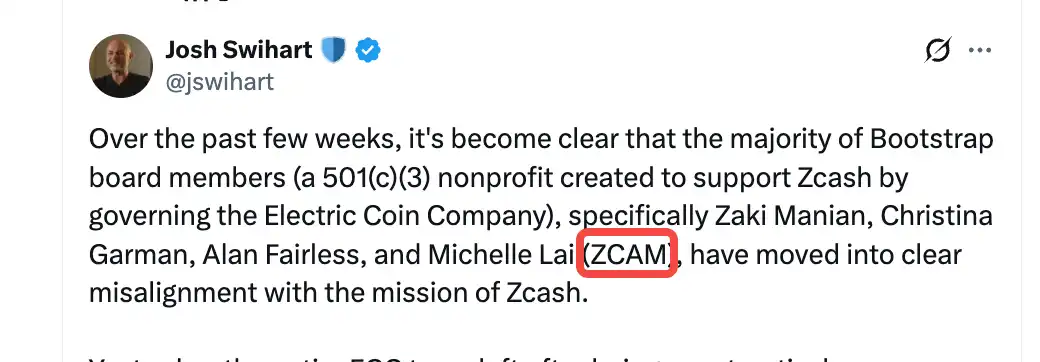
ZCAM. Sounds like SCAM. Not sure if it's intentional.

Among these four, Zaki Manian has the most stories.

He's an old-timer in the Cosmos ecosystem, was a core member of Tendermint. Resigned in 2020 after a public feud with founder Jae Kwon.

In 2023, the FBI informed him that two developers on a project he was responsible for were North Korean agents. After finding out, he concealed this for 16 months before making it public. In October 2024, Jae Kwon publicly accused him of "gross negligence" and "betraying the community's trust."

Now, he is a member of the Zcash board of directors.

The day after resigning, the former ECC team announced the formation of a new company, codenamed CashZ.

They said they would use the Zashi codebase to create a new wallet, to be launched within weeks. Existing Zashi users can migrate seamlessly.
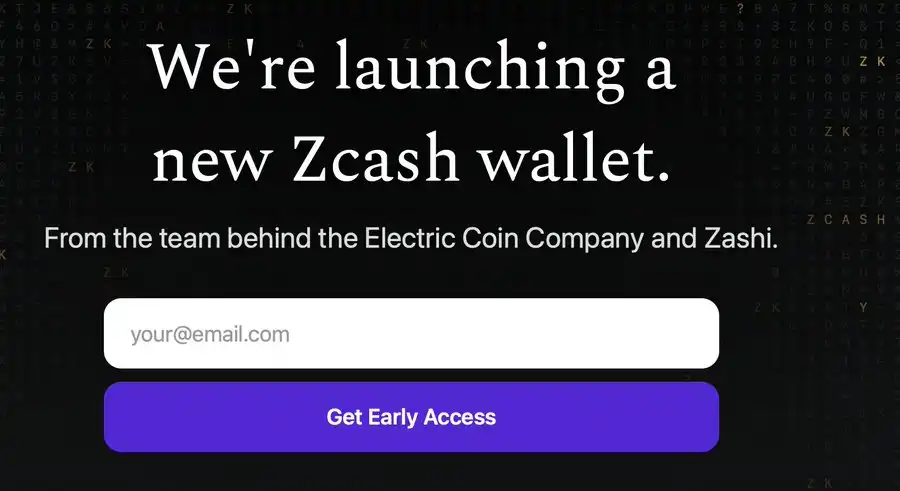
"We are the same team, with the same mission: to build unstoppable private money."

No new token, no starting from scratch, just changing the shell to keep working.

The most ironic part of this, we think, is the timing.

When ZEC was $15, no one cared who managed the wallet. When it hit $500, how much Zashi was worth became a matter of life and death.

When money appears, you find out who's family.

Similarly, the conflict between a non-profit and a startup team: OpenAI ended with the board losing, Zcash ended with the team leaving.

Who won is unclear, but this conflict is indeed common in crypto projects.

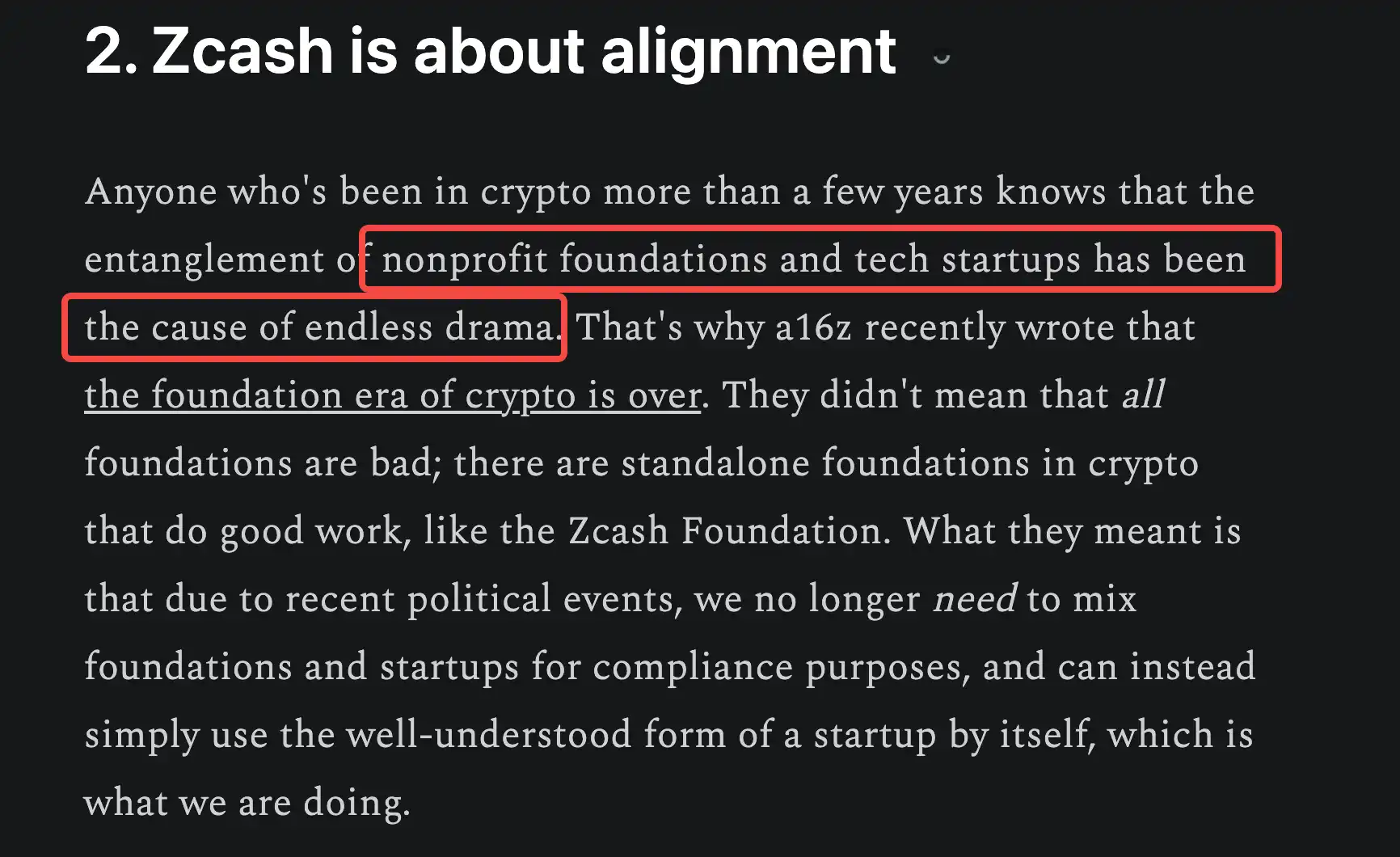
Swihart wrote a passage on the CashZ website explaining why they left:

"The non-profit foundation model is a relic of the compliance era in crypto. An era where projects needed 'compliance buffers' to protect themselves. But these buffers introduced bureaucracy and divergence in roadmap. Startups can scale fast, non-profits cannot."

He also said: "Anyone who's been in crypto for a few years knows that the entanglement of non-profit foundations and tech startups is a source of endless drama."

It truly is endless drama.
In 2023, when Zooko stepped down as CEO, there were rumors of disagreements with Swihart. In January 2025, Zcash Foundation board member Peter Van Valkenburgh also resigned.

A decade-old coin, those who were supposed to leave have pretty much all gone.

Someone asked on Twitter: Will Zcash die?

The chain is still running. The code is still there. It's just that the people writing the code have changed.

But Swihart is right, the conflict between non-profits and startups is a common disease in this industry. Cosmos argued. The Ethereum Foundation argued. The Solana Foundation argued.

The difference is only in the manner and intensity of the arguments.

Zcash chose the most straightforward way.

Break up.

Trend Kriptolar

İlgili Sorular

QWhat was the immediate market reaction to the resignation of the Zcash core development team?

AThe price of ZEC (Zcash) dropped by 20%.

QWhat was the primary reason for the conflict between the ECC team and the Bootstrap board of directors?

AThe conflict centered on the ECC team's proposal to privatize the Zashi wallet and bring in external investment, which the non-profit Bootstrap board opposed due to legal and fiduciary concerns.

QWhat is the name of the new company formed by the former ECC team, and what is its first project?

AThe new company is called CashZ, and its first project is to launch a new wallet based on the Zashi codebase, allowing for seamless migration for existing users.

QAccording to the article, what percentage of ZEC transactions actually used the coin's flagship privacy feature?

ALess than 1% of ZEC transactions used the privacy feature.

QWhich controversial figure on the Bootstrap board was previously involved in a scandal concerning North Korean developers?

AZaki Manian, a member of the Bootstrap board (part of the 'ZCAM' group), was previously involved in a scandal where he waited 16 months to disclose that two developers on a project he oversaw were North Korean agents.

İlgili Okumalar

As Consensus Accelerates, What Are Young Investors Betting On?

Title: As Consensus Forms Faster, What Are Young Investors Betting On? In the rapid evolution of tech investment, a new generation of young investors is navigating a landscape where AI, robotics, commercial aerospace, and quantum computing are advancing simultaneously. Traditional investment logic based on financial models is giving way to a need for deep technical understanding and the ability to act before industry consensus forms. An analysis of trends from the "WAIC FUTURE TECH" list of young investment leaders reveals key shifts in focus. The first major trend is the movement of AI from the digital screen into the physical world. Investment is shifting from large language models and chatbots towards embodied AI, robotics, AI hardware, and edge computing. While demonstrations generate excitement, the real challenge lies in achieving scalable, reliable, and cost-effective delivery in complex real-world environments like factories and logistics. Success depends not just on algorithms but on the integration of sensors, actuators, and control systems. Second, the competitive focus for large models is moving beyond raw capability toward building an "intelligence flywheel." The goal is to create self-reinforcing systems where user interaction generates data, improving the model, which in turn enhances the user experience and attracts more engagement. Companies that successfully embed AI into workflows to create these closed-loop systems can build lasting value that isn't easily erased by the next model upgrade. Third, facing a potential bottleneck in high-quality human-generated data, investors are looking at new underlying technologies. Reinforcement learning and self-play, as demonstrated by AlphaGo Zero, offer paths for AI to generate its own experience. Scientific foundation models, which aim to build general AI capabilities for fields like life sciences and materials discovery, represent a non-consensus direction that could unlock new frontiers of knowledge and data. Finally, in deep-tech areas like quantum computing, commercial aerospace, and space-based infrastructure, patient capital is essential. These fields have long, uncertain development and validation cycles involving complex engineering, supply chains, and regulations. Investment here requires a long-term view, focusing on foundational team capabilities and the eventual emergence of market demand, even if commercial returns are distant. Collectively, these trends illustrate how young investors are adapting to a new era. They are learning to make earlier, technically-informed judgments, balance hype with real-world viability, and provide the patient capital needed to build the deep-tech foundations of the future.

marsbit16 dk önce

As Consensus Accelerates, What Are Young Investors Betting On?

marsbit16 dk önce

Can Japan Buy Growth with AI? Will the Bond Market Believe It?

Japan's cabinet has introduced the 2026 Basic Policy on Economic and Fiscal Management and Reform, shifting its primary fiscal target. The new framework moves away from the traditional annual primary balance goal and instead prioritizes a stable reduction of the debt-to-GDP ratio. This change is tied to a strategy of increased "responsible proactive fiscal" spending, aiming to boost long-term growth through investments in strategic sectors like AI, semiconductors, energy, and robotics. The government estimates total public and private investment in 62 key technologies could exceed 370 trillion yen by 2040. The market reaction has been mixed and cautious. While equity markets may respond to policy signals, bond markets are focused on fiscal credibility. Concerns center on whether the weakening of the clear primary balance anchor could lead to looser fiscal discipline. If investors doubt that these strategic investments will generate sufficient productivity gains, tax revenue, and nominal growth to outpace rising interest costs, they may demand higher yields on Japanese Government Bonds (JGBs). Recent volatility in the yen and JGB yields, with the 10-year yield briefly reaching 2.9%, reflects this skepticism. The success of this new framework hinges on two factors: whether Japan can achieve a nominal growth rate consistently higher than its long-term interest rates, and whether future budgets demonstrate disciplined control over bond issuance. The government's narrative is that strategic investment is essential to break Japan's cycle of low growth, aging, and labor shortages. However, the bond market will continuously assess the credibility of this plan, pricing the risk that it may represent fiscal expansion rather than a viable growth strategy.

marsbit53 dk önce

Can Japan Buy Growth with AI? Will the Bond Market Believe It?

marsbit53 dk önce

Misjudged A-Shares: Resilience, Expectations, and Confidence

China's A-share market recently faced selling pressure, especially in tech sectors, initially triggered by a global tech sell-off that began in South Korea. However, the article argues this is a case of "mistaken injury" and highlights the market's underlying resilience. This resilience stems from three main pillars: **1) Tech Sector Fundamentals:** Unlike Korea's market dominated by a few memory chip stocks, China's tech sector is diversified across computing, communications, electronics, and semiconductors, supported by dual narratives of global AI supply chains and domestic substitution. Core areas like optical modules and fiber optics continue to show strong earnings growth. **2) "National Team" Support:** State-backed institutions and large corporations have made significant market purchases and announced buybacks, providing liquidity and signaling confidence. This is seen as a stabilizing policy signal, often associated with market bottoms. **3) Broader Market Pillars:** Other major sectors are showing endogenous recovery momentum. Consumer stocks benefit from stabilizing CPI and signs of sector recovery (e.g., liquor price hikes). Cyclical sectors like aluminum have high earnings, potential price increases due to tight supply, and low valuations. The financial sector offers stable dividends and low valuations. The conclusion is that the sell-off was driven by external contagion, not a collapse in fundamentals. With strong policy support and recovering momentum across key sectors, the A-share market possesses the toughness to regain stability.

marsbit1 saat önce

Misjudged A-Shares: Resilience, Expectations, and Confidence

marsbit1 saat önce

İşlemler

Spot

Popüler Makaleler

CORE Nasıl Satın Alınır

HTX.com’a hoş geldiniz! CORE (CORE) satın alma işlemlerini basit ve kullanışlı bir hâle getirdik. Adım adım açıkladığımız rehberimizi takip ederek kripto yolculuğunuza başlayın. 1. Adım: HTX Hesabınızı OluşturunHTX'te ücretsiz bir hesap açmak için e-posta adresinizi veya telefon numaranızı kullanın. Sorunsuzca kaydolun ve tüm özelliklerin kilidini açın. Hesabımı Aç2. Adım: Kripto Satın Al Bölümüne Gidin ve Ödeme Yönteminizi SeçinKredi/Banka Kartı: Visa veya Mastercard'ınızı kullanarak anında CORE (CORE) satın alın.Bakiye: Sorunsuz bir şekilde işlem yapmak için HTX hesap bakiyenizdeki fonları kullanın.Üçüncü Taraflar: Kullanımı kolaylaştırmak için Google Pay ve Apple Pay gibi popüler ödeme yöntemlerini ekledik.P2P: HTX'teki diğer kullanıcılarla doğrudan işlem yapın.Borsa Dışı (OTC): Yatırımcılar için kişiye özel hizmetler ve rekabetçi döviz kurları sunuyoruz.3. Adım: CORE (CORE) Varlıklarınızı SaklayınCORE (CORE) satın aldıktan sonra HTX hesabınızda saklayın. Alternatif olarak, blok zinciri transferi yoluyla başka bir yere gönderebilir veya diğer kripto para birimlerini takas etmek için kullanabilirsiniz.4. Adım: CORE (CORE) Varlıklarınızla İşlem YapınHTX'in spot piyasasında CORE (CORE) ile kolayca işlemler yapın.Hesabınıza erişin, işlem çiftinizi seçin, işlemlerinizi gerçekleştirin ve gerçek zamanlı olarak izleyin. Hem yeni başlayanlar hem de deneyimli yatırımcılar için kullanıcı dostu bir deneyim sunuyoruz.

371 Toplam GörüntülenmeYayınlanma 2024.12.13Güncellenme 2026.06.02

CORE Nasıl Satın Alınır

Tartışmalar

HTX Topluluğuna hoş geldiniz. Burada, en son platform gelişmeleri hakkında bilgi sahibi olabilir ve profesyonel piyasa görüşlerine erişebilirsiniz. Kullanıcıların CORE (CORE) fiyatı hakkındaki görüşleri aşağıda sunulmaktadır.

活动图片













