A Decade-Old Coin: Zcash Also Faces a Midlife Crisis

marsbit2026-01-09 tarihinde yayınlandı2026-01-09 tarihinde güncellendi

Özet

Zcash, a nearly decade-old privacy-focused cryptocurrency, faced a major crisis when its entire core development team, the Electric Coin Company (ECC), collectively resigned on January 7. The team, led by CEO Josh Swihart, left due to a governance dispute with the board of the non-profit Bootstrap organization, which oversees ECC. The conflict centered around Zashi, a privacy-first mobile wallet developed by ECC. The team wanted to privatize Zashi to attract external investment and operate as a nimble startup, but the board opposed, citing legal and compliance risks associated with converting a non-profit asset into a for-profit entity. This disagreement escalated into public accusations, with Swihart calling the board’s actions “malicious governance” and accusing them of making working conditions untenable. The board members, referred to as “ZCAM” (Zaki Manian, Christina, Alan, Michelle), were criticized—particularly Zaki, who had prior controversies in the crypto space. Following the resignation, the former ECC team announced a new venture, CashZ, and plans to launch a new wallet based on Zashi’s codebase, allowing seamless migration for existing users. The incident highlights recurring tensions in crypto between non-profit foundations and entrepreneurial development teams, especially as projects mature and face valuation pressures. Zcash’s token ZEC had surged nearly 800% in late 2025, making governance and control over key assets like Zashi increasingly contentious.

Written by: Kuli, Shenchao TechFow

On January 7th, the core development team of Zcash collectively resigned.

Not just one or two people throwing a tantrum, but the entire Electric Coin Company, about 25 people, led by the CEO, all left.

This company has an abbreviation, ECC, and is the main developer behind Zcash. You can understand it as: the people who write the code, quit.

Upon the news, ZEC plummeted by 20%.

A hot piece of knowledge: Zcash is almost ten years old.

Launched on October 28, 2016, it's older than many people's time in the crypto space. Its selling point back then was "private transactions"—sender, receiver, amount, all encrypted, nothing visible on the chain.

But the reality is, after nine years online, less than 1% of ZEC transactions actually used this feature.

The remaining 99% are still running naked.

Nine years. The product isn't used, but the team kept grinding. The price dropped from over $3,000 when it first launched in 2016 to $15 in July 2024.

Then, by the end of 2025, ZEC suddenly surged.

It was hovering around $40 at the start of the year, and by November 7th, it soared to $744, market cap breaking $10 billion, clawing its way back into the top twenty.

The long-dormant narrative of privacy coins suddenly became sexy again.

Okay, the price skyrocketed nearly 800%, and then, "the development team ran away."

This story sounds like a middle-aged man's script. Bought a Porsche, then got divorced. Year-end bonus came in, then it's splitsville.

When there's little money, everyone is comrades; when money increases, they start fighting over who calls the shots.

What are they fighting over? A wallet called Zashi.

Zashi is a mobile wallet released by ECC in early 2024, promoting "privacy features enabled by default." It's the most important user entry point in the Zcash ecosystem.
The ECC team wanted to privatize Zashi, bring in external investment, and turn it into a startup capable of raising funds and iterating quickly.

But ECC is not an independent company. In 2020, ECC was placed into a non-profit organization called Bootstrap, structured as a US 501(c)(3).

Simply put, this structure is specifically for charities and public welfare organizations. The benefit is no taxes, the downside is that money made cannot be distributed to insiders, and how assets are handled must be approved by the board of directors.

Back then, this was done for compliance, to avoid regulatory pressure from the SEC. In a bear market, no one cared about these details, as there was no money to share anyway.

Now, the Bootstrap board says, no.

The board's reasons are:

We are a non-profit organization with a fiduciary duty to protect donor interests. Privatizing Zashi could be illegal, could lead to lawsuits, could be politically attacked. They even gave an example: Look at OpenAI, trying to transition from non-profit to for-profit, how many people sued.

ECC's former CEO, Josh Swihart, sees it differently. He said on Twitter that the board's actions constitute "malicious governance behavior," making it "impossible for the team to perform their duties effectively and with dignity."

He used a legal term: "constructive discharge," meaning although not formally fired, the working conditions were altered to make the job untenable, equivalent to being forced out.

25 people forced out together.

Simultaneously, Swihart named four board members: Zaki, Christina, Alan, Michelle. He connected their initials, calling them "ZCAM."
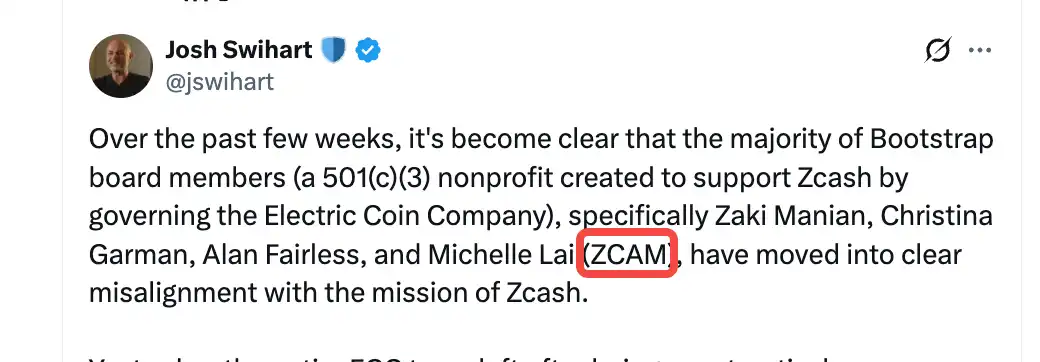
ZCAM. Sounds like SCAM. Not sure if it's intentional.

Among these four, Zaki Manian has the most stories.

He's an old-timer in the Cosmos ecosystem, was a core member of Tendermint. Resigned in 2020 after a public feud with founder Jae Kwon.

In 2023, the FBI informed him that two developers on a project he was responsible for were North Korean agents. After finding out, he concealed this for 16 months before making it public. In October 2024, Jae Kwon publicly accused him of "gross negligence" and "betraying the community's trust."

Now, he is a member of the Zcash board of directors.

The day after resigning, the former ECC team announced the formation of a new company, codenamed CashZ.

They said they would use the Zashi codebase to create a new wallet, to be launched within weeks. Existing Zashi users can migrate seamlessly.
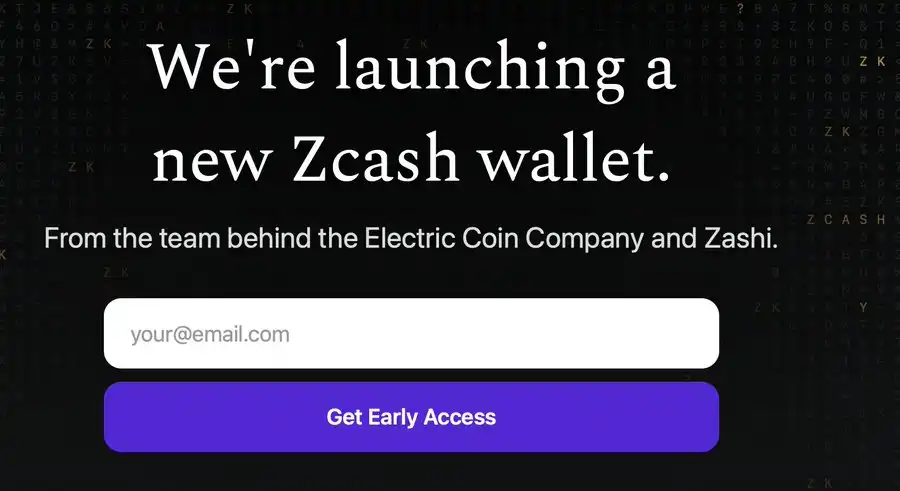
"We are the same team, with the same mission: to build unstoppable private money."

No new token, no starting from scratch, just changing the shell to keep working.

The most ironic part of this, we think, is the timing.

When ZEC was $15, no one cared who managed the wallet. When it hit $500, how much Zashi was worth became a matter of life and death.

When money appears, you find out who's family.

Similarly, the conflict between a non-profit and a startup team: OpenAI ended with the board losing, Zcash ended with the team leaving.

Who won is unclear, but this conflict is indeed common in crypto projects.

Swihart wrote a passage on the CashZ website explaining why they left:

"The non-profit foundation model is a relic of the compliance era in crypto. An era where projects needed 'compliance buffers' to protect themselves. But these buffers introduced bureaucracy and divergence in roadmap. Startups can scale fast, non-profits cannot."

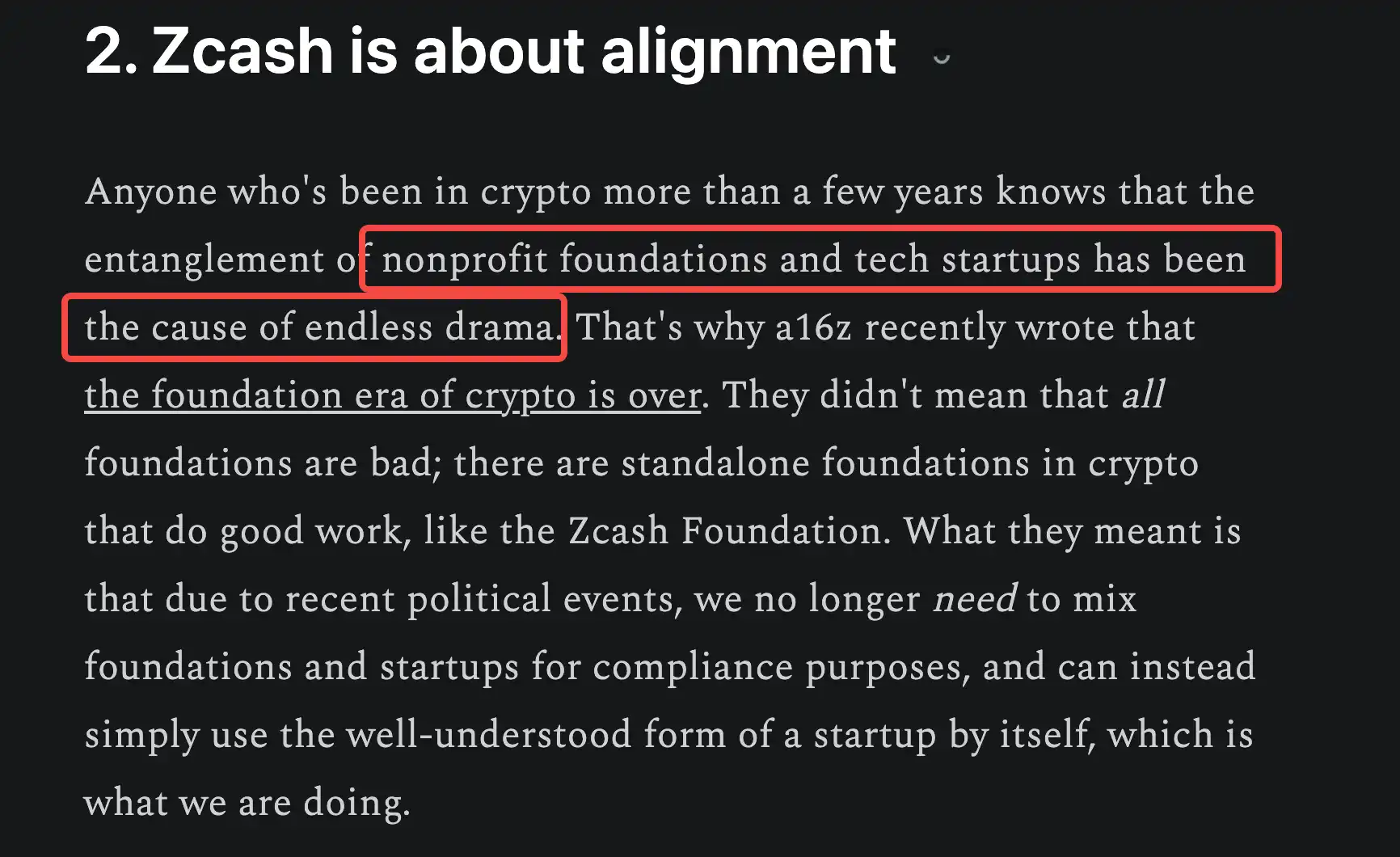
He also said: "Anyone who's been in crypto for a few years knows that the entanglement of non-profit foundations and tech startups is a source of endless drama."

It truly is endless drama.
In 2023, when Zooko stepped down as CEO, there were rumors of disagreements with Swihart. In January 2025, Zcash Foundation board member Peter Van Valkenburgh also resigned.

A decade-old coin, those who were supposed to leave have pretty much all gone.

Someone asked on Twitter: Will Zcash die?

The chain is still running. The code is still there. It's just that the people writing the code have changed.

But Swihart is right, the conflict between non-profits and startups is a common disease in this industry. Cosmos argued. The Ethereum Foundation argued. The Solana Foundation argued.

The difference is only in the manner and intensity of the arguments.

Zcash chose the most straightforward way.

Break up.

Trend Kriptolar

İlgili Sorular

QWhat was the immediate market reaction to the resignation of the Zcash core development team?

AThe price of ZEC (Zcash) dropped by 20%.

QWhat was the primary reason for the conflict between the ECC team and the Bootstrap board of directors?

AThe conflict centered on the ECC team's proposal to privatize the Zashi wallet and bring in external investment, which the non-profit Bootstrap board opposed due to legal and fiduciary concerns.

QWhat is the name of the new company formed by the former ECC team, and what is its first project?

AThe new company is called CashZ, and its first project is to launch a new wallet based on the Zashi codebase, allowing for seamless migration for existing users.

QAccording to the article, what percentage of ZEC transactions actually used the coin's flagship privacy feature?

ALess than 1% of ZEC transactions used the privacy feature.

QWhich controversial figure on the Bootstrap board was previously involved in a scandal concerning North Korean developers?

AZaki Manian, a member of the Bootstrap board (part of the 'ZCAM' group), was previously involved in a scandal where he waited 16 months to disclose that two developers on a project he oversaw were North Korean agents.

İlgili Okumalar

UNI Doubles in Two Months Against the Trend: A 5-Year-Overdue Value Realization

Amidst a generally stagnant crypto market in June and July, UNI, the governance token of Uniswap, saw a significant surge, nearly doubling in price from around $2.3 to $4.6. This rally represents a delayed but significant value reassessment, triggered by the practical implementation of its long-debated "fee switch" mechanism. The key turning point was the on-chain execution of the UNIfication proposal in December 2025. It activated a protocol fee on select pools, directed Unichain sequencer revenue (net of costs) to a communal treasury, executed a one-time burn of 100 million UNI, and established a system where all protocol revenue flows into a "TokenJar" contract. This treasury has a single exit: purchasing and permanently burning UNI via a "Firepit" contract. Initially, the market reacted tepidly as the generated revenue and corresponding burn rate were modest. The narrative shifted dramatically in July 2025 with two major developments. First, the launch of Robinhood Chain, tailored for tokenized stocks, rapidly became a primary source of volume and fees for Uniswap, at one point contributing nearly half of its weekly fees. Second, governance votes successfully expanded the fee mechanism to v4 pools and initiated a temperature check for fees on Robinhood Chain. The activation of v4 fees caused the protocol's daily revenue earmarked for UNI burns to nearly triple. The core of UNI's recent price action is the transition from a pure governance token to a cash-flow asset with a permanent, protocol-funded buyer. Its effectiveness is amplified by UNI's mature and widely distributed supply, with no major impending unlocks to dilute the impact of the buybacks. The sustainability of this rally now hinges on whether the transaction volume, particularly on Robinhood Chain, persists after its initial gas subsidies expire, determining if this is a genuine value realization or a subsidy-fueled spike.

marsbit1 saat önce

UNI Doubles in Two Months Against the Trend: A 5-Year-Overdue Value Realization

marsbit1 saat önce

Breaking: Google Earth Urgently Pulls Back Nano Banana 2 Image Generation Feature!

Google Earth's newly launched "Create image" feature, powered by the Nano Banana 2 AI image generation model, was abruptly withdrawn shortly after its release due to being "played" by users. The feature allowed users to generate and overlay AI-created visuals directly onto real-world satellite and 3D maps in Google Earth. The tool enabled creative applications like historical recreations (e.g., visualizing ancient Pompeii), generating informational graphics for landmarks, and envisioning architectural projects or futuristic cityscapes on real terrain. It operated under "geospatial grounding," meaning the AI respected the underlying geography, topography, and perspective of the chosen map view. The model also integrated with Gemini to retrieve relevant factual information. However, upon release, users quickly tested its limits. A prominent example involved reimagining Philadelphia's historic Independence Hall as a post-apocalyptic ruin overrun by "happy" zombies, evil clowns, and giant alien mechs. This highlighted both the feature's playful potential and its risks regarding the generation of inappropriate or misleading content on realistic maps, leading to its swift temporary removal. Google stated it would re-release the feature after implementing "enhanced guardrails." Analysts note this move strategically leverages Google's vast proprietary geospatial data, positioning its AI not just for artistic generation but for spatially accurate world visualization—a unique advantage in the competitive AI image generation landscape.

marsbit2 saat önce

Breaking: Google Earth Urgently Pulls Back Nano Banana 2 Image Generation Feature!

marsbit2 saat önce

Altman Admits: Overestimated AI Snatching Jobs! Huang Renxun: The Unemployment Narrative Is Completely Backwards

Sam Altman has revised his earlier predictions about AI rapidly replacing jobs, admitting he overestimated the speed at which AI would eliminate entry-level white-collar roles. Speaking on the "Invest Like the Best" podcast, he stated that people do not truly want an AI CEO, as accountability and human connection remain critical. He found that individuals prefer interacting with people who can be held responsible for decisions. Similarly, NVIDIA's Jensen Huang argued that the narrative of AI destroying jobs is misguided. He distinguishes between tasks and jobs, noting that while AI can automate specific tasks, entire jobs—encompassing communication, judgment, coordination, and accountability—are not eliminated. He cited examples like radiologists and software engineers, where demand for these roles has increased as AI handles repetitive tasks, allowing for business expansion and the creation of more positions. Data from a University of Maryland and LinkUp study supports this, showing that U.S. job postings for new graduates have actually risen, countering the fear of vanishing entry-level roles. However, a significant shift is occurring: the traditional entry-level tasks that help newcomers gain experience are being automated, making initial career access more challenging. The key insight is that as AI takes over standardized tasks, the enduring value of human work shifts toward areas of responsibility, trust-building, and final decision-making—aspects that AI cannot replicate. The real "moat" for professionals lies in these irreplaceable human elements.

marsbit2 saat önce

Altman Admits: Overestimated AI Snatching Jobs! Huang Renxun: The Unemployment Narrative Is Completely Backwards

marsbit2 saat önce

İşlemler

Spot

Popüler Makaleler

CORE Nasıl Satın Alınır

HTX.com’a hoş geldiniz! CORE (CORE) satın alma işlemlerini basit ve kullanışlı bir hâle getirdik. Adım adım açıkladığımız rehberimizi takip ederek kripto yolculuğunuza başlayın. 1. Adım: HTX Hesabınızı OluşturunHTX'te ücretsiz bir hesap açmak için e-posta adresinizi veya telefon numaranızı kullanın. Sorunsuzca kaydolun ve tüm özelliklerin kilidini açın. Hesabımı Aç2. Adım: Kripto Satın Al Bölümüne Gidin ve Ödeme Yönteminizi SeçinKredi/Banka Kartı: Visa veya Mastercard'ınızı kullanarak anında CORE (CORE) satın alın.Bakiye: Sorunsuz bir şekilde işlem yapmak için HTX hesap bakiyenizdeki fonları kullanın.Üçüncü Taraflar: Kullanımı kolaylaştırmak için Google Pay ve Apple Pay gibi popüler ödeme yöntemlerini ekledik.P2P: HTX'teki diğer kullanıcılarla doğrudan işlem yapın.Borsa Dışı (OTC): Yatırımcılar için kişiye özel hizmetler ve rekabetçi döviz kurları sunuyoruz.3. Adım: CORE (CORE) Varlıklarınızı SaklayınCORE (CORE) satın aldıktan sonra HTX hesabınızda saklayın. Alternatif olarak, blok zinciri transferi yoluyla başka bir yere gönderebilir veya diğer kripto para birimlerini takas etmek için kullanabilirsiniz.4. Adım: CORE (CORE) Varlıklarınızla İşlem YapınHTX'in spot piyasasında CORE (CORE) ile kolayca işlemler yapın.Hesabınıza erişin, işlem çiftinizi seçin, işlemlerinizi gerçekleştirin ve gerçek zamanlı olarak izleyin. Hem yeni başlayanlar hem de deneyimli yatırımcılar için kullanıcı dostu bir deneyim sunuyoruz.

390 Toplam GörüntülenmeYayınlanma 2024.12.13Güncellenme 2026.06.02

CORE Nasıl Satın Alınır

Tartışmalar

HTX Topluluğuna hoş geldiniz. Burada, en son platform gelişmeleri hakkında bilgi sahibi olabilir ve profesyonel piyasa görüşlerine erişebilirsiniz. Kullanıcıların CORE (CORE) fiyatı hakkındaki görüşleri aşağıda sunulmaktadır.

活动图片