A Century-Long Journey of an Egg: From Wall Street to Polymarket

marsbit2026-03-02 tarihinde yayınlandı2026-03-02 tarihinde güncellendi

Özet

The article traces the historical journey of egg futures, once one of the most active commodities traded on Wall Street. Beginning at the Chicago Butter and Egg Board (which later became the CME), egg futures were highly active in the early 20th century. However, by the 1980s, industrial farming and improved supply chains reduced price volatility, leading to the decline of egg futures trading in traditional markets. In 2013, China’s Dalian Commodity Exchange revived egg futures due to market volatility. More recently, egg price speculation has moved to Polymarket, a prediction market platform. One trader, "xcnstrategy," reportedly earned significant profits by shorting egg price intervals, likely leveraging expertise in commodity markets or agriculture. The piece highlights a broader trend: crypto and prediction markets like Polymarket and Hyperliquid are increasingly serving as 24/7 trading venues for traditional assets—including oil, gold, and forex—especially during periods when conventional markets are closed. This was evident during recent U.S.-Iran tensions when traders used these platforms to hedge and price assets amid traditional market closures. The evolution reflects an ongoing shift in price discovery power from established exchanges to decentralized, always-on crypto markets—echoing the original purpose of futures markets: to manage risk and determine prices.

"We went from eggs to yen"—this financial reminiscence from CME legend Leo Melamed bears witness to a time when eggs were once one of the world's most active futures products.

In the first half of the 20th century, egg futures were among the hottest trading instruments in Chicago. Trading volume in some years was second only to grain varieties, and there were even instances where futures trading far exceeded the volume of physical circulation.

The predecessor of the Chicago Mercantile Exchange (CME), the world's largest derivatives market, was called the "Chicago Butter and Egg Board." This was the foundation of what would later become a derivatives empire, and as the name implies, the exchange initially traded only two things: butter and eggs.

After the 1970s, the U.S. egg-laying industry rapidly industrialized, cold chains matured, and price fluctuations were gradually "smoothed out." As uncertainty began to fade, the noise in the trading pits quieted down. In 1982, egg futures officially exited the Chicago Mercantile Exchange. It didn’t collapse dramatically; rather, it was as if the times quietly turned off the lights.

In 2013, the Dalian Commodity Exchange in mainland China reignited this product. At that time, mainland China's egg-laying industry was still highly fragmented, with sharp price fluctuations, making hedging needs real and urgent.

Egg futures trading did not disappear; it merely migrated. And today, this migration has taken another step forward. The venue for trading egg prices has moved to Polymarket.
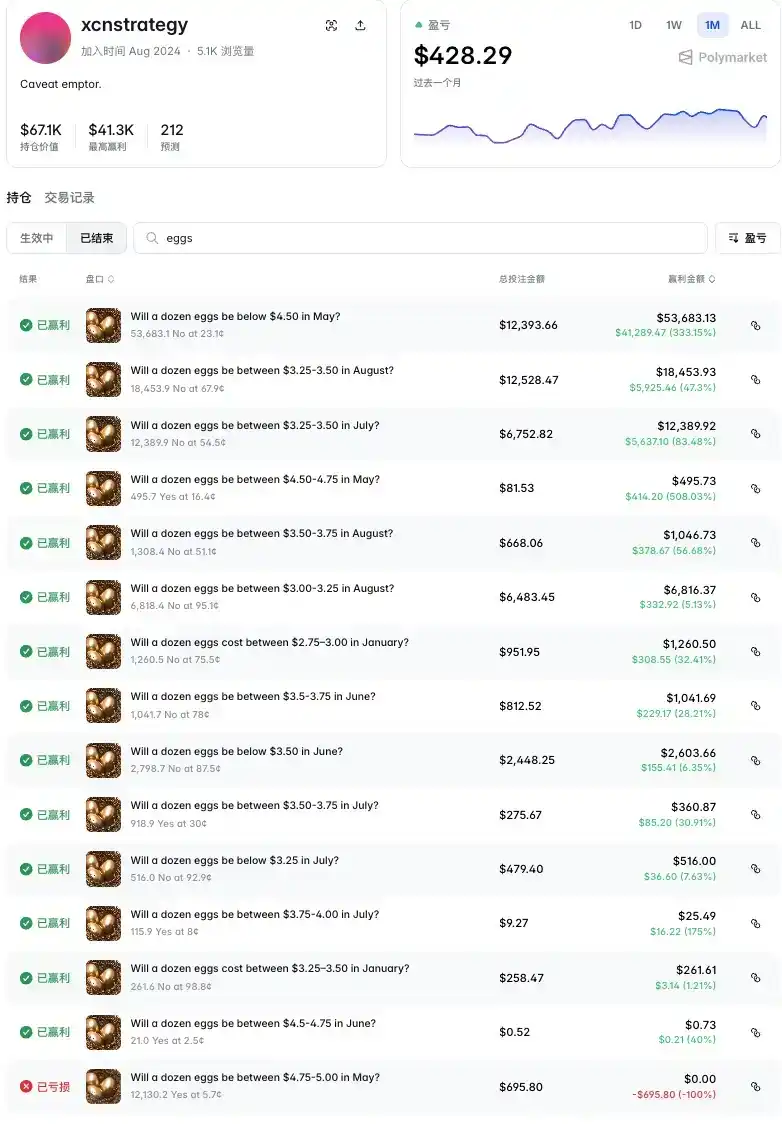
A trader with the ID "xcnstrategy" established positions in multiple expiration months—January, May, June, July, and August—for egg price predictions. The vast majority of these trades were shorting the "Yes" for certain price ranges, meaning betting that eggs would not reach certain price levels. The total betting amount was $44,800, with nearly $100,000 in profits. Out of 15 trades, all but the first were profitable.

The most recent trade was also the most profitable: a $12,393 bet on "No" for "a dozen eggs in May below $4.50," yielding a profit of $41,289 (+333%).

Speculations about xcnstrategy’s true identity, aside from possibly being an "egg enthusiast," include many who believe he is likely someone with a commodities market background or agricultural data research capabilities, analyzing that the U.S. avian flu-induced egg price surge starting in 2025 was a short-term phenomenon and that the market overestimated the probability of sustained high prices. Others think he is an industry insider in the egg supply chain, hedging against the volatility inherent in the industry.
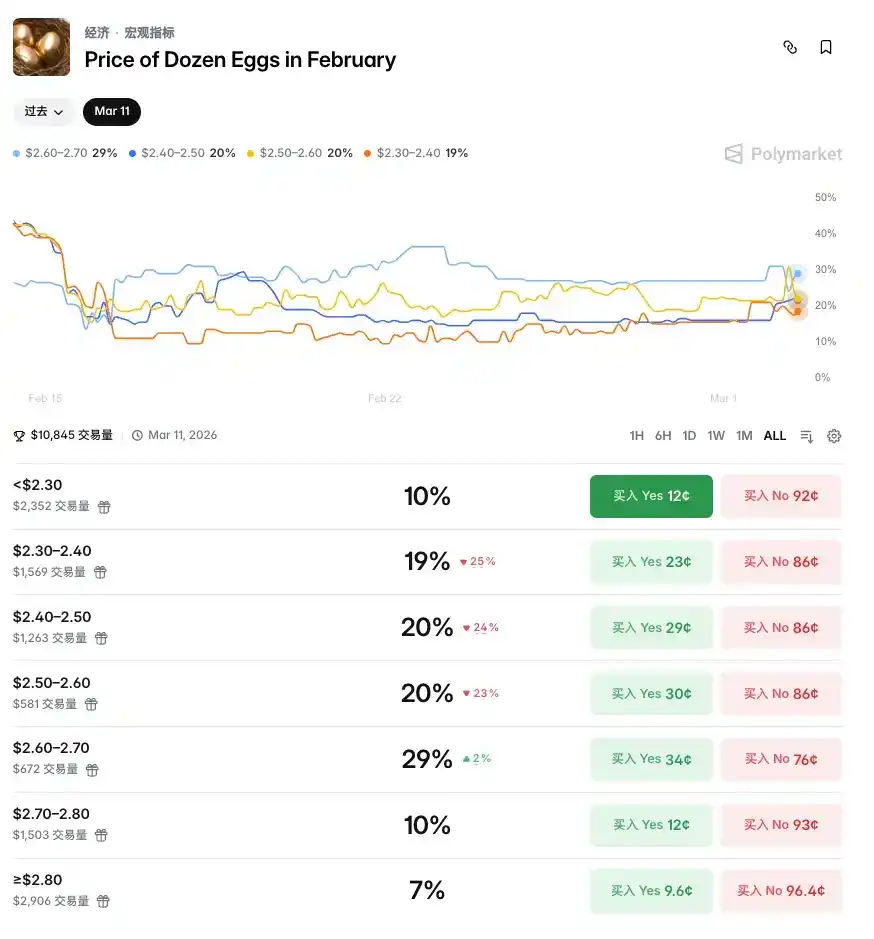
Eggs are just one example. The traditional asset标的 available for trading on Polymarket are far more diverse than one might imagine: from crude oil (CL), gold (GC), silver (SI), and other commodities to various foreign exchange rates and housing data—all can be found as markets on Polymarket.
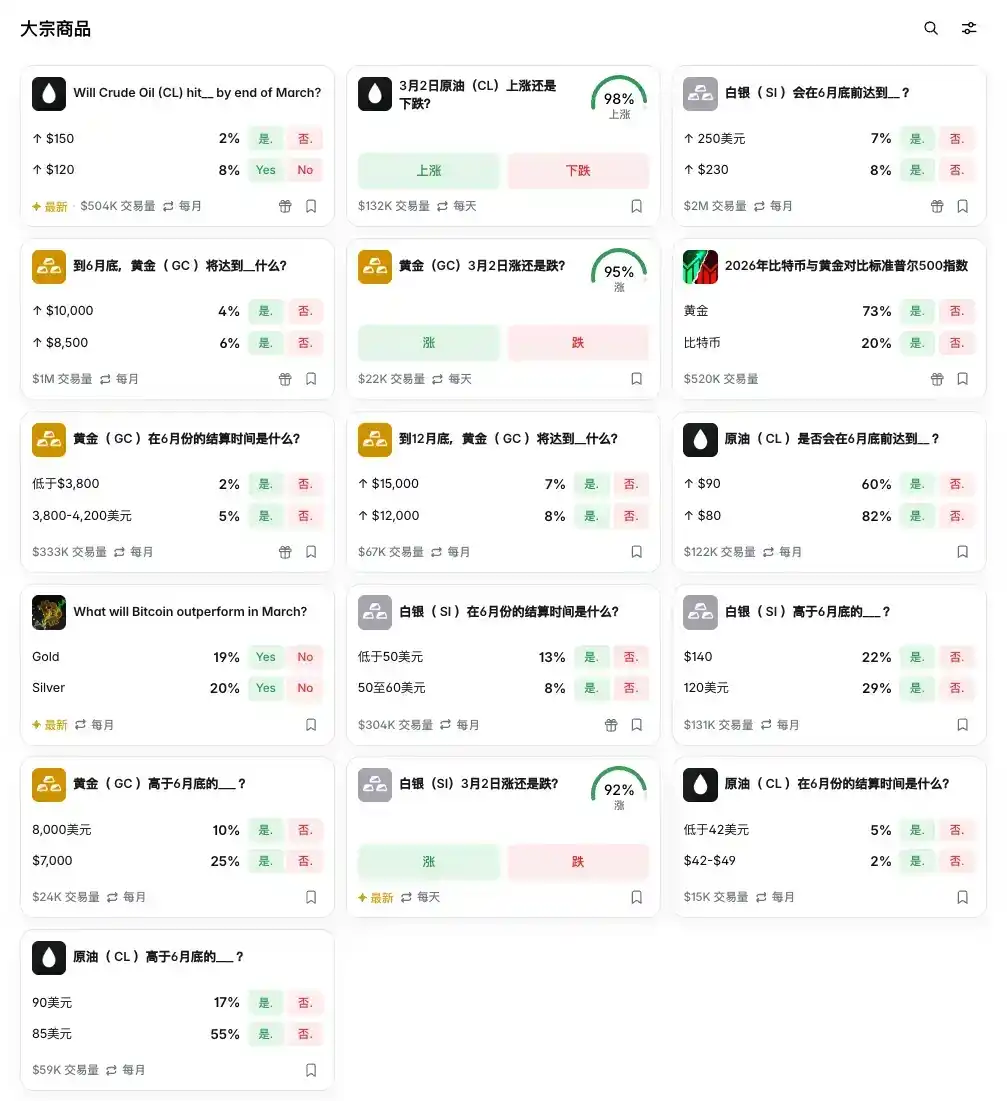
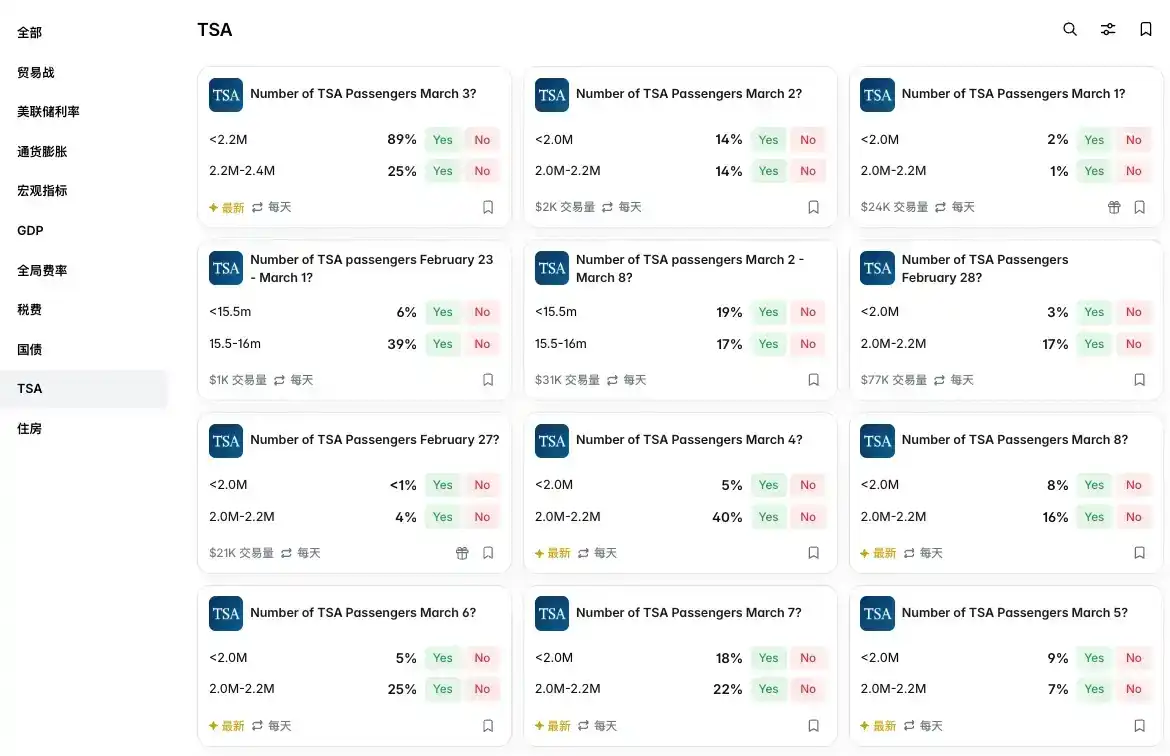
Operating 24/7 without closing is one of the biggest advantages of trading such markets on Polymarket. This advantage is particularly evident during traditional financial market closures, as seen with the U.S.-Iran conflict escalation last weekend.

In this regard, Hyperliquid shares the same advantage. The perpetual contracts on Hyperliquid, linked to crude oil and gold, have no expiration dates and run continuously, 24/7.

This leads to an increasingly hard-to-ignore phenomenon: the crypto market is quietly taking on the price discovery function of traditional financial markets, especially when the latter are closed.

Traditional futures markets have fixed trading hours; CME's crude oil and gold contracts close on weekends, and foreign exchange markets see liquidity dry up late at night. This means that when geopolitical shocks erupt after Friday's close, participants are left in the dark—unable to hedge, express views, or price assets.

Last weekend's U.S.-Iran conflict escalation is the latest validation. According to Bloomberg, around the time the conflict broke out, a large number of traders flocked to Hyperliquid to trade perpetual contracts linked to crude oil and gold to hedge against the geopolitical shock—while traditional markets were shut, crypto derivatives markets were the only place with the lights on. Investment firm executive Avi Felman had previously predicted that "Hyperliquid will become indispensable for fund managers because it’s 24/7." This judgment was concretely validated during this conflict.

At the same time, gold tokenization is accelerating another logic: when gold exists in the form of on-chain tokens and is continuously priced in decentralized markets, it no longer needs to wait for the London Metal Exchange or CME to open. To some extent, the tokenized gold market is acting as a "shadow pre-market" for traditional gold markets, pricing gold over the weekend and allowing price discovery to occur before traditional markets open.

In 2020, then the world's second-largest trading platform, FTX, launched tokenized stocks, allowing platform users to trade Tesla and NVIDIA shares with stablecoins. The idea was to capture pricing power—when U.S. stocks were closed, FTX's Tesla tokens could fill the market void, allowing users to trade Tesla stock when the company announced new models on Saturday, thereby influencing Nasdaq's Monday opening.

Unfortunately, due to liquidity issues, the pricing effect ultimately did not materialize. Six years later, tokenization has come full circle back to this vision. Today, Polymarket and Hyperliquid are viewed not merely as cryptocurrency trading platforms. Polymarket is already officially recognized as a public opinion polling agency and information exchange hub, while Hyperliquid is seen as a new type of full-asset trading platform.

Price discovery power has always been one of the core powers in financial infrastructure.

Back in the day, Chicago butter and egg merchants established the CME because they needed a venue to discover prices and transfer risks. Over a hundred years later, the same logic is replaying on-chain, only the medium has changed.

You might think the market is trading eggs, but in reality, the market is fighting for pricing power.


İlgili Sorular

QWhat was the original name of the Chicago Mercantile Exchange (CME) and what products did it initially trade?

AThe original name was the Chicago Butter and Egg Board, and it initially traded only two products: butter and eggs.

QWhy did the trading of egg futures decline and eventually cease on the CME in 1982?

AThe decline was due to the rapid industrialization of the U.S. egg-laying industry and the maturation of the cold chain, which smoothed out price volatility, reducing the uncertainty and need for hedging, leading to its quiet discontinuation.

QWhat is the significant advantage of trading assets like eggs, oil, and gold on platforms like Polymarket and Hyperliquid compared to traditional markets?

AThe significant advantage is that they operate 24/7, allowing for continuous trading, price discovery, and risk management even when traditional financial markets are closed, such as during weekends or overnight.

QAccording to the article, how did the recent U.S.-Iran conflict demonstrate the value of crypto derivative markets like Hyperliquid?

AWhen the conflict escalated over a weekend, traditional markets were closed, but traders flocked to Hyperliquid to trade perpetual contracts linked to oil and gold, making it the only available venue to hedge risks and express market views, thus validating its role in pricing during off-hours.

QWhat broader financial function are platforms like Polymarket and Hyperliquid increasingly seen as fulfilling, beyond just trading cryptocurrencies?

AThey are increasingly seen as fulfilling the core financial function of price discovery and acting as information hubs or full-asset trading platforms, effectively competing for pricing power that was traditionally held by established exchanges like the CME.

İlgili Okumalar

Must-Watch Events Next Week|CLARITY Act Could Face Senate Vote; SpaceX, Circle to Report Earnings (8.3-8.9)

**Summary: Key Events and Developments to Watch (August 3-9)** The upcoming week is marked by significant financial disclosures, key legislative deadlines, and notable product updates. **Major Financial Events:** Several companies are scheduled to release their Q2 2026 earnings. American Bitcoin (ABTC) will report on August 3, followed by SpaceX and Hut 8 Mining Corp. on August 4, and Circle on August 5. Notably, a significant portion of SpaceX shares (up to 12% of total shares) will be unlocked on August 6 following their earnings release. **Key Legislative Deadline:** The U.S. Senate faces an August 7 deadline to secure 60 votes for the CLARITY Act, a bipartisan bill aiming to establish a federal regulatory framework for cryptocurrencies. The Senate may hold a full vote on the bill during the week. **Economic Data:** The U.S. July Non-Farm Payrolls report will be released on August 7, providing crucial labor market data. **Technology & Product Updates:** * **Shutdowns:** DeFi portfolio tracker Zapper and wallet app Ctrl Wallet will cease operations on August 3. * **Upgrades:** LayerZero will deprecate its v1 relayers on August 3. XRP Ledger's new version 3.3.0, featuring five new functions, is expected next week. * **AI:** Elon Musk announced that the advanced Grok 4.6 AI model is set for release around August 7. * **Bitcoin:** The BIP-110 forced signaling for a potential Bitcoin network change is scheduled to begin around August 8. **Other Notable Events:** Chinese robotics firm Unitree Tech has set its preliminary price inquiry for its IPO for August 5. South Korean exchange Upbit will delist AQT and AERGO tokens on August 3.

marsbit58 dk önce

Must-Watch Events Next Week|CLARITY Act Could Face Senate Vote; SpaceX, Circle to Report Earnings (8.3-8.9)

marsbit58 dk önce

Stocks Are Plummeting More Sharply Than Cryptocurrencies. Where Has the Money Gone?

Stock Markets Plunge Deeper Than Cryptocurrencies: Where Did the Money Go? In late July, Seoul's Kospi index triggered circuit breakers for two consecutive days, plummeting over 40% from its June high. The collapse was led by heavyweight stocks like SK Hynix, whose record profits still disappointed investors, and devastating leveraged ETFs, with one major product losing over 83% of its value. This signaled a global, forced deleveraging targeting the most crowded trades. Interestingly, while stocks exhibited extreme volatility akin to crypto markets, Bitcoin rose nearly 15% in July after a prior steep drop. Analysis shows the money fleeing equities did not flow into Bitcoin. Instead, Bitcoin had already absorbed its sell-off in May-June, when U.S. spot Bitcoin ETFs saw historic outflows. The true safe-haven beneficiary was gold, whose price rose over 20% year-on-year, highlighting a decoupling between Bitcoin and gold as "digital gold." The sell-off was a targeted unwinding of leveraged positions in tech and semiconductors, accelerated by broker-dealer risk management and shifts in the AI narrative, including new competition from Chinese memory chipmakers. The retreat path was clear: from high-valuation tech stocks to cash and U.S. Treasuries, then to gold. For Bitcoin to attract sustained institutional inflows, conditions like eased global liquidity pressure, a "soft-landing" Fed rate cut, and U.S. regulatory clarity via legislation like the stalled CLARITY Act are needed. Currently, Bitcoin is not a safe haven but an already-cleared asset. Its low correlation with tech stocks, however, makes it a potential diversification play for institutional portfolios once the storm passes. The money isn't here yet, but the positioning is underway.

marsbit58 dk önce

Stocks Are Plummeting More Sharply Than Cryptocurrencies. Where Has the Money Gone?

marsbit58 dk önce

In Conversation with Ray Dalio: We Are Currently in an AI Bubble, with 1% of My Portfolio in Bitcoin

Ray Dalio, founder of Bridgewater Associates, warns in an interview that the current AI boom shows classic bubble characteristics, which could lead to significant economic downturns as seen in past cycles like 1929 or 2000. He explains that speculative enthusiasm, fueled by debt and overvaluation, often precedes a crash when rising rates or taxation force asset sales, causing widespread losses and recession. Dalio also outlines his "Big Cycle" theory, describing an approximate 80-year pattern where widening wealth gaps, massive government deficits, and shifting geopolitical power (like China's rise) create internal conflict and global instability. He emphasizes that we are in a late-cycle, transitional phase where traditional powers like the US and UK face decline. For personal wealth protection, Dalio advises diversification beyond cash into assets like stocks, bonds, real estate, and particularly gold, which he prefers over Bitcoin. While he holds about 1% of his portfolio in Bitcoin as a non-printable hard asset, he views gold as more secure from technological or governmental threats. Regarding AI's impact, Dalio believes it will disproportionately benefit capital owners, worsening inequality by replacing both physical and cognitive labor. He suggests that human intuition and emotional intelligence, combined with AI, will be key for future workers. On taxation, Dalio argues that wealth taxes are impractical and risk triggering asset sell-offs, reducing productive investment. He points to the UK as a cautionary example of debt, low productivity, and political strife. Geopolitically, Dalio foresees a more regionalized world, with the US showing weakness in prolonged conflicts like with Iran, akin to past imperial declines. The ideal outcome, he suggests, is coexisting powerful blocs (e.g., Americas, China-Asia Pacific) without major war.

marsbit4 saat önce

In Conversation with Ray Dalio: We Are Currently in an AI Bubble, with 1% of My Portfolio in Bitcoin

marsbit4 saat önce

İşlemler

Spot
活动图片




