A 30% Chance of a Fed Rate Hike Next Week?

链捕手2026-07-24 tarihinde yayınlandı2026-07-24 tarihinde güncellendi

Özet

Amid rising oil prices and a lack of clear guidance from the Federal Reserve, markets are repricing policy risk. While most economists expect the Fed to hold rates steady next week, interest rate markets now imply roughly a 30% probability of a hike, pushing U.S. Treasury yields higher across the curve. The 2-year yield hit a new high since early 2025, the 10-year yield reached its highest level this year, and the 30-year yield neared its highest since 2007. However, a Citigroup report from July 23 argues this market pricing does not reflect a widespread bet on an imminent hike. Instead, it represents a higher risk premium demanded by investors to hedge against a potential policy surprise. The report explains that with forward guidance becoming more ambiguous and oil prices boosting inflation risks, uncertainty has increased. Historically, the risk premium around Fed meetings was negligible, but it has now grown as the Fed relies more on data-dependent communication. The lack of clear guidance means that even if the Fed stands pat, yields may not fall significantly, as this uncertainty premium could persist until a clearer communication framework is reestablished.

Author: Li Jia


Under the dual impact of rising oil prices and the absence of forward guidance from the Federal Reserve, markets have begun repricing policy risks.

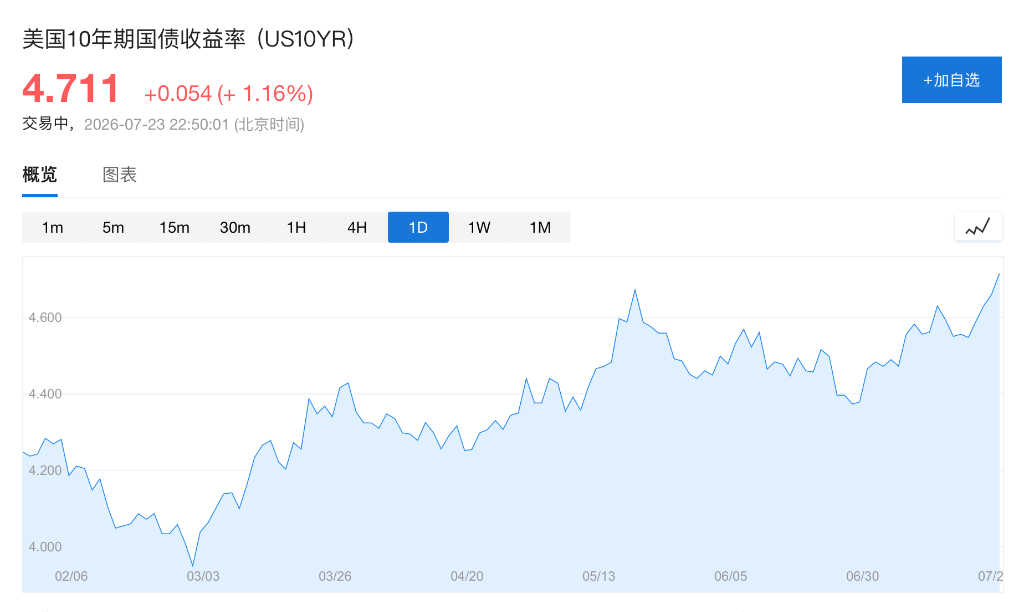
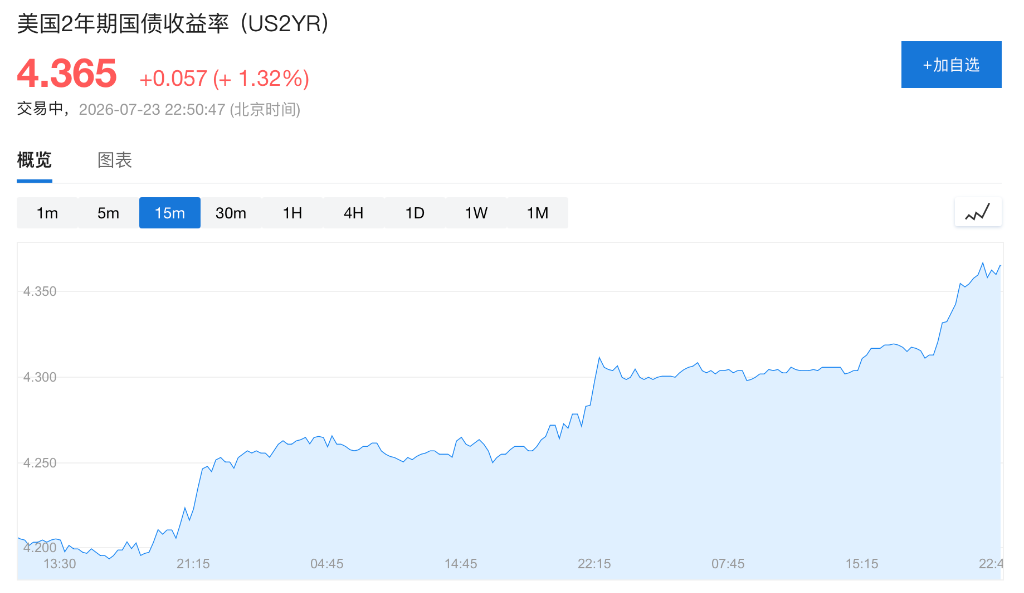
While mainstream economists unanimously expect the Fed to hold rates steady next week, the implied probability of a rate hike from interest rate markets has risen to about 30%, pushing U.S. Treasury yields higher across the curve. The yield on the two-year Treasury note hit a new high since early 2025, the benchmark 10-year yield rose to its highest level this year, and the 30-year yield approached its highest level since 2007.

A Citi research report released on July 23 suggests that this market pricing does not mean investors are widely betting on an imminent Fed rate hike, but rather reflects investors demanding higher risk premiums to hedge against policy surprises in an environment where forward guidance has become more ambiguous and oil prices are elevating inflation risks.
Rising Treasury Yields, Market Prices in ~30% Hike Probability

Recently, escalating tensions in the Middle East have driven a sustained rise in international oil prices, rekindling market concerns about a resurgence of inflation and consequently pushing U.S. Treasury yields higher.

On Thursday, the yield on the policy-sensitive two-year Treasury note rose to around 4.365%; the benchmark 10-year yield simultaneously set a new yearly high; and the 30-year yield climbed to 5.19%, just a step away from its highest level since 2007.

Meanwhile, interest rate futures show an implied probability of about 30% for a Fed rate hike at next week's meeting. However, this pricing deviates significantly from mainstream expectations. A Bloomberg survey shows that none of the 70 economists polled expect the Fed to raise rates next week.
Citi: The 30% is Not a Market Forecast, But a Risk Premium

Citi offers a different interpretation of this seemingly contradictory phenomenon.

Citi economists Andrew Hollenhorst, Veronica Clark, and Gisela Young point out that the 30% in market pricing does not mean investors genuinely believe the Fed has a three-in-ten chance of hiking; it incorporates an additional risk premium.

The report argues that since a rate cut is almost impossible at next week's meeting, policy risk is inherently skewed to one side. If the Fed were to surprise with a hike, the bond market would suffer a far greater shock than if it remained on hold. Therefore, investors are willing to pay an extra cost to price in this tail risk in advance.

Citi notes that historically, the risk premium associated with Fed meetings was typically only 1 to 2 basis points. However, as the Fed has reduced forward guidance in recent years and policy communication has become more data-dependent, uncertainty has increased, and the risk compensation demanded by the market has expanded accordingly.

This logic also explains the current movement in long-term rates. Citi believes that if a future meeting were to unexpectedly result in a rate hike, the market would likely interpret it as the start of a new rate-hiking cycle rather than an isolated event, thus lifting terminal rate expectations as well. For this reason, the market is currently pricing in more than 50 basis points of cumulative hikes by March of next year, but this does not mean it represents investors' base-case scenario.

Citi: The More Ambiguous the Guidance, the Easier for Rates to Stay High

Citi argues that the recent rise in oil prices is merely a catalyst prompting the market to reassess the policy path; the deeper reason lies in changes to the Fed's communication framework.

The report points out that Middle East tensions have pushed up oil and U.S. gasoline prices, strengthening market concerns about the risk of inflation reaccelerating. With Fed officials not providing clear policy guidance, this uncertainty has further amplified market anxiety about policy surprises.

Citi emphasizes that during periods of clear forward guidance, market risk premiums were typically negligible. However, currently, each policy meeting carries greater policy uncertainty, and investors need to pay a risk premium in advance for potential surprises.

This means that even if the Fed ultimately holds rates steady, Treasury yields may not necessarily retreat significantly as hike expectations fade. Citi believes that until the Fed re-establishes a clearer communication framework, the phenomenon of risk premiums pushing up interest rates may persist.


İlgili Sorular

QAccording to the article, what is the main reason behind the recent rise in US Treasury yields?

AThe main reason is a combination of rising oil prices due to Middle East tensions, which has reignited inflation concerns, and a lack of clear forward guidance from the Federal Reserve. This has led markets to price in a higher risk premium for potential policy surprises, pushing yields higher.

QWhat does the 30% probability of a Fed rate hike implied by the interest rate market primarily represent, according to Citigroup's analysis?

AAccording to Citigroup, the 30% probability does not primarily represent a widespread market bet that the Fed will hike rates. Instead, it reflects a risk premium investors are demanding to hedge against the potential tail risk of an unexpected policy tightening, given the lack of clear forward guidance and heightened inflation risks.

QHow does the article describe the divergence between market pricing and economist surveys regarding the upcoming Fed meeting?

AThe article notes a significant divergence. While interest rate futures imply about a 30% probability of a rate hike, a Bloomberg survey of 70 economists found that not a single one expects the Federal Reserve to raise interest rates at the upcoming meeting.

QWhy might US Treasury yields remain elevated even if the Federal Reserve does not raise interest rates, based on Citigroup's view?

ABased on Citigroup's view, yields might remain elevated because the risk premium priced into the market may not fully dissipate. In the absence of clear forward guidance from the Fed, uncertainty remains high for each policy meeting, requiring investors to maintain compensation for potential surprises, thus keeping a floor under yields.

QWhat role has the change in the Federal Reserve's communication framework played in recent market dynamics, as explained in the article?

AThe change in the Fed's communication framework, specifically its move away from providing clear forward guidance towards a more data-dependent approach, has increased policy uncertainty. This lack of clarity has amplified market concerns about potential policy surprises, leading investors to demand a higher risk premium, which contributes to higher interest rates and yield volatility.

İlgili Okumalar

Bitcoin Withdrawals Continue: 8 Years of Storage in a Coldcard Cold Wallet Ended in Zero

Coldcard Hardware Wallet Hacked: Losses Mount Due to Vulnerable Seed Generation A critical vulnerability in Coldcard hardware wallets has led to a continued wave of fund thefts. According to Galaxy Research, the total stolen has reached 1,367.05 BTC (approx. $88.6 million) from 4,585 addresses, a significant increase from the initial 594.5 BTC reported on July 30, 2026. Most of the stolen funds remain on the attackers' addresses. The issue is not with the current firmware, which Coinkite has updated, but with seed phrases generated on vulnerable devices between March 2021 and the release of fixed firmware versions. Due to a programmer error, devices switched from using a hardware random number generator to the software-based Yasmarang generator, which was initialized with publicly accessible data like the chip's serial number. This made the seed phrases predictable through offline brute-force attacks, meaning wallets remain at risk until funds are moved to a new wallet generated with the patched firmware. Affected devices include Mk2/Mk3 with firmware 4.0.1–4.1.9 (and up to 5.0.3), Mk4/Mk5 up to version 5.6.0, and Q models up to 1.5.0Q. The only exceptions are seeds created with a high-entropy method like at least 50 independent dice rolls or a strong unique BIP-39 passphrase. All other owners must generate a new seed on the fixed firmware and transfer their assets. A case highlighting the human impact involves a 39-year-old long-term investor who lost 2 BTC (approx. $130,000) in minutes. He had accumulated the Bitcoin over eight years through physical labor, viewing it as a financial lifeline and a retirement plan in a country suffering from hyperinflation. His story underscores that even conservative "buy and hold in cold storage" strategies can be compromised by such underlying technical flaws. From a technical perspective, this incident echoes historical failures where weak random number generators undermined cryptographic security, challenging the assumption that offline storage is automatically foolproof.

cryptonews.ru2 saat önce

Bitcoin Withdrawals Continue: 8 Years of Storage in a Coldcard Cold Wallet Ended in Zero

cryptonews.ru2 saat önce

İşlemler

Spot
活动图片




