A 30% Chance of a Fed Rate Hike Next Week?

链捕手2026-07-24 tarihinde yayınlandı2026-07-24 tarihinde güncellendi

Özet

Amid rising oil prices and a lack of clear guidance from the Federal Reserve, markets are repricing policy risk. While most economists expect the Fed to hold rates steady next week, interest rate markets now imply roughly a 30% probability of a hike, pushing U.S. Treasury yields higher across the curve. The 2-year yield hit a new high since early 2025, the 10-year yield reached its highest level this year, and the 30-year yield neared its highest since 2007. However, a Citigroup report from July 23 argues this market pricing does not reflect a widespread bet on an imminent hike. Instead, it represents a higher risk premium demanded by investors to hedge against a potential policy surprise. The report explains that with forward guidance becoming more ambiguous and oil prices boosting inflation risks, uncertainty has increased. Historically, the risk premium around Fed meetings was negligible, but it has now grown as the Fed relies more on data-dependent communication. The lack of clear guidance means that even if the Fed stands pat, yields may not fall significantly, as this uncertainty premium could persist until a clearer communication framework is reestablished.

Author: Li Jia


Under the dual impact of rising oil prices and the absence of forward guidance from the Federal Reserve, markets have begun repricing policy risks.

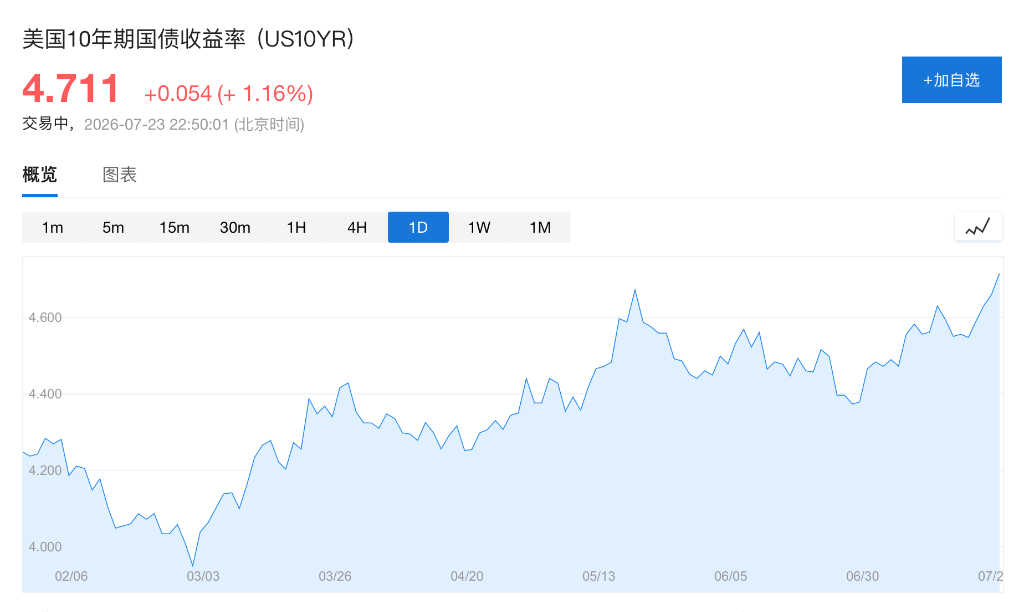
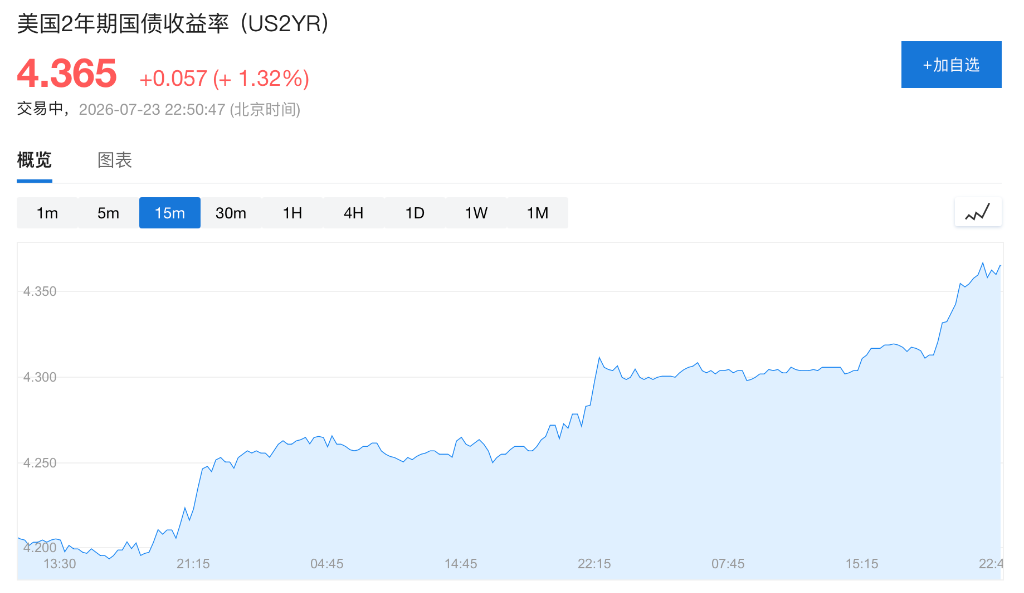
While mainstream economists unanimously expect the Fed to hold rates steady next week, the implied probability of a rate hike from interest rate markets has risen to about 30%, pushing U.S. Treasury yields higher across the curve. The yield on the two-year Treasury note hit a new high since early 2025, the benchmark 10-year yield rose to its highest level this year, and the 30-year yield approached its highest level since 2007.

A Citi research report released on July 23 suggests that this market pricing does not mean investors are widely betting on an imminent Fed rate hike, but rather reflects investors demanding higher risk premiums to hedge against policy surprises in an environment where forward guidance has become more ambiguous and oil prices are elevating inflation risks.
Rising Treasury Yields, Market Prices in ~30% Hike Probability

Recently, escalating tensions in the Middle East have driven a sustained rise in international oil prices, rekindling market concerns about a resurgence of inflation and consequently pushing U.S. Treasury yields higher.

On Thursday, the yield on the policy-sensitive two-year Treasury note rose to around 4.365%; the benchmark 10-year yield simultaneously set a new yearly high; and the 30-year yield climbed to 5.19%, just a step away from its highest level since 2007.

Meanwhile, interest rate futures show an implied probability of about 30% for a Fed rate hike at next week's meeting. However, this pricing deviates significantly from mainstream expectations. A Bloomberg survey shows that none of the 70 economists polled expect the Fed to raise rates next week.
Citi: The 30% is Not a Market Forecast, But a Risk Premium

Citi offers a different interpretation of this seemingly contradictory phenomenon.

Citi economists Andrew Hollenhorst, Veronica Clark, and Gisela Young point out that the 30% in market pricing does not mean investors genuinely believe the Fed has a three-in-ten chance of hiking; it incorporates an additional risk premium.

The report argues that since a rate cut is almost impossible at next week's meeting, policy risk is inherently skewed to one side. If the Fed were to surprise with a hike, the bond market would suffer a far greater shock than if it remained on hold. Therefore, investors are willing to pay an extra cost to price in this tail risk in advance.

Citi notes that historically, the risk premium associated with Fed meetings was typically only 1 to 2 basis points. However, as the Fed has reduced forward guidance in recent years and policy communication has become more data-dependent, uncertainty has increased, and the risk compensation demanded by the market has expanded accordingly.

This logic also explains the current movement in long-term rates. Citi believes that if a future meeting were to unexpectedly result in a rate hike, the market would likely interpret it as the start of a new rate-hiking cycle rather than an isolated event, thus lifting terminal rate expectations as well. For this reason, the market is currently pricing in more than 50 basis points of cumulative hikes by March of next year, but this does not mean it represents investors' base-case scenario.

Citi: The More Ambiguous the Guidance, the Easier for Rates to Stay High

Citi argues that the recent rise in oil prices is merely a catalyst prompting the market to reassess the policy path; the deeper reason lies in changes to the Fed's communication framework.

The report points out that Middle East tensions have pushed up oil and U.S. gasoline prices, strengthening market concerns about the risk of inflation reaccelerating. With Fed officials not providing clear policy guidance, this uncertainty has further amplified market anxiety about policy surprises.

Citi emphasizes that during periods of clear forward guidance, market risk premiums were typically negligible. However, currently, each policy meeting carries greater policy uncertainty, and investors need to pay a risk premium in advance for potential surprises.

This means that even if the Fed ultimately holds rates steady, Treasury yields may not necessarily retreat significantly as hike expectations fade. Citi believes that until the Fed re-establishes a clearer communication framework, the phenomenon of risk premiums pushing up interest rates may persist.


İlgili Sorular

QAccording to the article, what is the main reason behind the recent rise in US Treasury yields?

AThe main reason is a combination of rising oil prices due to Middle East tensions, which has reignited inflation concerns, and a lack of clear forward guidance from the Federal Reserve. This has led markets to price in a higher risk premium for potential policy surprises, pushing yields higher.

QWhat does the 30% probability of a Fed rate hike implied by the interest rate market primarily represent, according to Citigroup's analysis?

AAccording to Citigroup, the 30% probability does not primarily represent a widespread market bet that the Fed will hike rates. Instead, it reflects a risk premium investors are demanding to hedge against the potential tail risk of an unexpected policy tightening, given the lack of clear forward guidance and heightened inflation risks.

QHow does the article describe the divergence between market pricing and economist surveys regarding the upcoming Fed meeting?

AThe article notes a significant divergence. While interest rate futures imply about a 30% probability of a rate hike, a Bloomberg survey of 70 economists found that not a single one expects the Federal Reserve to raise interest rates at the upcoming meeting.

QWhy might US Treasury yields remain elevated even if the Federal Reserve does not raise interest rates, based on Citigroup's view?

ABased on Citigroup's view, yields might remain elevated because the risk premium priced into the market may not fully dissipate. In the absence of clear forward guidance from the Fed, uncertainty remains high for each policy meeting, requiring investors to maintain compensation for potential surprises, thus keeping a floor under yields.

QWhat role has the change in the Federal Reserve's communication framework played in recent market dynamics, as explained in the article?

AThe change in the Fed's communication framework, specifically its move away from providing clear forward guidance towards a more data-dependent approach, has increased policy uncertainty. This lack of clarity has amplified market concerns about potential policy surprises, leading investors to demand a higher risk premium, which contributes to higher interest rates and yield volatility.

İlgili Okumalar

In Jinjiang, Fujian, a Storage Super Unicorn Lies Quiet

In Fujian's Jinjiang, a city known for sportswear, lies a quiet semiconductor giant: Fujian Jinhua Integrated Circuit Co. (JHICC). Once a promising domestic DRAM manufacturer alongside Yangtze Memory and ChangXin Memory Technologies (CXMT), its journey was derailed in 2018 when the U.S. placed it on an Entity List and filed criminal charges for alleged trade secret theft. This halted production for years. A turning point came in February 2024 when a U.S. federal court found JHICC not guilty. However, it had lost crucial time. While CXMT soared to become a top-valued A-share company in 2024, JHICC, with an estimated valuation of 80 billion RMB, was just restarting. Its current output is primarily customized DDR4 chips, not the advanced DDR5/HBM demanded for AI, but it still benefits from the broader memory chip upcycle. JHICC's story is tied to Chen Zhengkun, a veteran engineer who left Micron to lead the venture. Founded in 2016 with state-backed funding, JHICC partnered with Taiwan's UMC to develop DRAM technology. Rapid progress was cut short by the U.S. actions, which Micron initiated, partly due to its heavy reliance on the Chinese market. Post-sanctions, Chen's team worked to rebuild the production line with reduced reliance on U.S. technology. According to its records, JHICC achieved small-scale production and revenue growth under immense pressure. It now focuses on the stable "niche" DRAM market (e.g., TVs, routers) with a monthly capacity of ~40,000 wafers, aiming for 60,000 by 2026. It holds over 1,000 patents but remains on the Entity List. For Jinjiang, investing in JHICC was a bold industrial leap. The local government provided unwavering financial and logistical support during the crisis, helping the company survive. JHICC has become the anchor for a growing local semiconductor cluster. Though its scale lags behind domestic peers, JHICC's persistence symbolizes a hard-won foothold in a global market long dominated by Samsung, SK Hynix, and Micron. Having missed one boom, it seeks a place in the new AI-driven memory supercycle.

marsbit37 dk önce

In Jinjiang, Fujian, a Storage Super Unicorn Lies Quiet

marsbit37 dk önce

Must-Watch Events Next Week|CLARITY Act Could Face Senate Vote; SpaceX, Circle to Report Earnings (8.3-8.9)

**Summary: Key Events and Developments to Watch (August 3-9)** The upcoming week is marked by significant financial disclosures, key legislative deadlines, and notable product updates. **Major Financial Events:** Several companies are scheduled to release their Q2 2026 earnings. American Bitcoin (ABTC) will report on August 3, followed by SpaceX and Hut 8 Mining Corp. on August 4, and Circle on August 5. Notably, a significant portion of SpaceX shares (up to 12% of total shares) will be unlocked on August 6 following their earnings release. **Key Legislative Deadline:** The U.S. Senate faces an August 7 deadline to secure 60 votes for the CLARITY Act, a bipartisan bill aiming to establish a federal regulatory framework for cryptocurrencies. The Senate may hold a full vote on the bill during the week. **Economic Data:** The U.S. July Non-Farm Payrolls report will be released on August 7, providing crucial labor market data. **Technology & Product Updates:** * **Shutdowns:** DeFi portfolio tracker Zapper and wallet app Ctrl Wallet will cease operations on August 3. * **Upgrades:** LayerZero will deprecate its v1 relayers on August 3. XRP Ledger's new version 3.3.0, featuring five new functions, is expected next week. * **AI:** Elon Musk announced that the advanced Grok 4.6 AI model is set for release around August 7. * **Bitcoin:** The BIP-110 forced signaling for a potential Bitcoin network change is scheduled to begin around August 8. **Other Notable Events:** Chinese robotics firm Unitree Tech has set its preliminary price inquiry for its IPO for August 5. South Korean exchange Upbit will delist AQT and AERGO tokens on August 3.

marsbit2 saat önce

Must-Watch Events Next Week|CLARITY Act Could Face Senate Vote; SpaceX, Circle to Report Earnings (8.3-8.9)

marsbit2 saat önce

İşlemler

Spot
活动图片




