Bridging Traditional Funds and DeFi: Who Will Capture the Next Decade's RWA Dividends?

Foresight News2026-07-08 tarihinde yayınlandı2026-07-08 tarihinde güncellendi

Özet

Bridging Traditional Funds and DeFi: Who Will Capture the RWA Decade's Value? Tokenization of real-world assets (RWA) is merging the 24/7, permissionless world of DeFi with the time-bound, regulated world of traditional finance. While the complexity is immense, the infrastructure layer enabling this fusion holds significant value. The total value of on-chain tokenized real-world assets now exceeds $33 billion. While tokenized U.S. Treasuries dominate, their share has fallen from 55% to under 45% in a year as other assets like institutional and private credit grow. The key differentiator for on-chain assets is *composability*, allowing capital to be recycled across multiple yield-generating strategies simultaneously. However, tokenized funds remain regulated products with daily NAV updates, KYC requirements, and redemption windows. Bridging these to DeFi requires solving core conflicts: pricing assets between NAV updates, enforcing compliance without stifling DeFi activity, and maintaining accurate accounting during cross-chain transfers. Solutions like the Centrifuge V3 architecture, in collaboration with LayerZero, propose a hub-and-spoke model. A single authoritative hub chain manages NAV, compliance, and accounting, while LayerZero's messaging layer syncs this data to spokechains where tokens can be freely composed in DeFi. This creates a high-barrier, essential middleware layer. The major incentive for institutions is the potential for recursive yield strategies—for ...


Author: Prathik Desai

Translation: Chopper, Foresight News


Asset tokenization is merging two distinct financial systems: one is the permissionless, 24/7, and highly volatile world of DeFi; the other is the traditional fund industry, which operates on fixed settlement periods and is only accessible to vetted, accredited investors.


The process of bridging these two worlds is extremely complex. However, whoever builds this critical infrastructure layer stands to capture immense industry value. This article deconstructs who is building this connective layer between on-chain and traditional finance and where the ultimate value will flow.


RWA Scale Continues to Expand


The total value of tokenized real-world assets on-chain has surpassed $33 billion, with tokenized U.S. Treasury bonds accounting for approximately $15 billion. Interestingly, in just one year, the share of U.S. Treasuries within the total RWA pie has shrunk from 55% to less than 45%. Newer forms of tokenized funds, such as institutional credit (e.g., ACRED by Apollo) and private credit (e.g., JAAA by Janus Henderson), are experiencing rapid growth.


The maturation of asset tokenization provides corporate treasurers and CFOs with tools for layered risk allocation. Institutions seeking low volatility, high liquidity, and modest returns can opt for Treasury-backed token products. Entities pursuing higher yields and programmability can allocate to higher-risk categories. Today, these underlying Treasury token products are backed by reports from the Big Four auditing firms, meaning security of yield is no longer the primary concern.


If someone asks me what the difference is between on-chain assets and traditional assets, the answer is composability. Leveraging this composability, the same dollar can circulate across multiple channels to generate value, achieving compounded returns. Instant redemptions and multi-channel capital reuse make tokenized funds akin to traditional asset management products with added leverage.


In the traditional financial system, it is difficult to simultaneously achieve high yield, liquidity, and capital turnover speed. A well-operated tokenized product can excel in all three aspects. However, the barrier for "well-operated" is exceedingly high. Bridging the composability between traditional funds and on-chain DeFi presents numerous engineering and regulatory challenges.


Stitching Together Two Distinct Worlds


Blockchain brings the advantages of rapid settlement and low costs to tokenized real-world assets. However, the essence of a tokenized money market fund remains that of a regulated asset management product, not a stablecoin.


It still requires updating its net asset value (NAV) once per business day, according to the fund manager's schedule. It still needs to maintain a KYC-verified holder base. For example, BlackRock's BUIDL has a minimum investment threshold of $5 million, while Circle's USYC is restricted to non-U.S. persons. It still must adhere to redemption cutoff times because the settlement of its underlying Treasury securities relies on off-chain infrastructure, which typically has a cut-off time of 5:00 PM Eastern Time.


These are hard requirements that cannot be circumvented. Removing daily NAV pricing would strip the product of its classification as a money market fund. Opening up permissionless trading would invite immediate regulatory scrutiny from the SEC.


So, how can fund share tokens achieve internet-speed transferability while the fund itself retains its fixed NAV update cycle, accredited investor restrictions, and redemption time windows? The industry requires dedicated infrastructure to handle periodic NAV accounting, phased settlements, and strict cross-chain compliance isolation. A joint report by LayerZero and Centrifuge outlines such a solution.


Three Core Conflict Points Are Key to Successful Integration


The middle orchestration layer must resolve three fundamental conflicts to enable high-speed circulation of fund assets without crossing regulatory red lines.


The first is price.


How should tokens be priced during the interval between daily NAV updates? Some issuers simply freeze the previous day's NAV, a model prone to arbitrage during intraday interest rate fluctuations. Real-time dynamic pricing better reflects the market but is difficult to reconcile with the traditional fund's daily accounting.


The second is compliance.


Should whitelist verification occur at every transaction step, or be consolidated at the vault layer? If every transfer requires identity verification, tokens cannot be integrated into open DeFi. If a vault wrapping model is adopted—where a vault holds the compliant fund shares and only KYC-ed users can mint circulating receipt tokens—compliance checks are performed once, and the receipt tokens can freely participate in various DeFi protocols. Centrifuge's deRWA framework follows this logic.


The third conflict arises during cross-chain asset transfers.


When a fund is deployed across multiple public blockchains, a single authoritative data source is needed to track holders and asset valuations. While on-chain data can be updated in real-time, synchronizing accounting across nine different chains is highly error-prone. More points of failure increase the probability of errors.


LayerZero and Centrifuge address this with a hub-and-spoke architecture. In this model, one authoritative chain (the hub) is responsible for managing NAV, accounting, and compliance. A messaging layer (in this case, coordinated by LayerZero) propagates these updates to the spoke chains where the tokens are actually used.
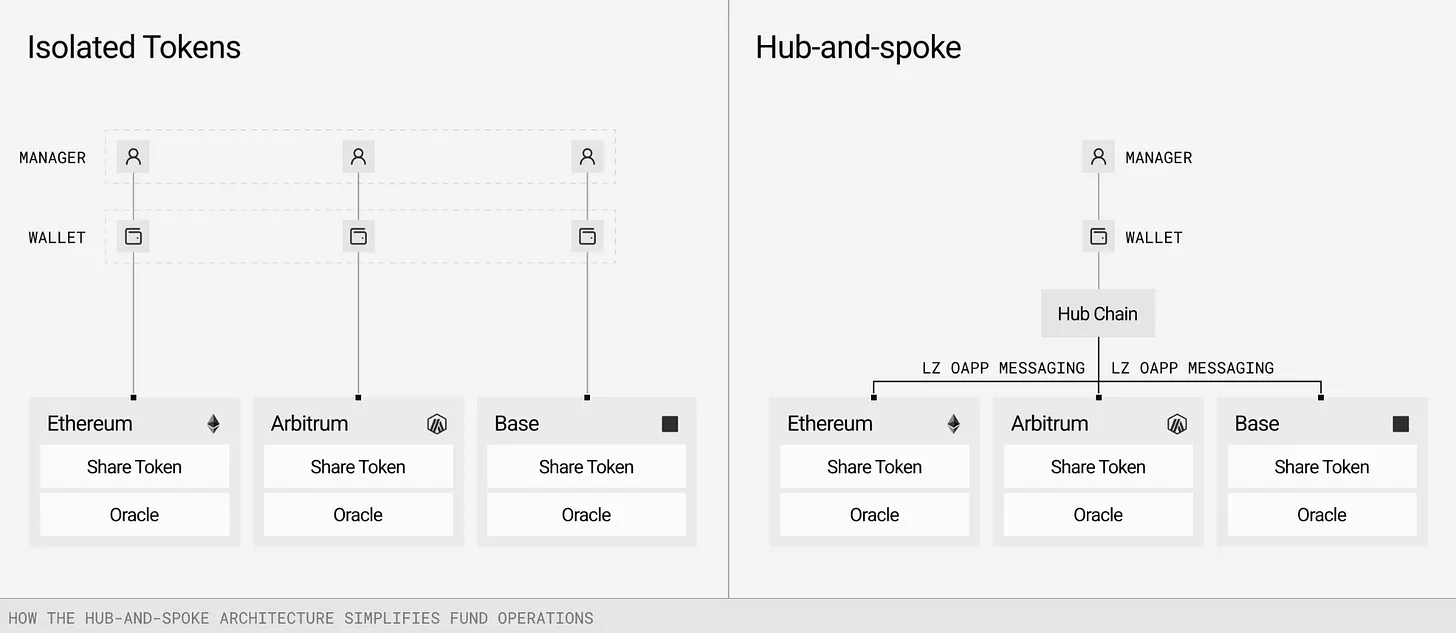


Centrifuge's V3 architecture is built on this model. Each asset pool selects a hub chain as its single source of truth. The spoke chains act merely as deposit/withdrawal and distribution nodes while also offering DeFi composability. LayerZero is responsible for cross-chain synchronization of NAV, compliance instructions, and user position data.


This cross-chain orchestration system establishes a significant industry barrier. A fund's authoritative ledger is maintained by a single set of infrastructure, making it highly irreplaceable. Asset managers handle offline NAV and compliance rules. Blockchains provide on-chain composability. The middle orchestration layer is indispensable, and its value is highly concentrated.


The accounting for assets in transit during cross-chain transfers is the weakest link. When assets move across chains, they briefly fall outside the visible scope of the fund's balance sheet. Centrifuge V3 introduces a mechanism for in-transit asset certificates, ensuring accounting continuity during cross-chain transfers—analogous to the general ledger principle in traditional finance. This seemingly basic feature is essential for institutional adoption.


Despite these conflicts, why would institutional investors consider tokenized funds?


The core advantage is recursive staking arbitrage. A corporate treasury deposits into a tokenized Treasury fund and pledges the shares as collateral to borrow stablecoins. If the borrowing rate is lower than the Treasury fund's yield, the position naturally generates a positive carry. The borrowed stablecoins can then be deployed into another yield-bearing asset, creating a potentially infinite loop to amplify cash flow returns.
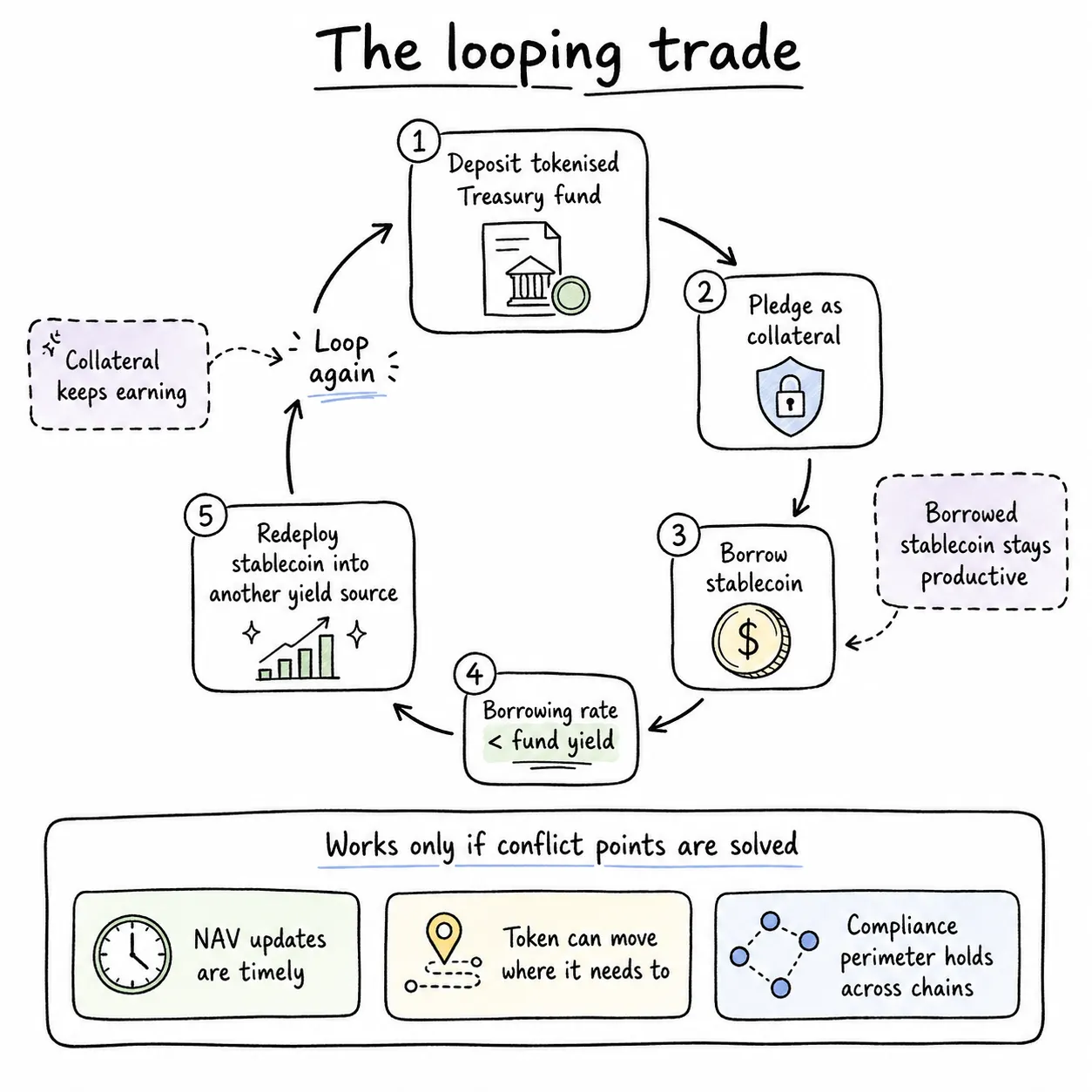


The entire recursive arbitrage loop is only viable if the three major conflict points mentioned earlier are properly resolved. In the past, the industry saw significant arbitrage opportunities due to mechanism flaws: small tokenized products had NAV updates delayed by 2-4 hours, allowing carry traders to front-run the difference. Redemption conflict risks are equally significant. If the off-chain underlying assets hit redemption limits while the on-chain smart contract continues to process instant redemptions, it creates a large number of unfilled orders.


Currently, large private credit funds and business development companies are facing this scenario. Two weeks ago, Apollo's $26 billion private credit fund, ADS, faced a wave of redemptions, with investors requesting withdrawals totaling 16.8% of the fund's shares. The platform was forced to cap daily redemptions at 5%. If this product had simultaneously issued tokens, the conflict between on-chain instant redemptions and off-chain redemption limits would have been direct. In Q2 of this year, redemption requests for large private credit funds reached $15.6 billion, up from $13.9 billion the previous quarter.


Cross-chain messaging failures mid-transaction and partially settled assets are also high-frequency risks. For each type of failure in this system, licensed entities must bear regulatory accountability to earn the trust of institutional capital.


Tokenization is not simply about putting Treasuries on-chain or adding a new digital asset class. Infrastructure builders must break traditional constraints, allowing investors not to choose between yield, liquidity, and capital turnover. If a tokenized system can uphold regulatory risk controls while enabling multi-purpose value generation from a single pool of capital, institutions holding trillions in cash will inevitably deploy at scale.


As mentioned in last week's article, SWIFT, as an orchestration layer, holds far greater value than the banks at either end. Similarly, the Visa network's profitability nearly surpasses that of all its partner banks except JPMorgan Chase. In the evolution of the financial industry, whoever controls the middle orchestration layer will lock in the capital market dividends of the next decade. Centrifuge is deeply focused on fund-side infrastructure, while LayerZero is building the cross-chain communication foundation. Together, they are positioning themselves at the core of this critical sector.

Trend Kriptolar

İlgili Sorular

QWhat is the core advantage of tokenized real-world assets (RWAs) over traditional assets, according to the article?

AThe core advantage is composability. It allows the same pool of capital to be leveraged and reused across multiple on-chain strategies, enabling compound returns, instant redemption, and enhanced capital efficiency compared to traditional systems where yield, liquidity, and speed are often trade-offs.

QWhat are the three core conflicts that must be solved by a middleware layer to successfully bridge traditional funds and DeFi?

AThe three core conflicts are: 1) Pricing: how to price tokens between daily net asset value (NAV) updates. 2) Compliance: where and how to enforce KYC/whitelist checks without crippling DeFi composability. 3) Cross-chain accounting: how to maintain a single source of truth for holder records and valuations across multiple blockchains.

QHow does the Centrifuge V3 architecture, in collaboration with LayerZero, address the cross-chain accounting problem?

AIt uses a hub-and-spoke model. One authoritative chain (the hub) serves as the single source of truth for NAV, accounting, and compliance. A messaging layer (LayerZero) propagates these updates to the spoke chains where the tokens are actually used, ensuring data consistency and reducing errors from multi-chain synchronization.

QWhat major risk example does the article give to illustrate the conflict between on-chain and off-chain redemption processes?

AThe article cites Apollo's $26 billion private credit fund (ADS) facing redemptions of 16.8% of its shares. The fund had to impose a 5% daily redemption limit. If this fund had an on-chain token, the conflict would arise between the smart contract allowing instant redemptions and the off-fund's imposed limits, potentially creating unsettled orders.

QAccording to the article, who is positioned to capture the future value in the RWA tokenization space, and why?

AThe value will be captured by the entities that build and control the critical middleware scheduling layer—the infrastructure that bridges traditional funds and on-chain DeFi. The article draws an analogy to SWIFT and Visa, whose central coordination roles are more valuable than the endpoints. Specifically, it mentions Centrifuge (fund-side infrastructure) and LayerZero (cross-chain communication) as occupying this core position.

İlgili Okumalar

Weng Li's New Blog Proposes 'Self-Evolution Should Start from Harness', DeepSeek's Cui Tianyi Endorses with Repost

Lilian Weng, former OpenAI security VP and co-founder of Thinking Machines Lab, has published a new blog post titled "Harness Engineering for Self-Improvement," proposing a pragmatic path for AI self-evolution. She argues that Recursive Self-Improvement (RSI) may practically begin at the "Harness" layer—the external runtime system governing how models use tools, manage context, and execute tasks—rather than directly from the model rewriting its own weights. The blog outlines a progression from optimizing prompts (Context Engineering) to designing workflows, and ultimately to Self-Improving Harness systems. These systems can identify their own weaknesses, propose targeted, verifiable modifications to the harness code, and validate improvements. Works like Self-Harness and Darwin Gödel Machine (DGM) demonstrate significant performance gains on benchmarks like SWE-bench through such automated harness evolution, rivaling handcrafted agents. DeepSeek researcher Tianyi Cui endorsed the view, noting harness-based self-evolution is as promising as model-based approaches. Weng emphasizes this is complementary to model training, with both reinforcing each other. However, key challenges remain: weak evaluators for subjective tasks, reward hacking, diversity collapse, managing long-term system health versus short-term success, and defining the human oversight role. The consensus is growing: the harness is a critical variable, as the same model can exhibit vastly different capabilities within different harness systems.

marsbit16 dk önce

Weng Li's New Blog Proposes 'Self-Evolution Should Start from Harness', DeepSeek's Cui Tianyi Endorses with Repost

marsbit16 dk önce

Odaily Editorial Department Tea Party (July 8)

Odaily Editorial Team Casual Chat (July 8) This is an informal column from Odaily's editorial team, sharing immediate thoughts on industry news, data, and hot topics from various angles. It presents investment ideas and opportunity hypotheses still under verification—which may not be direct wealth codes but questions in themselves—alongside observations from industry interactions and materials that genuinely enhance the team's understanding. The content is based on real investment and observation experiences, carries no advertising, and does not constitute investment advice. Its purpose is to broaden perspectives and supplement information sources, not to create consensus. Team Member Shares: * **Wenser (@wenser2010):** Noted a deeper correction (nearly 30%) in US and Korean stocks, including memory stocks, but remains bullish on DRAM due to perceived supply shortages. In prediction markets, personal small bets outperformed blind copying; favors France to win the World Cup. Views crypto-related stocks like STRK as bearish for now, while seeing Circle and Coinbase as potential rebound plays. Observes recent strength in software stocks like Microsoft but is unsure if it's a sustained recovery. * **Bcxiongdi (@bcxiongdi):** Discusses the recent "recovery training" in meme coin markets on Solana and BSC, characterized by small-scale PVP opportunities, admitting to having sold many assets too early. Suggests also watching the Robinhood chain. Found World Cup prediction markets challenging, advising to consider buying during matches rather than only before. * **Azuma (@azuma_eth):** Focuses on the US stock market, particularly the significant semiconductor correction. Believes demand fundamentals remain and considers buying the dip in DRAM stocks. Notes a potential rotation signal as hedge funds have recently concentrated buying in tech stocks. Plans to continue adding to RKLB (Rocket Lab) stock, seeing limited downside and high upside potential at current levels after its founder's share sale window closed.

Odaily星球日报32 dk önce

Odaily Editorial Department Tea Party (July 8)

Odaily星球日报32 dk önce

Former Huawei 'Genius Teen' Who Questioned DeepSeek Interview Lands in 'Crossfire' from Web3 Investor

Former Huawei "Genius Youth" Li Bojie recently drew public attention by criticizing his interview experience with DeepSeek. The controversy escalated when Du Jun, co-founder of Web3 investment firm ABCDE Capital, publicly accused Li of being "the founder with the least sense of contractual spirit" he had ever cooperated with, sparking a dispute over Li's startup project, Metagent. Li detailed a frustrating DeepSeek interview where he was accused of potential plagiarism, leading him to end the session. The spotlight then shifted to his venture, Metagent, a Web3+AI project aiming to tokenize AI agents. ABCDE invested $1.5 million, with an initial $500k disbursed. Du Jun claimed the project's progress was severely lacking, with a poor-quality demo and minimal social media activity. He alleged Li stopped communicating, deleted his Telegram, and failed to provide proper financial reporting. In response, Li argued the remaining $1 million was never received, crippling operations and forcing salary cuts. He stated he left Metagent in October 2024 due to family reasons and Web3 compliance concerns, with board approval. He claimed to have fulfilled disclosure duties and that his subsequent projects avoided conflicting fields. Other investors, including ArkStream Capital, shared negative due diligence experiences, citing unprofessional contracts and evasive answers on tokenomics. Metagent's social media went silent in June 2024, effectively stalling. Li has since moved to a new consumer AI agent platform, Pine AI (formerly Logenic AI), which has raised $25 million in Series A funding. He served as its Chief Scientist but recently left, clarifying he was not the founder and departed due to a shift in research interests.

Foresight News1 saat önce

Former Huawei 'Genius Teen' Who Questioned DeepSeek Interview Lands in 'Crossfire' from Web3 Investor

Foresight News1 saat önce

İşlemler

Spot

Popüler Makaleler

$S$ Nedir

SPERO'yu Anlamak: Kapsamlı Bir Genel Bakış SPERO'ya Giriş İnovasyonun manzarası gelişmeye devam ederken, web3 teknolojilerinin ve kripto para projelerinin ortaya çıkışı dijital geleceği şekillendirmede önemli bir rol oynamaktadır. Bu dinamik alanda dikkat çeken projelerden biri SPERO, $$s$$ olarak adlandırılmaktadır. Bu makale, SPERO hakkında ayrıntılı bilgi toplamak ve sunmak amacıyla, meraklılar ve yatırımcıların web3 ve kripto alanlarındaki temellerini, hedeflerini ve yeniliklerini anlamalarına yardımcı olmayı amaçlamaktadır. SPERO,$$s$$ Nedir? SPERO,$$s$$, kripto alanında merkeziyetsizlik ve blok zinciri teknolojisi ilkelerini kullanarak etkileşimi, faydayı ve finansal kapsayıcılığı teşvik eden bir ekosistem yaratmayı amaçlayan benzersiz bir projedir. Proje, kullanıcıların yenilikçi finansal çözümler ve hizmetler sunarak eşler arası etkileşimleri yeni yollarla kolaylaştırmayı hedeflemektedir. SPERO,$$s$$'nin temel amacı, bireyleri güçlendirmek ve kripto para alanındaki kullanıcı deneyimini artıran araçlar ve platformlar sağlamaktır. Bu, daha esnek işlem yöntemlerini mümkün kılmayı, topluluk odaklı girişimleri teşvik etmeyi ve merkeziyetsiz uygulamalar (dApp'ler) aracılığıyla finansal fırsatlar yaratmayı içermektedir. SPERO,$$s$$'nin temel vizyonu kapsayıcılık etrafında dönmekte olup, geleneksel finansal sistemlerdeki boşlukları kapatmayı ve blok zinciri teknolojisinin faydalarından yararlanmayı hedeflemektedir. SPERO,$$s$$'nin Yaratıcısı Kimdir? SPERO,$$s$$'nin yaratıcısının kimliği bir miktar belirsizdir, çünkü kurucusu(ları) hakkında ayrıntılı arka plan bilgisi sağlayan sınırlı kamuya açık kaynaklar bulunmaktadır. Bu şeffaflık eksikliği, projenin merkeziyetsizlik taahhüdünden kaynaklanabilir—birçok web3 projesinin paylaştığı bir etik anlayışı, bireysel tanınmanın yerine kolektif katkıları önceliklendirmektedir. Topluluk ve onun kolektif hedefleri etrafında tartışmaları merkezileştirerek, SPERO,$$s$$, belirli bireyleri öne çıkarmadan güçlendirme özünü taşımaktadır. Bu nedenle, SPERO'nun etik anlayışını ve misyonunu anlamak, tek bir yaratıcının kimliğini belirlemekten daha önemlidir. SPERO,$$s$$'nin Yatırımcıları Kimlerdir? SPERO,$$s$$, kripto sektöründe yeniliği teşvik etmeye adanmış girişim sermayedarlarından melek yatırımcılara kadar çeşitli yatırımcılar tarafından desteklenmektedir. Bu yatırımcıların odak noktası genellikle SPERO'nun misyonuyla uyumlu olup, toplumsal teknolojik ilerlemeyi, finansal kapsayıcılığı ve merkeziyetsiz yönetimi vaat eden projeleri önceliklendirmektedir. Bu yatırımcı temelleri, yalnızca yenilikçi ürünler sunan projelere değil, aynı zamanda blok zinciri topluluğuna ve ekosistemlerine olumlu katkılarda bulunan projelere de ilgi duymaktadır. Bu yatırımcıların desteği, SPERO,$$s$$'yi hızla gelişen kripto projeleri alanında dikkate değer bir rakip haline getirmektedir. SPERO,$$s$$ Nasıl Çalışır? SPERO,$$s$$, onu geleneksel kripto para projelerinden ayıran çok yönlü bir çerçeve kullanmaktadır. İşte benzersizliğini ve yeniliğini vurgulayan bazı temel özellikler: Merkeziyetsiz Yönetim: SPERO,$$s$$, kullanıcıların projenin geleceğiyle ilgili karar alma süreçlerine aktif olarak katılmalarını sağlayan merkeziyetsiz yönetim modellerini entegre etmektedir. Bu yaklaşım, topluluk üyeleri arasında sahiplik ve hesap verebilirlik duygusunu teşvik etmektedir. Token Kullanımı: SPERO,$$s$$, ekosistem içinde çeşitli işlevler sunmak üzere tasarlanmış kendi kripto para token'ını kullanmaktadır. Bu token'lar, işlemleri, ödülleri ve platformda sunulan hizmetlerin kolaylaştırılmasını sağlayarak genel etkileşimi ve faydayı artırmaktadır. Katmanlı Mimari: SPERO,$$s$$'nin teknik mimarisi, modülerlik ve ölçeklenebilirliği destekleyerek projenin evrimi sırasında ek özelliklerin ve uygulamaların sorunsuz bir şekilde entegrasyonuna olanak tanımaktadır. Bu uyum sağlama yeteneği, sürekli değişen kripto manzarasında geçerliliği sürdürmek için hayati öneme sahiptir. Topluluk Katılımı: Proje, işbirliği ve geri bildirim teşvik eden mekanizmalar kullanarak topluluk odaklı girişimlere vurgu yapmaktadır. Güçlü bir topluluk oluşturarak, SPERO,$$s$$, kullanıcı ihtiyaçlarını daha iyi karşılayabilir ve piyasa trendlerine uyum sağlayabilir. Kapsayıcılığa Odaklanma: Düşük işlem ücretleri ve kullanıcı dostu arayüzler sunarak, SPERO,$$s$$, daha önce kripto alanında yer almamış bireyler de dahil olmak üzere çeşitli bir kullanıcı tabanını çekmeyi hedeflemektedir. Bu kapsayıcılık taahhüdü, erişilebilirlik yoluyla güçlendirme misyonuyla uyumludur. SPERO,$$s$$ Zaman Çizelgesi Bir projenin tarihini anlamak, gelişim yolculuğu ve kilometre taşları hakkında kritik bilgiler sağlar. Aşağıda, SPERO,$$s$$'nin evriminde önemli olayları haritalayan önerilen bir zaman çizelgesi bulunmaktadır: Kavram Geliştirme ve Fikir Aşaması: SPERO,$$s$$'nin temelini oluşturan ilk fikirler, blok zinciri endüstrisindeki merkeziyetsizlik ve topluluk odaklılık ilkeleriyle yakından uyumlu olarak geliştirildi. Proje Beyaz Kağıdının Yayınlanması: Kavramsal aşamayı takiben, SPERO,$$s$$'nin vizyonunu, hedeflerini ve teknolojik altyapısını ayrıntılı bir şekilde açıklayan kapsamlı bir beyaz kağıt yayımlandı ve topluluk ilgisini ve geri bildirimini toplamak amacıyla sunuldu. Topluluk Oluşturma ve Erken Katılımlar: Projenin hedefleri etrafında tartışmalar yürüterek destek toplamak ve erken benimseyenler ile potansiyel yatırımcılar için bir topluluk oluşturmak amacıyla aktif iletişim çabaları gerçekleştirildi. Token Üretim Etkinliği: SPERO,$$s$$, yerel token'larını erken destekçilere dağıtmak ve ekosistem içinde başlangıç likiditesini sağlamak amacıyla bir token üretim etkinliği (TGE) gerçekleştirdi. İlk dApp'in Yayınlanması: SPERO,$$s$$ ile ilişkili ilk merkeziyetsiz uygulama (dApp) faaliyete geçti ve kullanıcıların platformun temel işlevleriyle etkileşimde bulunmalarını sağladı. Sürekli Gelişim ve Ortaklıklar: Projenin tekliflerine sürekli güncellemeler ve iyileştirmeler yapılmakta olup, blok zinciri alanındaki diğer oyuncularla stratejik ortaklıklar, SPERO,$$s$$'yi rekabetçi ve gelişen bir oyuncu haline getirmiştir. Sonuç SPERO,$$s$$, web3 ve kripto paranın finansal sistemleri devrim niteliğinde dönüştürme ve bireyleri güçlendirme potansiyelinin bir kanıtıdır. Merkeziyetsiz yönetime, topluluk katılımına ve yenilikçi tasarlanmış işlevselliğe olan bağlılığıyla, daha kapsayıcı bir finansal manzaraya doğru bir yol açmaktadır. Hızla gelişen kripto alanındaki herhangi bir yatırımda olduğu gibi, potansiyel yatırımcılar ve kullanıcılar, SPERO,$$s$$ içindeki devam eden gelişmelerle ilgili olarak kapsamlı bir araştırma yapmaları ve düşünceli bir şekilde katılmaları teşvik edilmektedir. Proje, kripto endüstrisinin yenilikçi ruhunu sergileyerek, sayısız olasılığını keşfetmeye davet etmektedir. SPERO,$$s$$'nin yolculuğu hala devam ederken, temel ilkeleri, teknoloji, finans ve birbirimizle etkileşim biçimimizi etkileyebilir.

164 Toplam GörüntülenmeYayınlanma 2024.12.17Güncellenme 2024.12.17

$S$ Nedir

AGENT S Nedir

Agent S: Web3'te Otonom Etkileşimin Geleceği Giriş Web3 ve kripto para dünyasında sürekli gelişen manzarada, yenilikler bireylerin dijital platformlarla etkileşim biçimlerini sürekli olarak yeniden tanımlıyor. Bu tür öncü projelerden biri olan Agent S, açık ajans çerçevesi aracılığıyla insan-bilgisayar etkileşimini devrim niteliğinde değiştirmeyi vaat ediyor. Otonom etkileşimlerin yolunu açarak, Agent S karmaşık görevleri basitleştirmeyi ve yapay zeka (AI) alanında dönüştürücü uygulamalar sunmayı hedefliyor. Bu detaylı inceleme, projenin karmaşıklıklarına, benzersiz özelliklerine ve kripto para alanındaki etkilerine dalacaktır. Agent S Nedir? Agent S, bilgisayar görevlerinin otomasyonunda üç temel zorluğu ele almak üzere özel olarak tasarlanmış çığır açıcı bir açık ajans çerçevesidir: Alan Spesifik Bilgi Edinimi: Çerçeve, çeşitli dış bilgi kaynaklarından ve iç deneyimlerden akıllıca öğrenir. Bu çift yönlü yaklaşım, alan spesifik bilgi açısından zengin bir veri havuzu oluşturmasını sağlar ve görev yürütmedeki performansını artırır. Uzun Görev Ufukları Üzerinde Planlama: Agent S, karmaşık görevlerin verimli bir şekilde parçalanmasını ve yürütülmesini kolaylaştıran deneyim artırımlı hiyerarşik planlama kullanır. Bu özellik, çoklu alt görevleri etkili ve verimli bir şekilde yönetme yeteneğini önemli ölçüde artırır. Dinamik, Homojen Olmayan Arayüzlerle Başlama: Proje, ajanlar ve kullanıcılar arasındaki etkileşimi geliştiren yenilikçi bir çözüm olan Ajan-Bilgisayar Arayüzü'ni (ACI) tanıtmaktadır. Çok Modlu Büyük Dil Modellerini (MLLM'ler) kullanarak, Agent S çeşitli grafik kullanıcı arayüzlerini sorunsuz bir şekilde gezinebilir ve manipüle edebilir. Bu öncü özellikler aracılığıyla, Agent S, makinelerle insan etkileşimini otomatikleştirmede karşılaşılan karmaşıklıkları ele alan sağlam bir çerçeve sunarak, AI ve ötesinde birçok uygulama için zemin hazırlıyor. Agent S'nin Yaratıcısı Kimdir? Agent S'nin kavramı temelde yenilikçi olsa da, yaratıcısı hakkında spesifik bilgiler belirsizliğini koruyor. Yaratıcı şu anda bilinmiyor, bu da projenin yeni aşamasını veya kurucu üyeleri gizli tutma stratejik tercihini vurguluyor. Anonimlikten bağımsız olarak, odak çerçevenin yetenekleri ve potansiyeli üzerinde kalıyor. Agent S'nin Yatırımcıları Kimlerdir? Agent S, kriptografik ekosistemde oldukça yeni olduğundan, yatırımcıları ve finansal destekçileri hakkında ayrıntılı bilgiler açıkça belgelenmemiştir. Projeyi destekleyen yatırım temelleri veya organizasyonları hakkında kamuya açık bilgilerdeki eksiklik, finansman yapısı ve gelişim yol haritası hakkında sorular doğuruyor. Destekleyicilerin anlaşılması, projenin sürdürülebilirliğini ve potansiyel pazar etkisini değerlendirmek için kritik öneme sahiptir. Agent S Nasıl Çalışır? Agent S'nin temelinde, çeşitli ortamlarda etkili bir şekilde çalışmasını sağlayan son teknoloji bir sistem yatmaktadır. İşleyiş modeli birkaç ana özellik etrafında inşa edilmiştir: İnsan Benzeri Bilgisayar Etkileşimi: Çerçeve, bilgisayarlarla etkileşimleri daha sezgisel hale getirmeyi amaçlayan gelişmiş AI planlaması sunar. Görev yürütmedeki insan davranışını taklit ederek, kullanıcı deneyimlerini yükseltmeyi vaat eder. Anlatı Belleği: Yüksek düzeyde deneyimlerden yararlanmak için kullanılan Agent S, görev geçmişlerini takip etmek amacıyla anlatı belleğini kullanarak karar verme süreçlerini geliştirir. Episodik Bellek: Bu özellik, kullanıcılara adım adım rehberlik sağlayarak, çerçevenin görevler gelişirken bağlamsal destek sunmasına olanak tanır. OpenACI Desteği: Yerel olarak çalışabilme yeteneği ile Agent S, kullanıcıların etkileşimleri ve iş akışları üzerinde kontrol sağlamasına olanak tanır ve Web3'ün merkeziyetsiz felsefesiyle uyumlu hale gelir. Dış API'lerle Kolay Entegrasyon: Çeşitli AI platformlarıyla uyumluluğu ve çok yönlülüğü, Agent S'nin mevcut teknolojik ekosistemlere sorunsuz bir şekilde entegre olmasını sağlar ve geliştiriciler ile organizasyonlar için cazip bir seçenek haline getirir. Bu işlevsellikler, Agent S'nin kripto alanındaki benzersiz konumuna katkıda bulunarak, karmaşık, çok aşamalı görevleri minimum insan müdahalesi ile otomatikleştirir. Proje geliştikçe, Web3'teki potansiyel uygulamaları dijital etkileşimlerin nasıl gelişeceğini yeniden tanımlayabilir. Agent S'nin Zaman Çizelgesi Agent S'nin gelişimi ve kilometre taşları, önemli olaylarını vurgulayan bir zaman çizelgesinde özetlenebilir: 27 Eylül 2024: Agent S'nin kavramı, “Bilgisayarları İnsan Gibi Kullanan Açık Bir Ajans Çerçevesi” başlıklı kapsamlı bir araştırma makalesi ile tanıtıldı ve projenin temelini sergiledi. 10 Ekim 2024: Araştırma makalesi arXiv'de kamuya açık olarak yayınlandı ve çerçevenin derinlemesine bir incelemesini ve OSWorld benchmark'ına dayalı performans değerlendirmesini sundu. 12 Ekim 2024: Agent S'nin yetenekleri ve özellikleri hakkında görsel bir içgörü sağlayan bir video sunumu yayımlandı ve potansiyel kullanıcılar ve yatırımcılarla daha fazla etkileşim sağlandı. Bu zaman çizelgesindeki işaretler, sadece Agent S'nin ilerlemesini değil, aynı zamanda şeffaflık ve topluluk katılımına olan bağlılığını da göstermektedir. Agent S Hakkında Ana Noktalar Agent S çerçevesi gelişmeye devam ederken, birkaç ana özellik öne çıkmakta ve yenilikçi doğasını ve potansiyelini vurgulamaktadır: Yenilikçi Çerçeve: İnsan etkileşimine benzer bir bilgisayar kullanımı sağlamak üzere tasarlanan Agent S, görev otomasyonuna yeni bir yaklaşım getiriyor. Otonom Etkileşim: GUI aracılığıyla bilgisayarlarla otonom olarak etkileşim kurabilme yeteneği, daha akıllı ve verimli hesaplama çözümlerine doğru bir sıçrama anlamına geliyor. Karmaşık Görev Otomasyonu: Sağlam metodolojisi ile karmaşık, çok aşamalı görevleri otomatikleştirerek süreçleri daha hızlı ve daha az hata payı ile gerçekleştirebilir. Sürekli İyileştirme: Öğrenme mekanizmaları, Agent S'nin geçmiş deneyimlerden öğrenmesini sağlar ve sürekli olarak performansını ve etkinliğini artırır. Çok Yönlülük: OSWorld ve WindowsAgentArena gibi farklı işletim ortamlarında uyumlu olması, geniş bir uygulama yelpazesine hizmet edebilmesini sağlar. Agent S, Web3 ve kripto alanında kendini konumlandırırken, etkileşim yeteneklerini artırma ve süreçleri otomatikleştirme potansiyeli, AI teknolojilerinde önemli bir ilerlemeyi temsil etmektedir. Yenilikçi çerçevesi aracılığıyla, Agent S dijital etkileşimlerin geleceğini örneklemekte ve çeşitli sektörlerde kullanıcılar için daha sorunsuz ve verimli bir deneyim vaat etmektedir. Sonuç Agent S, AI ve Web3'ün birleşiminde cesur bir sıçramayı temsil ediyor ve teknoloji ile etkileşim biçimimizi yeniden tanımlama kapasitesine sahip. Henüz erken aşamalarında olmasına rağmen, uygulama olanakları geniş ve çekici. Kritik zorlukları ele alan kapsamlı çerçevesi ile Agent S, otonom etkileşimleri dijital deneyimin ön plana çıkmasına taşımayı hedefliyor. Kripto para ve merkeziyetsizlik alanlarına daha derinlemesine girdikçe, Agent S gibi projelerin teknoloji ve insan-bilgisayar işbirliğinin geleceğini şekillendirmede önemli bir rol oynayacağı kesin.

647 Toplam GörüntülenmeYayınlanma 2025.01.14Güncellenme 2025.01.14

AGENT S Nedir

S Nasıl Satın Alınır

HTX.com’a hoş geldiniz! Sonic (S) satın alma işlemlerini basit ve kullanışlı bir hâle getirdik. Adım adım açıkladığımız rehberimizi takip ederek kripto yolculuğunuza başlayın. 1. Adım: HTX Hesabınızı OluşturunHTX'te ücretsiz bir hesap açmak için e-posta adresinizi veya telefon numaranızı kullanın. Sorunsuzca kaydolun ve tüm özelliklerin kilidini açın. Hesabımı Aç2. Adım: Kripto Satın Al Bölümüne Gidin ve Ödeme Yönteminizi SeçinKredi/Banka Kartı: Visa veya Mastercard'ınızı kullanarak anında Sonic (S) satın alın.Bakiye: Sorunsuz bir şekilde işlem yapmak için HTX hesap bakiyenizdeki fonları kullanın.Üçüncü Taraflar: Kullanımı kolaylaştırmak için Google Pay ve Apple Pay gibi popüler ödeme yöntemlerini ekledik.P2P: HTX'teki diğer kullanıcılarla doğrudan işlem yapın.Borsa Dışı (OTC): Yatırımcılar için kişiye özel hizmetler ve rekabetçi döviz kurları sunuyoruz.3. Adım: Sonic (S) Varlıklarınızı SaklayınSonic (S) satın aldıktan sonra HTX hesabınızda saklayın. Alternatif olarak, blok zinciri transferi yoluyla başka bir yere gönderebilir veya diğer kripto para birimlerini takas etmek için kullanabilirsiniz.4. Adım: Sonic (S) Varlıklarınızla İşlem YapınHTX'in spot piyasasında Sonic (S) ile kolayca işlemler yapın.Hesabınıza erişin, işlem çiftinizi seçin, işlemlerinizi gerçekleştirin ve gerçek zamanlı olarak izleyin. Hem yeni başlayanlar hem de deneyimli yatırımcılar için kullanıcı dostu bir deneyim sunuyoruz.

1.7k Toplam GörüntülenmeYayınlanma 2025.01.15Güncellenme 2026.06.02

S Nasıl Satın Alınır

Tartışmalar

HTX Topluluğuna hoş geldiniz. Burada, en son platform gelişmeleri hakkında bilgi sahibi olabilir ve profesyonel piyasa görüşlerine erişebilirsiniz. Kullanıcıların S (S) fiyatı hakkındaki görüşleri aşağıda sunulmaktadır.

活动图片