Bitcoin Price Approaches $100k Mark: Market Forecasts and Wall Street Views

cryptonews.ru2026-08-27 tarihinde yayınlandı2026-08-27 tarihinde güncellendi

Özet

Bitcoin Price Approaches $100,000: Market Forecasts and Wall Street Views Bitcoin is nearing the $100,000 threshold as traders on prediction markets like Polymarket and Kalshi weigh various price targets for the coming years. On Polymarket, with nearly $59.7 million in volume for contracts on Bitcoin's price by end-2026, the probability of hitting $85,000 is seen at 69%, while chances for $90,000 fall to 49%. The likelihood drops significantly for higher targets: $100,000 at 29%, $110,000 at 20%, and $120,000 at 13%. Extreme targets of $150,000 and above are given very low odds. This activity is not purely bullish. Traders also price in significant downside risk, with a 67% chance of Bitcoin falling to $70,000, 44% to $65,000, and 29% to $60,000 before year-end. This creates a wide battlefield of expectations rather than a simple optimistic consensus. Similarly, on Kalshi, a $100,000-target market shows traders assign only a 7% chance of reaching that level by October, 22% by December, and 29% by January 2027. Another contract bets a 21% chance Bitcoin crashes to $50,000 before it ever touches $100,000. In contrast, Wall Street firm Bernstein presents a much more bullish long-term outlook. Analyst Gautam Chhugani forecasts Bitcoin reaching approximately $125,000 by year-end, a new high of $150,000 by mid-2027, and a cycle peak around $300,000 by late 2029. This optimism is based on institutional ownership, ETF demand, and Bitcoin's fixed supply amid high sovereign debt. ...

The highest activity is observed on Polymarket, where contracts concerning what price Bitcoin will reach by the end of 2026 accounted for nearly $59.7 million in volume. As the Bitcoin price has recently been trading above $75,000, traders assess the probability of reaching the $85,000 mark at 69%, while the chances of reaching $90,000 drop to 49%.

Interest in bets declines rapidly as target levels become higher. According to Polymarket, the probability of reaching the $100,000 mark is 29%, $110,000 is 20%, and $120,000 is 13%. The probability of a return to the $150,000 mark is estimated at just 4%, while "sky-high" target marks of $250,000, $500,000, and $1 million are estimated at 2%, 1%, and 1% respectively.
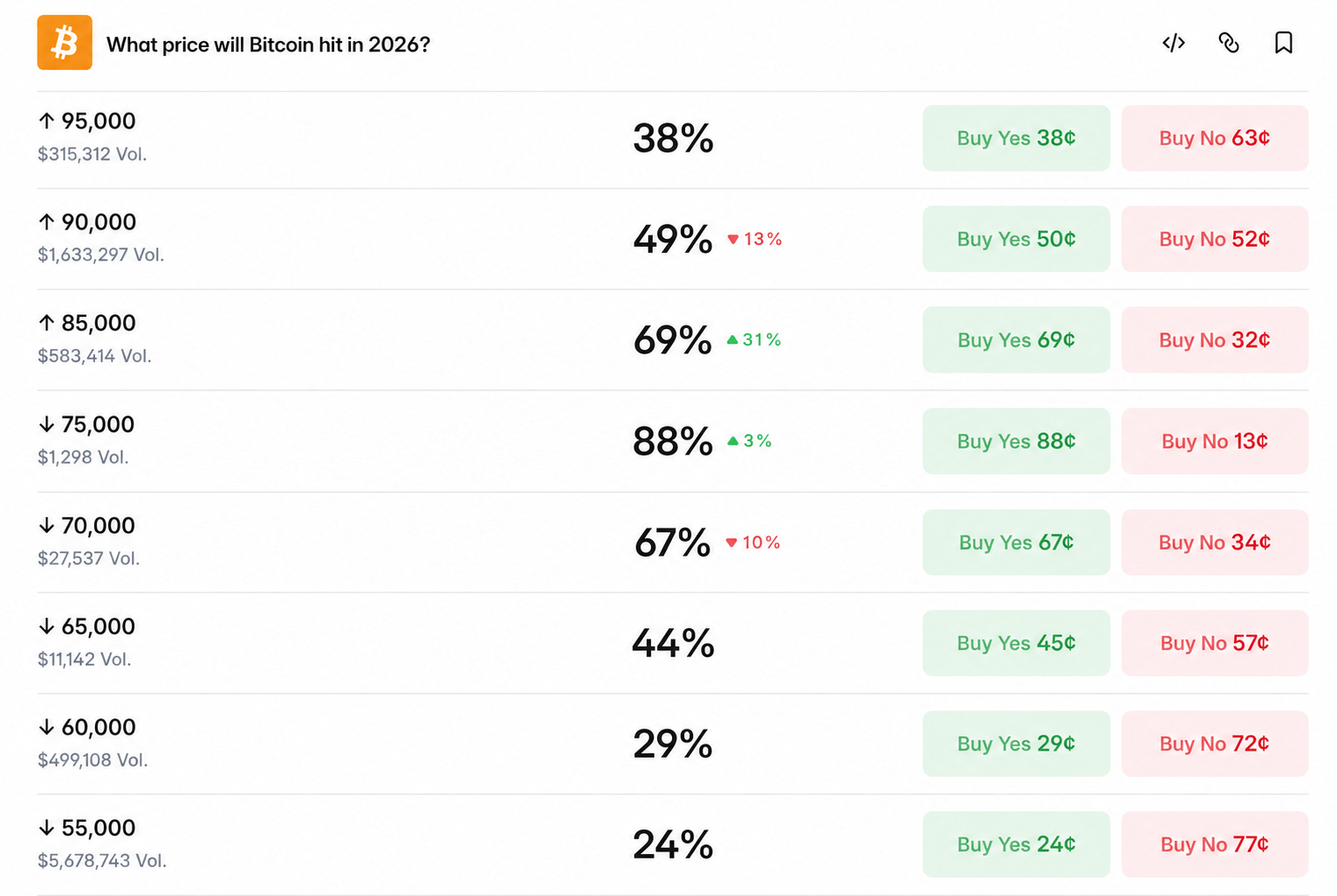
Some of the highest odds on the Polymarket event "What price will Bitcoin reach in 2026?". Screenshot taken on August 26, 2026.

These percentage values are not Wall Street target figures taken from a spreadsheet. Contracts on the prediction market trade based on specific outcomes, and their prices show what participants are actually willing to risk on these events. Money flow in any direction constantly reassesses the implied probabilities.

Traders are putting real money on a Bitcoin price drop

This activity is hardly a one-sided bet on growth. Polymarket traders estimate the probability of Bitcoin reaching $70,000 by year-end at 67%, and the probability of reaching $65,000 at 44%. The probability of a drop to $60,000 is 29%, to $50,000 is 17%, and to $40,000 is 8%.

Thus, instead of a clear optimistic consensus, an exceptionally wide battlefield is forming. Prediction market participants are willing to pay for a serious decline while maintaining hope for another surge into six-digit gains. More importantly, these contracts are settled upon reaching a specific threshold, not based on the level at which Bitcoin ends the year.

A separate Polymarket market dedicated to when Bitcoin will reach the $100,000 mark shows similar caution. Traders estimate the probability of reaching this mark by December 31, 2026 at 34%, by March 31, 2027 at 48%, by June 30 at 60%, and by the end of 2027 at 81%. However, with a trading volume of only $11,874, this market is significantly smaller than the larger pool of target prices.

Kalshi's Millions Build Another Barrier Wall at $100k

Those placing bets on Kalshi are sending a roughly similar warning. Trading volume on Kalshi's Bitcoin market with a $100,000 target mark was about $11.5 million, with the probability of reaching this mark being 7% by October, 22% by December, and 29% by January 2027.
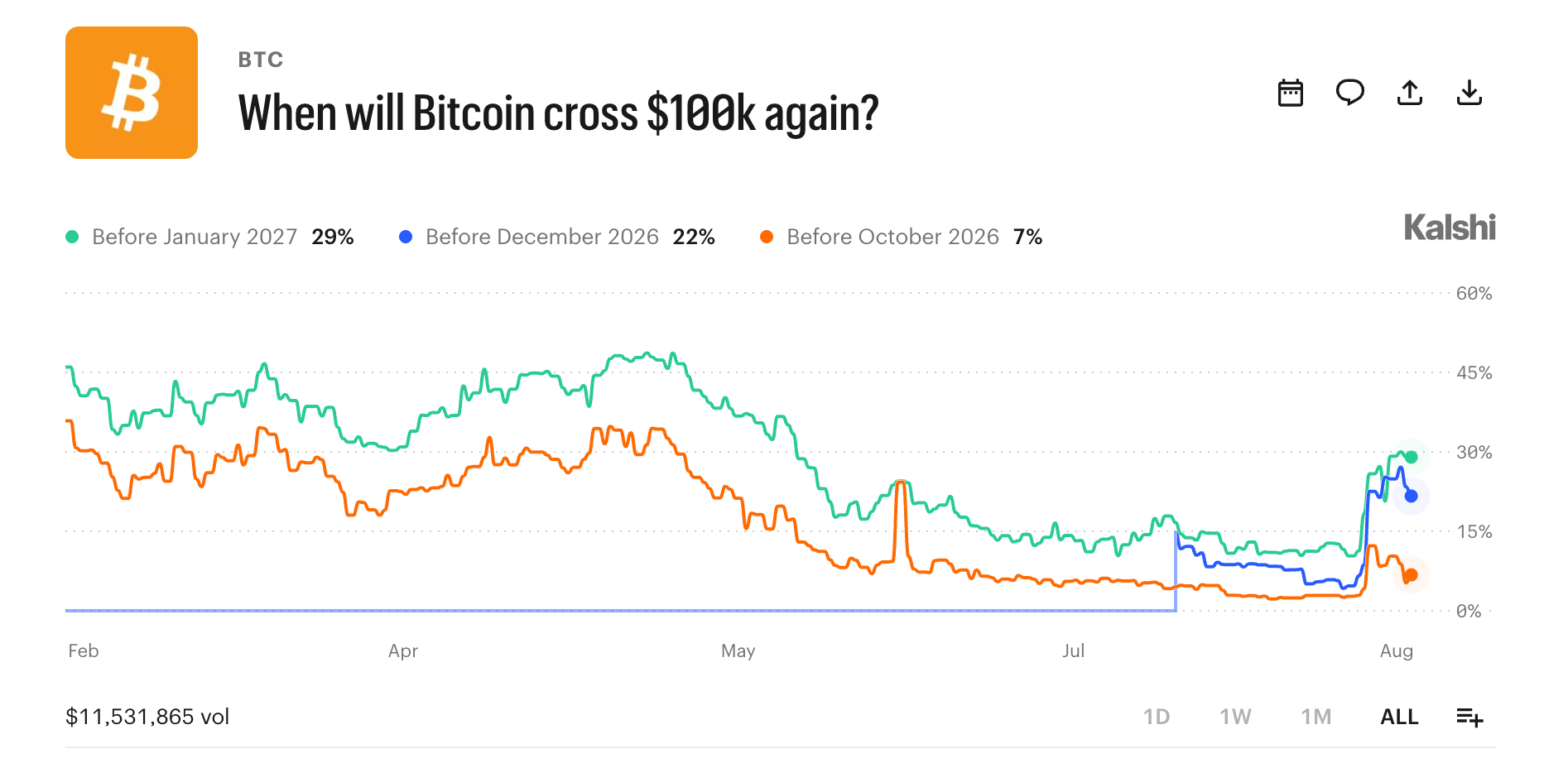
Another Kalshi contract makes the bet even sharper: will Bitcoin crash to $50,000 before reaching $100,000? Traders currently estimate the probability of the "$50k first" scenario at approximately 21%. This bet will be lost if Bitcoin first reaches the $100,000 mark or if neither of these prices is reached before expiration.

The $150,000 target is even more challenging to reach. Kalshi's market at this level has attracted over $36 million in trading volume, yet traders estimate the probability of Bitcoin reaching the $150,000 mark by January 2027 at only 6%.

Bernstein Stands Out from Prediction Market Participants

The Wall Street analytics firm Bernstein is much more optimistic regarding the period after 2026. In a report published on Wednesday, Bernstein's lead analyst Gautam Chhugani forecasts that Bitcoin will return to around $125,000 by year-end, reach a new high of $150,000 by mid-2027, and ultimately achieve a cycle peak of about $300,000 per coin by the end of 2029 in the firm's base case scenario.
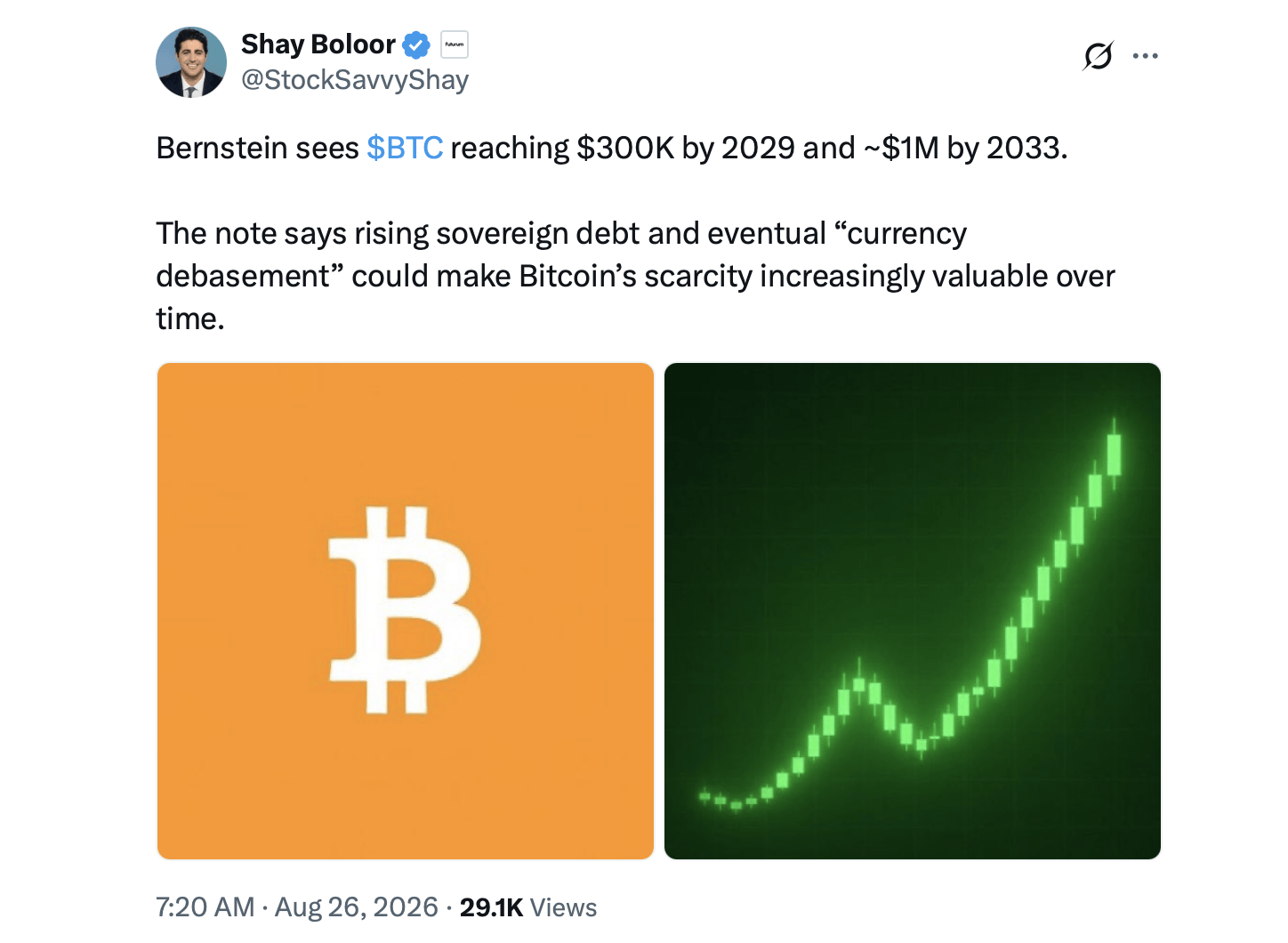
Bernstein's reasoning relies on institutional ownership, ETF demand, and Bitcoin's fixed supply of 21 million coins, while governments grapple with massive sovereign debt and rising interest expenses. Speculators using prediction markets are primarily anticipating a much rockier path. The nearest resistance levels are at $85,000, $90,000, and $100,000, while $70,000 and the formidable support level at $60,000 remain the lower levels where traders are actively opening hedging positions.

end-content

İlgili Sorular

QAccording to Polymarket data, what is the perceived probability of Bitcoin reaching $100,000 by the end of 2026?

AAccording to the data from the Polymarket prediction market, the perceived probability of Bitcoin reaching $100,000 by the end of 2026 is 29%.

QHow does the Wall Street firm Bernstein's price forecast for Bitcoin differ from the market sentiment on prediction markets like Polymarket and Kalshi?

AThe Wall Street firm Bernstein is significantly more optimistic. While prediction market traders show lower probabilities for high targets (e.g., 29% for $100k), Bernstein forecasts Bitcoin reaching $150,000 by mid-2027 and a cyclical peak around $300,000 by the end of 2029. The prediction markets suggest a much bumpier and more cautious short-term path.

QWhat is the central premise of the Kalshi contract that asks whether Bitcoin will drop to $50,000 before reaching $100,000?

AThe premise is to bet on which price threshold Bitcoin will hit first: $50,000 or $100,000. The contract will be lost if Bitcoin reaches $100,000 first, or if neither price is reached before the contract expires. Traders currently estimate the probability of the '$50,000 first' scenario at about 21%.

QAccording to the article, which specific price levels are acting as key resistance and support for Bitcoin based on trader activity?

ABased on trader activity in prediction markets, the nearest resistance levels for Bitcoin are at $85,000, $90,000, and $100,000. On the downside, $70,000 and a significant support level of $60,000 are the key levels where traders are actively hedging their positions.

QWhat is the significance of the trading volume differences mentioned between various contracts on Polymarket?

AThe volume differences highlight where market participants are most focused and willing to risk real money. The largest pool of volume ($59.7M) is in the main contract for Bitcoin's 2026 year-end price. The separate contract specifically for *when* Bitcoin reaches $100k has a much smaller volume (~$11.8k), indicating traders are more engaged in the broader price outcome than the specific timing of the $100k milestone.

İlgili Okumalar

Stripe Helps Revolut Issue a Euro Stablecoin

On August 26th, Revolut announced the rollout of EURR, a new euro-pegged stablecoin, to select users in Denmark, Poland, and Portugal, with plans to expand across the European Economic Area. The stablecoin, issued 1:1 against the euro on Ethereum and Polygon, is not issued by Revolut itself. Instead, it is issued by Bridge Building S.A., a Stripe-owned, Luxembourg-based electronic money institution licensed under the MiCA framework. This structure positions Revolut as the distribution channel for its over 80 million users, while Stripe/Bridge provides the compliant issuance infrastructure and reserve management. EURR's launch is essentially a cold start, with a circulating supply of only 374 tokens. It enters a euro stablecoin market dominated by Circle's EURC and Société Générale's EURCV, which itself is a tiny fraction of the massive dollar stablecoin market led by USDT and USDC. EURR's primary advantage is Revolut's vast user base, aiming to onboard retail banking customers to on-chain finance. However, its utility for the average Revolut user, who already enjoys fast euro transfers, remains tied to specific crypto-native use cases like DeFi. The launch coincides with Revolut's MiCA-driven phasing out of USDT for European users, positioning EURR as a compliant replacement. More broadly, the partnership highlights Stripe's strategy through its Bridge acquisition: building a "stablecoin-as-a-service" or "issuance-as-a-service" platform. Stripe aims to provide the compliant backend infrastructure—issuance, reserves, redemption—allowing other companies like Revolut to launch branded stablecoins easily, potentially reshaping the industry's competitive landscape from direct token competition to infrastructure services.

marsbit5 dk önce

Stripe Helps Revolut Issue a Euro Stablecoin

marsbit5 dk önce

U.S. Financial Risks Benefit Gold and Bitcoin! Record Capital Inflow Over the Last Five Trading Days! Here's All the Data

Concerns over U.S. fiscal prospects and growing government debt are driving investors towards both gold and Bitcoin. Over the last five trading days, a record $7 billion flowed into gold and Bitcoin ETFs. Approximately $3.4 billion entered the SPDR Gold Shares (GLD) fund, while BlackRock's spot Bitcoin ETF (IBIT) saw around $1.5 billion in inflows, placing both among the top ten U.S. ETFs by weekly capital inflow. Bloomberg notes the simultaneous strong inflows into both assets as particularly remarkable, a shift from past behavior where investors typically favored gold as a safe haven during market stress. Recent investor behavior has changed due to expectations of increased U.S. government borrowing, concerns about the dollar, and policies aimed at lowering long-term interest rates, boosting demand for assets with limited supply. The concurrent rise in the value of gold and Bitcoin indicates investors are turning to alternative assets to hedge against risks within the traditional financial system, especially amid heightened debates on U.S. debt sustainability. Experts suggest this strong ETF inflow may signal that institutional investors are increasingly viewing Bitcoin as a portfolio diversification tool similar to gold, though Bitcoin's high price volatility means the risk profiles of the two assets remain significantly different.

cryptonews.ru6 dk önce

U.S. Financial Risks Benefit Gold and Bitcoin! Record Capital Inflow Over the Last Five Trading Days! Here's All the Data

cryptonews.ru6 dk önce

Tokenized Deposits Could Raise US Lending Costs: Dallas Fed Economists

Tokenized deposits could increase U.S. lending costs and make bank funding less stable, according to an analysis by Dallas Fed economists. Rosy Leigh and Sreeni Ramaswamy note that instant settlement capabilities, programmable deposit tokens, and AI could allow depositors chasing higher yields to move funds faster between banks, reducing deposit tenures and increasing their sensitivity to interest rates. The economists estimate that a 10% increase in deposit rate sensitivity could reduce banks' capacity to hold long-term loans by around $700 billion over a ten‑year equivalent. A 10% reduction in deposit tenures could lower capacity by about $580 billion. These scenarios do not imply a direct, proportional cut in lending but highlight potential pressures. U.S. banks are developing blockchain networks for moving tokenized deposits around‑the‑clock while keeping funds within the regulated banking system. Thirty‑nine state banking associations recently formed the BankChain alliance to build a nationwide network, while The Clearing House is developing a separate network with major banks. Institutions like Standard Chartered and HSBC have also tested cross‑border tokenized deposit transactions via blockchain. Banks may respond to more volatile deposits by holding more liquid assets (like reserves and Treasuries) or relying more on wholesale debt—which would likely raise borrowing costs for consumers and businesses. The authors cite Brazil's Pix instant payment system as a comparative example, where increased use raised bank liquidity holdings and reduced credit intermediation.

cryptonews.ru8 dk önce

Tokenized Deposits Could Raise US Lending Costs: Dallas Fed Economists

cryptonews.ru8 dk önce

İşlemler

Spot
活动图片