Why Stripe’s $53B PayPal bid could reshape stablecoin payments

ambcrypto2026-07-15 tarihinde yayınlandı2026-07-15 tarihinde güncellendi

Özet

Stripe, in a joint bid with private equity firm Advent International, has made a $53 billion offer to acquire PayPal. The $60.50 per share offer represents a 28% premium and is backed by $50 billion in bank financing. While not yet accepted, prediction markets estimate a 72% chance of the deal closing. Analysts describe the potential acquisition as the "biggest story in the payments industry," noting that Stripe recently surpassed PayPal in annual payment volume. A combined entity would process an estimated $3.7 trillion annually. The move is seen as a major bet on stablecoin payments. Stripe has previously acquired Bridge to enable stablecoin transactions and built its own Tempo network. Acquiring PayPal would allow Stripe to scale retail offerings like Venmo and leverage PayPal's PYUSD stablecoin, merging Stripe's developer focus with PayPal's consumer trust. However, the deal faces significant regulatory and integration hurdles, including antitrust scrutiny. It highlights a broader trend of major payment firms like Mastercard and Visa also aggressively entering the stablecoin sector.

Payments giant Stripe has jointly made a $53 billion offer to acquire PayPal amid growing consolidation in the stablecoin sector. The joint move, which includes private equity firm Advent International, would acquire PayPal at $60.50 per share.

If completed, that would be a 28% premium on the value of the share as of the 15th of July. According to the Reuters report, Stripe and Advent would equally own the firm and not break it up.

The report added that the offer was submitted earlier this month but was first floated in April. Already, a $50 billion backing has been committed by banks for the offer.

Although Stripe and Advent are seeking advance discussions in the upcoming weeks, there was no certainty that it would result in a deal. Even so, the odds of a final acquisition deal surged by +50% to 72%, according to prediction site Polymarket.
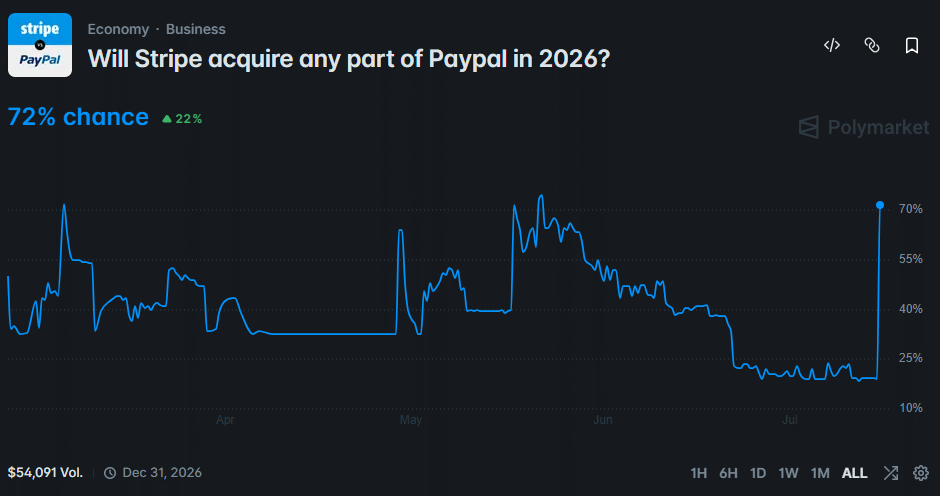
Source: Polymarket

As Stefan Deiss of the Hashgraph Group told AMBCrypto,

This offer signals that mainstream payments infrastructure is converging around crypto rails in a bigger way than ever.

Stripe’s stablecoin bet

Stripe has doubled down on stablecoin payments. Last year, the firm acquired Bridge for $1.1 billion to enable institutions to accept stablecoins via banks. Effectively, this allowed the firm to begin offering global stablecoin payments at a flat 1.5% fee.

To further avoid fluctuations in blockchain transfer fees, as most chains are used for speculation, Stripe opted to build its own network, Tempo, for enterprise payments.

If the PayPal bid is completed, Stripe will likely scale its retail offerings too (including Venmo) and stablecoin issuance through PYUSD.

Deiss added,

Stripe’s developer-first approach combined with PayPal’s consumer trust could make accepting crypto payments the default for millions of businesses.

Currently, PayPal’s PYUSD offers about a 4% yield but, like broader stablecoins, has seen a sharp decline in market supply from $4.2 billion to $2.8 billion.
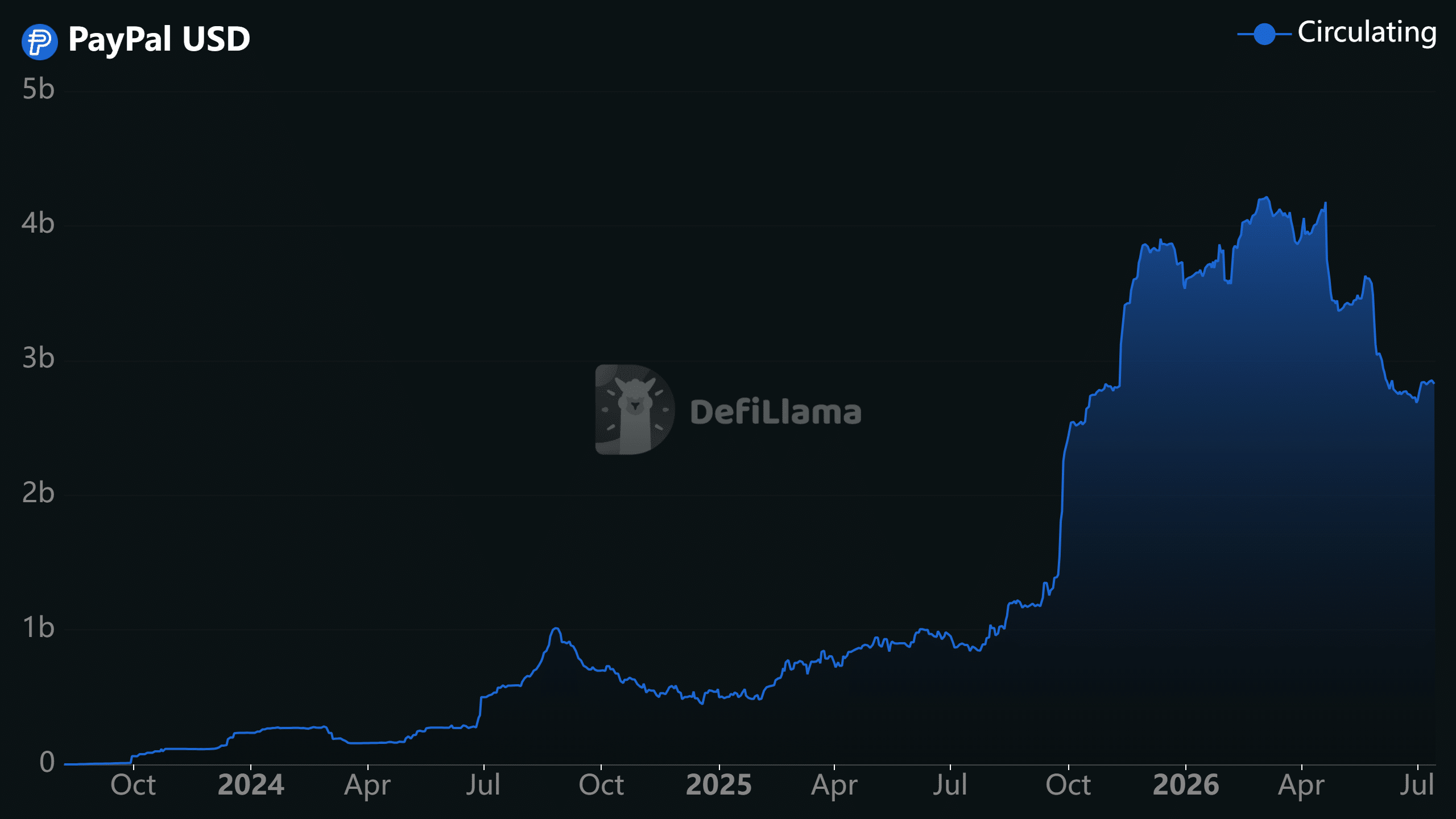
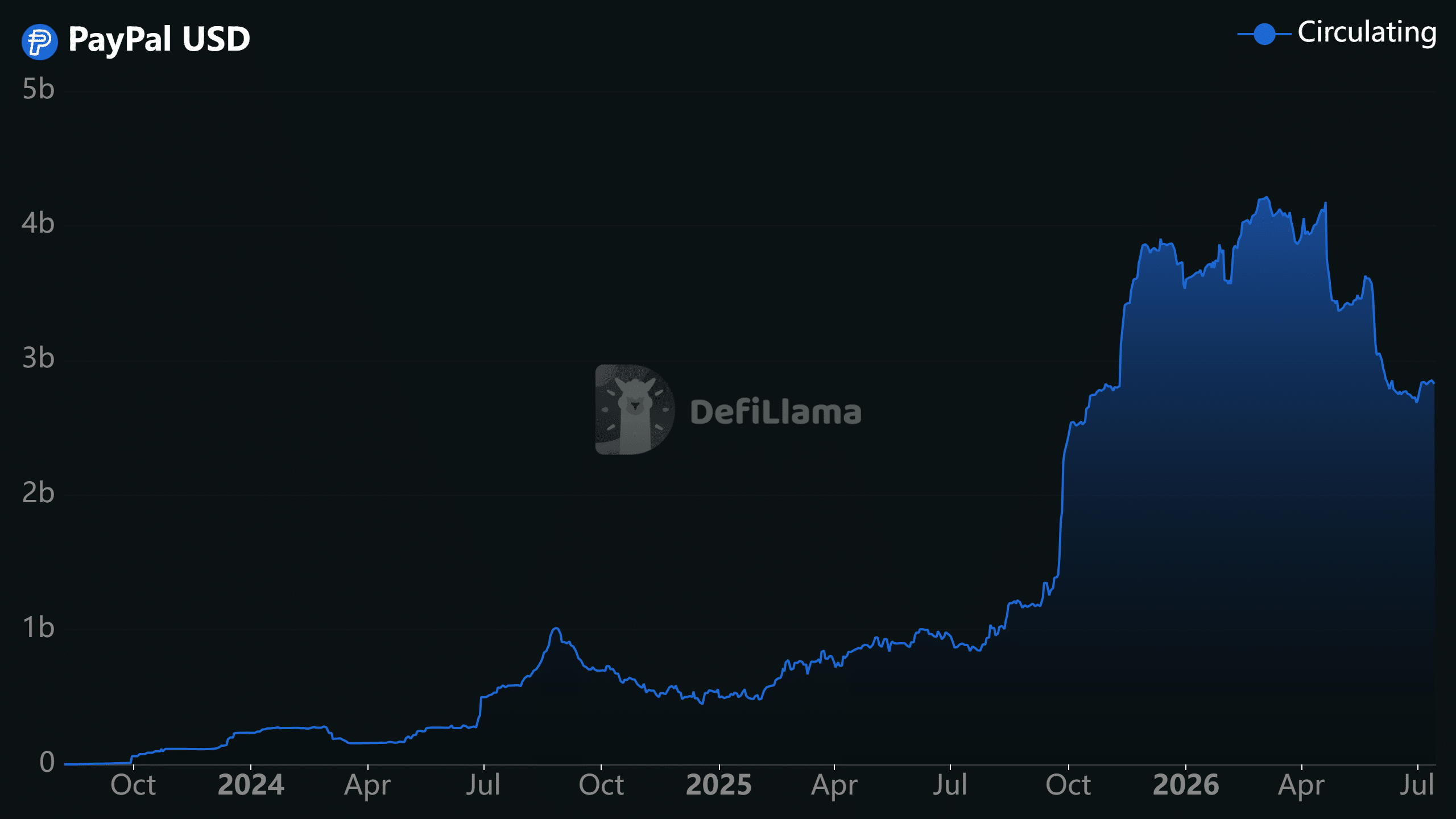
Source: DeFiLlama

Reacting to the Stripe acquisition offer, market analyst Simon Taylor dubbed it the ‘biggest story in the payment industry.’ He stated,

Last year was the first year Stripe’s payment volume passed PayPal’s. $1.9 trillion vs $1.79 trillion. The challenger passed the pioneer on volume, then went straight for the whole company.

He noted that if the deal is completed, Stripe will handle $3.7T in annual volume or 3% of global GDP. That would make it the ‘largest US merchant acquirer by volume.’ PayPal’s stock, PYPL, surged 18.9% to $56.35 in pre-market hours on the 15th of July following the update.

However, Deiss examined the deal from a critical lens.

Regulatory and integration risks are real. Antitrust scrutiny is inevitable given the combined market share. On the crypto side, stablecoin regulation will shape how products like PYUSD and Bridge can operate under unified ownership.

That said, the trend underscores a broader stablecoin race by major payment firms. For example, Mastercard acquired BVNK for $1.8 billion in early 2026 for enterprise stablecoin payouts.

On the other hand, Visa has gone the equity and partnership route as an early BVNK investor and Stripe’s Bridge partner for its stablecoin payments.


Final Summary

  • Stripe is pushing for a $53B PayPal acquisition, a move analysts billed as ‘biggest story in payments.’
  • Although PayPal was yet to respond to the offer, the market was pricing a 72% chance the deal could be completed.


İlgili Sorular

QWhat is the total value of Stripe's joint offer to acquire PayPal, and what premium does it represent over PayPal's stock price as of July 15th?

AStripe, jointly with Advent International, has made a $53 billion offer to acquire PayPal at $60.50 per share. This represents a 28% premium over the value of PayPal's share as of July 15th.

QAccording to the article, what specific technology area is Stripe focusing on, and what key acquisition and infrastructure project are mentioned in this context?

AStripe is doubling down on stablecoin payments. Last year, it acquired Bridge for $1.1 billion to enable institutions to accept stablecoins via banks. Furthermore, to avoid fluctuations in blockchain fees, Stripe is building its own network called Tempo for enterprise payments.

QWhat potential combined annual payment volume is mentioned if the Stripe-PayPal deal is completed, and what significance does this hold?

AIf the deal is completed, Stripe would handle an estimated $3.7 trillion in annual payment volume, which is about 3% of global GDP. This would make it the largest US merchant acquirer by volume.

QWhat are two main risks or challenges associated with the potential acquisition, as highlighted by Stefan Deiss in the article?

AStefan Deiss highlighted two main risks: 1) Regulatory and integration risks, including inevitable antitrust scrutiny due to the combined market share. 2) The impact of stablecoin regulation on how products like PYUSD and Bridge can operate under unified ownership.

QHow did the market and analysts react to the news of Stripe's offer for PayPal?

AFollowing the news, PayPal's stock (PYPL) surged 18.9% to $56.35 in pre-market hours on July 15th. Market analyst Simon Taylor dubbed it the 'biggest story in the payment industry.' Additionally, prediction site Polymarket showed the odds of a final acquisition deal surging by +50% to 72%.

İlgili Okumalar

Wall Street Unanimously Bullish: ASML's Capacity Surge, The 'Peak Theory' for Memory Can Be Put to Rest

Wall Street is collectively bullish on ASML after the company reported a far-better-than-expected Q2 and significantly raised its full-year guidance, while providing a rare 2027-2028 capacity expansion roadmap. Key financials surpassed consensus: Q2 revenue of €9.3B beat estimates, with gross margin at 54%. The company raised its 2026 revenue outlook to €43-€45B and expects Q3 revenue of €11-€12B. Most notably, management outlined aggressive capacity increases for both Low-NA EUV and immersion DUV systems. EUV capacity is projected to reach ~85 units in 2027 (up ~30% from 2026) and potentially ~110 in 2028. DUV capacity is set to rise to ~169 units in 2027 and ~220 in 2028. These targets exceed prior market expectations, leading analysts to significantly revise up 2028 earnings estimates, with JPMorgan suggesting EPS could surpass €65. Major banks including Goldman Sachs, JPMorgan, and Barclays maintained Buy/Overweight ratings. Analysts view the roadmap as a direct rebuttal to narratives about an AI-driven demand peak or an imminent memory price top. ASML stated that AI demand is accelerating expansion in both logic (for nodes like 2nm) and memory segments (driven by DDR/HBM shortages and the transition to more EUV-intensive nodes like 1c/1d DRAM). This structural shift, alongside the high wafer intensity of HBM production, is seen extending the memory upcycle. While most reactions were positive, some nuance existed on whether the 2027 EUV guidance was sufficiently aggressive versus heightened expectations. Overall, the results are seen as validating sustained AI-driven demand and ASML's unrivaled position as the key beneficiary of the industry's advanced node transition.

链捕手1 saat önce

Wall Street Unanimously Bullish: ASML's Capacity Surge, The 'Peak Theory' for Memory Can Be Put to Rest

链捕手1 saat önce

The Invisible Crypto Empire of Japan's Financial Giant SBI

In a series of concentrated moves, Japanese financial conglomerate SBI Holdings is aggressively expanding its digital asset footprint. Over three weeks, it executed three major strategic investments: a 46.7 billion yen ($289 million) full acquisition of Japanese licensed exchange Bitbank, a $76 million lead investment in the institutional crypto platform EDX Markets' Series C round, and an exclusive $125 million investment in DeFi risk analytics firm Gauntlet. This was followed by a strategic partnership announced on July 13 with the Solana Foundation to build Japan's on-chain financial markets. SBI, a long-time crypto industry participant through joint ventures and minority stakes, has recently shifted to a lead investor role, signaling a more assertive strategy. These investments target three distinct segments: the retail market in Japan (via Bitbank), U.S. institutional infrastructure (via EDX), and on-chain asset management and risk control (via Gauntlet). Concurrently, SBI is solidifying its position in the stablecoin and settlement layer space. It launched Japan's first trust-structured yen stablecoin, JPYSC, and secured the exclusive distribution for Ripple's RLUSD stablecoin on its SBI VC Trade platform. The partnership with Solana aims to leverage the blockchain's scalability for tokenizing real-world assets (RWA) and building cross-border payment networks. Analysts interpret SBI's moves as building the essential "pipes" for a next-generation, end-to-end digital asset financial system, spanning issuance, settlement, infrastructure, and distribution. Some view the timing—during a market downturn—as a strategic long-term play to acquire assets at lower valuations ahead of anticipated regulatory shifts in Japan. SBI's stated goal is a comprehensive on-chain transformation, providing a full suite of services from exchange to tokenization. By leading investments rather than fully acquiring companies like EDX and Gauntlet, SBI aims to secure a pivotal strategic position while preserving their neutrality to collaborate with other global financial giants.

链捕手1 saat önce

The Invisible Crypto Empire of Japan's Financial Giant SBI

链捕手1 saat önce

İşlemler

Spot
活动图片