Mantra CEO tells OM holders to withdraw from OKX over ‘inaccurate’ migration plan

cointelegraph2025-12-08 tarihinde yayınlandı2025-12-08 tarihinde güncellendi

Özet

Mantra CEO John Patrick Mullin has urged users to withdraw their OM tokens from the OKX exchange, accusing the platform of posting an "inaccurate" migration plan. Mullin claims OKX provided incorrect dates and details about the upcoming token migration from an Ethereum-based ERC-20 token to a native Mantra Chain token. He stated that OKX has not communicated with Mantra since April 13, when the OM token crashed over 90%, an event Mantra attributed to aggressive exchange leverage policies. Mullin advised users to avoid relying on OKX and complete the migration independently. The official migration is set to occur after January 15, contrary to OKX’s announced December timeline.

Tensions between blockchain platform Mantra and crypto exchange OKX are rising after Mantra accused the exchange of posting incorrect information about its token migration.

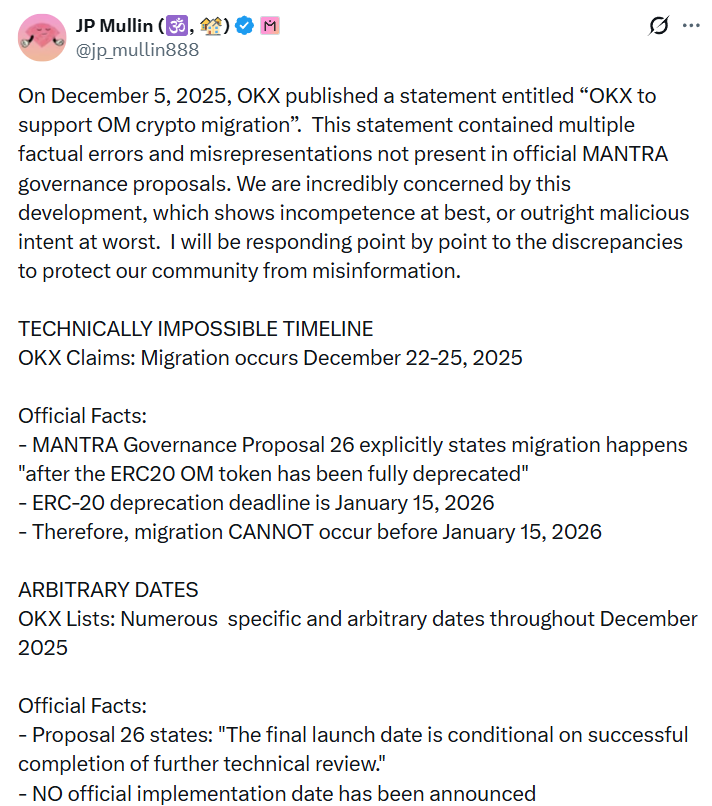
In a Monday X post, Mantra CEO John Patrick Mullin urged users of centralized cryptocurrency exchange (CEX) OKX to withdraw their Mantra (OM) tokens and cut their “dependency” on the platform.

“Users should consider withdrawing their OM tokens from OKX[...]. Avoid OKX Exchange Dependency: Complete migration without relying on potentially negligent or malicious intermediaries,” said Mullin.

His warning came in response to a Friday announcement from OKX about supporting the incoming OM token migration.
Source: JP Mullin

Related: BitMine buys $199M in Ether as smart money traders bet on ETH decline

According to Mullin, the OKX post contained multiple inaccuracies, including false migration and implementation dates.

OKX said the migration would occur between Dec. 22 and Dec. 25. Mantra’s governance proposal, by contrast, states that the migration will only take place after the Jan. 15 deprecation of the Ethereum-based ERC-20 OM token.

Mullin also said OKX’s post referenced “arbitrary dates throughout December 2025,” while Mantra has not yet announced an official implementation date.

He claimed OKX has not communicated with Mantra since “the events” of April 13, while Mantra has “helpfully [been] communicating with all other major exchanges regarding our migration.”
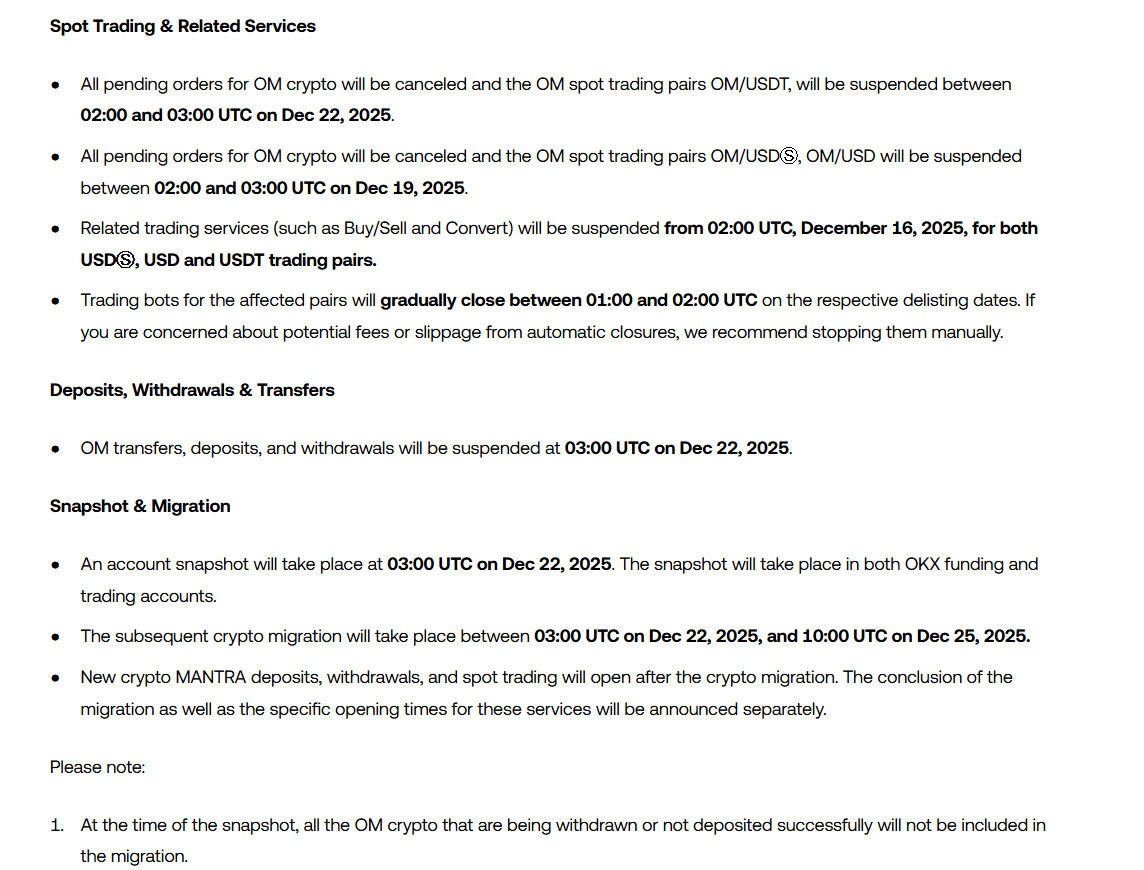
OKX’s OM Crypto Migration post. Source: okx.com

During the incoming migration, the OM token will migrate from an Ethereum-native ERC-20 token to a Mantra Chain-native token.

Cointelegraph has contacted OKX for comment but had not received a response by publication time.

Related: Prediction markets emerge as speculative ‘arbitrage arena’ for crypto traders

April crash still casting a shadow

On April 13, the Mantra’s OM token price fell by over 90% from around $6.30 to below $0.50.
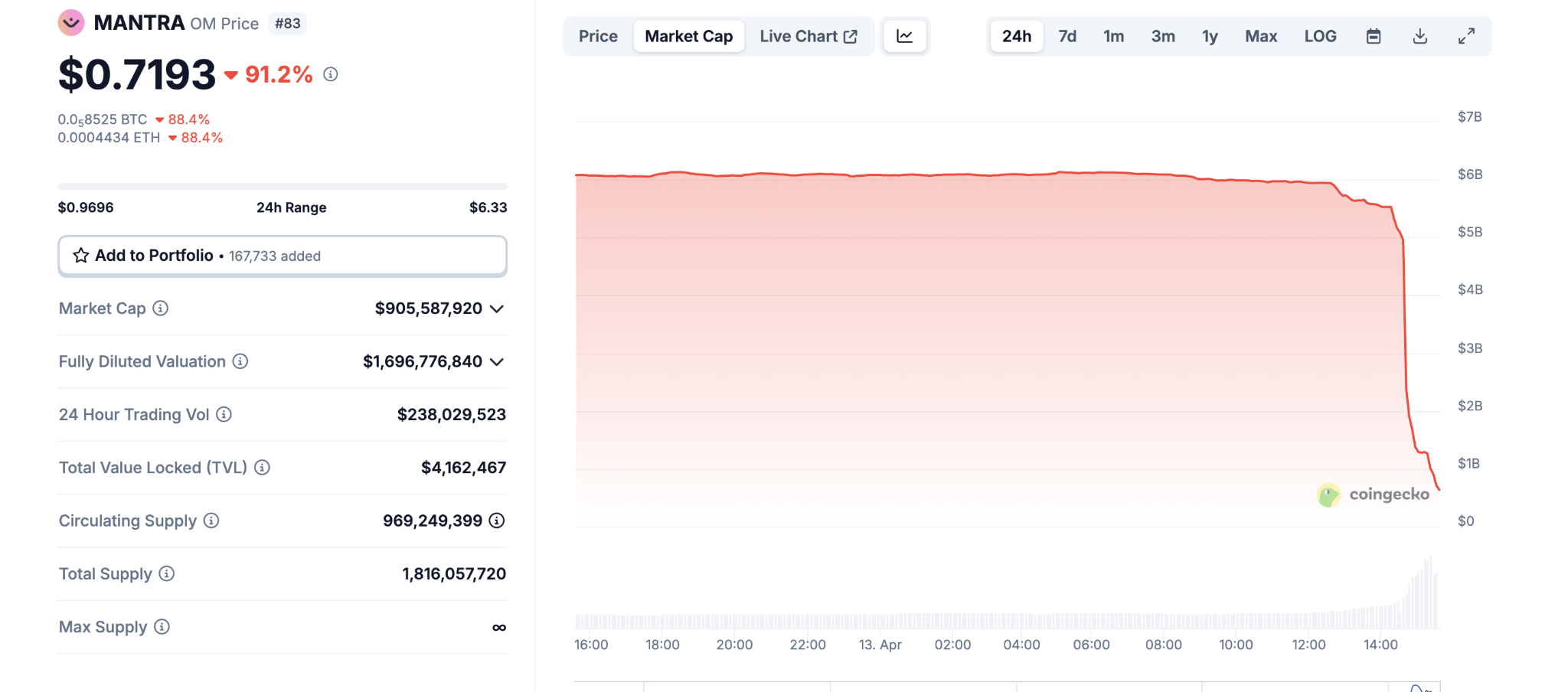
OM/USD, 1-day chart. Source: Coingecko.com

On April 30, Mantra published a post-mortem report that blamed the aggressive trading policies and high leverage on cryptocurrency exchanges for the token crash.

“Liquidation cascades could happen to any project in the crypto industry,” Mullin said in the post, pointing to the role of “aggressive leverage positions” on exchanges as a broader threat to investor safety.

Mullin also urged exchanges to review their leverage policies while implementing a transparency dashboard for OM tokenomics, along with announcing the burning of 150 million staked OM tokens, permanently removing them from circulation in a bid to tighten the token’s supply.

Magazine: If the crypto bull run is ending... it’s time to buy a Ferrari — Crypto Kid
İlgili Okumalar

AI Saved a Group of New Energy Investors

The article "AI Saves a Group of New Energy Investors" details a remarkable turnaround in the green energy investment sector, driven by its convergence with artificial intelligence infrastructure. After a prolonged downturn marked by valuation slumps and funding cold spells since 2022, the sector has experienced a dramatic resurgence in 2026. This shift is attributed to new policies, particularly the "AI-Energy Synergy" national strategy, which mandates green power and energy storage systems for new large-scale computing centers. This redefines green electricity and storage from traditional manufacturing into core, indispensable assets for AI's operational backbone, creating a new narrative where "computing power equals electricity, and green power equals assets." This paradigm change is reflected in surging market performance. Power stocks like Datang Power have seen massive gains, and green energy ETFs have recorded significant capital inflows. The IPO market is also active, with companies like Sige New Energy listing successfully. Investment and financing have accelerated sharply, with major expansion projects and large-scale IPOs like China Resources New Energy's record-breaking offering. Notably, some top projects have seen valuations rebound by approximately 60%. The article highlights that the previous industry trough became a prime investment window. With AI-driven demand predicted to create massive power shortfalls (e.g., a projected 55GW gap for data centers), sectors like energy storage, grid upgrades, and green power are seeing explosive growth. Investors are now prioritizing areas like power management, large-scale storage, virtual power plants, and supporting technologies like liquid cooling—the "pick-and-shovel" plays of the AI infrastructure boom. Examples like KKR's highly successful investment in cooling company CoolIT Systems underscore the lucrative opportunities. In conclusion, the integration with AI has sparked a fundamental revaluation of new energy assets. For investors who endured the sector's低谷, a harvest season has arrived, with the broader investment upswing seemingly just beginning.

marsbit4 dk önce

AI Saved a Group of New Energy Investors

marsbit4 dk önce

Learn Codex with the "Morning Briefing": Six Replicable Levels of Use

This article introduces a "Morning Briefing" as a simple, progressive framework for learning to effectively use Codex (an AI assistant), moving from basic information gathering to a more sophisticated, autonomous work partner. It outlines six actionable levels: **Level 1: Basic Information Query.** Start by simply asking Codex to check your Slack, Gmail, and Calendar to summarize what needs your attention today. **Level 2: Personalization with an Agents File.** Create a persistent file containing your default preferences for the briefing's format and content, so it's consistently useful. **Level 3: Automation.** Set the briefing to run automatically every weekday morning, creating a reliable starting point for your day. **Level 4: Project-Specific Briefings.** Instead of one overwhelming summary, create separate, dedicated threads for different projects (e.g., a launch, recruitment), each with its own focused briefing. **Level 5: Drafting Follow-Up Actions.** Elevate the briefing from a summary to an action starter by having it draft replies, prepare meeting notes, or highlight stalled decisions—ready for your review. **Level 6: Building a Memory System (Vault).** Integrate a knowledge vault (a structured file system) where important recurring information (project statuses, key people, decisions) is stored and updated. The briefing consults this vault to provide richer context and learns over time. The approach's strength is its incremental nature. Each level teaches a core Codex capability (connectors, personalization, automation, project context, assisted work, persistent memory) within a familiar, practical workflow, avoiding overwhelming theoretical concepts. It transforms a simple daily check-in into a personalized, evolving work operating system.

marsbit41 dk önce

Learn Codex with the "Morning Briefing": Six Replicable Levels of Use

marsbit41 dk önce

İşlemler

Spot
Futures
活动图片