Hyperliquid Traders Drive CXMT Trading Volumes to Peak Levels on IPO Day

cryptonews.ru2026-07-27 tarihinde yayınlandı2026-07-27 tarihinde güncellendi

Özet

On July 27th, ChangXin Memory Technologies (CXMT), a major Chinese DRAM manufacturer, made its highly anticipated debut on the Shanghai Stock Exchange (SSE), becoming China's most valuable publicly traded AI-infrastructure company. The IPO coincided with record trading volumes for CXMT on the Hyperliquid blockchain platform (HIP-3), peaking at over $9 million. The stock surged 470-530% at its debut, pushing its market cap over $483 billion, driven by massive demand exceeding the IPO's supply. On Hyperliquid, pre-IPO trading saw prices fluctuate significantly, with the futures market reaching $234 million in early hours. Notably, a former major Bitcoin trader shifted entirely to trading CXMT futures. The event highlights how crypto derivatives platforms are being used for early price discovery and potential hedging against volatility in major traditional market IPOs.

ChangXin Memory Technologies (CXMT) held its long-awaited IPO on Monday, July 27th. The stock listing coincided with a surge of activity on the Hyperliquid exchange, as CXMT attracted attention from both large and retail traders.

CXMT's IPO was expected to be the largest stock listing on the Shanghai Stock Exchange since 2011. As Cryptopolitan reported, the buzz around Chinese AI-related stocks was seen as a new opportunity, and crypto traders immediately seized it.
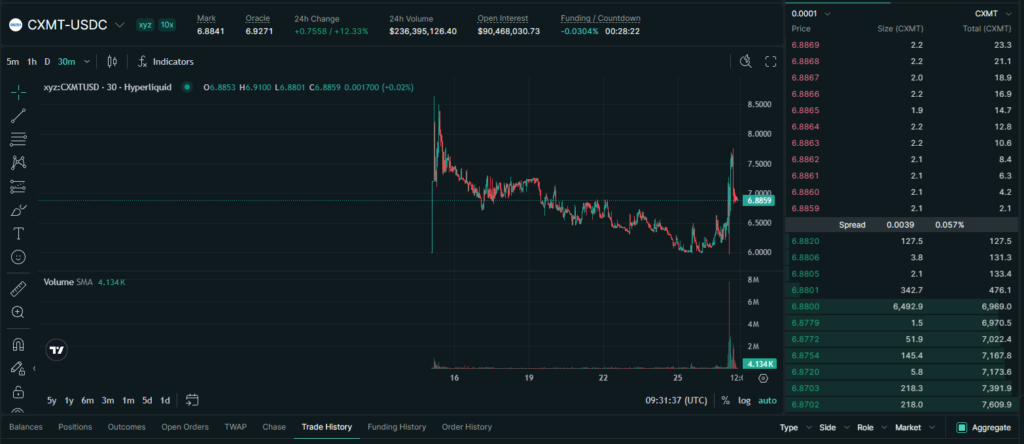
The CXMT exchange saw a record surge in activity, alongside an influx of large crypto investors taking directional positions in one of mainland China's largest IPOs. | Source: HIP-3

The CXMT exchange is already available through TradeXYZ after the platform acquired rights to this ticker on Hyperliquid for 500 HYPE.

As of July 27th, CXMT on HIP-3 exceeded $45 million, and after an initial record spike, daily trading volume reached a new peak, surpassing $9 million. The IPO day saw significant selling as both perpetual futures and the underlying shares were in price discovery.

CXMT Shares Soar in Shanghai Trading

Chipmaker CXMT became China's most valuable AI infrastructure company after its shares surged 470-530% upon its debut on the Shanghai exchange. The company's total market capitalization is estimated at over $483 billion, making it the most valuable company listed on an exchange in mainland China.

The stock market debut also tests the resilience of forecasts for chipmaker and AI-related stocks. CXMT is a major DRAM producer, a basic component used in consumer electronics and data centers.

Funds raised from the IPO are expected to be directed towards production expansion and additional R&D.

Beyond CXMT's business model, a key driver for the rapid price surge was peak demand for the shares, significantly exceeding IPO volumes.

The demand spread to blockchain trading as well, with Hyperliquid offering an entry point for early price discovery speculation. On the first day of trading, the HIP-3 market for CXMT reached 1.14% of the volumes on the Shanghai Stock Exchange, jumping to $234 million in the first hours after the IPO.

Former Major $BTC Market Player Shifts to CXMT

On the HIP-3 platform, the price of CXMT shares fluctuated from over $8 to $5.99. The price range set by perpetual futures traders was closer to the actual IPO price than the company's initial target price of $1.20 per share.

Following the IPO, the HIP-3 company held 13 large positions in CXMT shares, of which seven showed bullish sentiment, taking long positions.

The leader still holds a short position with a notional value of $17.87 million. After the price rise, the volume investment leader incurred an unrealized loss of $1.24 million.

Another major player, primarily known for their positions in $BTC, has fully switched to trading CXMT. Their position still stands at $4.81 million, fluctuating between a profit of $300k and small temporary losses. Large players are still waiting for the stock to choose its own direction in the first days after the IPO.

At this point, it is unknown whether any of the major investors managed to secure IPO shares directly from the company. In that case, selling CXMT shares short would be a hedging strategy in case of a sharp price drop after the initial hype. Such a scenario also points to Hyperliquid as a hedging tool that could be used in other upcoming major IPOs.

end-content

İlgili Sorular

QWhat company conducted a highly anticipated IPO and what was the date?

AThe company ChangXin Memory Technologies (CXMT) conducted its highly anticipated IPO on Monday, July 27th.

QWhich trading platform acquired the rights to trade the CXMT ticker on Hyperliquid?

AThe trading platform TradeXYZ acquired the rights to trade the CXMT ticker on Hyperliquid for 500 HYPE.

QHow much did CXMT's shares surge on its Shanghai stock exchange debut?

ACXMT's shares surged 470-530% on its debut on the Shanghai stock exchange.

QWhat was the estimated total market capitalization of CXMT after its IPO?

AThe estimated total market capitalization of CXMT after its IPO was over $483 billion.

QWhat did a trader known for major Bitcoin positions do regarding CXMT, according to the article?

AAccording to the article, a trader known for major Bitcoin positions fully switched to trading CXMT, with a current position worth $4.81 million.

İlgili Okumalar

Crypto.com, Backed by Citadel Securities, Transfers XYO and XL1 into Regulated Custody

Crypto.com, with backing from Citadel Securities, has placed XYO and XL1 tokens into regulated custody. This move provides eligible institutions and high-net-worth clients with a regulated mechanism for storing, managing, and exchanging these tokens without first having to transfer assets onto an exchange. The custody structure utilizes segregated MPC wallets managed by a bankruptcy-remote entity, with private keys secured via multi-party computation. Clients benefit from cold storage, audit trails, and direct access to Crypto.com's institutional liquidity while their assets are custodied, removing the operational step of pre-trade transfers. Company leadership positioned this as a strategic step to provide "unmatched security and seamless liquidity" for digital asset organizations, and to protect and scale the XYO ecosystem. The partnership builds on an existing relationship since XYO's initial listing on the exchange. This development follows Citadel Securities' $400 million investment in Crypto.com and comes as the company expands its regulatory standing, having received conditional approval to establish a national trust bank. For institutional investors, this custody agreement addresses a key barrier by demonstrating that smaller market-cap assets like XYO and XL1 can be held under the same regulatory and security standards as larger tokens. XYO operates a large DePIN network generating real-world data for AI and robotics, with XL1 handling its blockchain transactions and infrastructure.

cryptonews.ru1 saat önce

Crypto.com, Backed by Citadel Securities, Transfers XYO and XL1 into Regulated Custody

cryptonews.ru1 saat önce

Less Than Two Weeks Left — Bitcoin's BIP-110 Countdown Begins as Miner Support Grows Ahead of Decisive Moment

The BIP-110 activation process for Bitcoin, which proposes a temporary soft fork to limit specific data-heavy transaction types (like Ordinals inscriptions), is entering its critical final phase. As of July 27, 2026, there are roughly 1,790 blocks remaining until the mandatory signaling window begins at block 961,632 (estimated for August 9). Starting then, nodes enforcing BIP-110 will reject blocks not signaling for the proposal. While support from miners has grown from below 1% to around 3% recently, it remains concentrated among smaller pools and independent miners, with major pools like Foundry, Antpool, ViaBTC, and F2Pool largely not signaling. Foundry's stance is particularly decisive, as it holds a large share of the network's hashrate and has tied its signaling to a client vote. Without a major pool's shift, widespread activation is unlikely. If the current low signaling levels persist after the window opens, nodes enforcing BIP-110 will follow a slower, minority chain, potentially creating a chain split from the majority chain followed by legacy (e.g., Bitcoin Core) nodes. This activation mechanism differs from past soft forks like SegWit, resembling the 2017 UASF BIP-148 more closely. Proponents argue BIP-110 is necessary to curb spam-like data transactions that increase node costs and distort fee markets, framing opposition as a contentious hard fork. Critics, however, view the activation method as a radical overreaction to a minor issue. The final outcome in the coming two weeks hinges on whether a major pool switches support, if major exchanges clarify their chain preference, and how miners actually behave once the mandatory window is open.

cryptonews.ru1 saat önce

Less Than Two Weeks Left — Bitcoin's BIP-110 Countdown Begins as Miner Support Grows Ahead of Decisive Moment

cryptonews.ru1 saat önce

İşlemler

Spot
活动图片