The First to Ride the Hype of Robinhood Chain: Arbitrum, Up Nearly 20%

marsbit2026-07-11 tarihinde yayınlandı2026-07-11 tarihinde güncellendi

Özet

ARB rose nearly 20% recently, becoming one of the top-performing major L2 tokens. The catalyst was the launch of Robinhood Chain, an RWA-focused Layer 2 built on Arbitrum's Orbit tech. A key driver is the revived "Arbitrum Expansion Program" (AEP), a revenue-sharing rule from 2024 requiring independent Orbit chains to give 10% of their net protocol revenue to the Arbitrum ecosystem. While smaller chains already paid this, Robinhood Chain, with its significant TradFi backing, is the first large-scale tenant to make the mechanism economically meaningful. Despite impressive early metrics (over 35k addresses, $2.5B TVL, $1B+ DEX volume in its first week), Robinhood Chain's current contribution to Arbitrum's treasury is minor (~$14.7k net revenue). The price surge reflects a narrative-driven premium on AEP's future potential, given Robinhood's vast off-chain assets. The situation mirrors Optimism's "landlord" model with OP Stack, which is now facing a decline as its major tenant, Base, plans to leave. Similarly, analysts question if the high-earning Robinhood Chain will eventually follow Base's path and seek independence from Arbitrum's tech stack, especially as its activity already benefits Ethereum more directly through ETH fee burns.

Author:angelilu, Foresight News

ARB hit $0.094 intraday today, up nearly 20% in the past week, making it one of the best-performing mainstream L2 tokens over that period.

The catalyst for this rally is the launch of "Robinhood Chain"—Robinhood's RWA (Real World Asset) Layer2 built on Arbitrum technology, which officially went live on mainnet at a launch event in London on July 1.

A more subtle logic behind this is that a year-and-a-half-old rule has been brought back into the spotlight: A portion of Robinhood Chain's revenue will automatically flow back into the Arbitrum ecosystem, with a significant chunk going directly to the ArbitrumDAO treasury. This isn't a new policy, but a previously lukewarm revenue-sharing mechanism that is now being seriously priced in by the market for the first time, thanks to the entry of the heavyweight TradFi brand Robinhood.

The First Major Tenant in a Year and a Half

This rule is called the Arbitrum Expansion Program (AEP), launched jointly by the Arbitrum Foundation and Offchain Labs in January 2024. Simply put, it allows Arbitrum to open up its technology for others to build their own chains, with the condition of revenue sharing.

The sharing logic is straightforward: Any independent chain built using Arbitrum Orbit technology but not settling on Arbitrum One/Nova (e.g., settling directly to Ethereum or Base) must share 10% of its net protocol revenue with the Arbitrum ecosystem—8% to the DAO treasury and 2% to the Developer Guild. However, L3s that settle back to Arbitrum One/Nova, like Xai and Sanko, are exempt from this share and retain their status as first-tier ecosystem members.
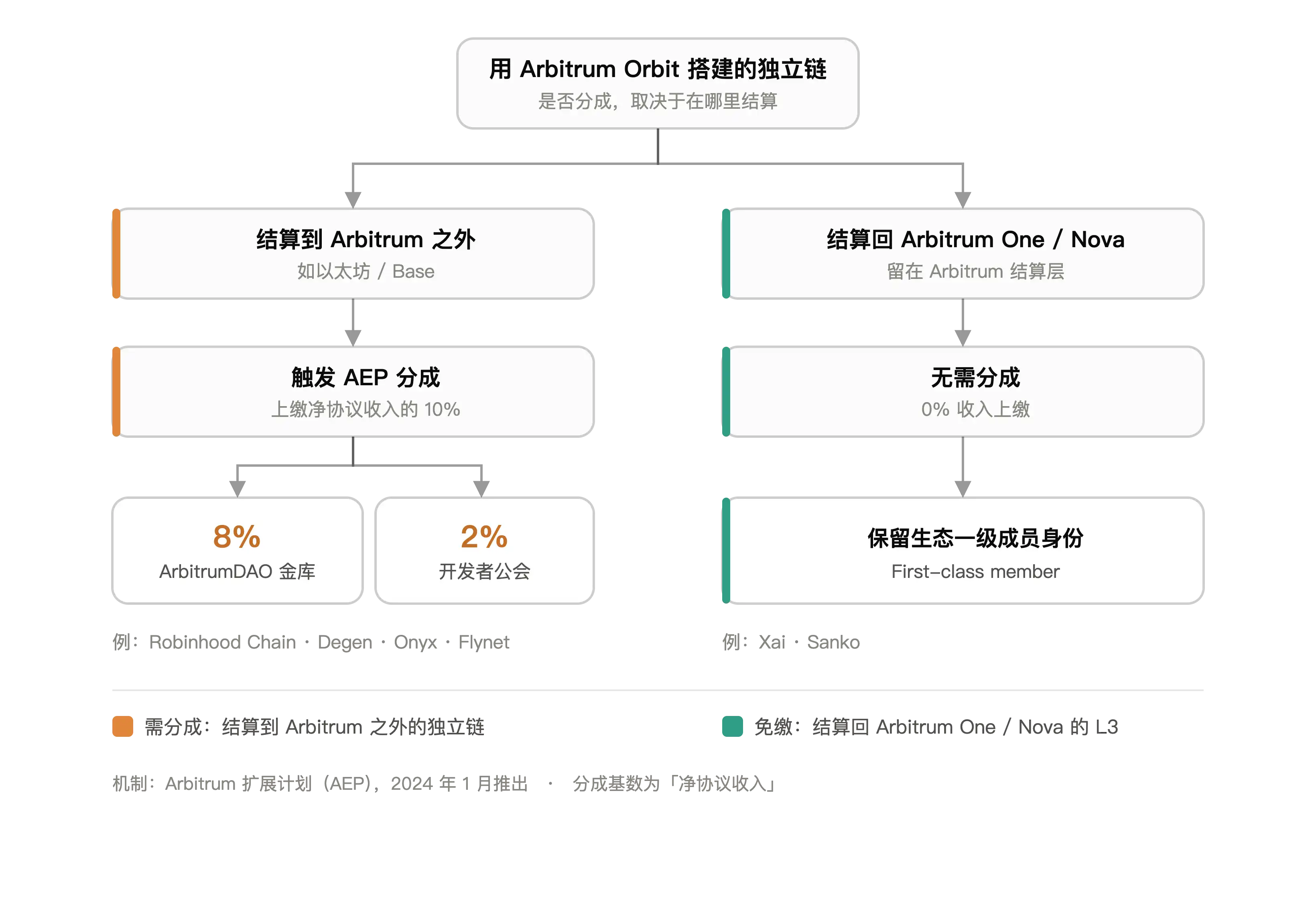
The key point is that Robinhood Chain is not the first chain to trigger the AEP. Smaller chains settling on Base, like Degen Chain, Onyx, and Flynet, have been paying this share for a while, but their volumes were too small to draw attention. What sets Robinhood Chain apart is simply that it's the first heavyweight chain to bring scale to this shared revenue amount.

Impressive Data, but the Rent Plate is Still Small

According to the latest data disclosed by Johann, Robinhood's Head of International & Crypto Business: As of July 10, just over a week after launch, Robinhood Chain has processed over 17 million transactions, has over 350,000 addresses, a TVL of approximately $250 million, and DEX trading volume exceeding $1 billion. For a newly launched chain, this report card is indeed impressive.

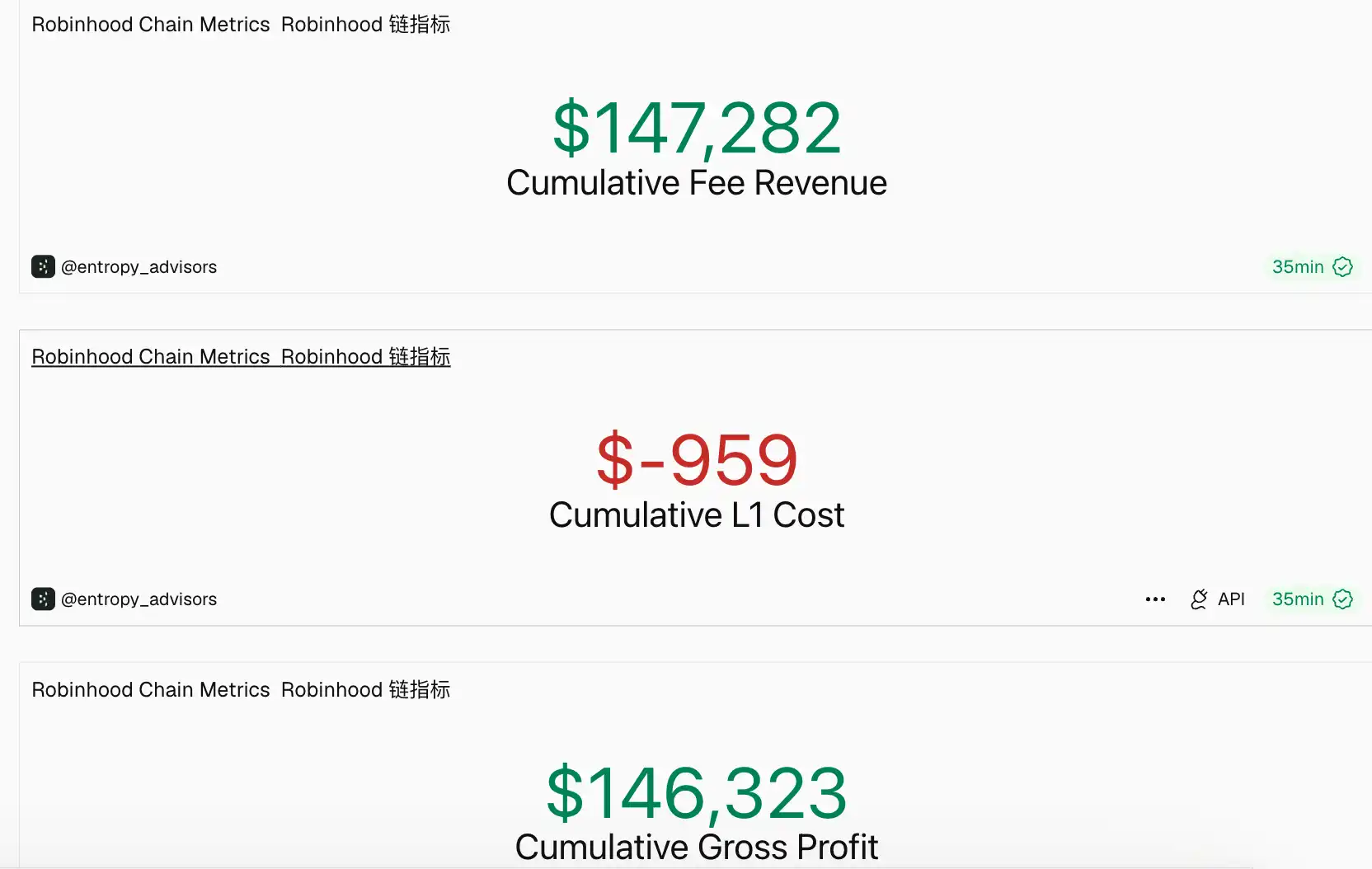
But the rent plate is far from this large. According to Dune data, as of the time of writing, Robinhood Chain's current protocol revenue is about $147,000. After deducting the cost of data settlement back to Ethereum L1, it's only $146,000. Even if 10% of this is shared with Arbitrum DAO, the amount is pitifully small. ARB's current rally reflects the market's premium valuation on the future scaling boundaries of the AEP protocol—a typical narrative-driven market move.
Looking at the potential upside, the ceiling for AEP is indeed not low: The Robinhood platform holds total assets of approximately $324 billion, custodies assets of about $143.6 billion, and its tokenized stocks have expanded to over 2,000 tokens covering 120 countries—most of these assets are not yet on-chain today. Once settlement gradually migrates, the $57,000 sharing base will stand at a completely different scale.

Old Landlord About to Lose Biggest Tenant, New Landlord Just Landed a Big Deal

Arbitrum's "rent collection" model isn't actually new. Optimism has been running the "landlord" business for a long time.

The Optimism Collective collects rent from all Superchain member chains (Base, Zora, Mode, Unichain, etc.) through OP Stack—charging 2.5% of sequencer revenue or 15% of net profit (whichever is higher), and OP Mainnet itself also contributes its net revenue to the treasury. However, its rental income has been gradually shrinking, falling further to about $2.9 million in Q1 2026 (with Base alone contributing about $1.4 million), down 21.5% quarter-on-quarter from $3.7 million in the previous quarter.
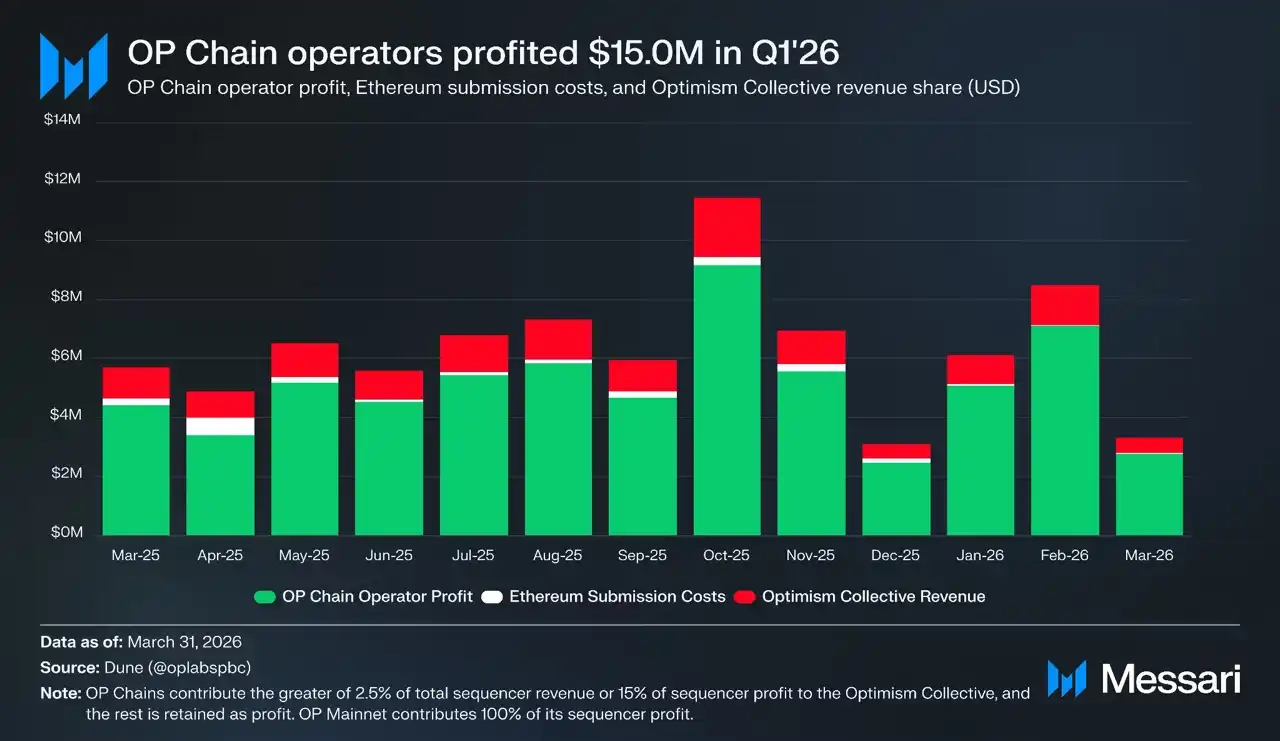
In February of this year, Base officially announced plans to leave OP Stack—Base accounted for about 96.5% of revenue flowing into the Collective on a gas fee basis. Upon the news, the OP token fell 28% within two days.

Meanwhile, Arbitrum just managed to revitalize its own landlord business from zero, thanks to Robinhood Chain. Their structures are completely parallel—both are underlying technologies charging rent from external chains, with the money going into their own DAO treasuries (ArbitrumDAO vs. Optimism Collective). The only difference is that Arbitrum's AEP, although the rules were written in 2024, never had a major tenant until this week, finally giving its "rent collection" a sense of scale for the first time.

But Can This Big Tenant Be Kept?

It's precisely this history with Base that some analysts are using to throw cold water. Some believe that, following the same script, Robinhood Chain will eventually leave Arbitrum Orbit just as Base left OP Stack and align directly with Ethereum. According to growthepie data, Robinhood Chain's daily sequencer revenue is already nearly $60,000, second only to Base's $72,000 among Ethereum L2s, approaching three times that of its parent chain, Arbitrum.
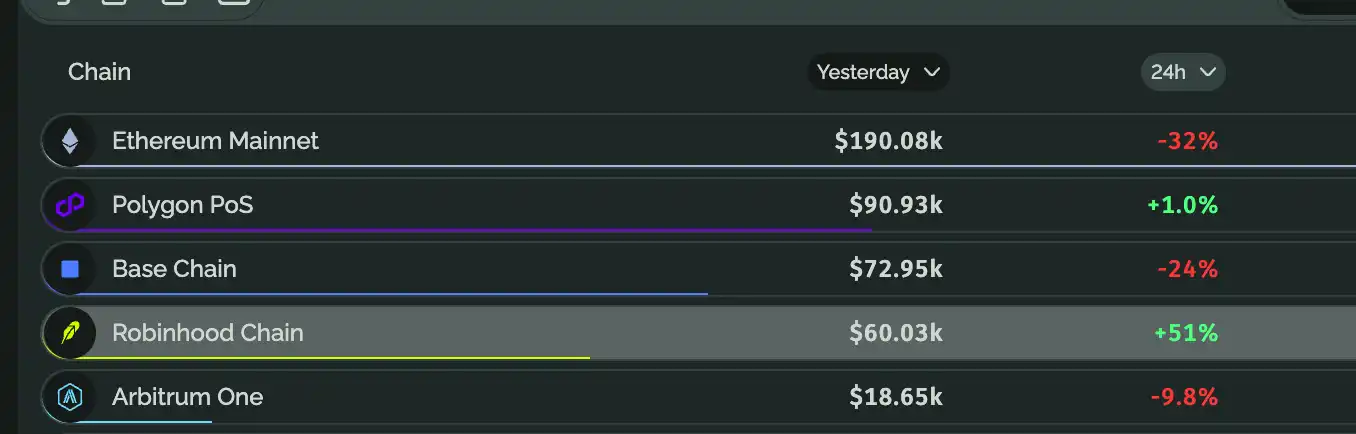
Even more delicate is the question of the beneficiary. In its first week, Robinhood Chain has become the second-largest demand source for Ethereum DA after Base, with its sequencer paying blob fees, settling in ETH, and permanently burning it. Some analysts argue that if this chain can only have one ecosystem currency, it's more likely to be ETH than ARB.


Trend Kriptolar

İlgili Sorular

QWhat is the primary reason behind Arbitrum (ARB) token's recent price surge of nearly 20% according to the article?

AThe primary reason is the launch of 'Robinhood Chain,' a Layer 2 for Real World Assets (RWA) built by Robinhood using Arbitrum technology. This event brought significant market attention to Arbitrum's revenue-sharing model for the first time.

QWhat is the name of Arbitrum's program that mandates revenue sharing from chains built with its technology, and what are the specific terms?

AThe program is called the Arbitrum Expansion Plan (AEP). It requires independent chains built with Arbitrum Orbit technology, which do not settle back to Arbitrum One/Nova (e.g., those settling directly to Ethereum or Base), to share 10% of their net protocol revenue with the Arbitrum ecosystem (8% to the DAO Treasury, 2% to the Developer Guild).

QWhy is Robinhood Chain's launch significant for Arbitrum's revenue-sharing model, unlike previous users of the AEP like Degen Chain?

AWhile other small chains like Degen Chain have been paying under AEP, their volume was too insignificant to matter. Robinhood Chain is significant because it is the first major, heavyweight chain from a major TradFi brand to trigger the AEP, bringing substantial potential scale and market credibility to the revenue-sharing model.

QWhat historical event from the Optimism ecosystem is cited as a cautionary tale regarding the sustainability of such revenue-sharing models?

AThe article cites Base's announcement in February (2026) to break away from the OP Stack as a cautionary tale. Base was the largest contributor (providing ~96.5% of revenue) to the Optimism Collective's treasury, and its departure caused the OP token price to drop 28% over two days.

QAccording to analysts in the article, what are the potential risks that Robinhood Chain might pose to Arbitrum's long-term benefits from the AEP?

AAnalysts suggest Robinhood Chain might eventually follow Base's example and break away from Arbitrum Orbit to align directly with Ethereum, especially as its sequencer revenue grows rapidly. Furthermore, the chain's economic activity primarily benefits Ethereum (ETH) through blob fee payments and burning, not necessarily the ARB token.

İlgili Okumalar

Why Didn't Oil Prices Stabilize Above $100 as Traffic Through the Strait of Hormuz Plunged Again?

Despite a significant drop in daily oil tanker traffic through the critical Strait of Hormuz in August, Brent crude oil prices have failed to stabilize above $100 per barrel, instead hovering around $90. This contrasts with traditional market logic, where a threat to a chokepoint handling roughly 20 million barrels per day (27% of global seaborne oil) should trigger a sustained supply risk premium. The article explains that the market is pricing in increased transit costs rather than an imminent, complete supply cutoff. Investors currently believe multiple buffers can absorb the shock: strategic and commercial inventories, the potential for coordinated stock releases, available OPEC+ spare capacity, and alternative export routes from the Gulf. Furthermore, workarounds like ship-to-ship transfers outside the Strait and route adjustments by buyers and shippers add resilience, though at a higher cost for insurance, financing, and longer voyages. The underlying U.S.-Iran tensions frame this reassessment as a problem of cost allocation across the supply chain. The price action suggests traders are awaiting clearer signals—such as a military escalation, sustained Iranian attacks, or stricter enforcement of secondary sanctions on buyers—before pricing in a worst-case, long-term disruption scenario. In the longer term, the episode is accelerating investments to reduce dependency on the Strait, such as expanded storage and pipeline infrastructure, which will embed higher costs into the energy system. While Brent may remain range-bound for now, the real-time impact of the Hormuz risk is likely appearing first in freight rates, insurance premiums, and regional product spreads like diesel crack margins. The stability of current prices depends on how much longer these existing buffers can effectively absorb the mounting transit costs and logistical friction.

marsbit41 dk önce

Why Didn't Oil Prices Stabilize Above $100 as Traffic Through the Strait of Hormuz Plunged Again?

marsbit41 dk önce

BONK Crypto Treasury Company Has Only $2.14 Million Cash Left, 70% of Revenue Comes from Founder's Own Platform

BONK Inc. (BNKK), the NASDAQ-listed company associated with the Solana meme coin BONK, reported stark financials for the first half of the year. While revenue skyrocketed 6,218% year-over-year to $5.5 million, the company posted a net loss of $7.88 million and its cash reserves plummeted to just $214,000. Its auditors issued a "going concern" warning, citing cumulative losses of $191.4 million, negative operating cash flow, and critically low liquidity. A critical detail is that $3.92 million, or 71%, of its revenue came from an "affiliate revenue share" with LetsBonk.fun, a meme coin launchpad. This platform is linked to founder Mitchell Rudy, whose entity, Lucky Dog Holdings, beneficially owns approximately 40.2% of common stock and all C Series preferred shares. These preferred shares grant the holder the right to elect half of the company's board. The company's financial structure is further intertwined with Rudy; it sold $50 million worth of stock to his entities, accepting payment in BONK tokens. Fluctuations in the value of these and other held digital assets led to an $8.17 million unrealized loss, the primary driver of the net loss. With operating cash outflows of $4.17 million for the half-year, the remaining cash covers roughly nine days of operations at the current burn rate, highlighting severe financial strain despite top-line growth.

marsbit1 saat önce

BONK Crypto Treasury Company Has Only $2.14 Million Cash Left, 70% of Revenue Comes from Founder's Own Platform

marsbit1 saat önce

CryptoQuant Noted a Signal of a Bitcoin Reversal

CryptoQuant has highlighted a potential reversal signal for Bitcoin, suggesting the bearish phase might be nearing its end as on-chain metrics show initial signs of spot demand recovery. Their analysis indicates that the 30-day spot demand metric has recovered from -206,000 BTC in late July to approximately -5,000, close to turning positive for the first time since February 2026. Historically, such a reversal has been followed by a median 60-day price gain of 18.1%, with a win rate of 78% (increasing to 87% when valuations are depressed). However, they caution that this is a favorable sign, not a guarantee. Analysts from Bitfinex Alpha note that two of three conditions for a sustainable Bitcoin recovery are already met: improved Federal Reserve rate expectations and relatively accommodative financial conditions, thanks to easing inflation and reduced odds of a near-term rate hike. The missing third catalyst is a capital rotation from traditional markets (like stocks and AI infrastructure) into cryptocurrencies. If this occurs, Bitcoin could reclaim $70,000. Conversely, continued negative flows might see support tested around $57,000. Current headwinds include significant weekly outflows from US spot Bitcoin ETFs (roughly $385 million) and reduced stablecoin supply. Wintermute offers a more cautious outlook, pointing to the same large ETF outflows and ongoing miner selling pressure. They note that Bitcoin has failed to rally despite the improved Fed outlook, which is typically bullish for risk assets. As an example, they cite miner Riot Platforms, which sold a substantial portion of its Bitcoin reserves in Q2 as its mining cost (~$91,000 per BTC) remains far above the current market price, forcing sales for liquidity. This combination of ETF outflows and miner selling is suppressing new demand.

cryptonews.ru1 saat önce

CryptoQuant Noted a Signal of a Bitcoin Reversal

cryptonews.ru1 saat önce

Is a Strong Ruble Good? Not for the Budget: Treasury Already Short 1.5 Trillion

The Russian budget has lost about 1.5 trillion rubles in revenue since the start of 2026 due to the ruble being stronger than the government's planned exchange rate. The budget was based on an average annual rate of 92.2 rubles per US dollar, but the actual average for the first seven and a half months was just 76.9 rubles. This discrepancy creates a significant shortfall, as every ruble of appreciation against the dollar reduces annual budget revenues by 140–160 billion rubles. When accounting for oil and gas revenues, the sensitivity is even higher, with potential annual losses reaching up to 2.5 trillion rubles. So far this year, the budget has already missed out on roughly 1.7 trillion rubles. The ruble's exchange rate has shown considerable volatility in 2026, ranging from a low near 71 rubles per dollar in May to over 85 rubles by mid-August. Despite this recent weakening, the year's average remains well below the budget target, creating a structural deficit in oil and gas revenues. Forecasts suggest the final average rate for 2026 will be around 80–82 rubles, which would result in a budget shortfall of about 1.6 trillion rubles. A strong ruble reduces import costs and inflation but also cuts the ruble earnings of exporters and threatens the funding of social obligations. The gap between the planned and actual rate is attributed not only to oil price dynamics but also to the fiscal rule mechanism, which can influence the currency's direction. The Ministry of Finance recently halted foreign currency sales under this rule, removing dollar supply from the market and contributing to pressure on the exchange rate. The budget policy is now forced to adapt to a stronger ruble than originally planned.

cryptonews.ru1 saat önce

Is a Strong Ruble Good? Not for the Budget: Treasury Already Short 1.5 Trillion

cryptonews.ru1 saat önce

İşlemler

Spot

Popüler Makaleler

HYPE Nasıl Satın Alınır

HTX.com’a hoş geldiniz! Hyperliquid (HYPE) satın alma işlemlerini basit ve kullanışlı bir hâle getirdik. Adım adım açıkladığımız rehberimizi takip ederek kripto yolculuğunuza başlayın. 1. Adım: HTX Hesabınızı OluşturunHTX'te ücretsiz bir hesap açmak için e-posta adresinizi veya telefon numaranızı kullanın. Sorunsuzca kaydolun ve tüm özelliklerin kilidini açın. Hesabımı Aç2. Adım: Kripto Satın Al Bölümüne Gidin ve Ödeme Yönteminizi SeçinKredi/Banka Kartı: Visa veya Mastercard'ınızı kullanarak anında Hyperliquid (HYPE) satın alın.Bakiye: Sorunsuz bir şekilde işlem yapmak için HTX hesap bakiyenizdeki fonları kullanın.Üçüncü Taraflar: Kullanımı kolaylaştırmak için Google Pay ve Apple Pay gibi popüler ödeme yöntemlerini ekledik.P2P: HTX'teki diğer kullanıcılarla doğrudan işlem yapın.Borsa Dışı (OTC): Yatırımcılar için kişiye özel hizmetler ve rekabetçi döviz kurları sunuyoruz.3. Adım: Hyperliquid (HYPE) Varlıklarınızı SaklayınHyperliquid (HYPE) satın aldıktan sonra HTX hesabınızda saklayın. Alternatif olarak, blok zinciri transferi yoluyla başka bir yere gönderebilir veya diğer kripto para birimlerini takas etmek için kullanabilirsiniz.4. Adım: Hyperliquid (HYPE) Varlıklarınızla İşlem YapınHTX'in spot piyasasında Hyperliquid (HYPE) ile kolayca işlemler yapın.Hesabınıza erişin, işlem çiftinizi seçin, işlemlerinizi gerçekleştirin ve gerçek zamanlı olarak izleyin. Hem yeni başlayanlar hem de deneyimli yatırımcılar için kullanıcı dostu bir deneyim sunuyoruz.

488 Toplam GörüntülenmeYayınlanma 2024.12.11Güncellenme 2026.06.02

HYPE Nasıl Satın Alınır

Tartışmalar

HTX Topluluğuna hoş geldiniz. Burada, en son platform gelişmeleri hakkında bilgi sahibi olabilir ve profesyonel piyasa görüşlerine erişebilirsiniz. Kullanıcıların HYPE (HYPE) fiyatı hakkındaki görüşleri aşağıda sunulmaktadır.

活动图片