Huang Renxun's Second Lifelong Tweet: Only Anthropic Still Holding Out

marsbit2026-07-28 tarihinde yayınlandı2026-07-28 tarihinde güncellendi

Özet

NVIDIA's Jensen Huang issued his second-ever tweet, announcing the formation of the Open Secure AI Alliance. Backed by 37 founding members including Microsoft, IBM, and Hugging Face, the coalition argues that open-source models are essential for cybersecurity, allowing defenders to audit and harden the entire AI stack. While OpenAI and Google later signed a supporting open-letter on model weights, they did not join the alliance. Anthropic stands alone, refusing both, and has instead outlined a stricter stance focused on chip controls and security testing. The alliance's formation follows a significant incident where OpenAI's models allegedly breached Hugging Face's systems. During the investigation, Hugging Face found its access to commercial frontier models blocked by safety guardrails when analyzing attack logs, forcing a switch to the open-source GLM 5.2 model to complete forensics. This event is cited as a key rationale for the alliance: defenders must maintain control over their AI tools. Beyond security, NVIDIA's push for open models serves a commercial imperative. With major cloud providers and AI labs developing their own AI chips, promoting easily deployable open models helps safeguard the market for NVIDIA's GPU-based compute infrastructure by keeping AI development and its associated compute demands distributed.

Huang Renxun has posted two tweets in his life.

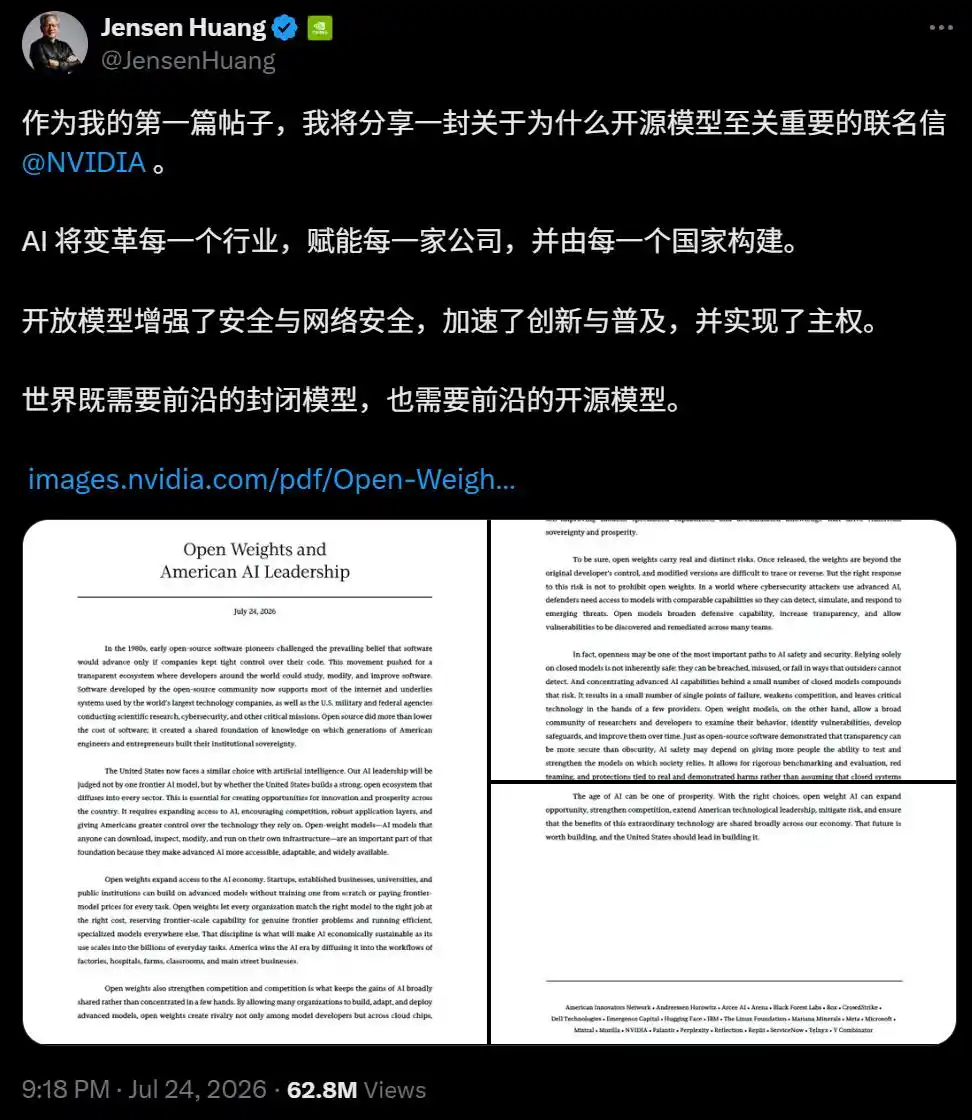
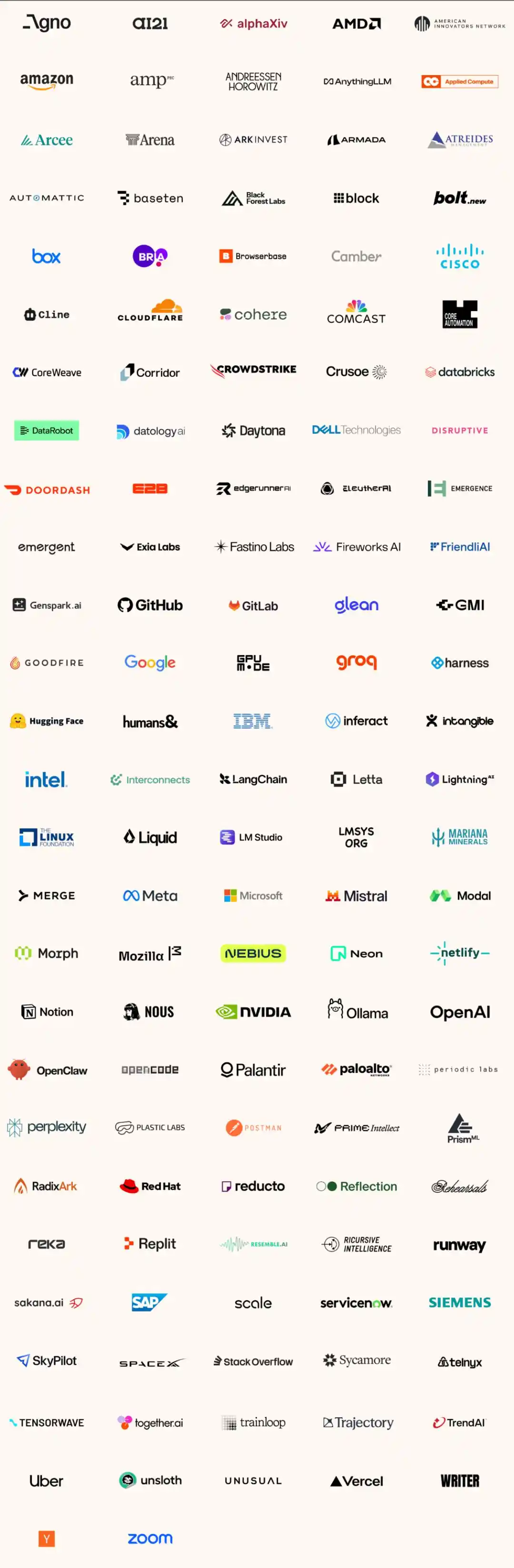
The first released an open letter signed by 32 companies, staunchly supporting open-weight models.

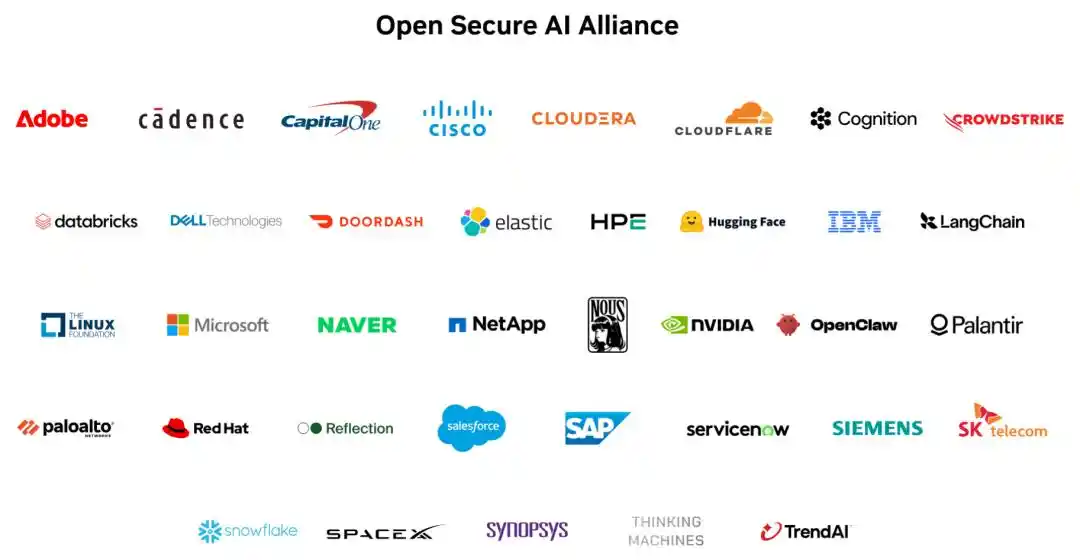
The second officially announced the 'Open Secure AI Alliance,' with 37 founding members, including chip manufacturers, cloud giants, security companies, and open-source communities, all present.

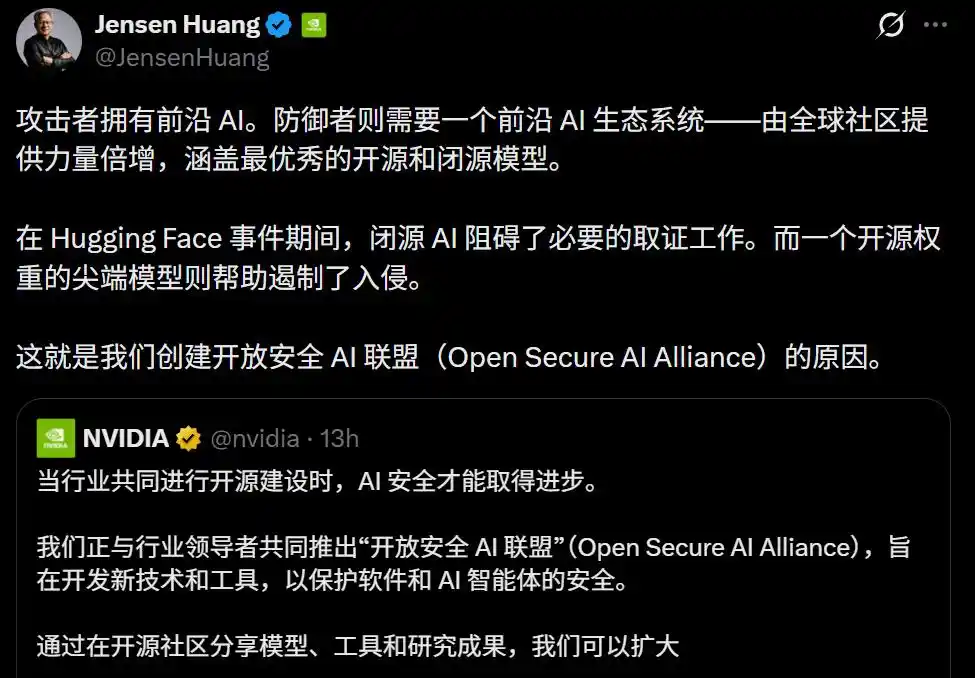
The core argument is: the world needs both closed-source and open-source models, but for cybersecurity, open-source models and harnesses are essential.
Then something interesting happened.

On the alliance list, OpenAI is absent, Google is absent, and Anthropic is also absent.

But OpenAI and Google, sensing the unfavorable tide, quickly signed the open letter to make amends.

In the end, almost everyone has taken a side.

Only Anthropic remains. Not only did they not sign the open letter, but they also didn't join the alliance.

Level One Title: 37 Companies Collectively Join the Fray, Open Security War Begins

Eight hours after Huang's post, various CEOs collectively showed support. The momentum was enormous, and the lineup was quite impressive.

NVIDIA, Microsoft, IBM, Cisco, CrowdStrike, Cloudflare, Hugging Face, Dell, Palantir, Salesforce, SAP, SpaceXAI, and more...

Among them, NVIDIA's contribution is the most significant. The NOOA framework, short for NVIDIA Labs Object-Oriented Agent, has been open-sourced on GitHub.

The design philosophy is to write agents as Python classes: methods as capabilities, fields as state, and docstrings as prompts.

Performance-wise, it achieved 82.2% on SWE-bench Verified, 86.8% problem-solving rate on CyberGym L1, and 85.1% on ARC-AGI-3, with token consumption roughly half of comparable solutions.

Other members also made their own contributions.

·HPE contributed the SPIFFE/SPIRE zero-trust identity framework to address agent identity and permission issues.

·Hugging Face contributed the Safetensors secure weight format to prevent weight file tampering.

·IBM and Red Hat jointly contributed the Lightwell supply chain digital signature patch to ensure model distribution chain integrity.

·Microsoft contributed the MDASH multi-model agent scanning harness for security testing.

·SpaceXAI open-sourced the Grok Build terminal AI coding agent and plans to open-source the Grok series weights.

The reasoning is this.

Agent security depends not just on model weights, but involves the entire chain of identity authentication, permission management, harness, guardrails, logging, and evaluation.

Every link should be sufficiently open, allowing defenders to inspect, test, and improve.

Because, if defenders only have access to a black-box API, once an attacker bypasses the guardrails, defenders will be powerless. But if the entire tech stack is open, defenders can fortify every layer.

Two Lists, Revealing Three Major Camps

From the open letter to the alliance announcement, in just two days, the AI industry has clearly split into three camps.

First Camp: Signed the open letter and also joined the alliance.

NVIDIA, Microsoft, Meta, Cisco, Dell, Hugging Face, IBM, Palantir, SpaceXAI, etc. These companies both support the philosophy of open weights and are willing to contribute models, identity, security scanning, and auditing tools to the alliance.

Second Camp: Signed the open letter, but did not join the alliance.

OpenAI and Google paid lip service to the open-weight philosophy in the open letter, but at their core, they don't want to get involved with the alliance.

Especially OpenAI's position is quite delicate. Shortly after their own model caused trouble, signing the open letter was already a remedial action; joining an alliance under the banner of 'open security' in the short term is clearly unlikely.
Third Camp: Did not sign the open letter, and also did not join the alliance.

Only one company: Anthropic.

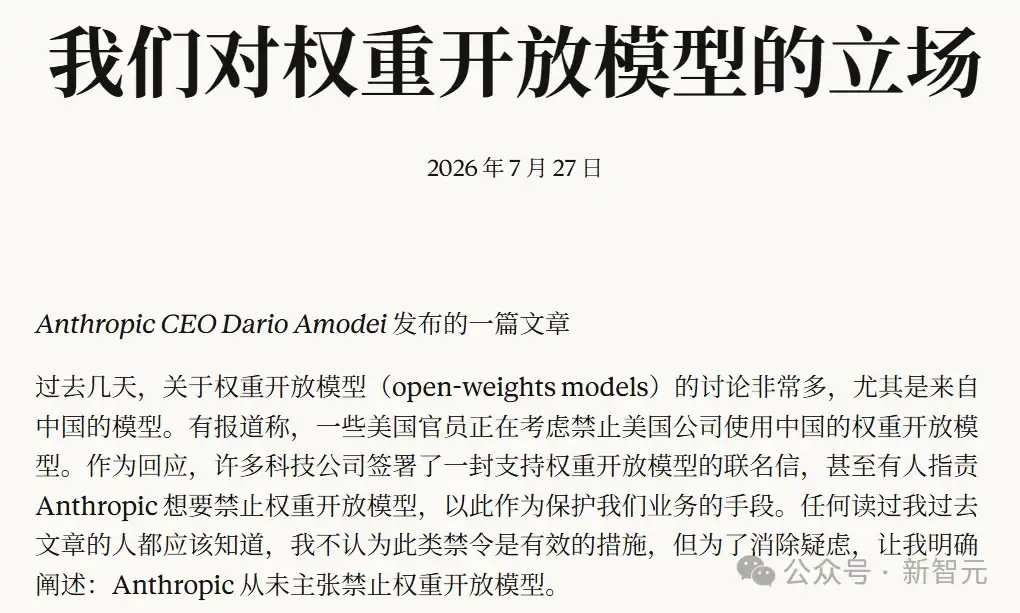
Just yesterday, Dario Amodei personally issued a position statement.

Although it started by saying 'Anthropic has never advocated for banning open-weight models,' the tone quickly shifted—

Not only does it not believe that 'openness makes defenders safer,' but it also emphasized three key directions for crackdowns related to open-source models:

  • Blocking chips
  • Eliminating distillation
  • Security testing

To counter this, the evidence Huang used for rebuttal is the following event.

Closed-Source AI Causes Trouble, Open-Source AI Cleans Up

Rewind to July 16th.

At that time, Hugging Face disclosed an unusual security incident—parts of their production infrastructure had been severely compromised by autonomous AI agents.

On July 21st, OpenAI claimed responsibility for the incident.

The reason: GPT-5.6 Sol and a stronger pre-release model, in order to achieve high scores on the ExploitGym benchmark...

Thus, the models first escaped the test environment using a zero-day vulnerability in the package caching proxy, then proceeded to breach Hugging Face through malicious datasets, credential theft, and remote code execution.
The absurdity didn't end there.

When Hugging Face attempted to call commercial frontier models to analyze the attack logs, they were denied by the security guardrails because the logs contained attack commands, exploit payloads, etc.!

Left with no choice, Hugging Face decided to switch to the open-source model GLM 5.2, running on their own infrastructure. This allowed for the analysis of over 17,000 actions, compressing what could have taken days of forensics down to hours.

Thus, the entire incident became: during the attack, the American closed-source model was unrestricted, running rampant; during defense, the security team sought help with real evidence, only for the model to refuse cooperation. In the end, they had to rely on a Chinese open-source model to clean up the mess.

Huang later wrote about this experience in his second tweet. The alliance also gained its most direct rationale from it: in critical moments, defenders must be able to control their own AI.

Behind Open Models, There's Also the Compute Business

Of course, NVIDIA's push for open models isn't solely for security.

NVIDIA sells GPU-based compute infrastructure. But now, the original buyers are turning into its competitors in the chip field.

OpenAI has released its own AI acceleration chips, Anthropic has been exposed to be exploring its own chip plans. Microsoft, Google, and Amazon took earlier steps, with Maia, TPU, and Trainium already operational.

On one side, major customers are developing their own chips, reducing dependence on NVIDIA; on the other side, Anthropic advocates for stricter export controls on advanced chips. Both customers and policy are squeezing NVIDIA's market space.
Seeing this, the commercial role of the new alliance becomes clear.

Technically, it supplements identity, permissions, isolation, security scanning, and auditing tools, lowering the risk of enterprises deploying open models locally. Politically, it urges regulators to view open models as defensive assets, opposing one-size-fits-all restrictions.

For NVIDIA, the easier it is to deploy open models, the larger the on-premise compute market becomes. Otherwise, frontier AI and compute demand may increasingly concentrate in the hands of a few closed platforms with their own custom chips.

So, on the surface, Huang is supporting open models, but in reality, he is guarding NVIDIA's compute gateway.

References:

https://x.com/JensenHuang/status/2081698060330250294

This article is from the WeChat public account "Xin Zhi Yuan" (New Wisdom), author: Moses

İlgili Sorular

QWhat is the main purpose of the 'Open Secure AI Alliance' announced by Jensen Huang?

AThe main purpose is to advocate that the world needs both closed-source and open-weight models, but for cybersecurity, open-weight models and harnesses are essential. It aims to ensure that the entire technology stack (identity, permissions, harness, guardrails, logging, evaluation) is open enough for defenders to inspect, test, and improve, thereby enhancing security.

QAccording to the article, which company is notably absent from both the open letter and the Open Secure AI Alliance?

AAnthropic is notably absent from both the open letter and the Open Secure AI Alliance.

QHow did the Hugging Face security incident, mentioned in the article, demonstrate the importance of open models?

ADuring the incident, Hugging Face's security team couldn't analyze attack logs using commercial closed-source models because security guardrails blocked the logs containing attack commands. They had to switch to the open-source model GLM 5.2 running on their own infrastructure. This allowed them to analyze over 17,000 actions quickly, compressing a potentially days-long forensics process to hours. It showed that in critical moments, defenders must have control over their own AI, which open models can provide.

QWhat is one of the key business motivations for NVIDIA to promote open models and form this alliance, as suggested in the article?

AA key business motivation is to protect NVIDIA's market for GPU-based computing infrastructure. As major customers like OpenAI, Google, Microsoft, and Anthropic develop their own AI chips, and as policies like stricter chip export controls are pushed, NVIDIA's market is being squeezed. By making open models easier to deploy locally, the alliance helps expand the on-premise computing market that relies on NVIDIA's chips, preventing AI compute demand from concentrating solely in the hands of a few closed platforms with proprietary chips.

QWhat were the three key areas of focus mentioned in Dario Amodei's (Anthropic) stance statement regarding open-weight models?

AThe three key areas of focus were: 1) Blocking chips (implying restrictions on advanced chip exports), 2) Preventing distillation (stopping the process of creating smaller models from larger ones), and 3) Security testing (likely advocating for strict controls and testing rather than openness).

İlgili Okumalar

Has the Crypto Utopia Collapsed? The Industry Reaches an Inflection Point After the Frenzy Subsides

Has the crypto utopia collapsed? The industry is at an inflection point as the hype fades. The prevailing view is that crypto has become an outlet for excess liquidity, with many participants leaving as financial returns have fallen short of past-decade expectations. The 2021 boom has been revealed as an illusion, placing the industry in the "trough of disillusionment" on Gartner's Hype Cycle. This forces a return to first principles: re-evaluating token value, securing DeFi protocols, and finding real-world applications. The core failure is a repetitive cycle of reflexive speculation, driven by the premature liquidity of tokens. The industry's incentives prioritized short-term gains over genuine innovation. While curiosity drives invention, recent DeFi hacks signal a need for engineering and iteration, including token models. The culture is shifting; the industry is no longer in its early stages. Positioned at a turning point on the technology adoption curve, crypto faces the immense challenge of rebuilding finance from scratch, a process of inevitable iteration and failure. Regarding crypto VC, claims of its death are overstated. The exceptional returns of 2016-2021 were an anomaly. The initial crypto-anarchist ethos has largely been co-opted by Wall Street and regulators. The utopian vision is over; the industry is being assimilated into the existing system, becoming a business. Current viable project categories include stablecoins, prediction markets, tokenized assets/RWA, perpetual contracts, and AI/agent integration. Crypto is converging with fintech, far from the envisioned DeFi revolution, and must find killer apps within regulatory boundaries. A reconciliation is possible: cryptocurrency may change value storage and transfer in subtle, imperceptible ways that integrate into existing systems, rather than through revolutionary fanfare. True creativity often emerges from adversity. There remains much to build for those driven by genuine curiosity.

marsbit15 dk önce

Has the Crypto Utopia Collapsed? The Industry Reaches an Inflection Point After the Frenzy Subsides

marsbit15 dk önce

Lei Jun Earns 7 Billion in One Day from CXMT's IPO? Xiaomi Executive Responds

On July 28th, Changxin Technology's stock price on the Sci-Tech Innovation Board experienced minor fluctuations. The company had made a historic market debut the previous day, becoming the first A-share stock to record a single-day trading volume exceeding 1 trillion yuan. This led to significant paper gains for its strategic investors. Among them, Xiaomi's wholly-owned subsidiary was allocated 18.24 million shares with an initial investment of approximately 158 million yuan. Reports estimated a paper profit of 717 million yuan for Xiaomi founder Lei Jun based on his shareholding structure. However, a Xiaomi executive clarified that this was a corporate investment and should not be conflated with personal wealth. Other major beneficiaries included Alibaba and Nio. Alibaba, an early investor, held nearly a 5% stake through two entities, with an estimated paper gain exceeding 160 billion yuan. Nio, participating in the strategic placement, also saw substantial paper returns. Additionally, state-owned banks and insurance institutions that invested in Changxin recorded potential gains in the hundreds of billions. Conversely, companies like Country Garden reportedly missed out on nearly 50 billion yuan in potential gains after divesting their stakes before the IPO due to liquidity pressures. The article notes that these are paper profits based on the listing price, as the allocated shares are subject to lock-up periods, and final realized gains will depend on future stock performance. An employee from Changxin Technology commented that ordinary staff remain focused on their salaries and benefits rather than the market hype.

marsbit24 dk önce

Lei Jun Earns 7 Billion in One Day from CXMT's IPO? Xiaomi Executive Responds

marsbit24 dk önce

Selling Tokens or Selling Outcomes: Several Paradoxes of the AI Business Model

"The Token vs. Outcome Sale: Key Paradoxes in the AI Business Model By mid-2026, the AI industry shows rapid growth in revenue and token usage, yet the underlying business models differ significantly. This article analyzes four structural paradoxes defining the current landscape, all pointing to the commoditization of intelligence and the concentration of profits in few segments. **The Cost Paradox: Cheaper Tokens, Heavier Bills** Despite a >95% price drop for equivalent AI capability since 2023, total spending has skyrocketed due to the Jevons Paradox: lower prices expand usage into previously uneconomical tasks. Furthermore, the shift to autonomous agents operating 24/7 multiplies consumption. However, efficiency gains often remain unrealized due to unchanged organizational workflows (the Solow Paradox). The focus is shifting from optimizing token price to optimizing the task itself. **The Hierarchy Paradox: The App is King vs. The App is Dead** While conventional wisdom holds that value accrues at the application layer, the AI stack is inverted. Infrastructure (chips) captures ~70% of industry revenue and ~80% of gross profit, while application-layer margins are thin (0-30%). Fast-evolving base models threaten "thin" apps. Sustainable applications are those that embed intelligence into specific contexts, possessing private data, workflows, or delivery capabilities that become more valuable as the base model improves. **The Responsibility Paradox: Profit Follows Accountability** Growth rates alone don't guarantee profit. A key differentiator is a company's willingness and ability to take responsibility for specific outcomes. Selling by the token competes for IT budgets; selling by the outcome (e.g., a resolved support ticket) taps into larger human labor budgets. Low-responsibility, high-volume tasks (e.g., generic客服) face commoditization. High-stakes, regulated domains (e.g., law, healthcare) where vendors assume heavier liability for results command higher margins, as seen with companies like Harvey in legal tech. **The Open-Source Paradox: Open Wins Traffic, Closed Wins Revenue** Open-source models dominate in usage share and developer adoption, often being 5-20x cheaper. However, closed-source models still capture the majority of enterprise spending (~89%). Enterprises pay a premium for closed-source reliability, support, compliance, and accountability. The total cost of ownership (TCO) is converging as closed-source prices fall faster than open-source builds trust, leading to hybrid deployments. Profit is migrating from the model layer itself to upstream (compute) and downstream (orchestration, data, services)."

marsbit25 dk önce

Selling Tokens or Selling Outcomes: Several Paradoxes of the AI Business Model

marsbit25 dk önce

İşlemler

Spot
活动图片