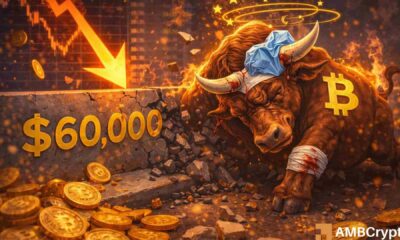
It feels brutal out there, hopeless. It's all over. You missed it. You screwed up again.
Everyone is angry and confused. Even those who saw it coming can't help but feel a bit smug, but many also know how much pain such price action can cause. These moments always feel like the worst of times.
I've been in the markets for 38 years (today's sell-off is my 'birthday gift', plus food poisoning last night!), and I've seen every type of crash and panic.
They all feel the same, terrible.
I entered the crypto market in 2013, buying Bitcoin for the first time at $200. It went up for a while after I bought, then fell 75%... and that was still a bull market, with the price eventually reaching over 10 times my purchase price. I didn't sell because it was a long-term investment, and I understood the risks. Then, in the 2014 bear market, it fell another 87%.
In the bull market leading up to 2017, I experienced three 35%–45% pullbacks... brutal. I eventually sold near $2000 (the 2013 previous high) due to the Bitcoin fork war. I had made 10 times my initial investment. But then it went up another 10 times (!!) by the end of the year, before starting another big, ugly bear market.
I sat out that entire bear market, and it felt good at the time.
During the pandemic crash, I bought back in at $6500 (3.5 times higher than my selling price). It turned out to be an expensive mistake of 'thinking I did the right thing'.
From April to July 2021, Bitcoin fell 50% in a market environment similar to today's. The sentiment on Twitter was awful, truly awful. But that time, the market wasn't as severely oversold as it is today...
By November 2021, the market was back at all-time highs: SOL was up 13x from its low, ETH doubled, and Bitcoin hit a new high, up 150%.
I've lived through all of this, all those terrifying, gut-wrenching moments, all happening within a long-term bull market.
I first bought at $200, and the price is now $65,000. I even missed a 3.5x move in the middle due to poor timing.
The first key lesson (for me): In a long-term upward trending asset, the best strategy is often to do nothing. 'HODL' became a meme for a good reason. It's more powerful than the 'four-year cycle' meme.
Second lesson: Be decisive about adding to your position during declines. Even if you can't perfectly time the bottom, consistently adding to your overall position during weakness compounds returns even more than dollar-cost averaging (DCA) in the long run.
I don't always have enough cash to buy heavily on the dips, but I always buy a little—it's crucial for mental training.
It always feels like: the opportunity is missed, it's not coming back, everything will collapse completely.
But that's not the case.
Ask yourself two questions: Will tomorrow be more digital than today? Will fiat currency be worth less tomorrow than it is today?
If the answer to both is 'yes', then keep going. BTFD, let 'time in the market' beat 'timing the market', because it always does. Adding significantly during large pullbacks dramatically lowers your cost basis, and that makes a huge difference.
Stress, fear, and self-doubt are the inevitable 'tax' on this journey.
Size your position according to your own risk tolerance. Don't worry, when prices fall, everyone feels their position is too large; when they rise, it feels too small. All you need to do is manage these emotions and find your own 'sweet spot'.
Another key point: Don't borrow someone else's conviction.
'DYOR' is a very important meme; without it, you simply won't get through these phases. Earn your conviction yourself. Borrowed conviction is like leverage—it will blow you up eventually.
Remember: When you're busy blaming others, you're really blaming yourself.
Yes, it feels dark right now. But soon, the sun will rise again, and this will just be another scar on the journey (provided you didn't use leverage! Leverage leads to permanent capital loss—you lose your chips at the casino). Never lose your chips.
When will this all end? I don't know, but I think it's more like April to November 2021—a panic within a bull market. I think it will end soon. Even if I'm wrong, I won't change my approach: as long as I have some cash, I'll keep adding.
But for you, it might be different. Try to build a 'regret minimization' portfolio: Could you handle another 50% drop from here? If not, then reduce your position, even if it seems stupid. The right mindset is crucial for survival. My mindset is 'how can I buy more', and yours might be the opposite.
There will always be timing experts who perfectly catch the decline, selling out or shorting. They will always exist. But honestly, you just need to tell yourself: this kind of thing can happen at any time. That way, when it does happen, you won't be as anxious because you expected it! It's just part of the story, not the whole story.
So what am I doing now?
I'm starting to buy some digital art (which also increases my ETH exposure), and I plan to continue increasing my crypto asset allocation over the next week—just like I do every time I get this opportunity.
I bought the pandemic crash, the 2021 pullback, the 2022 decline, the 2023 decline, and I'll do the same in 2024, 2025. I'll do it again this time. Every time, my profit and loss hits new highs before the market does, it's almost like magic. Again: BTFD!
Good luck. It's never easy.
Volatility is the price we pay for long-term compound returns. Embrace it.