Your Backtest Is Lying: Why You Must Use Point-in-Time Data

insights.glassnode2026-03-13 tarihinde yayınlandı2026-03-13 tarihinde güncellendi

Özet

The article warns that backtests using revised historical data are misleading due to look-ahead bias. It illustrates this with a hypothetical trading strategy based on Bitcoin exchange outflows from Binance: entering the market when the 5-day moving average of BTC balance falls below the 14-day average, and exiting on the reverse. Initial backtest results using current data appeared reasonably successful, even comparable to buy-and-hold at times. However, the author argues this is deceptive because metrics like exchange balances are often revised retroactively as new data arrives, meaning a backtest uses information that wasn't available in real-time. Re-running the identical strategy using Point-in-Time (PiT) data—which is immutable and reflects only what was known when the data was first published—yielded significantly worse performance. The PiT-based strategy failed to capture key market upswings as effectively, resulting in meaningfully lower cumulative returns. The key takeaway is that only immutable, Point-in-Time data ensures a backtest accurately replays history without look-ahead bias, and that using revised data will produce lying backtests.

Let's build a simple, hypothetical trading strategy. The premise is straightforward and rooted in a widely discussed narrative: when coins leave exchanges, it tends to be bullish. The reasoning is intuitive: coins moving off exchanges typically signal that holders are withdrawing to self-custody, reducing the available supply for selling. Conversely, coins flowing onto exchanges may indicate that holders are preparing to sell.

A single day of outflows, however, is just noise. To identify a genuine trend, we would apply a moving average crossover on the exchange balance. When the short-term average falls below the long-term average, it confirms that coins have been leaving exchanges consistently, as a sustained pattern, rather than isolated events.

Using Glassnode's exchange balance for Binance, we define the following:

  • Enter the market when the 5-day moving average of Binance's BTC balance falls below its 14-day moving average, signaling a sustained outflow trend.
  • Exit the market when the 5-day average rises back above the 14-day average, signaling that the outflow trend has reversed and coins are returning to the exchange.

We then benchmark this strategy against simply holding BTC over the same period, starting January 1, 2024 through March 9, 2026, with an initial capital of $1,000 and 0.1% trading fees applied to each trade.
This is a simplified trading strategy, designed primarily for illustrative purposes. It is not investment advice, nor is it meant to suggest that exchange balances are a robust foundation for a trading system.
Access live chart

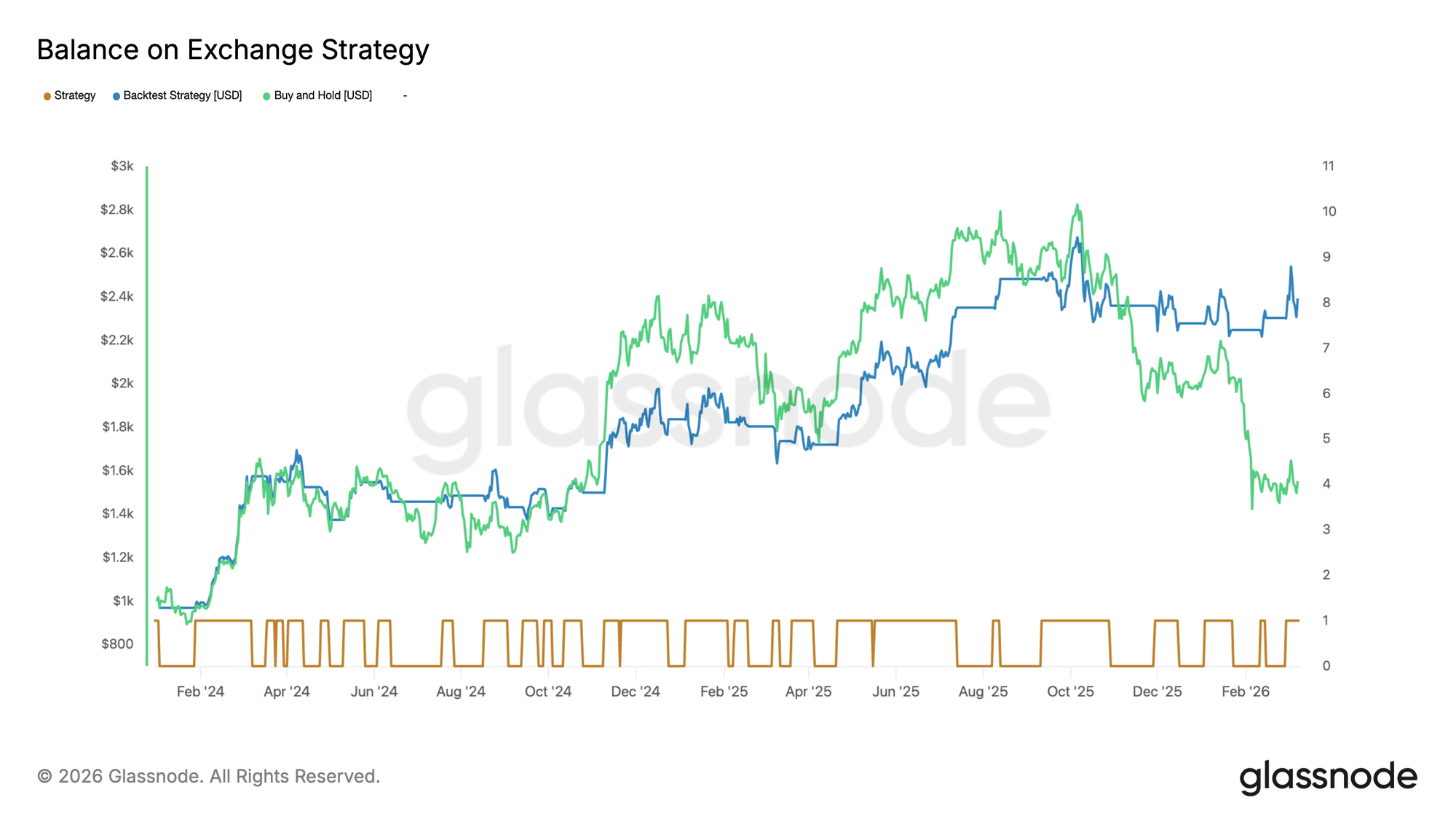
Here's how to read this chart:

🟫 The brown line at the bottom is the binary trading signal, toggling between in the market (1) and out of the market (0).

🟦 The blue line tracks the strategy's portfolio value over time.

🟩 The green line is the buy-and-hold portfolio benchmark.

We can observe that the exchange balance strategy performed reasonably well, although at times the buy-and-hold strategy outperformed it. In the final days of the research period, however, the exchange balance strategy caught up. While some investors may find the combination of reduced volatility and an ultimately comparable performance to buy-and-hold appealing, the final numbers are misleading – and here’s why.

The Problem: Data Mutation and Look-Ahead Bias

Metrics are not static. Many are retroactively revised as new information becomes available. This is particularly true for metrics that depend on address clustering or entity labeling, such as on-chain exchange balances. However, it is also the case for metrics such as trading volume or price, as individual exchanges can occasionally submit their data with slight delays.

This means that a value you see today for, say, January 15, 2024, may not be the same value that was published on January 15, 2024. The data has been revised with hindsight. When you backtest a strategy on this revised data, you are implicitly using information that was not available at the time the trading decisions would have been made. This introduces a look-ahead bias.

The Honest Backtest: Using Point-in-Time Data

Let's therefore repeat the exact same backtest – same signal logic, same parameters, same dates, same fees – but this time using the Point-in-Time (PiT) variant of the Exchange Balance metric, available in Glassnode Studio.

PiT metrics are strictly append-only and immutable. Each historical data point reflects only the information that was known at the time it was first computed. No retroactive revisions, no look-ahead bias.

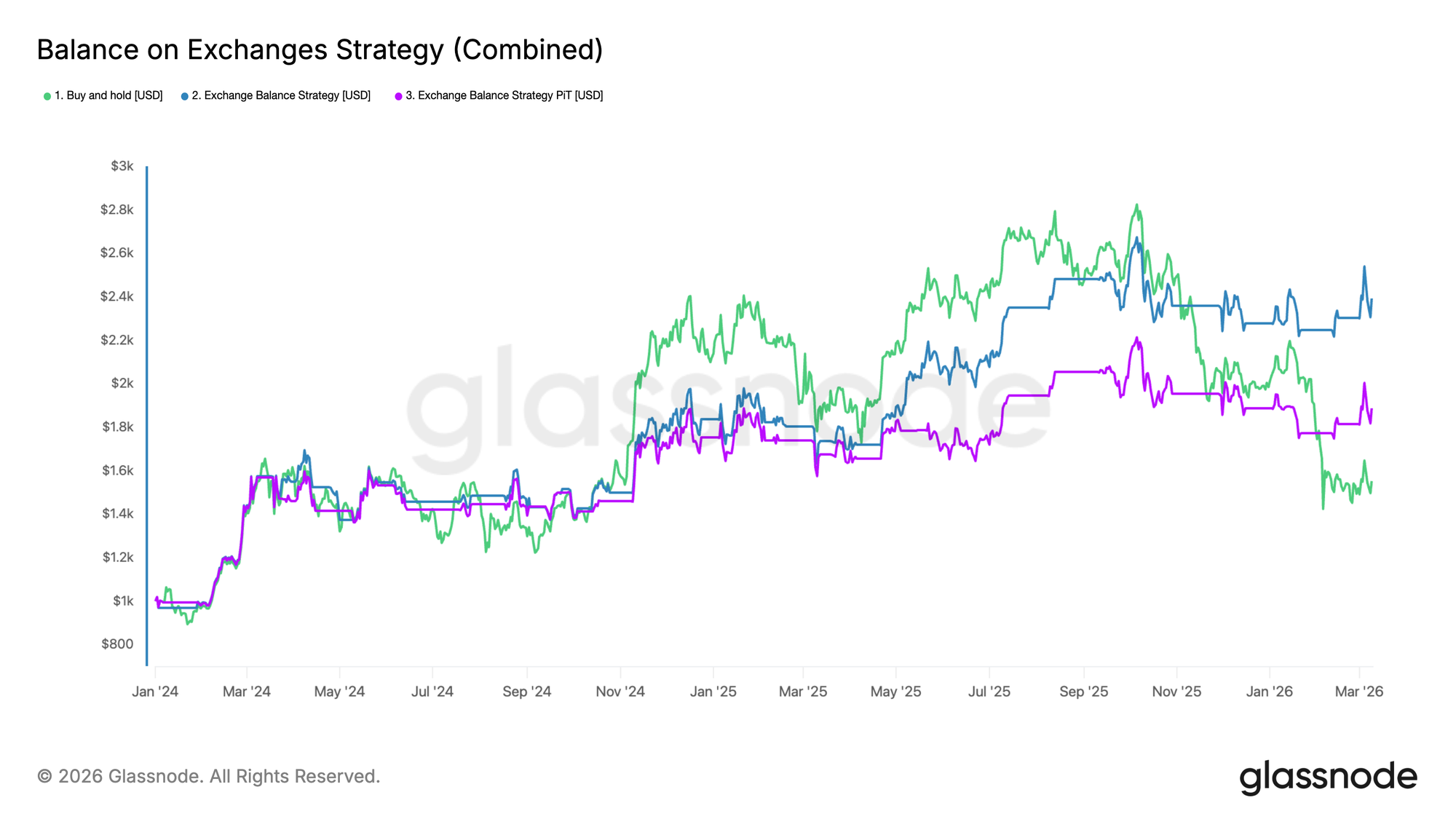
While we are using the same metric, the strategy now produces significantly different results, as illustrated by the purple line in the new chart below. The overall performance is notably worse.

Although both strategies behave similarly for much of 2024, we observe that the PiT-based version fails to capture the strong upticks in November 2024 and March 2025 as effectively. As a result, the cumulative performance diverges meaningfully and ends up considerably lower.
Access live chart

Key Takeaway

In this example, the purple strategy, which only has access to information as it was available at the time, performs noticeably worse. ► Backtests will lie if fed with wrong or revised data. Only immutable, Point-in-Time metrics ensure you’re replaying history as it actually happened.


İlgili Sorular

QWhat is the main premise of the hypothetical trading strategy described in the article?

AThe strategy is based on the narrative that when coins leave exchanges, it is a bullish signal, as it indicates holders are moving to self-custody and reducing available supply. It enters the market when the 5-day moving average of Binance's BTC balance falls below its 14-day average and exits when it rises back above.

QWhat is the primary problem identified with using standard historical data for backtesting?

AThe primary problem is data mutation and look-ahead bias. Many metrics are retroactively revised as new information becomes available, meaning a backtest uses data that was not known at the time of the original trading decision, leading to inaccurate and overly optimistic results.

QWhat is Point-in-Time (PiT) data and how does it differ from standard data?

APoint-in-Time data is strictly append-only and immutable. Each historical data point reflects only the information that was known and published at that specific time, with no retroactive revisions. This prevents look-ahead bias in backtesting.

QHow did the performance of the strategy change when backtested with Point-in-Time data?

AThe performance was significantly worse. The PiT-based strategy failed to capture strong market upticks as effectively, leading to a meaningfully lower cumulative performance compared to the backtest using revised data.

QWhat is the key takeaway from the article regarding backtesting and data?

AThe key takeaway is that backtests will produce misleading results if they use revised data. Only immutable, Point-in-Time metrics ensure an accurate historical replay of what was actually knowable at the time, preventing look-ahead bias.

İlgili Okumalar

After $1.26 Trillion: Why Are Circle and Stripe Rushing to Pay 'Wages' to AI Agents?

The article discusses the significant rise of stablecoins, particularly USDC, as the preferred payment method for AI agents. In March 2026, Circle and Stripe are competing to build stablecoin infrastructure for AI agent payments, with USDC processing $1.26 trillion in transactions, accounting for 70% of stablecoin activity. Key points include: - AI agents require programmable, instant, low-friction payment systems, which traditional finance (banks, credit cards) cannot provide. Stablecoins on blockchain meet these needs with 24/7 transfers, smart contract automation, and price stability. - Data shows 98.6% of AI agent payments on platforms like Stripe's x402 use USDC, indicating stablecoins are becoming the default for machine-to-machine transactions. - Regulatory developments are supporting this growth: Hong Kong is issuing its first stablecoin licenses, the US OCC has proposed a federal framework, and the EU has MiCA regulations, signaling global institutional adoption. - Stablecoins act as a "blood system" connecting the digital and real economies, facilitating both internal digital transactions (e.g., tokenized assets) and external fiat conversions. - Risks include security vulnerabilities, regulatory fragmentation, and market instability, but the trend is clear: stablecoins are evolving from crypto tools to essential infrastructure for AI-driven economies. The article concludes that as AI agents autonomously transact, stablecoins will be critical infrastructure, urging businesses and investors to prepare for this shift.

marsbit2 saat önce

After $1.26 Trillion: Why Are Circle and Stripe Rushing to Pay 'Wages' to AI Agents?

marsbit2 saat önce

From 'Collective Intelligence' to 'Super Individuals': How AI is Reshaping DAOs and the Ethereum Ecosystem?

From "Collective Intelligence" to "Super-Individual": How AI is Reshaping DAOs and the Ethereum Ecosystem AI is fundamentally transforming how work and governance are structured in Web3. While DAOs have long symbolized decentralized collective intelligence, AI is now enabling a shift toward the "individual + AI" unit, where a single person, augmented by AI agents, can perform tasks that previously required entire teams—such as research, trading, asset management, and governance. This shift raises a critical question: Is this beneficial for DAOs and the broader crypto ecosystem? AI addresses key DAO challenges like inefficient information processing, complex decision-making, and high participation costs by automating governance processes, analyzing proposals, and executing on-chain operations. This allows DAOs to operate with smaller core teams while significantly improving efficiency. For AI to participate in the on-chain economy, it requires asset custody, transaction execution, and trusted settlement—capabilities native to blockchain. Initiatives like Ethereum Foundation’s dAI team and the ERC-8004 standard aim to establish trust and verification for AI agents in a decentralized context. Wallets are evolving into "Agent Wallets," enabling non-custodial authorizations, cross-chain asset management, and human-AI collaboration through restricted sub-wallets and automated execution within set limits. Ethereum is positioning itself as the financial infrastructure for the AI economy, offering a trusted settlement layer for AI-driven activities. With its growing staking economy and mature DeFi ecosystem, Ethereum could serve as the neutral base where AI agents across platforms settle value and establish trust. In summary, AI and crypto convergence is reshaping organizations and infrastructure: AI amplifies individual capability and automates execution, while blockchain provides secure and decentralized settlement. Ethereum and crypto wallets are poised to become key interfaces connecting humans, AI, and the on-chain world.

marsbit2 saat önce

From 'Collective Intelligence' to 'Super Individuals': How AI is Reshaping DAOs and the Ethereum Ecosystem?

marsbit2 saat önce

İşlemler

Spot
Futures
活动图片