Six Years Later, UNI Finally Welcomes Its Own "Buyback Bull"

marsbit2026-07-31 tarihinde yayınlandı2026-07-31 tarihinde güncellendi

Özet

After years of debate, Uniswap's UNI token has finally entered a 'buyback bull' phase following the long-awaited activation of its fee-switch mechanism. The UNIfication proposal, executed in December 2025, redirected a portion of protocol fees from select pools and Unichain sequencer revenue into a treasury (TokenJar) dedicated to buying back and permanently burning UNI. Initial market reaction was muted due to modest early burn rates. A significant shift occurred in July 2026 with the launch of Robinhood Chain. Uniswap's immediate deployment there skyrocketed trading volume, making it a top fee-generator. Subsequently, governance votes extended the fee mechanism to v4 pools and Robinhood Chain, causing protocol revenue to nearly triple. Daily funds directed to UNI burns rose sharply, with Robinhood Chain contributing over half. This transitioned UNI's narrative from a governance token to a cash-flow asset backed by a perpetual automatic buyer. UNI's price, which had languished around $2.30 in early June, nearly doubled to approach $4.60 by late July. Analysts credit this to the tangible cash flow from fees rather than mere speculation. Unlike many newer projects where buybacks are offset by large investor unlocks, UNI's six-year history has resulted in a widely distributed and relatively clean supply, allowing the buyback pressure to effectively impact the secondary market. The key test will be whether trading activity, particularly on Robinhood Chain, sustains after its i...

Original Author: Eric, Foresight News

During the overall market volatility in June and July, the price movements of most major tokens were lackluster, but UNI performed unexpectedly strongly.

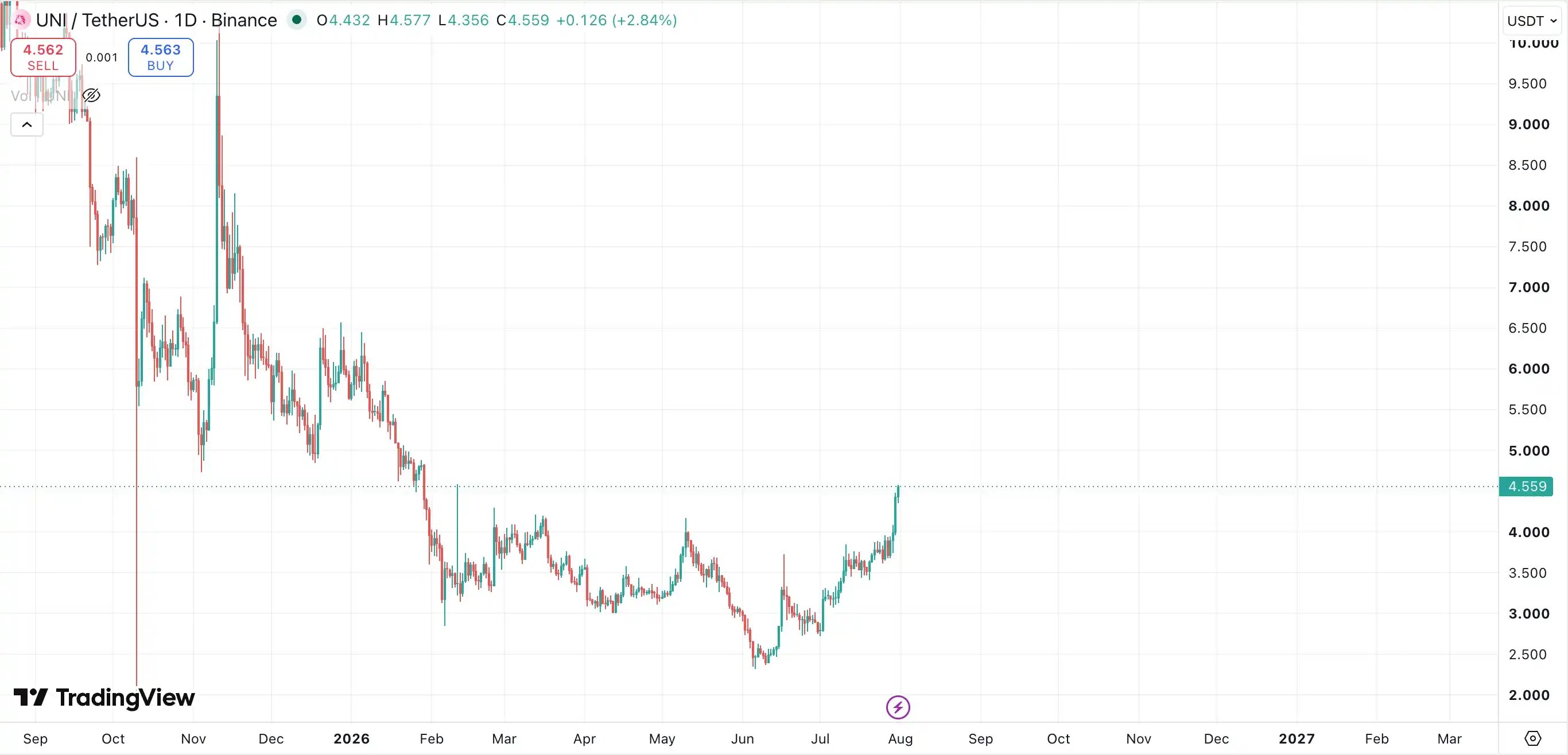
In early June, the price of UNI was hovering around $2.3. By the end of July, it had approached $4.6, nearly doubling in two months. Rewinding to last December, when Uniswap had just passed the long-debated fee switch proposal, UNI rose for only one day before falling alongside the broader market, with little market interest in the leading DEX of the DeFi world.
But the turning point had been set then, though few realized it at the time.

On December 28, 2025, the Uniswap governance proposal UNIfication was officially executed on-chain. The protocol fee switch was activated, diverting a portion of trading fees from Ethereum mainnet v2 pools and some v3 pools to the protocol; sequencer revenue from Unichain, after deducting OP shares and L1 data costs, also flowed into the same fund pool; a one-time burn of 100 million UNI tokens from the treasury served as retrospective compensation for the past years of the "free era"; Uniswap Labs reduced its fees for the frontend, wallet, and API to zero, while receiving an annual 20 million UNI growth budget. All these protocol revenues ultimately converged into a treasury contract named TokenJar, which had only one outlet: buying UNI through the Firepit contract for permanent destruction.

This is what the long-debated "fee switch" truly looked like upon implementation. Since DeFi Summer, the community had debated whether to allocate a portion of trading fees to the protocol, but each vote was stalled by concerns over profit distribution, legal risks, and LP attrition. When it finally passed, the market reaction was quite muted. When the proposal was announced, UNI surged nearly 50% in a few hours, but then declined as the broader market weakened. By March 2026, UNI had fallen below $3.8, ranging sideways around $3 in April and May, and even dropping to $2.3 in early June. The fee switch was turned on, but quietly.
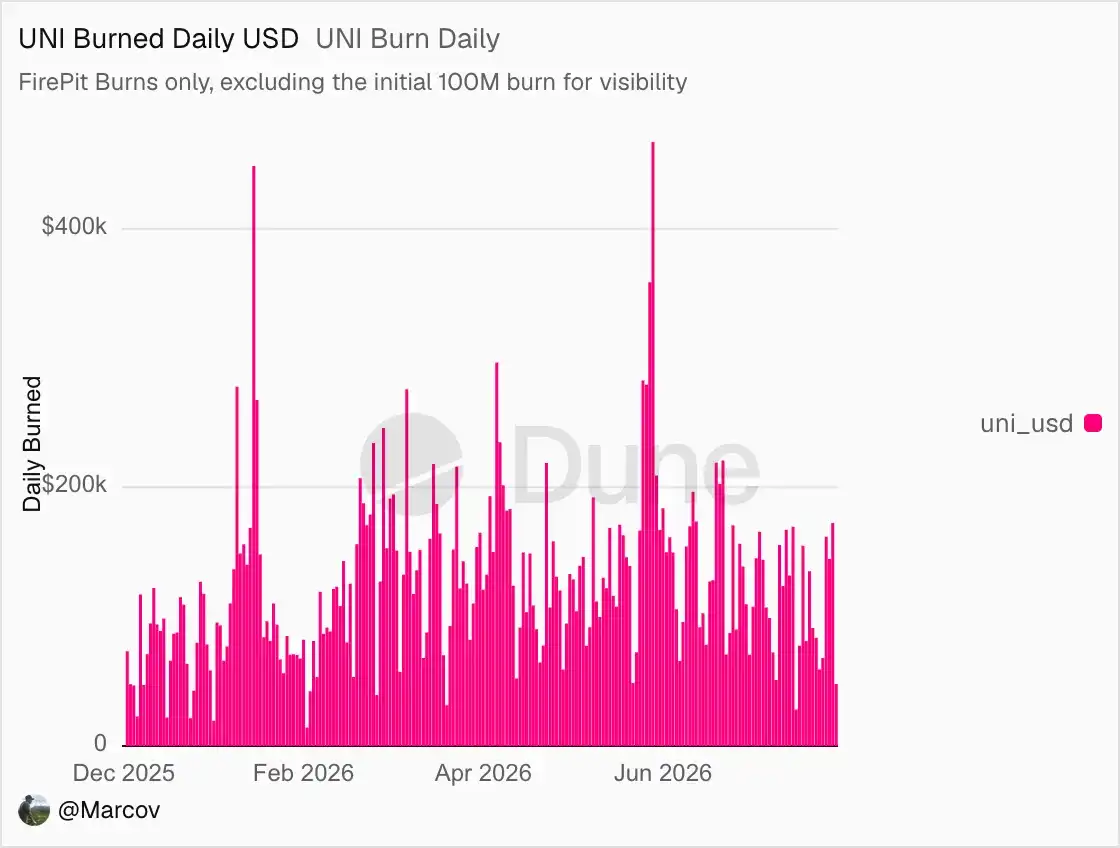
The quietness was due to underwhelming data. According to Dune statistics, in the first 12 days after the fee switch was activated, the cumulative value of burned UNI was only about $800,000, roughly $26-27 million annualized, corresponding to an annual burn of approximately 4 to 5 million UNI tokens. Considering the protocol's annual 20 million UNI growth budget expenditure, this figure held little appeal. By May 2026, cumulative protocol revenue was about $12.3 million, with daily protocol revenue around $73,000. The burn mechanism was operating, but it was more like an engine idling too quietly to be heard.

The change occurred in July. On July 1, Robinhood Chain officially launched, with Uniswap's v2, v3, v4, and UniswapX deployed on the first day. This chain, built for tokenized stocks, pushed Uniswap's daily trading volume to $5 billion within eight days, with cumulative trading volume surpassing $10 billion by July 10. In its first week, Robinhood Chain contributed nearly half of Uniswap's total weekly fees, approximately $11 million. Daily total protocol fees once reached $5.2 million, second only to the two major stablecoin issuers across the entire network. Uniswap founder Hayden Adams called it the most active chain outside of Ethereum mainnet.

Then came the votes. A Snapshot vote from July 7 to 12 decided to extend the fee mechanism to v4 pools, followed by on-chain voting the next week; a temperature check for activating protocol fees on the Robinhood Chain deployment ran from July 10 to 15. On July 27, the v4 fee switch was officially activated. The effect was immediate: according to DefiLlama data, protocol revenue nearly tripled after activation. Daily funds flowing to UNI burns rose from about $114,000 in early July to $325,000, with Robinhood Chain alone contributing $170,000, over half the total, and Ethereum mainnet contributing about $82,000. On the day the news materialized, UNI rose 12%, touching $4.4.

Looking back at this curve, the logic is quite clear. When the fee switch was turned on at the end of last year, the market priced in expectations, and when expectations weren't met, it fell back. But when the burn data climbed from a few hundred thousand dollars per month to a few hundred thousand dollars per day, and when the largest new revenue source by trading volume connected to this burn machine, the market began pricing not expectations but cash flow. For a protocol with annual trading volume in the trillions, token holders previously received nothing. Now, every transaction creates a permanent, automatic buyer for the token. This transformation from a governance token to a cash-flow asset is the core narrative behind this rally.

It's worth noting that buyback-and-burn mechanisms are no longer novel in today's crypto industry. Hyperliquid has a monthly buyback size of nearly $95 million, pump.fun has $35 million, Jupiter uses half its operating income for buybacks, and dYdX, Aave, and Lido are all advancing similar mechanisms. But whether buyback-and-burn works never depends on the mechanism itself, but on the token distribution structure.

UNI is an "old token" that completed its distribution in 2020. Six years have allowed for sufficiently dispersed holdings. There are no massive, pending unlocks in the circulating supply. Approximately $830 million worth of UNI is available for sale on exchanges. The buyback-formed buying pressure genuinely acts on the secondary market. Many new projects also sport buyback-and-burn labels, but the monthly token unlocks for teams and investors far exceed the buyback volume. The burned tokens are just a drop in the bucket against the constant influx of new supply, so prices naturally cannot hold.

This is a rare advantage for old DeFi projects. Having survived long enough, launching early enough, and having sufficiently cleaned-up token distribution allows the buyback-and-burn machine to truly start turning. For UNI, the next question to verify is also specific: Robinhood Chain's gas subsidies are set to expire roughly 90 days after launch. How much trading volume remains thereafter will determine whether this doubling is the beginning of value realization or just another illusion propped up by subsidies.


İlgili Sorular

QWhat is the main reason behind UNI's strong price performance from June to July, according to the article?

AThe article attributes UNI's strong performance to the effective implementation of the 'fee switch' and the subsequent shift from a governance token to a cash-flow asset. The key driver was the significant increase in daily protocol revenue, which funds an automatic buyback and burn mechanism, creating a permanent buyer for UNI. This was amplified by Uniswap's deployment on the new Robinhood Chain, which greatly boosted trading volume and fee revenue.

QWhat is the role of the TokenJar treasury contract and the Firepit contract in the new Uniswap fee mechanism?

AThe TokenJar treasury contract is the central pool that collects all protocol revenue from the activated fee switch (from Ethereum v2/v3 pools, etc.) and sequencer revenue from Unichain. The Firepit contract is its only exit; it uses the funds in TokenJar to buy UNI tokens and permanently burn them, directly linking protocol revenue to deflationary pressure on the token supply.

QHow did the launch of Robinhood Chain impact Uniswap's metrics in July 2026?

AThe launch of Robinhood Chain in July 2026 dramatically increased Uniswap's activity. In its first week, it contributed nearly half of Uniswap's total weekly fees (about $11 million), pushed Uniswap's daily trading volume to $500 million, and helped achieve a cumulative volume of over $1 billion by July 10. After the fee mechanism was extended to it, Robinhood Chain alone contributed over $170,000 daily to the UNI burn, which was more than half of the total daily burn amount at the time.

QWhy does the article claim that buyback/burn mechanisms work better for 'old DeFi projects' like UNI compared to many new projects?

AThe article argues that old DeFi projects like UNI, which launched and distributed tokens years ago (2020 for UNI), have a more favorable token distribution. Their circulating supply is widely distributed with no large, pending unlocks from teams or investors. This means the buyback pressure from protocol revenue acts directly on the secondary market supply. In contrast, many new projects have monthly unlock schedules where newly released tokens for teams and investors often far exceed the amount being bought back and burned, diluting the deflationary effect.

QWhat future challenge or test does the article mention for UNI's current bullish narrative?

AThe article identifies the upcoming expiration of Robinhood Chain's gas fee subsidies (around 90 days after launch) as a key test. The sustainability of Uniswap's trading volume and fee revenue on that chain after the subsidies end will determine whether the recent price increase represents a true 'value discovery' or was merely a temporary illusion propped up by incentives.

İlgili Okumalar

UNI Doubles in Two Months Against the Trend: A 5-Year-Overdue Value Realization

Amidst a generally stagnant crypto market in June and July, UNI, the governance token of Uniswap, saw a significant surge, nearly doubling in price from around $2.3 to $4.6. This rally represents a delayed but significant value reassessment, triggered by the practical implementation of its long-debated "fee switch" mechanism. The key turning point was the on-chain execution of the UNIfication proposal in December 2025. It activated a protocol fee on select pools, directed Unichain sequencer revenue (net of costs) to a communal treasury, executed a one-time burn of 100 million UNI, and established a system where all protocol revenue flows into a "TokenJar" contract. This treasury has a single exit: purchasing and permanently burning UNI via a "Firepit" contract. Initially, the market reacted tepidly as the generated revenue and corresponding burn rate were modest. The narrative shifted dramatically in July 2025 with two major developments. First, the launch of Robinhood Chain, tailored for tokenized stocks, rapidly became a primary source of volume and fees for Uniswap, at one point contributing nearly half of its weekly fees. Second, governance votes successfully expanded the fee mechanism to v4 pools and initiated a temperature check for fees on Robinhood Chain. The activation of v4 fees caused the protocol's daily revenue earmarked for UNI burns to nearly triple. The core of UNI's recent price action is the transition from a pure governance token to a cash-flow asset with a permanent, protocol-funded buyer. Its effectiveness is amplified by UNI's mature and widely distributed supply, with no major impending unlocks to dilute the impact of the buybacks. The sustainability of this rally now hinges on whether the transaction volume, particularly on Robinhood Chain, persists after its initial gas subsidies expire, determining if this is a genuine value realization or a subsidy-fueled spike.

marsbit1 saat önce

UNI Doubles in Two Months Against the Trend: A 5-Year-Overdue Value Realization

marsbit1 saat önce

Breaking: Google Earth Urgently Pulls Back Nano Banana 2 Image Generation Feature!

Google Earth's newly launched "Create image" feature, powered by the Nano Banana 2 AI image generation model, was abruptly withdrawn shortly after its release due to being "played" by users. The feature allowed users to generate and overlay AI-created visuals directly onto real-world satellite and 3D maps in Google Earth. The tool enabled creative applications like historical recreations (e.g., visualizing ancient Pompeii), generating informational graphics for landmarks, and envisioning architectural projects or futuristic cityscapes on real terrain. It operated under "geospatial grounding," meaning the AI respected the underlying geography, topography, and perspective of the chosen map view. The model also integrated with Gemini to retrieve relevant factual information. However, upon release, users quickly tested its limits. A prominent example involved reimagining Philadelphia's historic Independence Hall as a post-apocalyptic ruin overrun by "happy" zombies, evil clowns, and giant alien mechs. This highlighted both the feature's playful potential and its risks regarding the generation of inappropriate or misleading content on realistic maps, leading to its swift temporary removal. Google stated it would re-release the feature after implementing "enhanced guardrails." Analysts note this move strategically leverages Google's vast proprietary geospatial data, positioning its AI not just for artistic generation but for spatially accurate world visualization—a unique advantage in the competitive AI image generation landscape.

marsbit2 saat önce

Breaking: Google Earth Urgently Pulls Back Nano Banana 2 Image Generation Feature!

marsbit2 saat önce

Altman Admits: Overestimated AI Snatching Jobs! Huang Renxun: The Unemployment Narrative Is Completely Backwards

Sam Altman has revised his earlier predictions about AI rapidly replacing jobs, admitting he overestimated the speed at which AI would eliminate entry-level white-collar roles. Speaking on the "Invest Like the Best" podcast, he stated that people do not truly want an AI CEO, as accountability and human connection remain critical. He found that individuals prefer interacting with people who can be held responsible for decisions. Similarly, NVIDIA's Jensen Huang argued that the narrative of AI destroying jobs is misguided. He distinguishes between tasks and jobs, noting that while AI can automate specific tasks, entire jobs—encompassing communication, judgment, coordination, and accountability—are not eliminated. He cited examples like radiologists and software engineers, where demand for these roles has increased as AI handles repetitive tasks, allowing for business expansion and the creation of more positions. Data from a University of Maryland and LinkUp study supports this, showing that U.S. job postings for new graduates have actually risen, countering the fear of vanishing entry-level roles. However, a significant shift is occurring: the traditional entry-level tasks that help newcomers gain experience are being automated, making initial career access more challenging. The key insight is that as AI takes over standardized tasks, the enduring value of human work shifts toward areas of responsibility, trust-building, and final decision-making—aspects that AI cannot replicate. The real "moat" for professionals lies in these irreplaceable human elements.

marsbit2 saat önce

Altman Admits: Overestimated AI Snatching Jobs! Huang Renxun: The Unemployment Narrative Is Completely Backwards

marsbit2 saat önce

İşlemler

Spot
活动图片




