Stock Price Halved in 45 Days, Is Circle Actually the "DeFi Barometer"?

marsbit2026-06-29 tarihinde yayınlandı2026-06-29 tarihinde güncellendi

Özet

Over a 45-day period, Circle's stock price plummeted by approximately 50% to around $63, coinciding with a significant $70 billion decline in the circulation of its USDC stablecoin from its peak. In contrast, Tether's USDT saw a much smaller reduction. Analyst Ed Engel posits that Circle acts as a barometer for DeFi activity, as a high correlation exists between USDC supply and ETH price movements. The vast majority of USDC is concentrated within crypto exchanges and DeFi protocols for yield generation, rather than for widespread daily use in payments or commerce, unlike USDT which has stronger real-world adoption in various regions. The recent contraction in DeFi Total Value Locked (TVL), following security incidents like the Kelp DAO attack, appears to mirror Circle's declining stock performance. While Circle is actively promoting USDC's use as a settlement asset on platforms like Hyperliquid and in institutional payment corridors—where its organic transfer volume surpasses USDT's—these efforts have not sufficiently driven growth in USDC's overall supply. The company's revenue remains heavily tied to DeFi's expansion. For Circle's investment narrative to change, it must either significantly reduce its reliance on the volatile DeFi sector or demonstrably prove that real-world adoption can substantially and sustainably increase USDC circulation. In the near term, market confidence hinges on DeFi addressing its inherent risk-reward imbalances.

Original author: Eric, Foresight News

In June 2026, what seemed like a good show of bottoming out and rebounding for Circle just began and then came to an abrupt halt. As of June 25 US local time, the circulating supply of USDC has dropped to 73.6 billion, down about 7 billion from its peak, while Circle's stock price has also been nearly halved to around $63.
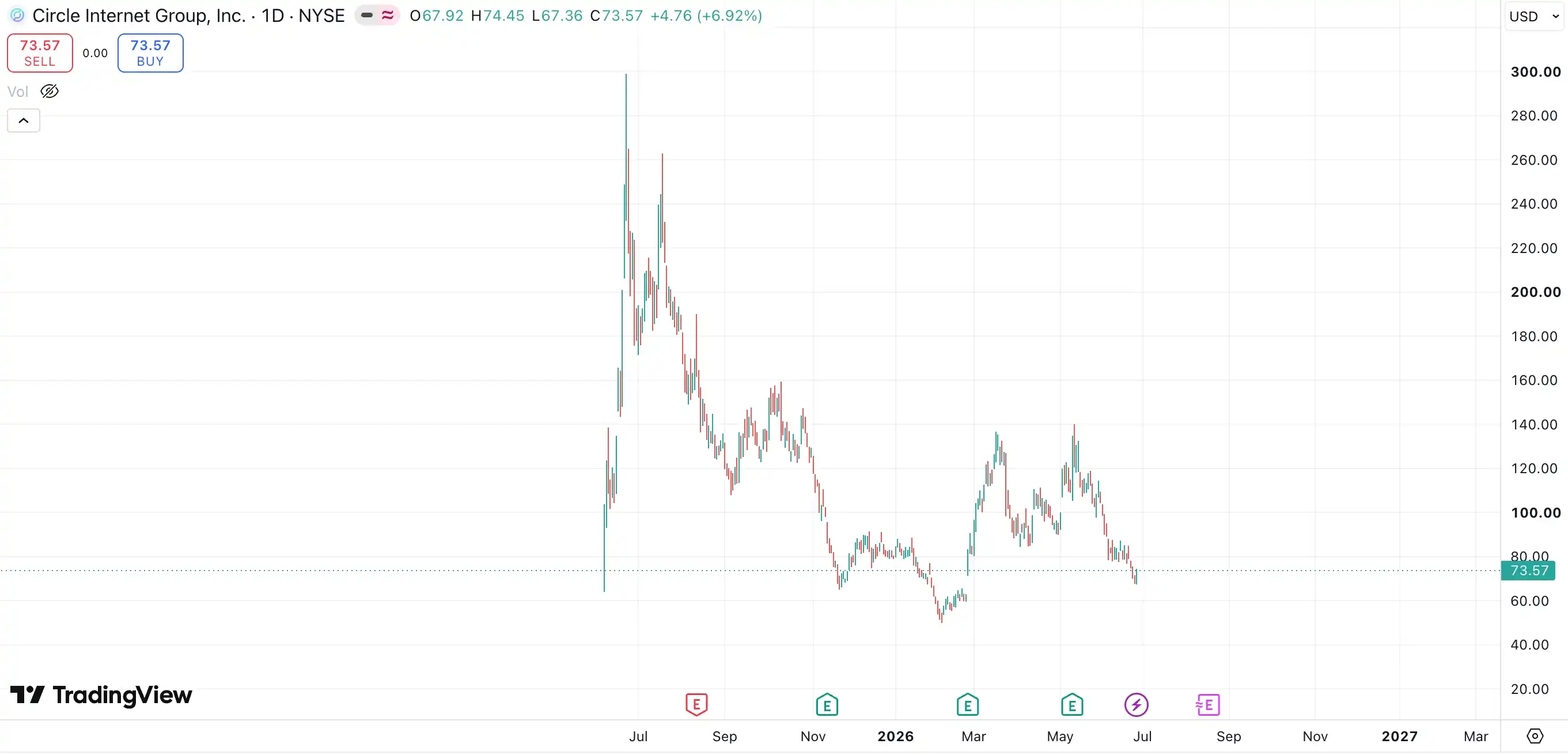
On the surface, 7 billion is less than 10% of 800 billion. For comparison, the circulating supply of USDT next door once reached a peak of around 191 billion, and now remains around 186.3 billion, having decreased by only 4.7 billion, a reduction proportion of less than 3%.

While there is no evidence directly linking the decline in USDC's circulating supply to the drop in Circle's stock price, their synchronized movement, along with the coincidental timing of security incidents in the DeFi space and Circle's stock price decline, inadvertently supports the view expressed by Compass Point analyst Ed Engel as early as January this year:

Circle is a barometer for DeFi activity.

Engel believed at the time that Circle trades similarly to cyclical stocks. From October 2025 to January 2026, the correlation coefficient between the USDC circulating supply curve and ETH's price trend reached 0.66. The core reason is this: 75% of USDC circulates in scenarios like cryptocurrency exchanges and DeFi protocols, while the amount of USDC actually used for daily consumption and cross-border payments is far lower than imagined.
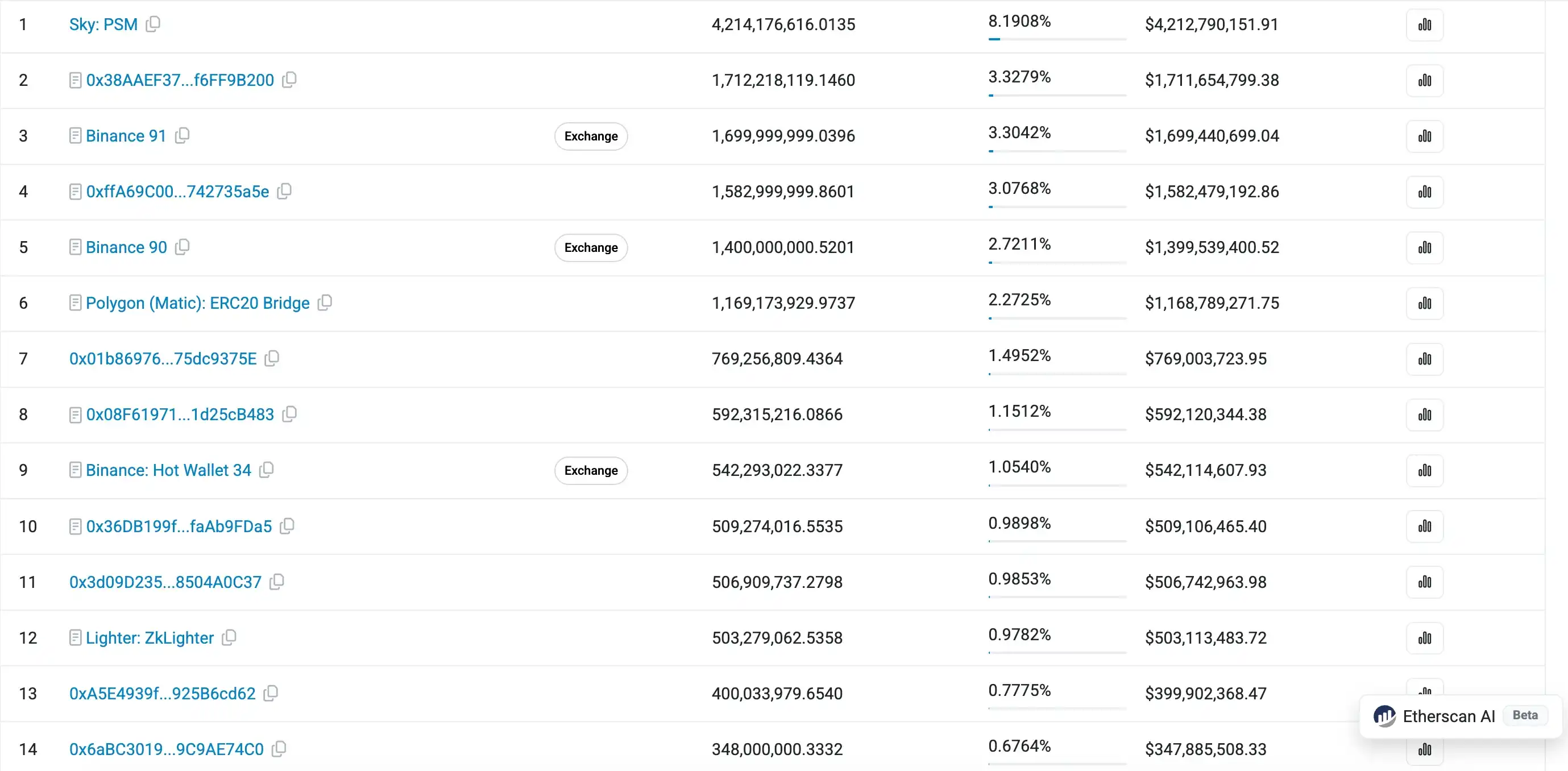
Looking at the Etherscan USDC holding address rankings, a large number of contract addresses appear on the first page. These USDC reside in protocols or addresses such as DeFi, exchange multi-signature wallets, and cross-chain bridges. Furthermore, the top 100 USDC holding addresses on Ethereum account for over 50% of the USDC supply, with just 0.32% of the addresses holding 93.55% of the total supply. A vast amount of USDC is placed in protocols to earn yields higher than bank deposits.

This level of concentration is not what a "digital dollar" intended for daily circulation should have. You might counter by pointing to USDT's even higher concentration on Ethereum, but it's very common for the Web3 industry to use USDT for salary payments, the foreign trade sector to use USDT for settlements, gray/black markets to use USDT to evade regulation, and third-world countries to use USDT to protect savings. These are practical use cases.

Although perhaps not as "glorious" as USDC, these scenarios also form the foundation of USDT. This has simultaneously led to USDT, which should theoretically be the most used stablecoin for crypto trading pairs, outperforming the more compliant USDC in terms of shrinkage during such a weak market. The news today that the local price of USDT in India is already at an 8% premium to its normal price also corroborates this view.
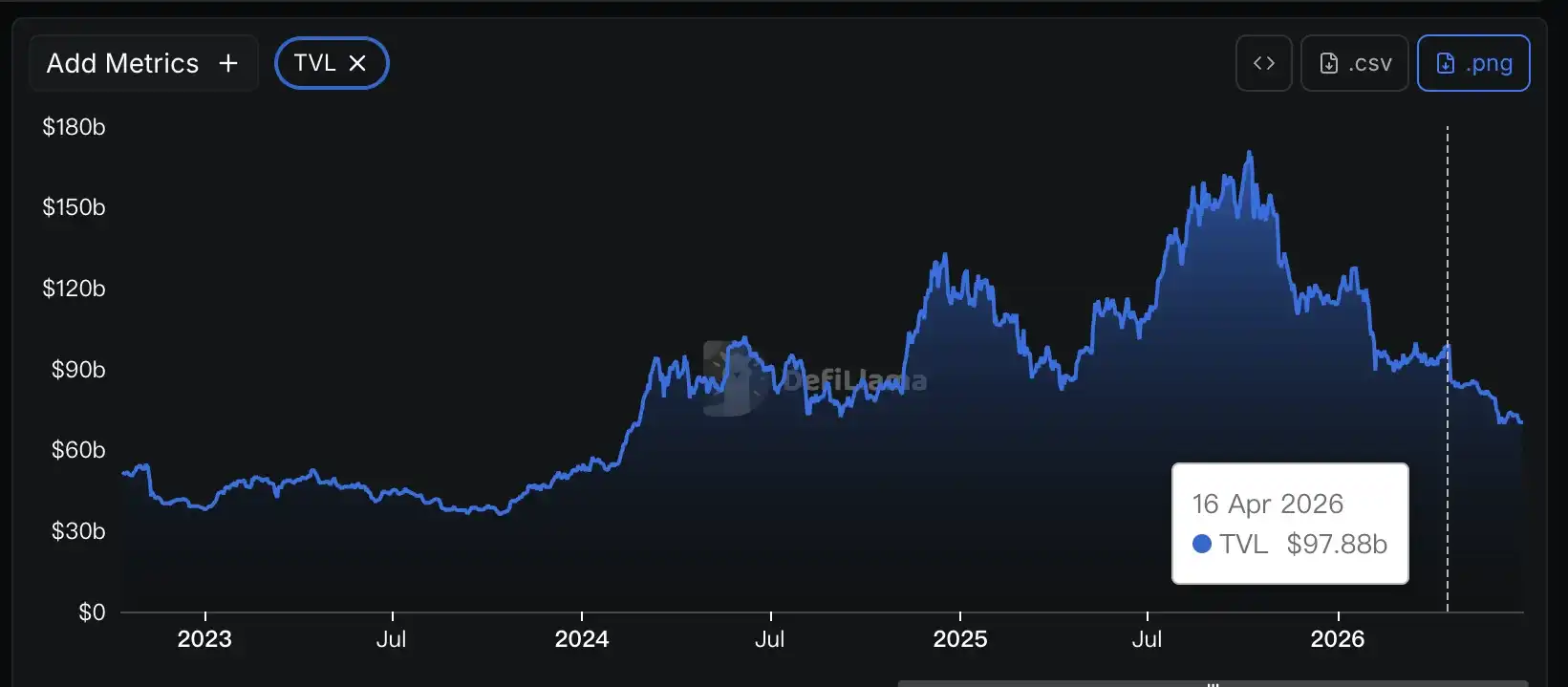
The overall TVL of DeFi started declining from mid-April, coinciding with the beginning of the Kelp DAO hack incident. Circle's stock price began its decline from mid-May. Although the starting times were spaced apart, the subsequent trends are largely similar.

Just last month, Circle and Coinbase jointly pushed USDC to become the settlement stablecoin on Hyperliquid. The cost was not only having to stake 500,000 HYPE tokens each but also ceding 90% of the income generated from the reserve assets backing USDC on Hyperliquid. Behind this seemingly "win-win-win" situation on the surface lies Circle's helplessness: the DeFi space, its main battleground, has begun to shrink rapidly. The Kelp DAO incident severely damaged DeFi's credibility. Waiting for DeFi to naturally increase the volume of USDC has hit a bottleneck, forcing Circle to "fend for itself."

If you observe closely, you'll find that USDC is not only the settlement asset for Hyperliquid but also for platforms like Lighter. Outside the cryptocurrency field, Circle is also sparing no effort to promote USDC "to be used as dollars." According to Artemis data, the "organic transfer volume" of USDC (excluding wash trading, high-frequency trading, exchange wallet consolidation, etc.) in 2025 was $18.3 trillion, while USDT's was $13.2 trillion.

It's an undeniable fact that USDC is widely used in institutional and compliant payment scenarios. However, the amount of USDC needed for these scenarios is not as high as one might imagine. The flow of funds may not always be in the form of USDC; instead, USDC might serve as an "intermediate state," reducing the time and capital costs of transfers between banks or financial institutions.

In other words, to increase the supply of USDC by 10 billion might require trillions of dollars in actual capital flow in the real world, but on-chain, it could just be a few large DeFi protocols, Memecoin trading platforms, or prediction markets. No matter how fast USDC circulates or how high its usage rate is in reality, if the issuance volume of USDC doesn't increase, neither will revenue nor profits.

Of course, none of this is enough to "pronounce a death sentence" on Circle. If in the future Circle can break free from its reliance on DeFi, or demonstrate that real-world usage significantly drives the growth of USDC issuance, then the investment logic for Circle might be rewritten. But in the short term, attention likely still needs to focus on whether DeFi can break the shackles of "asymmetric returns and risks" and give the market more confidence.


İlgili Sorular

QAccording to the article, what is the main reason why Circle's stock price is considered a barometer of DeFi activity?

AThe main reason is that approximately 75% of USDC's circulation is concentrated within cryptocurrency exchanges and DeFi protocols, meaning its demand and supply are heavily dependent on DeFi market activity, making Circle's performance cyclical and correlated with DeFi trends.

QHow does the usage pattern of USDC differ from that of USDT based on the article's analysis?

AUSDC is heavily concentrated in DeFi protocols and exchange wallets for yield generation, while USDT has a stronger 'real-world' basic demand from uses like cross-border payments, remittances, salary payments in some regions, and use in the shadow economy, making its circulation more resilient.

QWhat event does the article suggest triggered the decline in overall DeFi TVL, which subsequently impacted Circle?

AThe article suggests the decline in overall DeFi TVL began with the Kelp DAO hack/exploit in mid-April, which damaged public trust in DeFi.

QWhat recent move did Circle make on the Hyperliquid platform to promote USDC usage, and what does the article imply was the motivation behind it?

ACircle, in partnership with Coinbase, made USDC the settlement stable币 on Hyperliquid. The article implies the motivation was Circle's 'helplessness' as growth from its main DeFi战场 was stagnating, forcing it to proactively secure new on-chain use cases even by offering significant incentives (staking HYPE, sharing 90% of reserve收益).

QWhat key challenge must DeFi overcome to regain market confidence and positively impact Circle, according to the article's conclusion?

AAccording to the article's conclusion, DeFi must overcome the constraint of '收益与风险不对等' (收益与风险不对等), meaning it needs to solve the issue where the risks (like hacks) do not appropriately match the potential rewards, in order to restore market信心.

İlgili Okumalar

Lightning Fast Five-Whip Combo! Strategy's Self-Rescue Plan Officially Released

Strategy, amidst the STRC de-pegging crisis, has unveiled its "Digital Credit Capital Framework" self-rescue plan. The five-part framework includes: 1) **Cash Reserves**: Management of ~$2.55B in USD reserves, dedicated solely to covering ~17.4 months of preferred stock dividends and debt interest, with a 12-month minimum coverage floor. 2) **Dividend Policy**: STRC's dividend yield rises to 12% from July 1st, with monthly reviews. Strategy clarifies de-pegging does not automatically trigger further hikes. 3) **Preferred Stock Buyback**: A $1B authorization, prioritizing STRC repurchases to support its price, reduce future dividend obligations, and signal commitment, using funds separate from dividend reserves. 4) **Common Stock Buyback**: A separate $1B authorization for MSTR stock, aimed at creating shareholder value when the stock is deemed undervalued, establishing a two-way capital management mechanism. 5) **Bitcoin Monetization**: Formal authorization to sell BTC (up to $1.25B earmarked) to build USD reserves, cover dividends/interest, or fund buybacks, marking a strategic shift where BTC becomes a managed asset rather than a strictly "hold-only" reserve. Market reaction saw MSTR and STRC shares rise pre-market, while BTC remained stable. The plan aims to restore confidence in STRC, ensure dividend sustainability, and reopen Strategy's funding channels.

Odaily星球日报1 saat önce

Lightning Fast Five-Whip Combo! Strategy's Self-Rescue Plan Officially Released

Odaily星球日报1 saat önce

The Sword of Damocles Over the AI Bull Market: Not Just in South Korea, Leverage in U.S. Stocks Is Equally Staggering

Global equity markets are hitting new highs driven by the AI boom, but the fuel behind this rally is becoming increasingly dangerous. From the US to South Korea, margin debt and leveraged ETF assets have soared to historical extremes, with their pro-cyclical nature amplifying tail risks in market volatility. In the US, margin debt rose 54% year-over-year in May, reaching a record $1.4 trillion. Simultaneously, leveraged ETF assets nearly doubled in under 70 days to over $220 billion by early June, with intense focus on tech, semiconductor indices, and single stocks like NVIDIA and Tesla. A warning sign appeared in South Korea, where the KOSPI index experienced extreme volatility, plunging 10% to trigger a circuit breaker, then sharply rebounding before halting again, partly driven by concentrated, highly leveraged positions in chip stocks. Analysts are raising alarms. Barclays warns that leveraged funds have accumulated roughly $300 billion in equity-linked derivatives since late March, creating a major source of non-discretionary risk. Morgan Stanley notes an unprecedented reliance on leveraged financing by marginal buyers, with financing becoming more expensive and scarce. Charles Schwab has tightened margin requirements. The core risk lies in the mechanics: leveraged ETFs and derivatives can create a "tail wags the dog" effect, where fund flows force market makers to buy underlying stocks, amplifying gains. This process reverses in a downturn, triggering a self-reinforcing selling spiral as funds deleverage. Additionally, the cost of borrowing to buy stocks has spiked to multi-year highs. Morgan Stanley warns this sets up a nonlinear risk: high financing costs stall momentum, a price decline triggers forced deleveraging, and selling pressure is multiplied by leverage, potentially leading to outsized declines. The current market breadth is narrow, with gains heavily concentrated in tech, making the rally vulnerable to a pullback in leveraged positions. In summary, the AI-fueled bull market is increasingly propped up by record leverage. When this trend reverses, the deleveraging process could magnify losses, posing a significant threat to financial stability.

marsbit1 saat önce

The Sword of Damocles Over the AI Bull Market: Not Just in South Korea, Leverage in U.S. Stocks Is Equally Staggering

marsbit1 saat önce

Strategy Launches 'Digital Credit Capital Framework': Authorizes Sale of $12 Billion in Bitcoin, Ending the 'Never Sell' Script

Strategic, the world’s largest corporate holder of Bitcoin (formerly MicroStrategy), has dramatically shifted its long-standing “never sell Bitcoin” strategy by announcing a new “Digital Credit Capital Framework” on June 29. This plan authorizes the sale of up to $1.25 billion worth of Bitcoin to raise cash, establishes a $2.55 billion USD reserve, increases the dividend rate on its STRG preferred shares to 12%, and authorizes up to $1 billion each for repurchases of its own digital credit securities and Class A common stock. This pivot comes amid severe financial pressure. The company’s STRG preferred shares are trading at a ~24% discount to their $100 face value, making new issuances difficult and stalling its buy-Bitcoin funding flywheel. Its annualized dividend obligation has surged to ~$1.2 billion. Meanwhile, its MSTR stock has plummeted 36% in eight days, erasing its traditional premium over its Bitcoin holdings per share. In recent weeks, Strategic has already shifted focus from accumulating Bitcoin to bolstering cash reserves by selling its own MSTR shares. The new framework formalizes this defensive turn, aiming to ensure liquidity, cover dividends, and support its securities prices through buybacks. However, the move risks triggering a “death spiral” if Bitcoin sales pressure the market, further devaluing the company’s core asset. The company also faces a potential securities investigation and carries significant debt, with Bitcoin’s current price below its average acquisition cost.

marsbit1 saat önce

Strategy Launches 'Digital Credit Capital Framework': Authorizes Sale of $12 Billion in Bitcoin, Ending the 'Never Sell' Script

marsbit1 saat önce

İşlemler

Spot
活动图片