POLY's Appearance Hints Keep Coming, How Far Is the Airdrop?

marsbit2026-05-19 tarihinde yayınlandı2026-05-19 tarihinde güncellendi

Özet

The article discusses growing speculation around the potential launch and airdrop of the POLY token by prediction market platform Polymarket. It outlines a timeline of official hints, starting from CEO Shayne Coplan mentioning POLY alongside major cryptocurrencies in October 2025 to confirmations from other team members about a future token and airdrop. Recent developments include the appearance of POLY preview pages on CoinGecko and CoinMarketCap in April, and further product-related hints from the team in May about staking and airdrop criteria. Market prediction data suggests a 56% probability of a token launch before year-end, with significant potential market capitalization. The author's personal view is that Polymarket is unlikely to issue the token before the World Cup, prioritizing platform stability and infrastructure development for the high-traffic event instead. The article advises strategies like hedging trades and engaging on social media to potentially qualify for a future airdrop.

Recently, due to constant hints from Polymarket officials regarding POLY token-related content, various airdrop-farming communities have been analyzing the timing and scale of the POLY airdrop from different angles.

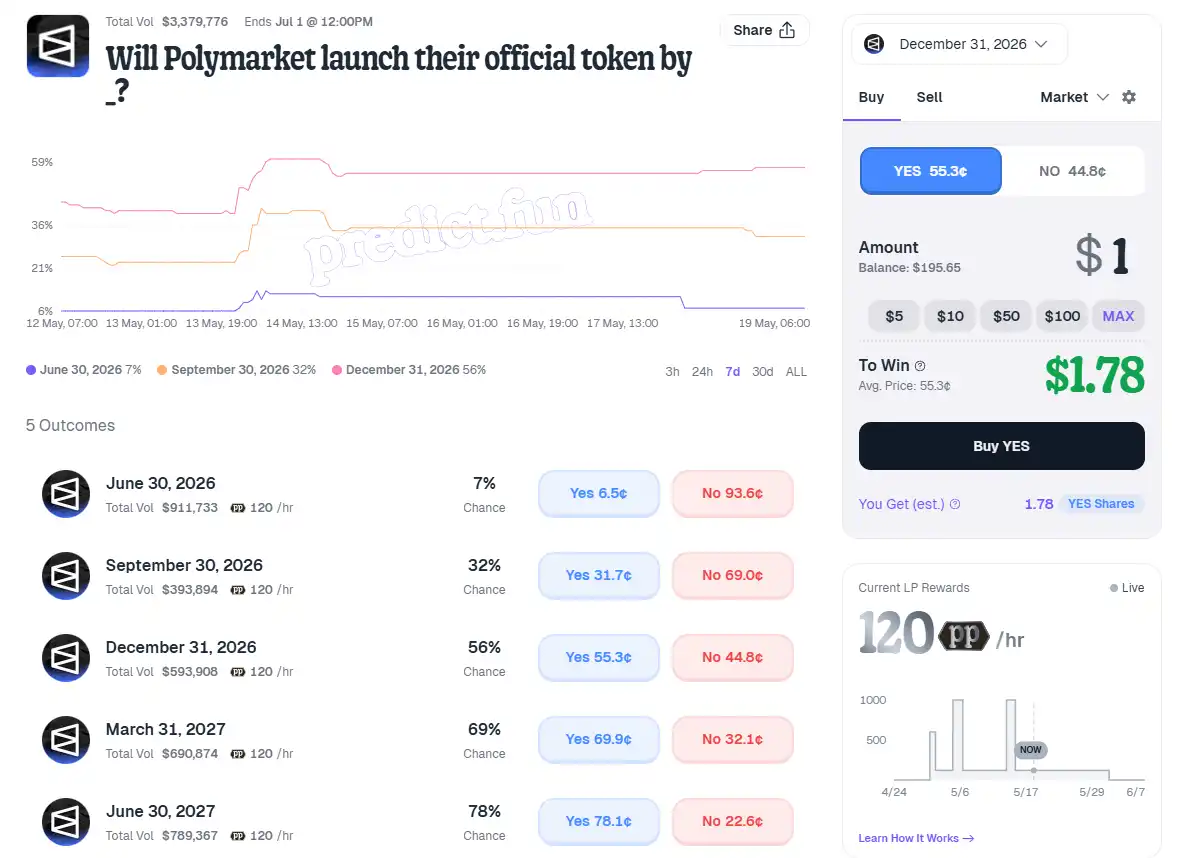
According to predict.fun data, the probability of the event "Polymarket will launch its official token before the end of this year" is currently 56%; there is even a 7% probability that "Polymarket will launch its official token before Q2 of this year."
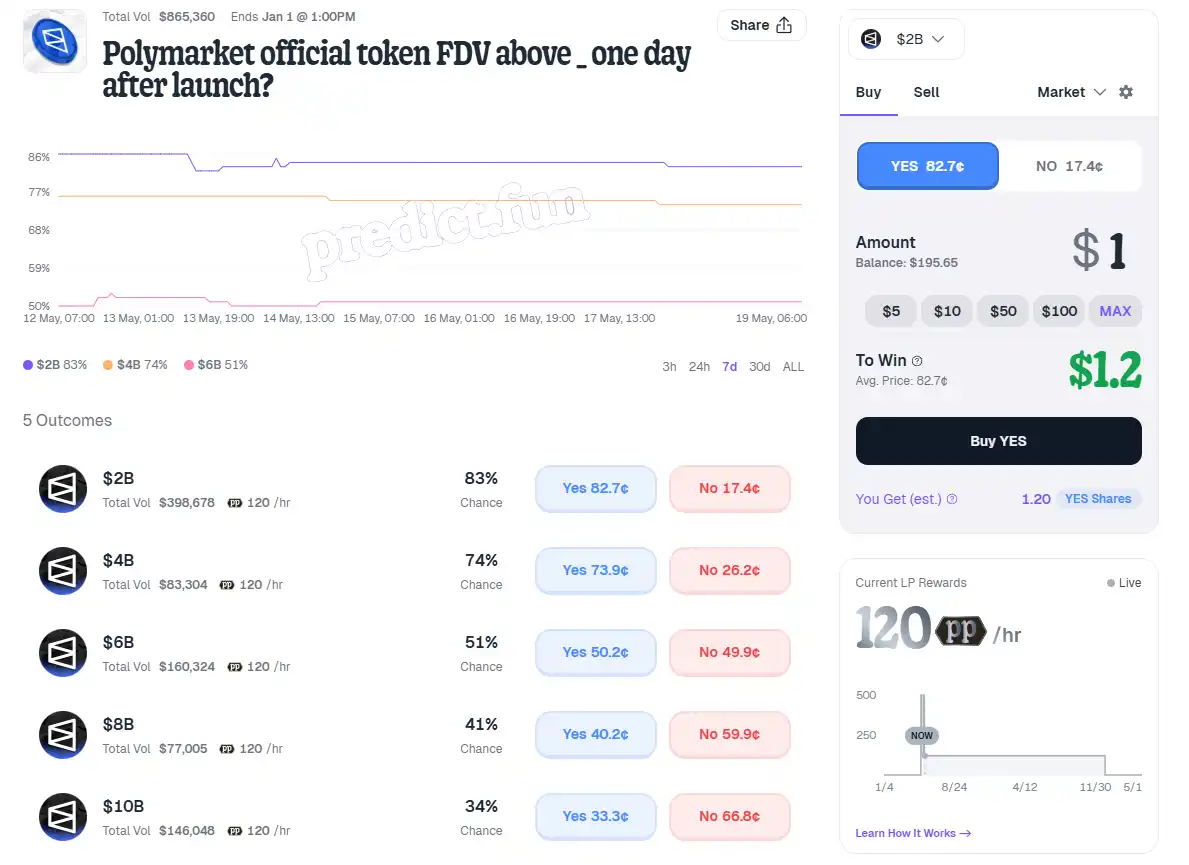
Additionally, regarding market cap, the probability for the event "Polymarket's FDV exceeds $6 billion one day after listing" is currently 51%; there is a 34% probability for "Polymarket's FDV exceeds $10 billion one day after listing."
Timeline of Official Polymarket Token Hints

October 2025: Initial Hints and Official Confirmation of the POLY Token

Official signals surrounding the POLY token from Polymarket can be traced back to last October.

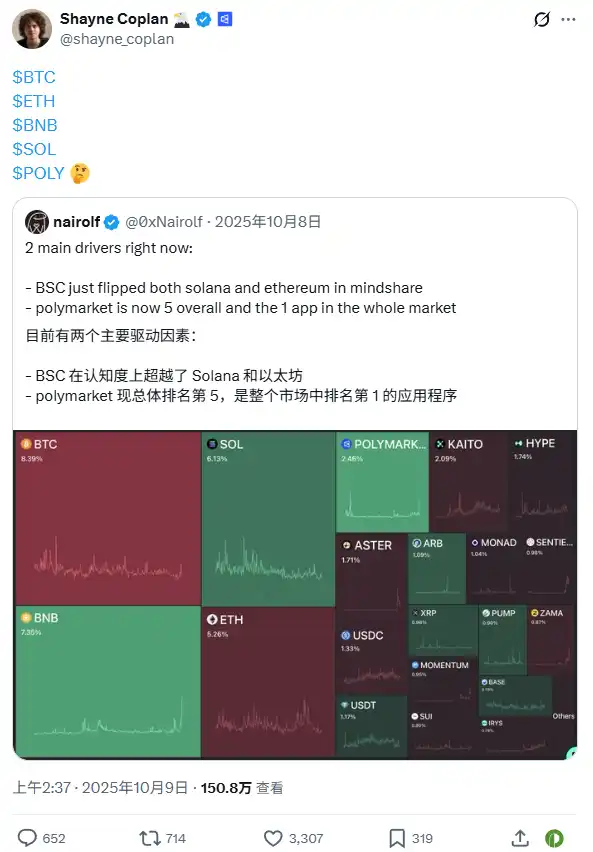
On October 8, 2025, Polymarket CEO Shayne Coplan posted on X, listing POLY alongside BTC, ETH, BNB, and SOL, sparking community speculation about a Polymarket token launch.

Although this was not an official token announcement, for the market, the founder personally writing $POLY was sensitive enough. Since then, community discussion about a Polymarket token launch has noticeably heated up.
The airdrop expectation was further brought into public discussion by official team members. On October 23, 2025, Polymarket Growth Lead William LeGate mentioned "prospective airdrop farmers" in a podcast or related discussion. While not a formal rule explanation, this essentially acknowledged the existence of user behavior and expectations around a Polymarket airdrop in the market.

The expectation for the POLY token was further solidified on October 24, 2025. Polymarket CMO Matthew Modabber explicitly stated in a podcast, "Polymarket will have a token, and it will have an airdrop." This statement became a key turning point for Polymarket's token expectation, shifting from community speculation to official confirmation.

Entering November, the focus of official discussion began to shift from whether there would be an airdrop to what kind of behavior would *not* qualify for an airdrop. On November 11, 2025, William LeGate, responding to Sybil farming, clearly stated, "I can confidently tell you these sybil-farmed accounts are not going to result in any airdrop allocations, they're just wasting their time."

April of This Year: Major Price Tracking Platforms Launch POLY Preview Pages

Entering April of this year, POLY token expectations have extended to major crypto price-tracking websites.

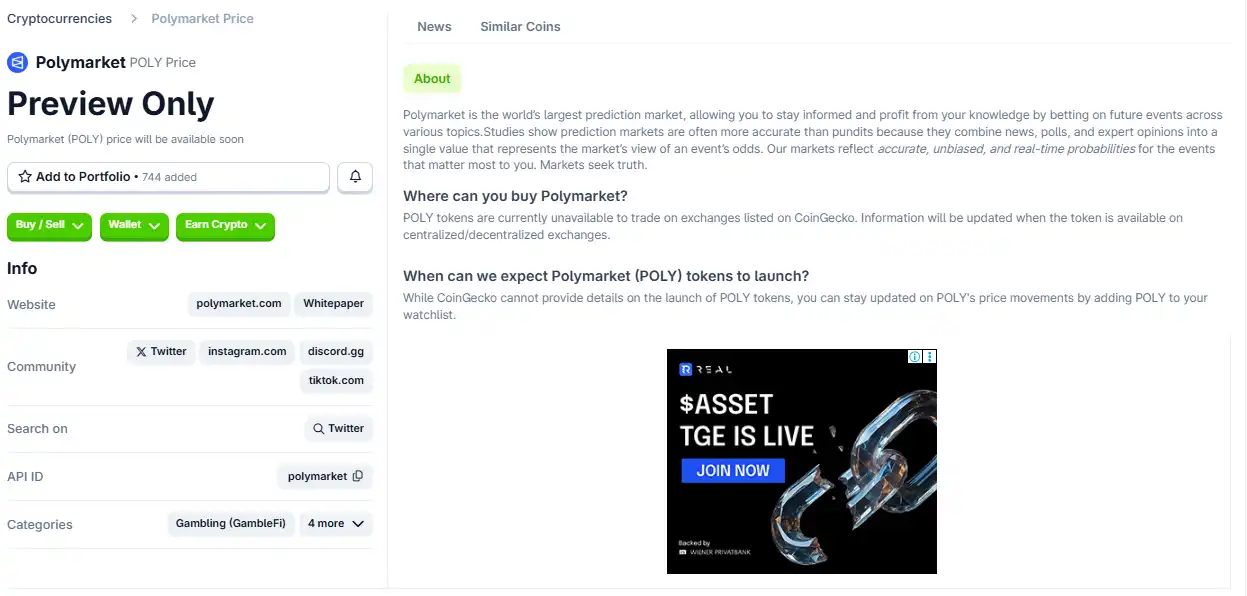
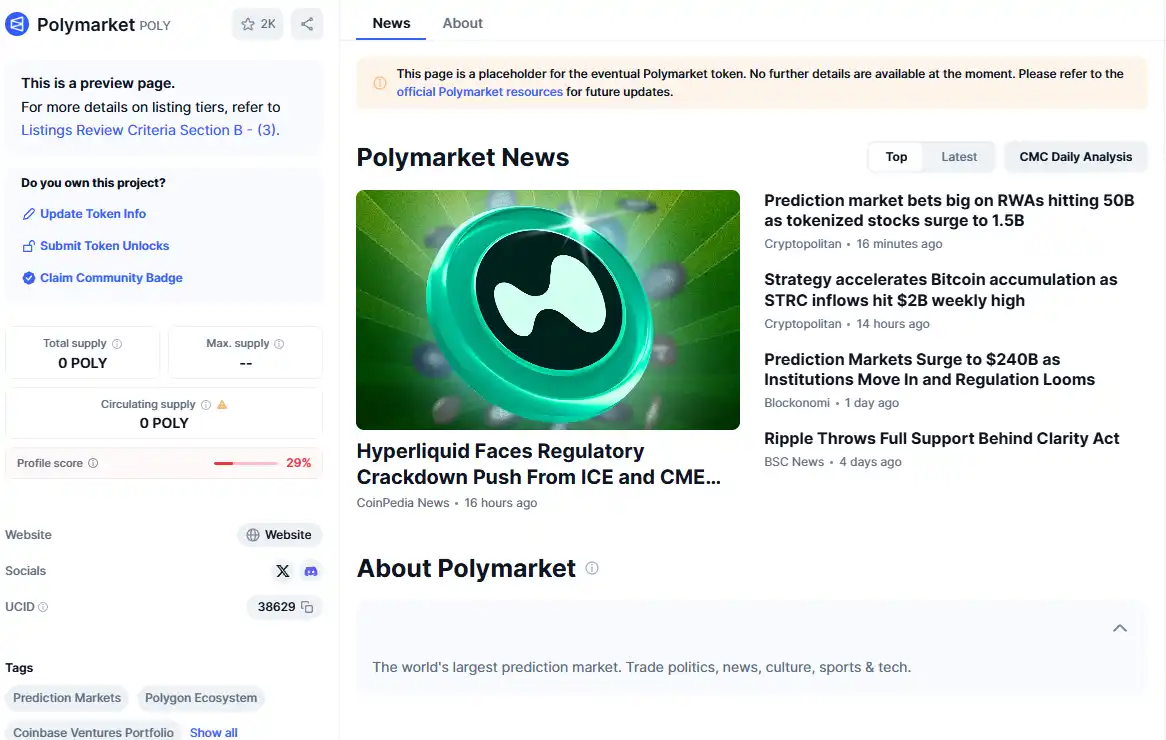
Currently, preview pages for Polymarket (POLY) have appeared on both CoinGecko and CoinMarketCap. While these pages are not equivalent to the official token launch nor do they represent Polymarket announcing a TGE timeline, the fact that external platforms are reserving pages for $POLY further strengthens the community's expectation of a Polymarket token launch.
May of This Year: POLY Token Moves from Airdrop Expectation to Product Hints

Entering May, the discussion around the POLY token has moved further towards specific functions and airdrop qualifications.

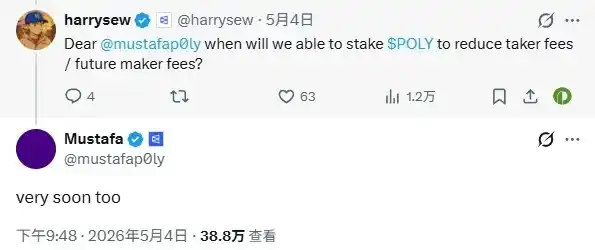
On the evening of May 4th, Polymarket official team member Mustafa responded to questions about the POLY token in a community interaction. A user asked when they could stake POLY to reduce taker fees, or potentially future maker fees.

Mustafa's reply was: "Soon." The community quickly interpreted this official response as Polymarket preparing for the token launch.
On May 13th, clues surrounding the POLY token continued to increase.

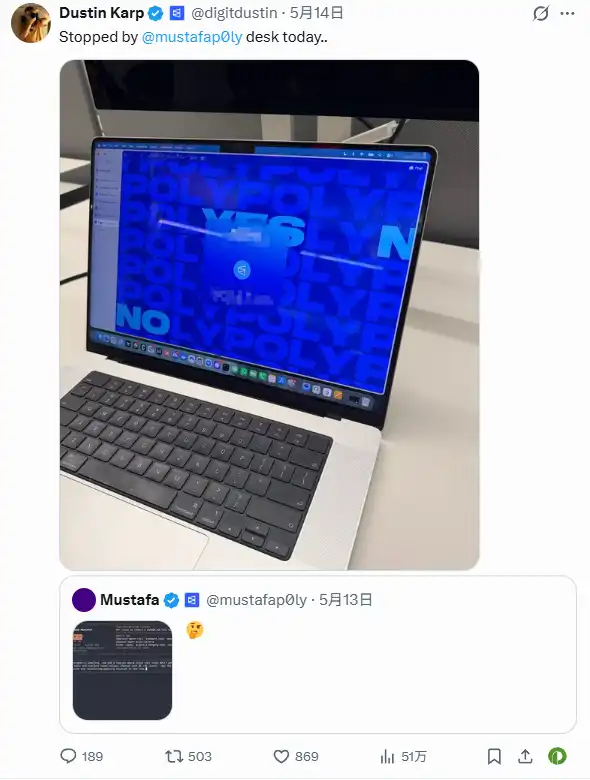
Polymarket Product Lead Dustin Karp posted a photo of his workstation, saying he passed by Mustafa's desk. The photo appeared to show an internal page related to the POLY token airdrop. The community zoomed in and found an "Airdrop" tab visible, further heightening expectations for a POLY token airdrop.
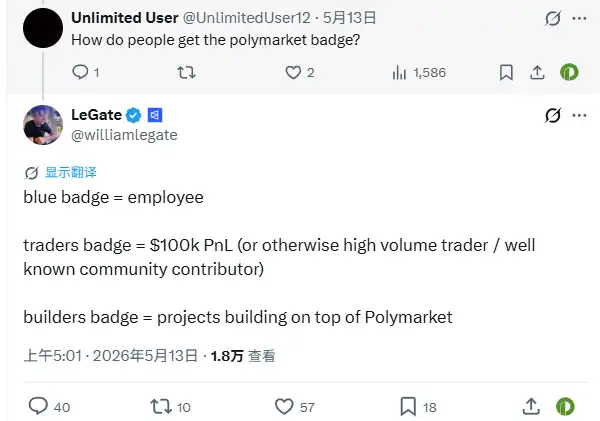
Subsequently, Polymarket Growth Lead LeGate also responded to questions about official badges in community discussions.

LeGate replied that the blue badge represents Polymarket employees; the "Traders" badge is primarily for traders with cumulative profits reaching $100,000, or other high-volume users (in other tweets, he mentioned a trading volume exceeding $10 million and said if users are active on Polymarket, the profit and volume thresholds can be slightly adjusted), and notable community contributors; the "Builders" badge is for projects building and developing based on the Polymarket ecosystem.
Badges might not be the only criteria for receiving an airdrop. The community inquired whether content contributions on X would be rewarded with POLY tokens. LeGate replied that linking your X account to your Polymarket account is only one-third of the conditions.

In addition, users should probably also put their Polymarket profile link in their X bio, actively share their trades, profit records, and market views on X, and maintain interaction with the community.
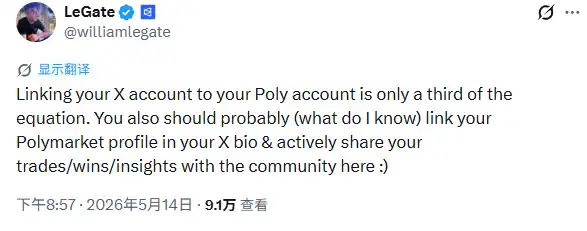
Although this reply did not explicitly confirm whether "shitposting" ("zui lu") could genuinely earn an airdrop, various communities were relatively optimistic and actively posted Polymarket-related content on X to seek potential token airdrops.

Personal Strategy

For someone who has been deeply involved in prediction markets throughout the first half of this year, I am still leaning towards the belief that Polymarket will not launch its token before the World Cup.

The reason is simple. Polymarket's more important task right now may not be to launch a token immediately, but to first refine the trading experience and infrastructure. Whether it's the continuous optimization of V2 or even a chain migration, it's essentially to prepare for high-traffic, high-frequency trading scenarios like the World Cup.

For Polymarket, if the platform experience is unstable during the World Cup, launching a token in advance would hardly help truly onboard new users and trading volume.

Therefore, recent trading has primarily been focused on hedging, placing orders on predict.fun to farm points, and then hedging positions received on Polymarket. At the same time, participating in various events on Polymarket with profitability as the goal.

Additionally, I am also linking my personal X account information on Polymarket and posting Polymarket-related content on X, hoping that when the token is launched in the future, a portion of the airdrop will also be allocated to "shitposting users" ("zui lu users").

İlgili Sorular

QWhat is the main subject of the article and what community activity does it discuss?

AThe main subject is the potential launch and airdrop of the POLY token by Polymarket. The article discusses extensive analysis and speculation within crypto 'airdrop farming' communities regarding the timing and scale of the airdrop.

QAccording to prediction market data, what is the estimated probability for Polymarket launching its official token before the end of this year?

AAccording to data from predict.fun, the probability of the event 'Polymarket will launch its official token before the end of this year' is currently reported at 56%.

QWhen did the first significant official hint about the POLY token occur, and who was involved?

AThe first significant hint occurred on October 8, 2025, when Polymarket CEO Shayne Coplan listed '$POLY' alongside major cryptocurrencies like BTC and ETH on X, sparking community speculation about a token launch.

QWhat two types of user badges did Polymarket's Growth Head, William LeGate, mention, and what are their general criteria?

AWilliam LeGate mentioned 'Traders' badges for users with over $100,000 in cumulative profit or high trading volume (over $10 million), and 'Builders' badges for projects developing on the Polymarket ecosystem.

QWhat is the author's personal prediction for the POLY token launch timeline and the primary reason behind it?

AThe author personally predicts that Polymarket will not launch the token before the FIFA World Cup. The primary reason is that the platform's priority is likely to optimize trading experience and infrastructure to handle the high traffic expected during the World Cup event.

İlgili Okumalar

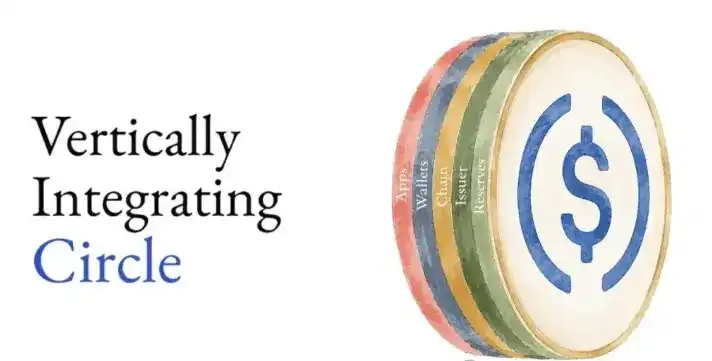
Circle: From Issuance to Infrastructure

Title: Circle: From Issuance to Infrastructure Circle, the issuer of the USDC stablecoin, is undergoing a strategic transformation to reduce its dependence on interest income from reserve holdings, which is declining due to falling interest rates. Historically, Circle's revenue came primarily from the yield on US Treasury reserves backing USDC. However, it also paid significant fees (approximately 60 cents of every dollar earned) to partners like Coinbase for distributing and settling USDC. To capture more value across the financial stack, Circle is vertically integrating into three new layers: 1. **Settlement Layer:** It is launching **Arc**, a native Layer-1 blockchain. Arc, which uses USDC as its gas token, aims to capture transaction fees currently paid to other blockchains (like Ethereum and Solana) and offers features like privacy for institutional payments. 2. **Distribution Layer:** The **Circle Payments Network (CPN)** connects financial institutions directly to Circle, reducing reliance on exchanges like Coinbase. While not yet monetized, CPN growth has improved Circle's margins. 3. **Application Layer:** Circle is building an **AI Agent Economy** infrastructure with products like Agent Wallets and Nanopayments. The goal is to capture fees from high-volume, automated transactions executed by AI agents, a market where USDC already dominates. These moves represent Circle's shift from a single-product company (USDC issuance) to a full-stack financial platform. The strategy faces challenges, including market competition from players like Stripe and Tether, and potential internal tension regarding how value created by the new Arc blockchain and token (ARC) will accrue to Circle's public shareholders (CRCL). Circle's long-term success depends on its ability to successfully execute this vertical integration and diversify its revenue streams away from interest income.

marsbit6 dk önce

Circle: From Issuance to Infrastructure

marsbit6 dk önce

Circle: From Issuance to Infrastructure

Title: Circle: From Issuance to Infrastructure Circle, the issuer of the USDC stablecoin, is undergoing a strategic transformation from a single-product company dependent on reserve interest income to a vertically integrated, full-stack financial platform. Its primary revenue source, earnings from US Treasury reserves backing USDC, is under pressure from declining Federal Reserve interest rates. Furthermore, Circle pays out a significant portion (~60 cents per dollar earned) to partners like Coinbase for distribution and settlement, leading to value leakage. To address these challenges and capture more value across the payment stack, Circle announced three key initiatives in Q1 2026: 1. **Settlement Layer**: Launching its own Layer-1 blockchain, **Arc**. Designed for institutional use with configurable privacy and quantum-resistant architecture, Arc uses USDC as its native gas token, allowing Circle to capture transaction fees currently paid to other blockchains like Ethereum. 2. **Distribution Layer**: Expanding the **Circle Payments Network (CPN)**, which connects financial institutions directly to Circle, reducing reliance on third-party exchanges for USDC distribution and on/off-ramps. 3. **Application Layer**: Building infrastructure for an **AI agent economy**, including tools for agent wallets, nanopayments, and a marketplace. Circle aims to monetize the high volume of AI-driven microtransactions predominantly settled in USDC. This vertical integration strategy aims to diversify Circle's revenue away from volatile interest income. However, a key challenge remains: aligning the value capture of the new ARC token with the interests of existing public market shareholders (CRCL) who invested primarily for reserve yields. The success of this stack-wide expansion hinges on Arc's adoption and Circle's ability to balance value distribution between its core corporate entity and its new blockchain ecosystem.

链捕手12 dk önce

Circle: From Issuance to Infrastructure

链捕手12 dk önce

Nvidia's Wednesday 'Big Test': The Battle That Will Determine the Fate of the AI Bull Market is Here!

NVIDIA Faces Key AI Bull Market Test with Wednesday Earnings Report NVIDIA is set to release its quarterly earnings after the market close on Wednesday, May 20th (US Eastern Time). This report is seen as a critical stress test for the current AI-driven bull market cycle. The semiconductor sector is technically severely overbought, with extremely bullish options positioning. The rare signal of stock prices and implied volatility rising simultaneously indicates significantly amplified two-way risk around this earnings event. The core tension identified by analysts is strong fundamental demand for AI versus mounting technical pressures. The Philadelphia Semiconductor Index (SOX) is trading approximately 60% above its 200-day moving average, a deviation not seen since the peak of the dot-com bubble in 1999/2000. While NVIDIA's current quarter revenue is expected to beat estimates by a substantial margin, market focus is intensely on the guidance for the next quarter. Historically, NVIDIA's stock has frequently declined on the day following its last five earnings reports. The options market presents contradictory signals: extreme bullish call skew persists, yet there is notable activity in tail-risk hedging via put options on broader indices and semiconductor ETFs. This suggests traders are chasing gains while simultaneously preparing for potential sharp volatility. A broader market concern is narrowing breadth. Despite the S&P 500's YTD gain, only about half of its constituents are positive, with leadership heavily concentrated in a few mega-cap AI and semiconductor names like NVIDIA. Analysts question whether this reflects market health or a "funding source" effect, where money flows out of lagging sectors into the AI trade. The earnings outcome and, crucially, the forward guidance will test the market's conviction in the AI compute super-cycle thesis. Given NVIDIA's high correlation with the semiconductor and broader tech sector, its results are poised to trigger widespread market moves in either direction.

marsbit21 dk önce

Nvidia's Wednesday 'Big Test': The Battle That Will Determine the Fate of the AI Bull Market is Here!

marsbit21 dk önce

The AI-Era Power Arms Race: Energy Order Reshuffle Behind NextEra's Acquisition of Dominion

The AI arms race is shifting from a focus on chips and models to a fundamental battle over electricity. NextEra Energy's proposed $66.8 billion acquisition of Dominion Energy highlights this profound change, as AI's explosive growth is rewriting the growth logic for the power sector. The deal is less about traditional utility consolidation and more about securing a strategic gateway to Virginia’s "Data Center Alley," a critical hub where tech giants have massive, signed load requirements. The core challenge is a growing disconnect: data center construction cycles are far shorter than the years needed to build new power generation and transmission infrastructure. Morgan Stanley predicts a 49GW gap in power availability for U.S. data centers by 2028. Electricity, once a taken-for-granted commodity, is now a scarce and strategic resource. This transforms the competitive landscape—future AI competitiveness may hinge not just on algorithms but on a company's ability to secure long-term, stable, and affordable power supply. The transaction signals a broader revaluation of the entire energy infrastructure chain, from natural gas and nuclear power for base load to storage and transmission equipment. However, the largest variable is regulation. Balancing rapid AI-driven grid expansion with public concerns over costs, fairness, and environmental impact will be a complex political and social challenge. The true value in the coming AI era may lie not just in power generation assets, but in owning the crucial infrastructure nodes, grid access rights, and the regulatory relationships needed to deliver electricity where it's needed most.

marsbit27 dk önce

The AI-Era Power Arms Race: Energy Order Reshuffle Behind NextEra's Acquisition of Dominion

marsbit27 dk önce

İşlemler

Spot
Futures
活动图片