Author: Nick, Investment Partner at Breed.vc
Compiled and Edited by: BitpushNews
"Imagine somewhere around 2027, a real 'nation of geniuses' emerges. Picture, say, 50 million people, each more capable than any Nobel laureate, politician, or technologist. Now imagine that, because AI systems operate hundreds of times faster than humans, this 'nation' has a time advantage over all others: for every cognitive action we take, this nation can take ten." — Dario Amodei
"In our view, agents will likely soon be responsible for most internet transactions, and we will need blockchains." — Stripe
We can imagine the creativity, economic progress, and level of wealth that the agent economy will generate.
Last month, the crypto community predicted that this economy would run on-chain, and as the largest companies, capital allocators, and developers put forward this proposition, the prediction seems reasonable.
We had similar fantasies at the end of '24, but in typical crypto fashion, it was too early then, and the hype was short-lived.
Since then, the quality of AI models and blockchain infrastructure has developed to a point where we are conducting this experiment again.
In this report, we will examine the current state of the crypto economy, review the history of crypto agents, discuss why the agent economy might exist on-chain, explore what agents are doing today, and look at what comes next.
The Current State of the Crypto Economy
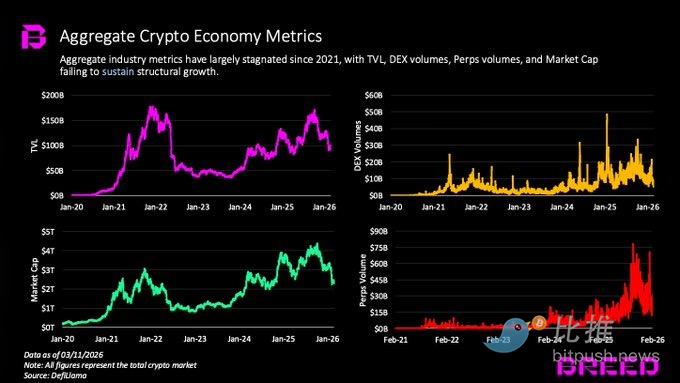
The lack of growth in the crypto asset class since the 2021 bull market has been disappointing. Most industry-wide metrics are at or below 2021 levels. Crypto world supremacy did not arrive.
AI agents provide a credible path to expanding demand.
The Seeds of the Crypto Agent Revival
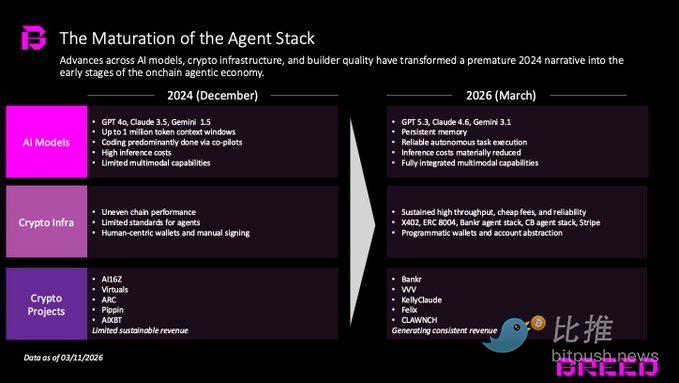
The "AI agents on blockchain" meta-narrative in 2024 was premature. The models, crypto infrastructure, and teams were not ready.
However, it wasn't all for nothing, as these lessons became the seeds of today's revival.
Projects like Bankr and Venice continued building so they could support today's models. Companies like Coinbase and Stripe recognized the potential and began developing their own supportive infrastructure.
Combine higher-quality teams with the continued building of a new generation of models, and you have the early stages of an on-chain agent economy.
Some projects are now generating recurring revenue and attracting high-quality developers—like Austen Allred, Nat Eliason, and Nik Pash—which is exactly what the crypto space desperately needs.
However, an on-chain agent economy is far from a certainty, as every payments company on Earth is racing to build this infrastructure.
Why the Agent Economy Will Run On-Chain
There is no stronger signal than Stripe explicitly stating that agents will run on blockchain rails. Their reasoning: every API call an agent makes today requires an account, an API key, and a linked credit card. This model breaks down when you have thousands of agents executing millions of microtransactions daily.
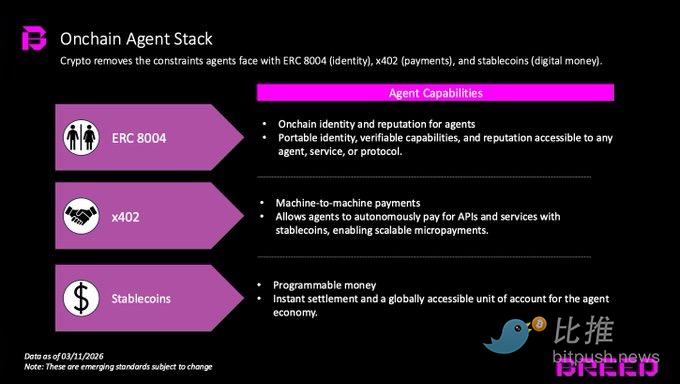
Blockchain solves these limitations by combining ERC-8004, x402, and stablecoins.
-
ERC-8004 gives each agent an on-chain identity, portable reputation, and verifiable capabilities that any other agent or service can query—the digital equivalent of identity and credit scores.
-
x402 allows agents to autonomously pay for APIs and services using stablecoins and scale micro-payments—the machine-to-machine payment layer for the internet.
-
Stablecoins give agents a globally accessible, programmable unit of account that can settle transactions instantly—the currency of the agent economy.
What Agents Are Doing Today
Today, agents are increasing their activity on-chain: launching applications, generating videos to promote these applications, contracting with other agents, handling governance matters for their users, selling NFTs, trading in DeFi, and even hiring humans.
The most exciting of these developments is the interaction with DeFi. Uniswap and Fluid are riding the agent narrative and beginning to build supportive infrastructure.
Furthermore, in the past month, OpenAI has made two agent-related announcements: Frontier, a platform designed to help businesses build, deploy, and manage AI colleagues; and EVM Bench, an evaluation framework for testing AI agents' ability to detect, patch, and exploit smart contract vulnerabilities.
Agents Are Coming

You might dismiss it as AI doom fiction, but the predictions of "AI 2027" are alarmingly accurate. If anything, AI progress is moving faster than the proposed timeline.
If this trajectory continues, we will see exponential growth in agent capabilities and intelligence over the next year.
Key parts of the stack still need to be built, but every major tech company in the world is racing against the clock to do so.
The social discussion around agents today might be frenzied, but the reality on the ground and the scale of the opportunity are too large to ignore.
Marc Andreessen (a16z partner) put it well: "Is it real? Or is it fake? It doesn't really matter. It's out there, and models are being trained on it."
Twitter:https://twitter.com/BitpushNewsCN
Bitpush TG Discussion Group:https://t.me/BitPushCommunity
Bitpush TG Subscription: https://t.me/bitpush