Audiera price prediction: Can BEAT break above $3 without fresh buying?

ambcrypto2026-07-14 tarihinde yayınlandı2026-07-14 tarihinde güncellendi

Özet

Escalating U.S.-Iran tensions impacted markets, with the S&P 500 and Dow Jones declining. Bitcoin faced selling pressure, while Audiera (BEAT) gained 0.74% despite a nearly halved daily trading volume. BEAT had previously rallied 18% despite a token release, but now faces a key resistance zone between $3.0 and $3.20. Technical indicators on the 1-day chart show bearish momentum. For BEAT to break above $3.20, it requires sustained organic buying pressure and higher lows. While recent token burns on July 13 may boost confidence, the token remains under scrutiny due to past allegations of similarities to other projects and an 87% price crash from June 12-18. Investor caution is advised due to lingering concerns over price manipulation and inflated valuation.

The U.S.-Iran ceasefire has ended, and hostilities have resumed. President Donald Trump stated the U.S. would be reinstating the blockade on Iranian ports, driving crude oil prices up on Monday, the 13th of July, and hurting stock markets.

The S&P 500 was down 49 points, and the Dow Jones Index was down 33 points, or 0.64% and 0.63% respectively, from their highs of the day.

A wave of Bitcoin [BTC] selling was spotted, and long positions were closed in the derivatives market. This leverage unwind has fueled the recent price reset and helped explain why crypto was down for the day.

Audiera [BEAT] was up 0.74% in the past 24 hours, but its daily trading volume has nearly halved from the previous day.

Recently, AMBCrypto reported that the $824 million market capitalization altcoin was able to rally 18% on high trading volume, even after a release of 21.25 million BEAT tokens. This represented 7.3% of the circulating supply.

Can organic demand drive BEAT prices higher?
Source: BEAT on TradingView

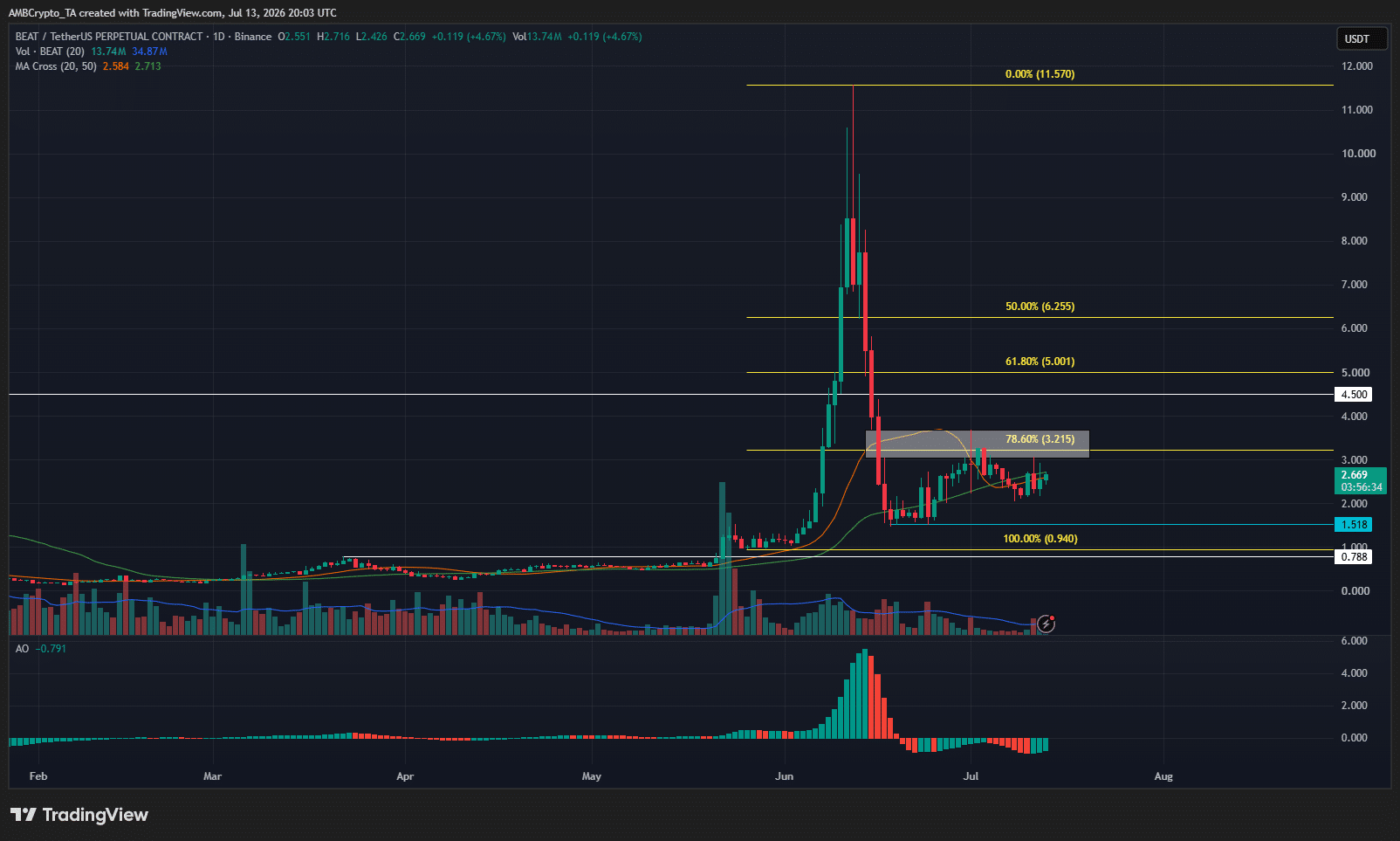
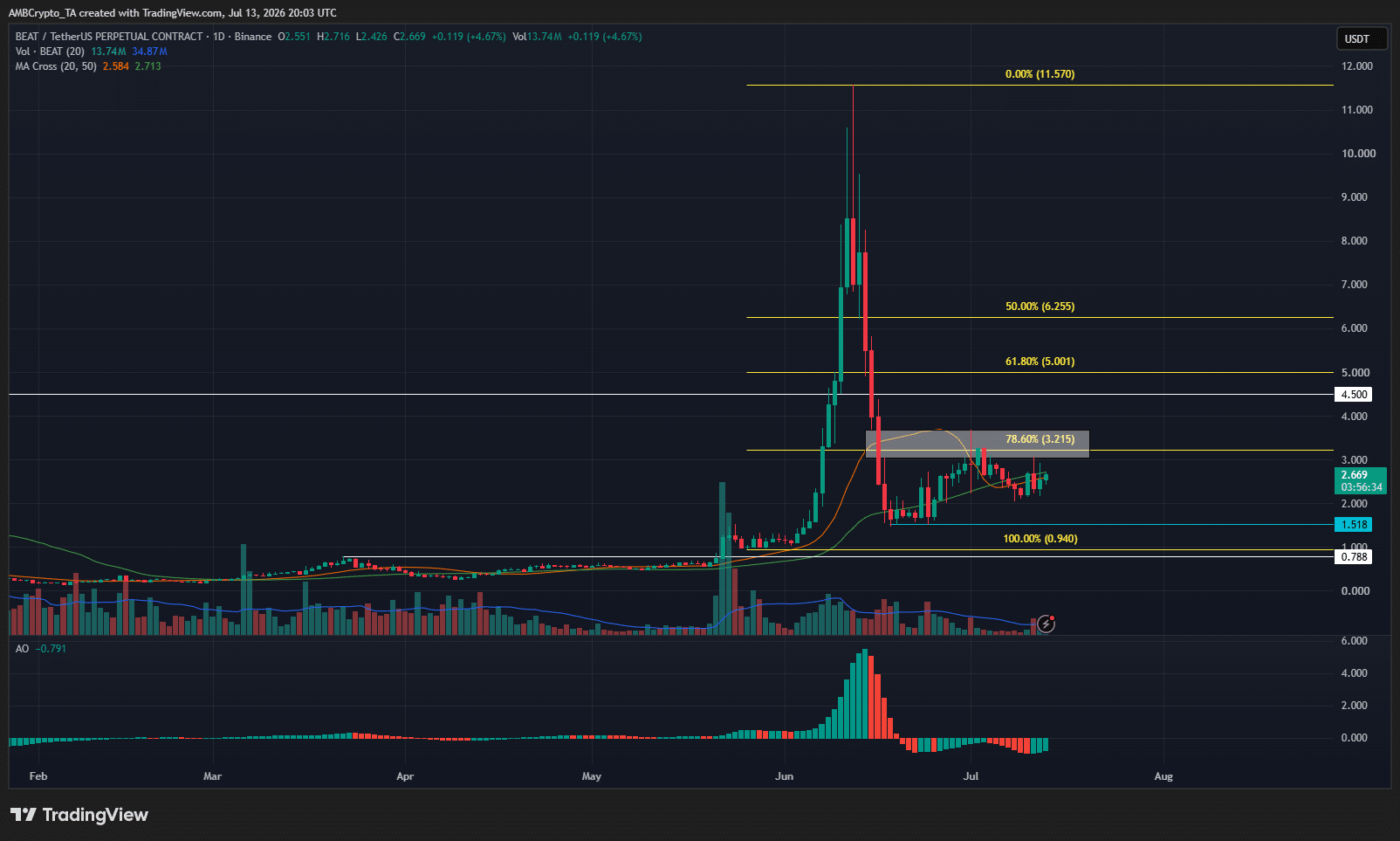
The swing structure remained bullish, but the $3.0-$3.20 area has become a local supply zone. The momentum was bearish on the 1-day timeframe, the Awesome Oscillator warned.

If BEAT can make higher lows in the coming days, it would signal that buyers were convinced of further gains. Such demand might be able to push prices past $3.20.

However, for this scenario to play out, BEAT needs to attract more capital towards itself.

Traders’ call to action- Caution
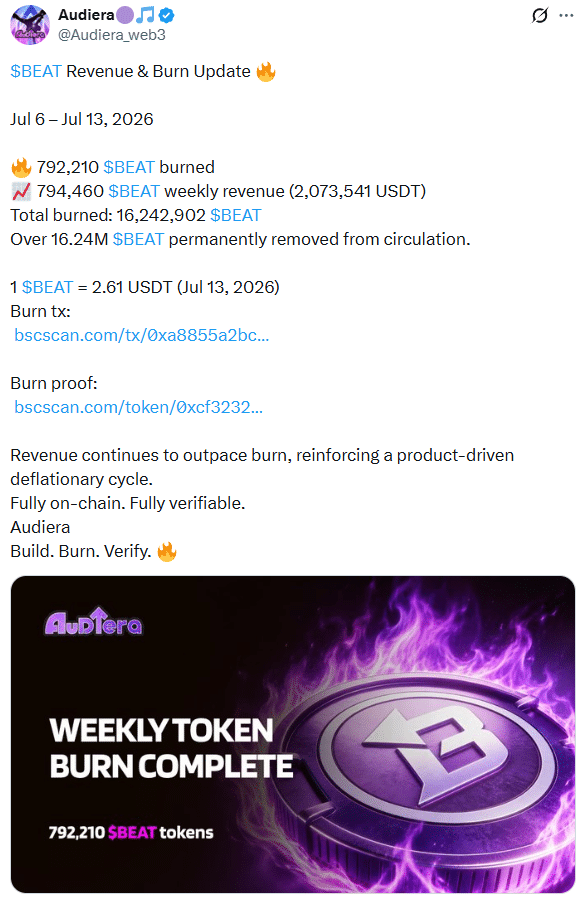
Source: Audiera on X

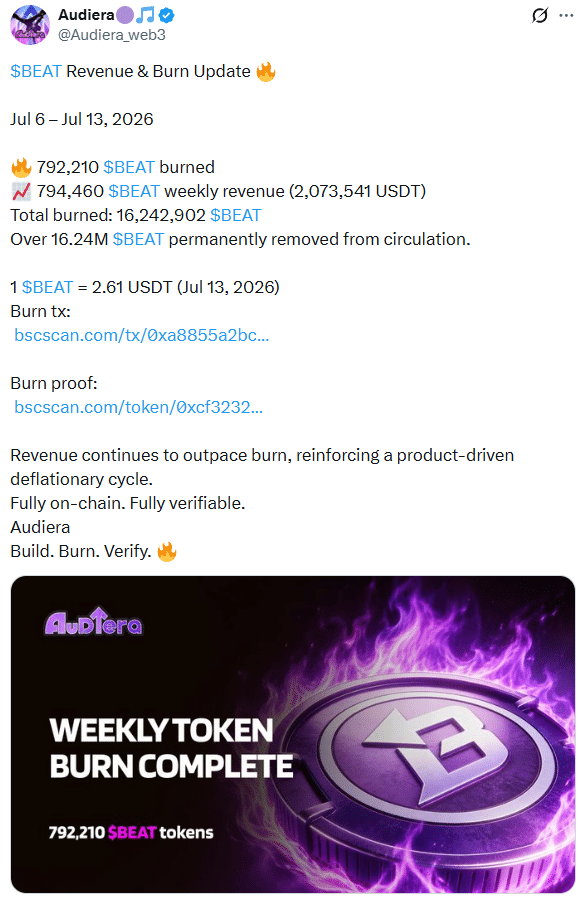
The news of the 792,210 BEAT burn on July 13 can buoy market participant confidence. Yet, the rally to $11.5 also coincided with public allegations that the Dance to Earn token showed onchain similarities to LAB and RIVER.
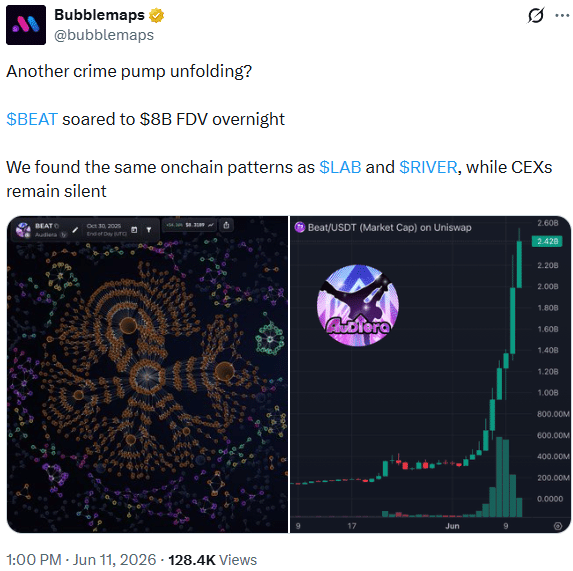
Source: Bubblemaps on X

From June 12 to 18, BEAT underwent an 87% correction, falling from $11.57 to $1.459. The visual analytics platform posted that they had no conclusive evidence tying BEAT to LAB and RIVER. Still, investor caution is warranted.


Final Summary

  • BEAT saw short-term upward momentum, and the weekly BEAT burns can help fuel a recovery.
  • Allegations of price manipulation and overinflated fully diluted value, or FDV, have not gone away.


İlgili Sorular

QWhat recent global event led to a decline in stock markets and Bitcoin, according to the article?

AThe resumption of hostilities between the U.S. and Iran, specifically the U.S. reinstating a blockade on Iranian ports, drove up crude oil prices and contributed to the decline in stock markets and Bitcoin.

QDespite the broader crypto market being down, what was BEAT's 24-hour price performance?

ABEAT was up 0.74% in the past 24 hours, although its daily trading volume had nearly halved from the previous day.

QWhat are the key price levels mentioned in the article that form a local supply zone for BEAT?

AThe article identifies the $3.0-$3.20 area as a local supply zone that BEAT needs to break through for further gains.

QWhat positive action taken by the Audiera project on July 13th might boost investor confidence?

AThe project executed a burn of 792,210 BEAT tokens on July 13th, which can buoy market participant confidence.

QWhat major concern regarding BEAT's fundamentals is highlighted in the article's final summary?

AThe final summary highlights that allegations of price manipulation and an overinflated fully diluted value (FDV) for BEAT have not gone away.

İlgili Okumalar

Wall Street Morning Report: U.S. Stocks Suffer Collective Setback, Apple Hits New High Against the Trend, Tonight's CPI and Waller's Hearing to Determine Interest Rate Path

Wall Street Morning Report: U.S. stocks fell collectively, while Apple hit a new record high. Key events including tonight's CPI data and Fed Chair Walsh's testimony will set the direction for interest rates. Markets experienced a sharp "risk-off" move due to escalating Middle East tensions and unexpected hawkish signals from the Federal Reserve. Major indices declined, with the Nasdaq Composite leading losses, down 1.55%. The VIX fear index surged over 14%. Geopolitical tensions spiked as the U.S. conducted consecutive airstrikes on Iran and announced a maritime blockade of Iranian ports, set to begin on July 15. This triggered a panic-driven rally in oil, with WTI crude soaring over 9% to breach $80 per barrel. Safe-haven flows bolstered the U.S. dollar and Treasury yields, while gold plunged nearly 3%, losing its $4,000 level. Rate markets now price a nearly 50% chance of a Fed rate hike in July, up significantly from prior expectations, following hawkish commentary from Fed Governor Waller. The tech sector, particularly AI-related stocks, faced intense selling pressure. The Philadelphia Semiconductor Index plunged 4%. Notable decliners included SK Hynix (down 9% on its second trading day as an ADR), Nvidia, AMD, and Intel. In contrast, Apple shares rose 0.63% to a record high, viewed as a stable haven away from the costly AI data center arms race. Key events to watch include the U.S. June CPI inflation data and Fed Chair Walsh's Congressional testimony tonight, which will critically influence the Fed's policy path. Major bank earnings also begin today. The formal implementation of the U.S. maritime blockade against Iran on July 15 and upcoming events like TSMC's Q2 earnings and a SpaceX Starship test flight remain in focus.

marsbit5 dk önce

Wall Street Morning Report: U.S. Stocks Suffer Collective Setback, Apple Hits New High Against the Trend, Tonight's CPI and Waller's Hearing to Determine Interest Rate Path

marsbit5 dk önce

Crude Oil Surges 10% in Intraday Trading! US Military Restores Blockade on Iran, Trump Warns of 'Heavy Blows' Tonight and Tomorrow, Imposes 20% Fee on Strait Shipping

Crude oil prices surged up to 10% intraday as tensions between the US and Iran escalated sharply. President Trump announced the reinstatement of a maritime blockade against Iran, targeting its ships and their customers, while stating the Strait of Hormuz would remain open to all other nations. He further declared that the US, as the "guardian" of the strait, would impose a 20% fee on all cargo transiting the strategic waterway to compensate for security costs. The US Central Command confirmed the naval blockade would commence on July 14 (GMT). Following Trump's statements, reports emerged of explosions near Iran's Larak Island and the port of Bandar Abbas, though Iranian authorities did not confirm their nature. Iran's Foreign Minister criticized the proposed 20% fee as excessive, asserting Iran's role as the guardian of the strait. An Iranian military spokesperson warned of a strong response to any unauthorized US interference in the waterway. The United Nations' International Maritime Organization (IMO) expressed opposition to charging tolls for passage through international straits, stating such measures lack legal foundation. Market reactions were pronounced, with Brent crude briefly surpassing $83 and WTI above $78. The situation intensified as Trump notified Congress of renewed hostilities with Iran, following US airstrikes on Iranian targets.

marsbit9 dk önce

Crude Oil Surges 10% in Intraday Trading! US Military Restores Blockade on Iran, Trump Warns of 'Heavy Blows' Tonight and Tomorrow, Imposes 20% Fee on Strait Shipping

marsbit9 dk önce

How to Regulate Single-Stock Leveraged ETFs? On Thursday, the Entire Market Is Watching This Korean Government Meeting

The highest-level economic coordination body in South Korea, the "F4" comprising the Ministry of Economy and Finance, the Financial Services Commission, the Bank of Korea, and the Financial Supervisory Service, will hold an emergency meeting on Thursday to discuss regulatory measures for single-stock leveraged ETFs. These products, launched just six weeks ago, have been widely blamed for exacerbating market volatility. The KOSPI's 8% plunge on Monday triggered the year's seventh trading halt, intensifying scrutiny. Regulators have expressed rare public regret over approving the products. FSS Governor Lee Bok-hyun stated he "regretted not doing everything possible to prevent" their introduction and acknowledged structural problems, citing massive retail investments and legal complications from a rushed rollout. Possible countermeasures under discussion include raising margin requirements, imposing daily price limits, and adjusting leverage caps. However, officials admit these may be temporary fixes. Data confirms the amplified volatility. Since the ETFs' launch, days with KOSPI moves exceeding 3% have nearly doubled. Trading halts have reached record levels, surpassing the 2008 financial crisis peak. The products allow 2x leveraged bets on giants like Samsung Electronics and SK Hynix. Their daily rebalancing to match returns is seen as mechanically fueling market swings. The outcome of Thursday's F4 meeting is highly anticipated, with expectations leaning towards stricter controls on leverage, investor access, or other structural constraints to curb the products' market impact.

marsbit24 dk önce

How to Regulate Single-Stock Leveraged ETFs? On Thursday, the Entire Market Is Watching This Korean Government Meeting

marsbit24 dk önce

AI Overhauled Terence Tao's 30-Year-Old Website, Uncovering Two Bugs Hidden for Over Two Decades in the Process

AI Revamps Terence Tao's 30-Year-Old Website, Unearthing Two 20-Year-Old Bugs in His Code Terence Tao, a renowned mathematician, has enlisted an AI agent to overhaul his personal academic website, which was built in 1997 with a static HTML, manually-maintained "Web 1.0" architecture. In just one day, the agent migrated 560 papers and preprints, 374 travel logs, 68 courses, 19 books, and 29 old math applets to a new system on GitHub Pages. The new site is structured around YAML files as the "single source of truth," with static HTML pages automatically generated from this data—a fundamental shift from maintaining individual documents to managing a centralized database. During the migration, the AI uncovered inconsistencies, outdated entries, and broken links that had accumulated over nearly three decades of manual updates. It also successfully ported a set of small educational Java 1.0 applets to JavaScript. Notably, while reviewing this translation, Tao found only one new bug introduced by the AI. Conversely, the AI identified two subtle bugs in his original Java code that he was previously unaware of. Tao emphasizes the project highlights AI's potential for automating tedious "digital housekeeping"—routine tasks like data migration and website maintenance that are costly and error-prone when done manually. He also revived a 27-year-old stalled project: a special relativity visualizer or "Minkowskian Inkscape." With AI assistance, a working alpha version was built in two hours. While AI still requires human oversight for critical work, Tao argues that for such structured, non-core tasks, "AI + human review" can result in lower error rates and drastically lower correction costs compared to purely manual maintenance over decades.

marsbit24 dk önce

AI Overhauled Terence Tao's 30-Year-Old Website, Uncovering Two Bugs Hidden for Over Two Decades in the Process

marsbit24 dk önce

İşlemler

Spot
活动图片