Real-world assets (RWAs) are gaining momentum as tokenized versions of traditional investments move beyond issuance and become active parts of onchain financial markets.
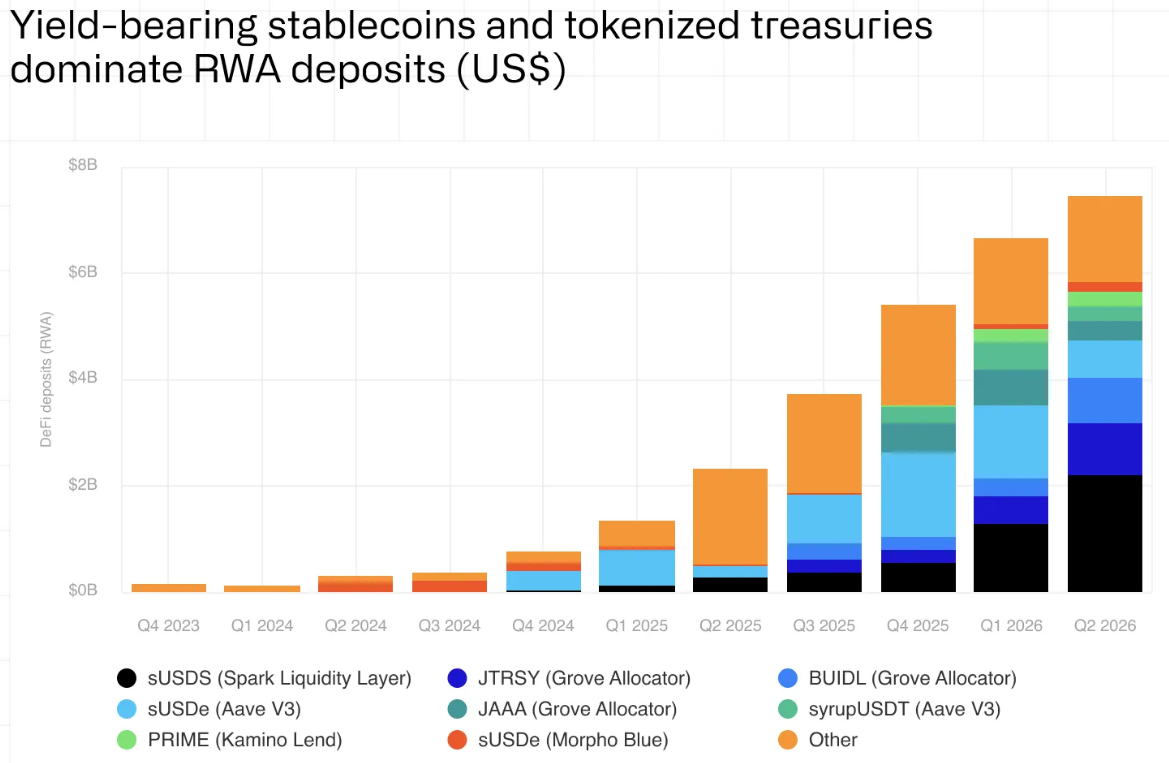
RWA deposits across decentralized finance platforms more than tripled year over year to $7.4 billion in the second quarter of 2026, while total DeFi deposits fell about 15%, according to a joint report by CoinShares and Token Terminal published Thursday.
CoinShares CEO Jean-Marie Mognetti said the divergence shows that RWA demand is being driven by practical use cases rather than broader market conditions.
“When an asset class grows through a downturn in its host ecosystem, demand is being driven by financial utility, not by market cycles,” he said.
The report suggested that the RWA market is entering a new phase, with investors using them as collateral, yield-generating instruments and trading products across onchain markets.
Yield-bearing stablecoins and Treasuries lead RWA deposits
Yield-bearing stablecoins and tokenized Treasury products have emerged as the largest categories of RWA assets used across DeFi, according to the report.
In Q2, Sky Protocol’s sUSDS led the category, giving holders exposure to a yield-generating version of its USDS stablecoin.
Tokenized Treasury funds, including BlackRock’s USD Institutional Digital Liquidity Fund (BUIDL), have also become a major source of onchain collateral, as investors use yield-bearing assets in decentralized lending markets.
Source: CoinShares, Token Terminal
The report said that RWA products currently offer yields ranging from about 3.2% to 5.5%, with lower-risk Treasury products at the bottom of the range and higher-yield strategies carrying additional risks.
Gold and yield-bearing dollars drive RWA volumes
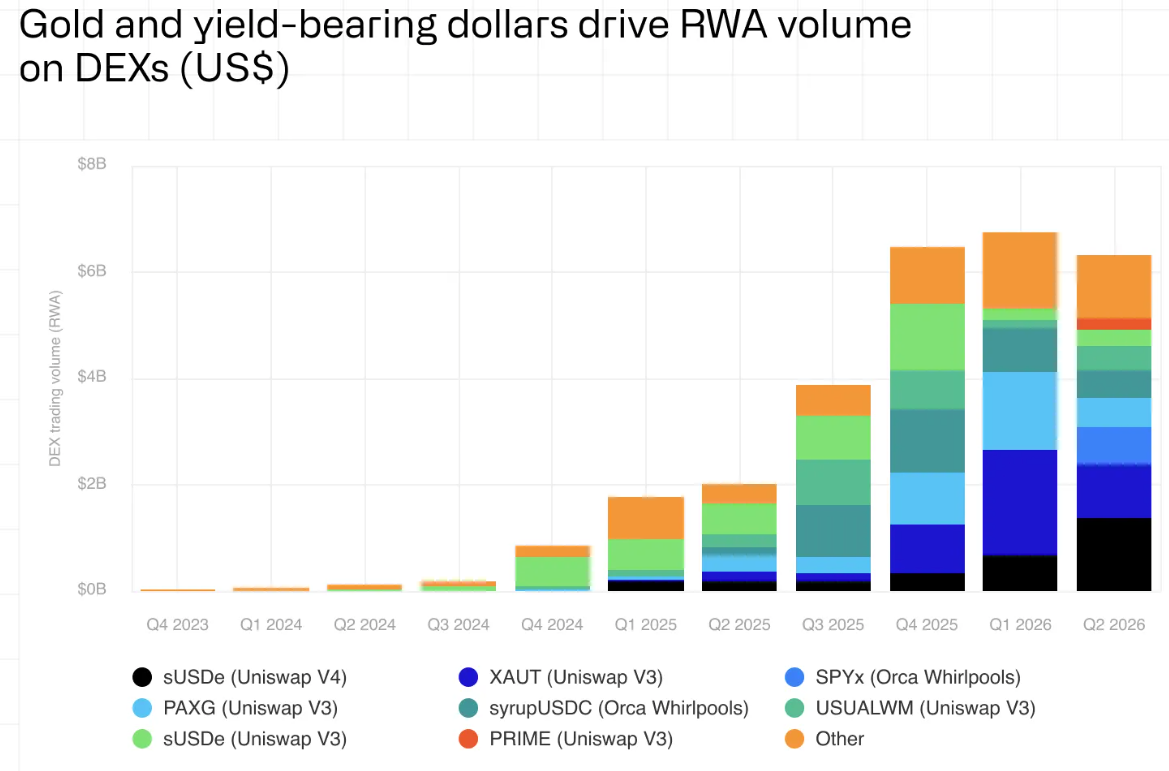
Gold-backed tokens and yield-bearing dollar products accounted for much of the RWA trading activity on decentralized exchanges (DEXs).
CoinShares classified gold-backed stablecoins such as Tether Gold (XAUt) and Paxos Gold (PAXG) as tokenized gold products within its broader RWA category.
Related: Gold hits 6-week highs on China demand as Bitcoin ignores fresh S&P 500 record
These assets generated significant trading volume as investors traded around gold price swings, while yield-bearing dollar products such as Ethena’s sUSDe also contributed to RWA spot activity.
Source: CoinShares, Token Terminal
RWA spot trading volumes rose roughly 220% year over year, even as overall DEX volumes fell about 70%. The divergence suggests tokenized assets are gaining traction as secondary markets, allowing investors to trade ownership rather than only buy assets directly from issuers.
RWAs expand into leveraged markets
Onchain exposure to RWAs is also expanding into derivatives markets, where traders can take leveraged positions without owning the underlying assets.
RWA perpetual futures trading has continued growing despite a broader slowdown in crypto-native derivatives markets. On tradeXYZ, an RWA-focused perpetual futures platform built on Hyperliquid, trading volume has increased roughly 20 times since launch, the report said.
Activity has concentrated around commodities, equity indexes such as the S&P 500 and Nasdaq-100, and technology stocks, while open interest has also continued rising.
Magazine: How Fake World Assets and onchain gacha became crypto’s latest craze