SpaceX, AI, and XRP: Why the Next Wealth Transfer Might Be Different?

marsbit2026-06-21 tarihinde yayınlandı2026-06-21 tarihinde güncellendi

Özet

The article posits that the global economy is transitioning into a new phase of infrastructure investment. Capital, facing slowing traditional growth engines, is flowing towards emerging foundational systems. This includes space infrastructure (exemplified by SpaceX), AI computing power, satellite networks, data centers, and global payment systems. A key driver is a potential new commodity supercycle fueled by industrial demand from these sectors. Concurrently, the role of blockchain is evolving from speculative assets to a critical settlement layer for the future economy. Digital assets like XRP and XLM, focused on payments and interoperability, are highlighted as potential rails for cross-border settlement, tokenized assets, and machine-to-machine (AI Agent) transactions. The narrative connects figures like Ripple's Jed McCaleb to space ventures, suggesting convergence. The argument emphasizes a shift from speculative narratives to utility-driven value. As AI and space commerce generate new economic activity, and regulatory clarity improves, blockchain networks may underpin real-time value transfer. The conclusion urges investors to consider which networks will form the backbone of this integrated next-generation economic infrastructure.

Editor's Note: This article attempts to understand SpaceX's IPO expectations, AI Agents, blockchain settlement networks, commodity demand, and digital asset regulation within the same overarching narrative: global capital may be shifting from purely chasing speculative growth to betting on the next generation of economic infrastructure.

The author's core argument is that as traditional growth engines slow, capital requires new vessels. Space infrastructure, AI computing power, satellite networks, data centers, and cross-border payment systems may collectively constitute the next cycle of infrastructure investment. Within this framework, commodities are no longer just cyclical goods but become the foundational inputs for AI, communications, orbital manufacturing, and energy systems; blockchain is not merely about trading assets but could become the financial rails for tokenized assets, AI Agent payments, and global real-time settlement.

The article particularly emphasizes the potential role of payment-oriented digital assets like XRP and XLM in cross-border settlement, interoperability, and machine-to-machine payments. It connects threads such as Ripple, Jed McCaleb, Vast, and SpaceX to paint a picture of a converging landscape of "space commerce + AI + blockchain settlement layer".

It is important to note that such narratives still carry a strong speculative element, especially when tying specific digital assets to future infrastructure cycles. The distance between long-term trends, commercial implementation, and market pricing must still be distinguished. However, the question it raises is worth attention: If AI is creating new economic actors, and space and data centers are creating new capital expenditure cycles, who will handle value transfer, identity management, and instant settlement between these systems? This may be the key for digital assets to move from a speculative narrative to an infrastructure narrative.

Below is the original article:

The financial world may be entering a new phase. This phase is not merely a continuation of traditional market cycles but a progression towards the construction of a completely new set of economic infrastructure. Recent developments around SpaceX, artificial intelligence, blockchain technology, and the clarification of digital asset regulations suggest that capital is starting to flow towards systems that could define the next generation of global commerce.

Behind the SpaceX IPO Expectations: Capital is Searching for New Infrastructure

The highly anticipated IPO of SpaceX has garnered immense attention, not just because of SpaceX itself, but because it represents a broader trend. As debt markets tighten and economic growth slows, governments and financial institutions are seeking new frontiers that can both absorb capital and justify sustained investment.

Space infrastructure, orbital manufacturing, satellite networks, data centers, and advanced communications systems are increasingly being viewed as trillion-dollar opportunities. These fields require massive physical capital, commodities, financing support, and technological synergy.

The logic is simple: when traditional growth engines mature, capital seeks new domains to support further expansion. Space might become one such frontier, even if the narrative itself is built on lies and deception.

A New Commodity Cycle: Both AI and Space Depend on Raw Materials

Large-scale infrastructure projects are inseparable from raw materials.

The expansion of data centers, satellite networks, AI computing facilities, and future space infrastructure will generate enormous demand for key commodities. Metals like gold, silver, platinum, copper, and rare earths will become indispensable inputs in the next generation of technological systems.

The world may be in the early stages of a structural commodity supercycle. This means demand will rise consistently over a longer period, driven by infrastructure investment and technological change.

Unlike previous cycles centered primarily on consumer demand, this one will be driven by industrial and technological needs.

Blockchain's New Role: Not Just Tokens, But a Real-Time Settlement Layer

As new industries emerge, capital must be able to flow efficiently within global markets.

The traditional banking system was designed for a slower world. The infrastructure of the future will involve tokenized assets, AI-driven transactions, international payments, and even potential space commerce, all requiring settlement systems that operate continuously and process at high speed.

This is where blockchain technology enters the conversation.

As highlighted in our podcast yesterday, as financial infrastructure evolves, digital assets focused on payments and interoperability may become increasingly important. Networks capable of settling transactions quickly and efficiently will benefit from the growing need for real-time value transfer.

Digital assets like XRP and XLM are notable in this context, as they focus on payments, interoperability, and cross-border settlement.

It is worth noting the existing connections between Ripple co-founder and XRP Ledger architect Jed McCaleb and commercial space projects. His company, Vast, has partnership connections to SpaceX and Starlink-related plans.
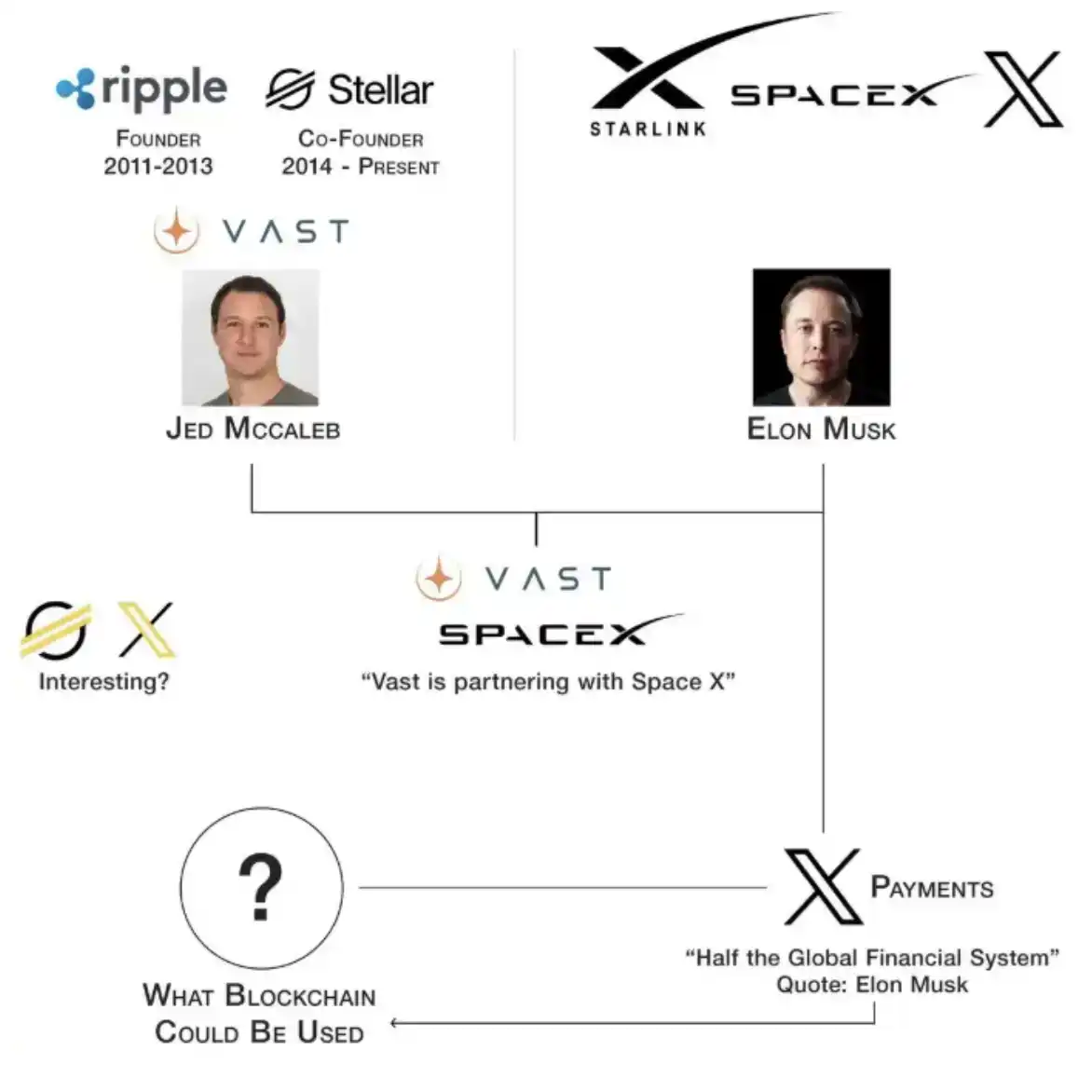
This suggests that blockchain and emerging infrastructure industries may see increasing intersections in the future.

The Convergence of Artificial Intelligence and Blockchain

One of the most overlooked points in current technological innovation might be the convergence of artificial intelligence and blockchain technology.

Ripple CEO Brad Garlinghouse recently mentioned that the company is advancing AI-related initiatives and developing tools to allow AI Agents to interact with the XRP Ledger. This reflects a broader trend taking shape across the tech industry.

AI systems are rapidly evolving from information-processing tools into autonomous agents capable of making decisions, executing transactions, and interacting with digital services.

For these agents to operate meaningfully in an economic sense, they require infrastructure that can support functions such as: sending payments; settling transactions instantly; managing digital identity; executing agreements; transferring value across different networks.

Blockchain technology provides many of these capabilities. As AI adoption accelerates, demand for payment rails capable of supporting large-scale machine-to-machine transactions may grow. This creates a potential fusion: AI generates economic activity, and blockchain networks provide the settlement layer that supports it.

Regulatory Clarity and Institutional Adoption

Another crucial topic is the increasing momentum towards digital asset regulation in the United States. Ripple's management has consistently argued that regulatory clarity is the single most important factor holding back broader institutional adoption. Banks, payment providers, corporate treasuries, and financial institutions typically require clear legal frameworks before committing significant capital to new technologies.

As regulatory certainty improves, institutions may become more willing to integrate blockchain-based systems into their existing business processes.

According to Garlinghouse, Ripple is expected to reach a revenue run-rate in the billions of dollars annually while continuing its global expansion. This indicates that demand for enterprise blockchain solutions continues to grow.

The importance of regulation is not merely legal. It reduces uncertainty and allows businesses and financial institutions to plan long-term.

From Speculative Narrative to Infrastructure Narrative

One of the strongest conclusions this month is that markets might be shifting from a speculative cycle to an infrastructure cycle. Historically, the crypto market has been largely driven by retail speculation and narrative-fueled investment. The next phase could be different.

If AI, tokenization, digital payments, commodity infrastructure, and global settlement systems continue to mature, the value of digital assets may increasingly come from actual utility, not just speculation.

This would represent a significant shift in how investors evaluate blockchain networks.

Market focus will shift away from being solely concentrated on price action, moving increasingly towards metrics like transaction volume, settlement activity, institutional adoption, growth in tokenization, and integration with emerging technologies.

Conclusion

The convergence of SpaceX, artificial intelligence, blockchain infrastructure, commodities, and regulatory clarity paints a picture of an economy undergoing structural transformation.

Space infrastructure is attracting capital, artificial intelligence is rapidly accelerating, and regulators are moving towards clearer digital asset frameworks.

Simultaneously, blockchain networks are increasingly being positioned as the settlement layer connecting these emerging systems.

For investors, the question may no longer be whether these technologies will converge, but how quickly this convergence will happen, and which networks will ultimately become the foundational backbone of the global economy's next phase.

Those who truly accumulate wealth have never been the late adopters. You must position yourself as an early investor in tomorrow's economic infrastructure, before mass adoption arrives.

Trend Kriptolar

İlgili Sorular

QAccording to the article, what is the core shift in the global capital investment trend?

AThe core shift is from chasing speculative growth to investing in the next generation of economic infrastructure, including space infrastructure, AI computing power, satellite networks, data centers, and cross-border payment systems.

QWhat role does the article suggest for specific digital assets like XRP and XLM in the emerging economic framework?

AThe article suggests they could play a crucial role as payment-focused digital assets for facilitating cross-border settlement, interoperability, and machine-to-machine payments, potentially forming the settlement layer for new economic activities driven by AI and space commerce.

QHow does the article connect the rise of AI Agents to blockchain technology?

AIt connects them by stating that as AI Agents evolve to make decisions and execute transactions, they will need an infrastructure for payments, instant settlement, and value transfer. Blockchain technology is positioned to provide this essential settlement layer for large-scale machine-to-machine economic activity.

QWhat is identified as a key factor for broader institutional adoption of blockchain-based systems?

ARegulatory clarity is identified as the most important factor. Clear legal frameworks reduce uncertainty and allow institutions like banks and payment providers to confidently integrate blockchain solutions into their long-term business planning.

QWhat major transition in market narrative does the article predict for the digital asset space?

AThe article predicts a transition from a speculative narrative, driven by retail investment and hype, to an infrastructure narrative, where the value of digital assets is increasingly derived from practical utility, transaction volume, institutional adoption, and integration with other emerging technologies like AI.

İlgili Okumalar

The Hunter Becomes the Hunted: The Most Profitable MEV Bot Gets Hacked

A well-known and highly profitable Ethereum MEV Bot, Jaredfromsubway.eth, suffered a sophisticated on-chain attack this Saturday, losing over $7.5 million. Analysis by Blockaid and others reveals this was not a conventional phishing or smart contract exploit, but a targeted "counter-MEV honeypot attack." The attacker meticulously laid a trap over several weeks, deploying 66 fake token contracts and liquidity pools disguised as major assets like WETH and USDC. These pools created the illusion of arbitrage opportunities. The MEV Bot's automated system detected these signals, executed trades, and in the process, granted approval permissions to attacker-controlled contracts. These approvals were not revoked, creating a persistent vulnerability. The attacker then exploited this in a single transaction, draining the bot's ETH, USDC, and USDT holdings. Jaredfromsubway.eth is notorious as one of Ethereum's most active and profitable MEV Bots, primarily known for executing "sandwich attacks" to profit from transaction slippage. Estimates suggest it has earned tens of millions in MEV revenue. The incident highlights escalating crypto security threats, demonstrating that even top-tier automated "predators" are vulnerable to novel, logic-based attacks designed to exploit their own operational rules. Following the hack, an unverified X account impersonating Jaredfromsubway.eth emerged, falsely offering a bounty for the return of funds, prompting developer warnings for users to stay vigilant.

marsbit1 saat önce

The Hunter Becomes the Hunted: The Most Profitable MEV Bot Gets Hacked

marsbit1 saat önce

The Reality of Payments in Latin America Is Not What You Think

The payment landscape in Latin America is undergoing a fundamental shift, driven by on-the-ground realities that challenge common perceptions. Based on over 500 hours of field research across the region, key insights emerge. Firstly, QR code payments, like Brazil's Pix, are becoming the dominant payment method in most emerging markets, overtaking cards. However, these domestic instant payment systems lack international interoperability, creating a significant gap for cross-border users. Secondly, the narrative around crypto cards is often misunderstood; their primary volume comes from high-net-worth professionals using them for salary conversions (e.g., USDT to local currency via Pix), not retail micro-payments. Competition in payments is shifting from customer acquisition to controlling the settlement layer, leading fintechs to acquire banking licenses for efficiency. Thirdly, treating "Latin America" as a single market is a mistake. Countries like Argentina, Brazil, and Mexico have distinct economic realities, user segments, and regulatory approaches. Brazil alone has at least five distinct user segments with different financial flows. Overlooked markets like Guatemala, Honduras, and El Salvador (the "forgotten five") offer high remittance volumes with lower competitive density. Finally, regulation in Latin America is often ahead of the US, with clearer frameworks for digital assets and a pragmatic approach from regulators focused on safety rather than obstruction. The margin on stablecoin forex is rapidly compressing toward zero, meaning future winners will be those building value-added services on top of the infrastructure, not just the cheapest exchange.

marsbit1 saat önce

The Reality of Payments in Latin America Is Not What You Think

marsbit1 saat önce

Making Music in a Bear Market: The Survival Experiment of a Bitcoin Band

"Orange Pill Jam: A Bitcoin Band's Survival in the Bear Market" Orange Pill Jam is a musical group exploring themes of financial sovereignty and privacy, born from the Bitcoin community. Formed after singer Mermaid performed her song "Dollar Apocalypse" at a 2022 conference, the band creates music intended for both Bitcoin enthusiasts and general audiences. Their creative process involves Mermaid writing lyrics and melodies, which producer/multi-instrumentalist Michi then shapes with a precise, rhythm-focused approach, often demanding numerous retakes to achieve his unique standard of timing. Their songs, like "Cypherpunks' Manifesto" and "Fire of Freedom," tackle concepts of digital privacy, the pitfalls of "free" services, and personal sovereignty, influenced by experiences in places like El Salvador. Despite operating in a crypto bear market with a Copyleft model (offering music for free sharing/remixing and accepting optional Bitcoin donations), they face practical challenges. Their growth is slow on platforms like YouTube and Spotify, which aren't optimized for their niche content. The band also navigates the rise of AI-generated music. While acknowledging AI's efficiency for certain tasks, they believe human creativity occupies a unique space that algorithms cannot replicate—the ability to create new genres and capture intangible rhythmic feeling. For Orange Pill Jam, the core argument for both Bitcoin in a downturn and human artistry in the AI age lies in this irreplaceable, intentional, and imperfectly human creative process. Their project persists as an anti-algorithm experiment, valuing the unquantifiable impact of music over scalable metrics.

marsbit1 saat önce

Making Music in a Bear Market: The Survival Experiment of a Bitcoin Band

marsbit1 saat önce

İşlemler

Spot
Futures

Popüler Makaleler

XRP 2.0 Nedir

XRP 2.0: Kriptopara Manzarasında Yeni Bir Sınır XRP 2.0'a Giriş Kriptopara alanı sürekli olarak evriliyor, yeni projeler sürekli olarak dikkat ve benimseme için mücadele ediyor. Bu vaatkar girişimlerden biri, ileri düzey blok zinciri teknolojisi ve güçlü şifreleme yöntemlerini kullanmak üzere tasarlanmış yeni bir kriptopara projesi olan XRP 2.0'dır. İsim Ripple’ın XRP'si ile benzerlikler taşısa da, XRP 2.0'un bağımsız olarak çalıştığını, işlem güvenliğini, gizliliği ve ölçeklenebilirliği artırmaya odaklandığını belirtmek önemlidir. Dijital finansal alan giderek merkeziyetsiz çözümleri benimsedikçe, XRP 2.0, web3'e ve genel olarak kriptopara projelerinin genişlemesine anlamlı bir şekilde katkıda bulunmayı hedeflemektedir. XRP 2.0 Nedir? XRP 2.0'ın temelinde, güvenli ve merkeziyetsiz bir dijital para ekosistemi yaratmayı amaçlayan bir kriptopara projesidir. Temel teknolojisi, karmaşık blok zinciri prensiplerini ileri düzey şifreleme teknikleriyle entegre eder. XRP 2.0'ın ana hedefi, hızlı işlem yürütümünü sağlarken kullanıcılar için artırılmış gizlilik korumalarını öncelikli hale getirerek kendini güvenilir ve etkili bir platform olarak kurmaktır. Proje, mevcut kriptoparaların karşılaştığı birçok sınırlamanın çözümü olarak tanıtılmakta ve daha yüksek işlem hacimlerini, geliştirilmiş hız ve gizlilikle yönetebilen bir sistem önermektedir. Bu çok yönlülük, XRP 2.0'ı çeşitli dijital para birimleriyle dolu bir pazarda önemli bir rakip haline getiriyor. XRP 2.0’ın Yaratıcıları Kimdir? XRP 2.0'ın yaratıcısının kimliği 'Wilbur' olarak belirtilmiştir. Ancak, Wilbur veya ona bağlı varlıklar hakkında kapsamlı bilgiler ulaşılmaz durumdadır. Birçok kriptopara yaratıcısının anonimliği, genellikle bir derece gizlilik ve güvenliği korumayı amaçlayan endüstride yaygın bir olgudur. XRP 2.0’ın Yatırımcıları Kimlerdir? Şu anda, XRP 2.0’ı destekleyen yatırım kuruluşları veya organizasyonlarına dair spesifik bilgiler kamuya açık değildir. Kriptopara sektöründe, tanınmış yatırımcılar tarafından desteklenmek bir projenin güvenilirliğini ve başarısını önemli ölçüde etkileyebilir; ancak XRP 2.0'ın finansal destekçileri ile ilgili şeffaflık henüz sağlanmamıştır. XRP 2.0 Nasıl Çalışır? XRP 2.0, güvenli ve merkeziyetsiz işlemler sağlamak için blok zinciri teknolojisi ve gelişmiş şifreleme algoritmalarının bir kombinasyonunu kullanarak öne çıkmaktadır. Yenilikçi yapısı, kullanıcı etkileşimini artırmaya ve geleneksel kriptopara işlemlerinin ötesinde işlevselliği genişletmeye yönelik tasarlanmış benzersiz özellikler içerir. Bu özellikler arasında, XRP 2.0, metin-görüntü ve metin-ses işlevsellikleri gibi yapay zeka destekli yetenekler entegre etmektedir. Bu eklemeler, kullanıcılar için etkileşimli deneyimi artırmayı ve çeşitli sektörlerde daha geniş uygulama alanını teşvik etmeyi amaçlamaktadır. Teknolojik ilerlemeleri, kullanıcı odaklı tasarımla birleştirerek, XRP 2.0, kriptopara çözümlerini operasyonel çerçevelerine entegre etmeyi düşünen çeşitli bireyler ve işletmelerin dikkatini çekmeyi hedeflemektedir. XRP 2.0 Zaman Çizelgesi XRP 2.0'ı anlamak, şu ana kadar tanımladığı dönüm noktalarını incelemeyi gerektirir: 23 Temmuz 2023: XRP 2.0, blok zinciri alanında güvenli ve merkeziyetsiz işlem kabiliyetlerini devrim niteliğinde sunmayı hedefleyen yeni bir kriptopara projesi olarak tanıtıldı. 8 Eylül 2023: XRP20 adlı başka bir projenin lansmanı gerçekleşti, bu, XRP 2.0 ile ilgisi olmayan Ethereum blok zincirinde bir ERC-20 token'ın ortaya çıkışını işaret ediyor. 13 Kasım 2023: XRP Defteri, rippled sunucu yazılımının 2.0.0 versiyonunun yayınlanmasıyla önemli bir güncelleme aldı. Bu gelişmenin XRP 2.0 kriptopara projesi ile bağlantılı olmadığını belirtmek önemlidir. XRP 2.0 Hakkında Anahtar Noktalar XRP 2.0'ın özünü distile etmek için birkaç kritik faktör öne çıkmaktadır: Benzersiz Özellikler: AI destekli metin-görüntü ve metin-ses gibi özelliklerin eklenmesi, XRP 2.0'ın potansiyel uygulamalarını daha da çeşitlendirir. Blockchain Teknolojisi: Çerçeve, işlemler için güvenli ve merkeziyetsiz bir ortam sağlamak üzere gelişmiş blok zinciri mekanizmaları ve şifreleme protokolleri kullanır. Ölçeklenebilirlik ve Gizlilik: XRP 2.0, işlem süreçlerinde artırılmış gizlilik korumalarını ve büyüyen kullanıcı tabanını karşılamak için gerekli ölçeklenebilirliği önceliklendirir. Ripple ile İlişki Yok: Önemli olarak, adıyla birlikte hareket etmemesine rağmen, XRP 2.0’ın Ripple’ın XRP’si ile herhangi bir bağı veya iş birliği bulunmamaktadır; bu, onun kriptopara ekosistemindeki operasyonel çerçevesini ve hedeflerini belirgin bir şekilde ayırmaktadır. Sonuç XRP 2.0, kriptopara alanında güvenlik, gizlilik ve verimlilik kombinasyonu sunmayı hedefleyen iddialı bir girişimi temsil etmektedir. Karmaşık teknolojileri ve kullanıcı dostu özellikleri entegre ederek, proje kriptoparanın günümüz dijital ekonomisinde neler başarabileceğinin ufkunu genişletmeyi hedefliyor. Yaratıcısının anonimliği ve açıklanmayan yatırımcıların eksikliği bazıları için soru işaretleri oluşturabilir, ancak XRP 2.0'ın ileri düzey işlevsellikler ve merkeziyetsizlik konusundaki odaklanması, onu giderek kalabalıklaşan bir kriptopara pazarında çekici kılmaktadır. Kriptopara manzarası evrimini sürdürdükçe, XRP 2.0, güvenli ve ölçeklenebilir blok zinciri çözümlerinin genişlemesinde önemli bir oyuncu olarak ortaya çıkabilir.

168 Toplam GörüntülenmeYayınlanma 2024.04.05Güncellenme 2024.12.03

XRP 2.0 Nedir

XRP Nasıl Satın Alınır

HTX.com’a hoş geldiniz! XRP (XRP) satın alma işlemlerini basit ve kullanışlı bir hâle getirdik. Adım adım açıkladığımız rehberimizi takip ederek kripto yolculuğunuza başlayın. 1. Adım: HTX Hesabınızı OluşturunHTX'te ücretsiz bir hesap açmak için e-posta adresinizi veya telefon numaranızı kullanın. Sorunsuzca kaydolun ve tüm özelliklerin kilidini açın. Hesabımı Aç2. Adım: Kripto Satın Al Bölümüne Gidin ve Ödeme Yönteminizi SeçinKredi/Banka Kartı: Visa veya Mastercard'ınızı kullanarak anında XRP (XRP) satın alın.Bakiye: Sorunsuz bir şekilde işlem yapmak için HTX hesap bakiyenizdeki fonları kullanın.Üçüncü Taraflar: Kullanımı kolaylaştırmak için Google Pay ve Apple Pay gibi popüler ödeme yöntemlerini ekledik.P2P: HTX'teki diğer kullanıcılarla doğrudan işlem yapın.Borsa Dışı (OTC): Yatırımcılar için kişiye özel hizmetler ve rekabetçi döviz kurları sunuyoruz.3. Adım: XRP (XRP) Varlıklarınızı SaklayınXRP (XRP) satın aldıktan sonra HTX hesabınızda saklayın. Alternatif olarak, blok zinciri transferi yoluyla başka bir yere gönderebilir veya diğer kripto para birimlerini takas etmek için kullanabilirsiniz.4. Adım: XRP (XRP) Varlıklarınızla İşlem YapınHTX'in spot piyasasında XRP (XRP) ile kolayca işlemler yapın.Hesabınıza erişin, işlem çiftinizi seçin, işlemlerinizi gerçekleştirin ve gerçek zamanlı olarak izleyin. Hem yeni başlayanlar hem de deneyimli yatırımcılar için kullanıcı dostu bir deneyim sunuyoruz.

2.1k Toplam GörüntülenmeYayınlanma 2024.12.10Güncellenme 2026.06.02

XRP Nasıl Satın Alınır

Tartışmalar

HTX Topluluğuna hoş geldiniz. Burada, en son platform gelişmeleri hakkında bilgi sahibi olabilir ve profesyonel piyasa görüşlerine erişebilirsiniz. Kullanıcıların XRP (XRP) fiyatı hakkındaki görüşleri aşağıda sunulmaktadır.

活动图片