Seed Round Secures $500 Million, It Aims to Be the 'Apple' of Payment Blockchains

比推2025-12-11 tarihinde yayınlandı2025-12-11 tarihinde güncellendi

Özet

Stripe's Tempo blockchain, a fork of Ethereum optimized for fintech applications, is now live on testnet. Backed by a $500 million seed round from Stripe and Paradigm, it aims to become the "Apple" of payment blockchains through vertical integration and a closed-architecture approach. Key innovations include: TIP-20, a stablecoin standard with prioritized transaction lanes; low, predictable gas fees payable in any stablecoin (converted automatically via a built-in AMM); and native smart accounts enabling batch payments, gas sponsorship, scheduled transactions, and passkey authentication. Unlike Ethereum’s open, permissionless validator set, Tempo uses a private, permissioned consensus mechanism (Simplex BFT) and is fully EVM-compatible. Its design prioritizes user experience, security, and commercial adoption over decentralization, targeting the payments industry as its primary market. The code is open-sourced under Apache/MIT licenses.

Author: Lex Sokolin

Original Title: Analysis: Stripe's Tempo is building the Apple of payment blockchains

Compiled and Edited by: BitpushNews


So fast!

Stripe's controversial payment chain—forked from Ethereum and modified with key adaptations for fintech applications—is now live on the testnet.

It's worth noting that the project has completed a seed funding round of $500 million, co-supported by Stripe and Paradigm, targeting the payment industry as its initial market entry point.
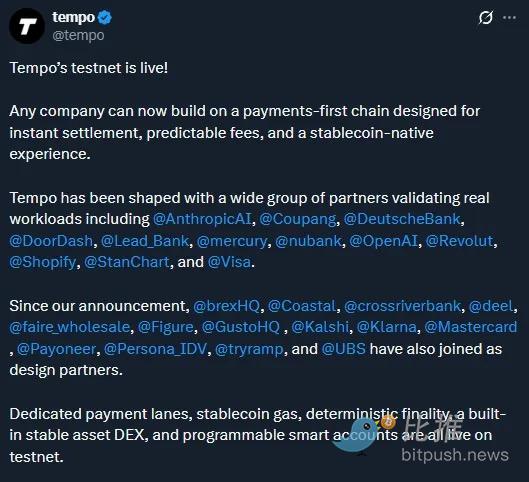
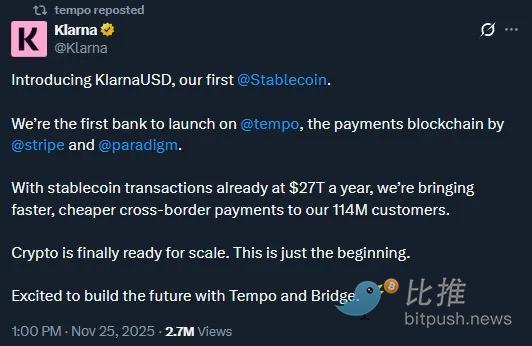
(Source Chart: Technical Architecture Comparison Diagram)

Interested parties can check out the code repository here.

The first thing we noticed is that the technology is released under the Apache or MIT open-source licenses. This is good news.

The Apache 2.0 license is a popular permissive open-source license from the Apache Software Foundation, allowing broad commercial use, modification, and distribution, requiring only the retention of copyright notices, provision of the license text, and notation of significant modifications, while also including an explicit patent grant from contributors to users.

Therefore, the open-source community is free to adopt any of Tempo's technological achievements. This means that although Ethereum may not gain the commercial landing advantages that Tempo brings to Stripe, it can still absorb its protocol-level technological innovations.

So what are the key differences? We quote the core design notes:

Payment Channels Reserved for TIP‐20 Transfers
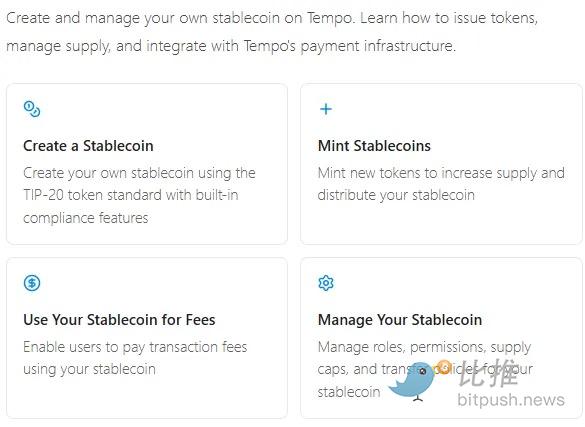
TIP‐20 is a stablecoin issuance standard created with specific functions. Its core effect is to bundle stablecoin issuance with prioritized transfers on-chain.

On Ethereum, different stablecoin issuers compete with each other, and these issuers are not fundamentally different from other token issuers.

On Tempo, the stablecoin issuance contract is solidified in the TIP20Factory, creating the potential for future on-chain revenue. Establishing a fast lane for such tokens gives them a permanent advantage. However, anyone can use this factory contract, meaning competition still exists at the distribution level, but manufacturing tends to be centralized.

Low, Predictable Fees Paid in Stablecoins
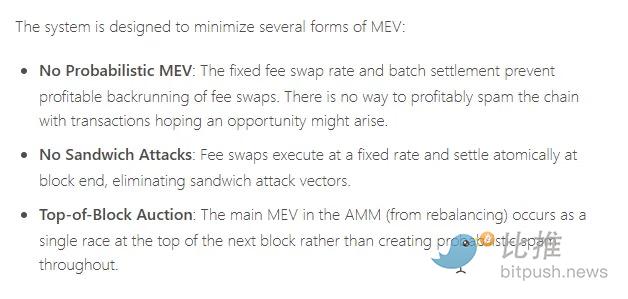
Users can pay Gas fees directly with USD stablecoins upon initiation. A fee automated market maker (AMM) will convert them into the validator's preferred stablecoin. The target cost for TIP‐20 transfers is less than one-thousandth of a dollar (<$0.001). Liquidity providers in the AMM can earn a 0.3% fee from each swap. This design also avoids Miner Extractable Value (MEV) and arbitrage attacks against transactions—which have cost users over $1 billion on Ethereum.

Generalizing the way users pay for transactions is a commendable design direction, and Tempo achieves multi-directional payment options.

Here, any asset can be converted into stablecoins to pay for Gas; on Ethereum, while any asset (including stablecoins) can also be converted to ETH to pay Gas, this process is not automated and requires support from smart accounts.

More importantly, Ethereum has execution competition between different AMMs, rather than solidifying a specific AMM within the chain mechanism. This competition is crucial when trying to spur innovation for new financial primitives; but for Tempo, which aims to industrialize financial primitives, its importance is relatively lower.

Native Smart Account Integration
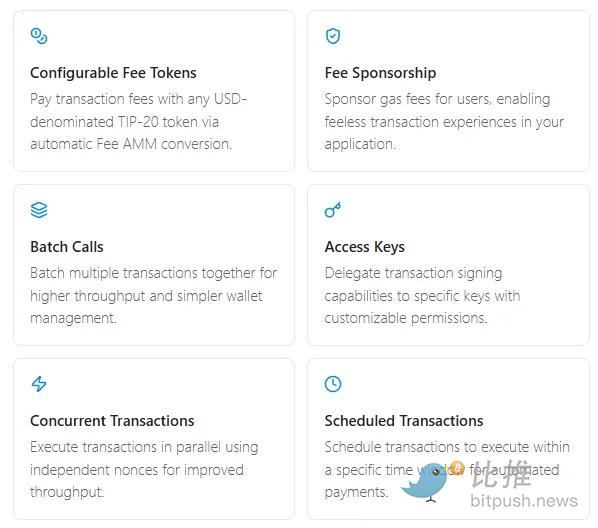
Tempo integrates the excellent concept of smart accounts into transactions: (1) supports batch processing of multiple operations (payroll, settlement, refunds); (2) a fee sponsorship mechanism, allowing applications to pay Gas on behalf of users; (3) scheduled payment functionality, supporting recurring and timed payments within protocol-level time windows; (4) modern authentication methods using passkeys (e.g., biometric login).
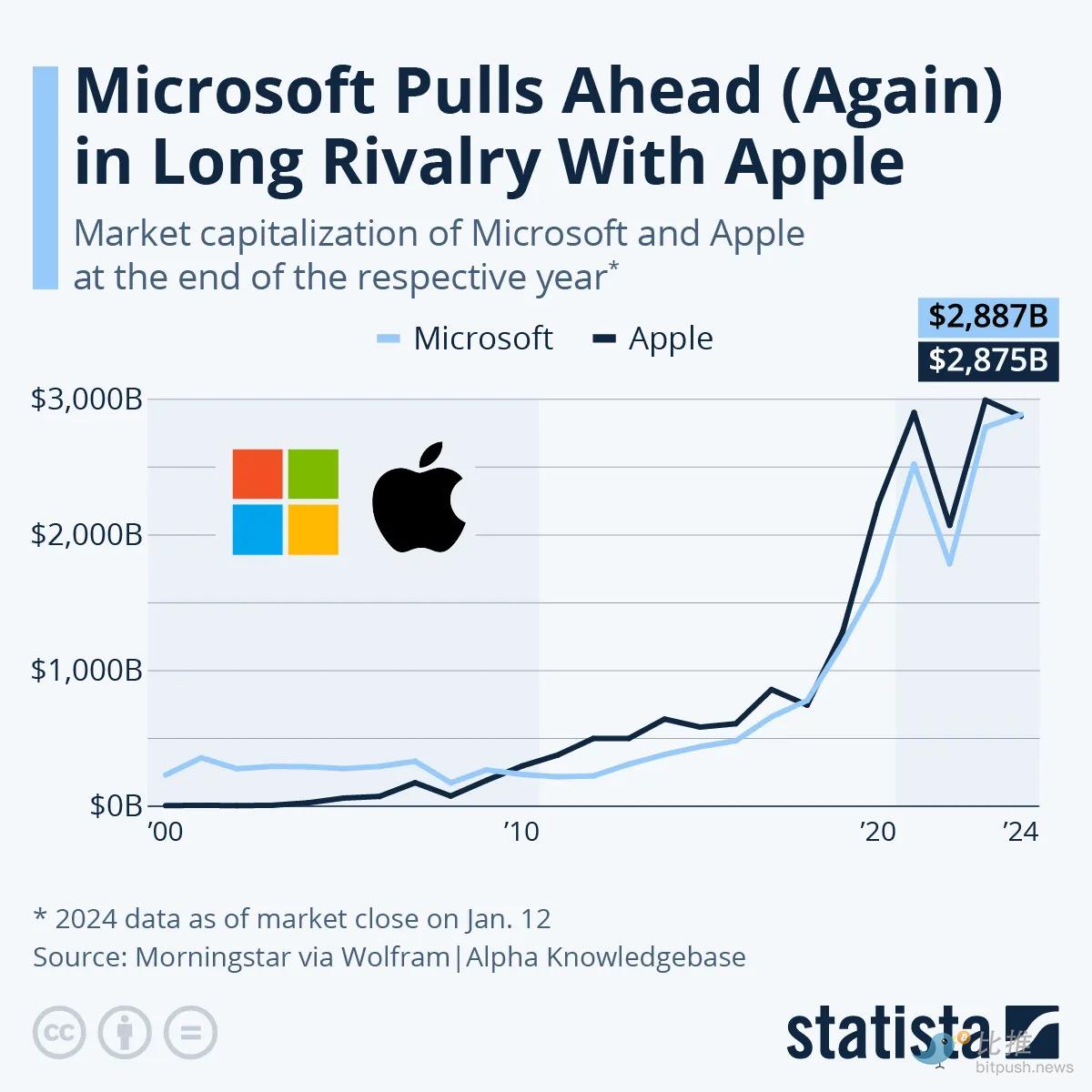
(Attached Figure: Statista chart of long-term competitive trends between Microsoft and Apple)

Just as Stripe itself integrates various fintech services into a single platform, Tempo is absorbing the most demanded payment features as native parts of the chain, rather than leaving them to third-party development and competing for user awareness. This is the Apple-style software development philosophy—all experiences are meticulously designed, proprietary, and vertically integrated—rather than the Windows-style model of gathering developers to create third-party applications (which may create functional breadth but often lack security and a unified user experience). More broadly, this reflects the fundamental difference between closed and open architecture systems.

Performance and Finality
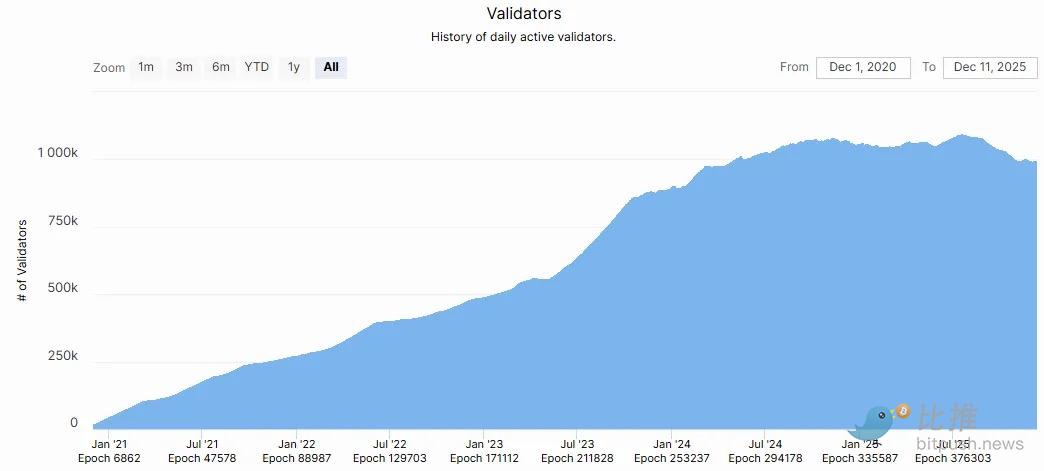
(Source: Ethereum Validator Distribution Chart)

Tempo is fully compatible with the Ethereum Virtual Machine (EVM). Developers can use the same tools, languages, and frameworks (e.g., Solidity, Foundry, Hardhat) as on Ethereum to deploy and interact with smart contracts. Its consensus algorithm uses Simplex BFT consensus (originating from Commonware, to which Tempo has invested $25 million). The validator set is currently private and permissioned, an expected design for the initial stage of a private company.

In contrast, Ethereum is antifragile and anti-censorship, meaning anyone can freely join or leave the validator set. There are currently about 1 million daily active validators on the chain.

Overall, the core impression of Stripe/Tempo is: it is advancing rapidly with a vertically integrated product approach, aiming to capture the fintech market. Its partnerships with AI companies, Web2 enterprises, and traditional banks fully demonstrate its strength in driving blockchain commercialization.


Original link:https://www.bitpush.news/articles/7595070

İlgili Sorular

QWhat is the core innovation of Tempo's TIP-20 standard compared to Ethereum's stablecoin issuance?

AThe TIP-20 standard binds stablecoin issuance with prioritized on-chain transfers by creating a dedicated payment channel for TIP-20 transfers. Unlike Ethereum where stablecoin issuers compete freely, Tempo centralizes the issuance mechanism through the TIP20Factory contract, creating potential for on-chain revenue while allowing distribution-level competition.

QHow does Tempo handle gas fee payments differently from Ethereum?

ATempo allows users to pay gas fees directly in dollar stablecoins through an automated market maker (AMM) that converts them to the validator's preferred stablecoin, with costs targeted below $0.001 per TIP-20 transfer. This differs from Ethereum where assets must be converted to ETH for gas payments, a process that isn't automated and requires smart account support.

QWhat are the key features of Tempo's native smart account integration?

ATempo's smart account integration includes: (1) batch processing for multiple operations like payroll and settlements, (2) fee sponsorship allowing applications to pay gas for users, (3) scheduled payments with protocol-level timing capabilities, and (4) modern authentication using passkeys like biometric login.

QWhat is the fundamental architectural difference between Tempo's approach and Ethereum's approach as described in the article?

ATempo follows an Apple-like closed architecture with vertical integration where payment features are natively incorporated into the chain with proprietary, carefully designed experiences. Ethereum follows a Windows-like open architecture that relies on third-party developers to create applications, resulting in broader functionality but potentially less security and unified user experience.

QHow does Tempo's consensus mechanism and validator system differ from Ethereum's?

ATempo uses Simplex BFT consensus with a private, permissioned validator set, which is expected for a private company's initial phase. Ethereum features an anti-fragile and anti-censorship design where anyone can freely join or leave the validator set, with approximately 1 million active validators daily.

İlgili Okumalar

The First Large-Scale Strike in the AI Era Comes from the Factories That Build AI

The article describes a potential large-scale strike at Samsung Electronics, narrowly averted in May 2026 after a temporary agreement. The strike, planned by the company's union, would have been the first major labor action in the AI era targeting a core AI supply chain player. Samsung, alongside SK Hynix, produces roughly two-thirds of the world's memory chips, critical components for AI training and data centers like HBM. An 18-day strike could have disrupted global supply, affecting prices and production for tech companies and cloud providers. For South Korea, where semiconductors constitute about 35% of exports and Samsung represents a quarter of the stock market's value, such an action threatens national economic stability. The union's demands include a 7% base wage increase and, crucially, a clear, substantial profit-sharing model. They want 15% of annual operating profit as an employee bonus pool and the removal of the existing cap (about 50% of annual salary). This frustration is amplified by seeing rival SK Hynix successfully negotiate a deal granting employees 10% of operating profit as bonuses, with reports suggesting some workers could receive bonuses equivalent to hundreds of thousands of dollars. The conflict stems from deeper issues in South Korea's chaebol (conglomerate) system, where rapid national industrialization often prioritized corporate growth over labor rights. Samsung long maintained a "no union" policy until a 2020 apology from its leader. The article argues this strike highlights a fundamental tension in the AI age: as technology advances and corporate profits soar—often driven by AI—the workers who build the infrastructure are demanding a fair share and dignity, rejecting the notion that they are mere expendable components in a machine that "must not stop." The piece concludes that the true test of the AI era isn't just computational power, but whether the people who build the future can secure a stable and valued place within it.

marsbit30 dk önce

The First Large-Scale Strike in the AI Era Comes from the Factories That Build AI

marsbit30 dk önce

Ripple’s Fed Master Account Bid Gains Momentum After Trump Order

President Donald Trump has signed an executive order directing financial regulators and the Federal Reserve to review expanding fintech and crypto firms' access to core payment infrastructure. This order significantly advances the industry's push for direct Fed connectivity, a central issue for Ripple. The company has been seeking a Federal Reserve master account as part of its strategy for its RLUSD stablecoin, which would allow it to hold reserves directly with the central bank and access its payment rails. The order, titled "Integrating Financial Technology Innovation into Regulatory Frameworks," mandates a Fed review within 120 days on allowing access for entities like uninsured depository institutions and non-bank financial companies, including those in digital assets. This creates a formal policy timeline for resolving whether crypto payment firms must rely on traditional bank intermediaries. Ripple's application for a national bank charter and a master account is part of this broader landscape. The issue gained precedent when Kraken Financial received a limited-purpose master account, while Custodia Bank's application was denied after a legal battle. The Fed has also proposed a more restricted "payment account" option. Trump's order does not guarantee approval for Ripple but forces a high-level examination of the regulatory barriers, bringing the company's long-running effort to the forefront of Washington's financial policy agenda.

bitcoinist44 dk önce

Ripple’s Fed Master Account Bid Gains Momentum After Trump Order

bitcoinist44 dk önce

Google's 2026 Roadmap is Hidden in This Keynote Speech

Google I/O 2026 was not merely a product launch, but a strategic unveiling of the company's decade-long roadmap. The core signal is that Google is evolving its AI, Gemini, from a feature within products into a foundational operating layer that integrates and reshapes its entire ecosystem—Search, Android, Chrome, YouTube, Workspace, XR, and developer tools. The traditional paradigms of digital interaction are being redefined. Search is shifting from finding links to understanding intent and completing tasks. Android is transforming from an app-centric OS into an AI-native platform that orchestrates workflows across services. Chrome is becoming an AI reasoning layer over the web, while YouTube is evolving into a conversational knowledge engine. Google is heavily investing in Agentic AI, aiming for AI to act as a digital operator that executes tasks autonomously. Underlying this vision is the integration of Gemini across all products, making it the central nervous system. Key developments include Gemini Omni for multimodal generation, deeper product integrations, and a push into XR glasses for contextual, ambient computing. Google is positioning AI not as an optional feature but as essential infrastructure, akin to electricity. The broader implication is a competition for the next computing interface. Google's goal is not just to win in chatbots or models, but to become the operating system for the AI era by controlling the primary entry points—search, assistant, OS, and browser—and weaving them into a unified, intelligent layer. This represents a fundamental shift in computing paradigms that will impact creators, developers, businesses, and how all users interact with technology.

marsbit1 saat önce

Google's 2026 Roadmap is Hidden in This Keynote Speech

marsbit1 saat önce

‘Withdraw Insurance to Buy Stocks’: South Koreans Over 60 Are Borrowing to Bet on Samsung

South Korea's stock market has seen a frenzy, with the KOSPI nearly doubling in six months. This boom is fueled by a surge in retail investors borrowing to buy stocks, with outstanding margin loans hitting a record high. A significant portion of this debt is held by people over 50, with the 60+ age group seeing the fastest growth. Many are reportedly cashing out savings-type life insurance policies—even at a loss—to fund their stock investments. They are heavily concentrated in major semiconductor stocks like Samsung Electronics and SK Hynix, which have driven most of the market's gains. This trend is particularly risky for older investors, who are leveraging their limited retirement savings. While a market correction in March caused significant losses for leveraged accounts, the swift recovery and continued rally have reinforced risky behavior. Stories of quick profits on platforms like Blind further fuel the speculative rush. The phenomenon is partly driven by economic anxiety. With South Korea having a high elderly poverty rate and a low public pension replacement rate, some seniors see the booming market as a last chance to improve their finances. This "FOMO" (fear of missing out) sentiment is palpable, even in public parks where retirees gather and now discuss stock tips alongside their usual activities. Despite regulatory warnings and the inherent risks of leverage—especially for those with little time to recover from losses—the borrowing binge continues. The market's heavy reliance on a few tech stocks and its cyclical nature pose a substantial threat to these elderly investors, for whom a downturn could be catastrophic.

marsbit1 saat önce

‘Withdraw Insurance to Buy Stocks’: South Koreans Over 60 Are Borrowing to Bet on Samsung

marsbit1 saat önce

İşlemler

Spot
Futures
活动图片