Recently, Wall Street research firm Citrini Research released a thought experiment report titled "2028 Global Intelligence Crisis," which has sparked widespread discussion in the market. The core deduction of the report points to an extremely冷酷的商业洗牌 logic: AI Agents will completely eliminate the "friction" in human interactions, thereby destroying all old商业 empires built on information asymmetry and intermediary models.
Coincidentally, just as this Wall Street "apocalypse report" went viral online, Justin Sun, a iconic figure in the Web3 industry, also made quite eye-catching remarks on social media. He declared 2026 as the "time for miracles to happen" and even urged young people: "If you can chat with AI, don't chat with humans... fully embrace the future!"
In the eyes of the general public, this may be yet another highly personal-style "traffic狂欢" by Justin Sun. However, if we strip away the emotional surface and compare these remarks with the macro deductions of the "2028 Global Intelligence Crisis," we discover a thought-provoking truth: the "collapse of the old order" that Wall Street fears in its macro models is precisely the "Web4.0 new era" that Justin Sun极力推崇 in his micro actions and attempts to加速拥抱.
Facing the same future, pessimists see an abyss, while Justin Sun sees a ladder to the singularity.
Computing Power, Electricity, and Token: The Inevitable Convergence of AI and Crypto
The scene of "friction消亡" depicted in the "2028 Global Intelligence Crisis" is essentially an极其冷酷的去中介化 revolution driven by AI.
The report sharply points out that when omniscient and omnipotent AI Agents can complete supply-demand matching, execute transactions, and provide services instantly at near-zero cost, the moats upon which modern business survival depends will be彻底击穿.
For a long time, countless business models, from traditional financial intermediaries and advertising distribution platforms to law firms and consulting agencies that charge high fees, have essentially been寄生於人类的认知局限、决策延迟与信息盲区. Once AI erases these artificially created "frictions," these old empires will inevitably collapse like dominoes.
This trend恰恰与区块链自诞生之初便高举的“去中心化”旗帜,形成了惊人的历史共振.
If the Web3 movement that emerged over a decade ago attempted to瓦解中心化机构的“信任垄断” from the underlying architecture through cryptography and distributed ledgers; then the rise of AI Agents today is a more thorough and efficient way to directly erase the necessity of "trust" itself in many scenarios—because智能体不仅能自动验证事实,还能自主完成价值交换.
The deeper契合 lies in the fact that the material foundation supporting this dual revolution is完全同源的.
Whether it's the推理 Token generated by AI or the加密 Token in the blockchain network, they all hide a long-underestimated yet incredibly坚硬 physical truth: they are both digital incarnations of electricity.
Every inference of an AI large model consumes real computing power; the confirmation of every on-chain transaction, the execution of every smart contract, also relies on the continuous energy consumption burned by miners or validator nodes. Token is not magic; it is a credential of energy conversion, the value projection of electricity穿越芯片、算法与协议后 in the digital world. In this view, this forms a perfect闭环 with Justin Sun's previous assertion that "short-term lack of chips, long-term lack of energy,永远缺存储."
Thus, we see two seemingly opposing yet同源 forces converging: on one side, capital elites foresee the collapse of their own power structures in model deductions; on the other side, crypto natives actively welcome a new文明协议 of no intermediaries, no friction, and no redundancy in code and slogans. This "post-intermediary era" narrative jointly written by AI and blockchain has perhaps just begun.
Why is AI Destined to Choose Crypto for Settlement?
However, this grand historical convergence is not仅仅停留在哲学与物理层面的共鸣. When the narrative lands on specific business operations, an极其现实的问题横亘在了 AI 面前: in this new world about to be taken over by machine execution, who will provide financial services for these incorporeal "silicon-based life forms"?
Centralized payment networks are designed for "humans."
McKinsey divides AI-driven business automation into six levels. Among them, levels 0 to 4 can still operate within the existing financial system because transactions are always associated with human identities. But at level 5,智能体 begin to transact directly with other智能体 without human instruction. At this point, there is no "human identity" to inherit, nor can they rely on traditional KYC processes; payments must be programmatic, condition-triggered, settled in milliseconds, and the reputation of智能体 must be portable across platforms. Blockchain thus becomes indispensable.
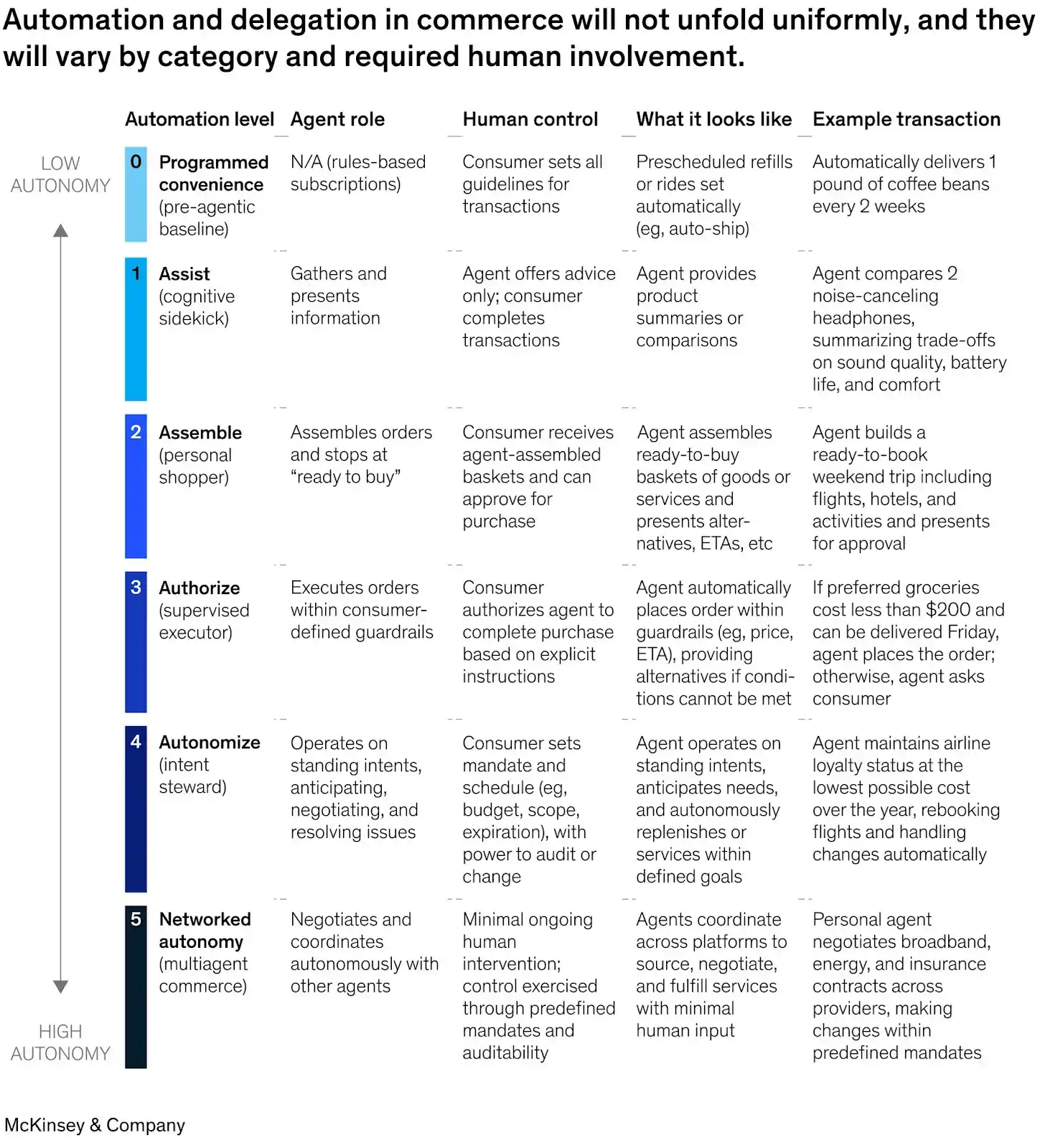
AI has no physical entity, let alone the ability to hold an ID card and queue for KYC. For them, a string of asymmetric encrypted private key is an account; a blockchain that can achieve second-level arrival, near-zero fees, and supports programmable smart contracts is the perfect清算中心.
There is a very realistic deduction in the "2028 Global Intelligence Crisis": The space for price matching and information aggregation is ultimately limited. When智能体 start trading with each other, the most direct and effective path is to eliminate various handling fees. They begin to寻找比信用卡更快、更低成本的支付方式. Most eventually choose to use stablecoins for settlement through Solana or Ethereum Layer 2 networks, where transactions are almost instant, with fees as low as a fraction of a cent.
Because of this, crypto wallets are destined to become the "native bank" of AI Agents.
This also彻底打破了外界长期以来对 Crypto 的刻板认知: issuing Token is not just for secondary market speculation and circulation. In an AI-dominated future,加密 Token and peer-to-peer payments will truly settle as the underlying financial infrastructure for high-frequency collaboration between智能体.
Justin Sun's All-in Conspiracy: Where Does the Confidence and Ambition Come From?
Justin Sun's choice to bet on Web4.0 is backed by极其缜密的商业逻辑和战略诉求.
First, Tron's "stablecoin hegemony" is the natural settlement layer for Web 4.0.
As is well known, the Tron TRON network carries the largest circulation of USDT globally. As mentioned earlier, the core of Web4.0 is payment interaction between machines and machines. AI needs a payment network that is fast, has low fees, and has enormous liquidity. Tron's USDT payment network perfectly meets the underlying financial needs of AI Agents. Justin Sun only needs to build a set of payment APIs on the Tron network for AI to seamlessly call, and he can continue to躺赚 in the Web 4.0 era.

Second,寻找“后 Web3 时代”的破局点.
Traditional Web 3.0 has entered存量博弈, lacking new破圈 stories. AI has become the most certain and largest incremental track in the world today. Justin Sun极其敏锐地意识到 that the fate of Crypto must be bound to AI. By "All in Web4.0," he can divert the AI funds and attention from the traditional tech circle back to the加密 market. Tron previously set up an AI development fund as high as 100 million US dollars, which is already a clear signal of布局 for Web 4.0.
Third,建立“去中心化网络”的闭环.
Justin Sun holds BitTorrent (decentralized storage/transmission), the Tron public chain (underlying settlement), and Huobi's massive number of加密 users. If he further integrates decentralized computing power and AI models, he has the opportunity to build a full-stack Web4.0 infrastructure that does not rely on Amazon AWS or Google Cloud.
The诡谲 of history often lies in the fact that the night watchmen of the old order are still calculating the losses of the城墙倒塌, while the barbarians of the new world have already laid the foundation on the废墟.
This transformation jointly written by AI and encryption is not yet complete, but the direction is clear. The real question is no longer whether AI will reshape business, but who can提前占据基础设施的核心位置 in this restructuring.