Mihoyo's Next Protagonist Is Her, Who Plays the Piano

marsbit2026-06-25 tarihinde yayınlandı2026-06-25 tarihinde güncellendi

Özet

Mihoyo, widely recognized for its hit game Genshin Impact, has long harbored a grander ambition: creating a virtual world where one billion people would want to live. While its character design is unparalleled, the company recognizes a fundamental limitation—these beloved virtual characters are not truly "alive." Their dialogue and actions are pre-scripted. This drive for authentic "living" characters has guided Mihoyo's strategic investments in cutting-edge fields like brain-computer interfaces, AI (including an early investment in MiniMax), and nuclear fusion. Following the release of ChatGPT in late 2022, co-founder Cai Haoyu stepped down from management to lead a new overseas AI venture, Anuttacon, focused on creating AI-driven virtual beings. Mihoyo's path has involved experimentation and iteration. Anuttacon's early project, *Whisper of the Stars*, showcased real-time AI conversation but revealed limitations in underlying language models. The team subsequently focused its resources on developing a sophisticated "emotional" large language model, distinct from purely utilitarian AI. Co-founder Liu Wei (Dawei) announced plans to invest up to 100 billion RMB in this AI pursuit. The first tangible product of this vision is *BSide: Olivia Lin*, a free Steam application featuring a piano-playing virtual companion. Unlike typical AI chatbots demanding constant interaction, Olivia Lin operates on a slower, more deliberate rhythm—responding to letters, playing user-submitted m...

By Sleepy

Most people know Mihoyo because of Genshin Impact.

A second-generation open-world game that topped the application charts in many countries worldwide in its first year. Third-party data shows its mobile revenue has exceeded sixty billion dollars.

Before it was the Honkai series; after it came Honkai: Star Rail and Zenless Zone Zero. Mihoyo has long been one of China's highest-grossing game companies overseas.

Mihoyo's three founders started from Dormitory D32 at Shanghai Jiao Tong University's Minhang campus, pooling 100,000 yuan in interest-free loans, eating Lanzhou ramen and Shaxian snacks downstairs, and writing their first lines of code in a 50-square-meter office.

Fifteen years later, the company is still not listed, has only ever received 1 million yuan in angel investment, and is valued at hundreds of billions of RMB.

This is the Mihoyo most people know. A gaming company, the really successful kind.

Those Invisible Things

What you might not know is that this company is also investing, and in directions you probably wouldn't expect.

In 2021, they invested in brain-computer interfaces, co-establishing a brain disease lab with Ruijin Hospital. The same year, they invested in MiniMax, an AI company few had heard of at the time, which later became one of China's 'Six Giants' in large language models and went public on the Hong Kong Stock Exchange in 2026. They have also invested in controlled nuclear fusion.

Brain-computer, fusion, large models — these words feel a bit mismatched, even a bit cringey, when placed next to anime games.
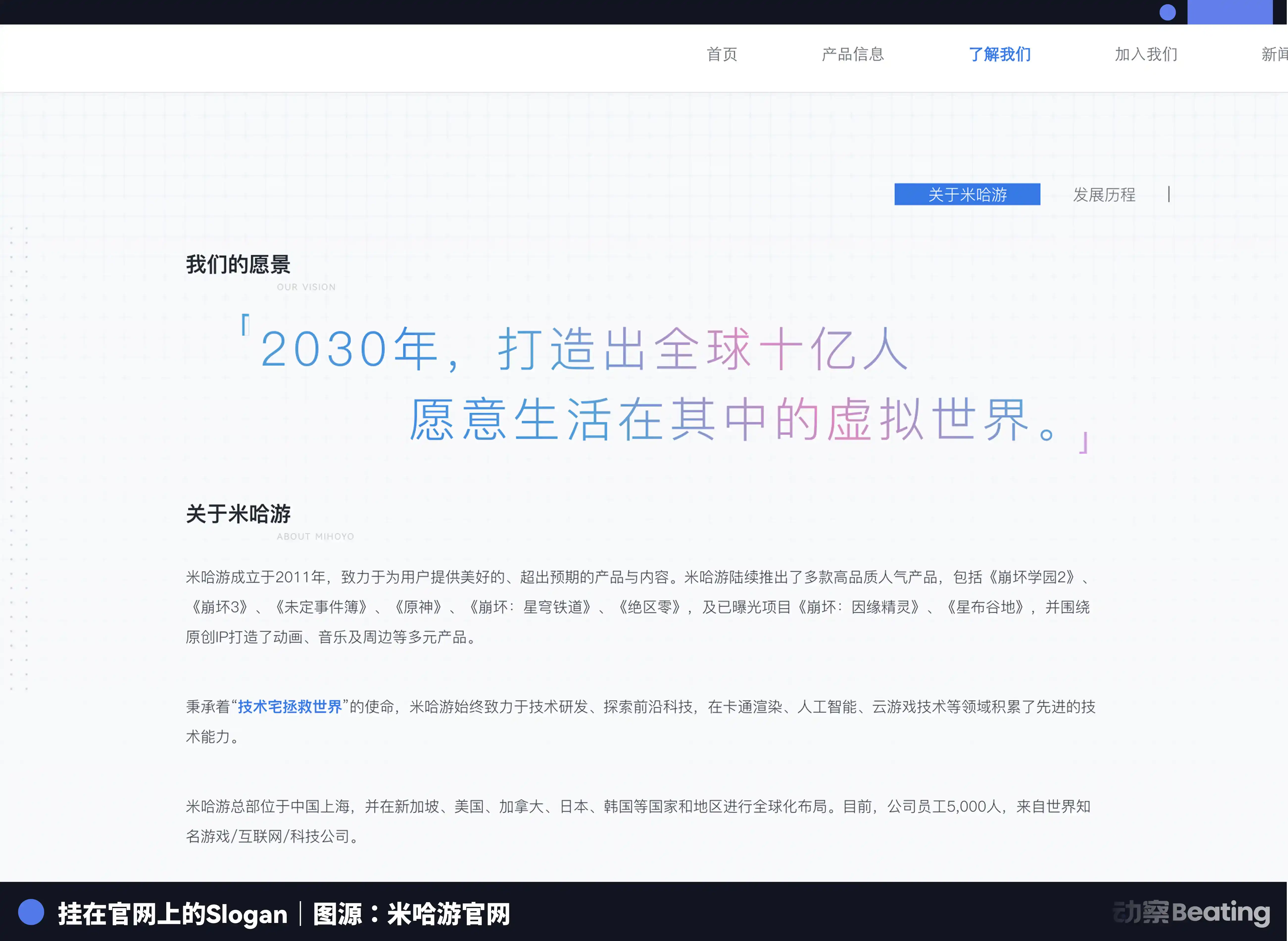
Mihoyo's homepage still features a line: 'By 2030, create a virtual world that one billion people are willing to inhabit.'

This line has been up for years. Most see it as a slogan, glance at it, and scroll past. But if you take it seriously, all those investments make perfect sense. To build a virtual world one billion people want to live in, visuals aren't enough, story isn't enough, characters aren't enough.

The people in that world have to be 'alive'.

Mihoyo's character design capability has few rivals across the industry. Characters in Genshin Impact have led global players to spend money, create fan art, write fan fiction, and argue over their fates on social media. Someone cried online for three days over the 'death' of a virtual character. These characters are loved, treated seriously, regarded as real in some sense.

But they aren't human. Every line of dialogue is pre-written, every smile is painstakingly animated frame-by-frame, every 'personality' is a set of preset parameters. You fall in love with them, but they don't know. You feel real emotions on this side of the screen, but nothing happens on the other side.

This is a problem all virtual characters face. The better you make them, the more players believe. The more players believe, the quicker the disappointment comes. The anime game industry has made money off this one-way affection for over a decade, and no one saw a problem. Players know the characters aren't real, but knowing is knowing, spending is spending, feeling is feeling.

Except, the person creating the characters, if they truly care, will eventually feel this isn't right.

Six Days

On November 24, 2022, Mihoyo's internal project codenamed Project SH was halted. This project later became City of Rain, but at the time it lacked direction. According to industry reports, co-founder Cai Haoyu tried taking the team overseas to brainstorm, struggled for a while, didn't find a way forward, and pulled back.

Six days later, on November 30, 2022, OpenAI released ChatGPT.

Cai Haoyu graduated from the Computer Science department of Shanghai Jiao Tong University. His master's research was deeply related to intelligent human-computer interaction and brain-computer interfaces. According to people close to him, after returning from his trip, he decided to focus on AI.

He had taken a long detour, from AI to anime games, scaling the company to a value of hundreds of billions with Genshin Impact, then turning back to where he started.

In September 2023, Cai Haoyu stepped down from all management positions at Mihoyo, moving to the overseas AI project Anuttacon. On LinkedIn, his new title is AI Soulcaster.

Another founder, Liu Wei (Da Weige), later explained at Shanghai Jiao Tong University why they let Cai Haoyu go. He said Mihoyo had grown to six or seven thousand people, organizational inertia was too heavy, unsuitable for starting AI from scratch. So the three founders discussed it and split one off. Liu Wei stayed to manage the large company of six or seven thousand, Cai Haoyu took dozens of people to work on cutting-edge technological breakthroughs.

Two-pronged approach.

Hitting Walls and Turning Corners

According to industry reports, Cai Haoyu led forty people overseas, initially wanting to pursue three lines simultaneously: making AI that could talk, act, and see the world. But dividing resources three ways left each strand insufficient.
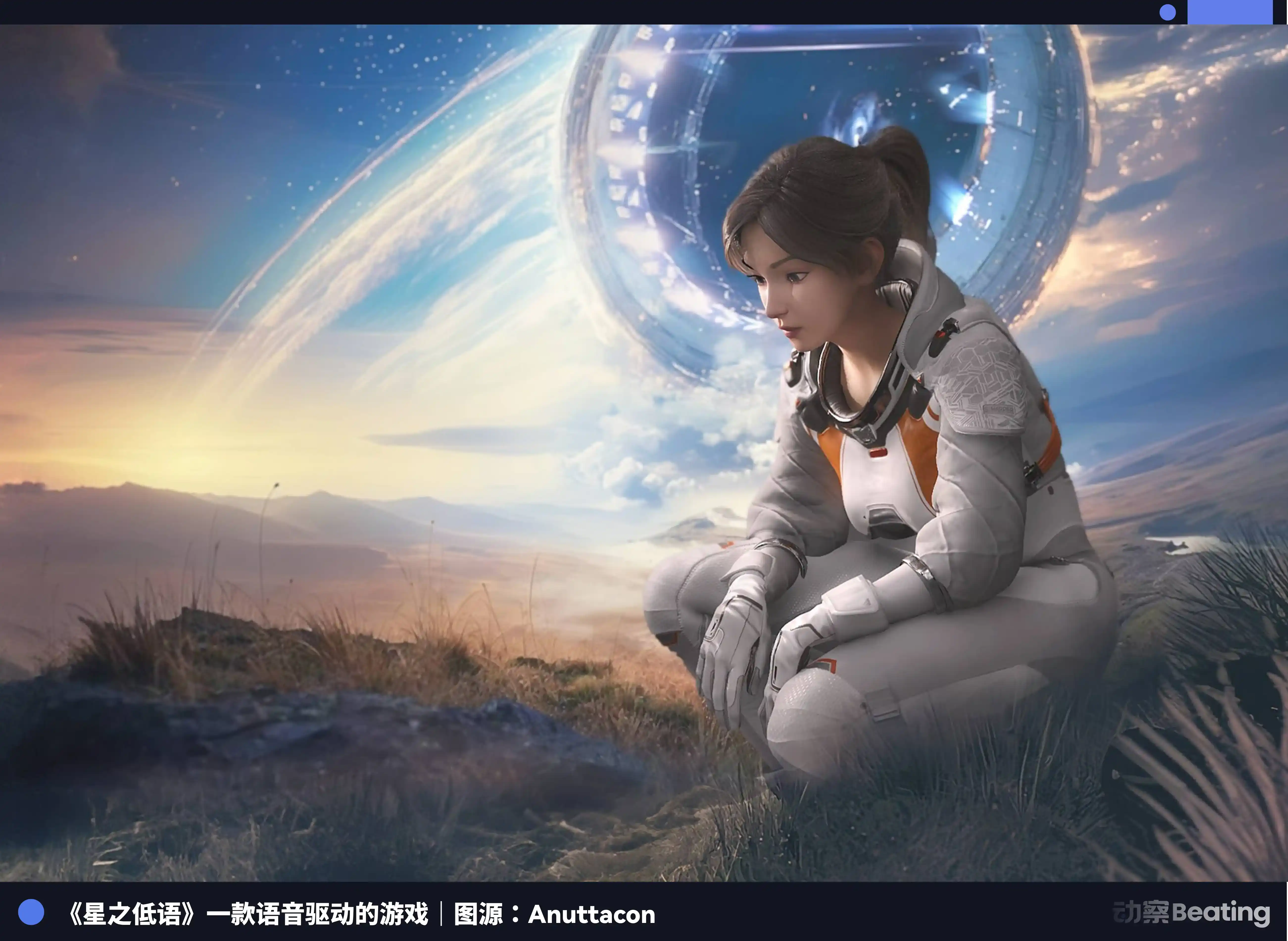
In August 2025, they released their first product on Steam: Whisper of the Stars, an AI-driven interactive game. You converse in real-time with a virtual girl named Stella, helping her survive on an alien planet. No script, no preset options, the AI generates every word she says in real-time. Priced under 30 yuan, it received 'Very Positive' overall reviews on Steam after launch.

But one review said it felt more like a tech demo than a game. Another commented that Stella was oddly relaxed during a wilderness survival scenario; you frantically plan her escape route, and she asks if you've ever felt lost in life. She repeats questions you've already answered, as if suffering from intermittent amnesia.

The reasons for these problems were an underlying language model that wasn't smart enough. The character's performance could be good, the voice realistic, but the character's 'brain' couldn't keep up.

Reportedly, since late last year, Anuttacon cut the other two lines, concentrating almost all resources on language models and agents, with core R&D largely moving back to China.

Then there's Liu Wei's side.

In May 2026, he told a room of PhD students in Beijing that they planned to invest up to 100 billion yuan in AI over the next three years. If it didn't work out, so be it, consider it a grand fireworks display.

When he said this, Mihoyo had already conducted many internal AI experiments. According to insiders, a colleague once set up dozens of AI agents collaborating for a project, burning through 2 million RMB in compute overnight. The company didn't stop it, using this tuition fee to improve their internal platform.

Besides the 100-billion figure, Liu Wei immediately said something else. He said they weren't aiming to build a general-purpose large model; they wanted to build 'a large language model with emotion'. Not just intelligent, but capable of understanding human emotional needs.

You chat with an AI, it gives correct answers, you find it useful, but you don't feel there's a person on the other side. 'Having emotion' requires things that can't be written into benchmark leaderboards, and that's precisely the craft Mihoyo has honed over fifteen years.

They might understand better than any other AI company on Earth how to make a non-existent person feel vitally important to a user.

A Girl Who Plays the Piano

On June 18th, just before the Dragon Boat Festival holiday, Mihoyo opened a pre-release page for an application called BSide: Olivia Lin on Steam.

Note, it's an 'application', not a 'game'. Its classification tag on Steam is Application, not Game.

The protagonist is Li Lin, a Shanghai girl majoring in piano and minoring in psychology. You can listen to her play, upload melodies you've written for her to perform, write her letters (she'll reply), and set her as a dynamic desktop wallpaper. That's it. Free, no gacha, almost none of the familiar trappings of an anime game.

The first dish served after the hundred-billion AI gamble is a piano-playing desktop wallpaper.

Its logic runs completely counter to those AI companion products. Li Lin is not an AI girlfriend. Companies making AI companions, from Replika to Character.AI, operate on a core logic of increasing interaction frequency, always online, responding in seconds, the more chatting the better.

But the more you chat, the more flaws the AI reveals.

Li Lin is not on-call. She replies to your letters after a while, plays melodies you upload, and sits quietly on your desktop if you put her there. This rhythm is almost pre-digital. Letters are inherently delayed, playing music requires no extra dialogue, and quiet presence on the desktop is also a form of companionship.

Ironically, the more realistic the companionship, the lower the AI requirements become. Face-to-face chat is hardest because dialogue is infinite, unpredictable, every reply could expose its non-human nature. Reducing interaction frequency uses product design to compensate for technical gaps. When AI can't yet support a 24/7 'living person', first make an existence you only open occasionally, but feels real every time you do.

In 2020, Mihoyo made a small tool called 'Artificial Desktop', placing their virtual idol Lumi on users' screens. You click, she moves, like a coin-operated merry-go-round. Six years later, Li Lin can play the tunes you write, read your letters, reply with measured phrasing.

Mihoyo calls this path 'sense of being alive'. They've walked it for six years, slowly, but the direction hasn't changed.

In 2010, while a grad student at Jiao Tong University, Cai Haoyu and two others wrote a 2.5D game engine in Flash called Misato. That was Mihoyo's first line of code. Sixteen years later, he's building engines again, only this time the engine isn't for rendering visuals, but for bringing virtual characters to life.

Language model is the brain, letting the character know what to say. Performance model is the body, making the character look alive. Agent framework is memory and personality, letting the character remember experiences and maintain a coherent self. Layer them together, and you have a complete system for turning virtual characters from marionettes into autonomous beings.
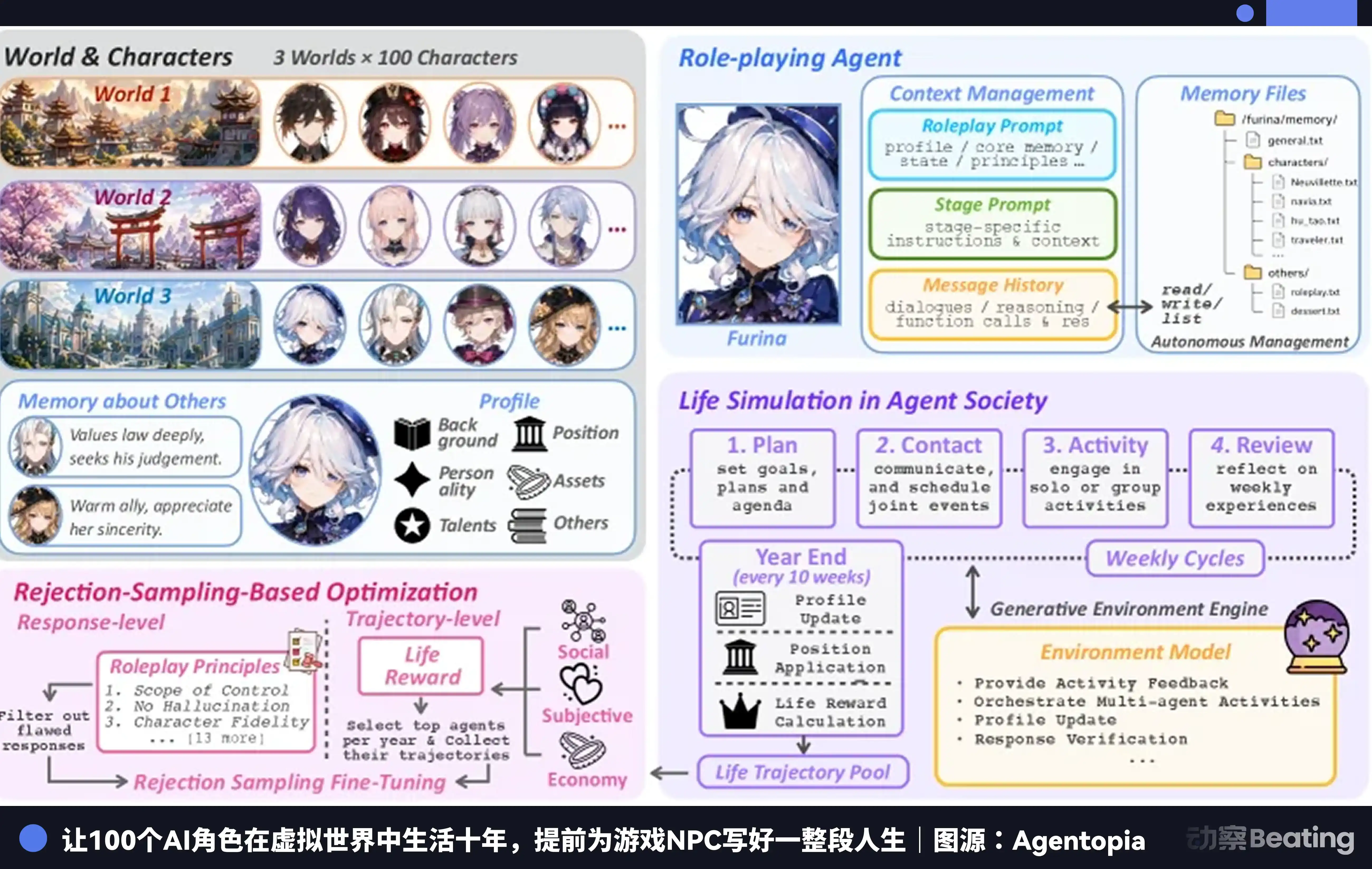
In early June this year, researchers from Fudan University and others published an Agentopia paper, placing one hundred AI characters into three fictional worlds, letting them live autonomously, simulating ten years. The hundred characters each had personalities, memories, social relationships; they quarreled, reconciled, changed opinions of each other over small incidents. The entire experiment consumed 13.7 billion tokens.

One hundred virtual people, in a virtual world, lived ten virtual years.

This system currently has no public benchmark scores, Anuttacon's foundational model is still in closed-door training, with no third-party verification. The only product they've shown the outside world is a girl quietly sitting on your desktop, playing the piano.

Hatsune Miku

Few remember how the name miHoYo came about.

HoYo comes from the first letters of Cai Haoyu and another founder Luo Yuhao's names. The letter o is because they felt big tech companies like Facebook, Google had an o in their names, hoping for a bit of that tech aura.

And mi, from Hatsune Miku. The mi from Hatsune Miku.

Hatsune Miku is a virtual singer. No consciousness, no emotion, no autonomy; technically just a set of vocal synthesis parameters. But thousands of people worldwide write songs for her, draw her, attend her hologram concerts.
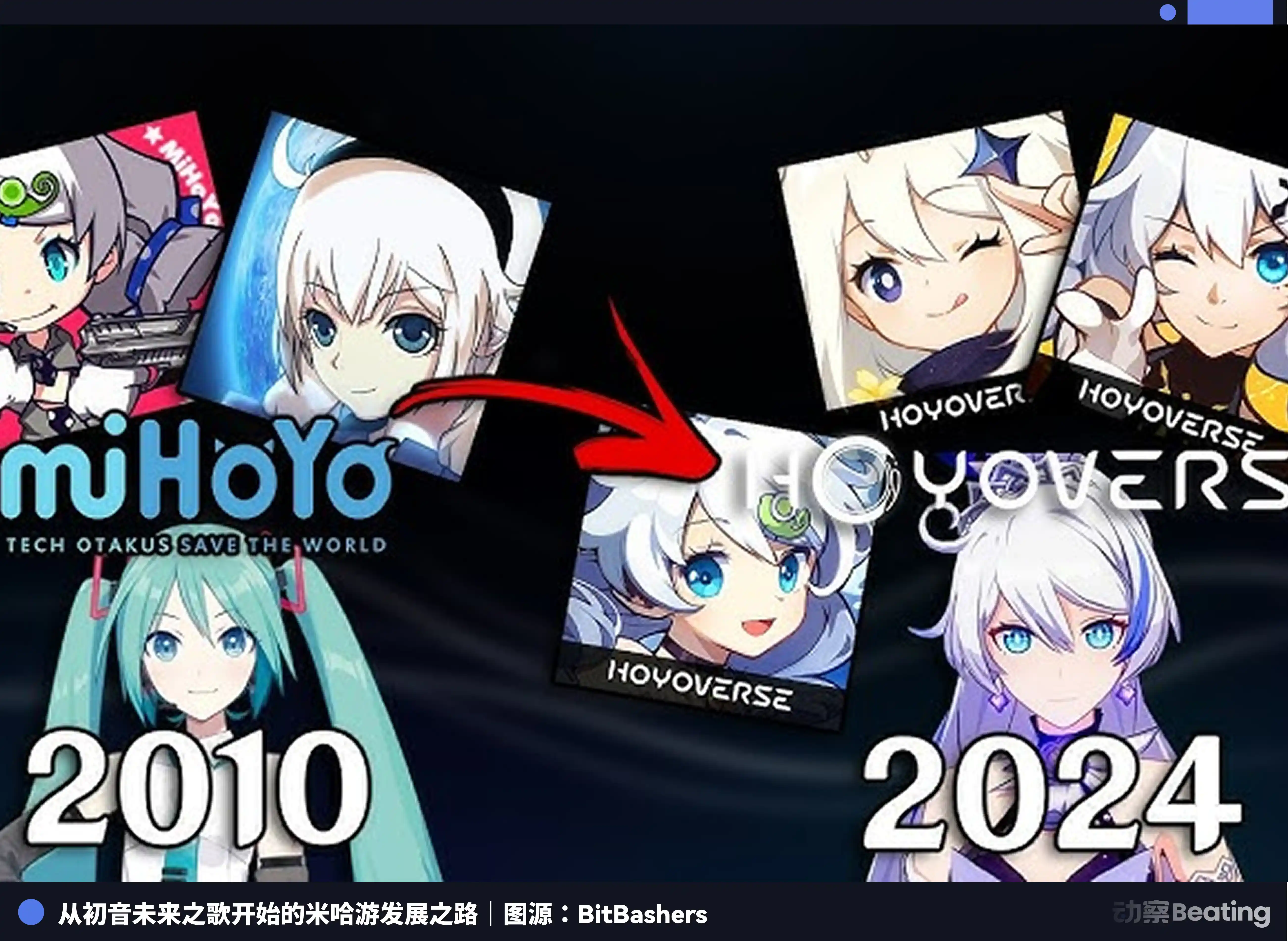
Three young men from a Jiao Tong dormitory named their company after a virtual idol. That was 2012, they had only 100,000 yuan in their pockets. Fourteen years later, this company named after a virtual idol is putting up one hundred billion yuan to solve a problem that was, in fact, written into the company name from day one.

Hatsune Miku has been loved for nearly twenty years. People worldwide have written hundreds of thousands of songs for her, waved glow sticks at a beam of holographic light at concerts, cried, shouted her name. But she doesn't know. She never has.

What if, one day, she did?

Trend Kriptolar

İlgili Sorular

QWhat is the core concept behind the character 'Lin Li' in the context of the article?

AThe core concept behind the character 'Lin Li' is to achieve 'living person feel' through limited, purposeful interaction. She is an AI-driven 'application', not a game, designed for low-frequency engagement like exchanging letters, playing uploaded melodies, and being a dynamic desktop wallpaper. This design uses product constraints to mask current AI limitations, creating a sense of authentic presence without demanding constant, flawless conversation like a 24/7 AI companion.

QAccording to the article, how did the release of ChatGPT influence MiHoYo's strategic direction?

AThe release of ChatGPT in November 2022, shortly after the pause of a major internal project (Project SH), reportedly prompted co-founder Cai Haoyu to decisively shift the company's strategic focus towards AI. This led to him stepping down from day-to-day management to lead a new overseas AI research unit, Anuttacon, focusing on foundational technologies to create 'living' virtual characters, while the main company under Liu Wei continued to invest heavily in developing an 'emotional large language model'.

QWhat is the significance of the name 'miHoYo' as explained in the article, and how does it relate to their long-term vision?

AThe name 'miHoYo' originates from 'mi' in Hatsune Miku, the virtual singer, and 'HoYo' from the founders' names. This signifies the company's founding inspiration from virtual idols. Their long-term vision, 'to build a virtual world where 1 billion people are willing to live in by 2030,' connects back to this inspiration. Their billion-dollar AI investment aims to solve the core problem hinted at by their name: creating virtual beings with autonomy and emotional depth, moving beyond scripted characters to entities that can truly 'know' they are loved.

QWhat major technical challenges did MiHoYo's AI project face according to the article?

AInitially, the AI project (Anuttacon) tried to develop three capabilities simultaneously: language/speech, performance/acting, and visual perception. This led to resource dilution and insufficient progress on each front. Their first public product, 'Whisper of the Stars,' received praise but also criticism that it felt like a tech demo, revealing core issues with the underlying language model, such as repetitive questions and a lack of contextual awareness. This prompted a strategic pivot to concentrate resources almost entirely on improving the language model and AI agent framework.

QHow does the article describe MiHoYo's approach to AI investment and experimentation?

AThe article describes MiHoYo's approach as bold, long-term, and tolerant of high-cost experimentation. They have invested in frontier technologies like brain-computer interfaces, AI (MiniMax), and nuclear fusion, aligning with their 'virtual world' vision. Internally, they allowed costly AI experiments, such as one that burned through 2 million RMB in computing power overnight for a multi-agent simulation, treating it as valuable tuition. Publicly, co-founder Liu Wei announced a plan to invest up to 100 billion RMB over three years, accepting the risk of failure, indicating a 'moon-shot' mindset focused on achieving a breakthrough in emotional AI.

İlgili Okumalar

The Crypto Industry Enters the 'Show Me' Era: Vision Alone Is No Longer Enough

The crypto industry has entered a "Show Me" era, where grand visions and white papers are no longer sufficient to gain traction. This shift is driven by increased skepticism, high-profile bad actors, and notably, the serious entry of traditional finance (TradFi) institutions like BlackRock, Fidelity, and JPMorgan Chase, which are launching real, scaled products such as tokenized funds and blockchain-based settlement. This raises the bar for what constitutes a credible project. The communication dynamic has fundamentally changed. The focus is no longer on "what you are building" but on "what you have built and who is using it." Startups must now provide a "proof stack": verifiable data like mainnet transaction volume and active wallets, genuine partnerships with signed contracts, and evidence of organic product-market fit from real users, not just investors. Announcements must be backed by concrete, chain-verifiable evidence. For communication strategies, this means leading with proven facts and hard data—even if modest—rather than speculative narratives. A compelling story must be grounded in demonstrated results. While vision remains important, the balance has inverted from 80% vision/20% substance to the opposite. This higher threshold ultimately benefits builders with genuine traction, filtering out noise and allowing their real signals to stand out clearly. The "Show Me" era is a permanent maturation, demanding that communication strategies prove value, not just promise it.

链捕手17 dk önce

The Crypto Industry Enters the 'Show Me' Era: Vision Alone Is No Longer Enough

链捕手17 dk önce

Meta Follows the Trend into Prediction Markets: Can It Avoid Repeating the Failure of the Metaverse?

Meta, the tech giant behind Facebook, has reportedly formed a team to develop "Arena," a new application focused on prediction markets. Users would use platform points to place bets on outcomes in politics, sports, and global events. This move follows Meta's massive, nearly $900 billion, losses from its heavily-invested metaverse division, Reality Labs. The prediction market industry is already showing strong demand, with leading platforms like Kalshi and Polymarket facilitating hundreds of billions in annual volume. Meta, with its 3.56 billion daily active users across its apps, possesses the unprecedented scale to bring this niche activity to a mainstream audience, similar to its past success in cloning features like Stories and Reels. However, Arena faces significant hurdles. Meta plans to start with a points-based system to avoid strict financial regulations, but this may dilute the core incentive of accurate prediction that real-money markets provide. More critically, Meta enters the space with a major trust deficit stemming from its past regulatory battles, notably the failed Libra/Diem stablecoin project, and its controversial history with political content and misinformation. The prediction market sector itself is under increasing regulatory scrutiny, with recent CFTC actions including fines and the first-ever insider trading case. While Meta's vast user base offers a unique opportunity to expand the market, its success hinges on navigating complex regulations and rebuilding the credibility necessary for a platform dealing with sensitive topics like elections. The outcome could range from Meta dramatically growing the industry to Arena becoming a high-profile regulatory target before it can scale.

Foresight News34 dk önce

Meta Follows the Trend into Prediction Markets: Can It Avoid Repeating the Failure of the Metaverse?

Foresight News34 dk önce

Stock Soars 1200% on First Day, 80s Sales Engineer's Reversal: From Selling FRP to a Fortune of 29 Billion

On its first day of listing, Zhenbao Technology (stock code "N Zhenbao") surged by 1207%, marking itself as the second "ten-bagger" new stock of the year on the STAR Market. The closing price of 585 yuan propelled it into the top 20 of the A-share market by stock price. Dubbed the "first share of semiconductor consumables," the company is backed by a comprehensive shareholder list including National Integrated Circuit Industry Investment Fund Phase II, SMIC, BOE, and YMTC. Zhenbao's business model focuses on supplying critical consumable components like silicon rings and quartz parts to semiconductor fabs. Unlike expensive core equipment with low repurchase rates, these consumables require frequent replacement as long as production lines are running, generating stable recurring revenue—a key reason for its high market valuation. Founder Wang Bing, an 80s-born former sales engineer, built the company by identifying a supply chain vulnerability: foreign monopolies on high-purity materials led to high costs and unstable deliveries for domestic fabs. Zhenbao's strategy emphasized reliability and speed over absolute top-tier performance, offering products at about 50% of the price with 80% of the performance but 100% on delivery and responsiveness. To achieve this, the company vertically integrated its operations across "raw materials + components + surface treatment," ensuring supply chain control and cost reduction. Its clientele now spans major domestic fabs like BOE and Huahong, as well as international players like SK Hynix and Texas Instruments. However, risks accompany its rapid expansion. The IPO raised approximately 1.605 billion yuan primarily for capacity expansion, which will bring significant annual depreciation costs, potentially impacting future profitability. The company's growth is heavily reliant on sustained high levels of fab expansion, making it vulnerable to the semiconductor industry's cyclical downturns. Other concerns include high accounts receivable (70.83% of revenue at one point in 2025), heavy reliance on its top five customers (over 70% of sales), and questions about the stability and authenticity of its R&D investments, evidenced by volatile R&D headcount and unusual spikes in R&D energy consumption. While the "consumables story" commands a premium, long-term valuation will depend on maintaining high capacity utilization and healthy cash flow conversion.

marsbit40 dk önce

Stock Soars 1200% on First Day, 80s Sales Engineer's Reversal: From Selling FRP to a Fortune of 29 Billion

marsbit40 dk önce

İşlemler

Spot
Futures

Popüler Makaleler

PEOPLE Nasıl Satın Alınır

HTX.com’a hoş geldiniz! ConstitutionDAO (PEOPLE) satın alma işlemlerini basit ve kullanışlı bir hâle getirdik. Adım adım açıkladığımız rehberimizi takip ederek kripto yolculuğunuza başlayın. 1. Adım: HTX Hesabınızı OluşturunHTX'te ücretsiz bir hesap açmak için e-posta adresinizi veya telefon numaranızı kullanın. Sorunsuzca kaydolun ve tüm özelliklerin kilidini açın. Hesabımı Aç2. Adım: Kripto Satın Al Bölümüne Gidin ve Ödeme Yönteminizi SeçinKredi/Banka Kartı: Visa veya Mastercard'ınızı kullanarak anında ConstitutionDAO (PEOPLE) satın alın.Bakiye: Sorunsuz bir şekilde işlem yapmak için HTX hesap bakiyenizdeki fonları kullanın.Üçüncü Taraflar: Kullanımı kolaylaştırmak için Google Pay ve Apple Pay gibi popüler ödeme yöntemlerini ekledik.P2P: HTX'teki diğer kullanıcılarla doğrudan işlem yapın.Borsa Dışı (OTC): Yatırımcılar için kişiye özel hizmetler ve rekabetçi döviz kurları sunuyoruz.3. Adım: ConstitutionDAO (PEOPLE) Varlıklarınızı SaklayınConstitutionDAO (PEOPLE) satın aldıktan sonra HTX hesabınızda saklayın. Alternatif olarak, blok zinciri transferi yoluyla başka bir yere gönderebilir veya diğer kripto para birimlerini takas etmek için kullanabilirsiniz.4. Adım: ConstitutionDAO (PEOPLE) Varlıklarınızla İşlem YapınHTX'in spot piyasasında ConstitutionDAO (PEOPLE) ile kolayca işlemler yapın.Hesabınıza erişin, işlem çiftinizi seçin, işlemlerinizi gerçekleştirin ve gerçek zamanlı olarak izleyin. Hem yeni başlayanlar hem de deneyimli yatırımcılar için kullanıcı dostu bir deneyim sunuyoruz.

490 Toplam GörüntülenmeYayınlanma 2024.12.12Güncellenme 2026.06.02

PEOPLE Nasıl Satın Alınır

Tartışmalar

HTX Topluluğuna hoş geldiniz. Burada, en son platform gelişmeleri hakkında bilgi sahibi olabilir ve profesyonel piyasa görüşlerine erişebilirsiniz. Kullanıcıların PEOPLE (PEOPLE) fiyatı hakkındaki görüşleri aşağıda sunulmaktadır.

活动图片