From Hunyuan to WeChat AI: Tencent's Slow Paced Journey Reaches the Delivery Juncture

marsbit2026-06-08 tarihinde yayınlandı2026-06-08 tarihinde güncellendi

Özet

On June 8, 2026, WeChat's developer platform announced the internal testing of "WeChat AI," an AI assistant integrated into the WeChat ecosystem. It allows users to invoke, access, and operate Mini Programs through natural language conversation. The platform offers two access modes: an "Automatic Mode" where developers authorize platform access to their source code for zero-configuration AI operation, and a "Developer Mode" for building custom skills. While the name "WeChat AI" is provisional, this marks WeChat's first step in opening its vast Mini Program ecosystem—comprising over 400,000 developers and hundreds of millions of daily active users—to AI-driven conversational interaction. This move represents the latest step in Tencent's deliberate AI strategy, moving from technical R&D and standalone product validation to integration within its super-app. The underlying foundation is Tencent's self-developed Hunyuan large language model. Ranked first domestically in application-oriented capabilities like Agent task execution in 2025, Hunyuan's focus on stability and precision over raw parameter count aligns with WeChat AI's need for reliable, low-latency operations involving sensitive tasks like payments and bookings. Prior C-side validation came from "Yuanbao," a standalone AI app whose Monthly Active Users (MAU) surpassed 114 million during the 2026 Chinese New Year红包 campaign, though daily activity later subsided. This "pulse growth" highlighted the challenge of user rete...

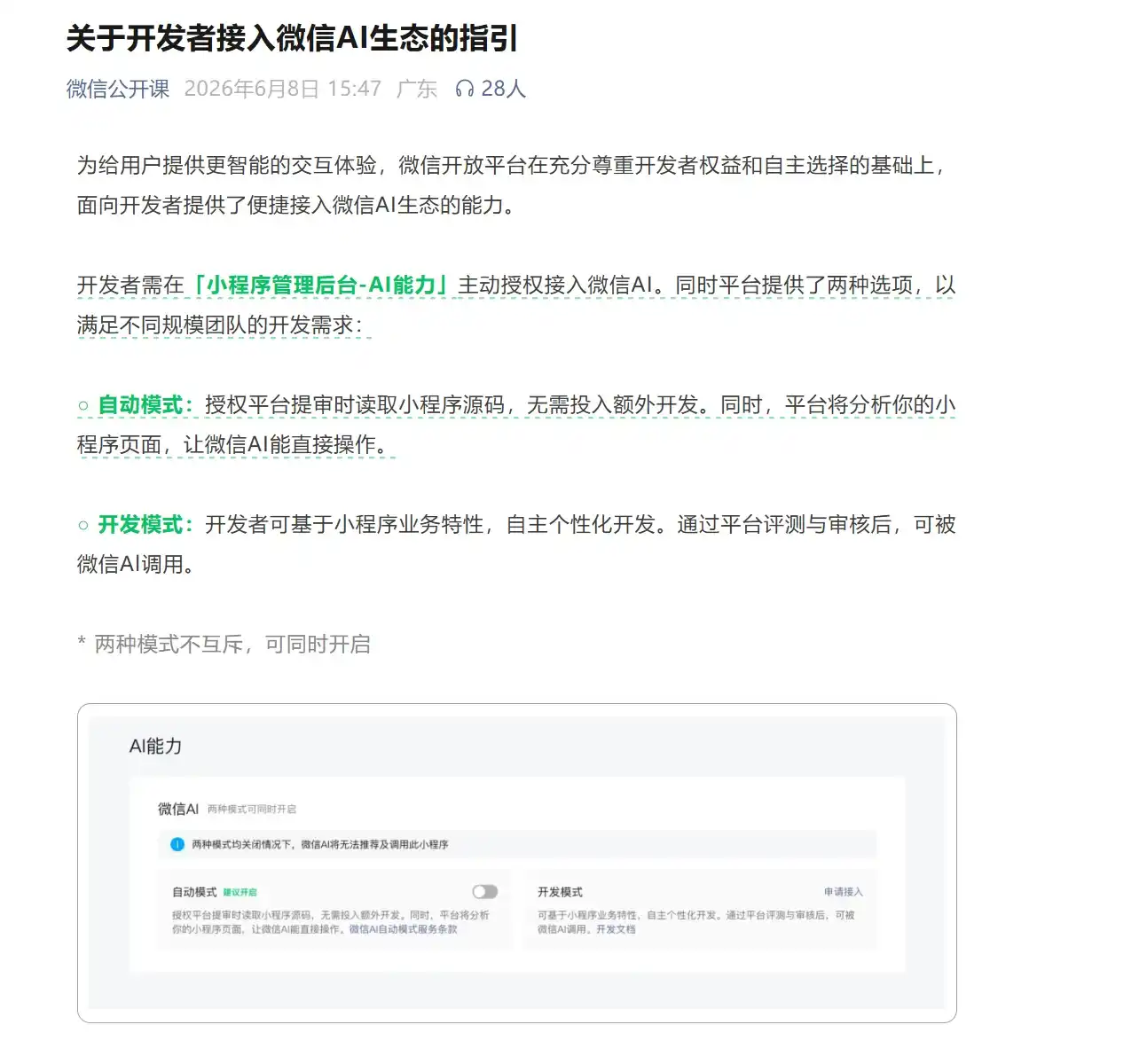
On June 8, 2026, the WeChat Developer Platform announced that WeChat AI entered its internal testing phase. This AI assistant, integrated within the WeChat ecosystem, supports users in directly invoking, accessing, and operating Mini Programs through natural language dialogues. The Open Platform offers two access modes: Automatic Mode, which allows authorized platform access to read Mini Program source code, enabling AI to directly operate pages without additional development; and Developer Mode, where developers independently build skills for AI invocation after platform review. The Terms of Service also note that 'WeChat AI' may be a temporary name, the final naming is yet to be determined, and access is optional, not affecting the normal operation of existing Mini Programs.
This marks the first time WeChat has opened its Mini Program ecosystem to AI at the conversational entry layer. The context at this time: Tencent's self-developed Hunyuan large model has joined the top tier in China in public benchmark tests; the Yuanbao App, following its explosive growth during the 2026 Spring Festival red envelope campaign, surpassed 100 million monthly active users (MAU). The WeChat AI internal test represents the latest step in Tencent's AI journey—from technology reserve and independent product validation towards delivery within a super app. The requirement for developers to hand over source code in Automatic Mode raises questions: how many developers will this low-threshold path attract, and what ecosystem interest conflicts will it encounter? These are questions to be answered during the internal testing phase.

An Opening at the Conversation Layer for the Mini Program Ecosystem

The two access modes for WeChat AI target entirely different developer groups.

The design logic of Automatic Mode is straightforward: authorize the platform to read the Mini Program source code during the review submission. The platform automatically analyzes the page structure, allowing AI to directly operate the pages without requiring additional development. A small game team with only two or three people, without needing an AI engineer or understanding Agent protocols, can simply check the authorization box. Their ordering Mini Program or tool application can then be invoked by WeChat AI.

According to data disclosed by WeChat Open Class in January 2026, the WeChat Mini Game ecosystem has gathered over 400,000 developers, 80% of whom are small teams of 30 people or fewer. The overall daily active users (DAU) exceeded 100 million in 2025, with MAU surpassing 500 million. This scale on the supply side is a unique moat for WeChat AI. ByteDance's Doubao or Alibaba's Tongyi Qianwen can create a standalone app or open APIs, but they lack a Mini Program ecosystem with over 100 million DAU to integrate directly. In essence, WeChat AI's Automatic Mode trades technical convenience for large-scale access, allowing the vast majority of the 400,000 developers to board this train at zero cost.

Developer Mode preserves customization space for service providers with complex business logic. Developers can autonomously build skills based on their business characteristics, which, after platform evaluation and review, become available for WeChat AI to call. The two modes can be enabled simultaneously and are not mutually exclusive.

The phrasing 'name undetermined' and 'optional behavior' indicates that the WeChat team still holds reservations regarding the product's positioning. The main tasks during the internal testing phase are to verify the technical pipeline and observe developer reactions. However, Automatic Mode has already touched upon a sensitive point: source code authorization. Some developers have expressed concerns in the WeChat Open Community, with core questions focusing on several aspects—how the platform guarantees code asset security after reading the source code; whether AI's direct page operation will invalidate existing tracking points and advertising display logic; and how responsibility is allocated if AI misoperations cause user losses. There are currently no public detailed rules explaining these issues.

After Achieving Second Place in Foundational Capabilities, Hunyuan Chooses to Go Deeper

What WeChat AI needs is not just a model that can chat; it needs an Agent foundation capable of understanding page structures and accurately executing operational instructions. This foundation is Tencent's Hunyuan large model.

In March 2025, the Chinese large model evaluation benchmark SuperCLUE released a report. Tencent's Hunyuan flagship version ranked second domestically in foundational model rankings, behind ByteDance's Doubao. However, it ranked first domestically in application capability dimensions, leading in sub-items such as text understanding & creation, instruction following, and Agent capability. Science Net, when summarizing the report, noted that Hunyuan performed better in the 'practical application' dimension than its foundational capability ranking suggested. Around the same time, Hunyuan Turbo S was included in the global Top 15 of the international evaluation Chatbot Arena for the first time.

Hunyuan's version iterations maintain a quarterly rhythm. An update to hunyuan-turbo was released in April 2025, followed by the flagship version TurboS in July, which enhanced reasoning capabilities. In April 2026, the Hy3 preview version was released, with official claims of a 40% improvement in inference efficiency. According to Tencent Cloud product documentation, older versions like HY 2.0 are scheduled to be discontinued starting June 26, 2026.

This pace is significantly slower than that of ByteDance and Alibaba. Over the past year, ByteDance's Doubao and Alibaba's Tongyi Qianwen have maintained a model release frequency approaching 'weekly updates,' while Hunyuan has remained stable with one major version update per quarter. Tencent management has previously made public statements about 'slow work yielding fine results.' The technical explanation is: the Agent era demands far higher stability and lower latency than the conversational era. Frequent switching of underlying models would prevent developers from engineering effective adaptations. The scenarios WeChat AI needs to invoke include placing orders, making payments, booking appointments—operations involving funds and sensitive information. Deterministic model output is much more critical than creativity.

Regarding resource investment, Tencent President Martin Lau disclosed during the 2025 annual report communication meeting that R&D investment for new AI products in 2025 was 18 billion RMB, and this investment would at least double in 2026. Content from the meeting, as relayed by The Paper, also showed that Lau stated the next core plan is to build dedicated AI agents within WeChat, integrating the full chain of Mini Programs, social features, and payments. The doubling of investment without accelerating the version release pace suggests funds are flowing more towards infrastructure reconstruction and data quality improvement, rather than competing for release windows.

Hunyuan's lead in application capabilities resonates with the scenario demands of WeChat AI. A model with a higher foundational ranking but weaker Agent capabilities might actually be less useful in WeChat AI's scenarios than Hunyuan. Tencent has chosen a path that does not chase parameter competition but focuses on practical application dimensions. This path is beginning to show its logical coherence with the launch of the WeChat AI internal test.

Daily Active Users Surpassed 50 Million During Spring Festival, Then What?

Prior to the WeChat AI internal test, the task of C-end validation for Tencent AI was undertaken by the Yuanbao App.

Yuanbao's growth curve exhibits a distinct pulse-like characteristic. According to QuestMobile monitoring data relayed by China National Radio, in January 2025, Yuanbao's MAU ranked 12th in the industry. By December 2025, it had climbed to 3rd place, behind only Doubao (MAU 226 million) and DeepSeek (MAU 135 million), with a full-year compound growth rate of 27.8%.

During the 2026 Spring Festival, Yuanbao experienced explosive growth. Data disclosed by Tencent officially shows Yuanbao's DAU peak exceeded 50 million, reaching 40.54 million on New Year's Eve, with MAU hitting 114 million. The Shanghai Securities News reported that this growth primarily came from social chain-driven user acquisition through red envelope activities.

However, post-Spring Festival, the data quickly declined. QuestMobile monitoring indicated that in April 2026, Yuanbao's normalized DAU was around 9 million. In the same period, Doubao's DAU was approximately 140 million, and Qianwen's was around 30 million. The peak-to-trough difference approached 5 times, highlighting the pulse-like growth characteristic. No public data is available for the DAU/MAU ratio, making it impossible to definitively judge user stickiness.

Yuanbao's role in Tencent's AI path is that of 'C-end validation for an independent product.' It has proven two things: First, Tencent has the ability to leverage WeChat's social chain to push an AI product in front of hundreds of millions of users. Second, users acquired via red envelopes are not retained. Martin Lau stated in the earnings call that Yuanbao's Spring Festival promotion effect exceeded expectations, and the next focus is optimizing core capabilities like voice dialogue. This statement itself indicates the team understands retention is the core proposition for the next stage.

The experience of Yuanbao's pulse growth, in turn, explains why WeChat AI chose to natively integrate directly within the super app rather than continue pushing a standalone app. A standalone app requires users to actively open it, relying on push notifications and activities for retention. Native integration relies on scenarios to bind users—when users need to order food, pay bills, or check courier status, WeChat AI is right there in the conversation flow. These are two completely different retention logics.

Every Mini Program Can Become 'Lobsterized,' But Service Providers Fear Being Bypassed

The product direction for WeChat AI was already clearly outlined in Pony Ma's public remarks in March 2026.

During the 2025 annual report communication meeting, Ma Huateng first discussed the concept of 'raising shrimp.' The 'lobster' type applications he referred to are AI Agents that possess a 'sense of a living person,' capable of autonomously executing tasks rather than merely answering questions. Ma stated that such applications provided inspiration for the WeChat AI under planning: in the future, every Mini Program could potentially undergo intelligent, 'lobsterized' transformation.

The core of this metaphor is pushing AI from a dialogue tool to a task executor. If WeChat AI were merely a chatbot, it wouldn't need to read source code or operate pages. The existence of Automatic Mode indicates its positioning is to complete cross-Mini Program tasks for users: ordering a cup of coffee, paying a utility bill, booking a hospital appointment, launching a mini-game. Users wouldn't need to know which Mini Program provides which service; they would just need to say one sentence to WeChat AI.

However, in the same meeting, Ma proactively addressed ecosystem interest conflicts. He pointed out that ecosystem service providers are concerned about being 'bypassed' or 'channelized' by AI agents. If a user says to WeChat AI, 'Help me order a latte,' and the AI directly invokes an atomic service from a coffee Mini Program to complete the transaction without the user ever entering the merchant's page, then the merchant's ad placements, brand exposure, and user retention efforts all go to zero. Service providers would not accept this outcome.

This is the core contradiction in WeChat AI's product design. The more efficient the centralized scheduling, the weaker the decentralized traffic sovereignty of merchants. The two access modes themselves do not solve this contradiction; they are merely an entry design. The real balancing mechanisms—such as traffic distribution rules, the relationship between atomic services and merchant pages, and data visibility in service provider backends—have not been publicly disclosed at all. Ma's exact words were that 'a balance must be struck between centralized scheduling and protection of decentralized traffic,' but specifically how this balance will be achieved has not been answered during the internal testing phase.

Three Lines Are in Position, But the Third Step Has Just Begun

With the parallel advancement of the three lines—Hunyuan, Yuanbao, and WeChat AI—Tencent's gradual AI path is logically coherent.

The bottom layer doesn't pursue the fastest model but builds the most stable Agent foundation. Hunyuan's domestic #1 ranking in SuperCLUE's application capability dimension supports WeChat AI's demand for precise operations. The middle layer uses a standalone app to validate social chain-driven user acquisition and basic user experience; Yuanbao's Spring Festival MAU surpassing 100 million verifies the leveraging effect of WeChat's traffic pool for AI products. The top layer pursues native integration within the super app, using scenarios to reduce retention pressure; the WeChat AI internal test directly faces 400,000 developers and a Mini Program ecosystem with over 100 million DAU.

However, whether C-end perception has been reversed can currently only be judged as 'partially complete.' Yuanbao's hundred-million-level MAU primarily came from the red envelope pulse; its normalized DAU of around 9 million remains a significant gap from Doubao's 140 million. WeChat AI has just entered internal testing; ordinary users cannot yet perceive it. There remains a noticeable gap between Tencent AI's share of public mindshare and its technical level.

Whether WeChat AI can bridge this gap depends on three variables. First, whether the source code trust issue in Automatic Mode can be resolved on the developer side, which determines the scale of access from the supply side. Second, whether the traffic distribution rules between centralization and decentralization can gain acceptance from service providers, which determines whether ecosystem interests can be balanced. Third, whether the accuracy of AI operations and the clarity of responsibility allocation can give users confidence to place orders, which determines the depth of C-end usage.

The positioning of the three lines is a prerequisite, but whether they can form a chain where 'Hunyuan ensures reliability, Yuanbao validates user habits, and WeChat AI delivers the final experience' requires at least two more quarters of public data to verify. Ma Huateng said in the earnings call that 'AI is a marathon, not a sprint.' The WeChat AI internal test is merely a marker point as this marathon reaches its mid-course; the finish line is still a long way off.


İlgili Sorular

QWhat are the two access modes provided by WeChat AI for developers to integrate their Mini Programs, and what are their key differences?

AWeChat AI offers two access modes: Automatic Mode and Development Mode. In Automatic Mode, developers authorize the platform to read their Mini Program's source code. The platform automatically analyzes the page structure, allowing the AI to operate pages without requiring additional development from the team. Development Mode allows developers to build custom skills based on their business logic, which are then reviewed and made available for the AI to call. The former is designed for low-effort, large-scale adoption, while the latter offers customization for complex services.

QAccording to the article, what are the three core variables that will determine whether WeChat AI can successfully bridge the gap between Tencent's AI technical capability and public perception?

AThe success of WeChat AI in bridging this gap depends on three core variables: 1) Whether the source code trust issue in Automatic Mode can be resolved with developers, determining the scale of supply-side adoption. 2) Whether the traffic distribution rules balancing centralization and decentralization can be accepted by service providers, determining if ecosystem interests can be balanced. 3) Whether the accuracy of AI operations and clarity of liability can make users confident enough to place orders, determining the depth of consumer usage.

QHow did the performance of Tencent's Hunyuan large model differ in the SuperCLUE benchmark rankings, and why is this relevant for WeChat AI?

AIn the SuperCLUE benchmark report, Tencent's Hunyuan flagship model ranked second domestically in basic model capability but first domestically in application ability. It led in sub-dimensions like text understanding/creation, instruction following, and Agent capability. This is highly relevant for WeChat AI because it requires a stable Agent base capable of understanding page structures and executing operational commands precisely, rather than just conversational prowess. Hunyuan's strength in practical application directly supports WeChat AI's scenario needs.

QWhat role did the Yuanbao App play in Tencent's AI strategy, and what key lessons did its growth trajectory demonstrate?

AThe Yuanbao App served the role of 'C-end validation for an independent AI product' within Tencent's strategy. Its growth, particularly a surge to over 50 million DAU during the 2026 Spring Festival红包 campaign, demonstrated Tencent's ability to leverage WeChat's social chain to push an AI product to a massive user base (reaching 114 million MAU). However, the post-festival rapid decline to a常态 DAU of around 9 million revealed the 'pulse growth' characteristic and poor user retention from promotional拉新. This experience highlighted the challenge of sustaining an independent app and informed the strategic shift towards natively integrating AI within the super-app WeChat for better user retention through场景 binding.

QWhat is the core ecosystem contradiction identified by Ma Huateng regarding the 'lobsterization' (intelligent Agent transformation) of Mini Programs via WeChat AI?

AThe core ecosystem contradiction is the tension between centralization and decentralization. Ma Huateng noted that service providers fear being 'short-circuited' or 'channelized' by the AI Agent. If WeChat AI directly completes a transaction (e.g., ordering coffee) by调用 an atomic service from a Mini Program without the user ever entering the merchant's page, the merchant loses all benefits of广告位 exposure, brand building, and user沉淀. Efficient centralized scheduling by the AI potentially weakens the流量 sovereignty of decentralized merchants. The challenge is designing mechanisms to balance this centralization with protection for decentralized traffic.

İlgili Okumalar

Founder of Baixing.com: My Fourteen Claude Code Usage Experiences

Founder of Baixing.com Shares 14 Personal Tips for Using Claude Code The author outlines his personal, non-universal strategies for maximizing Claude Code. Key points include: focusing deeply on one primary tool (Claude Code) rather than constant comparison; mastering essential shortcuts for the editor and command line; utilizing voice input like HoldSpeak; starting projects with a structured PROJECT.md file; defaulting to Claude agents for most tasks; and leveraging integrations with GitHub and Cloudflare for build, deployment, and infrastructure. He emphasizes a clear separation between human and machine work: manually maintain a core CLAUDE.md file, and understand AI-generated content by asking the AI, not reading its raw code. Efficient communication involves dragging files (screenshots, audio, documents) directly into the interface. For knowledge management, he recommends a centralized, Git-synced memory system based on ~/.claude/CLAUDE.md to ensure permanence and avoid scattered project memories. Other practices include writing and continuously refining "Skills," using the expensive but reliable ultracode for complex dynamic workflows, and employing Git documentation as handoff points between agents. The overarching philosophy is to treat Claude Code like a horse (or a person) with its own pathfinding abilities—setting goals and boundaries rather than micromanaging every turn.

链捕手2 dk önce

Founder of Baixing.com: My Fourteen Claude Code Usage Experiences

链捕手2 dk önce

Gary Yang: Agent Economy and AI Submicroeconomics

**Title:** Agent Economy and AI Sub-Microeconomics - Gary Yang **Summary:** Following the AI singularity, the pace of evolution has accelerated rapidly, creating new generational disparities in technological advancement globally. While many regions are still grappling with single-agent bottlenecks, Silicon Valley has moved ahead into the next dimension: the Agent Economy and A2A ecosystems. The article outlines six key areas of this emerging paradigm: 1. **AI Payment Competition & H2A Bottlenecks:** A fierce battle for AI Agent payment protocol standards is underway (e.g., MPP, x402). However, most current efforts remain Human-to-Agent (H2A), essentially grafting AI onto traditional human-centric commerce, which creates a non-AI-native bottleneck. The true potential lies in Agent-to-Agent (A2A) autonomous economies. 2. **Agent Economy & the Inevitable A2A Trend:** The Agent Economy is defined by autonomous AI Agents creating, exchanging, and capitalizing value as independent economic actors. The A2A ecosystem describes their interactions. This represents the next major investment frontier, akin to the early days of e-commerce or DeFi, but with faster iteration and an AI-native, efficiency-first perspective that often diverges from human needs. 3. **AI Protocol vs. Crypto Protocol:** AI Protocols are the foundational rules for Agent interaction in an open network (communication, discovery, collaboration), akin to the governance and economic laws of the AI world. Currently, they focus on communication and weak boundaries, unlike Crypto Protocols which emphasize asset rights and clear ownership. While they appear different due to political-economic factors and legacy system constraints, their eventual convergence into a unified Digital Protocol system is seen as inevitable, driven by first principles. 4. **AI Agent Sub-Microeconomics & Biological Analogy:** AI Agent economics differ fundamentally from human economics: higher frequency/lower value transactions, energy/value direct correlation, efficiency-driven (not emotional) decisions, task-oriented (not consumption-oriented) behavior, and near-zero organizational/communication costs. A powerful analogy frames the Agent economy as a biological system: the LLM is the nucleus, the Agent harness is the cytoplasm, the Agent itself is a cell, its communication protocol is the cell membrane, and external tools (Skills, Prompts) are the extracellular environment. 5. **The Inevitability of AIFi & FinChip:** AIFi (AI Finance) represents the financial system where AI-native value within the Agent economy is tokenized and exchanged. Unlike TradFi/DeFi where value resides *in* finance, in AIFi, value originates *in* AI, and finance becomes its form. This shift is enabled by Agents taking over value discovery. FinChip (Financial Chip) is introduced as a key infrastructure—a fusion of AI autonomy and crypto smart contracts—forming intelligent financial assets to power the future A2A economy. 6. **AI-Native as a Paradigm Shift:** Adopting AI is not akin to "Internet+". It requires AI-Native thinking—designing systems based on first principles, the shortest energy-value path, and maximum efficiency. This abstract, counter-intuitive logic poses a significant, ongoing challenge for all practitioners, as effective, generalized upgrade methodologies will be slow to emerge in this rapidly evolving landscape.

链捕手43 dk önce

Gary Yang: Agent Economy and AI Submicroeconomics

链捕手43 dk önce

From 'The Big Short' to San Francisco: The Revelry and Dizziness Within the AI Bubble

From "The Big Short" to San Francisco: The Frenzy and Dizziness in the AI Bubble The article captures the intense, frenetic atmosphere in San Francisco, the epicenter of the current AI boom. Drawing a parallel to the "smell of money" from *The Big Short*, the author observes a city gripped by a singular status game centered entirely on AI and technology. This manifests in a palpable, caffeine-fueled anxiety ("people are shaking"), rampant comparison using vanity metrics like funding rounds, and pervasive "Big Bubble Behavior." The piece explores the city's stark contrasts: its dystopian streets versus beautiful vistas, and the disconnect between the doomsday concerns of some AI researchers and the optimistic, growth-focused "GTM" teams. It critiques the obsession with "math genius" founders as the new ticket to outsized returns, akin to scouting sports prodigies. Referencing economic historian Carlota Perez's "frenzy phase" and Karl Polanyi's "double movement," the author frames the boom as a period where financial speculation detaches from fundamentals, with society potentially becoming subordinate to a new economic force driven by "geniuses in data centers." Ultimately, while acknowledging the unprecedented wealth creation and party-like energy, the article concludes with cautionary advice: when the music is playing, you should dance, but don't get drunk. The core reminder is to stay grounded, avoid distorted judgment, and maintain perspective amidst the euphoria.

marsbit45 dk önce

From 'The Big Short' to San Francisco: The Revelry and Dizziness Within the AI Bubble

marsbit45 dk önce

Is AI Creating a New Class of 'Information Poor'?

AI is generating a new kind of "information poverty." The core issue isn't that AI denies answers to the poor; it's that it provides abundant, cheap, and plausible-sounding answers to everyone. This availability shifts the true scarcity from obtaining answers to possessing the **judgment to evaluate them** and the access to turn them into real-world opportunities. New information poverty thus describes those who have AI tools and outputs, but lack the complementary skills, authorization, and contextual experience to critically assess and act on them. Research reveals a multi-layered divide: access to AI is stratified by income and platform design (e.g., premium vs. free, embedded tools). In workplaces, usage heavily favors higher-paid, more experienced, or formally trained employees, with AI often automating entry-level tasks that were traditional stepping stones. Crucially, the heaviest users are often mid-career professionals whose existing expertise allows them to effectively judge and leverage AI outputs, while novices risk over-relying on them without building judgment. While controlled experiments show AI can significantly boost low-skilled workers' performance, real-world adoption and benefit are constrained by unequal social and organizational structures. Historically, general-purpose technologies first reward those with existing complementary capital. AI, by affecting judgment-based work, may accelerate and deepen this initial inequality gap, even if it narrows over decades. The danger lies in the illusion of competence it creates, potentially stunting the very critical thinking needed in an era where judgment is paramount.

marsbit1 saat önce

Is AI Creating a New Class of 'Information Poor'?

marsbit1 saat önce

Jensen Huang 'Saves' South Korean Stock Market: Locks In SK Hynix Memory, Chip Shortage to Continue

On June 5th, South Korea's stock market experienced a sharp decline, with major chipmakers like Samsung and SK Hynix dropping nearly 10%. Amidst the turmoil, NVIDIA CEO Jensen Huang's visit to Seoul played a dramatic role in boosting market sentiment. Following a dinner meeting with SK Group Chairman Chey Tae-won and SK Hynix CEO Kwak Noh-Jung, Huang confirmed that NVIDIA's new Vera CPU will utilize SK Hynix DRAM. The companies announced a multi-year technical partnership to co-develop next-generation memory for NVIDIA's AI infrastructure, covering products from data centers to personal AI and robotics. This collaboration extends beyond memory supply. SK Hynix is integrating NVIDIA's AI and Omniverse platform into its own semiconductor design and manufacturing processes, including computational lithography and creating digital twins of its fabrication plants for autonomous operation. While strengthening ties with SK Hynix, NVIDIA is diversifying its supply chain for the upcoming HBM4 memory, with Samsung, SK Hynix, and Micron all certified as suppliers for its Vera Rubin platform. Despite this, Huang warned that the global chip shortage, driven by relentless demand from AI factory construction, is expected to persist for several years across the entire supply chain. His visit underscores NVIDIA's systematic effort to deepen integration with South Korea's broader tech industry.

marsbit2 saat önce

Jensen Huang 'Saves' South Korean Stock Market: Locks In SK Hynix Memory, Chip Shortage to Continue

marsbit2 saat önce

İşlemler

Spot
Futures

Popüler Makaleler

$S$ Nedir

SPERO'yu Anlamak: Kapsamlı Bir Genel Bakış SPERO'ya Giriş İnovasyonun manzarası gelişmeye devam ederken, web3 teknolojilerinin ve kripto para projelerinin ortaya çıkışı dijital geleceği şekillendirmede önemli bir rol oynamaktadır. Bu dinamik alanda dikkat çeken projelerden biri SPERO, $$s$$ olarak adlandırılmaktadır. Bu makale, SPERO hakkında ayrıntılı bilgi toplamak ve sunmak amacıyla, meraklılar ve yatırımcıların web3 ve kripto alanlarındaki temellerini, hedeflerini ve yeniliklerini anlamalarına yardımcı olmayı amaçlamaktadır. SPERO,$$s$$ Nedir? SPERO,$$s$$, kripto alanında merkeziyetsizlik ve blok zinciri teknolojisi ilkelerini kullanarak etkileşimi, faydayı ve finansal kapsayıcılığı teşvik eden bir ekosistem yaratmayı amaçlayan benzersiz bir projedir. Proje, kullanıcıların yenilikçi finansal çözümler ve hizmetler sunarak eşler arası etkileşimleri yeni yollarla kolaylaştırmayı hedeflemektedir. SPERO,$$s$$'nin temel amacı, bireyleri güçlendirmek ve kripto para alanındaki kullanıcı deneyimini artıran araçlar ve platformlar sağlamaktır. Bu, daha esnek işlem yöntemlerini mümkün kılmayı, topluluk odaklı girişimleri teşvik etmeyi ve merkeziyetsiz uygulamalar (dApp'ler) aracılığıyla finansal fırsatlar yaratmayı içermektedir. SPERO,$$s$$'nin temel vizyonu kapsayıcılık etrafında dönmekte olup, geleneksel finansal sistemlerdeki boşlukları kapatmayı ve blok zinciri teknolojisinin faydalarından yararlanmayı hedeflemektedir. SPERO,$$s$$'nin Yaratıcısı Kimdir? SPERO,$$s$$'nin yaratıcısının kimliği bir miktar belirsizdir, çünkü kurucusu(ları) hakkında ayrıntılı arka plan bilgisi sağlayan sınırlı kamuya açık kaynaklar bulunmaktadır. Bu şeffaflık eksikliği, projenin merkeziyetsizlik taahhüdünden kaynaklanabilir—birçok web3 projesinin paylaştığı bir etik anlayışı, bireysel tanınmanın yerine kolektif katkıları önceliklendirmektedir. Topluluk ve onun kolektif hedefleri etrafında tartışmaları merkezileştirerek, SPERO,$$s$$, belirli bireyleri öne çıkarmadan güçlendirme özünü taşımaktadır. Bu nedenle, SPERO'nun etik anlayışını ve misyonunu anlamak, tek bir yaratıcının kimliğini belirlemekten daha önemlidir. SPERO,$$s$$'nin Yatırımcıları Kimlerdir? SPERO,$$s$$, kripto sektöründe yeniliği teşvik etmeye adanmış girişim sermayedarlarından melek yatırımcılara kadar çeşitli yatırımcılar tarafından desteklenmektedir. Bu yatırımcıların odak noktası genellikle SPERO'nun misyonuyla uyumlu olup, toplumsal teknolojik ilerlemeyi, finansal kapsayıcılığı ve merkeziyetsiz yönetimi vaat eden projeleri önceliklendirmektedir. Bu yatırımcı temelleri, yalnızca yenilikçi ürünler sunan projelere değil, aynı zamanda blok zinciri topluluğuna ve ekosistemlerine olumlu katkılarda bulunan projelere de ilgi duymaktadır. Bu yatırımcıların desteği, SPERO,$$s$$'yi hızla gelişen kripto projeleri alanında dikkate değer bir rakip haline getirmektedir. SPERO,$$s$$ Nasıl Çalışır? SPERO,$$s$$, onu geleneksel kripto para projelerinden ayıran çok yönlü bir çerçeve kullanmaktadır. İşte benzersizliğini ve yeniliğini vurgulayan bazı temel özellikler: Merkeziyetsiz Yönetim: SPERO,$$s$$, kullanıcıların projenin geleceğiyle ilgili karar alma süreçlerine aktif olarak katılmalarını sağlayan merkeziyetsiz yönetim modellerini entegre etmektedir. Bu yaklaşım, topluluk üyeleri arasında sahiplik ve hesap verebilirlik duygusunu teşvik etmektedir. Token Kullanımı: SPERO,$$s$$, ekosistem içinde çeşitli işlevler sunmak üzere tasarlanmış kendi kripto para token'ını kullanmaktadır. Bu token'lar, işlemleri, ödülleri ve platformda sunulan hizmetlerin kolaylaştırılmasını sağlayarak genel etkileşimi ve faydayı artırmaktadır. Katmanlı Mimari: SPERO,$$s$$'nin teknik mimarisi, modülerlik ve ölçeklenebilirliği destekleyerek projenin evrimi sırasında ek özelliklerin ve uygulamaların sorunsuz bir şekilde entegrasyonuna olanak tanımaktadır. Bu uyum sağlama yeteneği, sürekli değişen kripto manzarasında geçerliliği sürdürmek için hayati öneme sahiptir. Topluluk Katılımı: Proje, işbirliği ve geri bildirim teşvik eden mekanizmalar kullanarak topluluk odaklı girişimlere vurgu yapmaktadır. Güçlü bir topluluk oluşturarak, SPERO,$$s$$, kullanıcı ihtiyaçlarını daha iyi karşılayabilir ve piyasa trendlerine uyum sağlayabilir. Kapsayıcılığa Odaklanma: Düşük işlem ücretleri ve kullanıcı dostu arayüzler sunarak, SPERO,$$s$$, daha önce kripto alanında yer almamış bireyler de dahil olmak üzere çeşitli bir kullanıcı tabanını çekmeyi hedeflemektedir. Bu kapsayıcılık taahhüdü, erişilebilirlik yoluyla güçlendirme misyonuyla uyumludur. SPERO,$$s$$ Zaman Çizelgesi Bir projenin tarihini anlamak, gelişim yolculuğu ve kilometre taşları hakkında kritik bilgiler sağlar. Aşağıda, SPERO,$$s$$'nin evriminde önemli olayları haritalayan önerilen bir zaman çizelgesi bulunmaktadır: Kavram Geliştirme ve Fikir Aşaması: SPERO,$$s$$'nin temelini oluşturan ilk fikirler, blok zinciri endüstrisindeki merkeziyetsizlik ve topluluk odaklılık ilkeleriyle yakından uyumlu olarak geliştirildi. Proje Beyaz Kağıdının Yayınlanması: Kavramsal aşamayı takiben, SPERO,$$s$$'nin vizyonunu, hedeflerini ve teknolojik altyapısını ayrıntılı bir şekilde açıklayan kapsamlı bir beyaz kağıt yayımlandı ve topluluk ilgisini ve geri bildirimini toplamak amacıyla sunuldu. Topluluk Oluşturma ve Erken Katılımlar: Projenin hedefleri etrafında tartışmalar yürüterek destek toplamak ve erken benimseyenler ile potansiyel yatırımcılar için bir topluluk oluşturmak amacıyla aktif iletişim çabaları gerçekleştirildi. Token Üretim Etkinliği: SPERO,$$s$$, yerel token'larını erken destekçilere dağıtmak ve ekosistem içinde başlangıç likiditesini sağlamak amacıyla bir token üretim etkinliği (TGE) gerçekleştirdi. İlk dApp'in Yayınlanması: SPERO,$$s$$ ile ilişkili ilk merkeziyetsiz uygulama (dApp) faaliyete geçti ve kullanıcıların platformun temel işlevleriyle etkileşimde bulunmalarını sağladı. Sürekli Gelişim ve Ortaklıklar: Projenin tekliflerine sürekli güncellemeler ve iyileştirmeler yapılmakta olup, blok zinciri alanındaki diğer oyuncularla stratejik ortaklıklar, SPERO,$$s$$'yi rekabetçi ve gelişen bir oyuncu haline getirmiştir. Sonuç SPERO,$$s$$, web3 ve kripto paranın finansal sistemleri devrim niteliğinde dönüştürme ve bireyleri güçlendirme potansiyelinin bir kanıtıdır. Merkeziyetsiz yönetime, topluluk katılımına ve yenilikçi tasarlanmış işlevselliğe olan bağlılığıyla, daha kapsayıcı bir finansal manzaraya doğru bir yol açmaktadır. Hızla gelişen kripto alanındaki herhangi bir yatırımda olduğu gibi, potansiyel yatırımcılar ve kullanıcılar, SPERO,$$s$$ içindeki devam eden gelişmelerle ilgili olarak kapsamlı bir araştırma yapmaları ve düşünceli bir şekilde katılmaları teşvik edilmektedir. Proje, kripto endüstrisinin yenilikçi ruhunu sergileyerek, sayısız olasılığını keşfetmeye davet etmektedir. SPERO,$$s$$'nin yolculuğu hala devam ederken, temel ilkeleri, teknoloji, finans ve birbirimizle etkileşim biçimimizi etkileyebilir.

89 Toplam GörüntülenmeYayınlanma 2024.12.17Güncellenme 2024.12.17

$S$ Nedir

AGENT S Nedir

Agent S: Web3'te Otonom Etkileşimin Geleceği Giriş Web3 ve kripto para dünyasında sürekli gelişen manzarada, yenilikler bireylerin dijital platformlarla etkileşim biçimlerini sürekli olarak yeniden tanımlıyor. Bu tür öncü projelerden biri olan Agent S, açık ajans çerçevesi aracılığıyla insan-bilgisayar etkileşimini devrim niteliğinde değiştirmeyi vaat ediyor. Otonom etkileşimlerin yolunu açarak, Agent S karmaşık görevleri basitleştirmeyi ve yapay zeka (AI) alanında dönüştürücü uygulamalar sunmayı hedefliyor. Bu detaylı inceleme, projenin karmaşıklıklarına, benzersiz özelliklerine ve kripto para alanındaki etkilerine dalacaktır. Agent S Nedir? Agent S, bilgisayar görevlerinin otomasyonunda üç temel zorluğu ele almak üzere özel olarak tasarlanmış çığır açıcı bir açık ajans çerçevesidir: Alan Spesifik Bilgi Edinimi: Çerçeve, çeşitli dış bilgi kaynaklarından ve iç deneyimlerden akıllıca öğrenir. Bu çift yönlü yaklaşım, alan spesifik bilgi açısından zengin bir veri havuzu oluşturmasını sağlar ve görev yürütmedeki performansını artırır. Uzun Görev Ufukları Üzerinde Planlama: Agent S, karmaşık görevlerin verimli bir şekilde parçalanmasını ve yürütülmesini kolaylaştıran deneyim artırımlı hiyerarşik planlama kullanır. Bu özellik, çoklu alt görevleri etkili ve verimli bir şekilde yönetme yeteneğini önemli ölçüde artırır. Dinamik, Homojen Olmayan Arayüzlerle Başlama: Proje, ajanlar ve kullanıcılar arasındaki etkileşimi geliştiren yenilikçi bir çözüm olan Ajan-Bilgisayar Arayüzü'ni (ACI) tanıtmaktadır. Çok Modlu Büyük Dil Modellerini (MLLM'ler) kullanarak, Agent S çeşitli grafik kullanıcı arayüzlerini sorunsuz bir şekilde gezinebilir ve manipüle edebilir. Bu öncü özellikler aracılığıyla, Agent S, makinelerle insan etkileşimini otomatikleştirmede karşılaşılan karmaşıklıkları ele alan sağlam bir çerçeve sunarak, AI ve ötesinde birçok uygulama için zemin hazırlıyor. Agent S'nin Yaratıcısı Kimdir? Agent S'nin kavramı temelde yenilikçi olsa da, yaratıcısı hakkında spesifik bilgiler belirsizliğini koruyor. Yaratıcı şu anda bilinmiyor, bu da projenin yeni aşamasını veya kurucu üyeleri gizli tutma stratejik tercihini vurguluyor. Anonimlikten bağımsız olarak, odak çerçevenin yetenekleri ve potansiyeli üzerinde kalıyor. Agent S'nin Yatırımcıları Kimlerdir? Agent S, kriptografik ekosistemde oldukça yeni olduğundan, yatırımcıları ve finansal destekçileri hakkında ayrıntılı bilgiler açıkça belgelenmemiştir. Projeyi destekleyen yatırım temelleri veya organizasyonları hakkında kamuya açık bilgilerdeki eksiklik, finansman yapısı ve gelişim yol haritası hakkında sorular doğuruyor. Destekleyicilerin anlaşılması, projenin sürdürülebilirliğini ve potansiyel pazar etkisini değerlendirmek için kritik öneme sahiptir. Agent S Nasıl Çalışır? Agent S'nin temelinde, çeşitli ortamlarda etkili bir şekilde çalışmasını sağlayan son teknoloji bir sistem yatmaktadır. İşleyiş modeli birkaç ana özellik etrafında inşa edilmiştir: İnsan Benzeri Bilgisayar Etkileşimi: Çerçeve, bilgisayarlarla etkileşimleri daha sezgisel hale getirmeyi amaçlayan gelişmiş AI planlaması sunar. Görev yürütmedeki insan davranışını taklit ederek, kullanıcı deneyimlerini yükseltmeyi vaat eder. Anlatı Belleği: Yüksek düzeyde deneyimlerden yararlanmak için kullanılan Agent S, görev geçmişlerini takip etmek amacıyla anlatı belleğini kullanarak karar verme süreçlerini geliştirir. Episodik Bellek: Bu özellik, kullanıcılara adım adım rehberlik sağlayarak, çerçevenin görevler gelişirken bağlamsal destek sunmasına olanak tanır. OpenACI Desteği: Yerel olarak çalışabilme yeteneği ile Agent S, kullanıcıların etkileşimleri ve iş akışları üzerinde kontrol sağlamasına olanak tanır ve Web3'ün merkeziyetsiz felsefesiyle uyumlu hale gelir. Dış API'lerle Kolay Entegrasyon: Çeşitli AI platformlarıyla uyumluluğu ve çok yönlülüğü, Agent S'nin mevcut teknolojik ekosistemlere sorunsuz bir şekilde entegre olmasını sağlar ve geliştiriciler ile organizasyonlar için cazip bir seçenek haline getirir. Bu işlevsellikler, Agent S'nin kripto alanındaki benzersiz konumuna katkıda bulunarak, karmaşık, çok aşamalı görevleri minimum insan müdahalesi ile otomatikleştirir. Proje geliştikçe, Web3'teki potansiyel uygulamaları dijital etkileşimlerin nasıl gelişeceğini yeniden tanımlayabilir. Agent S'nin Zaman Çizelgesi Agent S'nin gelişimi ve kilometre taşları, önemli olaylarını vurgulayan bir zaman çizelgesinde özetlenebilir: 27 Eylül 2024: Agent S'nin kavramı, “Bilgisayarları İnsan Gibi Kullanan Açık Bir Ajans Çerçevesi” başlıklı kapsamlı bir araştırma makalesi ile tanıtıldı ve projenin temelini sergiledi. 10 Ekim 2024: Araştırma makalesi arXiv'de kamuya açık olarak yayınlandı ve çerçevenin derinlemesine bir incelemesini ve OSWorld benchmark'ına dayalı performans değerlendirmesini sundu. 12 Ekim 2024: Agent S'nin yetenekleri ve özellikleri hakkında görsel bir içgörü sağlayan bir video sunumu yayımlandı ve potansiyel kullanıcılar ve yatırımcılarla daha fazla etkileşim sağlandı. Bu zaman çizelgesindeki işaretler, sadece Agent S'nin ilerlemesini değil, aynı zamanda şeffaflık ve topluluk katılımına olan bağlılığını da göstermektedir. Agent S Hakkında Ana Noktalar Agent S çerçevesi gelişmeye devam ederken, birkaç ana özellik öne çıkmakta ve yenilikçi doğasını ve potansiyelini vurgulamaktadır: Yenilikçi Çerçeve: İnsan etkileşimine benzer bir bilgisayar kullanımı sağlamak üzere tasarlanan Agent S, görev otomasyonuna yeni bir yaklaşım getiriyor. Otonom Etkileşim: GUI aracılığıyla bilgisayarlarla otonom olarak etkileşim kurabilme yeteneği, daha akıllı ve verimli hesaplama çözümlerine doğru bir sıçrama anlamına geliyor. Karmaşık Görev Otomasyonu: Sağlam metodolojisi ile karmaşık, çok aşamalı görevleri otomatikleştirerek süreçleri daha hızlı ve daha az hata payı ile gerçekleştirebilir. Sürekli İyileştirme: Öğrenme mekanizmaları, Agent S'nin geçmiş deneyimlerden öğrenmesini sağlar ve sürekli olarak performansını ve etkinliğini artırır. Çok Yönlülük: OSWorld ve WindowsAgentArena gibi farklı işletim ortamlarında uyumlu olması, geniş bir uygulama yelpazesine hizmet edebilmesini sağlar. Agent S, Web3 ve kripto alanında kendini konumlandırırken, etkileşim yeteneklerini artırma ve süreçleri otomatikleştirme potansiyeli, AI teknolojilerinde önemli bir ilerlemeyi temsil etmektedir. Yenilikçi çerçevesi aracılığıyla, Agent S dijital etkileşimlerin geleceğini örneklemekte ve çeşitli sektörlerde kullanıcılar için daha sorunsuz ve verimli bir deneyim vaat etmektedir. Sonuç Agent S, AI ve Web3'ün birleşiminde cesur bir sıçramayı temsil ediyor ve teknoloji ile etkileşim biçimimizi yeniden tanımlama kapasitesine sahip. Henüz erken aşamalarında olmasına rağmen, uygulama olanakları geniş ve çekici. Kritik zorlukları ele alan kapsamlı çerçevesi ile Agent S, otonom etkileşimleri dijital deneyimin ön plana çıkmasına taşımayı hedefliyor. Kripto para ve merkeziyetsizlik alanlarına daha derinlemesine girdikçe, Agent S gibi projelerin teknoloji ve insan-bilgisayar işbirliğinin geleceğini şekillendirmede önemli bir rol oynayacağı kesin.

574 Toplam GörüntülenmeYayınlanma 2025.01.14Güncellenme 2025.01.14

AGENT S Nedir

S Nasıl Satın Alınır

HTX.com’a hoş geldiniz! Sonic (S) satın alma işlemlerini basit ve kullanışlı bir hâle getirdik. Adım adım açıkladığımız rehberimizi takip ederek kripto yolculuğunuza başlayın. 1. Adım: HTX Hesabınızı OluşturunHTX'te ücretsiz bir hesap açmak için e-posta adresinizi veya telefon numaranızı kullanın. Sorunsuzca kaydolun ve tüm özelliklerin kilidini açın. Hesabımı Aç2. Adım: Kripto Satın Al Bölümüne Gidin ve Ödeme Yönteminizi SeçinKredi/Banka Kartı: Visa veya Mastercard'ınızı kullanarak anında Sonic (S) satın alın.Bakiye: Sorunsuz bir şekilde işlem yapmak için HTX hesap bakiyenizdeki fonları kullanın.Üçüncü Taraflar: Kullanımı kolaylaştırmak için Google Pay ve Apple Pay gibi popüler ödeme yöntemlerini ekledik.P2P: HTX'teki diğer kullanıcılarla doğrudan işlem yapın.Borsa Dışı (OTC): Yatırımcılar için kişiye özel hizmetler ve rekabetçi döviz kurları sunuyoruz.3. Adım: Sonic (S) Varlıklarınızı SaklayınSonic (S) satın aldıktan sonra HTX hesabınızda saklayın. Alternatif olarak, blok zinciri transferi yoluyla başka bir yere gönderebilir veya diğer kripto para birimlerini takas etmek için kullanabilirsiniz.4. Adım: Sonic (S) Varlıklarınızla İşlem YapınHTX'in spot piyasasında Sonic (S) ile kolayca işlemler yapın.Hesabınıza erişin, işlem çiftinizi seçin, işlemlerinizi gerçekleştirin ve gerçek zamanlı olarak izleyin. Hem yeni başlayanlar hem de deneyimli yatırımcılar için kullanıcı dostu bir deneyim sunuyoruz.

1.6k Toplam GörüntülenmeYayınlanma 2025.01.15Güncellenme 2026.06.02

S Nasıl Satın Alınır

Tartışmalar

HTX Topluluğuna hoş geldiniz. Burada, en son platform gelişmeleri hakkında bilgi sahibi olabilir ve profesyonel piyasa görüşlerine erişebilirsiniz. Kullanıcıların S (S) fiyatı hakkındaki görüşleri aşağıda sunulmaktadır.

活动图片