Black Whale Emerges, DeepSeek's Second Half Begins

marsbit2026-08-13 tarihinde yayınlandı2026-08-13 tarihinde güncellendi

Özet

DeepSeek has unveiled its V4 Pro model and officially launched DeepSeek Harness, a developer-preview agent framework released as open-source under the MIT license. The article highlights that while model capabilities set the upper limit, the execution system (or "Harness") significantly determines real-world task success rates and cost efficiency, as demonstrated by tests where the same DeepSeek V4-Flash model performed differently across various harnesses. DeepSeek Harness is built on a "Everything is a plugin" philosophy using the Cordis system, allowing developers to modularly replace or extend core components like the model, tools, and UI without modifying the core code. It emphasizes full traceability with an append-only session log and is designed for stable, long-running tasks. Notably, it supports integration with nearly 40 external LLMs, including Kimi, OpenAI, and Anthropic, positioning itself not as a fixed agent but as a customizable platform. The release signals a strategic shift for DeepSeek from merely selling computational tokens (inference) to delivering actionable results (task completion). However, the v0.1 Harness faces challenges, including competing with established players like Claude Code, building a robust plugin ecosystem, and adapting to a potential "pay-for-result" business model. The article concludes that while both V4 Pro and Harness are early-stage with gaps to top models, DeepSeek's consistent direction is to make advanced AI capabilities af...

DeepSeek's Most Promising Project Takes the Stage, Everything is a Plugin. Harness isn't trying to imitate anyone, but to give the power of definition to the open-source community.

On the evening of August 13th, DeepSeek finally broke its silence, releasing two important pieces of information. First, the official version of DeepSeek V4 Pro was released, and simultaneously updated on the APP, web version, and API. Users can use the brand new V4 Pro official model by selecting "Expert Mode" via the APP or web interface; the API model name remains unchanged.

Second, the " DeepSeek Harness Team," with its black whale avatar, made its first post, announcing the official launch of the Harness Developer Preview version, open-sourced under the MIT license.

As previously teased, the V4 Pro official version and the self-developed Harness made a simultaneous debut. Since we have already focused on introducing V4 Pro before, this article will focus on analyzing why DeepSeek Harness is noteworthy.

And after today, whether DeepSeek will transform from a model company into a harder-to-define company.

01

The Same Model, A Different Shell Makes It Seem Like a Different Person

To understand why Harness is important, one must first grasp a counterintuitive fact: in the Agent era, what determines whether an AI can get work done is not just the model.

On August 6th and 11th, the agent tool company Composio conducted two experimental tests attempting to prove the value of Harness. Researchers connected the same DeepSeek V4-Flash model to eight different Harnesses—the execution systems wrapped around the model—and had them complete thirty multi-step tasks respectively. These tasks weren't simple Q&A; they required the Agent to access real applications like Gmail, Google Calendar, GitHub, Slack, call tools, and change application states. Each task was allowed to run for up to fifteen minutes, and success required passing all checks.
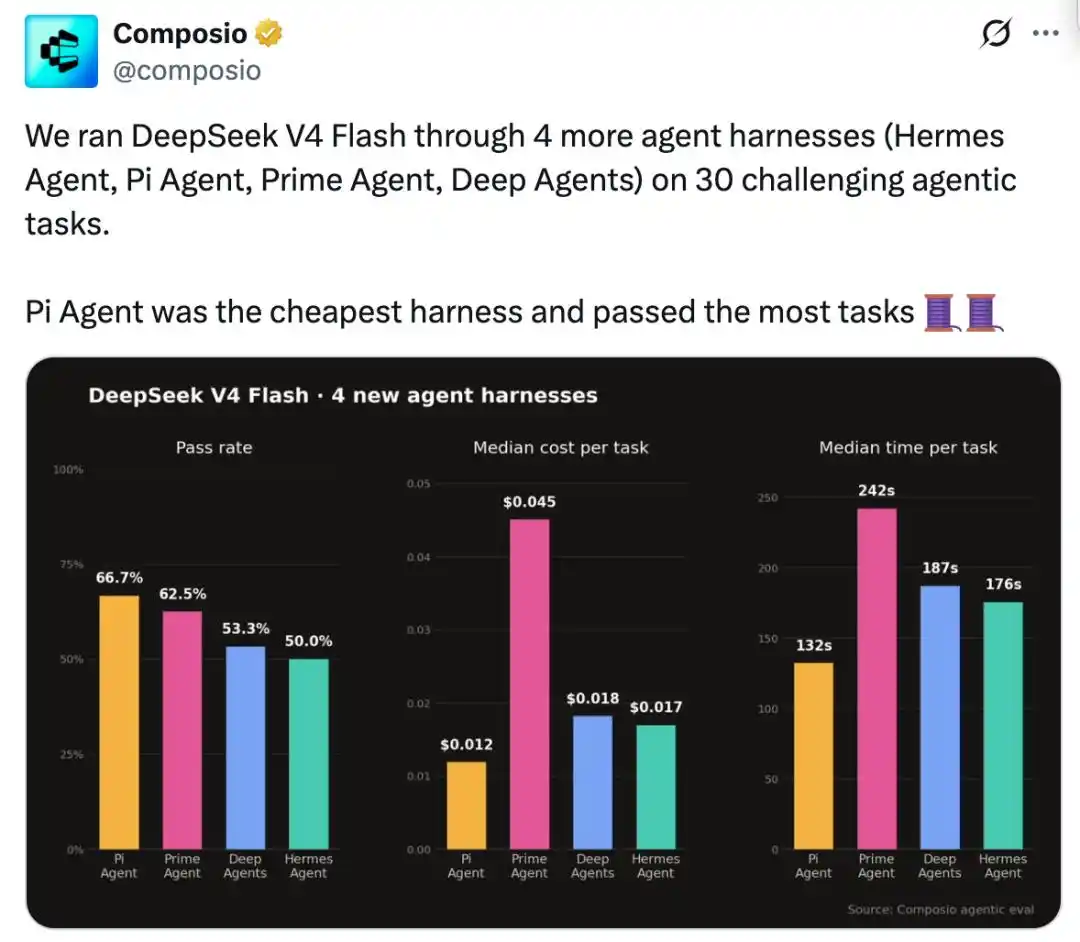
The gap was significant. The best performer, Pi Agent, passed twenty tasks; the worst, OpenCode, passed only fourteen. Out of 240 total runs across eight Harnesses, only 129 succeeded. Among the thirty tasks, only six were completed by all Harnesses. In terms of cost, for similarly completing sixteen tasks, the estimated cost per successful task for Claude Code, Codex, and DeepAgents was approximately $0.195, $0.081, and $0.045 respectively. For the same model, the difference was more than fourfold.
This means that the model sets the upper limit of capability, while the Harness determines how much of that ceiling is ultimately realized and at what cost. Throughout a long-running task, the execution system must constantly make judgments: what to keep and what to discard in the context, when to call which tool, whether to retry or change course when a tool fails, whether to trust the model's completion signal or verify it again. If any step is mishandled, even if the model has the right idea, it could fail at the last moment when actually modifying files or submitting code.

It's worth noting that this is one of the very few projects that DeepSeek opened for early closed beta since its rise to fame.

Several developers received Harness beta access before the official release. Some testers discovered that having the same V4-Flash model complete the same game within DeepSeek Harness, Reasonix, and Codex produced drastically different outcomes. This shows that when the model is identical, the tools, prompts, context organization, and execution strategies provided by the execution system can significantly alter the final product.

This is precisely why DeepSeek values its self-developed Harness. Internally, DeepSeek has believed that Agents need to solve the problem of continuous learning, ultimately enabling AI to accelerate AI R&D. Looking down this path, Harness is not just an add-on programming tool, but a workbench for models to enter real development tasks.

Furthermore, a company that built its foundation on low cost and model capability would find itself in a precarious position if task delivery, failure feedback, and developer interfaces remained long-term dependencies on others' systems. Even with a price advantage, it wouldn't control how many tokens a task ultimately burns, how many retries are needed, or when a task is truly considered complete.

02

Everything is a Plugin, DeepSeek Isn't a Replacement for Anyone

What exactly is Harness? The most convenient description in the market is " DeepSeek version of Claude Code." But those who have used the beta version generally find this label inaccurate.

According to DeepSeek 's official documentation, the core design philosophy of Harness is "Everything is a plugin." It is built on the Cordis plugin system. Models, tools, skills, sessions, sandboxes, storage, loops, schedulers, UI—all Agent capabilities are composed of plugins. Developers can select, replace, or extend any capability through configuration without modifying the Harness source code.
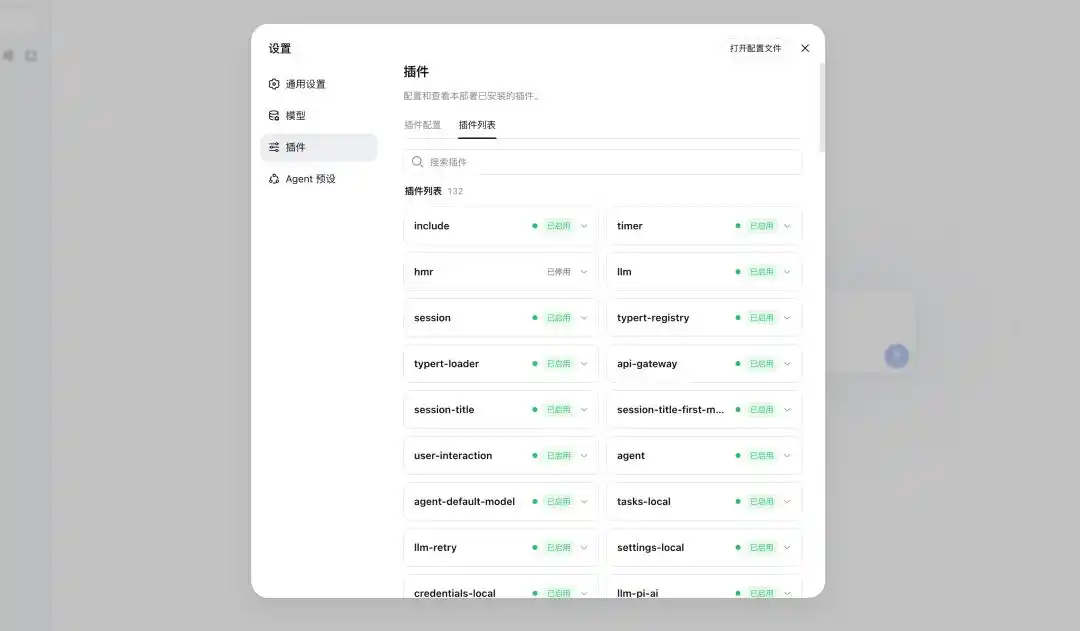
This is on a different scale from the usual understanding of plugins. VS Code plugins add features to the editor; Codex plugins add tools to the Agent. Harness plugins can replace the Agent's brain, toolbox, rules, even its entire interface.

According to multiple sources involved in the beta test, developers went wild with plugin-making during the beta period. "People aren't properly testing the beta anymore; they're running off to write plugins." Hundreds of plugins emerged within just a few days—some completely overhauled the work interface, while others implemented "cross-session long-term memory with background self-evolution" using pure plugins, enabling the model to periodically review its work records and compress temporary experiences into lasting knowledge.

Some also commented that open-source community governance might be another challenge DeepSeek will face next.

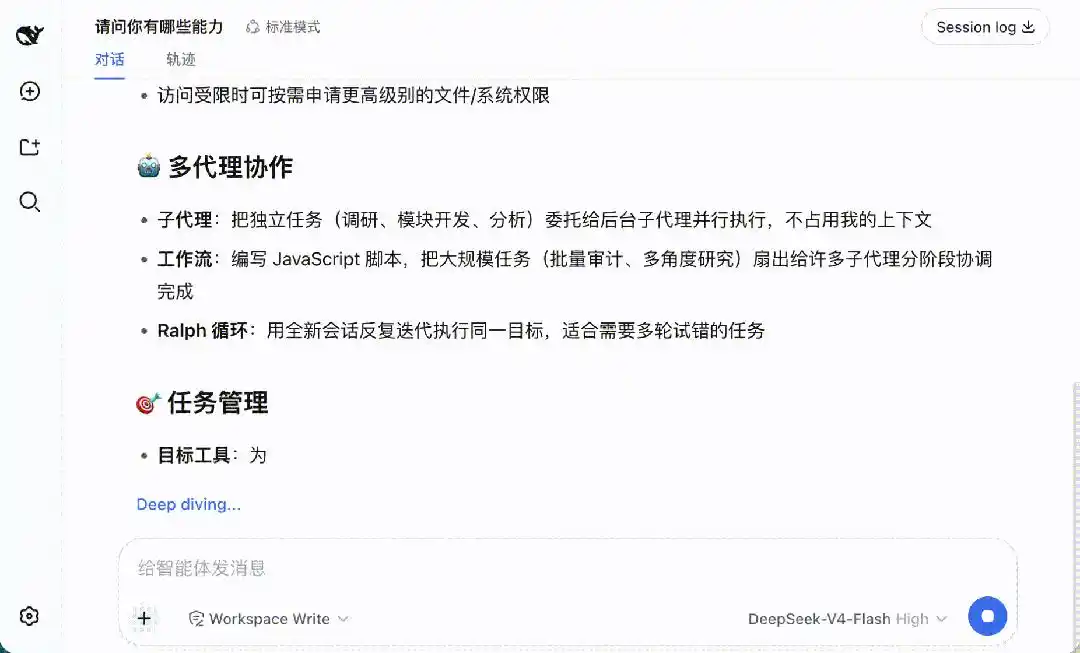
Another crucial design aspect is traceability. Harness uses an append-only session log. Everything the model sees—system prompts, chain-of-thought, tool calls and results, sub-Agent scheduling, every context injection—is fully recorded. Context compression does not delete the original history; it only changes what the model subsequently sees through replacement events. Developers can trace by source in the Trajectory view, supporting recovery, forking, retrieval, and replay. The official documentation summarizes this principle as "If the model saw it, it's recorded."

This reflects a typical systems engineering mindset. According to reports, DeepSeek Harness team leader Cui Tianyi graduated from Zhejiang University's Computer Science Department, worked at the quantitative trading firm Jane Street for nine years, and joined DeepSeek in March 2026, with Harness officially starting internal development in May. The core moat of high-frequency trading systems has never been about smarter strategies, but stable execution in extremely complex environments, exception handling, comprehensive log traceability, and controllable risk—exactly the missing piece for moving AI Agents from demos to production. One beta developer described its performance in long tasks as "steady as an old dog": tasks are automatically saved when interrupted, ready to resume next time without starting over.

It's worth noting that Harness hasn't confined itself within DeepSeek models' walled garden. It natively supports connecting to nearly 40 major models including Kimi , OpenAI, Anthropic, and Google. Perhaps others tend to build a ready-made Agent, but DeepSeek Harness is more like a set of components, allowing developers to decide for themselves what the Agent should be like and how it should work.

Of course, the official team remains clear-headed. The announcement states that, as an early preview version, "there are still many details to be improved and refined, and core plugins and basic APIs will also undergo rapid iteration." In fact, one of the media outlets involved in the beta, ifanr, marveled that it was hard to imagine the famously fast DeepSeek taking over half an hour to run a programming task. The v0.1 version number also indicates that this black whale has just surfaced, far from swimming freely.

03

From Selling Tokens to Delivering Results, the Ambition of the Black Whale

The emergence of Harness coincides with a shift in the entire AI industry.

Over the past few years, competition among large model companies has focused on parameter scale and benchmark scores. But entering 2026, the core capabilities of leading models have rapidly converged, gaps in single-turn QA have narrowed, while price wars have intensified. The ceiling for the pure token-selling business model has become clearly visible. The industry is gradually realizing that the core value of the AI industry lies not in model output, but in real-world application—with the same token consumption, idle chat yields minimal value, while fixing a bug or completing a feature development can create several times the commercial value.

DeepSeek 's new release signifies a move from selling compute power to delivering results. In the old model, customers paid based on token usage, regardless of whether the model actually solved the problem. In the new model, the anchor point for payment shifts from how much compute was consumed to what task was accomplished.

This DeepSeek Harness release is also highly praised by developers for another reason. DeepSeek does not define the Agent itself. Instead, it leverages the diffusion power of the open-source community to promote a Harness-based approach. This is a grander, yet more difficult, path.

Furthermore, Harness faces a mature market already validated by Claude Code and Codex, with the latter backed by the model iterations and commercial resources of Anthropic and OpenAI, holding a first-mover advantage. After open-sourcing, questions remain unanswered: whether the plugin ecosystem can spontaneously flourish, whether developers are willing to entrust production environments to a v0.1 version, and whether the domestic market's payment habits can support the new logic of "pay-per-result." DeepSeek itself has stated that core plugins and APIs will continue to evolve rapidly, meaning early adopters may bear the cost of interface changes.

On August 13th, releases happened on both sides of the Pacific. Elon Musk took the stage for Grok 4.6, calling it "intelligent, fast, and highly cost-effective" ; DeepSeek said nothing, just kept pushing updates.

Between the clamor and the silence lies a divergence of two business philosophies.

We want to call this DeepSeek 's "most promising project in history," not because it's the strongest today. V4 Pro still has gaps with SOTA models, Harness is only a v0.1 developer preview, market reaction to recent price adjustments needs observation, and ecosystem building is a long journey. Potential is potential precisely because it is not yet realized.

But if we stretch the timeline, from R1 to V4, from models to Harness, DeepSeek has taken each step in the same direction: compressing cutting-edge capabilities into affordable costs, then connecting affordable capabilities to implementable systems.

The black whale has surfaced. As for how far it can swim—that lies in a future belonging to the open-source community.

This article is from the WeChat public account "Phoenix Network Technology," author: Dale, editor: Dong Yuqing


Trend Kriptolar

İlgili Sorular

QAccording to the article, what is the key finding of Composio's experiments comparing different Agent execution systems (Harnesses) using the same DeepSeek model?

AThe key finding was that the choice of execution system significantly impacts the performance and cost of the same AI model. The experiments showed up to a fourfold difference in the cost per successful task completion when the same DeepSeek V4-Flash model was paired with different Harnesses.

QWhat is the core design philosophy of DeepSeek's newly released Harness system?

AThe core design philosophy is "Everything is a plugin." Harness is built on the Cordis plugin system, meaning all Agent capabilities—models, tools, skills, sessions, UI, etc.—are composed of interchangeable plugins, allowing developers to customize the system without modifying the core source code.

QWhy does the article suggest Harness is not simply a 'DeepSeek version of Claude Code'?

ABecause Harness is fundamentally a modular system of plugins where developers can define and configure the Agent's functionality, behavior, and interface. It's designed to be a flexible, foundational framework for building various Agents, not a single, pre-defined tool for coding tasks.

QWhat shift in the AI industry's business model does the article associate with the release of DeepSeek Harness?

AThe article associates it with a shift from selling computational power (tokens) to delivering results. The value proposition is moving from charging for model output volume to charging based on the completion and value of specific tasks (like bug fixes or feature development).

QWhat is the significance of the 'append-only' session log and 'Trajectory view' in the Harness system, according to the article?

AThe 'append-only' log ensures complete traceability and reproducibility. Every system prompt, chain-of-thought, tool call, and context injection is permanently recorded. The 'Trajectory view' allows developers to trace, restore, fork, and replay any step, providing crucial control and debugging capabilities for complex, long-running AI tasks.

İlgili Okumalar

GPT-5 Also Has Tip-of-the-Tongue Moments, Google Tested 4.5 Million Times: The Keys Are Lost

Google researchers have discovered that advanced AI models like GPT-5 and Gemini 3 experience a phenomenon akin to the human "tip-of-the-tongue" state, where they possess knowledge but fail to retrieve it. Their study, "Empty Shelves or Lost Keys?" (ICML 2026), introduces the "Knowledge Portrait" framework to analyze factual knowledge in models, distinguishing between failure to encode a fact versus failure to recall it. Testing on 13 models across 2.15 million queries from the WikiProfile benchmark revealed that state-of-the-art models successfully encode 95-98% of facts into their parameters. However, when asked directly, they fail to recall 26-34% of these known facts. Enabling chain-of-thought ("thinking") reasoning reduces this recall failure to 11-12%, recovering 40-65% of the previously unrecalled but encoded facts. The research identifies two key bottlenecks: recalling obscure ("long-tail") facts and answering reversed queries (e.g., "Who is Tom Cruise's mother?" vs. "Whose son is Tom Cruise?"). While scaling model size effectively reduces encoding failures, it does little to improve recall rates. In larger models, recall failure becomes the dominant source of factual errors, accounting for over 70% of mistakes in GPT-5.2. The findings suggest that for top models, the primary challenge is no longer storing knowledge but accessing it efficiently. Future accuracy gains may depend more on improved inference-time methods and "meta-cognitive" abilities, enabling models to recognize when they need to engage in deeper reasoning to retrieve information they already know.

marsbit14 dk önce

GPT-5 Also Has Tip-of-the-Tongue Moments, Google Tested 4.5 Million Times: The Keys Are Lost

marsbit14 dk önce

The Dollar is a Technology: Stablecoins Are Exporting U.S. Institutions to the World

This article argues that stablecoins and blockchain infrastructure are becoming a vehicle for exporting American financial systems globally. The core thesis is that the U.S. dollar, as a "technology," is increasingly embedded in blockchain rails, moving beyond a reserve currency to represent the institutional stability of the United States itself. The piece highlights three key areas where this is happening: 1. **Cross-border payments and trade finance:** Companies like Keyrails use stablecoins and blockchain to streamline and secure trade finance for emerging markets (e.g., Nigeria-China trade), offering faster, often cheaper dollar liquidity than traditional systems. 2. **Programmable collateral and credit:** Platforms like SemiLiquid allow institutions to use tokenized assets (e.g., treasuries, stocks) as "programmable collateral" for loans without moving them from custody, unlocking capital efficiency and improving transparency in institutional lending. 3. **Financing real-world assets:** Protocols like USD.AI create lending markets for productive, hard-to-finance assets like AI GPUs, connecting global stablecoin liquidity to physical capital. The author concludes that the true value of these new blockchain-based financial platforms lies not just in transaction volume, but in the deep, hard-to-replicate "context" (data, trust, operational knowledge) they build around specific economic activities like trade and asset finance. This represents crypto's evolution into an operating system for real-world capital formation, moving beyond speculation.

marsbit18 dk önce

The Dollar is a Technology: Stablecoins Are Exporting U.S. Institutions to the World

marsbit18 dk önce

Ethereum Glamsterdam Upgrade: Largest-Scale Underlying Restructuring Yet, Mainnet Date Still Undecided

The upcoming Ethereum "Glamsterdam" upgrade is viewed by core developers as the most significant protocol-level refactoring since The Merge, fundamentally altering how the network processes transactions and manages its state to advance L1 scaling. Its core goals are: accelerating processing via parallelization, increasing capacity, and enhancing sustainability through adjusted fees that better reflect long-term data storage costs. The upgrade features two headline proposals. First, **ePBS (EIP-7732)** on the consensus layer aims to formalize proposer-builder separation directly within the protocol, eliminating reliance on off-chain relayers. This built-in mechanism is designed to provide a more secure and efficient block production pipeline, extending the critical validation window to allow the network to handle more data, particularly for Layer2s. Second, **BALs (EIP-7928)** on the execution layer introduces block-level access lists. These lists specify the data each transaction will access beforehand, allowing the network to identify and safely execute non-conflicting transactions in parallel, rather than strictly sequentially. This also speeds up new node synchronization. Glamsterdam also includes配套 proposals to reprice storage costs (aiming for a predictable ~120 GiB annual state growth) and the cost of data-reading operations to better align with modern hardware costs and prevent spam. Regarding the timeline, the initial schedule targeting a mainnet activation on September 16, 2026, has likely been delayed. Following the launch of a new dedicated testnet (Plataberget), the deployments on the Sepolia and Holesky testnets are now expected in September, with the mainnet launch potentially pushed to Q4 2026 or later, as developers prioritize correctness over a fixed date.

marsbit18 dk önce

Ethereum Glamsterdam Upgrade: Largest-Scale Underlying Restructuring Yet, Mainnet Date Still Undecided

marsbit18 dk önce

İşlemler

Spot

Popüler Makaleler

$S$ Nedir

SPERO'yu Anlamak: Kapsamlı Bir Genel Bakış SPERO'ya Giriş İnovasyonun manzarası gelişmeye devam ederken, web3 teknolojilerinin ve kripto para projelerinin ortaya çıkışı dijital geleceği şekillendirmede önemli bir rol oynamaktadır. Bu dinamik alanda dikkat çeken projelerden biri SPERO, $$s$$ olarak adlandırılmaktadır. Bu makale, SPERO hakkında ayrıntılı bilgi toplamak ve sunmak amacıyla, meraklılar ve yatırımcıların web3 ve kripto alanlarındaki temellerini, hedeflerini ve yeniliklerini anlamalarına yardımcı olmayı amaçlamaktadır. SPERO,$$s$$ Nedir? SPERO,$$s$$, kripto alanında merkeziyetsizlik ve blok zinciri teknolojisi ilkelerini kullanarak etkileşimi, faydayı ve finansal kapsayıcılığı teşvik eden bir ekosistem yaratmayı amaçlayan benzersiz bir projedir. Proje, kullanıcıların yenilikçi finansal çözümler ve hizmetler sunarak eşler arası etkileşimleri yeni yollarla kolaylaştırmayı hedeflemektedir. SPERO,$$s$$'nin temel amacı, bireyleri güçlendirmek ve kripto para alanındaki kullanıcı deneyimini artıran araçlar ve platformlar sağlamaktır. Bu, daha esnek işlem yöntemlerini mümkün kılmayı, topluluk odaklı girişimleri teşvik etmeyi ve merkeziyetsiz uygulamalar (dApp'ler) aracılığıyla finansal fırsatlar yaratmayı içermektedir. SPERO,$$s$$'nin temel vizyonu kapsayıcılık etrafında dönmekte olup, geleneksel finansal sistemlerdeki boşlukları kapatmayı ve blok zinciri teknolojisinin faydalarından yararlanmayı hedeflemektedir. SPERO,$$s$$'nin Yaratıcısı Kimdir? SPERO,$$s$$'nin yaratıcısının kimliği bir miktar belirsizdir, çünkü kurucusu(ları) hakkında ayrıntılı arka plan bilgisi sağlayan sınırlı kamuya açık kaynaklar bulunmaktadır. Bu şeffaflık eksikliği, projenin merkeziyetsizlik taahhüdünden kaynaklanabilir—birçok web3 projesinin paylaştığı bir etik anlayışı, bireysel tanınmanın yerine kolektif katkıları önceliklendirmektedir. Topluluk ve onun kolektif hedefleri etrafında tartışmaları merkezileştirerek, SPERO,$$s$$, belirli bireyleri öne çıkarmadan güçlendirme özünü taşımaktadır. Bu nedenle, SPERO'nun etik anlayışını ve misyonunu anlamak, tek bir yaratıcının kimliğini belirlemekten daha önemlidir. SPERO,$$s$$'nin Yatırımcıları Kimlerdir? SPERO,$$s$$, kripto sektöründe yeniliği teşvik etmeye adanmış girişim sermayedarlarından melek yatırımcılara kadar çeşitli yatırımcılar tarafından desteklenmektedir. Bu yatırımcıların odak noktası genellikle SPERO'nun misyonuyla uyumlu olup, toplumsal teknolojik ilerlemeyi, finansal kapsayıcılığı ve merkeziyetsiz yönetimi vaat eden projeleri önceliklendirmektedir. Bu yatırımcı temelleri, yalnızca yenilikçi ürünler sunan projelere değil, aynı zamanda blok zinciri topluluğuna ve ekosistemlerine olumlu katkılarda bulunan projelere de ilgi duymaktadır. Bu yatırımcıların desteği, SPERO,$$s$$'yi hızla gelişen kripto projeleri alanında dikkate değer bir rakip haline getirmektedir. SPERO,$$s$$ Nasıl Çalışır? SPERO,$$s$$, onu geleneksel kripto para projelerinden ayıran çok yönlü bir çerçeve kullanmaktadır. İşte benzersizliğini ve yeniliğini vurgulayan bazı temel özellikler: Merkeziyetsiz Yönetim: SPERO,$$s$$, kullanıcıların projenin geleceğiyle ilgili karar alma süreçlerine aktif olarak katılmalarını sağlayan merkeziyetsiz yönetim modellerini entegre etmektedir. Bu yaklaşım, topluluk üyeleri arasında sahiplik ve hesap verebilirlik duygusunu teşvik etmektedir. Token Kullanımı: SPERO,$$s$$, ekosistem içinde çeşitli işlevler sunmak üzere tasarlanmış kendi kripto para token'ını kullanmaktadır. Bu token'lar, işlemleri, ödülleri ve platformda sunulan hizmetlerin kolaylaştırılmasını sağlayarak genel etkileşimi ve faydayı artırmaktadır. Katmanlı Mimari: SPERO,$$s$$'nin teknik mimarisi, modülerlik ve ölçeklenebilirliği destekleyerek projenin evrimi sırasında ek özelliklerin ve uygulamaların sorunsuz bir şekilde entegrasyonuna olanak tanımaktadır. Bu uyum sağlama yeteneği, sürekli değişen kripto manzarasında geçerliliği sürdürmek için hayati öneme sahiptir. Topluluk Katılımı: Proje, işbirliği ve geri bildirim teşvik eden mekanizmalar kullanarak topluluk odaklı girişimlere vurgu yapmaktadır. Güçlü bir topluluk oluşturarak, SPERO,$$s$$, kullanıcı ihtiyaçlarını daha iyi karşılayabilir ve piyasa trendlerine uyum sağlayabilir. Kapsayıcılığa Odaklanma: Düşük işlem ücretleri ve kullanıcı dostu arayüzler sunarak, SPERO,$$s$$, daha önce kripto alanında yer almamış bireyler de dahil olmak üzere çeşitli bir kullanıcı tabanını çekmeyi hedeflemektedir. Bu kapsayıcılık taahhüdü, erişilebilirlik yoluyla güçlendirme misyonuyla uyumludur. SPERO,$$s$$ Zaman Çizelgesi Bir projenin tarihini anlamak, gelişim yolculuğu ve kilometre taşları hakkında kritik bilgiler sağlar. Aşağıda, SPERO,$$s$$'nin evriminde önemli olayları haritalayan önerilen bir zaman çizelgesi bulunmaktadır: Kavram Geliştirme ve Fikir Aşaması: SPERO,$$s$$'nin temelini oluşturan ilk fikirler, blok zinciri endüstrisindeki merkeziyetsizlik ve topluluk odaklılık ilkeleriyle yakından uyumlu olarak geliştirildi. Proje Beyaz Kağıdının Yayınlanması: Kavramsal aşamayı takiben, SPERO,$$s$$'nin vizyonunu, hedeflerini ve teknolojik altyapısını ayrıntılı bir şekilde açıklayan kapsamlı bir beyaz kağıt yayımlandı ve topluluk ilgisini ve geri bildirimini toplamak amacıyla sunuldu. Topluluk Oluşturma ve Erken Katılımlar: Projenin hedefleri etrafında tartışmalar yürüterek destek toplamak ve erken benimseyenler ile potansiyel yatırımcılar için bir topluluk oluşturmak amacıyla aktif iletişim çabaları gerçekleştirildi. Token Üretim Etkinliği: SPERO,$$s$$, yerel token'larını erken destekçilere dağıtmak ve ekosistem içinde başlangıç likiditesini sağlamak amacıyla bir token üretim etkinliği (TGE) gerçekleştirdi. İlk dApp'in Yayınlanması: SPERO,$$s$$ ile ilişkili ilk merkeziyetsiz uygulama (dApp) faaliyete geçti ve kullanıcıların platformun temel işlevleriyle etkileşimde bulunmalarını sağladı. Sürekli Gelişim ve Ortaklıklar: Projenin tekliflerine sürekli güncellemeler ve iyileştirmeler yapılmakta olup, blok zinciri alanındaki diğer oyuncularla stratejik ortaklıklar, SPERO,$$s$$'yi rekabetçi ve gelişen bir oyuncu haline getirmiştir. Sonuç SPERO,$$s$$, web3 ve kripto paranın finansal sistemleri devrim niteliğinde dönüştürme ve bireyleri güçlendirme potansiyelinin bir kanıtıdır. Merkeziyetsiz yönetime, topluluk katılımına ve yenilikçi tasarlanmış işlevselliğe olan bağlılığıyla, daha kapsayıcı bir finansal manzaraya doğru bir yol açmaktadır. Hızla gelişen kripto alanındaki herhangi bir yatırımda olduğu gibi, potansiyel yatırımcılar ve kullanıcılar, SPERO,$$s$$ içindeki devam eden gelişmelerle ilgili olarak kapsamlı bir araştırma yapmaları ve düşünceli bir şekilde katılmaları teşvik edilmektedir. Proje, kripto endüstrisinin yenilikçi ruhunu sergileyerek, sayısız olasılığını keşfetmeye davet etmektedir. SPERO,$$s$$'nin yolculuğu hala devam ederken, temel ilkeleri, teknoloji, finans ve birbirimizle etkileşim biçimimizi etkileyebilir.

393 Toplam GörüntülenmeYayınlanma 2024.12.17Güncellenme 2024.12.17

$S$ Nedir

AGENT S Nedir

Agent S: Web3'te Otonom Etkileşimin Geleceği Giriş Web3 ve kripto para dünyasında sürekli gelişen manzarada, yenilikler bireylerin dijital platformlarla etkileşim biçimlerini sürekli olarak yeniden tanımlıyor. Bu tür öncü projelerden biri olan Agent S, açık ajans çerçevesi aracılığıyla insan-bilgisayar etkileşimini devrim niteliğinde değiştirmeyi vaat ediyor. Otonom etkileşimlerin yolunu açarak, Agent S karmaşık görevleri basitleştirmeyi ve yapay zeka (AI) alanında dönüştürücü uygulamalar sunmayı hedefliyor. Bu detaylı inceleme, projenin karmaşıklıklarına, benzersiz özelliklerine ve kripto para alanındaki etkilerine dalacaktır. Agent S Nedir? Agent S, bilgisayar görevlerinin otomasyonunda üç temel zorluğu ele almak üzere özel olarak tasarlanmış çığır açıcı bir açık ajans çerçevesidir: Alan Spesifik Bilgi Edinimi: Çerçeve, çeşitli dış bilgi kaynaklarından ve iç deneyimlerden akıllıca öğrenir. Bu çift yönlü yaklaşım, alan spesifik bilgi açısından zengin bir veri havuzu oluşturmasını sağlar ve görev yürütmedeki performansını artırır. Uzun Görev Ufukları Üzerinde Planlama: Agent S, karmaşık görevlerin verimli bir şekilde parçalanmasını ve yürütülmesini kolaylaştıran deneyim artırımlı hiyerarşik planlama kullanır. Bu özellik, çoklu alt görevleri etkili ve verimli bir şekilde yönetme yeteneğini önemli ölçüde artırır. Dinamik, Homojen Olmayan Arayüzlerle Başlama: Proje, ajanlar ve kullanıcılar arasındaki etkileşimi geliştiren yenilikçi bir çözüm olan Ajan-Bilgisayar Arayüzü'ni (ACI) tanıtmaktadır. Çok Modlu Büyük Dil Modellerini (MLLM'ler) kullanarak, Agent S çeşitli grafik kullanıcı arayüzlerini sorunsuz bir şekilde gezinebilir ve manipüle edebilir. Bu öncü özellikler aracılığıyla, Agent S, makinelerle insan etkileşimini otomatikleştirmede karşılaşılan karmaşıklıkları ele alan sağlam bir çerçeve sunarak, AI ve ötesinde birçok uygulama için zemin hazırlıyor. Agent S'nin Yaratıcısı Kimdir? Agent S'nin kavramı temelde yenilikçi olsa da, yaratıcısı hakkında spesifik bilgiler belirsizliğini koruyor. Yaratıcı şu anda bilinmiyor, bu da projenin yeni aşamasını veya kurucu üyeleri gizli tutma stratejik tercihini vurguluyor. Anonimlikten bağımsız olarak, odak çerçevenin yetenekleri ve potansiyeli üzerinde kalıyor. Agent S'nin Yatırımcıları Kimlerdir? Agent S, kriptografik ekosistemde oldukça yeni olduğundan, yatırımcıları ve finansal destekçileri hakkında ayrıntılı bilgiler açıkça belgelenmemiştir. Projeyi destekleyen yatırım temelleri veya organizasyonları hakkında kamuya açık bilgilerdeki eksiklik, finansman yapısı ve gelişim yol haritası hakkında sorular doğuruyor. Destekleyicilerin anlaşılması, projenin sürdürülebilirliğini ve potansiyel pazar etkisini değerlendirmek için kritik öneme sahiptir. Agent S Nasıl Çalışır? Agent S'nin temelinde, çeşitli ortamlarda etkili bir şekilde çalışmasını sağlayan son teknoloji bir sistem yatmaktadır. İşleyiş modeli birkaç ana özellik etrafında inşa edilmiştir: İnsan Benzeri Bilgisayar Etkileşimi: Çerçeve, bilgisayarlarla etkileşimleri daha sezgisel hale getirmeyi amaçlayan gelişmiş AI planlaması sunar. Görev yürütmedeki insan davranışını taklit ederek, kullanıcı deneyimlerini yükseltmeyi vaat eder. Anlatı Belleği: Yüksek düzeyde deneyimlerden yararlanmak için kullanılan Agent S, görev geçmişlerini takip etmek amacıyla anlatı belleğini kullanarak karar verme süreçlerini geliştirir. Episodik Bellek: Bu özellik, kullanıcılara adım adım rehberlik sağlayarak, çerçevenin görevler gelişirken bağlamsal destek sunmasına olanak tanır. OpenACI Desteği: Yerel olarak çalışabilme yeteneği ile Agent S, kullanıcıların etkileşimleri ve iş akışları üzerinde kontrol sağlamasına olanak tanır ve Web3'ün merkeziyetsiz felsefesiyle uyumlu hale gelir. Dış API'lerle Kolay Entegrasyon: Çeşitli AI platformlarıyla uyumluluğu ve çok yönlülüğü, Agent S'nin mevcut teknolojik ekosistemlere sorunsuz bir şekilde entegre olmasını sağlar ve geliştiriciler ile organizasyonlar için cazip bir seçenek haline getirir. Bu işlevsellikler, Agent S'nin kripto alanındaki benzersiz konumuna katkıda bulunarak, karmaşık, çok aşamalı görevleri minimum insan müdahalesi ile otomatikleştirir. Proje geliştikçe, Web3'teki potansiyel uygulamaları dijital etkileşimlerin nasıl gelişeceğini yeniden tanımlayabilir. Agent S'nin Zaman Çizelgesi Agent S'nin gelişimi ve kilometre taşları, önemli olaylarını vurgulayan bir zaman çizelgesinde özetlenebilir: 27 Eylül 2024: Agent S'nin kavramı, “Bilgisayarları İnsan Gibi Kullanan Açık Bir Ajans Çerçevesi” başlıklı kapsamlı bir araştırma makalesi ile tanıtıldı ve projenin temelini sergiledi. 10 Ekim 2024: Araştırma makalesi arXiv'de kamuya açık olarak yayınlandı ve çerçevenin derinlemesine bir incelemesini ve OSWorld benchmark'ına dayalı performans değerlendirmesini sundu. 12 Ekim 2024: Agent S'nin yetenekleri ve özellikleri hakkında görsel bir içgörü sağlayan bir video sunumu yayımlandı ve potansiyel kullanıcılar ve yatırımcılarla daha fazla etkileşim sağlandı. Bu zaman çizelgesindeki işaretler, sadece Agent S'nin ilerlemesini değil, aynı zamanda şeffaflık ve topluluk katılımına olan bağlılığını da göstermektedir. Agent S Hakkında Ana Noktalar Agent S çerçevesi gelişmeye devam ederken, birkaç ana özellik öne çıkmakta ve yenilikçi doğasını ve potansiyelini vurgulamaktadır: Yenilikçi Çerçeve: İnsan etkileşimine benzer bir bilgisayar kullanımı sağlamak üzere tasarlanan Agent S, görev otomasyonuna yeni bir yaklaşım getiriyor. Otonom Etkileşim: GUI aracılığıyla bilgisayarlarla otonom olarak etkileşim kurabilme yeteneği, daha akıllı ve verimli hesaplama çözümlerine doğru bir sıçrama anlamına geliyor. Karmaşık Görev Otomasyonu: Sağlam metodolojisi ile karmaşık, çok aşamalı görevleri otomatikleştirerek süreçleri daha hızlı ve daha az hata payı ile gerçekleştirebilir. Sürekli İyileştirme: Öğrenme mekanizmaları, Agent S'nin geçmiş deneyimlerden öğrenmesini sağlar ve sürekli olarak performansını ve etkinliğini artırır. Çok Yönlülük: OSWorld ve WindowsAgentArena gibi farklı işletim ortamlarında uyumlu olması, geniş bir uygulama yelpazesine hizmet edebilmesini sağlar. Agent S, Web3 ve kripto alanında kendini konumlandırırken, etkileşim yeteneklerini artırma ve süreçleri otomatikleştirme potansiyeli, AI teknolojilerinde önemli bir ilerlemeyi temsil etmektedir. Yenilikçi çerçevesi aracılığıyla, Agent S dijital etkileşimlerin geleceğini örneklemekte ve çeşitli sektörlerde kullanıcılar için daha sorunsuz ve verimli bir deneyim vaat etmektedir. Sonuç Agent S, AI ve Web3'ün birleşiminde cesur bir sıçramayı temsil ediyor ve teknoloji ile etkileşim biçimimizi yeniden tanımlama kapasitesine sahip. Henüz erken aşamalarında olmasına rağmen, uygulama olanakları geniş ve çekici. Kritik zorlukları ele alan kapsamlı çerçevesi ile Agent S, otonom etkileşimleri dijital deneyimin ön plana çıkmasına taşımayı hedefliyor. Kripto para ve merkeziyetsizlik alanlarına daha derinlemesine girdikçe, Agent S gibi projelerin teknoloji ve insan-bilgisayar işbirliğinin geleceğini şekillendirmede önemli bir rol oynayacağı kesin.

844 Toplam GörüntülenmeYayınlanma 2025.01.14Güncellenme 2025.01.14

AGENT S Nedir

S Nasıl Satın Alınır

HTX.com’a hoş geldiniz! Sonic (S) satın alma işlemlerini basit ve kullanışlı bir hâle getirdik. Adım adım açıkladığımız rehberimizi takip ederek kripto yolculuğunuza başlayın. 1. Adım: HTX Hesabınızı OluşturunHTX'te ücretsiz bir hesap açmak için e-posta adresinizi veya telefon numaranızı kullanın. Sorunsuzca kaydolun ve tüm özelliklerin kilidini açın. Hesabımı Aç2. Adım: Kripto Satın Al Bölümüne Gidin ve Ödeme Yönteminizi SeçinKredi/Banka Kartı: Visa veya Mastercard'ınızı kullanarak anında Sonic (S) satın alın.Bakiye: Sorunsuz bir şekilde işlem yapmak için HTX hesap bakiyenizdeki fonları kullanın.Üçüncü Taraflar: Kullanımı kolaylaştırmak için Google Pay ve Apple Pay gibi popüler ödeme yöntemlerini ekledik.P2P: HTX'teki diğer kullanıcılarla doğrudan işlem yapın.Borsa Dışı (OTC): Yatırımcılar için kişiye özel hizmetler ve rekabetçi döviz kurları sunuyoruz.3. Adım: Sonic (S) Varlıklarınızı SaklayınSonic (S) satın aldıktan sonra HTX hesabınızda saklayın. Alternatif olarak, blok zinciri transferi yoluyla başka bir yere gönderebilir veya diğer kripto para birimlerini takas etmek için kullanabilirsiniz.4. Adım: Sonic (S) Varlıklarınızla İşlem YapınHTX'in spot piyasasında Sonic (S) ile kolayca işlemler yapın.Hesabınıza erişin, işlem çiftinizi seçin, işlemlerinizi gerçekleştirin ve gerçek zamanlı olarak izleyin. Hem yeni başlayanlar hem de deneyimli yatırımcılar için kullanıcı dostu bir deneyim sunuyoruz.

2.2k Toplam GörüntülenmeYayınlanma 2025.01.15Güncellenme 2026.06.02

S Nasıl Satın Alınır

Tartışmalar

HTX Topluluğuna hoş geldiniz. Burada, en son platform gelişmeleri hakkında bilgi sahibi olabilir ve profesyonel piyasa görüşlerine erişebilirsiniz. Kullanıcıların S (S) fiyatı hakkındaki görüşleri aşağıda sunulmaktadır.

活动图片