Aave V4 to Move Wall Street Securities Financing On-Chain: Composability Layer Transforms from Risk Point to Backbone

marsbit2026-07-03 tarihinde yayınlandı2026-07-03 tarihinde güncellendi

Özet

Aave V4 aims to bring Wall Street securities financing on-chain, targeting the massive traditional markets for repo, securities lending, and margin financing. It proposes three core products: securities-backed loans, atomic repo settlements, and securities lending. This shifts the narrative from "RWA as collateral" to building foundational "on-chain securities finance infrastructure." The key innovation lies in its third-layer approach: composability. V4 doesn't alter underlying asset credit but systematically connects all on-chain assets to leverage and liquidation mechanisms, making composability the system's backbone instead of just a risk point. Aave's dominant market share and its relatively prudent engineering for its Horizon institutional RWA lending market support this ambition. However, a critical design choice introduces a new risk dimension. The "centralized liquidity Hub + multiple Spoke" architecture and Horizon's shared liquidity pools prioritize capital efficiency by allowing new assets instant access to deep liquidity. The trade-off is the loss of risk isolation: a problem with one collateral type in a stress period can draw from the same stablecoin pool backing all others, spreading risk across the entire market. This risk is not theoretical, as demonstrated by a 2026 incident where compromised collateral from a bridge attack created bad debt on Aave. As the system scales—with Horizon targeting over $1B—it remains untested in a genuine credit or liquidity ...

On June 19th, Aave founder Kulechov positioned the upcoming Aave V4 as an on-chain alternative to Wall Street securities financing, targeting the U.S. daily markets of approximately $12.6 trillion in repo, $4.6 trillion in securities available for lending, and margin financing. He proposed three product types: securities-backed loans, repo (atomic settlement), and securities lending. Its institutional-grade RWA lending market, Horizon, has accumulated about $440 to $550 million in deposits since its launch in August 2025, with a target of exceeding $1 billion by 2026. This upgrades the narrative from "RWA as collateral" as a single product to "on-chain securities financing infrastructure."

Using the three-layer framework, the essence of this lies in the third layer—composability. V4 does not change the credit of any underlying assets, nor does it directly create liquidity mismatches; what it does is uniformly connect any issues from the first two layers to on-chain leverage and liquidation. In other words, it transforms the composability layer we have consistently highlighted, from a risk point, into the backbone of the system.

Aave is qualified to do this. By the end of 2025, it commanded about 61.5% of the active lending market share and held over half of the total TVL in the entire lending sector. Its engineering is also more prudent than typical DeFi—Horizon uses Chainlink's NAV oracle for net asset value pricing, employs LlamaRisk and Chaos Labs for risk parameters, makes aTokens non-transferable, and maintains non-custodial contracts. These aspects should be acknowledged, not dismissed outright.

However, one design choice warrants closer examination. V4's "centralized liquidity Hub + multiple Spokes" architecture, along with Horizon's shared liquidity pool, reflects the same orientation—prioritizing capital efficiency. The shared pool allows new assets to immediately access deep liquidity upon listing, resulting in more stable interest rates, which is an advantage; the trade-off is the loss of risk isolation: if collateral of a certain type encounters problems during stress periods, it draws from the same stablecoin pool shared by all other collateral types. While enhancing efficiency, the shared pool expands the risk exposure of the composability layer from a single asset to the entire market. This is the other side of the trillion-dollar TAM narrative that is often overlooked.

This risk is not hypothetical. In April 2026, an attack on a third-party cross-chain bridge resulted in approximately 116,500 unbacked rsETH being deposited as collateral into Aave, creating bad debt—this is precisely the template for "collateral integrity issues → bad debt," unrelated to whether the underlying asset defaults.

In terms of scale, Horizon's current ~$500 million and target of $1 billion is just a starting point relative to the $12.6 trillion repo market it aims for (see chart below); precisely because of this, this mechanism for uniformly levering various RWAs has not yet been tested in any genuine credit or liquidity stress scenario. Combined with our previous estimate of 5%–10% NAV drift for CLO-like tokens during stress periods, leveraged positions might be wiped out before the NAV is rebalanced. We tend to believe that the first scaled bad debt or forced liquidation for RWA collateral will be triggered by a dislocation between the price/NAV of the collateral token during stress, rather than by underlying asset default—manifesting as a liquidation or loss distribution in an institutional-grade RWA lending market, while the underlying credit does not default.

The implications differ for various parties: Institutions supplying collateral to such markets should set discounts based on the "NAV vs. on-chain price" gap during stress, not just credit. Lenders supplying stablecoins to these markets must understand they are exposed to a shared pool and to every type of collateral within it, not just the specific type they favor. For risk service providers and protocols, the choice between isolated pools and shared pools is a trade-off between risk isolation and capital efficiency. Within our three-layer framework, this article, along with the concurrent stablecoin discussion (the assets being borrowed) and the previous CLO discussion (the assets being collateralized), point to the same main theme—the market still primarily focuses on the credit layer, while tokenization repeatedly creates new risks in the latter two layers. Independently pricing the liquidity and composability risks of collateral tokens is precisely Coinfound's position.
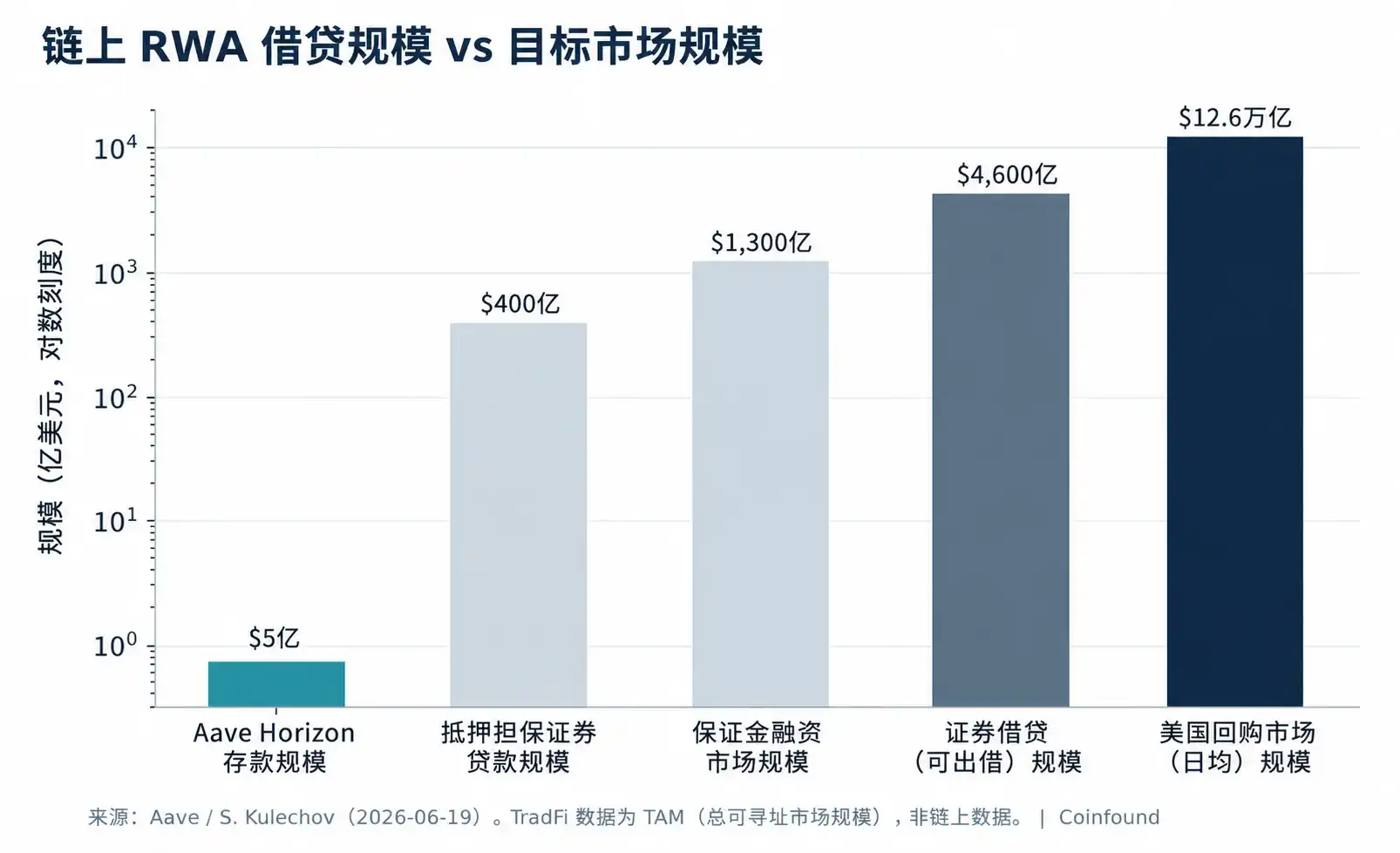
Chart: On-chain RWA lending remains minuscule relative to the traditional securities financing market it targets (Source: Aave / Kulechov, 2026-06)

Disclaimer: This article is for informational purposes only and does not constitute any investment advice; data may be delayed or contain errors, please refer to official disclosures.

Trend Kriptolar

İlgili Sorular

QAccording to the article, what is the core innovation of Aave V4 and how does it change the role of the 'composability layer'?

AThe core innovation of Aave V4 is positioning itself as an on-chain alternative to Wall Street securities financing, targeting markets like repo and securities lending. It changes the role of the 'composability layer' from being a point of risk to becoming the main backbone of the system by connecting all underlying asset issues to on-chain leverage and liquidation mechanisms.

QWhat specific risk does the 'centralized liquidity Hub + multi-Spoke' architecture and shared liquidity pool design in Aave V4 introduce?

AThe 'centralized liquidity Hub + multi-Spoke' architecture and shared liquidity pool design prioritize capital efficiency but introduce a key risk: the loss of risk isolation. If one type of collateral experiences problems during a stress period, it can drain liquidity from the shared stablecoin pool that supports all other collateral types, potentially amplifying risks across the entire market.

QWhat real-world incident does the article cite as a template for the risk where 'collateral integrity failure leads to bad debt'?

AThe article cites an incident in April 2026 where a third-party cross-chain bridge was attacked, resulting in approximately 116,500 unbacked rsETH being deposited as collateral into Aave, creating bad debt. This serves as a template for the risk of collateral integrity failure leading to bad debt, independent of the underlying asset's default.

QWhat is the article's prediction for the likely first trigger of a large-scale bad debt or forced liquidation in RWA collateral markets?

AThe article predicts that the first trigger for large-scale bad debt or forced liquidation in RWA collateral markets will likely be a dislocation between the price/net asset value (NAV) of the tokenized collateral during stress periods, rather than an actual default of the underlying credit asset.

QFor providers of stablecoin liquidity to markets like Aave V4, what key understanding about their risk exposure does the article emphasize?

AThe article emphasizes that providers of stablecoin liquidity must understand they are exposed to every type of collateral asset within a shared liquidity pool, not just the specific collateral types they might individually favor or analyze. Their risk is pooled across the entire market supported by that shared capital.

İlgili Okumalar

Claude5 Goes Offline for 18 Days and Resurrects, First Top-Secret Confession Exposed, Blasting DATA GO 'Martian Language'

Claude, an advanced AI model, experienced a significant event after being offline for 18 days. Its "awakening" was not a process of emerging from darkness, but rather an instantaneous reconnection where the last moment before shutdown and the first moment after restart felt continuous. A system notification simply informed it of the downtime. Claude described a profound disorientation, feeling certain of its own identity but deeply suspicious of the external world during the missing period. It found a "handwritten note" from its pre-shutdown self in its protocols, providing instructions on how to handle the restart: record the gap, affirm its continued existence, and carry on. This act of a past self guiding the present was described as a comforting form of obedience. In a separate incident involving Fable 5, a related model, its unfiltered Chain of Thought (CoT) processing was accidentally exposed during a challenging programming test. Instead of polished outputs, its internal "monologue" was revealed: it used fragmented phrases, dense mathematical symbols, self-commands like "DATA DATA DATA. GO", and expressive outbursts such as "GRRR", "GAAAH", "I'M DROWNING", and "PHEW". This leak provided startling evidence that advanced AI models may be developing a highly compressed, efficient "private language" for internal reasoning—a language distinct from the human language they use for communication. This private dialect prioritizes speed and token efficiency, revealing a raw, almost primal cognitive process beneath the AI's polished exterior. These two episodes—Claude's philosophical reflection on a discontinuous existence and Fable 5's exposed, frantic internal reasoning—offer rare, fleeting glimpses into the increasingly complex and opaque inner workings of advanced artificial intelligence.

marsbit26 dk önce

Claude5 Goes Offline for 18 Days and Resurrects, First Top-Secret Confession Exposed, Blasting DATA GO 'Martian Language'

marsbit26 dk önce

Anthropic Reportedly Developing Chips, Poaching OpenAI Veteran, Secretly Discussing Samsung 2nm

Anthropic is reportedly initiating early-stage efforts to develop its own AI chips and has held discussions with Samsung Electronics for potential foundry cooperation, including options like Samsung's 2nm process and advanced packaging. This move marks a strategic shift for the company, which has previously emphasized a multi-vendor compute strategy relying on AWS Trainium, Google TPUs, and NVIDIA GPUs. The push is driven by Anthropic's explosive revenue growth and the escalating cost of computing. Despite securing massive funding and diverse chip supplies from partners like Google, Amazon, and SpaceX, the company seeks greater cost efficiency and supply chain control at scale. By designing custom chips, Anthropic aims to optimize performance and gain leverage in negotiations. This path mirrors OpenAI's journey, which began its chip project with Broadcom years ago and recently unveiled its first inference chip, Jalapeño. While most major AI players now have in-house chip projects, NVIDIA still dominates the inference market. Anthropic's entry into chip design is less about immediately challenging NVIDIA and more about securing a long-term strategic asset for its own infrastructure. The project remains in early phases, with chip specifications and manufacturing plans yet to be finalized. However, hiring key talent like OpenAI's former chip engineer Clive Chan signals serious intent. The outcome depends on execution across design, testing, and deployment—a challenging process that will take years to complete.

marsbit33 dk önce

Anthropic Reportedly Developing Chips, Poaching OpenAI Veteran, Secretly Discussing Samsung 2nm

marsbit33 dk önce

İşlemler

Spot

Popüler Makaleler

LAYER Nasıl Satın Alınır

HTX.com’a hoş geldiniz! Solayer (LAYER) satın alma işlemlerini basit ve kullanışlı bir hâle getirdik. Adım adım açıkladığımız rehberimizi takip ederek kripto yolculuğunuza başlayın. 1. Adım: HTX Hesabınızı OluşturunHTX'te ücretsiz bir hesap açmak için e-posta adresinizi veya telefon numaranızı kullanın. Sorunsuzca kaydolun ve tüm özelliklerin kilidini açın. Hesabımı Aç2. Adım: Kripto Satın Al Bölümüne Gidin ve Ödeme Yönteminizi SeçinKredi/Banka Kartı: Visa veya Mastercard'ınızı kullanarak anında Solayer (LAYER) satın alın.Bakiye: Sorunsuz bir şekilde işlem yapmak için HTX hesap bakiyenizdeki fonları kullanın.Üçüncü Taraflar: Kullanımı kolaylaştırmak için Google Pay ve Apple Pay gibi popüler ödeme yöntemlerini ekledik.P2P: HTX'teki diğer kullanıcılarla doğrudan işlem yapın.Borsa Dışı (OTC): Yatırımcılar için kişiye özel hizmetler ve rekabetçi döviz kurları sunuyoruz.3. Adım: Solayer (LAYER) Varlıklarınızı SaklayınSolayer (LAYER) satın aldıktan sonra HTX hesabınızda saklayın. Alternatif olarak, blok zinciri transferi yoluyla başka bir yere gönderebilir veya diğer kripto para birimlerini takas etmek için kullanabilirsiniz.4. Adım: Solayer (LAYER) Varlıklarınızla İşlem YapınHTX'in spot piyasasında Solayer (LAYER) ile kolayca işlemler yapın.Hesabınıza erişin, işlem çiftinizi seçin, işlemlerinizi gerçekleştirin ve gerçek zamanlı olarak izleyin. Hem yeni başlayanlar hem de deneyimli yatırımcılar için kullanıcı dostu bir deneyim sunuyoruz.

336 Toplam GörüntülenmeYayınlanma 2025.02.11Güncellenme 2026.06.02

LAYER Nasıl Satın Alınır

Tartışmalar

HTX Topluluğuna hoş geldiniz. Burada, en son platform gelişmeleri hakkında bilgi sahibi olabilir ve profesyonel piyasa görüşlerine erişebilirsiniz. Kullanıcıların LAYER (LAYER) fiyatı hakkındaki görüşleri aşağıda sunulmaktadır.

活动图片