From Gas Limit to Keyed Nonces: How to Understand the Next Stage of Ethereum's Scalability?

marsbit2026-05-14 tarihinde yayınlandı2026-05-14 tarihinde güncellendi

Özet

From Gas Limits to Keyed Nonces: Understanding the Next Phase of Ethereum Scalability This article explores how recent Ethereum developments focus on moving complexity away from end-users, wallets, and DApps to the protocol layer. It discusses the consensus around significantly increasing the Gas Limit to 200 million, a change aimed at reducing fees and improving network capacity. However, it emphasizes that this increase is part of a holistic approach that includes mechanisms like enshrined Proposer-Builder Separation (ePBS) and Block-Level Access Lists to manage state growth and maintain node decentralization. The piece also delves into Keyed Nonces (EIP-8250), a proposed upgrade to Ethereum's transaction ordering. It explains how moving from a single, linear nonce queue per account to multiple independent nonce domains ("channels") can enable parallel transaction streams for different use cases. This is particularly crucial for privacy protocols and smart wallets, reducing transaction conflicts and unlocking new design possibilities. Ultimately, the article argues that these technical upgrades—alongside native account abstraction and cross-L2 interoperability—are converging towards a singular goal: enhancing the overall user experience. This means making on-chain interactions smoother, safer, and more cohesive, with wallets serving as the critical interface translating complex protocol improvements into intuitive user actions.

Author: imToken

Objectively speaking, for some time now, many users' intuitive understanding of Ethereum has often not come from roadmap or developer meetings, but from specific on-chain operations.

For example, in recent years, what everyone has personally felt includes lower Gas during transfers, improved cross-chain interoperability experiences, and so on. This is precisely why Ethereum's scaling has never been a simple 'performance race' problem—for ordinary users, higher TPS, larger blocks, and more complex underlying architectures only make sense when they are truly translated into lower costs, smoother operations, and safer wallet experiences.

And recently, a series of new developments in Ethereum happen to point towards Ethereum's attempt to systematically shift the complexity that was previously borne by wallets, DApps, third-party relayers, and users themselves, forward to the protocol layer.

Among these are Keyed Nonces with Vitalik's involvement, the directional consensus formed around the 200 million Gas Limit floor in the Glamsterdam upgrade, and the series of subtle clues in the 2026 roadmap that continue to emphasize native account abstraction, cross-L2 interoperability, and L1 security strengthening.
I. Gas Limit Increased to 200 Million?

First, let's look at the most easily perceived point for users: Gas Limit.

As is well known, in the Ethereum network, every transaction (whether it's a transfer or a contract interaction) consumes a certain amount of Gas, and the Gas Limit capacity of each Ethereum block is fixed, meaning the number of 'slots' is limited: the more slots, the more 'passengers' can be transported in the same time period; the more slots are tight, people have to bid for the same seat, and Gas fees also rise.

Theoretically, expanding the block Gas limit would indeed directly and significantly improve the performance of the Ethereum mainnet. However, in the past, against the backdrop of significant developments in routes like L2, Ethereum has been relatively cautious and restrained about this. Most of the scaling pressure has been intentionally directed towards the L2 track.

Looking at the expansion curve of Ethereum's Gas Limit reveals that after the Ethereum network's Gas Limit first broke through 10 million from 8 million in September 2019, it wasn't until this year, over 7 years, that the Gas Limit increased from 8 million to 60 million. Especially, it truly entered the acceleration phase only in 2025—from 30 million to 36 million in February, increased again to 45 million in July, and upgraded to 60 million after the Fusaka upgrade in December.

It can be said that most of the expansion was squeezed into the year 2025. Of course, as we mentioned earlier, 2025 is also a crucial year in Ethereum's development history. The Fusaka upgrade, just 7 months after the May Pectra upgrade, proved that the EF, despite undergoing significant leadership changes, still has the ability to drive major updates. It also marked Ethereum's formal entry into an accelerated development rhythm of 'two hard forks per year' (See Extended Reading《Ethereum 2026: Interpreting EF's Latest Protocol Roadmap, Officially Entering the Era of 'Engineering Upgrades'?》).
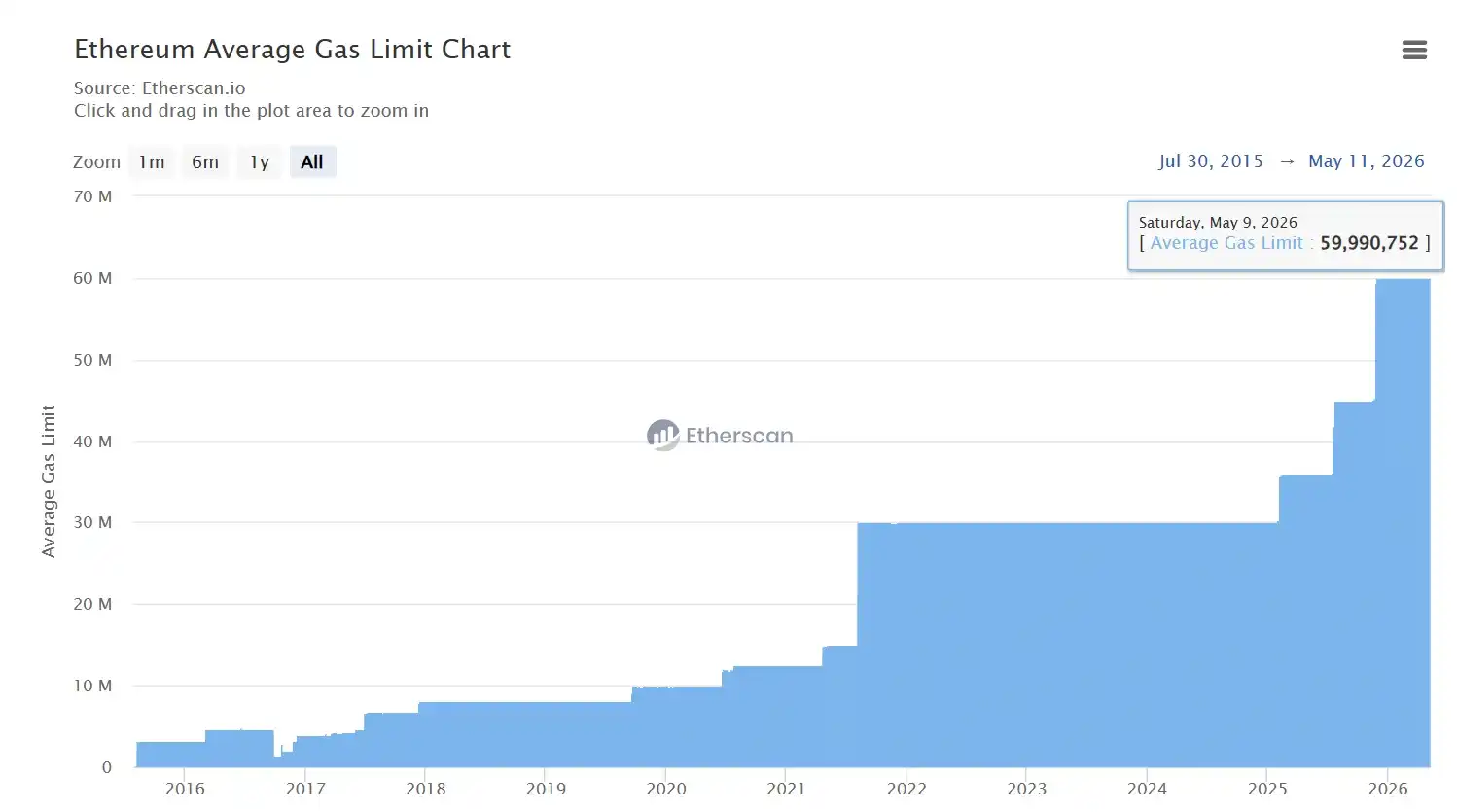
Source: Etherscan

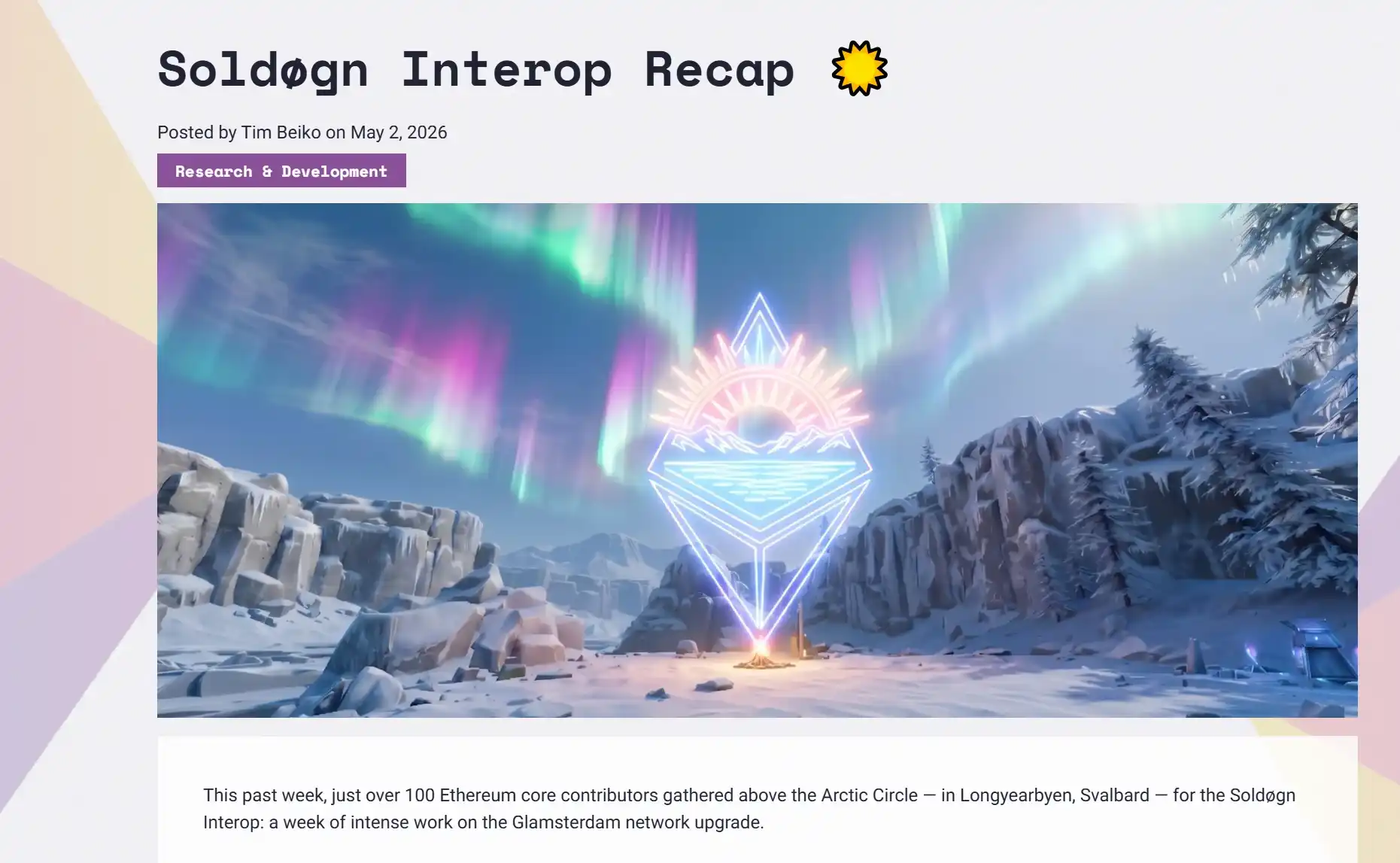
According to the Ethereum Foundation's Soldøgn Interop Recap released on May 2nd, over 100 core Ethereum contributors participated in an interoperability conference in Svalbard, Norway, focusing on the Glamsterdam upgrade. The key goals were to advance the multi-client implementation, testing, and parameter alignment for Glamsterdam. At the end of the conference, developers had formed a directional consensus around a 200 million Gas Limit after Glamsterdam.

This means that if subsequent processes go smoothly, the execution capacity of Ethereum L1 is expected to increase from the current approximately 60 million Gas Limit to a magnitude of 200 million. On a longer time scale, the Ethereum ecosystem's publicly discussable attitude towards Gas Limit has clearly become much more 'radical'. The EIP-9698 proposal even suggests 'increasing tenfold every two years', raising the Gas Limit to 3.6 billion by 2029, which is 50 times the current level.

However, it needs to be emphasized here that increasing the Gas Limit is not simply about making blocks bigger.

If it only roughly increases the computational capacity each block can hold, it might lower fees in the short term, but in the long run, it would burden nodes more heavily, cause state data inflation, and also mean it becomes more difficult for ordinary users to run nodes, ultimately weakening Ethereum's most core decentralized foundation.

Therefore, Glamsterdam's scaling approach is a combination punch:

  • ePBS (enshrined Proposer-Builder Separation) more clearly incorporates the block building and verification process into protocol rules, allowing validators to more securely handle larger blocks;
  • Block-Level Access Lists (BAL) pre-record the accounts and storage locations to be accessed during block execution, thereby supporting parallel disk reads, parallel transaction verification, and parallel state root calculation;
  • And EIP-8037 increases the cost of state creation-related operations to avoid excessive state growth after the Gas Limit is increased.

Ultimately, Ethereum doesn't just want to 'fit more transactions'; it's also thinking about how to not make node operation thresholds increasingly higher while fitting more transactions.

This is also the fundamental difference between Ethereum's scaling roadmap and many high-performance chain narratives. It has always pursued not sacrificing verification cost for superficial throughput, but rather increasing the mainnet's own carrying capacity while trying to maintain ordinary node participation and system verifiability.

II. Keyed Nonces: Turning 'One Queue' into 'Multiple Lanes'

If Gas Limit solves 'how much a block can hold', then Keyed Nonces focuses on another more detailed but crucial question: how should a transaction be queued?

As is well known, in Ethereum, a nonce can be simply understood as the 'sequence number' of an account's transaction. Its role is to prevent the same transaction from being executed repeatedly and to ensure transactions from the same account are processed in order.

This mechanism is easy to understand in ordinary transfer scenarios: it's the first transaction, second transaction, third transaction in sequence, queued one after another.

However, the problem is that when account capabilities become more complex, such as involving private transactions, smart wallets, session keys, batch operations, third-party payment, etc., a single linear nonce can become a bottleneck. Therefore, the core idea of Keyed Nonces, proposed in EIP-8250, is to change from an account having only one nonce queue to being able to have multiple nonce domains.

Specifically, it replaces the single sender nonce in EIP-8141 Frame Transaction with a (nonce_key, nonce_seq) structure, where nonce_key == 0 corresponds to the traditional account nonce, while non-zero keys can choose independent protocol-managed nonce sequences. Transactions under different keys are independent of each other, and replay protection does not interfere between them.

This sounds technical, but it can be understood with a life analogy: In the past, an account was like having only one window at a bank, all business had to queue in the same line; Keyed Nonces is like assigning different businesses to different windows. Transfers, private withdrawals, session authorizations, batch executions can each take their own lane.
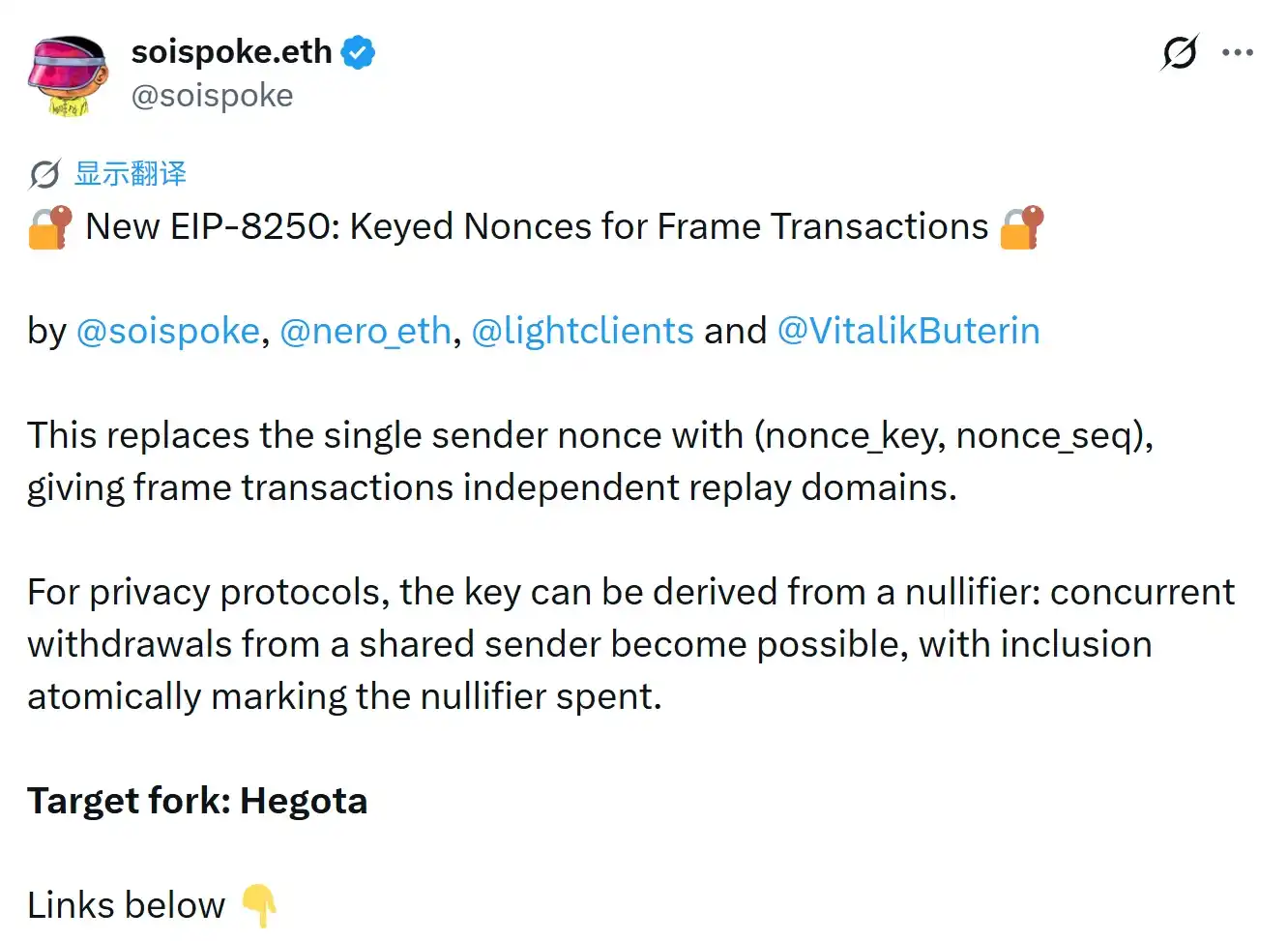
This is especially important for privacy protocols because, to avoid directly binding users' on-chain activities to a single public address, privacy protocols might have multiple users initiate transactions through the same shared sender address. However, under a single nonce mechanism, once one user's transaction is packaged, it could cause other users' waiting transactions to become invalid or blocked.

Whereas Keyed Nonces allows each withdrawal to choose its own nonce domain, for example, derived from a privacy nullifier, reducing this queuing conflict from the protocol layer.

Vitalik's own positioning of it is even more ambitious. When introducing EIP-8250, he clearly stated that Keyed Nonces 'not only provides stronger support for protocol-layer privacy solutions, but may also be the first step in Ethereum's new state scaling strategy—by creating storage types specifically optimized for different use cases, achieving ultimate scalability while maintaining protocol decentralization.'

In other words, it can be simply understood as: Gas Limit solves the 'size of the block', while Keyed Nonces explores the 'shape of the state'—what Ethereum needs to carry in the future is not just more transactions, but more types of transactions.

III. How Will This Affect Ordinary Users?

For the Ethereum ecosystem, many protocol upgrades seem far from ordinary users, but ultimately they all land on the wallet experience.

Because the real entry point for users to interact with Ethereum is not EIPs, clients, or developer meetings, but every transfer, authorization, signature, cross-chain, and DApp interaction within the wallet. That is to say, changes at the protocol layer only truly complete the transformation from technical upgrade to user experience upgrade when they are translated into clearer, smoother, and safer operational experiences at the wallet layer.

For example, the now familiar account abstraction is not meant to make users understand more technical terms, but to allow users to more naturally use on-chain accounts in the future. Therefore, in recent years, batch transactions, Gas payment by others, recovery mechanisms, different signature methods, session authorizations, and more flexible security strategies have gradually become basic capabilities in wallets.

Similarly, taking Keyed Nonces as an example, it sounds like a very low-level optimization of the account queuing mechanism. But on the user side, its potential impact is not abstract. Because today, many users may have encountered similar scenarios during on-chain operations: a transaction is not confirmed for a long time, subsequent transactions get stuck; wanting to cancel or speed up a transaction but not understanding the relationship between nonce, Gas, and replacement transactions; especially during parallel multi-step operations, one failed step affects all subsequent processes.

For ordinary users, these problems seem like 'the wallet isn't easy to use' or 'the chain isn't easy to use'. But behind them is actually related to the design of the single linear nonce in the Ethereum account model. The direction represented by Keyed Nonces is to allow accounts to no longer have to execute all operations in order through one queue, but to split into multiple parallel lanes according to different usage scenarios.

In the future, ordinary transfers, DApp authorizations, private transactions, batch transactions, Gas payment by others, and other operations could theoretically have more independent execution spaces, reducing the probability of blocking and conflicts with each other.

This will undoubtedly further expand the design space for smart wallets.

More importantly, in the past, these capabilities often required the complexity to be shared among wallets, DApps, relay services, and users. Users needed to understand authorization scopes, judge whether Gas was reasonable, know exactly what they were signing, and repeatedly confirm in multi-step operations like cross-chain, swapping, staking, and claiming rewards. Any misunderstanding at any step could lead to operational failure and asset loss risk.

What Ethereum is now trying to do is to move part of this complexity forward to the protocol layer, allowing wallets to provide better interaction abstraction for users based on more standardized, more native underlying capabilities.

This is also why Gas Limit, BAL, ePBS, Keyed Nonces, Frame Transactions, native account abstraction, and cross-L2 interoperability, seemingly belonging to different technical modules, are actually all serving the same thing: enabling Ethereum to carry more complex on-chain usage scenarios without sacrificing decentralization and security.

Looking specifically, putting these dynamics together reveals that Ethereum's recent focus is not scattered:

  • Gas Limit increase addresses mainnet execution capacity and fee pressure;
  • BAL, ePBS, EIP-8037 address how to maintain node verifiability and controlled state growth during scaling;
  • Keyed Nonces and Frame Transactions address bottlenecks in account models, privacy protocols, and smart wallets at the protocol layer;
  • Native account abstraction and cross-L2 interoperability further point towards the experience improvements that ordinary users can truly feel.

This also means Ethereum is entering a new stage.

After all, in the past few years, the market paid more attention to L2 scaling, Blob fee reduction, and modular narratives. Users also gradually got used to transferring assets between different L2s and finding lower-cost interaction environments. However, as the mainnet Gas Limit continues to increase, upgrades like Glamsterdam progress, and account abstraction and interoperability solutions continue to evolve, the question Ethereum is answering is no longer just 'how to make transactions cheaper', but 'how to make the on-chain experience more like a whole'.

In this process, the importance of wallets will undoubtedly be further amplified.

Because wallets are not only the entry point for users into Ethereum, but also the interface through which protocol capabilities are truly understood and used by users. In the future, the more complex the underlying upgrades, the more they need to be translated by wallets into clearer signature prompts, more understandable transaction paths, more upfront risk identification, and smoother on-chain interaction experiences.

Let's encourage each other.

İlgili Sorular

QWhat is the core purpose of increasing the Gas Limit to 200 million in the context of the Glamsterdam upgrade, and what are the associated technical measures?

AThe core purpose is to significantly increase the execution capacity of the Ethereum mainnet, potentially lowering transaction fees for users in the short term. However, it is not a simple block size increase. To prevent negative long-term impacts like increased node burden and state data bloat, the Glamsterdam upgrade employs a combination of technical measures including ePBS (enshrined Proposer-Builder Separation) to securely handle larger blocks, Block-Level Access Lists (BAL) to enable parallel processing, and EIP-8037 to control the cost and growth of state creation operations.

QHow does the Keyed Nonces mechanism (EIP-8250) improve upon the traditional single linear nonce system in Ethereum?

AKeyed Nonces replaces the traditional single nonce queue for an account with multiple independent nonce domains, structured as (nonce_key, nonce_seq). A nonce_key of 0 corresponds to the traditional account nonce, while non-zero keys can manage independent nonce sequences. This allows different types of transactions (e.g., regular transfers, privacy transactions, session authorizations, batch operations) to proceed on separate, parallel channels without blocking or interfering with each other, thus solving bottlenecks for complex account scenarios involving privacy protocols, smart wallets, and third-party gas payment.

QAccording to the article, why is the wallet's role becoming increasingly important in Ethereum's evolving landscape?

AThe wallet is the primary interface through which users interact with Ethereum. As protocol-layer upgrades (like Gas Limit increases, Keyed Nonces, native account abstraction) introduce more complex underlying capabilities, the wallet's role is crucial in translating these technical advancements into clear, safe, and smooth user experiences. This includes providing clearer signature prompts, understandable transaction paths, proactive risk identification, and seamless cross-L2 interactions, thereby completing the transformation from technical upgrade to user experience upgrade.

QWhat fundamental distinction does the article highlight between Ethereum's scaling approach and that of other high-performance blockchains?

AThe article emphasizes that Ethereum's scaling approach fundamentally differs from many high-performance chain narratives. Ethereum does not pursue superficial throughput at the cost of verification costs or node decentralization. Instead, it aims to increase the mainnet's carrying capacity while striving to maintain accessibility for ordinary node operators and preserving the system's verifiability and security. This is a core principle behind its combined technical measures like ePBS and BAL alongside Gas Limit increases.

QWhat broader question is Ethereum now attempting to address, moving beyond just making transactions cheaper?

ABeyond simply making transactions cheaper, Ethereum is now focusing on answering the question of 'how to make the on-chain experience more like a cohesive whole.' This involves integrating improvements across execution capacity (Gas Limit), node verifiability (ePBS, BAL), account models (Keyed Nonces), and user experience (native account abstraction, cross-L2 interoperability) to create a more unified, seamless, and capable on-chain ecosystem for diverse and complex use cases.

İlgili Okumalar

Breaking: OpenAI Undergoes Major Reorganization, President Brockman Assumes Command

OpenAI has announced a major internal reorganization just months before its anticipated IPO. The company is merging its three flagship product lines—ChatGPT, Codex, and the API platform—into a single, unified product organization. The most significant leadership change involves co-founder and President Greg Brockman moving from a background technical role to take full, permanent control over all product strategy. This follows the indefinite medical leave of AGI Deployment CEO Fidji Simo. Additionally, ChatGPT's longtime lead, Nick Turley, has been reassigned to enterprise products, with former Instagram executive Ashley Alexander taking over consumer offerings. The consolidation, internally framed as a strategic move towards an "Agentic Future," aims to break down internal silos and create a cohesive "Super App." This planned desktop application would integrate ChatGPT's conversational abilities, Codex's coding power, and a rumored internal web browser named "Atlas" to autonomously perform complex user tasks. The reorganization occurs amid significant internal and external pressures. OpenAI has recently seen a wave of high-profile departures, including Sora co-lead Bill Peebles and other senior technical leaders, leading to concerns about a thinning executive bench. Externally, rival Anthropic recently secured funding at a staggering $900 billion valuation, surpassing OpenAI's own. Google's upcoming I/O developer conference also poses a competitive threat. Analysts suggest the dramatic restructure is a pre-IPO move to present a clearer, more focused narrative to Wall Street—streamlining operations and demonstrating decisive leadership under Brockman to counter internal turbulence and intense market competition.

marsbit4 dk önce

Breaking: OpenAI Undergoes Major Reorganization, President Brockman Assumes Command

marsbit4 dk önce

Two Survival Structures of Market Makers and Arbitrageurs

Market makers and arbitrageurs represent two distinct survival structures in high-frequency trading. Market makers primarily use limit orders (makers) to profit from the bid-ask spread, enjoying high capital efficiency (nominally 100%) but bearing inventory risk. This "inventory risk" arises from passive, fragmented, and discontinuous order fills in the limit order book (LOB). This risk, while a potential cost, can also contribute to excess profit if managed within control boundaries, allowing for mean reversion. Market makers essentially sell "time" (uncertainty over execution timing) to the market for price control and low fees. In contrast, cross-exchange arbitrageurs typically use market orders (takers) to exploit price differences or funding rates, resulting in lower nominal capital efficiency (requiring capital on both exchanges) and higher transaction costs. Their risk exposure stems from asymmetries in exchange rules (e.g., minimum order sizes), execution latency, and infrastructure risks (e.g., ADL, oracle drift). These exposures are active, exogenous gaps that primarily erode profits rather than contribute to them. Arbitrageurs essentially sell "space" (capital sunk across venues) for localized, immediate certainty. Both strategies engage in a trade-off between execution friction and residual risk. Optimal systems allow for temporary, controlled risk exposure rather than enforcing zero exposure at all costs. Their evolution converges towards hybrid models: arbitrageurs may use maker orders to reduce costs, while market makers may use taker orders or hedges for risk management. Ultimately, both use different forms of risk exposure—market makers exposing inventory, arbitrageurs immobilizing capital—to extract marginal, hard-won certainty from the market.

链捕手4 dk önce

Two Survival Structures of Market Makers and Arbitrageurs

链捕手4 dk önce

Who Will Define the Rules of the AI Era? Anthropic Discusses the 2028 US-China AI Landscape

This article, based on Anthropic's analysis, outlines the intensifying systemic competition between the U.S./allies and China for AI leadership by 2028. It argues that access to advanced computing power ("compute") is the critical bottleneck, where the U.S. currently holds a significant advantage through chip export controls and allied innovation. However, China's AI labs remain competitive by exploiting policy loopholes—via chip smuggling, overseas data center access, and "model distillation" attacks to copy U.S. model capabilities—keeping them close to the frontier. The piece presents two contrasting scenarios for 2028. In the first, decisive U.S. action to tighten compute controls and curb distillation locks in a 12-24 month AI capability lead, cementing democratic influence over global AI norms, security, and economic infrastructure. In the second, policy inaction allows China to achieve near-parity through continued access to U.S. technology, enabling Beijing to promote its AI stack globally and integrate advanced AI into its military and governance systems, altering the strategic balance. Anthropic contends that maintaining a decisive U.S. lead is essential for shaping safe AI development and governance. The core recommendation is for U.S. policymakers to urgently close compute and model access loopholes while promoting global adoption of the U.S. AI technology stack to secure a lasting strategic advantage.

marsbit2 saat önce

Who Will Define the Rules of the AI Era? Anthropic Discusses the 2028 US-China AI Landscape

marsbit2 saat önce

“Why Didn’t You Buy 2x Long SK Hynix?”

The article discusses the immense popularity of the "2x Long SK Hynix ETF" (07709.HK) in Hong Kong, which became the world's largest single-stock leveraged ETF by May 2026. Launched in October 2025, the ETF's net value soared over 1000% in seven months, significantly outperforming the 324% gain of SK Hynix's underlying stock, driven by the AI boom and a critical shift in industry demand from computing power to memory. It highlights the mechanics and risks of daily-rebalanced leveraged ETFs. In a smooth bullish market, they generate amplified returns, but during volatile periods—exemplified by market swings during geopolitical tensions in the Strait of Hormuz in March-April 2026—they suffer severe "volatility decay," where choppy price action can cause losses far exceeding twice the drop of the underlying asset. The piece frames SK Hynix, as NVIDIA's primary HBM supplier, within the classic cycle of the memory chip industry—a commoditized sector prone to boom-and-bust cycles of shortage, price hikes, overcapacity, and crashes. While current AI-driven demand and high margins (Q1 2026毛利率~79%) create a "super cycle," the article questions its sustainability. It warns that extreme profits will inevitably tempt competitors like Samsung and Micron to ramp up HBM production, potentially eroding scarcity. Furthermore, the entire narrative remains tethered to the massive AI capital expenditure of tech giants. In conclusion, the ETF's trajectory symbolizes the accelerated, all-in nature of the current AI revolution, where timeframes are compressed and market moves are extreme. However, it also underscores that while industry trends define ultimate returns, macro-geopolitical risks dictate the volatile and uncertain path to get there.

marsbit2 saat önce

“Why Didn’t You Buy 2x Long SK Hynix?”

marsbit2 saat önce

İşlemler

Spot
Futures

Popüler Makaleler

$S$ Nedir

SPERO'yu Anlamak: Kapsamlı Bir Genel Bakış SPERO'ya Giriş İnovasyonun manzarası gelişmeye devam ederken, web3 teknolojilerinin ve kripto para projelerinin ortaya çıkışı dijital geleceği şekillendirmede önemli bir rol oynamaktadır. Bu dinamik alanda dikkat çeken projelerden biri SPERO, $$s$$ olarak adlandırılmaktadır. Bu makale, SPERO hakkında ayrıntılı bilgi toplamak ve sunmak amacıyla, meraklılar ve yatırımcıların web3 ve kripto alanlarındaki temellerini, hedeflerini ve yeniliklerini anlamalarına yardımcı olmayı amaçlamaktadır. SPERO,$$s$$ Nedir? SPERO,$$s$$, kripto alanında merkeziyetsizlik ve blok zinciri teknolojisi ilkelerini kullanarak etkileşimi, faydayı ve finansal kapsayıcılığı teşvik eden bir ekosistem yaratmayı amaçlayan benzersiz bir projedir. Proje, kullanıcıların yenilikçi finansal çözümler ve hizmetler sunarak eşler arası etkileşimleri yeni yollarla kolaylaştırmayı hedeflemektedir. SPERO,$$s$$'nin temel amacı, bireyleri güçlendirmek ve kripto para alanındaki kullanıcı deneyimini artıran araçlar ve platformlar sağlamaktır. Bu, daha esnek işlem yöntemlerini mümkün kılmayı, topluluk odaklı girişimleri teşvik etmeyi ve merkeziyetsiz uygulamalar (dApp'ler) aracılığıyla finansal fırsatlar yaratmayı içermektedir. SPERO,$$s$$'nin temel vizyonu kapsayıcılık etrafında dönmekte olup, geleneksel finansal sistemlerdeki boşlukları kapatmayı ve blok zinciri teknolojisinin faydalarından yararlanmayı hedeflemektedir. SPERO,$$s$$'nin Yaratıcısı Kimdir? SPERO,$$s$$'nin yaratıcısının kimliği bir miktar belirsizdir, çünkü kurucusu(ları) hakkında ayrıntılı arka plan bilgisi sağlayan sınırlı kamuya açık kaynaklar bulunmaktadır. Bu şeffaflık eksikliği, projenin merkeziyetsizlik taahhüdünden kaynaklanabilir—birçok web3 projesinin paylaştığı bir etik anlayışı, bireysel tanınmanın yerine kolektif katkıları önceliklendirmektedir. Topluluk ve onun kolektif hedefleri etrafında tartışmaları merkezileştirerek, SPERO,$$s$$, belirli bireyleri öne çıkarmadan güçlendirme özünü taşımaktadır. Bu nedenle, SPERO'nun etik anlayışını ve misyonunu anlamak, tek bir yaratıcının kimliğini belirlemekten daha önemlidir. SPERO,$$s$$'nin Yatırımcıları Kimlerdir? SPERO,$$s$$, kripto sektöründe yeniliği teşvik etmeye adanmış girişim sermayedarlarından melek yatırımcılara kadar çeşitli yatırımcılar tarafından desteklenmektedir. Bu yatırımcıların odak noktası genellikle SPERO'nun misyonuyla uyumlu olup, toplumsal teknolojik ilerlemeyi, finansal kapsayıcılığı ve merkeziyetsiz yönetimi vaat eden projeleri önceliklendirmektedir. Bu yatırımcı temelleri, yalnızca yenilikçi ürünler sunan projelere değil, aynı zamanda blok zinciri topluluğuna ve ekosistemlerine olumlu katkılarda bulunan projelere de ilgi duymaktadır. Bu yatırımcıların desteği, SPERO,$$s$$'yi hızla gelişen kripto projeleri alanında dikkate değer bir rakip haline getirmektedir. SPERO,$$s$$ Nasıl Çalışır? SPERO,$$s$$, onu geleneksel kripto para projelerinden ayıran çok yönlü bir çerçeve kullanmaktadır. İşte benzersizliğini ve yeniliğini vurgulayan bazı temel özellikler: Merkeziyetsiz Yönetim: SPERO,$$s$$, kullanıcıların projenin geleceğiyle ilgili karar alma süreçlerine aktif olarak katılmalarını sağlayan merkeziyetsiz yönetim modellerini entegre etmektedir. Bu yaklaşım, topluluk üyeleri arasında sahiplik ve hesap verebilirlik duygusunu teşvik etmektedir. Token Kullanımı: SPERO,$$s$$, ekosistem içinde çeşitli işlevler sunmak üzere tasarlanmış kendi kripto para token'ını kullanmaktadır. Bu token'lar, işlemleri, ödülleri ve platformda sunulan hizmetlerin kolaylaştırılmasını sağlayarak genel etkileşimi ve faydayı artırmaktadır. Katmanlı Mimari: SPERO,$$s$$'nin teknik mimarisi, modülerlik ve ölçeklenebilirliği destekleyerek projenin evrimi sırasında ek özelliklerin ve uygulamaların sorunsuz bir şekilde entegrasyonuna olanak tanımaktadır. Bu uyum sağlama yeteneği, sürekli değişen kripto manzarasında geçerliliği sürdürmek için hayati öneme sahiptir. Topluluk Katılımı: Proje, işbirliği ve geri bildirim teşvik eden mekanizmalar kullanarak topluluk odaklı girişimlere vurgu yapmaktadır. Güçlü bir topluluk oluşturarak, SPERO,$$s$$, kullanıcı ihtiyaçlarını daha iyi karşılayabilir ve piyasa trendlerine uyum sağlayabilir. Kapsayıcılığa Odaklanma: Düşük işlem ücretleri ve kullanıcı dostu arayüzler sunarak, SPERO,$$s$$, daha önce kripto alanında yer almamış bireyler de dahil olmak üzere çeşitli bir kullanıcı tabanını çekmeyi hedeflemektedir. Bu kapsayıcılık taahhüdü, erişilebilirlik yoluyla güçlendirme misyonuyla uyumludur. SPERO,$$s$$ Zaman Çizelgesi Bir projenin tarihini anlamak, gelişim yolculuğu ve kilometre taşları hakkında kritik bilgiler sağlar. Aşağıda, SPERO,$$s$$'nin evriminde önemli olayları haritalayan önerilen bir zaman çizelgesi bulunmaktadır: Kavram Geliştirme ve Fikir Aşaması: SPERO,$$s$$'nin temelini oluşturan ilk fikirler, blok zinciri endüstrisindeki merkeziyetsizlik ve topluluk odaklılık ilkeleriyle yakından uyumlu olarak geliştirildi. Proje Beyaz Kağıdının Yayınlanması: Kavramsal aşamayı takiben, SPERO,$$s$$'nin vizyonunu, hedeflerini ve teknolojik altyapısını ayrıntılı bir şekilde açıklayan kapsamlı bir beyaz kağıt yayımlandı ve topluluk ilgisini ve geri bildirimini toplamak amacıyla sunuldu. Topluluk Oluşturma ve Erken Katılımlar: Projenin hedefleri etrafında tartışmalar yürüterek destek toplamak ve erken benimseyenler ile potansiyel yatırımcılar için bir topluluk oluşturmak amacıyla aktif iletişim çabaları gerçekleştirildi. Token Üretim Etkinliği: SPERO,$$s$$, yerel token'larını erken destekçilere dağıtmak ve ekosistem içinde başlangıç likiditesini sağlamak amacıyla bir token üretim etkinliği (TGE) gerçekleştirdi. İlk dApp'in Yayınlanması: SPERO,$$s$$ ile ilişkili ilk merkeziyetsiz uygulama (dApp) faaliyete geçti ve kullanıcıların platformun temel işlevleriyle etkileşimde bulunmalarını sağladı. Sürekli Gelişim ve Ortaklıklar: Projenin tekliflerine sürekli güncellemeler ve iyileştirmeler yapılmakta olup, blok zinciri alanındaki diğer oyuncularla stratejik ortaklıklar, SPERO,$$s$$'yi rekabetçi ve gelişen bir oyuncu haline getirmiştir. Sonuç SPERO,$$s$$, web3 ve kripto paranın finansal sistemleri devrim niteliğinde dönüştürme ve bireyleri güçlendirme potansiyelinin bir kanıtıdır. Merkeziyetsiz yönetime, topluluk katılımına ve yenilikçi tasarlanmış işlevselliğe olan bağlılığıyla, daha kapsayıcı bir finansal manzaraya doğru bir yol açmaktadır. Hızla gelişen kripto alanındaki herhangi bir yatırımda olduğu gibi, potansiyel yatırımcılar ve kullanıcılar, SPERO,$$s$$ içindeki devam eden gelişmelerle ilgili olarak kapsamlı bir araştırma yapmaları ve düşünceli bir şekilde katılmaları teşvik edilmektedir. Proje, kripto endüstrisinin yenilikçi ruhunu sergileyerek, sayısız olasılığını keşfetmeye davet etmektedir. SPERO,$$s$$'nin yolculuğu hala devam ederken, temel ilkeleri, teknoloji, finans ve birbirimizle etkileşim biçimimizi etkileyebilir.

89 Toplam GörüntülenmeYayınlanma 2024.12.17Güncellenme 2024.12.17

$S$ Nedir

AGENT S Nedir

Agent S: Web3'te Otonom Etkileşimin Geleceği Giriş Web3 ve kripto para dünyasında sürekli gelişen manzarada, yenilikler bireylerin dijital platformlarla etkileşim biçimlerini sürekli olarak yeniden tanımlıyor. Bu tür öncü projelerden biri olan Agent S, açık ajans çerçevesi aracılığıyla insan-bilgisayar etkileşimini devrim niteliğinde değiştirmeyi vaat ediyor. Otonom etkileşimlerin yolunu açarak, Agent S karmaşık görevleri basitleştirmeyi ve yapay zeka (AI) alanında dönüştürücü uygulamalar sunmayı hedefliyor. Bu detaylı inceleme, projenin karmaşıklıklarına, benzersiz özelliklerine ve kripto para alanındaki etkilerine dalacaktır. Agent S Nedir? Agent S, bilgisayar görevlerinin otomasyonunda üç temel zorluğu ele almak üzere özel olarak tasarlanmış çığır açıcı bir açık ajans çerçevesidir: Alan Spesifik Bilgi Edinimi: Çerçeve, çeşitli dış bilgi kaynaklarından ve iç deneyimlerden akıllıca öğrenir. Bu çift yönlü yaklaşım, alan spesifik bilgi açısından zengin bir veri havuzu oluşturmasını sağlar ve görev yürütmedeki performansını artırır. Uzun Görev Ufukları Üzerinde Planlama: Agent S, karmaşık görevlerin verimli bir şekilde parçalanmasını ve yürütülmesini kolaylaştıran deneyim artırımlı hiyerarşik planlama kullanır. Bu özellik, çoklu alt görevleri etkili ve verimli bir şekilde yönetme yeteneğini önemli ölçüde artırır. Dinamik, Homojen Olmayan Arayüzlerle Başlama: Proje, ajanlar ve kullanıcılar arasındaki etkileşimi geliştiren yenilikçi bir çözüm olan Ajan-Bilgisayar Arayüzü'ni (ACI) tanıtmaktadır. Çok Modlu Büyük Dil Modellerini (MLLM'ler) kullanarak, Agent S çeşitli grafik kullanıcı arayüzlerini sorunsuz bir şekilde gezinebilir ve manipüle edebilir. Bu öncü özellikler aracılığıyla, Agent S, makinelerle insan etkileşimini otomatikleştirmede karşılaşılan karmaşıklıkları ele alan sağlam bir çerçeve sunarak, AI ve ötesinde birçok uygulama için zemin hazırlıyor. Agent S'nin Yaratıcısı Kimdir? Agent S'nin kavramı temelde yenilikçi olsa da, yaratıcısı hakkında spesifik bilgiler belirsizliğini koruyor. Yaratıcı şu anda bilinmiyor, bu da projenin yeni aşamasını veya kurucu üyeleri gizli tutma stratejik tercihini vurguluyor. Anonimlikten bağımsız olarak, odak çerçevenin yetenekleri ve potansiyeli üzerinde kalıyor. Agent S'nin Yatırımcıları Kimlerdir? Agent S, kriptografik ekosistemde oldukça yeni olduğundan, yatırımcıları ve finansal destekçileri hakkında ayrıntılı bilgiler açıkça belgelenmemiştir. Projeyi destekleyen yatırım temelleri veya organizasyonları hakkında kamuya açık bilgilerdeki eksiklik, finansman yapısı ve gelişim yol haritası hakkında sorular doğuruyor. Destekleyicilerin anlaşılması, projenin sürdürülebilirliğini ve potansiyel pazar etkisini değerlendirmek için kritik öneme sahiptir. Agent S Nasıl Çalışır? Agent S'nin temelinde, çeşitli ortamlarda etkili bir şekilde çalışmasını sağlayan son teknoloji bir sistem yatmaktadır. İşleyiş modeli birkaç ana özellik etrafında inşa edilmiştir: İnsan Benzeri Bilgisayar Etkileşimi: Çerçeve, bilgisayarlarla etkileşimleri daha sezgisel hale getirmeyi amaçlayan gelişmiş AI planlaması sunar. Görev yürütmedeki insan davranışını taklit ederek, kullanıcı deneyimlerini yükseltmeyi vaat eder. Anlatı Belleği: Yüksek düzeyde deneyimlerden yararlanmak için kullanılan Agent S, görev geçmişlerini takip etmek amacıyla anlatı belleğini kullanarak karar verme süreçlerini geliştirir. Episodik Bellek: Bu özellik, kullanıcılara adım adım rehberlik sağlayarak, çerçevenin görevler gelişirken bağlamsal destek sunmasına olanak tanır. OpenACI Desteği: Yerel olarak çalışabilme yeteneği ile Agent S, kullanıcıların etkileşimleri ve iş akışları üzerinde kontrol sağlamasına olanak tanır ve Web3'ün merkeziyetsiz felsefesiyle uyumlu hale gelir. Dış API'lerle Kolay Entegrasyon: Çeşitli AI platformlarıyla uyumluluğu ve çok yönlülüğü, Agent S'nin mevcut teknolojik ekosistemlere sorunsuz bir şekilde entegre olmasını sağlar ve geliştiriciler ile organizasyonlar için cazip bir seçenek haline getirir. Bu işlevsellikler, Agent S'nin kripto alanındaki benzersiz konumuna katkıda bulunarak, karmaşık, çok aşamalı görevleri minimum insan müdahalesi ile otomatikleştirir. Proje geliştikçe, Web3'teki potansiyel uygulamaları dijital etkileşimlerin nasıl gelişeceğini yeniden tanımlayabilir. Agent S'nin Zaman Çizelgesi Agent S'nin gelişimi ve kilometre taşları, önemli olaylarını vurgulayan bir zaman çizelgesinde özetlenebilir: 27 Eylül 2024: Agent S'nin kavramı, “Bilgisayarları İnsan Gibi Kullanan Açık Bir Ajans Çerçevesi” başlıklı kapsamlı bir araştırma makalesi ile tanıtıldı ve projenin temelini sergiledi. 10 Ekim 2024: Araştırma makalesi arXiv'de kamuya açık olarak yayınlandı ve çerçevenin derinlemesine bir incelemesini ve OSWorld benchmark'ına dayalı performans değerlendirmesini sundu. 12 Ekim 2024: Agent S'nin yetenekleri ve özellikleri hakkında görsel bir içgörü sağlayan bir video sunumu yayımlandı ve potansiyel kullanıcılar ve yatırımcılarla daha fazla etkileşim sağlandı. Bu zaman çizelgesindeki işaretler, sadece Agent S'nin ilerlemesini değil, aynı zamanda şeffaflık ve topluluk katılımına olan bağlılığını da göstermektedir. Agent S Hakkında Ana Noktalar Agent S çerçevesi gelişmeye devam ederken, birkaç ana özellik öne çıkmakta ve yenilikçi doğasını ve potansiyelini vurgulamaktadır: Yenilikçi Çerçeve: İnsan etkileşimine benzer bir bilgisayar kullanımı sağlamak üzere tasarlanan Agent S, görev otomasyonuna yeni bir yaklaşım getiriyor. Otonom Etkileşim: GUI aracılığıyla bilgisayarlarla otonom olarak etkileşim kurabilme yeteneği, daha akıllı ve verimli hesaplama çözümlerine doğru bir sıçrama anlamına geliyor. Karmaşık Görev Otomasyonu: Sağlam metodolojisi ile karmaşık, çok aşamalı görevleri otomatikleştirerek süreçleri daha hızlı ve daha az hata payı ile gerçekleştirebilir. Sürekli İyileştirme: Öğrenme mekanizmaları, Agent S'nin geçmiş deneyimlerden öğrenmesini sağlar ve sürekli olarak performansını ve etkinliğini artırır. Çok Yönlülük: OSWorld ve WindowsAgentArena gibi farklı işletim ortamlarında uyumlu olması, geniş bir uygulama yelpazesine hizmet edebilmesini sağlar. Agent S, Web3 ve kripto alanında kendini konumlandırırken, etkileşim yeteneklerini artırma ve süreçleri otomatikleştirme potansiyeli, AI teknolojilerinde önemli bir ilerlemeyi temsil etmektedir. Yenilikçi çerçevesi aracılığıyla, Agent S dijital etkileşimlerin geleceğini örneklemekte ve çeşitli sektörlerde kullanıcılar için daha sorunsuz ve verimli bir deneyim vaat etmektedir. Sonuç Agent S, AI ve Web3'ün birleşiminde cesur bir sıçramayı temsil ediyor ve teknoloji ile etkileşim biçimimizi yeniden tanımlama kapasitesine sahip. Henüz erken aşamalarında olmasına rağmen, uygulama olanakları geniş ve çekici. Kritik zorlukları ele alan kapsamlı çerçevesi ile Agent S, otonom etkileşimleri dijital deneyimin ön plana çıkmasına taşımayı hedefliyor. Kripto para ve merkeziyetsizlik alanlarına daha derinlemesine girdikçe, Agent S gibi projelerin teknoloji ve insan-bilgisayar işbirliğinin geleceğini şekillendirmede önemli bir rol oynayacağı kesin.

486 Toplam GörüntülenmeYayınlanma 2025.01.14Güncellenme 2025.01.14

AGENT S Nedir

S Nasıl Satın Alınır

HTX.com’a hoş geldiniz! Sonic (S) satın alma işlemlerini basit ve kullanışlı bir hâle getirdik. Adım adım açıkladığımız rehberimizi takip ederek kripto yolculuğunuza başlayın. 1. Adım: HTX Hesabınızı OluşturunHTX'te ücretsiz bir hesap açmak için e-posta adresinizi veya telefon numaranızı kullanın. Sorunsuzca kaydolun ve tüm özelliklerin kilidini açın. Hesabımı Aç2. Adım: Kripto Satın Al Bölümüne Gidin ve Ödeme Yönteminizi SeçinKredi/Banka Kartı: Visa veya Mastercard'ınızı kullanarak anında Sonic (S) satın alın.Bakiye: Sorunsuz bir şekilde işlem yapmak için HTX hesap bakiyenizdeki fonları kullanın.Üçüncü Taraflar: Kullanımı kolaylaştırmak için Google Pay ve Apple Pay gibi popüler ödeme yöntemlerini ekledik.P2P: HTX'teki diğer kullanıcılarla doğrudan işlem yapın.Borsa Dışı (OTC): Yatırımcılar için kişiye özel hizmetler ve rekabetçi döviz kurları sunuyoruz.3. Adım: Sonic (S) Varlıklarınızı SaklayınSonic (S) satın aldıktan sonra HTX hesabınızda saklayın. Alternatif olarak, blok zinciri transferi yoluyla başka bir yere gönderebilir veya diğer kripto para birimlerini takas etmek için kullanabilirsiniz.4. Adım: Sonic (S) Varlıklarınızla İşlem YapınHTX'in spot piyasasında Sonic (S) ile kolayca işlemler yapın.Hesabınıza erişin, işlem çiftinizi seçin, işlemlerinizi gerçekleştirin ve gerçek zamanlı olarak izleyin. Hem yeni başlayanlar hem de deneyimli yatırımcılar için kullanıcı dostu bir deneyim sunuyoruz.

1.4k Toplam GörüntülenmeYayınlanma 2025.01.15Güncellenme 2025.03.21

S Nasıl Satın Alınır

Tartışmalar

HTX Topluluğuna hoş geldiniz. Burada, en son platform gelişmeleri hakkında bilgi sahibi olabilir ve profesyonel piyasa görüşlerine erişebilirsiniz. Kullanıcıların S (S) fiyatı hakkındaki görüşleri aşağıda sunulmaktadır.

活动图片