By | Caihua She
July has just passed, and the Hong Kong IPO market continued the hot momentum from the first half of the year, but the characteristic of 'ice and fire coexisting' became more pronounced: 'Super IPOs' coexisted with 'mini IPOs', and while hard tech remained the main theme of the market, the rate of breakings (falling below issue price) surged significantly for the entire month.
Wind data shows that 17 new stocks were listed on the Hong Kong stock market in July (compared to 24 in June), with 14 new stocks 'gushing' onto the market in just three days from July 8th to 10th. July 9th even witnessed the spectacle of seven new stocks listing on the same day, with a combined net fundraising exceeding HKD 38 billion.
On one side, the largest IPO in nearly seven years made a high-profile debut; on the other side, nearly half of the new stocks broke on their listing day. What market logic lies behind this round of divergent performance? Let's review from three dimensions.
The Debut of Super IPOs, A+H Shares Supporting Half of Fundraising
The number one event in July's IPO market was undoubtedly InnoLight Technology (03308.HK).
On July 30th, the global leader in optical interconnect, InnoLight Technology, officially listed on the Hong Kong Stock Exchange. With a total fundraising of HKD 53.41 billion, it topped the list for Hong Kong IPO fundraising scale in 2026, simultaneously setting a new high for Hong Kong IPO fundraising in nearly seven years since Alibaba's (09988.HK) secondary listing in Hong Kong in 2019. If the 15% over-allotment option is fully exercised, the total fundraising could reach up to approximately HKD 61.4 billion. The issue price was set at HKD 980 per share, a slight 3% discount to the upper limit of the price range of HKD 1010.
This InnoLight Technology IPO attracted numerous renowned cornerstone investors, including Hillhouse, BlackRock, Temasek, Abu Dhabi Investment Authority, Alibaba, Tencent, etc., collectively subscribing to nearly HKD 27 billion.
Prior to InnoLight Technology, Luxshare Precision (02475.HK) had already set the year-to-date record at that time with a HKD 24.266 billion fundraising on July 9th. Additionally, San Huan Group (06951.HK) raised HKD 7.158 billion, Nexchip Semiconductor (02249.HK) raised HKD 6.982 billion, and Momenta-W (06880.HK) raised approximately HKD 5.894 billion. The total fundraising for companies listed in July was about HKD 116 billion, with InnoLight Technology alone contributing nearly half.
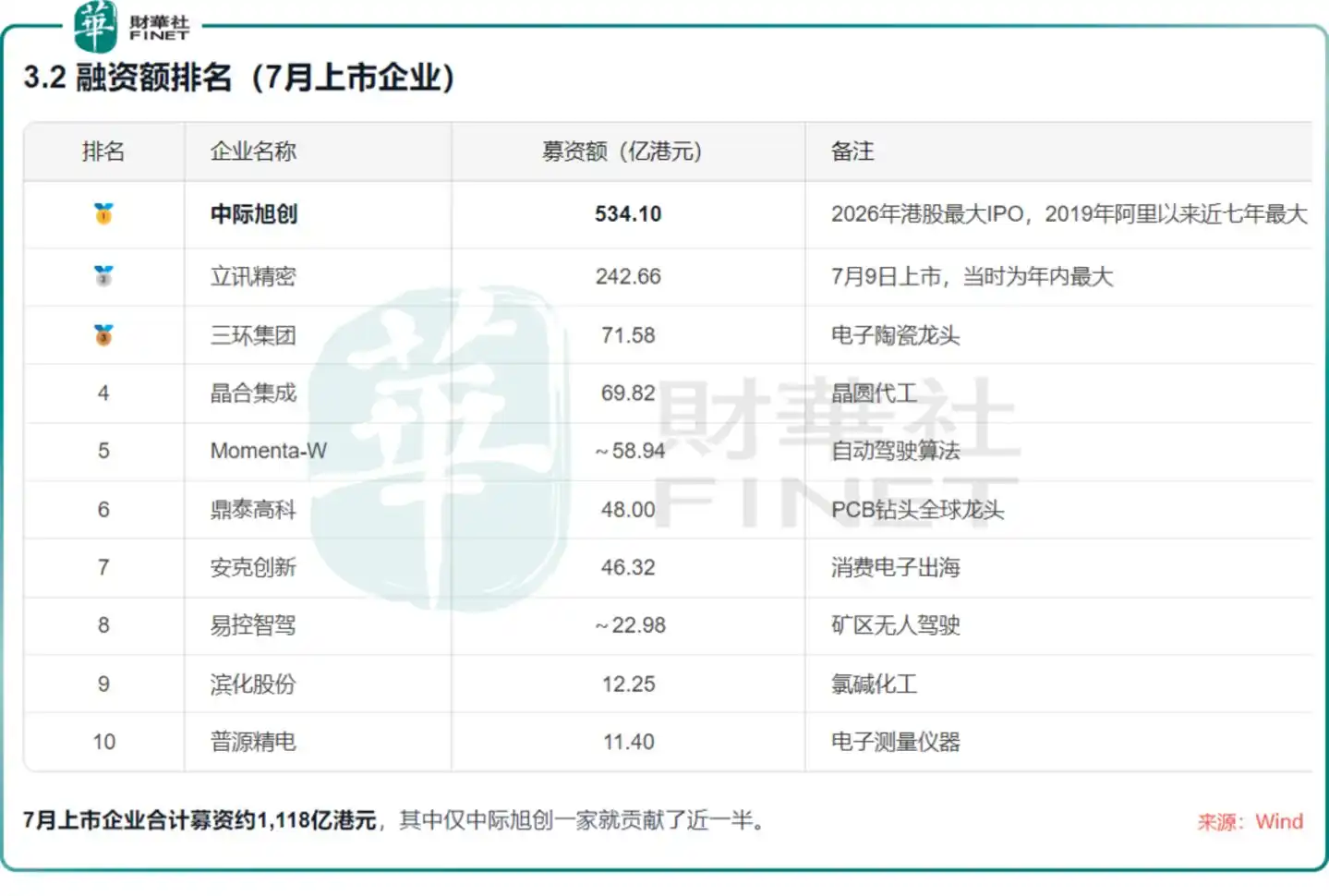
It is worth noting that among the 17 companies listed in July, 8 were A+H listed companies—Anker Innovations (00668.HK), Luxshare Precision, San Huan Group, DIT Technology (01377.HK), Rigol Technologies (00537.HK), Nexchip Semiconductor, Binhu Chemical (06745.HK), and InnoLight Technology, accounting for about 47% in number, and also contributing an extremely high proportion of the total fundraising.
According to Wind data, looking back at the first half of the year, A-share leaders such as Shenghong Technology (02476.HK), Muyuan Foods (02714.HK), and Montage Technology (06809.HK) had already taken the lead in listing on the Hong Kong Stock Exchange. Among the companies that filed applications in July, there were concentrated filings from A-share companies including Sunline, Dinolite, CVTE, Powtech, Giantec, Deye, Hand Enterprise, and Xingyu Automotive Lighting.
Overall, A-share leaders forming groups to go to Hong Kong has shifted from a 'trend' to a 'norm', constituting the most core supply source for Hong Kong IPOs.
Wave of Breakings Arrives, the Era of 'Guaranteed Profits from New Listings' Ends
In sharp contrast to the clamor of super IPOs is the sharply rising rate of breakings.
Among the 17 new stocks in July, 7 companies broke on their first day of trading, with a first-day breaking rate of about 41%, significantly higher than the levels in the first half of the year. If statistics are counted until the end of July, the number of breaking companies expanded to 8, and the breaking rate rose to 47%, with nearly half of the companies suffering from breakings.
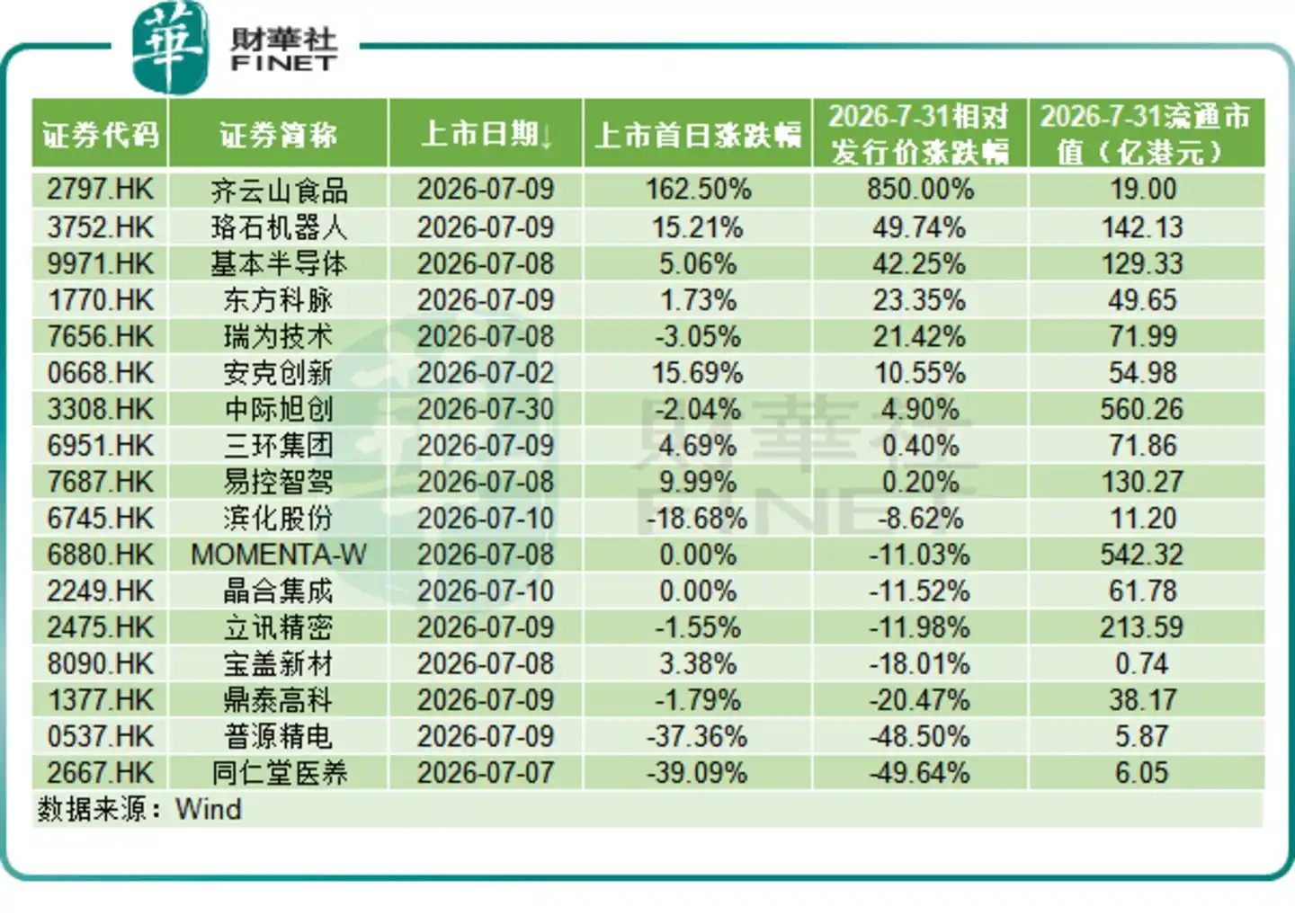
On July 7th, Tong Ren Tang Healthcare (02667.HK) plunged 39.09% on its listing day, marking the largest decline of the month; on July 9th, Rigol Technologies closed down 37.36%; on July 10th, Binhu Chemical fell 18.68%; even the much-anticipated Luxshare Precision broke at the open, with its stock price once falling over 9% during the session, ultimately closing down 1.55%.
Even more surprising was InnoLight Technology—this near seven-year largest IPO broke on its first day, closing at HKD 960 per share, down about 2.04% from the issue price. Regarding this, Lu Suiqi, retired associate professor at Peking University's School of Economics, analyzed that this breaking was not due to a deterioration in the company's fundamentals, but rather a 'negative feedback from good news realization' formed by the resonance of multiple factors, including valuation system restructuring, AH share price gap and safety margin contraction, and concentrated profit-taking by high-position holders.
It is worth noting that intensive supply was the direct driver of the rising breaking rate. In the week from July 6th to 10th, 15 new stocks were listed intensively, severely diverting funds for new subscriptions. Coupled with the market sentiment suppression brought by the peak of cornerstone investor lock-up expiries in July, the market's capacity to absorb new stocks clearly declined. During the new subscription frenzy in the first half of the year, many investors had already accumulated substantial floating profits. Faced with the intensive listing of new stocks, profit-taking became the preferred choice.
The deeper reasons lie in valuation shifts and liquidity games. In the first half of the year, the stock prices of hard tech new listings like Zhipu AI (02513.HK) and Tianshu Zhixin (09903.HK) kept climbing, pushing market expectations for tech stocks to extremely high levels. However, among the companies listed in July, the profitability models and commercialization prospects of some targets were not clearer than those in the first half, yet they carried equal or even higher valuation expectations. When the overall liquidity of the Hong Kong stock market did not show significant incremental improvement, these new stocks naturally faced stricter pricing scrutiny. The good old days in the first half of the year where one could 'close their eyes and subscribe to new listings' to make money were put on pause in July.
Hard Tech Still the Main Theme, But Capital Begins 'Voting with Feet'
Despite the wave of breakings, hard tech was still the absolute protagonist of July IPOs.
Wind data shows that among the 17 listed companies, at least 12 can be classified as hard-core technology enterprises, accounting for over 70%. The semiconductor industry chain occupied half of the stage: Basic Semiconductor (SiC power device IDM), Nexchip Semiconductor (foundry), San Huan Group (electronic ceramics), and DIT Technology (PCB drill bits) collectively made their appearance. Additionally, there were several companies in the AI and autonomous driving tracks, including autonomous driving software supplier Momenta-W, the world's first listed mining area autonomous driving company Yikong Zhijia (07687.HK), and Hong Kong's first visual embodied intelligence company Revo Technology (07656.HK), though Momenta-W and Yikong Zhijia have now broken.
Among them, Basic Semiconductor can be called the 'most popular stock' of July: its public offering was oversubscribed by 4812.72 times, receiving approximately 207,700 valid applications, with a lottery win rate for one board lot of only 0.17%. This is already one of several 'thousand-fold oversubscription' cases appearing consecutively in Hong Kong since 2026. After Yifei Technology (06871.HK) set a historical record with 14,855.4 times oversubscription in the first half of the year, the market's frenzy for new stock subscriptions has not subsided, but capital has become more discerning: only companies in high-growth sectors, possessing scarcity, and with reasonable pricing can receive such extreme追捧.
An even more noteworthy signal is that the market has shifted from 'subscribing with eyes closed' to carefully selecting, even 'voting with feet'. Companies with clear commercialization paths and scarcity are favored by capital (e.g., Loxo Robotics rose 49.74% cumulatively in July, Qiyunshan Food rose 850% cumulatively in July), while targets with unclear profitability models or overstretched valuations are ruthlessly abandoned (e.g., Baogai New Materials, Rigol Technologies both broke significantly). This divergence is not a bad thing;恰恰相反, it precisely indicates that the Hong Kong IPO market is returning from sentiment-driven to value-driven.
From a more macro perspective, on July 24th, the Hong Kong Stock Exchange officially implemented listing mechanism reforms: extending confidential filing to all IPO new applicants, lowering the market capitalization threshold for weighted voting rights to HKD 20 billion, and optimizing the overseas issuer system. These reforms will further lower the barriers and uncertainty for tech companies to list in Hong Kong, paving the way for more hard tech companies in the future.
Regarding the pipeline of new listings, according to Wind statistics, as of August 2nd, there were 352 companies in the Hong Kong IPO queue, with A-share listed companies accounting for nearly 30%. SHEIN had already passed its hearing on July 26th and is expected to list as early as the end of August, potentially becoming the largest cross-border e-commerce IPO in Hong Kong in 2026. Shenwan Hongyuan expects the total number of Hong Kong IPOs in 2026 to reach 175-195, with total fundraising amounting to HKD 450-520 billion.
However, as new stock supply remains high and the pressure from cornerstone lock-up expiries gradually releases, only companies truly possessing hard-core competitiveness and clear commercialization paths can continuously attract the favor of global capital. The wave of breakings in July is not a signal of market cooling, but a healthy valuation correction—for investors, this means the need to more prudently screen targets; for high-quality enterprises, this means true value will ultimately be seen by the market.